

Nvidia and LG Group expanded their partnership in Seoul on June 8, 2026, with Jensen Huang saying the companies will work on humanoid robots, data center architecture, cooling, power delivery, AI factories, and vehicle intelligence after meeting LG Chairman Koo Kwang-mo. The announcement is best read less as a single robotics deal than as Nvidia’s latest attempt to make its platform the operating layer for physical AI. LG brings something Nvidia cannot manufacture on its own: messy, industrial, appliance-filled, factory-scale reality. That is why this partnership matters beyond Korea, beyond robotics demos, and beyond another round of AI infrastructure press releases.
The headline phrase is “humanoid robots,” because humanoids are what cut through the noise. They photograph well, they make investors imagine a labor market reboot, and they let CEOs talk about the future without getting trapped in the swamp of quarterly procurement cycles. But the more consequential part of Nvidia’s LG deal is not a robot walking across a stage; it is the stack around the robot.
Huang’s comments after meeting Koo were telling. He did not just talk about AI brains. He talked about motor technology, mechanical systems, cooling, power delivery, and facility design. That is the vocabulary of an industrial platform company, not a chip vendor waiting for the next GPU order.
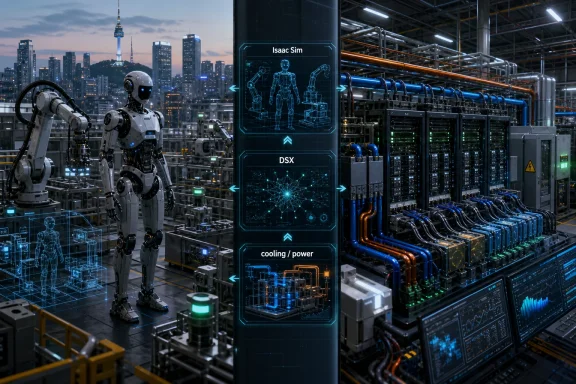
For Nvidia, the pitch has shifted from “buy our accelerators” to “build your next industrial system around our accelerators.” The company’s Isaac tools, GR00T ecosystem, DRIVE platforms, Omniverse-style simulation logic, and DSX AI factory concept all point in the same direction. Nvidia wants the world’s next machines to be trained, simulated, deployed, powered, cooled, and updated inside its orbit.
LG is a useful partner precisely because it is not a pure software company. It has appliances in homes, components in vehicles, batteries in industrial supply chains, telecom infrastructure, systems integration, and manufacturing facilities that generate the kind of real-world data AI labs crave. If Nvidia is serious about physical AI, it needs companies that already know how physical things break.
Homes are chaotic in ways factories are not. They contain pets, loose cables, stairs, rugs, reflective surfaces, children, poor lighting, rearranged furniture, and users who will not read the manual. A robot that succeeds in a polished booth can fail spectacularly when asked to pick up socks from a half-lit bedroom.
That is why simulation matters, but it is also why simulation is not enough. LG’s advantage is its installed base and product knowledge. The company understands kitchens, laundry rooms, living rooms, displays, air systems, and appliance maintenance. Nvidia can provide the training environment and AI models; LG can provide the contact with domestic reality.
The factory side may arrive first. LG CNS plans to integrate Nvidia robotics technologies into its PhysicalWorks industrial robot platform, while LG Innotek will supply sensing modules and optical components aligned with Nvidia GPU architecture. These are less glamorous than humanoids, but they are more likely to produce near-term operational value. Industrial robots do not need to charm a homeowner; they need to move predictably, perceive accurately, and reduce downtime.
Nvidia’s DSX platform is the connective tissue in this narrative. LG Electronics is working on cooling technologies such as coolant distribution units and cold plates, while LG Uplus, LG Electronics, and LG Energy Solution are planning AI factories based on Nvidia DSX. LG CNS also intends to build AI factories powered by Nvidia GPUs, and LG Uplus is developing a large-scale AI data center designed to house Nvidia’s latest hardware.
That list reads like a conglomerate-wide mobilization. Cooling, power, telecom, systems integration, batteries, data centers, and AI hardware are being pulled into the same frame. Nvidia is not merely asking LG to buy GPUs; it is asking LG to help define the building blocks of AI-era infrastructure.
This is where WindowsForum readers should pay attention. The AI boom is often discussed as if it lives entirely in the cloud abstraction layer, somewhere behind an API endpoint. In practice, it is rapidly becoming a facilities engineering problem. Power density, liquid cooling, rack design, grid interconnection, uptime, sovereign capacity, and energy storage are now as strategically important as model size.
LG Energy Solution’s exploration of 800-volt direct-current energy systems for future data centers fits neatly into that broader trend. High-voltage DC architectures are not a consumer-facing feature, but they speak to the same pressure reshaping the industry: AI compute is forcing data centers to reconsider electrical assumptions that worked well enough in the previous cloud era. The rack is becoming more like an industrial machine.
That distinction matters. A humanoid robot capable of reliable, general-purpose work remains an unsolved commercial challenge. The industry has made visible progress in locomotion, manipulation, imitation learning, and perception, but controlled demos should not be mistaken for durable deployment. The closer a robot gets to working around humans in unstructured environments, the more the edge cases multiply.
Nvidia’s wager is that the bottleneck is not just the robot body or the AI model. It is the workflow. Companies need ways to generate training data, run simulations, validate behaviors, deploy models to edge hardware, and connect robots back to the infrastructure that improves them. In that worldview, the robot is an endpoint in a much larger computing system.
LG’s participation strengthens that thesis. A home robot needs appliance context. A factory robot needs production context. A vehicle platform needs mobility context. A data center needs cooling and power context. Nvidia is building the computational spine, but LG can supply environments where that spine is tested against reality.
South Korea is one of the few places where Nvidia can assemble nearly the whole AI industrial chain in a compact geography. It has advanced memory through SK Hynix and Samsung, telecom operators with sovereign AI ambitions, manufacturing conglomerates with robotics use cases, battery makers, automotive suppliers, cloud platforms, and a government eager not to be reduced to a customer of foreign AI systems. For Nvidia, Korea is not just a market; it is a systems lab.
SK Telecom’s plan for a gigawatt-scale AI cloud using Nvidia technology, with the first AI-focused data center expected in 2027, reinforces the same story. The fine print around buildout phases will matter, because “gigawatt-scale” can describe a long-term ambition rather than day-one capacity. But the direction is clear: telecom operators are trying to become AI infrastructure providers, and Nvidia is offering the hardware and platform language to make that transition credible.
Naver’s involvement in broader Nvidia AI factory plans points to another part of the puzzle: sovereign AI. Countries and large regional platforms do not want every critical model, dataset, and inference workload mediated by a handful of U.S. cloud giants. Nvidia can sell into that anxiety by positioning itself as the neutral arms supplier for national and regional AI infrastructure.
Robotics could change that, if it works. A home robot would be an appliance, a sensor platform, a mobility system, a service endpoint, and an AI interface all at once. It would also let LG extend beyond the replacement cycle of washers, TVs, and refrigerators into a more service-heavy relationship with the household.
The risk is that LG becomes a hardware wrapper around Nvidia’s intelligence layer. That is the familiar platform dilemma. If Nvidia owns the simulation tooling, foundation model ecosystem, edge AI hardware, and data center architecture, LG must ensure it keeps enough differentiation in mechanics, sensing, industrial design, services, and domain data.
Still, LG has leverage. Nvidia needs deployment partners with credible manufacturing experience. No amount of GPU dominance automatically teaches a company how to make machines survive dust, heat, vibration, human abuse, and regulatory scrutiny. LG’s practical knowledge is not decorative; it is the difference between physical AI as a keynote phrase and physical AI as shipped equipment.
AI has made that abstraction fragile. Training and inference workloads are so hungry, and GPU supply chains so concentrated, that the physical design of the data center now shapes product strategy. If you cannot power and cool the cluster, you cannot run the model. If you cannot reserve capacity, you cannot launch the service. If you cannot meet national data and infrastructure expectations, you may lose the customer before the benchmark race begins.
That is why LG’s cooling and power contributions are not peripheral. Coolant distribution units and cold plates may sound like plumbing, but plumbing is where the AI boom becomes real. The future of model deployment may depend as much on thermal efficiency and facility design as on the next architecture slide from Santa Clara.
For IT pros, this is a reminder that AI adoption will not be measured only in subscriptions. It will show up in data center retrofits, energy contracts, procurement fights, new vendor dependencies, and pressure on networking and storage. The AI PC may be the visible endpoint, but the AI factory is where the economic gravity sits.
Vehicles are becoming rolling compute platforms, and Nvidia has spent years positioning DRIVE as an end-to-end stack for autonomy, cockpit intelligence, and software-defined vehicle architectures. LG’s auto components business gives the partnership a path into sensing, infotainment, electronics, and integration work that automakers actually buy. A humanoid robot may still be a bet; automotive electronics are already a battlefield.
There is also a conceptual overlap. A self-driving vehicle and a mobile robot both need perception, planning, simulation, safety validation, edge compute, and continuous model improvement. Nvidia’s ability to reuse platform pieces across factories, cars, and robots is central to its strategy. Every new domain makes the others look less isolated.
That does not mean the same software can be casually transplanted from a warehouse robot into a car or a kitchen assistant. Safety requirements, liability regimes, sensor layouts, and operating environments differ sharply. But Nvidia’s claim is not that every machine is identical. Its claim is that every intelligent machine will need a similar computational supply chain.
The enterprise endpoint is being redefined by AI infrastructure upstream. Windows PCs will increasingly become clients, control surfaces, development terminals, monitoring stations, and edge participants in systems whose heavy intelligence lives in GPU clusters and AI factories. The administrative problem will not stop at managing devices; it will extend into managing access to AI capacity, data flows, model governance, and automation that reaches into physical operations.
Nvidia’s partnerships also signal a vendor-stack problem. Enterprises are already used to Microsoft, VMware, Dell, HP, Lenovo, Cisco, and cloud providers shaping their infrastructure choices. Nvidia is becoming another platform center of gravity, especially where AI workloads touch simulation, robotics, and accelerated computing. That creates opportunity, but it also creates dependency.
The practical question for IT leaders is not whether humanoid robots arrive next year. It is whether the organization’s data, identity systems, networks, security controls, and procurement practices are ready for AI systems that cross from software into physical processes. A robot on a factory floor is not just a machine; it is an endpoint with sensors, actuators, models, logs, updates, credentials, and failure modes.
That does not mean panic is useful. Industrial control systems, robotics cells, and automotive software have long dealt with safety and reliability requirements. But the AI layer adds probabilistic behavior, opaque model decisions, larger training pipelines, and new dependencies on simulation data and cloud-connected infrastructure. The attack surface gets wider, and the audit trail can get harder to interpret.
A compromised chatbot can leak data or mislead users. A compromised robot fleet can damage inventory, halt production, or injure people. A flawed model update can turn a rare edge case into a repeated operational failure. The more Nvidia and LG succeed at connecting AI factories to physical deployment, the more governance has to follow the machine beyond the dashboard.
For Windows-heavy enterprises, this will land through familiar mechanisms: identity, device management, certificate handling, network segmentation, endpoint monitoring, privileged access, and patch discipline. The novelty is that the endpoint may have wheels, arms, cameras, and torque.
LG’s expanded partnership shows how lock-in can be built without calling it lock-in. If a company trains robots in Isaac, validates them in Nvidia simulation environments, deploys them on Nvidia edge hardware, powers their data loops through Nvidia GPU clusters, and designs facilities around Nvidia DSX expectations, switching costs become structural. The platform becomes architecture.
That is not inherently bad. Integrated stacks can make hard technologies usable. Enterprises often prefer a coherent platform to a science project stitched together from incompatible tools. Robotics and AI infrastructure are complicated enough that a strong reference architecture may accelerate deployment.
But the industry should be honest about the bargain. The easier Nvidia makes physical AI adoption, the more influence it gains over how that adoption happens. Partners like LG are not passive, but they are entering a world where Nvidia’s roadmap can shape their own.
LG and Nvidia appear to understand this better than some of the louder players in the market. The emphasis on simulation, reference robots, sensing, mechanical systems, and data center infrastructure suggests a long game. That does not eliminate hype, but it grounds the partnership in the unglamorous work needed before robots become products.
The economics will be decisive. A home robot must justify its price against appliances, services, and human labor alternatives. An industrial robot must prove uptime, throughput, safety, and integration value. A data center must justify its power commitments and cooling complexity. Nvidia’s narrative is powerful, but customers will eventually ask for math.
That is where LG’s manufacturing discipline may become the partnership’s most important asset. Consumer electronics companies know brutal cost curves. Automotive suppliers know qualification cycles. Battery companies know safety scrutiny. Telecom operators know uptime expectations. If physical AI is going to leave the keynote stage, it needs all of that.
 Nvidia Is Selling the Factory Before the Robot Is Ready
The headline phrase is “humanoid robots,” because humanoids are what cut through the noise. They photograph well, they make investors imagine a labor market reboot, and they let CEOs talk about the future without getting trapped in the swamp of quarterly procurement cycles. But the more consequential part of Nvidia’s LG deal is not a robot walking across a stage; it is the stack around the robot.Huang’s comments after meeting Koo were telling. He did not just talk about AI brains. He talked about motor technology, mechanical systems, cooling, power delivery, and facility design. That is the vocabulary of an industrial platform company, not a chip vendor waiting for the next GPU order.
For Nvidia, the pitch has shifted from “buy our accelerators” to “build your next industrial system around our accelerators.” The company’s Isaac tools, GR00T ecosystem, DRIVE platforms, Omniverse-style simulation logic, and DSX AI factory concept all point in the same direction. Nvidia wants the world’s next machines to be trained, simulated, deployed, powered, cooled, and updated inside its orbit.
LG is a useful partner precisely because it is not a pure software company. It has appliances in homes, components in vehicles, batteries in industrial supply chains, telecom infrastructure, systems integration, and manufacturing facilities that generate the kind of real-world data AI labs crave. If Nvidia is serious about physical AI, it needs companies that already know how physical things break.
LG Gives Nvidia a Route Into the Home, the Factory, and the Data Hall
LG’s role in this partnership is unusually broad. LG Electronics is expected to use Nvidia Isaac Sim and Isaac Lab to simulate, train, and test home robots before deployment. That alone puts Nvidia’s robotics software into a domain where the gap between demo and durability is brutally wide: the household.Homes are chaotic in ways factories are not. They contain pets, loose cables, stairs, rugs, reflective surfaces, children, poor lighting, rearranged furniture, and users who will not read the manual. A robot that succeeds in a polished booth can fail spectacularly when asked to pick up socks from a half-lit bedroom.
That is why simulation matters, but it is also why simulation is not enough. LG’s advantage is its installed base and product knowledge. The company understands kitchens, laundry rooms, living rooms, displays, air systems, and appliance maintenance. Nvidia can provide the training environment and AI models; LG can provide the contact with domestic reality.
The factory side may arrive first. LG CNS plans to integrate Nvidia robotics technologies into its PhysicalWorks industrial robot platform, while LG Innotek will supply sensing modules and optical components aligned with Nvidia GPU architecture. These are less glamorous than humanoids, but they are more likely to produce near-term operational value. Industrial robots do not need to charm a homeowner; they need to move predictably, perceive accurately, and reduce downtime.
The AI Factory Is Becoming Nvidia’s Favorite Metaphor for Control
The data center half of the LG deal is not an add-on. It is the infrastructure mirror of the robotics story. If robots are the bodies, AI factories are the metabolism.Nvidia’s DSX platform is the connective tissue in this narrative. LG Electronics is working on cooling technologies such as coolant distribution units and cold plates, while LG Uplus, LG Electronics, and LG Energy Solution are planning AI factories based on Nvidia DSX. LG CNS also intends to build AI factories powered by Nvidia GPUs, and LG Uplus is developing a large-scale AI data center designed to house Nvidia’s latest hardware.
That list reads like a conglomerate-wide mobilization. Cooling, power, telecom, systems integration, batteries, data centers, and AI hardware are being pulled into the same frame. Nvidia is not merely asking LG to buy GPUs; it is asking LG to help define the building blocks of AI-era infrastructure.
This is where WindowsForum readers should pay attention. The AI boom is often discussed as if it lives entirely in the cloud abstraction layer, somewhere behind an API endpoint. In practice, it is rapidly becoming a facilities engineering problem. Power density, liquid cooling, rack design, grid interconnection, uptime, sovereign capacity, and energy storage are now as strategically important as model size.
LG Energy Solution’s exploration of 800-volt direct-current energy systems for future data centers fits neatly into that broader trend. High-voltage DC architectures are not a consumer-facing feature, but they speak to the same pressure reshaping the industry: AI compute is forcing data centers to reconsider electrical assumptions that worked well enough in the previous cloud era. The rack is becoming more like an industrial machine.
Humanoid Robots Are the Marketing Layer; Simulation Is the Product Layer
Nvidia’s robotics strategy has a useful trick: it lets the company benefit from humanoid excitement without depending entirely on humanoid maturity. Isaac Sim, Isaac Lab, GR00T, robot foundation models, reference designs, digital twins, and synthetic data pipelines are all valuable even if the humanoid market develops slowly. The robot may be speculative; the tooling is sellable now.That distinction matters. A humanoid robot capable of reliable, general-purpose work remains an unsolved commercial challenge. The industry has made visible progress in locomotion, manipulation, imitation learning, and perception, but controlled demos should not be mistaken for durable deployment. The closer a robot gets to working around humans in unstructured environments, the more the edge cases multiply.
Nvidia’s wager is that the bottleneck is not just the robot body or the AI model. It is the workflow. Companies need ways to generate training data, run simulations, validate behaviors, deploy models to edge hardware, and connect robots back to the infrastructure that improves them. In that worldview, the robot is an endpoint in a much larger computing system.
LG’s participation strengthens that thesis. A home robot needs appliance context. A factory robot needs production context. A vehicle platform needs mobility context. A data center needs cooling and power context. Nvidia is building the computational spine, but LG can supply environments where that spine is tested against reality.
Korea Has Become a Showcase for Nvidia’s Industrial AI Diplomacy
Huang’s Seoul trip was not limited to LG. Nvidia also moved to deepen relationships with SK Group, SK Hynix, SK Telecom, Naver, Doosan Group, and Hyundai-related robotics interests during the same broader Korea push. The pattern is too deliberate to treat as coincidence.South Korea is one of the few places where Nvidia can assemble nearly the whole AI industrial chain in a compact geography. It has advanced memory through SK Hynix and Samsung, telecom operators with sovereign AI ambitions, manufacturing conglomerates with robotics use cases, battery makers, automotive suppliers, cloud platforms, and a government eager not to be reduced to a customer of foreign AI systems. For Nvidia, Korea is not just a market; it is a systems lab.
SK Telecom’s plan for a gigawatt-scale AI cloud using Nvidia technology, with the first AI-focused data center expected in 2027, reinforces the same story. The fine print around buildout phases will matter, because “gigawatt-scale” can describe a long-term ambition rather than day-one capacity. But the direction is clear: telecom operators are trying to become AI infrastructure providers, and Nvidia is offering the hardware and platform language to make that transition credible.
Naver’s involvement in broader Nvidia AI factory plans points to another part of the puzzle: sovereign AI. Countries and large regional platforms do not want every critical model, dataset, and inference workload mediated by a handful of U.S. cloud giants. Nvidia can sell into that anxiety by positioning itself as the neutral arms supplier for national and regional AI infrastructure.
LG Is Not Just Buying Nvidia’s Future; It Is Hedging Its Own
For LG, the partnership is equally defensive and ambitious. The company has spent years pushing AI into appliances, mobility components, displays, smart home systems, and enterprise services. But “AI appliance” has often meant a slightly smarter feature, not a redefinition of the product category.Robotics could change that, if it works. A home robot would be an appliance, a sensor platform, a mobility system, a service endpoint, and an AI interface all at once. It would also let LG extend beyond the replacement cycle of washers, TVs, and refrigerators into a more service-heavy relationship with the household.
The risk is that LG becomes a hardware wrapper around Nvidia’s intelligence layer. That is the familiar platform dilemma. If Nvidia owns the simulation tooling, foundation model ecosystem, edge AI hardware, and data center architecture, LG must ensure it keeps enough differentiation in mechanics, sensing, industrial design, services, and domain data.
Still, LG has leverage. Nvidia needs deployment partners with credible manufacturing experience. No amount of GPU dominance automatically teaches a company how to make machines survive dust, heat, vibration, human abuse, and regulatory scrutiny. LG’s practical knowledge is not decorative; it is the difference between physical AI as a keynote phrase and physical AI as shipped equipment.
The Data Center Is Now Part of the Product
One of the most important shifts in AI is that infrastructure is no longer backstage. In previous software cycles, most users and even many enterprise buyers could treat data centers as someone else’s problem. Cloud hid the power plant, the cooling loop, and the procurement queue behind a dashboard.AI has made that abstraction fragile. Training and inference workloads are so hungry, and GPU supply chains so concentrated, that the physical design of the data center now shapes product strategy. If you cannot power and cool the cluster, you cannot run the model. If you cannot reserve capacity, you cannot launch the service. If you cannot meet national data and infrastructure expectations, you may lose the customer before the benchmark race begins.
That is why LG’s cooling and power contributions are not peripheral. Coolant distribution units and cold plates may sound like plumbing, but plumbing is where the AI boom becomes real. The future of model deployment may depend as much on thermal efficiency and facility design as on the next architecture slide from Santa Clara.
For IT pros, this is a reminder that AI adoption will not be measured only in subscriptions. It will show up in data center retrofits, energy contracts, procurement fights, new vendor dependencies, and pressure on networking and storage. The AI PC may be the visible endpoint, but the AI factory is where the economic gravity sits.
DRIVE Keeps Nvidia in the Vehicle Even as the Robot Steals the Spotlight
The LG agreement also extends into mobility. LG Electronics is aligning advanced driver-assistance systems and in-vehicle AI with Nvidia DRIVE platforms, including DRIVE Hyperion and DRIVE AGX, for autonomous driving and software-defined vehicles. That is less flashy than humanoid robots, but it may be commercially steadier.Vehicles are becoming rolling compute platforms, and Nvidia has spent years positioning DRIVE as an end-to-end stack for autonomy, cockpit intelligence, and software-defined vehicle architectures. LG’s auto components business gives the partnership a path into sensing, infotainment, electronics, and integration work that automakers actually buy. A humanoid robot may still be a bet; automotive electronics are already a battlefield.
There is also a conceptual overlap. A self-driving vehicle and a mobile robot both need perception, planning, simulation, safety validation, edge compute, and continuous model improvement. Nvidia’s ability to reuse platform pieces across factories, cars, and robots is central to its strategy. Every new domain makes the others look less isolated.
That does not mean the same software can be casually transplanted from a warehouse robot into a car or a kitchen assistant. Safety requirements, liability regimes, sensor layouts, and operating environments differ sharply. But Nvidia’s claim is not that every machine is identical. Its claim is that every intelligent machine will need a similar computational supply chain.
The Windows Angle Is Not Windows — It Is the Shape of Enterprise Compute
At first glance, this story sits outside the usual Windows orbit. It is about Nvidia, LG, robots, data centers, and South Korea, not Patch Tuesday or Windows 11 deployment headaches. But for Windows administrators and enterprise IT teams, the relevance is hiding in plain sight.The enterprise endpoint is being redefined by AI infrastructure upstream. Windows PCs will increasingly become clients, control surfaces, development terminals, monitoring stations, and edge participants in systems whose heavy intelligence lives in GPU clusters and AI factories. The administrative problem will not stop at managing devices; it will extend into managing access to AI capacity, data flows, model governance, and automation that reaches into physical operations.
Nvidia’s partnerships also signal a vendor-stack problem. Enterprises are already used to Microsoft, VMware, Dell, HP, Lenovo, Cisco, and cloud providers shaping their infrastructure choices. Nvidia is becoming another platform center of gravity, especially where AI workloads touch simulation, robotics, and accelerated computing. That creates opportunity, but it also creates dependency.
The practical question for IT leaders is not whether humanoid robots arrive next year. It is whether the organization’s data, identity systems, networks, security controls, and procurement practices are ready for AI systems that cross from software into physical processes. A robot on a factory floor is not just a machine; it is an endpoint with sensors, actuators, models, logs, updates, credentials, and failure modes.
Physical AI Turns Security From Data Protection Into Motion Control
Security teams should be wary of the phrase “physical AI” precisely because it sounds like branding. Behind the branding is a serious escalation. When AI systems control robots, vehicles, industrial workflows, or building systems, a software failure can have physical consequences.That does not mean panic is useful. Industrial control systems, robotics cells, and automotive software have long dealt with safety and reliability requirements. But the AI layer adds probabilistic behavior, opaque model decisions, larger training pipelines, and new dependencies on simulation data and cloud-connected infrastructure. The attack surface gets wider, and the audit trail can get harder to interpret.
A compromised chatbot can leak data or mislead users. A compromised robot fleet can damage inventory, halt production, or injure people. A flawed model update can turn a rare edge case into a repeated operational failure. The more Nvidia and LG succeed at connecting AI factories to physical deployment, the more governance has to follow the machine beyond the dashboard.
For Windows-heavy enterprises, this will land through familiar mechanisms: identity, device management, certificate handling, network segmentation, endpoint monitoring, privileged access, and patch discipline. The novelty is that the endpoint may have wheels, arms, cameras, and torque.
The Real Deal Is an Ecosystem Lock-In Race
Nvidia’s strongest position is no longer just silicon performance. It is ecosystem gravity. CUDA created the original moat for GPU computing; the current strategy is to extend that moat into robotics simulation, AI factories, autonomous vehicles, and industrial digital twins.LG’s expanded partnership shows how lock-in can be built without calling it lock-in. If a company trains robots in Isaac, validates them in Nvidia simulation environments, deploys them on Nvidia edge hardware, powers their data loops through Nvidia GPU clusters, and designs facilities around Nvidia DSX expectations, switching costs become structural. The platform becomes architecture.
That is not inherently bad. Integrated stacks can make hard technologies usable. Enterprises often prefer a coherent platform to a science project stitched together from incompatible tools. Robotics and AI infrastructure are complicated enough that a strong reference architecture may accelerate deployment.
But the industry should be honest about the bargain. The easier Nvidia makes physical AI adoption, the more influence it gains over how that adoption happens. Partners like LG are not passive, but they are entering a world where Nvidia’s roadmap can shape their own.
The Hype Cycle Will Punish Anyone Who Confuses Pilots With Deployment
Humanoid robotics remains vulnerable to overstatement. The industry has seen too many videos where a robot performs a task under ideal conditions, only for the public to infer general competence. The gap between “can do this once” and “can do this safely, cheaply, repeatedly, and maintainably for years” is where most robotics dreams go to die.LG and Nvidia appear to understand this better than some of the louder players in the market. The emphasis on simulation, reference robots, sensing, mechanical systems, and data center infrastructure suggests a long game. That does not eliminate hype, but it grounds the partnership in the unglamorous work needed before robots become products.
The economics will be decisive. A home robot must justify its price against appliances, services, and human labor alternatives. An industrial robot must prove uptime, throughput, safety, and integration value. A data center must justify its power commitments and cooling complexity. Nvidia’s narrative is powerful, but customers will eventually ask for math.
That is where LG’s manufacturing discipline may become the partnership’s most important asset. Consumer electronics companies know brutal cost curves. Automotive suppliers know qualification cycles. Battery companies know safety scrutiny. Telecom operators know uptime expectations. If physical AI is going to leave the keynote stage, it needs all of that.
Seoul Gave Nvidia a Conglomerate-Sized Test Bench
The concrete lesson from the LG announcement is that Nvidia’s AI strategy is no longer separable into chips, robots, cars, or cloud. It is a single attempt to own the computational fabric behind intelligent machines. LG gives that strategy a sprawling Korean test bench with enough industrial diversity to matter.- Nvidia and LG are working across robotics, AI data centers, cooling, power delivery, sensing, mobility, and systems integration rather than pursuing a narrow humanoid robot project.
- LG Electronics’ use of Isaac Sim and Isaac Lab points to simulation becoming a required step before robots enter homes, factories, or commercial environments.
- LG’s cooling and power work matters because AI infrastructure is increasingly constrained by facilities engineering, not just GPU availability.
- The partnership strengthens Nvidia’s push to make DSX-style AI factories the default architecture for large-scale AI deployment.
- For enterprise IT, the practical impact is a future in which AI systems become physical endpoints that require security, governance, identity, and lifecycle management.
- The most important uncertainty is timing, because humanoid robots remain technically and economically immature even as the infrastructure around them accelerates.
References
- Primary source: Technobezz
Published: 2026-06-14T21:00:21.863291
Nvidia Partners with LG Group on Humanoid Robots and Next Generation Data Centers | Technobezz
Nvidia and LG Group partner on humanoid robots and next-gen data centers, spanning robotics frameworks, cooling tech, and AI factories.www.technobezz.com - Related coverage: axios.com
Nvidia CEO Jensen Huang: "No one" better with robots than Hyundai
Nvidia CEO Jensen Huang — a close ally of Tesla CEO Elon Musk — heaped praise on Hyundai's robotic technology and said the two companies will broaden their partnership.www.axios.com
- Related coverage: nvidianews.nvidia.com
SK Telecom and NVIDIA Build AI Infrastructure to Power Korea’s AI Innovation | NVIDIA Newsroom
NVIDIA and SK Telecom today announced that SK Telecom plans to build a gigawatt-scale AI Cloud in Korea using the NVIDIA DSX™ platform, with the first AI factory coming online in 2027.nvidianews.nvidia.com - Related coverage: techtimes.com
Naver, Nvidia Seal 1GW AI Factory Plan: DSX Platform Powers Korea Sovereign Cloud
Naver Nvidia AI factory partnership: South Korea’s largest domestic cloud operator commits to Nvidia’s DSX platform for gigawatt-scale AI factories, starting at 55MW at Gak Sejong in 2027 and scalingwww.techtimes.com - Related coverage: robotsbeat.com
LG and NVIDIA Expand Partnership Across Humanoid Robots, AI Factories, and Autonomous Vehicles
LG Group and NVIDIA expand their strategic partnership across humanoid robots, AI factories, and autonomous driving, combining LG's manufacturing data with NVIDIA's AI and simulation platforms.robotsbeat.com - Related coverage: blogs.nvidia.com
NVIDIA and LG Group Build an AI Factory to Advance Physical AI, Mobility and AI Infrastructure | NVIDIA Blog
New AI factory to serve as the foundation for LG Group’s robotics, autonomous driving, data center technologies and GPU cloud services.blogs.nvidia.com
- Related coverage: investing.com
Nvidia CEO says company is working with LG on humanoid robots and data centers By Reuters
Nvidia CEO says company is working with LG on humanoid robots and data centerswww.investing.com - Related coverage: dcpulse.com
SK Telecom and NVIDIA Build Gigawatt AI Cloud in Korea
SK Telecom and NVIDIA will build a gigawatt-scale AI cloud in South Korea using DSX AI Factory architecture to power sovereign AI and enterprise workloads.dcpulse.com
- Related coverage: thesiliconreview.com
Nvidia CEO Confirms LG Humanoid Robots Partnership
Nvidia CEO Jensen Huang announces collaboration with LG on humanoid robots and AI data centers during surprise Seoul visit. Read more on The Silicon Review thesiliconreview.com
- Related coverage: tipranks.com
- Related coverage: techradar.com
