

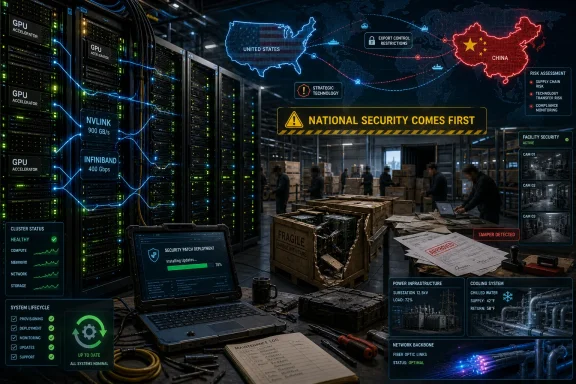
Nvidia CEO Jensen Huang used the company’s June 24, 2026, annual stockholder meeting to warn that smuggled Nvidia-powered AI data centers are a national-security problem and a technical dead end, after prosecutors charged a Supermicro co-founder in a $2.5 billion China diversion case. The message was aimed at shareholders, but it landed far beyond Wall Street. Huang’s argument was that America’s AI lead is not merely a pile of GPUs; it is an ecosystem of hardware, software, manufacturing, energy, logistics, and trusted support. That is why the alleged smuggling scheme matters less as a caper than as a stress test of the entire AI boom.
The Supermicro case gave Huang a unusually concrete backdrop for a familiar Nvidia theme. Federal prosecutors allege that Yih-Shyan “Wally” Liaw, a Supermicro co-founder, and two others helped divert restricted Nvidia-equipped servers to China through front companies, false paperwork, and staged dummy hardware meant to satisfy auditors. The defendants have not been convicted, and the charges remain allegations, but the scale alone made the case impossible for Nvidia to treat as someone else’s compliance problem.
Huang’s answer was blunt: “National security comes first.” That line matters because Nvidia has spent years walking a narrow commercial and geopolitical ridge. China remains a major AI market, but U.S. export controls increasingly define what Nvidia can sell, to whom, and under what conditions.
The more interesting part of Huang’s answer was not legalistic. He argued that a data center built from diverted chips is not simply unlawful; it is likely to be operationally crippled. Modern Nvidia systems are not boxes of silicon that customers can quietly plug in and run forever. They are integrated computing platforms that depend on firmware, networking, software stacks, drivers, updates, service contracts, and deep technical support.
That is the wake-up call inside the wake-up call. The AI race is often described as a chip race because chips are easy to count. Huang is insisting that the chip is only the visible artifact of a much larger industrial machine.
An H100, H200, B200, or Blackwell-era system is not a standalone trophy. It is part of a dense, high-power cluster where GPUs, CPUs, memory, storage, switches, optics, cooling, orchestration software, and model frameworks all have to behave as one machine. At the scale of modern AI training and inference, small inefficiencies compound into unusable economics.
That is why Huang’s “dead end” framing is credible. A smuggled server may boot. A warehouse of smuggled servers may even run jobs. But the promise of frontier AI infrastructure is not that a few accelerators can execute code; it is that thousands or tens of thousands of accelerators can operate with predictable throughput, manageable failure rates, secure updates, and a software stack that keeps improving.
This is also where Nvidia’s moat becomes more complicated than its critics sometimes admit. The company’s advantage is not merely CUDA, although CUDA remains central. It is the way CUDA, NVLink, InfiniBand and Ethernet networking, reference architectures, libraries, deployment tooling, and support relationships turn hardware into a production platform. Smuggling the hardware does not smuggle the relationship.
The alleged Supermicro scheme shows how ugly that incentive structure can become. Prosecutors described an operation involving front companies, re-export channels, manipulated labels, forged documents, and dummy servers staged to mislead compliance checks. The image of serial numbers being moved from real packages to fake servers is almost comic until you remember the strategic context: these are the systems powering the most consequential computing race of the decade.
But the same case also reveals why export controls are evolving from customs paperwork into lifecycle control. If the commodity being restricted were a pallet of conventional servers, getting it across the border might be enough. With AI systems, the initial shipment is only the beginning of the relationship.
That does not make export controls airtight. Nothing in global technology policy is airtight. It does mean that U.S. policymakers and Nvidia now have a shared interest in making advanced AI infrastructure harder to operate outside approved channels, not just harder to purchase.
The idea is deceptively simple. A nation can have brilliant model builders and still run out of power. It can have power and still lack transformers, cooling systems, fiber, switches, construction crews, and permitting capacity. It can own chips and still lack the software and operational support required to turn them into reliable AI factories.
That is why Huang keeps pointing to electricians, construction workers, optics, and manufacturing plants. The AI economy is not weightless. It requires land, grid upgrades, specialized glass, lasers, substations, networking gear, packaging capacity, and workers who can build physical systems at speed.
For WindowsForum readers, this should feel familiar. Every sysadmin knows that the spec sheet is only the beginning. The difference between a lab success and production infrastructure is monitoring, patching, support, lifecycle management, redundancy, procurement discipline, and the unglamorous work of keeping systems alive at 3 a.m. Huang is applying that old enterprise truth to national AI strategy.
The bigger AI clusters become, the more communication matters. Compute is wasted when accelerators sit idle waiting for data. Networking limits show up as cost, latency, lower utilization, and slower model development. Inference workloads, especially those serving millions of users, turn networking from background plumbing into a profit variable.
That is why optics have become strategically important. The AI data center is a machine for turning electricity into tokens, and every layer of the machine has to scale. If Nvidia can sell more GPUs only when customers can also connect, power, cool, and maintain them, then the company’s interest in domestic fiber and optical manufacturing is not patriotic decoration. It is self-preservation.
Huang’s manufacturing rhetoric should be read in that light. “Made in America” is politically useful language, but Nvidia’s commercial reason is more direct. The company needs the physical supply chain to keep up with demand. If that supply chain happens to create American jobs and strengthen U.S. strategic resilience, Nvidia gets to align shareholder value with national policy.
That helps explain Huang’s confidence at the shareholder meeting. If customers are fighting legal, political, and logistical gravity to get access to Nvidia systems, it is hard to argue that demand is imaginary. The AI bubble debate may continue, but the short-term hunger for compute is plainly real.
The harder question is whether today’s demand translates into durable returns. Huang says the return-on-investment debate has been answered, pointing to AI-assisted coding and rising software productivity as proof that compute is creating economic output. GitHub activity is a useful signal, but it is not the entire economy.
There is a difference between AI producing value and every AI infrastructure investment producing an attractive return. Nvidia can be right that AI is economically transformative while some customers overbuild, misprice demand, or discover that their workloads do not justify their capital expenditures. The railroad analogy is tired because it is useful: transformative infrastructure can be real, and still punish those who build too much in the wrong places at the wrong price.
Washington heard a different message. If Nvidia’s systems are so central that they cannot be easily replicated, unsupported, or substituted, then Nvidia is not merely a vendor. It is a choke point in the global AI supply chain. That makes the company valuable, but it also makes it politically exposed.
The U.S. government wants to deny adversaries access to the most advanced AI infrastructure without kneecapping American companies. Nvidia wants access to global markets without becoming the weak link in export-control enforcement. Those goals overlap, but they are not identical.
This is the tension Huang is trying to manage. By saying national security comes first, he is putting Nvidia on the side of the state. By warning that smuggled systems will fail without support, he is reminding buyers that Nvidia’s ecosystem cannot be separated from Nvidia’s permission.
That uncertainty is not a footnote. It is one of the biggest strategic questions facing Nvidia. China is too large a market to ignore, but too politically sensitive to treat as ordinary. Every sale can be scrutinized as a national-security issue; every restriction can push Chinese firms toward domestic substitutes; every workaround can invite harsher rules.
The smuggling allegations make that environment worse. They give export-control hawks a vivid example of why restrictions need teeth. They also give Nvidia a reason to emphasize its own compliance posture and the practical futility of unauthorized deployments.
For American AI strategy, the China issue is bigger than Nvidia’s quarterly numbers. The United States is trying to preserve a lead without creating incentives that accelerate a parallel Chinese stack. The more Washington restricts access, the more Beijing invests in independence. The more Nvidia argues that its ecosystem is indispensable, the more China has reason to prove otherwise.
AI infrastructure has a lifecycle. Firmware matters. Driver compatibility matters. Security advisories matter. Networking configurations matter. Workload schedulers matter. Replacement parts matter. Vendor escalation paths matter. The more expensive and specialized the system, the more dangerous it becomes to run it outside trusted support channels.
This is old news to anyone who has managed production Windows fleets, storage arrays, hypervisors, or enterprise databases. The bargain hardware that cannot be patched, supported, or integrated usually becomes the most expensive hardware in the room. AI simply raises the stakes because the capital intensity is extreme and the failure modes can be opaque.
The temptation to cut corners will grow as demand for compute outstrips supply. Smaller firms will look for secondary markets. Regional cloud providers will hunt for discounted capacity. Brokers will promise availability where official channels cannot. Huang’s warning should be read as a flashing red light: in AI, provenance is not paperwork; it is an operational dependency.
A system without trusted updates and support can accumulate vulnerabilities quickly. Misconfigured management interfaces, outdated drivers, compromised firmware, and undocumented supply-chain changes are not theoretical risks. They are the ordinary hazards of high-value infrastructure operated under pressure.
That matters because AI data centers are becoming part of national critical infrastructure. They support software development, drug discovery, financial modeling, defense research, logistics, industrial design, and increasingly government workloads. If the infrastructure layer is compromised, the applications above it inherit the risk.
This is where export control, cybersecurity, and enterprise governance converge. The provenance of hardware matters. The legitimacy of the support channel matters. The ability to verify what is running in the rack matters. AI has made the data center politically visible again, and that visibility will bring more audits, not fewer.
Data centers need electricians, welders, fiber technicians, HVAC specialists, power engineers, construction managers, and security staff. They need local permitting, grid interconnection, water strategy, and supply-chain coordination. They also need the kind of boring industrial competence that does not show up in demo videos.
That does not mean AI will automatically produce a broad manufacturing renaissance. Communities that host data centers may get construction jobs but fewer permanent roles than promised. Power demand can strain local grids. Water use can become controversial. Tax incentives can transfer public value to private operators if governments negotiate poorly.
Still, Huang’s core point is hard to dismiss. If AI is the next major computing platform, then the country that builds the physical substrate gains leverage. The American AI advantage will not be defended by model weights alone. It will be defended by the ability to build, power, connect, secure, and maintain the machines that produce intelligence at scale.
He is also telling ordinary workers and IT professionals that AI is not happening somewhere else. It is entering the job market through data-center construction, enterprise software, security policy, procurement rules, and infrastructure planning. Even if a worker never trains a model or writes a prompt, the AI buildout can still reshape their industry.
That is the part of the story that gets lost when the debate collapses into hype versus bubble. The infrastructure is being built either way. The question is whether it is built coherently, securely, and with enough domestic capacity to matter.
The Supermicro allegations are therefore not a weird subplot. They are a preview of the pressures that appear when a technology becomes strategically scarce. Scarcity produces premiums. Premiums produce workarounds. Workarounds produce enforcement. Enforcement produces new architectures of control.
 Huang Turns a Smuggling Case Into an Infrastructure Doctrine
The Supermicro case gave Huang a unusually concrete backdrop for a familiar Nvidia theme. Federal prosecutors allege that Yih-Shyan “Wally” Liaw, a Supermicro co-founder, and two others helped divert restricted Nvidia-equipped servers to China through front companies, false paperwork, and staged dummy hardware meant to satisfy auditors. The defendants have not been convicted, and the charges remain allegations, but the scale alone made the case impossible for Nvidia to treat as someone else’s compliance problem.Huang’s answer was blunt: “National security comes first.” That line matters because Nvidia has spent years walking a narrow commercial and geopolitical ridge. China remains a major AI market, but U.S. export controls increasingly define what Nvidia can sell, to whom, and under what conditions.
The more interesting part of Huang’s answer was not legalistic. He argued that a data center built from diverted chips is not simply unlawful; it is likely to be operationally crippled. Modern Nvidia systems are not boxes of silicon that customers can quietly plug in and run forever. They are integrated computing platforms that depend on firmware, networking, software stacks, drivers, updates, service contracts, and deep technical support.
That is the wake-up call inside the wake-up call. The AI race is often described as a chip race because chips are easy to count. Huang is insisting that the chip is only the visible artifact of a much larger industrial machine.
The GPU Is No Longer the Product
For PC enthusiasts, the old mental model of Nvidia is a graphics card in a box. You bought it, installed the driver, watched temperatures, maybe overclocked it, and upgraded when a new generation made your frame rates look embarrassing. The AI data center version of Nvidia is a very different animal.An H100, H200, B200, or Blackwell-era system is not a standalone trophy. It is part of a dense, high-power cluster where GPUs, CPUs, memory, storage, switches, optics, cooling, orchestration software, and model frameworks all have to behave as one machine. At the scale of modern AI training and inference, small inefficiencies compound into unusable economics.
That is why Huang’s “dead end” framing is credible. A smuggled server may boot. A warehouse of smuggled servers may even run jobs. But the promise of frontier AI infrastructure is not that a few accelerators can execute code; it is that thousands or tens of thousands of accelerators can operate with predictable throughput, manageable failure rates, secure updates, and a software stack that keeps improving.
This is also where Nvidia’s moat becomes more complicated than its critics sometimes admit. The company’s advantage is not merely CUDA, although CUDA remains central. It is the way CUDA, NVLink, InfiniBand and Ethernet networking, reference architectures, libraries, deployment tooling, and support relationships turn hardware into a production platform. Smuggling the hardware does not smuggle the relationship.
Export Controls Meet the Reality of Cloud-Scale Computing
Washington’s chip controls have always had a basic enforcement problem. Semiconductors are small, valuable, and globally traded. A single high-end accelerator can be worth more than a car, and a server rack can be worth more than a house. That creates obvious incentives for intermediaries, gray-market brokers, and customers willing to route hardware through jurisdictions where paperwork can be massaged.The alleged Supermicro scheme shows how ugly that incentive structure can become. Prosecutors described an operation involving front companies, re-export channels, manipulated labels, forged documents, and dummy servers staged to mislead compliance checks. The image of serial numbers being moved from real packages to fake servers is almost comic until you remember the strategic context: these are the systems powering the most consequential computing race of the decade.
But the same case also reveals why export controls are evolving from customs paperwork into lifecycle control. If the commodity being restricted were a pallet of conventional servers, getting it across the border might be enough. With AI systems, the initial shipment is only the beginning of the relationship.
That does not make export controls airtight. Nothing in global technology policy is airtight. It does mean that U.S. policymakers and Nvidia now have a shared interest in making advanced AI infrastructure harder to operate outside approved channels, not just harder to purchase.
America’s Advantage Is the Stack, Not the Slogan
Huang has been making a version of this argument all year: AI supremacy belongs to countries that scale the entire stack. At Davos, he framed AI as a layered system of energy, chips, infrastructure, models, and applications. At Nvidia’s manufacturing announcements, he presented the AI buildout as a generational opportunity to revive American industrial capacity. At the shareholder meeting, he folded national security into the same thesis.The idea is deceptively simple. A nation can have brilliant model builders and still run out of power. It can have power and still lack transformers, cooling systems, fiber, switches, construction crews, and permitting capacity. It can own chips and still lack the software and operational support required to turn them into reliable AI factories.
That is why Huang keeps pointing to electricians, construction workers, optics, and manufacturing plants. The AI economy is not weightless. It requires land, grid upgrades, specialized glass, lasers, substations, networking gear, packaging capacity, and workers who can build physical systems at speed.
For WindowsForum readers, this should feel familiar. Every sysadmin knows that the spec sheet is only the beginning. The difference between a lab success and production infrastructure is monitoring, patching, support, lifecycle management, redundancy, procurement discipline, and the unglamorous work of keeping systems alive at 3 a.m. Huang is applying that old enterprise truth to national AI strategy.
The Corning Deal Was Not a Side Quest
Nvidia’s partnership with Corning looked, at first glance, like another supply-chain press release. It was more than that. By backing a major expansion of U.S.-based optical connectivity capacity, Nvidia was addressing one of the less glamorous bottlenecks in AI data centers: moving data fast enough between increasingly powerful systems.The bigger AI clusters become, the more communication matters. Compute is wasted when accelerators sit idle waiting for data. Networking limits show up as cost, latency, lower utilization, and slower model development. Inference workloads, especially those serving millions of users, turn networking from background plumbing into a profit variable.
That is why optics have become strategically important. The AI data center is a machine for turning electricity into tokens, and every layer of the machine has to scale. If Nvidia can sell more GPUs only when customers can also connect, power, cool, and maintain them, then the company’s interest in domestic fiber and optical manufacturing is not patriotic decoration. It is self-preservation.
Huang’s manufacturing rhetoric should be read in that light. “Made in America” is politically useful language, but Nvidia’s commercial reason is more direct. The company needs the physical supply chain to keep up with demand. If that supply chain happens to create American jobs and strengthen U.S. strategic resilience, Nvidia gets to align shareholder value with national policy.
Smuggling Proves the Demand, Not the Durability
One uncomfortable truth is that smuggling itself is a market signal. People generally do not risk prison sentences, corporate implosions, and international investigations to obtain products nobody needs. The alleged diversion of Nvidia-equipped servers to China suggests that restricted hardware remains highly valuable, even as Chinese companies develop domestic alternatives and adapt to constrained supply.That helps explain Huang’s confidence at the shareholder meeting. If customers are fighting legal, political, and logistical gravity to get access to Nvidia systems, it is hard to argue that demand is imaginary. The AI bubble debate may continue, but the short-term hunger for compute is plainly real.
The harder question is whether today’s demand translates into durable returns. Huang says the return-on-investment debate has been answered, pointing to AI-assisted coding and rising software productivity as proof that compute is creating economic output. GitHub activity is a useful signal, but it is not the entire economy.
There is a difference between AI producing value and every AI infrastructure investment producing an attractive return. Nvidia can be right that AI is economically transformative while some customers overbuild, misprice demand, or discover that their workloads do not justify their capital expenditures. The railroad analogy is tired because it is useful: transformative infrastructure can be real, and still punish those who build too much in the wrong places at the wrong price.
Wall Street Hears ROI; Washington Hears Control
Nvidia’s shareholders wanted reassurance that hyperscale AI spending is not about to roll over. Huang gave it to them. He argued that Nvidia systems generate the lowest cost tokens and the highest throughput, even if they are not the cheapest systems to buy. That is the classic enterprise pitch: upfront cost matters less than total cost of ownership when utilization and output dominate the equation.Washington heard a different message. If Nvidia’s systems are so central that they cannot be easily replicated, unsupported, or substituted, then Nvidia is not merely a vendor. It is a choke point in the global AI supply chain. That makes the company valuable, but it also makes it politically exposed.
The U.S. government wants to deny adversaries access to the most advanced AI infrastructure without kneecapping American companies. Nvidia wants access to global markets without becoming the weak link in export-control enforcement. Those goals overlap, but they are not identical.
This is the tension Huang is trying to manage. By saying national security comes first, he is putting Nvidia on the side of the state. By warning that smuggled systems will fail without support, he is reminding buyers that Nvidia’s ecosystem cannot be separated from Nvidia’s permission.
The China Revenue Problem Does Not Go Away
Nvidia’s China business has already been reshaped by export controls. The company has designed compliant products, waited for approvals, dealt with changing rules, and watched Chinese customers face pressure to buy domestic alternatives. Huang’s shareholder remarks acknowledged that approved H200 exports had not yet translated into revenue and that China’s own import stance remained uncertain.That uncertainty is not a footnote. It is one of the biggest strategic questions facing Nvidia. China is too large a market to ignore, but too politically sensitive to treat as ordinary. Every sale can be scrutinized as a national-security issue; every restriction can push Chinese firms toward domestic substitutes; every workaround can invite harsher rules.
The smuggling allegations make that environment worse. They give export-control hawks a vivid example of why restrictions need teeth. They also give Nvidia a reason to emphasize its own compliance posture and the practical futility of unauthorized deployments.
For American AI strategy, the China issue is bigger than Nvidia’s quarterly numbers. The United States is trying to preserve a lead without creating incentives that accelerate a parallel Chinese stack. The more Washington restricts access, the more Beijing invests in independence. The more Nvidia argues that its ecosystem is indispensable, the more China has reason to prove otherwise.
Enterprise IT Should Recognize the Support Trap
The most practical lesson for IT leaders is not about geopolitics. It is about unsupported infrastructure. Huang’s argument that smuggled data centers are a dead end is also a warning against any attempt to treat AI hardware like a one-time procurement win.AI infrastructure has a lifecycle. Firmware matters. Driver compatibility matters. Security advisories matter. Networking configurations matter. Workload schedulers matter. Replacement parts matter. Vendor escalation paths matter. The more expensive and specialized the system, the more dangerous it becomes to run it outside trusted support channels.
This is old news to anyone who has managed production Windows fleets, storage arrays, hypervisors, or enterprise databases. The bargain hardware that cannot be patched, supported, or integrated usually becomes the most expensive hardware in the room. AI simply raises the stakes because the capital intensity is extreme and the failure modes can be opaque.
The temptation to cut corners will grow as demand for compute outstrips supply. Smaller firms will look for secondary markets. Regional cloud providers will hunt for discounted capacity. Brokers will promise availability where official channels cannot. Huang’s warning should be read as a flashing red light: in AI, provenance is not paperwork; it is an operational dependency.
The Security Story Is Bigger Than Export Law
There is another layer here that Nvidia did not need to spell out. Unsupported AI systems are not just unreliable; they can become security liabilities. Large GPU clusters process valuable data, host proprietary models, connect to enterprise networks, and often sit inside complex cloud or colocation environments.A system without trusted updates and support can accumulate vulnerabilities quickly. Misconfigured management interfaces, outdated drivers, compromised firmware, and undocumented supply-chain changes are not theoretical risks. They are the ordinary hazards of high-value infrastructure operated under pressure.
That matters because AI data centers are becoming part of national critical infrastructure. They support software development, drug discovery, financial modeling, defense research, logistics, industrial design, and increasingly government workloads. If the infrastructure layer is compromised, the applications above it inherit the risk.
This is where export control, cybersecurity, and enterprise governance converge. The provenance of hardware matters. The legitimacy of the support channel matters. The ability to verify what is running in the rack matters. AI has made the data center politically visible again, and that visibility will bring more audits, not fewer.
The American Worker Is Back in the AI Story
One reason Huang’s message resonates beyond investors is that he keeps refusing to describe AI as merely a software revolution. His manufacturing argument is politically convenient, but it is also technically grounded. The AI buildout requires physical work at a scale the software industry has sometimes preferred to abstract away.Data centers need electricians, welders, fiber technicians, HVAC specialists, power engineers, construction managers, and security staff. They need local permitting, grid interconnection, water strategy, and supply-chain coordination. They also need the kind of boring industrial competence that does not show up in demo videos.
That does not mean AI will automatically produce a broad manufacturing renaissance. Communities that host data centers may get construction jobs but fewer permanent roles than promised. Power demand can strain local grids. Water use can become controversial. Tax incentives can transfer public value to private operators if governments negotiate poorly.
Still, Huang’s core point is hard to dismiss. If AI is the next major computing platform, then the country that builds the physical substrate gains leverage. The American AI advantage will not be defended by model weights alone. It will be defended by the ability to build, power, connect, secure, and maintain the machines that produce intelligence at scale.
The Wake-Up Call Is Aimed at More Than Washington
The phrase “wake-up call to all Americans” risks sounding like cable-news packaging, but in this case the underlying message is real. Huang is telling policymakers that national advantage depends on industrial capacity. He is telling investors that AI returns are showing up in production, not just in demos. He is telling smugglers and gray-market buyers that hardware without ecosystem support is a trap.He is also telling ordinary workers and IT professionals that AI is not happening somewhere else. It is entering the job market through data-center construction, enterprise software, security policy, procurement rules, and infrastructure planning. Even if a worker never trains a model or writes a prompt, the AI buildout can still reshape their industry.
That is the part of the story that gets lost when the debate collapses into hype versus bubble. The infrastructure is being built either way. The question is whether it is built coherently, securely, and with enough domestic capacity to matter.
The Supermicro allegations are therefore not a weird subplot. They are a preview of the pressures that appear when a technology becomes strategically scarce. Scarcity produces premiums. Premiums produce workarounds. Workarounds produce enforcement. Enforcement produces new architectures of control.
Huang’s June Message Leaves Little Room for Comfortable Myths
The shareholder meeting crystallized a year of Nvidia messaging into a few hard truths. One paragraph is enough to capture the operational stakes, but the consequences will be with the industry for years.- Smuggled AI servers may cross borders, but they cannot easily recreate Nvidia’s full support, software, networking, and maintenance ecosystem.
- The alleged Supermicro diversion case shows that advanced AI hardware is now valuable enough to generate elaborate criminal-risk behavior.
- Nvidia’s U.S. manufacturing and optics partnerships are part of the same strategy as its GPU roadmap, because AI scale depends on the physical stack.
- Export controls are becoming less about one-time shipment denial and more about controlling the lifecycle of high-end computing systems.
- Enterprise buyers should treat AI hardware provenance and supportability as core security and reliability requirements, not procurement formalities.
- America’s AI advantage will depend on energy, infrastructure, skilled labor, software, and supply-chain resilience as much as on accelerator performance.
References
- Primary source: aol.com
Published: 2026-06-26T11:00:15.353882
Nvidia CEO sends serious wake up call to all Americans - AOL
In March 2026, federal prosecutors charged the co-founder of Supermicro with masterminding a $2.5 billion scheme to smuggle Nvidia-equipped servers to China through front companies, forged documents, and dummy servers staged to fool auditors. Jensen Huang had been watching this unfold for...www.aol.com - Related coverage: tomshardware.com
China black market Nvidia prices rocket in wake of smuggling crackdown and customs freeze — five-year-old A100 servers triple in price, now fetching up to $82,000 | Tom's Hardware
Buyers are repurposing gaming GPUs and bidding up older Ampere hardware.www.tomshardware.com - Related coverage: techradar.com
Biggest heist of the US-China Chip War: 3 charged in $2.5bn scheme | TechRadar
Three men are facing charges of conspiracy to smuggle restricted GPUs to Chinawww.techradar.com - Related coverage: crn.com
Supermicro Co-Founder, Two Others Charged In Alleged Nvidia AI Chip Smuggling Operation
Supermicro says it was informed of the indictment of the three individuals, and that the company itself was not named as a defendant in the indictment.www.crn.com - Related coverage: fortune.com
Supermicro—accused of smuggling $2.5 billion in Nvidia chips to China—has been here before, in Iran | Fortune
Yih-Shyan “Wally” Liaw was arrested on Thursday and resigned his seat on the Super Micro Computer board on Friday.fortune.com
- Related coverage: investor.nvidia.com
NVIDIA Corporation - NVIDIA Stockholder Meeting Set for June 24; Individuals Can Participate Online
SANTA CLARA, Calif., June 11, 2026 (GLOBE NEWSWIRE) - NVIDIA today announced it will hold its 2026 Annual Meeting of Stockholders online on Wednesday, June 24, at 9 a.m. PT. The meeting will take place virtually at https://www.virtualshareholdermeeting.com/NVDA2026 . Stockholders will need their...investor.nvidia.com
- Related coverage: banking.senate.gov
Letter to Commerce re Nvidia Supermicro
Letter to Commerce re Nvidia Supermicrowww.banking.senate.gov
- Related coverage: thestreet.com
- Related coverage: undergroundinfrastructure.com
NVIDIA, Corning expand U.S. fiber manufacturing for AI infrastructure | Underground Construction
Corning plans major U.S. fiber and optical infrastructure expansion tied to AI data center growth, including new manufacturing plants and increased domestic production capacity.undergroundinfrastructure.com - Related coverage: thenextweb.com
Nvidia CEO Jensen Huang says smuggled data centres are a dead end and national security comes first
Jensen Huang told shareholders that Nvidia would prioritise US national security over sales and called smuggled chip data centres unworkable.thenextweb.com - Related coverage: technologies.org
- Related coverage: nsjonline.com
Nvidia, Corning strike deal to expand U.S. AI manufacturing – The North State Journal
Nvidia and Corning are teaming up in a multiyear partnership aimed at scaling up U.S.-based manufacturing for the optical systems that underpin artificial intelligence infrastructure. The agreement centers on expanding production of fiber, connectivity and photonics technologies needed to support t nsjonline.com
- Related coverage: washingtonpost.com
- Related coverage: chinatechnews.com
Nvidia CEO says AI partnership with Corning will 'revitalize American manufacturing' - ChinaTechNews.com
Monday - Friday, 6:00 - 7:00 PM ET Nvidia CEO Jensen Huang highlighted his company's partnership with Corning as an opportunity to reinvest in American ... - AI, artificial intelligence, Business, CEO, China, chip, chips, CNBC, Computing, construction, data, data center, development...www.chinatechnews.com - Related coverage: nvidianews.nvidia.com
- Related coverage: techxplore.com
