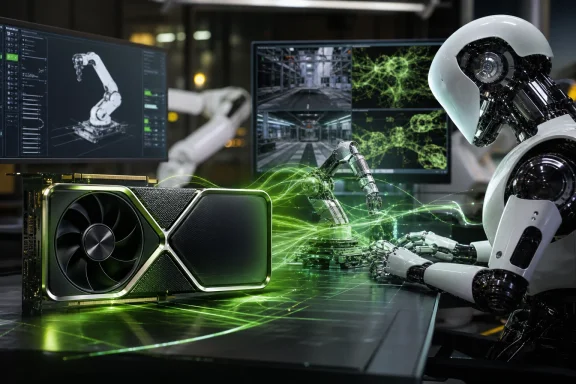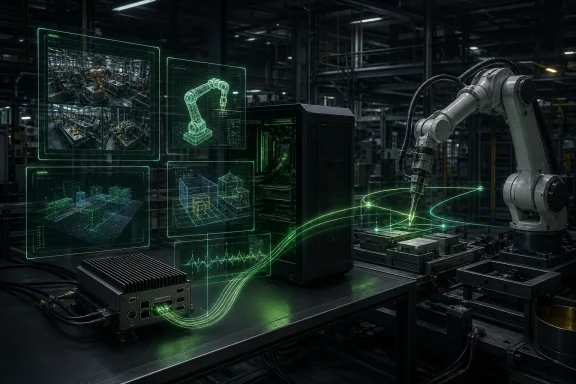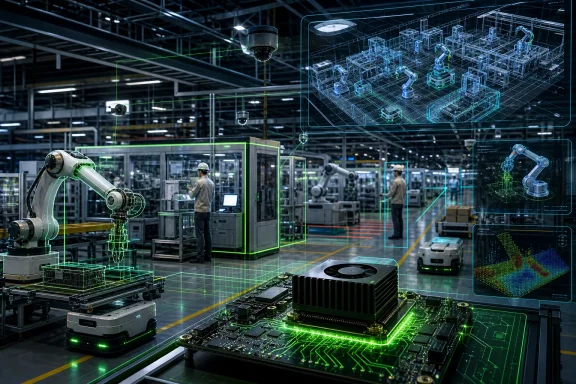
Nvidia has introduced Cosmos 3 Edge, a 4-billion-parameter AI model aimed at putting vision reasoning and robot-action generation directly on edge hardware rather than relying on a remote data center. The company announced the model in Tokyo on July 15, positioning it for NVIDIA Jetson Thor systems and deployments across RTX GPUs, DGX systems and Jetson modules.
The release is a meaningful extension of Nvidia’s Cosmos 3 physical-AI platform, but it is not a consumer robotics product or a new Windows feature. For Windows enthusiasts and enterprise developers, the relevant point is that Nvidia is expanding the software stack around RTX-class hardware into industrial vision, robotics and local AI inference.
According to Nvidia’s announcement, Cosmos 3 Edge is built on its Nemotron architecture and is intended to help robots and vision AI agents interpret their surroundings, reason about a scene in real time and generate actions locally.
That differs from a conventional chatbot or image generator. The target workloads include factory inspection, warehouse automation, autonomous machines, smart-building systems and robotics. A local model can reduce latency and avoid sending every camera frame or sensor reading to a cloud service, both of which matter when a system must react to moving equipment or changing physical conditions.
Nvidia describes Cosmos 3 Edge as lightweight enough for edge GPUs and says developers can post-train it for particular robots, sensors, vehicles and environments. The company is also pitching a broader open Cosmos framework that includes models, datasets, curation libraries and training tools.
The practical use case is likely to be teams building and testing computer-vision or robotics systems on RTX-equipped workstations, then deploying the tuned model to Jetson hardware in the field. Nvidia’s related developer material continues to emphasize containers, model checkpoints, NIM microservices, CUDA tooling and post-training workflows rather than a turnkey Windows experience.
That distinction matters. “Runs on RTX” should not be read as “runs out of the box on any Windows gaming PC.” Hardware capacity, driver support, memory requirements and the surrounding inference stack will still determine whether a given setup is viable.
Those are partnership and development announcements, not evidence of broad production deployment or near-term revenue. Nvidia’s own claims about faster model adaptation and development gains should likewise be treated as vendor benchmarks until independently reproduced across real-world robot deployments.
Cosmos 3 Edge gives Nvidia a smaller on-device model for robotics developers, but Windows users should expect it to arrive first as part of a professional AI and edge-computing toolchain rather than a consumer-facing release.
The release is a meaningful extension of Nvidia’s Cosmos 3 physical-AI platform, but it is not a consumer robotics product or a new Windows feature. For Windows enthusiasts and enterprise developers, the relevant point is that Nvidia is expanding the software stack around RTX-class hardware into industrial vision, robotics and local AI inference.
What Cosmos 3 Edge does
According to Nvidia’s announcement, Cosmos 3 Edge is built on its Nemotron architecture and is intended to help robots and vision AI agents interpret their surroundings, reason about a scene in real time and generate actions locally.That differs from a conventional chatbot or image generator. The target workloads include factory inspection, warehouse automation, autonomous machines, smart-building systems and robotics. A local model can reduce latency and avoid sending every camera frame or sensor reading to a cloud service, both of which matter when a system must react to moving equipment or changing physical conditions.
Nvidia describes Cosmos 3 Edge as lightweight enough for edge GPUs and says developers can post-train it for particular robots, sensors, vehicles and environments. The company is also pitching a broader open Cosmos framework that includes models, datasets, curation libraries and training tools.
The Windows angle is mostly developer hardware
Nvidia explicitly lists RTX GPUs among the supported deployment targets, which makes this more relevant to workstation-class PCs than earlier robotics stacks limited to embedded hardware. But the announcement does not promise a packaged Windows desktop application, consumer download, or a simple local installer for GeForce users.The practical use case is likely to be teams building and testing computer-vision or robotics systems on RTX-equipped workstations, then deploying the tuned model to Jetson hardware in the field. Nvidia’s related developer material continues to emphasize containers, model checkpoints, NIM microservices, CUDA tooling and post-training workflows rather than a turnkey Windows experience.
That distinction matters. “Runs on RTX” should not be read as “runs out of the box on any Windows gaming PC.” Hardware capacity, driver support, memory requirements and the surrounding inference stack will still determine whether a given setup is viable.
More ecosystem than immediate breakthrough
Nvidia paired the Edge announcement with a push into Japan’s manufacturing and robotics sector. It said companies including FANUC, Fujitsu, Hitachi, Kawasaki Heavy Industries, NEC, Sony, SoftBank and Yaskawa Electric intend to join its Cosmos Coalition, while several firms are exploring or building systems using Nvidia’s Cosmos, Isaac, Metropolis and Jetson platforms.Those are partnership and development announcements, not evidence of broad production deployment or near-term revenue. Nvidia’s own claims about faster model adaptation and development gains should likewise be treated as vendor benchmarks until independently reproduced across real-world robot deployments.
Cosmos 3 Edge gives Nvidia a smaller on-device model for robotics developers, but Windows users should expect it to arrive first as part of a professional AI and edge-computing toolchain rather than a consumer-facing release.
References
- Primary source: 24/7 Wall St.
Published: 2026-07-17T12:49:57+00:00
Loading…
247wallst.com - Related coverage: investor.nvidia.com
Loading…
investor.nvidia.com - Related coverage: blogs.nvidia.cn
Loading…
blogs.nvidia.cn - Related coverage: blogs.nvidia.co.jp
Loading…
blogs.nvidia.co.jp - Related coverage: blogs.nvidia.com.tw
Loading…
blogs.nvidia.com.tw - Related coverage: theinformation.com
Loading…
www.theinformation.com