

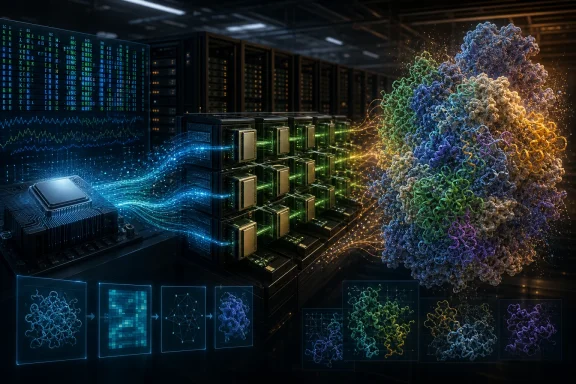
NVIDIA is recasting biomolecular co-folding as an end-to-end GPU systems problem, combining MMseqs2-GPU, cuEquivariance, an optimized OpenFold3 NIM, Fold-CP, and the BioNeMo Agent Toolkit to accelerate alignment, inference, serving, and multi-GPU prediction from ordinary proteins to 32,000-token assemblies. The individual numbers are striking: homology alignment reported at up to 177× the speed of CPU JackHMMER, OpenFold3 inference reduced by as much as roughly fourfold on Blackwell GPUs, and a 32,000-token Boltz-2 run spread across 64 B300 GPUs. But the larger claim is more consequential than any one benchmark: NVIDIA wants the practical limit of structure prediction to be set by an organization’s GPU infrastructure, not by a CPU preprocessing stage or the memory capacity of one accelerator.
That makes this less a story about a faster folding model than about the machinery surrounding one. NVIDIA has not replaced the science inside OpenFold3, Boltz, or the other supported open-source models; it has attacked the sequence search, triangular operations, deployment path, memory layout, and orchestration overhead that determine whether those models remain research demonstrations or become repeatable production workloads.
Structure prediction is often discussed as though inference begins when a trained neural network receives a neatly prepared input and ends when it emits atomic coordinates. Real pipelines are less tidy. They must gather evolutionary context, build a multiple sequence alignment, prepare model features, execute repeated co-folding and diffusion steps, rank candidate structures, calculate confidence, move artifacts between services, and decide what to do when a job exceeds available memory.
A major acceleration in one stage can therefore produce surprisingly little practical improvement if another stage is still serialized, CPU-bound, remote, or operationally fragile. NVIDIA’s central argument is that biomolecular prediction has become an end-to-end systems problem, with throughput governed by the least scalable component rather than by the theoretical performance of the model alone.
This distinction matters most in two demanding classes of work. Virtual screening may require a structure-prediction system to process enormous numbers of molecular candidates against a smaller set of protein targets, making even modest per-job delays financially significant. Large molecular assemblies create a different pressure: runtime grows steeply as residue count increases, while pairwise representations consume enough memory to place a hard ceiling on the complexes that can be handled by one GPU.
The BioNeMo Agent Toolkit sits above those layers as an orchestration mechanism. An agent can be instructed to create an MSA, pass it to OpenFold3, and return ranked structures with confidence scores, but the agent is not itself the performance breakthrough. Its value depends on whether every tool below it is fast, reliable, locally deployable, and explicit about resource limits.
That is the useful way to read NVIDIA’s announcement. The toolkit is the interface, but the actual engineering story lies in GPU homology search, specialized co-folding kernels, optimized model serving, and distributed context parallelism.
NVIDIA’s MSA Search NIM uses MMseqs2-GPU to move that search onto NVIDIA accelerators. The implementation scales across both Hopper and Blackwell architectures, with newer work adding architecture-specific optimizations, support for searches involving databases larger than GPU memory on NVIDIA Grace systems, and improved Blackwell DPX instructions available through CUDA 13.2.
Importantly, NVIDIA says these contributions have been upstreamed into the main MMseqs2 repository rather than confined to a proprietary service. That means the acceleration can reach researchers through the underlying open-source software as well as through the packaged NIM and BioNeMo agent skill.
The headline figure comes from the MMseqs2-GPU work published in Nature Methods: alignment up to 177× faster than CPU JackHMMER for a single-query comparison on one L40S GPU. The paper provides valuable external grounding for the narrow homology-search claim, but it also helps define its boundaries. This is an alignment benchmark against a particular CPU tool and configuration, not evidence that every complete structure-prediction job will finish 177 times sooner.
NVIDIA’s separate MSA-stage results focus on scaling with input size. On H100 and B300 GPUs, the stage reportedly continues scaling smoothly beyond 10,000 tokens, with measured latency around 429 seconds and 463 seconds at approximately that size. The closeness of those two results is a reminder that newer hardware does not automatically dominate every stage by the same margin; database movement, algorithmic structure, utilization, and implementation choices can matter as much as peak arithmetic throughput.
The operational implication is nevertheless significant. If the MSA is generated by a GPU service, the alignment stage can be scheduled, monitored, capacity-planned, and colocated more like the inference service that consumes it. That makes the whole pipeline easier to reason about than a hybrid arrangement in which a CPU search farm, shared database storage, and GPU inference cluster behave as separate queues.
These measurements answer different questions. The alignment result asks how much faster one homology-search implementation can be than another; the cuEquivariance result asks how much specialized kernels reduce a model forward pass; the NIM result adds further serving and inference optimization; and Fold-CP asks how large a problem can fit when pairwise state is distributed across devices.
That is not a weakness in the work, but it changes how the business case should be built. A team should profile the time spent in MSA generation, feature preparation, inference, confidence calculation, storage, and retries for its own input distribution, then apply the relevant acceleration only to the stage it actually replaces.
In a short-protein workflow dominated by service startup, network transfer, or downstream analysis, a dramatic search benchmark may barely move total latency. In a long-sequence workflow where MSA construction dominates the queue, moving the stage to MMseqs2-GPU could change both throughput and cluster design. The difference is why end-to-end telemetry matters more than a collection of vendor maxima.
That simplicity comes with an unusually direct warning from NVIDIA: the hosted build.nvidia.com endpoints are not designed for large-volume requests and will time out. For substantial screening, batch prediction, or shared institutional use, NVIDIA recommends a self-hosted NIM.
The warning is more important than the convenience of the sample prompt. A public endpoint that succeeds during an interactive evaluation may fail under concurrent submissions, long inputs, or retry storms, and an agent can amplify that failure by repeatedly invoking the same constrained service. A hosted demo endpoint is not production infrastructure, even when the API presented to the agent looks identical.
Self-hosting moves responsibility back to the operator. Administrators must provision compatible GPUs, obtain the required containers and credentials, manage sequence databases, set request limits, observe queue depth, and decide how failures are surfaced to the agent. That is more work, but it is also the only arrangement in which an organization can make meaningful promises about throughput and data handling.
NVIDIA’s cuEquivariance library provides accelerated implementations of Triangle Attention, Triangle Multiplication, and Attention Pair Bias. These are not generic speedups applied blindly to an entire Python program; they are targeted kernels for operations that dominate meaningful portions of co-folding inference.
OpenFold3’s own documentation confirms support for cuEquivariance triangle kernels as an optional acceleration path, with fallbacks available for shapes that are not handled efficiently. NVIDIA has also integrated or contributed these kernels to OpenFold2, RosettaFold3, Protenix, and Boltz, broadening the benefit beyond one NIM or one model family.
The reported OpenFold3 forward-pass results show why sequence length is the critical dimension. The gain is useful but comparatively modest at 1,024 tokens, then becomes much larger as the B300 workload grows.
At 2,048 tokens, the optimized B300 run cuts the forward pass from 300.1 seconds to 97.6 seconds. That is not simply a faster version of the 1,024-token result; it indicates that the specialized implementation is avoiding enough inefficient work or memory pressure for its relative advantage to increase with problem size.
The table also reveals why a single “GPU speedup” number would be misleading. At 1,024 tokens, the H100 result shows a slightly higher relative cuEquivariance gain than the B300 result, even though the B300 completes both implementations faster in absolute terms. Performance depends on the baseline, tensor shapes, memory behavior, kernel path, and sequence length, not merely the generation printed on the accelerator.
That is a broad range rather than a universal cutoff, as it should be. The point at which an out-of-memory error occurs can depend on molecule composition, model settings, diffusion samples, precision, templates, intermediate tensors, allocator behavior, and other processes sharing the device. Still, the gap illustrates how an optimized kernel can change the set of jobs that are possible, not merely shorten jobs that already fit.
For computational biology teams, this makes benchmark interpretation more complicated but also more useful. Latency can be translated into jobs per day or cost per prediction. Capacity changes determine whether a target complex can be processed intact, must be cropped or decomposed, or cannot be attempted under the current pipeline.
Cropping a molecular assembly is not equivalent to compressing a video or dividing an independent batch. Long-range interactions may be part of the biological phenomenon under investigation. If a model sees only fragments, it may lose the cross-chain or distant structural context that motivated the prediction in the first place.
The strategic implication is that memory capacity is part of model capability. Two deployments running nominally the same model can support meaningfully different scientific questions if one can preserve more of the assembly in a single context.
The NIM also raises the stated single-B300 sequence capacity to approximately 6,400 tokens. That is only moderately beyond the roughly 5,900-token cuEquivariance figure, but near a memory boundary, an additional few hundred tokens can determine whether a complete assembly fits.
The distinction between open-source kernel acceleration and a packaged NIM matters. Researchers can obtain cuEquivariance gains through supported open-source model integrations, while the fully optimized NIM is NVIDIA’s deployment-oriented path for the additional acceleration. Organizations therefore have a choice between greater control over the open-source environment and a more vertically optimized service abstraction.
The OpenFold3 skill follows the same agent pattern as the MSA skill. It can be installed with
This is a clean demonstration of state passing between scientific tools, but production systems must make that state explicit. The exact FASTA input, MSA artifact, model configuration, container image, random settings, diffusion sampling parameters, confidence output, logs, and generated structures should be retained as a traceable job record. A conversational transcript is not a sufficient provenance system for a drug-discovery workflow.
The crucial scaling expression is per-device memory of O(N²/P), where N is token count and P is the number of GPUs. The quadratic term reflects the cost of pairwise representations, while division by P describes how context parallelism spreads that state across the participating devices.
With the Boltz-2 model, NVIDIA reports reaching 32,000 tokens on 64 B300 GPUs, about a 12× increase over the cited single-GPU limit. This is scale-up for one biological system, not conventional data parallelism in which each GPU processes a separate protein or ligand.
That difference changes the economics of the cluster. A screening service usually wants many independent jobs packed efficiently across available accelerators. Fold-CP instead reserves a coordinated GPU group for one large prediction, making interconnect behavior, synchronized execution, placement, and failure recovery part of the scientific run.
The official Boltz-CP repository describes the implementation as a proof of concept and says the context-parallel capability is being worked toward the upstream Boltz codebase. That caveat should shape adoption: Fold-CP is evidence that the memory wall can be moved, but it should not yet be treated as an invisible switch in an established production scheduler.
Fold-CP must preserve the communication and computation required for triangular updates and attention-like operations across the sharded context. Per-device memory may improve according to O(N²/P), but the system still pays communication, coordination, and synchronization costs. More GPUs create capacity; they do not make those costs disappear.
NVIDIA supplies a smaller example for context-parallel inference across four GPUs, using one data-parallel group and a context-parallel size of four. The example also specifies three recycling steps, 200 sampling steps, and five diffusion samples, illustrating that GPU count is only one dimension of the run configuration.
For infrastructure teams, the appropriate unit of planning is therefore not “a GPU job.” It is a gang-scheduled distributed job with a particular context-parallel topology, expected memory profile, sampling configuration, runtime, and output volume. If one participant fails or becomes unavailable, the entire prediction may need to be retried.
This is also where the biological and operational definitions of success can diverge. A system may successfully fit a 32,000-token input but still require scientific validation of confidence, reproducibility, and usefulness on the class of assemblies being studied. NVIDIA’s results demonstrate computational reach; they do not remove the need to assess whether a generated structure is biologically credible.
The value of processing a large complex in one context is not simply aesthetic completeness. Molecular function often emerges from interfaces and coordinated behavior among multiple components, so predicting isolated pieces can omit precisely the relationships a researcher wants to investigate.
That does not mean every ribosome-scale target should immediately receive a multi-GPU co-folding run. Large jobs will be expensive, and experimental design should determine whether global context is necessary, what alternative evidence exists, and how the predicted structure will be evaluated. Fold-CP changes “this cannot fit” into “this may be schedulable,” which is a profound shift without being a guarantee of scientific payoff.
The same reasoning applies to large signaling assemblies and other multi-protein systems. Extending context makes it possible to ask questions that were previously ruled out by memory before the model could even run. It also moves the constraint downstream: the challenge becomes deciding which large predictions deserve scarce coordinated GPU time.
But an agent does not eliminate the need for a workflow engine, job database, secrets manager, artifact store, or scheduler. If anything, natural-language invocation raises the importance of those controls because it becomes easier for a user—or another automated process—to launch expensive work without understanding the resources involved.
A robust deployment should translate an agent request into a validated, immutable job specification. It should confirm input location and format, estimate token length, choose the MSA and inference endpoints, reject unsupported configurations, reserve the necessary GPUs, record software and model versions, and return a durable job identifier before computation begins.
Rate limiting is equally important. NVIDIA explicitly warns that its hosted endpoints can time out under large-volume requests, but a self-hosted service can also collapse if an agent recursively retries or submits many long jobs concurrently. Backoff, idempotency, quotas, and cancellation must be properties of the platform rather than behaviors left to the language model.
Security teams will also need to decide where proprietary sequences can travel. A hosted demonstration may be acceptable for public examples but inappropriate for confidential drug targets or partner data. Self-hosting provides more control, though it also creates obligations around access logs, container provenance, network isolation, output retention, and credential rotation.
Whether that happens depends on reuse. If many compounds are evaluated against the same protein target, some target-side preprocessing and alignment work may be reusable or cacheable. If each candidate changes the co-folding input and requires multiple diffusion samples, inference may remain the dominant expense even after kernel acceleration.
This is why NVIDIA’s layered approach is strategically sensible. MMseqs2-GPU addresses the MSA bottleneck, cuEquivariance lowers the cost of core operations, OpenFold3 NIM packages additional inference optimization, and agent tooling makes the stages composable. A screening platform can optimize the stage that actually limits its throughput rather than replacing the entire workflow at once.
The business consequence will vary sharply by workload. A team running occasional predictions may value shorter interactive waits and simpler invocation. A company operating a large screening pipeline will care more about sustained throughput, failure rate, GPU occupancy, cache effectiveness, and cost per usable ranked structure.
The difference between a successful prediction and a useful prediction also matters. Faster generation can create a new downstream bottleneck in quality review, visualization, scoring, experimental prioritization, and data management. Accelerating inference without improving how results are triaged may simply produce an expensive backlog of structures.
Still, most figures originate from NVIDIA-controlled hardware and software comparisons. Buyers should expect strong results on NVIDIA accelerators from a stack engineered by NVIDIA, and they should reproduce the relevant tests using their own molecular inputs, model settings, storage path, container environment, and concurrency level.
The benchmark labels also need to remain attached to the numbers. A forward-pass latency is not necessarily full request latency. A homology-search alignment speedup is not total MSA-service throughput. A maximum sequence length does not say how long the run took, how many samples were generated, or how much cluster time was consumed.
Input composition can matter as much as nominal length. Two jobs with the same token count may differ in atom count, number of chains, MSA depth, template use, diffusion configuration, and confidence workload. Capacity planning based solely on token buckets will be convenient but incomplete.
There is also a deployment trade-off between vertical optimization and portability. A packaged NIM can offer a fast route to an optimized supported service, while an open-source integration may be easier to inspect, modify, or run across a heterogeneous environment. Many organizations will use both: NIMs for standard production paths and open-source environments for experimentation and validation.
That makes this less a story about a faster folding model than about the machinery surrounding one. NVIDIA has not replaced the science inside OpenFold3, Boltz, or the other supported open-source models; it has attacked the sequence search, triangular operations, deployment path, memory layout, and orchestration overhead that determine whether those models remain research demonstrations or become repeatable production workloads.
 NVIDIA’s Real Target Is the Slowest Stage in the Pipeline
Structure prediction is often discussed as though inference begins when a trained neural network receives a neatly prepared input and ends when it emits atomic coordinates. Real pipelines are less tidy. They must gather evolutionary context, build a multiple sequence alignment, prepare model features, execute repeated co-folding and diffusion steps, rank candidate structures, calculate confidence, move artifacts between services, and decide what to do when a job exceeds available memory.A major acceleration in one stage can therefore produce surprisingly little practical improvement if another stage is still serialized, CPU-bound, remote, or operationally fragile. NVIDIA’s central argument is that biomolecular prediction has become an end-to-end systems problem, with throughput governed by the least scalable component rather than by the theoretical performance of the model alone.
This distinction matters most in two demanding classes of work. Virtual screening may require a structure-prediction system to process enormous numbers of molecular candidates against a smaller set of protein targets, making even modest per-job delays financially significant. Large molecular assemblies create a different pressure: runtime grows steeply as residue count increases, while pairwise representations consume enough memory to place a hard ceiling on the complexes that can be handled by one GPU.
The BioNeMo Agent Toolkit sits above those layers as an orchestration mechanism. An agent can be instructed to create an MSA, pass it to OpenFold3, and return ranked structures with confidence scores, but the agent is not itself the performance breakthrough. Its value depends on whether every tool below it is fast, reliable, locally deployable, and explicit about resource limits.
That is the useful way to read NVIDIA’s announcement. The toolkit is the interface, but the actual engineering story lies in GPU homology search, specialized co-folding kernels, optimized model serving, and distributed context parallelism.
MMseqs2-GPU Moves the Waiting Room Onto the Accelerator
For many folding workflows, MSA construction has traditionally been the awkward preliminary step that makes an expensive GPU wait for a CPU. Homology search examines large sequence databases to find related proteins, supplying evolutionary information that can materially improve structural prediction. It is computationally heavy, database-intensive, and not naturally hidden behind the runtime of the model that follows it.NVIDIA’s MSA Search NIM uses MMseqs2-GPU to move that search onto NVIDIA accelerators. The implementation scales across both Hopper and Blackwell architectures, with newer work adding architecture-specific optimizations, support for searches involving databases larger than GPU memory on NVIDIA Grace systems, and improved Blackwell DPX instructions available through CUDA 13.2.
Importantly, NVIDIA says these contributions have been upstreamed into the main MMseqs2 repository rather than confined to a proprietary service. That means the acceleration can reach researchers through the underlying open-source software as well as through the packaged NIM and BioNeMo agent skill.
The headline figure comes from the MMseqs2-GPU work published in Nature Methods: alignment up to 177× faster than CPU JackHMMER for a single-query comparison on one L40S GPU. The paper provides valuable external grounding for the narrow homology-search claim, but it also helps define its boundaries. This is an alignment benchmark against a particular CPU tool and configuration, not evidence that every complete structure-prediction job will finish 177 times sooner.
NVIDIA’s separate MSA-stage results focus on scaling with input size. On H100 and B300 GPUs, the stage reportedly continues scaling smoothly beyond 10,000 tokens, with measured latency around 429 seconds and 463 seconds at approximately that size. The closeness of those two results is a reminder that newer hardware does not automatically dominate every stage by the same margin; database movement, algorithmic structure, utilization, and implementation choices can matter as much as peak arithmetic throughput.
The operational implication is nevertheless significant. If the MSA is generated by a GPU service, the alignment stage can be scheduled, monitored, capacity-planned, and colocated more like the inference service that consumes it. That makes the whole pipeline easier to reason about than a hybrid arrangement in which a CPU search farm, shared database storage, and GPU inference cluster behave as separate queues.
The 177× Number Is Powerful—and Easy to Misuse
A laboratory planning capacity should resist multiplying NVIDIA’s largest stage-level claims together. The 177× figure applies to MMseqs2-GPU alignment against CPU JackHMMER on a single L40S, while the OpenFold3 figures compare different inference implementations on H100 and B300. Fold-CP, meanwhile, addresses maximum context and per-device memory rather than promising that adding GPUs will reduce total runtime in direct proportion to GPU count.These measurements answer different questions. The alignment result asks how much faster one homology-search implementation can be than another; the cuEquivariance result asks how much specialized kernels reduce a model forward pass; the NIM result adds further serving and inference optimization; and Fold-CP asks how large a problem can fit when pairwise state is distributed across devices.
That is not a weakness in the work, but it changes how the business case should be built. A team should profile the time spent in MSA generation, feature preparation, inference, confidence calculation, storage, and retries for its own input distribution, then apply the relevant acceleration only to the stage it actually replaces.
In a short-protein workflow dominated by service startup, network transfer, or downstream analysis, a dramatic search benchmark may barely move total latency. In a long-sequence workflow where MSA construction dominates the queue, moving the stage to MMseqs2-GPU could change both throughput and cluster design. The difference is why end-to-end telemetry matters more than a collection of vendor maxima.
NVIDIA’s Hosted Endpoint Is a Demonstration, Not a Capacity Plan
The easiest path into the workflow is the MSA Search NIM skill for the BioNeMo Agent Toolkit. NVIDIA’s example installs it for Claude Code withnpx skills add NVIDIA-BioNeMo/bionemo-agent-toolkit --skill msa-search-nim --agent claude-code, after which the agent can be prompted to build an MSA from a target FASTA file.That simplicity comes with an unusually direct warning from NVIDIA: the hosted build.nvidia.com endpoints are not designed for large-volume requests and will time out. For substantial screening, batch prediction, or shared institutional use, NVIDIA recommends a self-hosted NIM.
The warning is more important than the convenience of the sample prompt. A public endpoint that succeeds during an interactive evaluation may fail under concurrent submissions, long inputs, or retry storms, and an agent can amplify that failure by repeatedly invoking the same constrained service. A hosted demo endpoint is not production infrastructure, even when the API presented to the agent looks identical.
Self-hosting moves responsibility back to the operator. Administrators must provision compatible GPUs, obtain the required containers and credentials, manage sequence databases, set request limits, observe queue depth, and decide how failures are surfaced to the agent. That is more work, but it is also the only arrangement in which an organization can make meaningful promises about throughput and data handling.
cuEquivariance Attacks the Operations That Make Co-Folding Expensive
Once the MSA and model inputs are ready, the bottleneck moves into the co-folding architecture itself. Modern structure models repeatedly update representations of relationships among residues, atoms, chains, and other molecular entities. The triangular operations used for this pairwise reasoning are computationally expensive and become increasingly punishing as sequence length grows.NVIDIA’s cuEquivariance library provides accelerated implementations of Triangle Attention, Triangle Multiplication, and Attention Pair Bias. These are not generic speedups applied blindly to an entire Python program; they are targeted kernels for operations that dominate meaningful portions of co-folding inference.
OpenFold3’s own documentation confirms support for cuEquivariance triangle kernels as an optional acceleration path, with fallbacks available for shapes that are not handled efficiently. NVIDIA has also integrated or contributed these kernels to OpenFold2, RosettaFold3, Protenix, and Boltz, broadening the benefit beyond one NIM or one model family.
The reported OpenFold3 forward-pass results show why sequence length is the critical dimension. The gain is useful but comparatively modest at 1,024 tokens, then becomes much larger as the B300 workload grows.
| Sequence and GPU | PyTorch OSS | cuEquivariance | Reported speedup |
|---|---|---|---|
| 1,024 tokens, H100 | 79.4 s | 41.6 s | 1.9× |
| 1,024 tokens, B300 | 49.1 s | 27.3 s | 1.8× |
| 1,536 tokens, B300 | 149.0 s | 56.2 s | 2.7× |
| 2,048 tokens, B300 | 300.1 s | 97.6 s | 3.1× |
The table also reveals why a single “GPU speedup” number would be misleading. At 1,024 tokens, the H100 result shows a slightly higher relative cuEquivariance gain than the B300 result, even though the B300 completes both implementations faster in absolute terms. Performance depends on the baseline, tensor shapes, memory behavior, kernel path, and sequence length, not merely the generation printed on the accelerator.
Memory Capacity Becomes a Feature, Not Just a Constraint
The more consequential cuEquivariance claim may be capacity rather than latency. NVIDIA reports that the accelerated kernels extend maximum sequence length to roughly 5,900 tokens, whereas the PyTorch path runs out of memory beyond approximately 1,500 to 2,500 tokens.That is a broad range rather than a universal cutoff, as it should be. The point at which an out-of-memory error occurs can depend on molecule composition, model settings, diffusion samples, precision, templates, intermediate tensors, allocator behavior, and other processes sharing the device. Still, the gap illustrates how an optimized kernel can change the set of jobs that are possible, not merely shorten jobs that already fit.
For computational biology teams, this makes benchmark interpretation more complicated but also more useful. Latency can be translated into jobs per day or cost per prediction. Capacity changes determine whether a target complex can be processed intact, must be cropped or decomposed, or cannot be attempted under the current pipeline.
Cropping a molecular assembly is not equivalent to compressing a video or dividing an independent batch. Long-range interactions may be part of the biological phenomenon under investigation. If a model sees only fragments, it may lose the cross-chain or distant structural context that motivated the prediction in the first place.
The strategic implication is that memory capacity is part of model capability. Two deployments running nominally the same model can support meaningfully different scientific questions if one can preserve more of the assembly in a single context.
OpenFold3 NIM Compounds the Kernel Gain
cuEquivariance is only the first inference layer in NVIDIA’s stack. The OpenFold3 NIM incorporates the accelerated kernels and applies additional optimizations, producing NVIDIA’s claim of more than threefold faster folding on H100 and fourfold on B300 in its optimized comparison.The NIM also raises the stated single-B300 sequence capacity to approximately 6,400 tokens. That is only moderately beyond the roughly 5,900-token cuEquivariance figure, but near a memory boundary, an additional few hundred tokens can determine whether a complete assembly fits.
The distinction between open-source kernel acceleration and a packaged NIM matters. Researchers can obtain cuEquivariance gains through supported open-source model integrations, while the fully optimized NIM is NVIDIA’s deployment-oriented path for the additional acceleration. Organizations therefore have a choice between greater control over the open-source environment and a more vertically optimized service abstraction.
The OpenFold3 skill follows the same agent pattern as the MSA skill. It can be installed with
npx skills add NVIDIA-BioNeMo/bionemo-agent-toolkit --skill openfold3-nim --agent claude-code, then prompted to fold a target using an MSA from the previous stage and return ranked structures with confidence scores.This is a clean demonstration of state passing between scientific tools, but production systems must make that state explicit. The exact FASTA input, MSA artifact, model configuration, container image, random settings, diffusion sampling parameters, confidence output, logs, and generated structures should be retained as a traceable job record. A conversational transcript is not a sufficient provenance system for a drug-discovery workflow.
Fold-CP Turns One Oversized Prediction Into a Distributed Job
Even a 6,400-token limit leaves many important biological assemblies out of reach. NVIDIA’s answer is Fold-CP, a context-parallel framework that distributes the model’s context and pairwise state across multiple GPUs rather than forcing the whole prediction into the memory of one device.The crucial scaling expression is per-device memory of O(N²/P), where N is token count and P is the number of GPUs. The quadratic term reflects the cost of pairwise representations, while division by P describes how context parallelism spreads that state across the participating devices.
With the Boltz-2 model, NVIDIA reports reaching 32,000 tokens on 64 B300 GPUs, about a 12× increase over the cited single-GPU limit. This is scale-up for one biological system, not conventional data parallelism in which each GPU processes a separate protein or ligand.
That difference changes the economics of the cluster. A screening service usually wants many independent jobs packed efficiently across available accelerators. Fold-CP instead reserves a coordinated GPU group for one large prediction, making interconnect behavior, synchronized execution, placement, and failure recovery part of the scientific run.
The official Boltz-CP repository describes the implementation as a proof of concept and says the context-parallel capability is being worked toward the upstream Boltz codebase. That caveat should shape adoption: Fold-CP is evidence that the memory wall can be moved, but it should not yet be treated as an invisible switch in an established production scheduler.
The 32,000-Token Result Is About Reach, Not Free Performance
It is tempting to interpret 64 B300 GPUs as brute force applied to a larger input, but the core innovation is the ability to partition operations that were designed around dense, globally connected representations. Co-folding architectures are not interchangeable with ordinary language-model inference, where established tensor and context-parallel patterns can often be reused more directly.Fold-CP must preserve the communication and computation required for triangular updates and attention-like operations across the sharded context. Per-device memory may improve according to O(N²/P), but the system still pays communication, coordination, and synchronization costs. More GPUs create capacity; they do not make those costs disappear.
NVIDIA supplies a smaller example for context-parallel inference across four GPUs, using one data-parallel group and a context-parallel size of four. The example also specifies three recycling steps, 200 sampling steps, and five diffusion samples, illustrating that GPU count is only one dimension of the run configuration.
For infrastructure teams, the appropriate unit of planning is therefore not “a GPU job.” It is a gang-scheduled distributed job with a particular context-parallel topology, expected memory profile, sampling configuration, runtime, and output volume. If one participant fails or becomes unavailable, the entire prediction may need to be retried.
This is also where the biological and operational definitions of success can diverge. A system may successfully fit a 32,000-token input but still require scientific validation of confidence, reproducibility, and usefulness on the class of assemblies being studied. NVIDIA’s results demonstrate computational reach; they do not remove the need to assess whether a generated structure is biologically credible.
Ribosome-Scale Predictions Change the Question Researchers Can Ask
NVIDIA uses a complex of roughly 10,000 residues—approximately the scale of a bacterial ribosome—to make the capacity argument concrete. Such an assembly sits beyond the range of the cited single-B300 OpenFold3 NIM limit but well below the 32,000-token Fold-CP demonstration.The value of processing a large complex in one context is not simply aesthetic completeness. Molecular function often emerges from interfaces and coordinated behavior among multiple components, so predicting isolated pieces can omit precisely the relationships a researcher wants to investigate.
That does not mean every ribosome-scale target should immediately receive a multi-GPU co-folding run. Large jobs will be expensive, and experimental design should determine whether global context is necessary, what alternative evidence exists, and how the predicted structure will be evaluated. Fold-CP changes “this cannot fit” into “this may be schedulable,” which is a profound shift without being a guarantee of scientific payoff.
The same reasoning applies to large signaling assemblies and other multi-protein systems. Extending context makes it possible to ask questions that were previously ruled out by memory before the model could even run. It also moves the constraint downstream: the challenge becomes deciding which large predictions deserve scarce coordinated GPU time.
Agentic Science Still Needs Conventional Platform Engineering
The BioNeMo Agent Toolkit makes the workflow legible in natural language. An operator can tell an agent to build an MSA for a sequence, fold the target with that alignment, and return ranked structures. This reduces the friction involved in discovering tools, connecting APIs, and remembering command syntax.But an agent does not eliminate the need for a workflow engine, job database, secrets manager, artifact store, or scheduler. If anything, natural-language invocation raises the importance of those controls because it becomes easier for a user—or another automated process—to launch expensive work without understanding the resources involved.
A robust deployment should translate an agent request into a validated, immutable job specification. It should confirm input location and format, estimate token length, choose the MSA and inference endpoints, reject unsupported configurations, reserve the necessary GPUs, record software and model versions, and return a durable job identifier before computation begins.
Rate limiting is equally important. NVIDIA explicitly warns that its hosted endpoints can time out under large-volume requests, but a self-hosted service can also collapse if an agent recursively retries or submits many long jobs concurrently. Backoff, idempotency, quotas, and cancellation must be properties of the platform rather than behaviors left to the language model.
Security teams will also need to decide where proprietary sequences can travel. A hosted demonstration may be acceptable for public examples but inappropriate for confidential drug targets or partner data. Self-hosting provides more control, though it also creates obligations around access logs, container provenance, network isolation, output retention, and credential rotation.
Action checklist for admins
- Profile existing wall-clock time separately for MSA generation, feature preparation, OpenFold3 inference, confidence calculation, storage, and retries before estimating savings.
- Use NVIDIA’s hosted NIM endpoints only for low-volume evaluation; deploy self-hosted NIM instances for batch, screening, or shared production workloads.
- Install the MSA and OpenFold3 agent skills only in controlled environments, and pin the surrounding packages, containers, and model assets through the organization’s normal release process.
- Place token-length, diffusion-sample, concurrency, timeout, and GPU-count limits in the job service rather than relying on prompts to enforce them.
- Schedule Fold-CP as a coordinated multi-GPU workload, with topology-aware placement, failure handling, checkpoint or retry policy, and explicit cost accounting.
- Preserve the input FASTA, generated MSA, run parameters, model outputs, confidence scores, logs, and environment metadata as one auditable prediction record.
- Test representative short, medium, long, and oversized targets; do not extrapolate a capacity plan from NVIDIA’s largest benchmark alone.
Faster Folding Changes Screening Economics Unevenly
For virtual screening, the most attractive promise is not necessarily the ability to fold a 32,000-token complex. It is the possibility of lowering the per-candidate cost enough that co-folding can be used earlier and across larger libraries rather than reserved for a narrow final set.Whether that happens depends on reuse. If many compounds are evaluated against the same protein target, some target-side preprocessing and alignment work may be reusable or cacheable. If each candidate changes the co-folding input and requires multiple diffusion samples, inference may remain the dominant expense even after kernel acceleration.
This is why NVIDIA’s layered approach is strategically sensible. MMseqs2-GPU addresses the MSA bottleneck, cuEquivariance lowers the cost of core operations, OpenFold3 NIM packages additional inference optimization, and agent tooling makes the stages composable. A screening platform can optimize the stage that actually limits its throughput rather than replacing the entire workflow at once.
The business consequence will vary sharply by workload. A team running occasional predictions may value shorter interactive waits and simpler invocation. A company operating a large screening pipeline will care more about sustained throughput, failure rate, GPU occupancy, cache effectiveness, and cost per usable ranked structure.
The difference between a successful prediction and a useful prediction also matters. Faster generation can create a new downstream bottleneck in quality review, visualization, scoring, experimental prioritization, and data management. Accelerating inference without improving how results are triaged may simply produce an expensive backlog of structures.
Vendor Benchmarks Are the Start of Capacity Planning, Not the End
NVIDIA’s reported results are coherent, and the MMseqs2-GPU alignment claim is supported by the published Nature Methods work. OpenFold3’s documentation likewise supports the availability of cuEquivariance integration, while NVIDIA’s public Fold-CP work describes how distributed context can move beyond single-device memory.Still, most figures originate from NVIDIA-controlled hardware and software comparisons. Buyers should expect strong results on NVIDIA accelerators from a stack engineered by NVIDIA, and they should reproduce the relevant tests using their own molecular inputs, model settings, storage path, container environment, and concurrency level.
The benchmark labels also need to remain attached to the numbers. A forward-pass latency is not necessarily full request latency. A homology-search alignment speedup is not total MSA-service throughput. A maximum sequence length does not say how long the run took, how many samples were generated, or how much cluster time was consumed.
Input composition can matter as much as nominal length. Two jobs with the same token count may differ in atom count, number of chains, MSA depth, template use, diffusion configuration, and confidence workload. Capacity planning based solely on token buckets will be convenient but incomplete.
There is also a deployment trade-off between vertical optimization and portability. A packaged NIM can offer a fast route to an optimized supported service, while an open-source integration may be easier to inspect, modify, or run across a heterogeneous environment. Many organizations will use both: NIMs for standard production paths and open-source environments for experimentation and validation.
The Numbers Worth Carrying Into Architecture Reviews
The practical lesson is that NVIDIA has produced a stack of distinct accelerations rather than one magical co-folding multiplier. Teams should retain the stage, hardware, and comparison behind each number when deciding whether the stack fits their work.- MMseqs2-GPU reports up to 177× faster alignment than CPU JackHMMER on a single L40S, not a 177× acceleration of the complete folding pipeline.
- MSA latency reportedly continues scaling beyond 10,000 tokens on H100 and B300, but the hosted NVIDIA endpoint is explicitly unsuitable for large-volume production traffic.
- cuEquivariance reduces OpenFold3 forward-pass latency by up to 3.1× in the listed comparison and extends reported capacity to roughly 5,900 tokens.
- The optimized OpenFold3 NIM raises the single-B300 limit to approximately 6,400 tokens and is reported at more than fourfold faster on B300 in NVIDIA’s optimized comparison.
- Fold-CP scales per-device memory as O(N²/P) and demonstrates 32,000 tokens on 64 B300 GPUs with Boltz-2, but its public implementation should be approached as evolving distributed software.
- The BioNeMo Agent Toolkit simplifies composition; it does not replace scheduling, provenance, security, validation, or cost controls.
References
- Primary source: NVIDIA Developer
Published: Fri, 10 Jul 2026 13:21:16 GMT
Accelerating End-to-End Co-Folding Performance with NVIDIA BioNeMo Agent Toolkit | NVIDIA Technical Blog
Biomolecular structure prediction and co-folding with models like OpenFold3 are now mainstream, large-scale workloads powering drug discovery and protein design.developer.nvidia.com
- Related coverage: docs.nvidia.com

triangle_attention — cuEquivariance
docs.nvidia.com
- Related coverage: research.nvidia.com
- Related coverage: nvidia.github.io

attention_pair_bias — cuEquivariance
nvidia.github.io
- Related coverage: nvidia.com
Accelerate the Path to In-Silico Life Sciences and Drug Discovery S81663 | GTC San Jose 2026 | NVIDIA On-Demand
Representing life in silico and designing compounds and therapies that modulate that biology are among the most foundational goals of modern life scienceswww.nvidia.com - Official source: github.com
GitHub - NVIDIA-BioNeMo/boltz-cp: Context Parallelism Code for Boltz-2 · GitHub
Context Parallelism Code for Boltz-2. Contribute to NVIDIA-BioNeMo/boltz-cp development by creating an account on GitHub. github.com
- Related coverage: developer.nvidia.cn
在 NVIDIA BioNeMo 中使用上下文并行性扩展生物分子建模 - NVIDIA 技术博客
几十年来,计算生物学一直在简化主义妥协下运作。为了将复杂的生物系统整合到单个 GPU 的有限内存中,developer.nvidia.cn
- Related coverage: linkedin.com
NVIDIA BioNeMo Breaks GPU Memory Wall for Biomolecular Folding | Roy Tal posted on the topic | LinkedIn
We just broke the GPU memory wall for co-folding and biomolecular foundation models! 🧬 To design highly specific therapeutics, we have to simulate massive biomolecular machines — but until today, GPU memory limits forced researchers to crop these assemblies apart, systematically destroying the...www.linkedin.com