

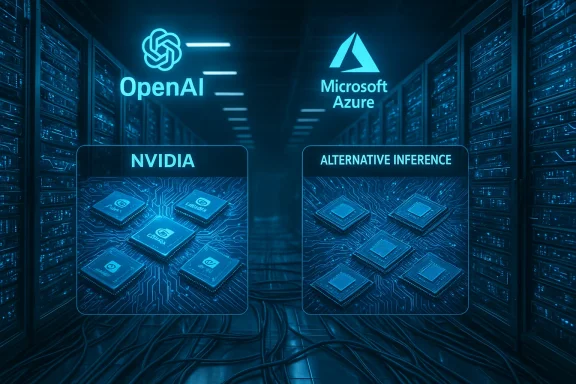
Nvidia’s recent second thoughts about its headline-grabbing OpenAI pact are more than a private spat between two Silicon Valley giants — they are a flashing caution light for Microsoft, whose cloud, products and bet‑the‑company AI strategy are deeply entangled with OpenAI’s fortunes.
Background
The public story is straightforward: in late 2025 Nvidia and OpenAI announced a sweeping memorandum of intent that, in its most ambitious formulation, outlined up to $100 billion in investment and a plan to build massive new compute capacity for OpenAI. Within weeks of media follow‑ups, however, reporting surfaced that Nvidia executives had grown uncomfortable with the scale and structure of the proposal and had described the $100 billion figure as an upper bound rather than a signed commitment. Those reports also said Nvidia had privately voiced concerns about OpenAI’s commercial discipline and about competitive dynamics in the AI stack.Nvidia chief executive Jensen Huang pushed back publicly, calling suggestions of a rupture “nonsense” and saying Nvidia would “definitely participate” in OpenAI’s funding round and “invest a great deal of money.” OpenAI’s Sam Altman likewise reaffirmed that NVIDIA makes “the best AI chips in the world” and that the companies remain close partners. Still, independent reporting from Reuters and other outlets added a technical wrinkle: sources said OpenAI had become dissatisfied with performance characteristics of some of Nvidia’s latest inference hardware and had quietly explored alternatives. Altman denied that claim as well.
Those twin strains — financial and technical — are the ones Microsoft needs to watch. Microsoft’s relationship with OpenAI has been the most consequential commercial tie in the modern cloud era: a multibillion-dollar strategic relationship that integrates OpenAI’s models into Microsoft products and routes enormous compute consumption through Azure. Anything that reshapes the OpenAI‑Nvidia axis therefore ripples across Microsoft’s product roadmaps, capital planning, and competitive posture.
Why Nvidia’s doubts matter — the strategic mechanics
1. Nvidia is not just a vendor; it’s an infrastructure anchor
Nvidia isn’t a typical supplier that Microsoft can swap out quietly. Its datacenter GPUs (and full-stack ecosystem: interconnects, libraries, tooling, and partner OEMs) are the de facto standard for training and many inference workloads today. If OpenAI — the single largest and most compute‑dense commercial AI user — signals vagueness about its needs or dissatisfaction with parts of that stack, the consequences are magnified.- Nvidia’s chips drive throughput and economics for large models; procurement, pricing and roadmap alignment affect the entire industry’s total cost of ownership.
- A chill in Nvidia‑OpenAI relations would not instantly disrupt Microsoft’s operations, but it would change bargaining power, pricing expectations, and supply planning at scale.
2. Microsoft’s exposure is both commercial and operational
Microsoft has built major product plays around OpenAI’s models (integrations inside Microsoft 365 Copilot, Azure OpenAI Service, and Bing/consumer experiences). It is simultaneously a cloud host for high-volume model inference and a financier/stakeholder in OpenAI’s growth. That creates a dual exposure:- As a platform provider, Microsoft counts on predictable, long‑term demand to amortize data‑center investments and to structure capacity and capacity‑purchase agreements.
- As a strategic partner and investor, Microsoft’s financial returns and optionality are tied to OpenAI’s capitalization, model roadmap and customer monetization.
3. Infrastructure is capital‑heavy and path dependent
Building hyperscale AI capacity isn’t incremental like buying more compute racks; it is multi‑year, medium‑term capital planning tied to land, power, interconnects and long procurement lead times for specialized chips. If OpenAI’s compute needs move — either to a multi‑vendor strategy or to third‑party ventures like Oracle/SoftBank’s Stargate — Microsoft risks stranded leases, mismatched server mixes, and over‑or under‑provisioning in the regions it had planned to host OpenAI workloads.This is not theoretical. Analysts and industry channel checks have reported that Microsoft canceled or allowed to lapse certain data‑center leases and converted fewer "statements of qualification" into final deals, actions described by some as a recalibration of capacity needs. Whether those moves reflect prudence or a meaningful pullback matters — because timing mismatches in the data‑center world compound capital risk and hurt margins.
The technical heart of the matter: training vs inference and why it complicates vendor choice
Modern large models have two very different compute phases: training (where raw FLOPS for model pretraining dominate) and inference (where latency, memory architecture and per‑token throughput matter). Historically, Nvidia’s GPUs have been dominant across both domains, but the industry’s emphasis has shifted.- Training demands have been met by high‑bandwidth GPUs with fast interconnects and efficient mixed‑precision capabilities.
- Inference — particularly for low‑latency, high‑concurrency services — stresses memory architecture, deterministic latency and cost per query.
If OpenAI does diversify inference hardware to reduce latency or to negotiate better economics, Nvidia still remains central for training but may face lost share in a high‑margin, high‑volume segment of inference provisioning. For Microsoft, that would change the overall supplier mix it needs to host and optimize around. Microsoft has already been deploying newer Nvidia architectures (Microsoft announced clusters of the latest GB300/Blackwell family in some facilities), but inflections in workload patterns create real re‑engineering pressure.
Financial plumbing: huge numbers, shifting commitments, and valuation risk
The headlines about a "$100 billion" Nvidia participation were always an upper bound and a public shorthand for a far more complex, staged investment and capacity plan. Multiple reputable outlets reported that the $100 billion figure described in the original memorandum was non‑binding and designed as a multi‑year infrastructure target rather than a single check. Nvidia’s CEO emphasized that while Nvidia will “definitely participate,” the final size will be “nothing like that” headline when calibrated to OpenAI’s immediate needs.Still, the underlying economics are enormous. OpenAI’s compute and infrastructure commitments — across Microsoft, Oracle and potential sovereign or strategic investors — run into tens or hundreds of billions over the medium term. SoftBank, Oracle and other partners have been publicly reported as moving capital and engineering into major data‑center projects to support OpenAI. Those parallel efforts reduce single‑vendor dependency but increase systemic complexity.
For Microsoft, the financial risk is threefold:
- Capital allocation: building or leasing data‑center capacity to service OpenAI takes billions. Overbuilding risks stranded assets if demand forecasts change.
- Revenue volatility: if OpenAI routes some workloads to other clouds or to dedicated infrastructure partners, Microsoft could lose high‑margin, high‑volume revenues it anticipated.
- Equity and valuation exposure: Microsoft’s direct and indirect financial exposure to OpenAI — through investments, preferential commercial terms, and revenue‑sharing constructs — means that valuation setbacks or funding drama at OpenAI can cause balance‑sheet accounting headaches and investor concern.
Strategic implications and operational pathways for Microsoft
Microsoft has a range of responses — some are defensive and tactical, others proactive and strategic. Below are practical actions Microsoft can and likely will consider, ranked roughly from tactical to strategic.- Rebalance capacity commitments and increase fungibility
- Prioritize server‑level fungibility so GPU inventories can flex between customers and workloads.
- Favor modular, lease‑oriented capacity over sunk capital in nascent markets to avoid stranded assets.
- Harden multi‑vendor architectures
- Add support (both software and supply‑chain) for inference‑optimized architectures alongside Nvidia GPUs to reduce supplier concentration risk.
- Expand partnerships with companies offering alternative accelerators, while preserving Nvidia for core training tasks.
- Negotiate product‑level protections
- Revisit data‑transfer, exclusivity and preferential pricing clauses with OpenAI to ensure Azure isn’t left exposed should the model of consumption change.
- Structure incremental capacity payments and shared risk clauses in new contracts.
- Accelerate internal model development and product integration
- Invest further in Microsoft’s own state‑of‑the‑art models and verticalized agents to reduce single‑model dependence.
- Use Microsoft’s product reach (Office, M365 Copilot, enterprise contracts) to bake in models where Microsoft retains control of the stack and monetization.
- Financial hedging and JV structures
- Explore co‑investment vehicles with other hyperscalers or sovereign investors to underwrite shared infrastructure in high‑cost regions.
- Consider explicit carve‑outs: if OpenAI moves some workloads to Oracle/SoftBank’s Stargate, Microsoft could secure exclusivity for other product classes or earn increased margins where it remains the provider.
Risks that deserve heightened attention
- Reputational and regulatory: Microsoft’s deep commercial ties to OpenAI have already attracted regulatory attention in multiple jurisdictions. Any material mismatch in contracts or sudden market moves will renew antitrust scrutiny and political concern about concentration of AI power.
- Stranded assets: data centers are long‑lived investments; a mid‑cycle demand reforecast can create years of depressed returns on expensive builds.
- Performance mismatch: adding inference‑optimized chips into Azure’s fleet is not a drop‑in: platform, orchestration and developer stacks must be adapted for new primitives, adding cost and integration risk.
- Market contagion: if OpenAI’s valuation or funding narrative weakens materially, it will depress demand signal confidence across Azure’s sales funnel for AI services and enterprise adoption timelines.
- Price and margin pressure: competition for inference capacity could lower wholesale prices, pressuring Azure’s gross margins unless Microsoft captures higher value in software and services.
Opportunities for Microsoft if it plays its cards well
The flip side of risk is optionality. Microsoft controls three strategic levers that can convert an OpenAI realignment into a durable advantage:- Distribution and customers: Microsoft’s installed base (Windows, Office, enterprise contracts) remains unmatched. Even with model supply reshuffles, Microsoft can monetize unique integrations and premium Copilot features that combine model outputs with enterprise data, identity and compliance guardrails.
- Cloud engineering muscle: Microsoft can turn a multi‑vendor reality into a selling point: an Azure that supports the best mix of accelerators for given workloads could be attractive to enterprises who want predictable performance and cost.
- Vertical AI: by investing in industry‑specific foundation models and tools that require deep enterprise data integration (healthcare, finance, manufacturing), Microsoft can extract value independent of where base models are hosted.
What to watch next — practical signals to monitor
- Contract and capacity updates from Microsoft’s earnings transcripts. Watch for language about “directional capacity,” “fungibility,” and explicit mentions of non‑Nvidia accelerators in live clusters.
- OpenAI’s procurement disclosures and any public statements about multi‑cloud or multi‑chip strategies.
- Nvidia’s investor communications and capital‑allocation cadence: any signal that the company will not underwrite large, long‑dated infrastructure commitments would be material.
- Oracle/SoftBank/Stargate execution milestones: if those projects begin to take volume away from Azure, Microsoft’s exposure will be clearer.
- Data‑center lease churn reported by industry analysts (TD Cowen and others) — cancellations or contract extensions will provide near‑term clarity on demand pacing.
Conclusion
The public vaudeville of denials and reassurances that followed the reports about Nvidia’s unease with OpenAI masks a substantive industry pivot: the AI infrastructure market is moving from a single‑vendor, headline‑sized narrative to a more granular, economically disciplined reality. For Microsoft, that pivot is a real test of strategic agility.Microsoft’s scale, product reach and engineering depth give it multiple levers to manage exposure. But scale is a double‑edged sword: when normalizing the economics of generative AI becomes the new market logic, the company’s heavy and public reliance on one partner — whether framed as investment, preferential access, or hosting — will draw close scrutiny and create execution risk on a very large balance sheet.
Nvidia’s doubts — whether they are about governance, business discipline, or piece‑part chip performance — are therefore a warning sign, not an existential threat by themselves. They should prompt Microsoft to accelerate what it has often said it is already doing: make capacity fungible, support multi‑vendor stacks, productize deeper enterprise value around models, and structure partnerships so that capital and operational risk are shared rather than concentrated.
In a market where compute is a commodity but integration and trust are not, Microsoft’s best defense is a pragmatic blend of diversification, operational rigor, and product differentiation — because the next wave of winners will be judged less by who controls chips and more by who controls consistent, secure, and profitable customer outcomes.
Source: Bloomberg.com https://www.bloomberg.com/opinion/a...as-openai-doubts-are-a-warning-for-microsoft/
