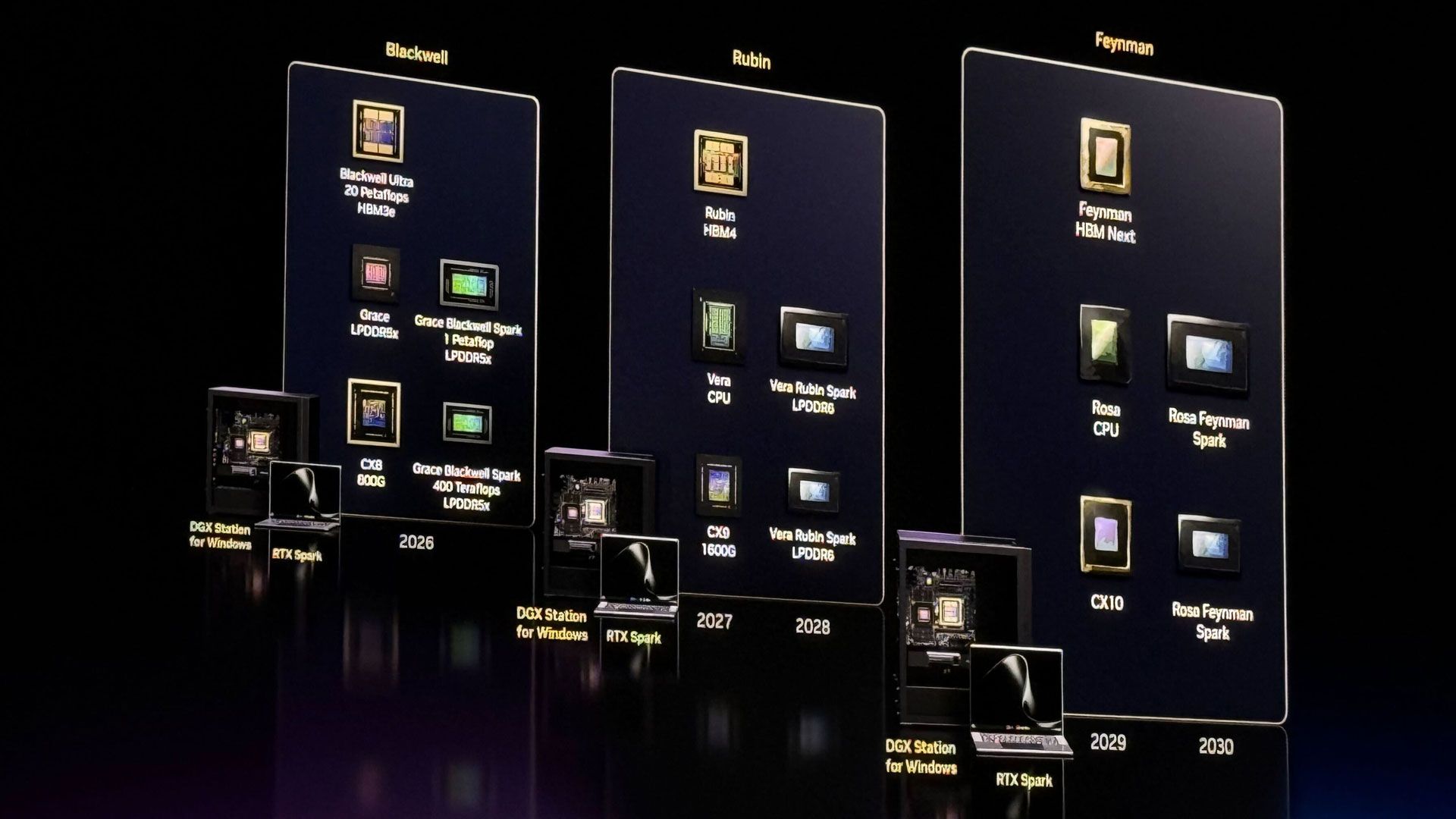
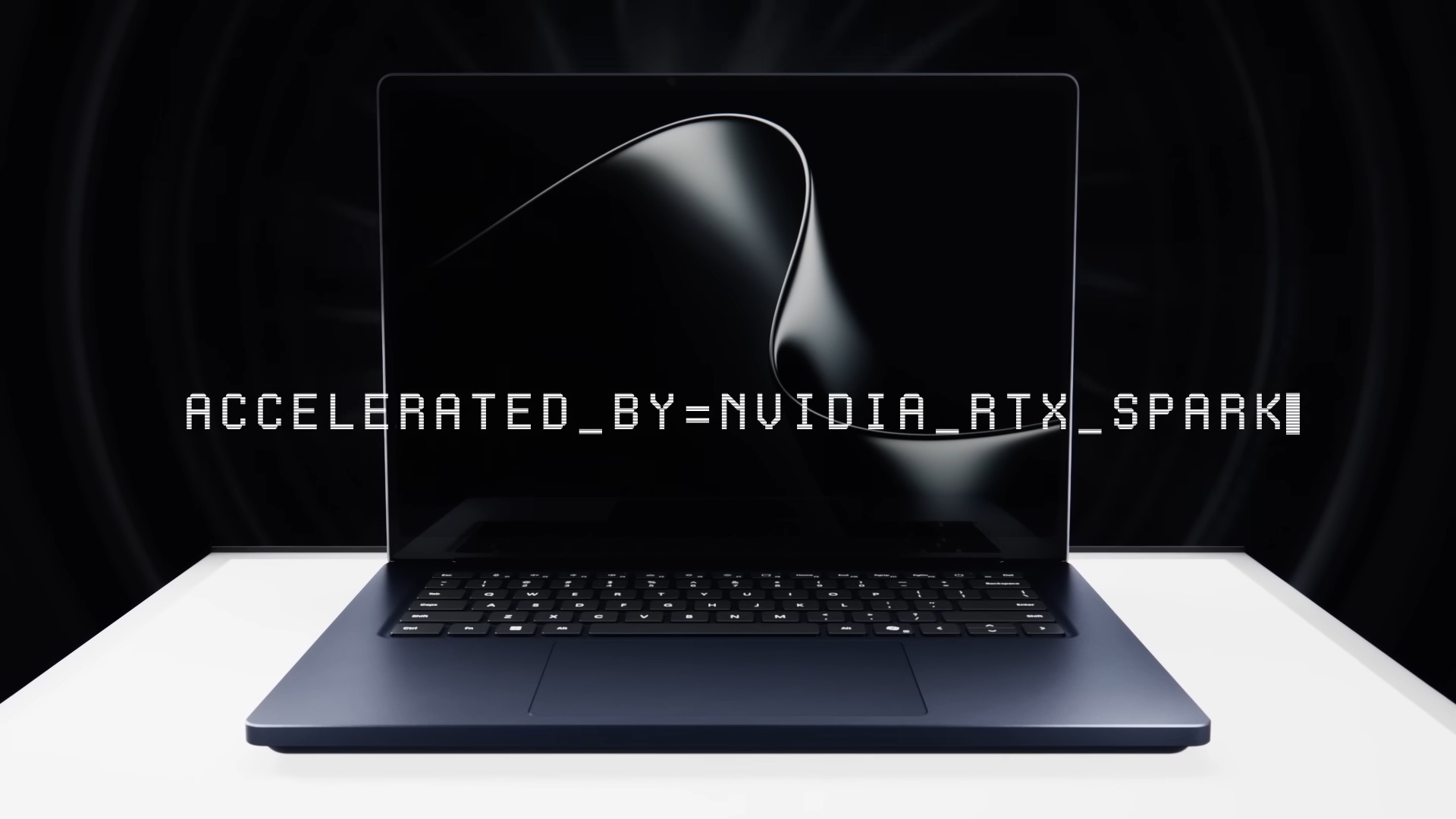
NVIDIA and Microsoft announced RTX Spark on May 31, 2026, at GTC Taipei, pitching a new class of Windows laptops and compact desktops built around a 1-petaflop NVIDIA superchip, up to 128GB of unified memory, and local AI agents arriving from major PC makers this fall. The headline sounds like another round of “AI PC” branding, but the subtext is more consequential: NVIDIA is trying to move from graphics supplier to system-platform owner inside Windows. Microsoft, meanwhile, is trying to make local AI feel less like a Copilot sidebar and more like a native operating-system capability. If the companies deliver, RTX Spark could become the first Windows AI PC platform that feels meaningfully different from a faster laptop with a sticker.

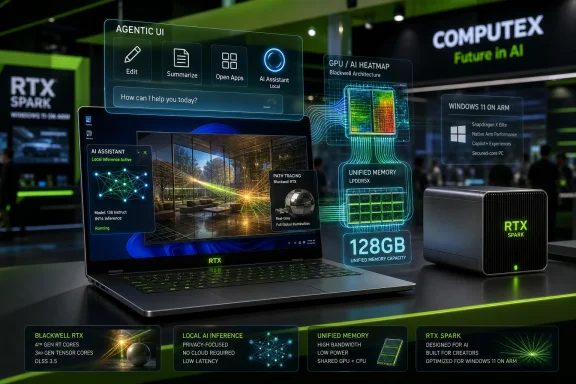
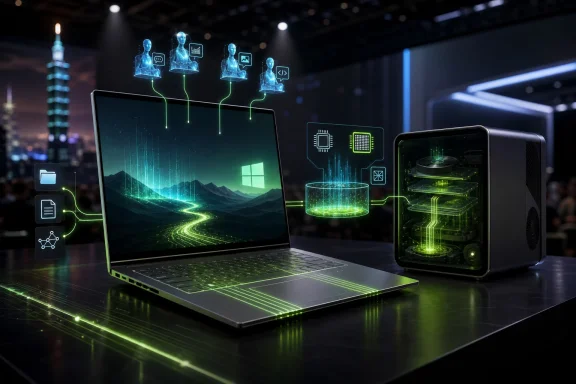
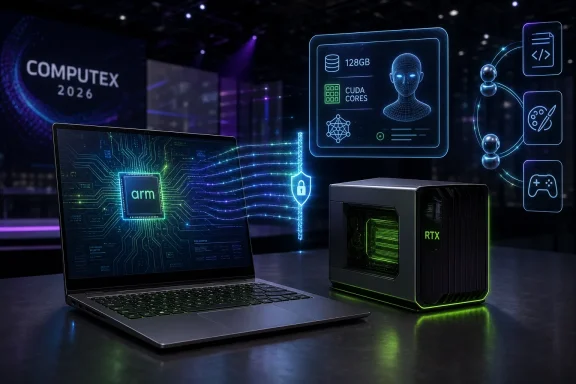
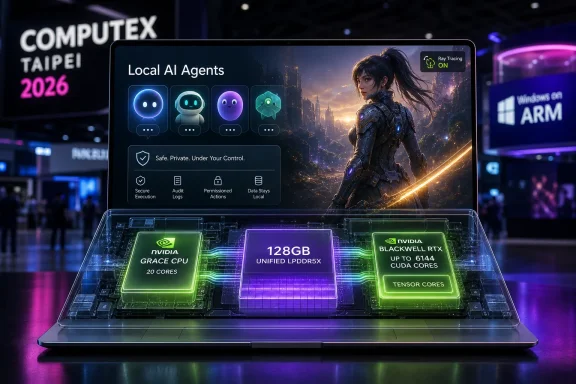
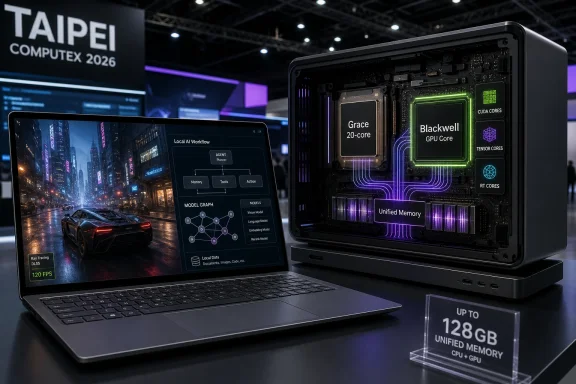
NVIDIA GTC Taipei 2026 promotional graphic showing AI hardware specs, unified 128GB memory, and RTX devices.NVIDIA Is Not Selling a Faster Laptop So Much as a New Center of Gravity​

The first wave of AI PCs was defined by the NPU, a low-power accelerator tucked beside the CPU and GPU to satisfy Microsoft’s Copilot+ requirements. That approach made sense for battery life, camera effects, local transcription, and modest model inference. It did not, however, make most Windows users feel as though the personal computer had been reinvented.
RTX Spark is a more aggressive answer. NVIDIA says the platform combines a Blackwell RTX GPU, fifth-generation Tensor Cores, FP4 support, a 20-core Grace CPU designed with MediaTek, and NVLink-C2C between the CPU and GPU. The pitch is not just “AI acceleration,” but an integrated Windows machine with the memory and compute profile to run large local models, creative pipelines, games, and agentic workflows on the same device.
That matters because NVIDIA’s advantage has never been only silicon. CUDA, TensorRT, OptiX, DLSS, Reflex, RTX Video, and the developer habits built around them are the real moat. RTX Spark tries to bring that stack into the form factor and operating system where most individual professionals still live: a Windows PC.
The announcement also reframes what counts as a premium Windows machine. For two decades, that category was largely about CPU class, discrete GPU tier, screen quality, and chassis design. NVIDIA now wants the key spec to be whether the system can host a private, capable, local agent without punting every serious request to the cloud.

Microsoft Gets a Second Chance at the AI PC Story​

Microsoft’s AI PC campaign has had a strange problem: the company has been ahead of most users’ trust and behind NVIDIA’s compute curve. Copilot+ PCs created a useful baseline for local AI hardware, but the initial narrative was swallowed by Recall controversy, unclear app value, and the awkwardness of explaining why a new class of PC was necessary for features that often looked incremental.
RTX Spark gives Microsoft a different stage. Instead of arguing that every consumer needs an NPU to summarize meetings or blur backgrounds, Microsoft can point to workloads that are easier to understand: local agents that manipulate Windows apps, semantic search across personal files, large-context coding assistants, AI video generation, and high-end creative editing. The difference is not philosophical. It is practical.
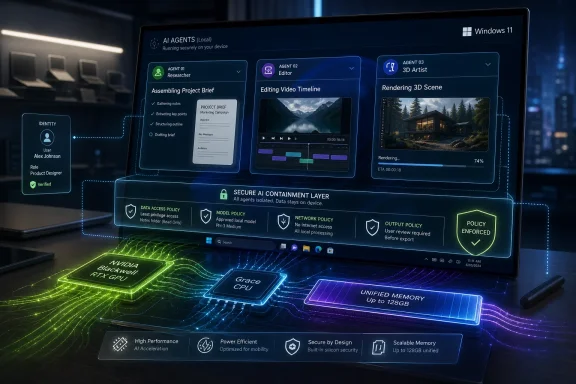
The company is also leaning into security primitives, containment, identity, and policy as part of the announcement. That is not decorative language. If an AI agent can operate across applications, read files, invoke tools, and act on behalf of a user, it becomes a new kind of software actor inside Windows. The operating system needs to know what the agent is, what it is allowed to touch, what it can send outside the machine, and how a user or administrator can stop it.
This is where Microsoft’s involvement becomes more important than the silicon itself. NVIDIA can make a monster local inference box. Microsoft has to make that box safe enough for real Windows desktops, enterprise fleets, regulated environments, and skeptical users who still remember every privacy overreach dressed up as convenience.

The Agent Is the App Model Microsoft Never Managed to Finish​

For years, Microsoft has tried to pull Windows developers toward new app models. The Windows Store, UWP, WinUI, Progressive Web Apps, widgets, and Copilot plugins all promised some version of a cleaner, more modern software surface. None displaced the old reality: Windows remains a sprawling ecosystem of Win32 apps, browser tabs, shell extensions, background services, drivers, and line-of-business tools.
Agents are attractive to Microsoft because they offer a way around that fragmentation. Instead of waiting for every application to be rewritten for a new UI paradigm, an agent can theoretically reason across existing interfaces, documents, windows, APIs, and workflows. That is the dream behind the “PC does the work” language.
But that dream is also where the risk lives. A local agent with access to files and applications is not a chatbot. It is closer to a junior operator with hands on the keyboard, memory of your work, and permission to improvise. The value proposition is enormous if the agent can reconcile a spreadsheet, file an expense report, prepare a project folder, edit a video rough cut, or automate a deployment checklist. The failure modes are equally obvious if it hallucinates, leaks data, clicks the wrong thing, or misunderstands intent.
NVIDIA’s OpenShell runtime is meant to provide an additional policy layer, including rules for what agents can do and routing decisions between local and cloud models based on privacy preferences. That is a serious acknowledgment of the problem. It is also an admission that Windows-native agents will need governance from day one, not after the first viral mishap.

Unified Memory Is the Spec That Makes the Promise Plausible​

The most interesting RTX Spark number may not be 1 petaflop. It may be 128GB of unified memory. AI performance claims are notoriously slippery because they depend on precision, model type, software stack, batching, thermals, and what vendors choose to count. Memory capacity is less glamorous, but it is often the wall that local AI runs into first.
Large language models, diffusion models, video models, and agent workflows do not merely need compute. They need room for parameters, context, embeddings, intermediate states, and application data. NVIDIA’s claim that RTX Spark can run 120-billion-parameter models with up to a 1-million-token context is a direct challenge to the idea that serious AI work has to leave the device.
For developers, this could be more meaningful than another benchmark victory. A laptop that can run substantial models locally changes iteration loops. It lets engineers test privacy-sensitive workflows without sending customer data to a hosted API. It gives researchers, students, and small teams a personal machine that looks less like a thin client for cloud AI and more like a workstation.
For IT departments, unified memory also complicates procurement. These machines will not fit neatly into old laptop categories. They may be too powerful and expensive for standard knowledge-worker fleets, but too portable and user-facing to be treated like traditional workstations. Expect RTX Spark systems to land first with developers, creators, data teams, executives, and specialized engineering groups rather than broad office deployments.

Adobe and the Creative Apps Make the Platform Real​

Hardware launches often arrive with an impressive list of partners and a thinner list of reasons to buy on day one. NVIDIA avoided some of that problem by putting Adobe near the center of the announcement. Photoshop and Premiere are not niche demos. They are daily tools for the exact customers who already buy expensive Windows laptops with NVIDIA GPUs.
Adobe’s commitment to rearchitect Photoshop and Premiere for RTX Spark is more than a logo slide if it materializes as promised. A new Premiere pipeline using unified memory, Blackwell GPU features, and TensorRT could matter for real editors working with heavy timelines and AI-assisted effects. Photoshop optimization for GPU compositing, live filters, HDR, and natural brushing similarly speaks to latency and responsiveness, not just export times.
The creative angle is important because it gives RTX Spark a reason to exist even before the agent story matures. Local agents may take years to become trustworthy and ordinary. Faster AI-assisted editing, high-resolution generative workflows, 12K video handling, and large 3D scenes are immediate pain points for professionals.
That is also why NVIDIA included gaming in the pitch. A platform that can run agents but cannot run games would feel alien to the Windows enthusiast market. A platform that can run large local models, Adobe workflows, and AAA games at 1440p with DLSS and Reflex starts to look less like an appliance and more like the next premium PC template.

Windows on Arm Is No Longer Just Qualcomm’s Argument​

RTX Spark’s Grace CPU and MediaTek involvement place the platform squarely in the Arm conversation, even if NVIDIA’s announcement focuses more on AI than instruction-set politics. That matters because Windows on Arm has spent years trying to escape the perception that it is a compatibility compromise for people who value battery life more than performance. NVIDIA’s entrance changes the tone.
If RTX Spark laptops deliver strong battery life, serious GPU performance, and Windows app compatibility good enough for professionals, they could normalize Arm in the premium Windows market faster than Qualcomm alone. Not because users suddenly care about Arm, but because they care about what the machine can do. The architecture becomes a footnote when the experience is compelling.
That is a big “if.” Windows on Arm has improved substantially, but compatibility remains a real-world concern for drivers, utilities, plug-ins, anticheat systems, enterprise agents, VPN clients, niche creative tools, and old line-of-business software. NVIDIA can bring an extraordinary GPU stack, but the Windows ecosystem is still full of sharp edges that only appear when a machine hits messy daily use.
This is where Microsoft must do the unglamorous work. Developers need clear tooling. Enterprises need deployment confidence. Users need apps that simply run. NVIDIA’s brand can get attention; Windows compatibility will determine whether RTX Spark becomes a platform or a curiosity.

Intel and AMD Are Suddenly Fighting a Different Battle​

Intel and AMD have spent the last few years adapting to the AI PC era by adding NPUs, improving integrated graphics, and refining power efficiency. That work is real and useful. But RTX Spark shifts the competitive framing from “how many TOPS does the NPU deliver?” to “can this machine run frontier-adjacent local workloads with a mature AI software stack?”
That is a more dangerous fight for the incumbents. Intel and AMD can compete in CPUs, integrated graphics, discrete GPUs, NPUs, and platform features. NVIDIA competes from the software ecosystem outward. Developers already optimize for CUDA and NVIDIA inference libraries because the cloud AI world is overwhelmingly NVIDIA-shaped. RTX Spark tries to make the local Windows endpoint resemble that world.
The incumbents still have advantages. x86 compatibility remains a powerful default. Enterprise validation, supply-chain diversity, existing management practices, and price segmentation all favor Intel and AMD in mainstream fleets. Most users do not need a 120-billion-parameter model on a laptop, and many businesses will prefer cheaper systems that handle everyday AI features efficiently.
But the high end matters because it defines aspiration. If the most exciting Windows machines become NVIDIA-led systems, Intel and AMD risk being cast as suppliers of normal PCs while NVIDIA owns the narrative around new PCs. That does not have to be fatal, but it is not a comfortable place to be.

The Fall 2026 Launch Window Leaves Plenty of Room for Reality​

The timing is ambitious. NVIDIA says RTX Spark laptops and compact desktops will be available this fall from ASUS, Dell, HP, Lenovo, Microsoft Surface, and MSI, with Acer and GIGABYTE to follow. That is a broad OEM lineup for a first-generation platform, and it signals that this is not merely a developer board in premium clothing.
Still, “available this fall” leaves unanswered questions. Pricing will shape everything. A $1,999 RTX Spark laptop is a different market event from a $4,999 mobile workstation with futuristic branding. Battery life claims will need independent testing. Thermals will matter, especially in designs as thin as 14 millimeters and as light as three pounds. So will fan noise, sustained performance, driver maturity, and how much performance survives away from the wall.
The compact desktop versions may be the sleeper category. A small Windows AI workstation with 128GB of unified memory could be more attractive to developers and labs than a thermally constrained laptop. It could also become the local inference box under a desk, serving a team or a power user without the procurement overhead of a rack system or cloud commitment.
The original Tbreak framing around a “fall 2024” chip appears out of step with the actual NVIDIA announcement, which is dated May 31, 2026 and points to fall 2026 availability. That distinction matters because AI hardware roadmaps move quickly, and a wrong year changes the competitive context entirely. RTX Spark is not a lost 2024 curiosity. It is NVIDIA’s 2026 attempt to define the next premium Windows platform.

Security Will Decide Whether Agents Stay a Demo​

The most credible part of the announcement is that NVIDIA and Microsoft are not pretending agents are only a UX problem. They are talking about identity, containment, policy, end-to-end security, local routing, personal-information masking, and user control. That is the right vocabulary for software that can act across a primary PC.
The question is whether the controls will be understandable and enforceable. Windows users already struggle with permission prompts, startup apps, browser extensions, file sync clients, and background services. If agent permissions become another noisy dialog layer, users will click through. If the controls are too restrictive, agents will be useless. If they are too permissive, attackers will treat them as a new automation surface.
Enterprises will ask harder questions. Can administrators define which agents are allowed? Can actions be logged? Can sensitive data be blocked from cloud escalation? Can an agent be prevented from touching regulated files, production credentials, password managers, source repositories, or financial systems? Can EDR tools see what the agent is doing in a meaningful way?
Microsoft’s answer has to be more than “trust the platform.” The company has spent years hardening Windows against malware that abuses scripting, macros, living-off-the-land binaries, and user tokens. Agents could accidentally recreate some of that automation risk under a friendlier name. The difference between a breakthrough and a security headache will be policy that works before the incident report is written.

The Cloud Does Not Disappear; It Gets Repriced​

Local AI is often sold as a privacy story, and that is partly true. Keeping prompts, documents, source code, creative assets, and personal context on the device reduces exposure to cloud providers and network intermediaries. It also reduces latency and avoids per-token costs that can make ambitious agent workflows expensive at scale.
But RTX Spark does not mean the cloud goes away. NVIDIA’s own positioning includes intelligent routing between local and cloud models. That hybrid model is likely where the market settles. Small, private, latency-sensitive, and repetitive tasks run locally. Larger reasoning jobs, specialized models, fleet-scale training, and collaborative workflows still use cloud infrastructure.
The change is leverage. If a developer, creator, or business can run meaningful workloads locally, cloud AI becomes a choice rather than an unavoidable meter. That could reshape software pricing as much as hardware. Vendors that charge by remote inference will need to justify why a task cannot run on the user’s own machine.
For Windows enthusiasts, this is the most appealing version of the AI PC: not a machine that forces more subscription services into the shell, but one that gives the owner more compute agency. The PC has always been most interesting when it lets users do powerful things locally. RTX Spark revives that argument with AI as the workload.

The First RTX Spark Buyers Are Really Buying an Ecosystem Bet​

Early adopters will not simply be buying a fast Windows machine. They will be buying NVIDIA’s claim that the future of personal computing belongs to local agents, large unified memory, GPU-first software stacks, and hybrid AI workflows. That is a bigger bet than buying the next GPU generation.
The upside is obvious. A successful RTX Spark machine could consolidate roles that currently require a gaming laptop, mobile workstation, cloud AI budget, and local development box. It could make Windows feel newly relevant to AI developers who have drifted toward Linux workstations or cloud notebooks. It could also give creators a portable system that handles AI-heavy media work without constant proxy workflows or remote rendering.
The downside is first-generation platform risk. New silicon, new Windows integrations, new agent security models, new OEM designs, and newly optimized applications create many places for rough edges to hide. The hardware may be ahead of the software for a while. The agents may be impressive in demos and uneven in daily use. The best creative optimizations may roll out gradually rather than all at launch.
That does not make RTX Spark vapor. It makes it a platform transition, and platform transitions are messy by nature. The question is whether NVIDIA and Microsoft can make the mess feel worth it.
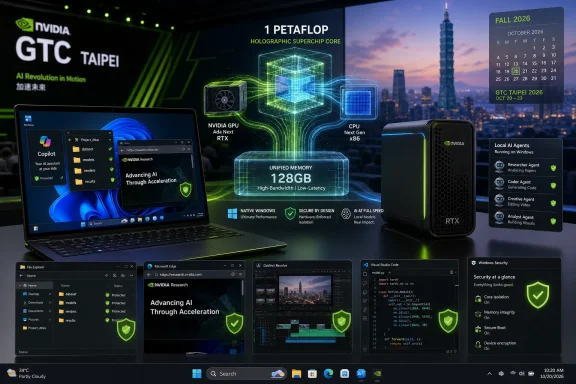
The Spec Sheet Finally Matches the AI PC Sales Pitch​

RTX Spark is the first AI PC announcement in a while where the phrase “AI PC” does not feel laughably underspecified. The platform still needs pricing, benchmarks, battery tests, app validation, and real security review, but the pieces are finally large enough to support the rhetoric.
  • RTX Spark is scheduled for fall 2026 systems from major Windows OEMs, including ASUS, Dell, HP, Lenovo, Microsoft Surface, and MSI.
  • The platform pairs a Blackwell RTX GPU with a 20-core Grace CPU, MediaTek design collaboration, NVLink-C2C, and up to 128GB of unified memory.
  • NVIDIA is positioning the machines for local agents, large language models, creative workloads, AI video, 3D rendering, and gaming rather than simple Copilot+ features.
  • Microsoft’s role is critical because agent containment, identity, policy, and Windows integration will determine whether local agents are trusted or treated as a risk.
  • Adobe’s promised Photoshop and Premiere work gives RTX Spark a practical creator-market reason to exist even before agent workflows become mainstream.
  • The platform puts new pressure on Intel, AMD, and Qualcomm by shifting the AI PC conversation from NPU checkboxes to full-stack local compute.
RTX Spark may not reinvent the PC overnight, but it exposes the weakness of the first AI PC wave: too much branding, not enough capability. NVIDIA is now offering Microsoft a more powerful story, and Microsoft is offering NVIDIA the operating-system surface it needs to make local agents feel native rather than bolted on. If fall 2026 brings machines that are fast, secure, compatible, and merely somewhat affordable, the Windows PC market will have a new high-end reference point — and everyone else will have to explain why their AI PC is more than a sticker.

References​

  1. Primary source: Tbreak Media
    Published: Mon, 01 Jun 2026 04:53:34 GMT
  2. Independent coverage: NVIDIA Newsroom
    Published: Mon, 01 Jun 2026 04:30:43 GMT
  3. Related coverage: tomshardware.com
  4. Related coverage: axios.com
  5. Related coverage: investor.nvidia.com
  6. Related coverage: blogs.nvidia.com
  1. Related coverage: nvidia.com
  2. Related coverage: globenewswire.com
  3. Related coverage: newsroom.intel.com
 

NVIDIA announced RTX Spark on June 1, 2026, at Computex as a Windows 11 Arm PC platform for laptops and mini desktops, pairing a Grace-based CPU, Blackwell RTX graphics, local AI acceleration, and up to 128GB of unified memory. The announcement is not just another AI PC branding exercise; it is NVIDIA’s most direct attempt in years to turn the Windows PC processor market into a GPU-first contest. If the company and Microsoft can make the software transition feel boring, RTX Spark could become the most serious challenge yet to the Intel-AMD-Qualcomm order. If they cannot, it risks becoming another impressive Arm PC that proves the ecosystem is still the product.

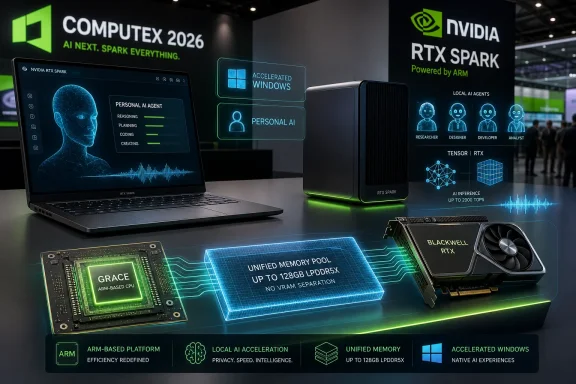
Futuristic RTX laptop display at COMPUTEX shows agentic UI, AI heatmap, and unified memory specs.NVIDIA Is Not Selling a Faster Laptop Chip. It Is Selling a New PC Contract​

The old PC bargain was simple: the processor ran Windows, Windows ran applications, and users did the steering. Even when GPUs became essential to gaming, media work, and accelerated compute, the CPU remained the anchor around which the machine was marketed and understood. RTX Spark tries to reverse that hierarchy.
NVIDIA’s pitch is that the next Windows PC should be built around local agents, local models, and local acceleration. In that telling, the computer is no longer a passive workspace that waits for clicks and keystrokes. It becomes a machine that can interpret intent, manipulate applications, generate media, search data, and coordinate tasks without constantly asking a cloud service for permission.
That is the theory, anyway. The practical version is more complicated and much more interesting. RTX Spark is a consumer-facing Windows on Arm platform derived from the GB10 Grace Blackwell silicon already associated with DGX Spark, but reshaped for notebooks and compact desktops rather than Linux-first AI development boxes.
The result is a product that lands in several markets at once. It is an Arm PC processor, an RTX gaming platform, a local AI workstation, a Copilot+ PC candidate, and a direct shot at Apple’s vertically integrated Mac strategy. That breadth is the point, but it is also the risk.

The GB10 Lineage Gives RTX Spark Credibility That Most AI PCs Lack​

The AI PC category has been drowning in vague promises. For the past two years, vendors have treated neural processing units as if the presence of a TOPS number automatically created a new computing era. Most users, meanwhile, have seen modest background effects: faster camera blur, a few local generation features, some developer demos, and marketing slides with too many sparkles.
RTX Spark starts from a stronger technical position because it is not relying on a small NPU to carry the story. The platform is described as using a heavily modified GB10-class design with a 20-core Arm CPU complex co-developed with MediaTek, a Blackwell-based integrated GPU with 48 streaming multiprocessors and 6,144 CUDA cores, fifth-generation Tensor Cores, and up to 1 petaflop of FP4 AI performance. That is not a typical laptop NPU story.
The memory story matters just as much. NVIDIA is talking about up to 128GB of unified memory and roughly 300GB/s of memory bandwidth, giving the system enough capacity to run much larger local models than today’s mainstream laptops can realistically host. The claim that systems can run up to 200-billion-parameter models locally will need careful qualification in practice, because quantization, context length, responsiveness, and thermals all matter. But the direction is unmistakable: NVIDIA wants the PC to become a local inference box, not merely a thin client for cloud AI.
That helps explain why the company is leaning on the word agentic. A small NPU can accelerate a feature. A large GPU-backed unified-memory system can potentially run the model, the tool chain, the UI automation, and the creative workload in the same local environment. The difference is not semantic. It is the difference between a laptop that can improve a video call and one that might plausibly operate as a personal workstation for AI-assisted production.

Windows on Arm Gets Its Most Powerful Evangelist Yet​

For Microsoft, RTX Spark arrives at an awkward but promising moment. Windows on Arm is no longer a science project, but it is still not culturally default. Qualcomm’s Snapdragon X systems helped make the category real for mainstream buyers, and Microsoft’s Prism translation layer improved the experience for legacy x86 applications. Still, Windows users have long memories, and the phrase “Arm Windows laptop” still carries echoes of compatibility compromises.
NVIDIA changes the conversation because it brings a developer ecosystem that Microsoft cannot replicate by itself. CUDA remains one of the most important moats in accelerated computing, and RTX is one of the few consumer technology brands that still means something concrete to PC buyers. If NVIDIA can make Windows on Arm feel like the natural home for CUDA, TensorRT, RTX video, DLSS, local models, and creative acceleration, the platform stops looking like a compatibility bet and starts looking like a performance bet.
That is why the software announcements may matter more than the silicon. NVIDIA says it is working with independent software vendors and game developers to build Arm-native versions of popular applications and optimize them for RTX Spark. Adobe’s name carries obvious weight here, especially if Photoshop and Premiere get RTX Spark-aware agentic workflows rather than simple recompiles. The same goes for developer tools, model runners, creator suites, and rendering applications.
The problem is that “working with” is doing a lot of work. Windows history is full of initiatives that depended on third-party software enthusiasm and then discovered that the long tail matters more than launch-stage logos. The first wave can be premium and curated. The second wave decides whether the machine becomes a platform.

The Agentic UI Is the Bet Microsoft Could Not Make Alone​

The most provocative part of RTX Spark is not the Blackwell GPU or the Arm CPU. It is the claim that the user interface itself is changing. NVIDIA and Microsoft are effectively arguing that future PCs will be driven less by direct manipulation and more by delegated intent: “do this,” “edit that,” “summarize these,” “turn this folder into a project,” “open Premiere and assemble a rough cut.”
This is a radical claim hiding inside a familiar laptop announcement. The graphical user interface has survived because it is visible, predictable, and inspectable. Toolbars, menus, panels, files, and windows may be inefficient, but they give users a mental model. Agentic interfaces threaten to replace that model with orchestration, and orchestration is only useful when it is trustworthy.
That is where Windows becomes both an asset and a liability. Windows has decades of application depth, automation hooks, enterprise management, file-system conventions, and productivity habits. It also has decades of permissions sprawl, legacy behaviors, background services, and software that was never designed to be driven by an autonomous assistant.
Microsoft’s challenge is not merely to let agents click buttons. It must create boundaries around what agents can see, change, remember, and transmit. If local agents are going to operate across apps, files, and workflows, the security model has to be more legible than the average Windows permission dialog. Users must know when an agent is observing, when it is acting, and how to stop it.
NVIDIA’s hardware can make the experience fast. It cannot, by itself, make the experience safe.

The Gaming Pitch Is Both Necessary and Dangerous​

NVIDIA knows the Windows PC market. A premium Windows laptop with RTX branding cannot talk only about AI agents and expect enthusiasts to care. That is why RTX Spark is being positioned as a gaming-capable platform, with a Blackwell-class integrated GPU, DirectX 12 Ultimate support, ray tracing, path tracing, Reflex, G-SYNC, and future-facing DLSS branding.
On paper, that is a far more aggressive graphics pitch than most integrated GPUs can make. A 48-SM Blackwell iGPU with unified memory support sounds closer to a compact gaming machine than a conventional productivity notebook. If OEMs can ship thin 14-inch and 16-inch systems that play modern games well at 1440p-class settings, NVIDIA will have an answer to one of the oldest objections to Arm laptops: they are efficient, but they are not serious gaming PCs.
The danger is compatibility. Native Arm games on Windows remain the exception, not the rule, and translation can only carry so much of the burden. Microsoft’s Prism layer is much better than the bad old days of Windows RT, but game compatibility is not the same as productivity compatibility. Anti-cheat systems, launchers, overlays, drivers, modding tools, shader compilers, and performance-sensitive engines all create failure points.
NVIDIA’s developer relations machine is formidable, and that matters. The company has spent decades building relationships with game studios around drivers, DLSS, Reflex, and RTX features. If any vendor can push Arm-native Windows gaming into a more serious phase, it is NVIDIA. But buyers should not confuse “supported by major developers” with “your Steam library works exactly as it does on x86.”
That distinction will shape the first reviews. RTX Spark can be a technical triumph and still disappoint a gamer who expects it to behave like a GeForce laptop with an Intel or AMD CPU. The hardware may be ready before the culture of Windows gaming is ready.

OEMs Are Being Asked to Build the Anti-Commodity PC​

The first RTX Spark systems are expected from the usual premium PC cast: ASUS, Dell, HP, Lenovo, MSI, Microsoft Surface, and others. NVIDIA’s reference notebook guidance reportedly emphasizes 14-inch and 16-inch designs, 16:10 tandem OLED displays, G-SYNC certification, HD cameras, all-day battery life, matte-glass touchpads, aluminum chassis, Wi-Fi 7, USB4, and high-end connectivity. In desktop form, the idea is a small AI-capable PC closer in spirit to DGX Spark than to a beige box.
That is a very deliberate kind of PC. NVIDIA is not trying to win the $499 laptop aisle on day one. It is trying to define a premium category where the chip, chassis, display, memory, software stack, and AI story are all part of the same controlled experience. In other words, it is borrowing from Apple without admitting that the Windows OEM ecosystem has spent years fighting the very standardization that makes Apple’s model work.
The OEMs may welcome the discipline. The Windows laptop market has often struggled to communicate why one premium model is meaningfully different from another beyond screen, weight, and processor generation. RTX Spark gives vendors a sharper story: this is the local AI machine; this is the Windows laptop that runs CUDA; this is the Arm PC that can game; this is the Surface or XPS or Yoga that is not just another Intel refresh.
But standardization also narrows freedom. If NVIDIA’s platform requirements are strict, OEM differentiation shifts to industrial design, thermals, display tuning, keyboard quality, battery size, and price. That may be good for buyers, but it also means the weakest first-generation systems will be exposed quickly. A hot, loud, expensive RTX Spark laptop would damage the whole category.

Apple Is the Obvious Target, but AMD May Be the Immediate Problem​

The Mac comparison is unavoidable. Apple Silicon taught the industry that unified memory, high-performance Arm cores, strong media engines, and tight software integration could reset expectations for laptops. NVIDIA is now trying to bring a similar vertically integrated logic to Windows, but with a much stronger GPU and AI software stack as the differentiator.
Against Apple, RTX Spark’s strongest argument is local AI and GPU compute. CUDA remains a default language of serious AI experimentation, and NVIDIA’s Tensor Core ecosystem is better understood by developers than anything Apple offers on the Mac. A Windows laptop with large unified memory and native NVIDIA AI tooling could be compelling for students, researchers, creators, and developers who want local experimentation without moving fully into Linux or buying a workstation.
Apple’s counterargument is consistency. Macs do not need to solve Windows on Arm compatibility, legacy x86 translation for decades of software, OEM variance, or the messy politics of PC drivers. Apple controls the operating system, the silicon, the frameworks, the store, the hardware design, and the user experience. NVIDIA and Microsoft can match pieces of that model, but not the whole chain.
AMD may be the more practical near-term comparison. Ryzen AI Max systems already point toward a world where large integrated graphics, wide memory, and strong x86 CPU performance make compact workstations viable. AMD does not have CUDA, but it has native x86 compatibility, increasingly credible integrated graphics, and a familiar Windows path. For many users, “it runs everything I already own” remains a devastating feature.
Intel, meanwhile, faces a different problem. Panther Lake and future Core Ultra parts may be competitive in mainstream AI PC terms, but RTX Spark reframes the fight around the high end of local AI and graphics. Intel can still win volume, enterprise trust, and platform stability. It will have a harder time making a 2026 premium laptop feel more futuristic than NVIDIA’s most ambitious Windows play.

The Real Product Is the Software Stack​

NVIDIA rarely enters a market with only hardware. It enters with libraries, frameworks, developer programs, certification logos, performance claims, and enough software gravity to make competitors argue on its terms. RTX Spark is no different.
The stack matters because the raw silicon is only half the promise. CUDA, TensorRT, NVFP4 support, RTX acceleration, DLSS, Reflex, G-SYNC, Studio tools, and local model tooling all create a reason for developers to target the platform. That is especially important in Windows on Arm, where native software momentum needs every incentive it can get.
For creators, the best-case scenario is powerful and simple. A Premiere or Photoshop workflow could use local models for tedious edits, object isolation, timeline assembly, color matching, generative fill, transcription, and batch processing while keeping sensitive assets on the device. A Blender or rendering workflow could lean on RTX features without requiring a discrete GPU. A developer could run coding agents, local inference, containers, and accelerated testing on a laptop without immediately reaching for cloud credits.
The catch is that the stack can become a moat and a maze. NVIDIA’s software ecosystem is powerful because it is integrated, but that integration can make the platform feel proprietary even when it runs on Windows. If the most compelling agentic Windows experiences are meaningfully better on RTX Spark than on Qualcomm, AMD, or Intel systems, Microsoft will face an uncomfortable platform question. Is Windows becoming more capable for everyone, or is the best version of the next Windows experience tied to a single silicon vendor?
That tension has haunted the PC industry before. Vendor-specific acceleration can move the market forward, but it can also fragment development. The best outcome is that RTX Spark forces Windows software to modernize for local AI while Microsoft keeps the underlying agent frameworks broadly portable. The worst outcome is an AI PC market where every vendor has demos, and users have confusion.

Enterprise IT Will See the Promise and the Blast Radius​

For IT departments, RTX Spark is both tempting and alarming. A Windows laptop that can run meaningful local AI workloads could reduce cloud dependence, improve latency, preserve data locality, and give power users new capabilities without provisioning separate workstations. For regulated industries, local inference sounds especially attractive.
But agentic computing changes the risk model. Traditional endpoint management assumes applications act when users act. Agents blur that line. If a local model can read files, invoke tools, automate apps, and generate outputs across a user’s workspace, administrators need precise controls over identity, logging, data access, retention, and policy enforcement.
The security questions are not abstract. Can an agent access a confidential spreadsheet because the user can? Can it summarize a document into a less protected location? Can it call a plug-in that transmits data externally? Can it be tricked by malicious content embedded in an email, web page, PDF, or project file? Can administrators audit not just what the user did, but what the agent did on the user’s behalf?
Windows has the enterprise management foundation to answer some of these questions. Microsoft can integrate policy controls through Entra ID, Intune, Defender, Purview, and existing Windows security primitives. But “agentic Windows” raises expectations faster than management consoles can mature. Enterprises will not deploy this broadly because a keynote says it is safe. They will deploy it when they can constrain it, monitor it, and explain it to auditors.
This is where NVIDIA’s consumer and enterprise stories collide. DGX Spark can be sold to developers who understand the risks of local AI systems. RTX Spark is aimed at mainstream Windows PCs, where the user may simply expect the assistant to “do the thing.” That gap between capability and governance will define adoption outside enthusiast and creator circles.

Pricing Will Decide Whether RTX Spark Is a Platform or a Halo​

NVIDIA has not yet turned RTX Spark into a clean price ladder in public. That omission is not surprising, but it is important. The difference between a fascinating premium experiment and a serious Windows platform will be measured in SKUs, memory configurations, and whether buyers can get meaningful systems below workstation pricing.
The 128GB machines will attract attention because they make the AI story real. They will also be expensive. Unified memory at that capacity, premium OLED panels, high-end chassis, and first-generation platform costs do not point toward bargain laptops. If the first wave lives entirely in luxury territory, RTX Spark will influence the market without transforming it.
The more interesting question is what happens at 16GB, 32GB, and 64GB. A 16GB RTX Spark laptop may carry the brand but struggle to deliver the local-model magic NVIDIA is advertising. A 32GB or 64GB machine could be the practical sweet spot for creators and developers. A 128GB model becomes a portable AI workstation, but only if thermals and sustained performance cooperate.
NVIDIA also has to avoid confusing buyers with too many partially enabled versions of the chip. The company reportedly plans multiple processor models with different CPU and GPU configurations. That is normal in the PC market, but RTX Spark’s promise depends heavily on memory capacity, GPU resources, NPU compliance, and software certification. If the branding stretches too far downmarket, the name could mean everything and nothing by the second generation.

The First Reviews Need to Measure the Right Things​

RTX Spark will not be fairly judged by a single benchmark. Traditional CPU tests will matter, but they will not explain the platform. Gaming benchmarks will matter, but they will be distorted by native versus translated execution. AI throughput numbers will matter, but they can be gamed through precision choices and model selection. Battery life will matter, but only if measured under the kinds of mixed workloads the product is supposed to enable.
The most useful reviews will test workflows, not just components. Can a creator edit, generate, transcode, and export without falling off a thermal cliff? Can a developer run local models and coding tools while keeping the system responsive? Can games launch reliably, avoid anti-cheat problems, and deliver stable frame pacing? Can x86 applications under Prism feel ordinary enough that users stop thinking about architecture?
Reviewers should also test idle behavior, memory pressure, external display support, driver maturity, sleep and resume, peripheral compatibility, and Windows update reliability. Those are not glamorous. They are exactly the things that decide whether a first-generation platform becomes someone’s daily machine.
The AI agent demos deserve even more skepticism. A staged workflow that edits a photo or assembles a video is useful as a direction-of-travel signal, not proof of a new interface paradigm. The real test is whether agents can handle messy files, ambiguous instructions, conflicting app states, missing fonts, broken plug-ins, and the thousand small failures that define actual PC work.
If RTX Spark makes those failures less common, it will deserve the hype. If it merely fails faster and with better lighting, the market will notice.

The Windows PC Just Got a New Center of Gravity​

The concrete implications of RTX Spark are easier to state than the grand promises. NVIDIA has given Windows on Arm a flagship silicon story, Microsoft has gained a hardware partner that can make local AI feel serious, and OEMs now have a premium PC category that is not just another CPU refresh. The unresolved question is whether users get a better computer or a more elaborate demo platform.
  • RTX Spark is NVIDIA’s most direct consumer Windows processor play, built around Arm CPU cores, Blackwell graphics, and local AI acceleration rather than a conventional CPU-first PC design.
  • The platform’s strongest technical argument is unified memory paired with RTX-class AI and graphics hardware, especially in configurations that reach 64GB or 128GB.
  • Windows on Arm compatibility remains the largest practical risk, particularly for games, professional plug-ins, drivers, anti-cheat systems, and obscure legacy applications.
  • Microsoft’s agentic Windows ambitions will succeed only if permissions, auditing, and user control become as central to the experience as model performance.
  • First-generation pricing and OEM execution will determine whether RTX Spark becomes a real platform or a premium halo that mostly pressures competitors.
  • The most important benchmarks will be workflow reliability, sustained performance, battery life, native software availability, and whether translated apps feel invisible in daily use.
NVIDIA has spent years making the GPU the most important component in the data center; RTX Spark is the company’s attempt to make the same argument inside the Windows PC. The move is bold because it attacks several settled assumptions at once: that x86 compatibility is the safest default, that AI PCs are defined by NPUs, that Windows on Arm is a secondary tier, and that local agents are still a future problem. The first RTX Spark machines may not settle those arguments, but they will force the PC industry to have them in public — and that alone makes this more than another Computex chip announcement.

References​

  1. Primary source: TechPowerUp
    Published: Mon, 01 Jun 2026 05:30:44 GMT
  2. Related coverage: tomshardware.com
  3. Related coverage: nvidianews.nvidia.com
  4. Related coverage: techspot.com
  5. Related coverage: nvidia.com
  6. Official source: blogs.windows.com
  1. Related coverage: forbes.com
  2. Related coverage: pcgameshardware.de
  3. Related coverage: notebookcheck.net
  4. Related coverage: marketplace.nvidia.com
 

NVIDIA unveiled RTX Spark on June 1, 2026, at GTC Taipei, positioning the Grace-Blackwell superchip as the engine for a new class of premium Windows laptops and compact desktops arriving this fall from Microsoft Surface, Dell, HP, Lenovo, ASUS, and MSI. The pitch is not merely that Windows PCs are getting faster. It is that the center of gravity in personal computing is shifting from launching apps to delegating work to local AI agents. If NVIDIA is right, RTX Spark is less a laptop chip than a bid to make CUDA-native, GPU-rich Windows machines the default workstation for the AI era.

Futuristic tech setup with glowing green circuit graphics on a laptop and gaming PC in a server arena.NVIDIA Wants the PC to Stop Acting Like a Thin Client​

For most of the last two years, the AI PC has been sold with a strangely modest promise. A neural processing unit would make video calls cleaner, Windows features more responsive, and a handful of generative tools less dependent on the cloud. That was useful, but it was not transformational. It made the PC a better endpoint, not a fundamentally different machine.
RTX Spark is NVIDIA’s attempt to move the argument up a tier. Instead of talking about TOPS as a marketing checkbox, NVIDIA is talking about local agents, large models, CUDA workflows, generative media, 3D rendering, and gaming on the same machine. The company is not pretending the NPU is the hero. It is saying, with typical NVIDIA subtlety, that the GPU still owns the future.
That matters because the Windows PC industry has been searching for a coherent answer to Apple Silicon and Qualcomm’s Snapdragon X push. Apple proved that integrated memory, custom silicon, and tight hardware-software coordination could make laptops feel both fast and efficient. Qualcomm tried to bring that same Arm-native logic to Windows, with mixed but meaningful results. NVIDIA is now entering the fight from a different angle: not just battery life, but workstation-class AI capability in a thin machine.
The result is a very NVIDIA kind of PC reboot. RTX Spark is not primarily about Office, browser tabs, and standby time. It is about making the laptop credible again for the workloads that usually force professionals back to a tower, a cloud instance, or a remote workstation.

The Spec Sheet Is Really a Manifesto​

On paper, RTX Spark combines a 20-core Grace CPU with a Blackwell RTX GPU offering up to 6,144 CUDA cores, fifth-generation Tensor Cores, FP4 support, and up to 128GB of unified memory. NVIDIA says the platform can reach up to 1 petaflop of FP4 AI performance. Those numbers will need independent testing, but the architecture tells us what NVIDIA is trying to do.
The most important number may be the memory capacity. A laptop-class system with up to 128GB of unified memory changes the practical ceiling for local AI and creative work. For developers experimenting with large language models, creators working in high-resolution media pipelines, and 3D artists dealing with huge scenes, memory is often the wall long before raw compute becomes the wall.
Unified memory also changes the conversation around what “GPU memory” means in a mobile system. Traditional Windows laptops split system RAM and VRAM, and that split can become painful when models or scenes grow. RTX Spark’s unified pool lets CPU and GPU access a much larger shared memory space, at least in theory reducing the friction that comes from shuttling large workloads between separate islands of memory.
There are caveats. Unified memory is not magic, and bandwidth, thermals, driver maturity, app optimization, and real-world power limits will decide whether the promised experience materializes. But the direction is unmistakable. NVIDIA is building a laptop platform for the kind of users who already know why memory topology matters.

Surface Laptop Ultra Gives Microsoft a New Flagship Story​

Microsoft’s role is especially important because Surface has often been less about volume than signaling. When Microsoft builds a Surface device around a new platform, it is telling OEMs and developers what kind of Windows machine it wants the market to imagine. Surface Laptop Ultra, optimized for RTX Spark, is that signal.
Microsoft describes the device as its most powerful Surface Laptop to date, with a Blackwell RTX GPU, up to 128GB of unified memory, full CUDA support, and the ability to run very large local models. That is a notable shift for a brand that has historically leaned into thinness, premium materials, touch, pen support, and Windows integration rather than workstation bravado.
The port selection is also revealing. HDMI, USB-C, USB-A, SD card, and a headphone jack are not glamorous, but they suggest Microsoft understands the audience it is courting. Creators, photographers, video editors, and developers do not want a dongle sermon. They want the ports they use.
The Surface Laptop Ultra is therefore more than a Microsoft-branded RTX Spark machine. It is a tacit admission that the highest end of Windows laptop computing has been underdefined. Surface Pro owns the detachable story. Surface Laptop owns the elegant mainstream story. Surface Laptop Ultra appears designed to own the “local AI workstation you can carry” story.

Dell, Lenovo, HP, ASUS, and MSI Turn a Chip Into a Category​

A chip launch becomes a platform only when OEMs start building around it, and NVIDIA has lined up the right names for the first wave. Dell’s XPS 16 Creator Edition is perhaps the cleanest expression of the target market. XPS has long carried the burden of being Dell’s premium Windows showcase, but the Creator Edition label makes the workload explicit: 4K timelines, exports, compositing, local AI assistance, and serious multitasking.
Dell’s emphasis on Tandem OLED, True Black HDR 600, HDMI, and an SD card reader is not incidental. It points to a class of buyer that cares as much about workflow completeness as benchmark charts. A fast chip in a machine with bad thermals, poor color, or missing ports is still a compromised tool.
Lenovo’s Yoga Pro 9n takes the familiar creator-laptop formula and pushes it into the AI workstation lane. HP is splitting its bet between the OmniBook Ultra 16 and the smaller OmniBook X 14, suggesting RTX Spark will not be confined to one chassis size. ASUS is bringing ProArt models, which makes sense given that ProArt is already aimed squarely at creators and visual professionals. MSI’s Prestige N16 Flip AI+ adds the 2-in-1 angle, with a 16-inch UHD+ Tandem OLED display and a 99.9Wh battery.
That diversity matters. If RTX Spark arrived only in one thick creator brick, the story would be familiar. Instead, NVIDIA and its partners are trying to normalize the idea that a serious AI-capable GPU platform can fit into premium Windows laptops that still look like laptops rather than portable lab equipment.

The Windows-on-Arm Question Comes Back With CUDA Attached​

RTX Spark also reopens the Windows-on-Arm debate, but with a twist. Qualcomm’s Snapdragon X machines argued that Arm could finally give Windows the battery life and standby behavior that users expect from modern laptops. The challenge was compatibility, especially for legacy x86 applications, drivers, and niche professional tools.
NVIDIA’s angle is different because CUDA changes the software incentives. Developers and AI researchers already live in NVIDIA’s ecosystem. If RTX Spark gives them a portable Windows machine that runs CUDA natively, the compatibility story is no longer only about whether old Windows software behaves. It is also about whether the new AI software stack has a better reason to care.
That does not erase the risk. Windows on Arm still lives or dies by app availability, driver support, emulation quality, and professional software certification. Creative professionals are famously unforgiving when a plug-in, capture device, color tool, or hardware peripheral breaks. Sysadmins will be equally cautious about managing a new architecture at scale.
But NVIDIA has a weapon that Qualcomm lacks: the gravitational pull of GPU-accelerated development. If the people building AI tools want CUDA on a local laptop, and if major creative apps optimize around RTX Spark, the Windows-on-Arm argument becomes less defensive. It stops being “Can this run my old stuff?” and becomes “Can this run the new stuff better?”

Local AI Is the Privacy Argument and the Performance Argument​

NVIDIA and Microsoft are both leaning into the idea of local agents. That framing is not accidental. Cloud AI is powerful, but it is also expensive, latency-sensitive, privacy-sensitive, and dependent on connectivity. A local agent running on the user’s own machine offers a cleaner story for sensitive work, regulated data, and personal context.
For WindowsForum readers, the security angle deserves more than marketing applause. Local execution can reduce exposure to cloud services, but it also moves more sensitive computation onto endpoints. That means endpoint protection, identity boundaries, model permissions, agent sandboxing, and data governance become more important, not less. An AI agent with access to local files, email, source code, credentials, and browser sessions is powerful precisely because it is dangerous if mismanaged.
The enterprise version of this debate will be brutal. IT departments will want policy controls, auditability, patch cadence visibility, model management, and clear boundaries around what agents can read and do. The consumer version may be messier, because home users will likely adopt agent features before they understand the threat model.
Still, the local AI argument is real. If RTX Spark can run capable models and workflows without round-tripping everything to a cloud API, it gives Windows a stronger answer to the growing discomfort around always-online AI. The machine becomes not just a client for someone else’s intelligence, but a private compute environment for your own.

Apple Silicon Finally Gets a Windows Counterpunch With Teeth​

For years, Apple’s advantage has been coherence. The company controls the silicon, OS, frameworks, memory architecture, app distribution incentives, and flagship hardware. Windows OEMs, by contrast, have had to assemble greatness from a parts bin shaped by Intel, AMD, NVIDIA, Microsoft, and their own industrial design teams.
RTX Spark does not make Windows magically Apple-like. The ecosystem remains broader, messier, and harder to optimize. But it gives Windows PC makers a story Apple cannot easily copy: full NVIDIA RTX, CUDA, DLSS, broad PC gaming support, and the existing AI developer stack in a premium laptop.
That is the strategic point. Apple’s unified memory and efficient SoCs are formidable, especially for media workflows and battery life. But NVIDIA owns the dominant software platform for accelerated AI development. A Windows laptop with a Grace CPU, Blackwell RTX GPU, large unified memory, and CUDA support is aimed directly at the users who find Macs attractive but cannot leave NVIDIA’s ecosystem.
This is also a challenge to Intel and AMD, though not necessarily an existential one. Intel and AMD will continue to dominate large portions of the PC market, and both are investing heavily in NPUs, GPUs, and AI acceleration. But RTX Spark gives OEMs another premium silicon story, and premium stories tend to pull the market’s imagination even before they pull its volume.

The Premium First Wave Leaves the Mainstream Waiting​

The first RTX Spark systems will sit at the high end. That is obvious from the brands, displays, memory ceiling, chassis language, and target workloads. Surface Laptop Ultra, XPS 16 Creator Edition, ProArt, Yoga Pro, OmniBook Ultra, and MSI Prestige are not budget devices.
That premium positioning is both sensible and limiting. It is sensible because early platforms need margin, and the buyers who can justify local AI compute are likely to be creators, developers, researchers, and professionals. It is limiting because the AI PC narrative will not transform everyday computing until it reaches mainstream price points.
NVIDIA says RTX Spark will eventually expand into a broader family, including lower-memory configurations starting at 16GB. That will be the real test of the platform’s elasticity. A 128GB flagship can be exciting; a 16GB mainstream laptop has to prove it is not just another AI sticker on the palm rest.
Pricing remains the great unknown. If RTX Spark laptops land deep into workstation territory, they will be judged against mobile workstations, MacBook Pro configurations, cloud GPU costs, and desktop rigs. If they come in closer to premium creator laptops, they could force a much wider reassessment of what a high-end Windows machine should include.

Reviewers Will Decide Whether the Battery-Life Claim Survives Contact With Reality​

NVIDIA and its partners are promising slim laptops, all-day battery life, and sustained AI performance. That is the holy trinity, and it is also where laptop marketing most often goes to die. The hard question is not whether RTX Spark can post impressive numbers plugged into the wall. The hard question is how it behaves on battery, under sustained load, inside a thin chassis.
Thermals will be decisive. A 16-inch creator laptop has more room to breathe than a 14-inch compact machine, but all of these devices are trying to square difficult physics. If performance collapses after a few minutes, if fan noise becomes intrusive, or if battery life evaporates during real AI workloads, the platform will still be useful but not revolutionary.
The other review battlefield is software maturity. CUDA support is a major advantage, but Windows-on-Arm compatibility, driver polish, creative app optimizations, game behavior, plug-in support, and peripheral reliability will all matter. A machine can be architecturally exciting and still frustrating in daily professional use.
That is why the fall 2026 launch window is important. NVIDIA and the OEMs have time to tune, but expectations are now set. The first reviews will not merely test laptops; they will test whether the AI PC category has finally grown out of its demo phase.

The Practical Stakes Are Bigger Than Another Premium Laptop Launch​

For sysadmins, RTX Spark raises procurement and management questions. A fleet that mixes x86 Windows machines, Snapdragon systems, and NVIDIA Arm-based RTX Spark devices could complicate imaging, driver management, application validation, and support. The upside is that some workflows currently pushed to cloud GPU environments might become local again.
For developers, the appeal is obvious. A laptop that can prototype, fine-tune, or run serious local inference with CUDA support could shorten iteration loops. It will not replace large training clusters, but it could reduce dependency on remote resources for a meaningful class of work.
For creators, the promise is portability without surrendering the GPU-accelerated pipeline. Video editing, 3D rendering, generative imaging, and AI-assisted compositing are exactly the kinds of workflows that benefit from both memory and acceleration. The catch is that creators tend to rely on entire ecosystems of tools, codecs, devices, and plug-ins, so platform readiness will matter as much as silicon speed.
For gamers, RTX Spark is more complicated. NVIDIA is promising RTX technologies, DLSS, Reflex, G-SYNC, and AAA gaming performance targets. But gamers will want to know how the GPU compares with discrete GeForce laptop parts, how thermals behave, and whether Arm compatibility introduces edge-case weirdness. The gaming story is credible, but it is not automatically the headline.

The First Spark Machines Tell Us Where Windows Is Heading​

The initial RTX Spark lineup is best understood as a map of NVIDIA’s ambitions rather than a normal product roster. It shows which parts of the Windows market NVIDIA thinks are ready for a new class of machine and which buyers it believes will pay first.
  • Microsoft Surface Laptop Ultra makes RTX Spark a Windows platform story, not merely an OEM experiment.
  • Dell XPS 16 Creator Edition points the chip directly at creators who need GPU acceleration, color accuracy, and practical ports in one premium machine.
  • Lenovo, HP, ASUS, and MSI give the launch enough breadth to look like a category rather than a single halo device.
  • The 128GB unified-memory ceiling is the feature most likely to separate RTX Spark from ordinary AI PC marketing.
  • The fall 2026 launch window gives NVIDIA and its partners a clear target, but real credibility will depend on independent tests of battery life, thermals, compatibility, and sustained performance.
  • The platform’s long-term success will depend on whether NVIDIA can scale RTX Spark beyond expensive flagships without diluting the reason it exists.
RTX Spark is the most coherent Windows AI PC pitch yet because it does not pretend that a small NPU and a few OS tricks are enough to reinvent the personal computer. It puts the GPU, unified memory, local models, and professional workflows back at the center of the machine. If the first laptops deliver, Windows will have something it has lacked in the Apple Silicon era: a premium hardware story that is not merely defensive, but genuinely different.

References​

  1. Primary source: NewsX
    Published: 2026-06-01T09:52:07.033141
  2. Related coverage: axios.com
  3. Related coverage: nvidia.com
  4. Related coverage: dell.com
  5. Related coverage: investor.nvidia.com
  6. Related coverage: gizmochina.com
  1. Related coverage: nvidia.cn
  2. Related coverage: techspot.com
  3. Related coverage: tomshardware.com
  4. Related coverage: moneycontrol.com
  5. Official source: blogs.windows.com
  6. Related coverage: toolhalla.ai
  7. Related coverage: tweakers.net
  8. Related coverage: images.nvidia.com
  9. Related coverage: techradar.com
  10. Related coverage: elpais.com
  11. Related coverage: docs.nvidia.com
  12. Related coverage: tdsynnex.com
 

NVIDIA unveiled RTX Spark at Computex 2026 as an Arm-based, AI-focused Windows PC platform scheduled for fall 2026 systems from Microsoft Surface, Dell, HP, ASUS, Lenovo, MSI, and later Acer and GIGABYTE, pairing NVIDIA graphics technology with unified memory and local AI acceleration. The short version is that NVIDIA is no longer content to be the GPU vendor inside somebody else’s PC story. It wants to define the next premium Windows machine around local AI agents, CUDA software, and a hardware model closer to Apple Silicon than the old CPU-plus-discrete-GPU playbook. For Windows users, this is both exciting and familiar: the future is being announced again, and the hard part will be making it feel better than the PC they already own.

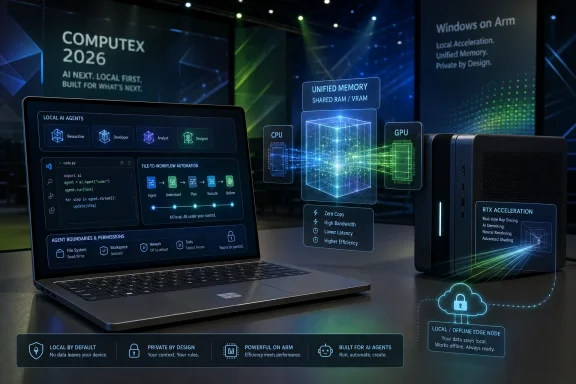
Futuristic COMPUTEX 2026 display shows local AI agents, unified memory, CPU/GPU links, and offline edge node.NVIDIA Is Turning the AI PC From a Sticker Into a Platform​

The “AI PC” label has been wandering around the industry for two years, usually attached to laptops with neural processing units, Copilot keys, and benchmark claims that sounded more meaningful to procurement teams than to actual users. RTX Spark is NVIDIA’s attempt to end that vagueness by giving the category a heavyweight silicon anchor. Instead of treating AI as a small efficiency block beside a conventional PC processor, NVIDIA is putting the GPU, memory system, software stack, and developer pitch at the center.
That matters because NVIDIA has a credibility advantage most PC vendors do not. It already owns the developer mindshare for AI training and inference through CUDA, TensorRT, RTX acceleration, and its data-center dominance. When NVIDIA says a Windows PC should run local agents, creators’ models, coding assistants, image workflows, and game-enhancement tools, it is not inventing a software ecosystem from scratch.
But credibility is not the same thing as product-market fit. The consumer PC market has a long history of absorbing powerful new chips and turning them into confusing product tiers, thermal compromises, and battery-life footnotes. RTX Spark will only become more than a keynote phrase if buyers can see the difference in everyday Windows work.
NVIDIA’s bet is that local AI becomes the next obvious reason to buy a premium PC. Not “AI” as a cloud chatbot in a sidebar, but AI that can work with files, projects, code, media, and games on the machine itself. That is a far more ambitious proposition than faster autocomplete, and it is also much harder to deliver safely.

Microsoft Gets the Partner It Needed for a More Serious Windows on Arm Push​

The Microsoft angle is as important as the NVIDIA one. Windows on Arm has improved substantially, but its reputation is still shaped by years of compromises: app compatibility worries, performance caveats, unclear device positioning, and the sense that users were being asked to join an experiment. Qualcomm’s Snapdragon X machines helped move the conversation forward, especially around battery life, but they did not erase the broader question of whether Arm Windows could become a first-class performance platform.
RTX Spark changes the tone. NVIDIA brings gaming credibility, creator credibility, and developer credibility to a space where Windows on Arm has often felt too dependent on battery-life arguments. If Microsoft Surface ships a flagship RTX Spark machine, it is not just another Arm laptop. It is Microsoft placing Windows on Arm into the premium workstation-adjacent conversation.
That does not solve compatibility by magic. Windows users still care about drivers, plug-ins, anti-cheat systems, legacy utilities, virtualization, enterprise agents, VPN clients, and all the awkward software that never appears in launch demos. NVIDIA’s participation raises expectations because it implies that the platform should not merely be acceptable; it should be excellent.
Microsoft also gets something subtler from this partnership: a way to move beyond Copilot branding fatigue. Copilot has become a catch-all for Microsoft’s AI ambitions, but Windows still needs hardware that can make AI features feel immediate, private, and persistent. RTX Spark gives Microsoft a story in which Windows is not just calling Azure for intelligence. It is becoming an operating system that can host agents locally and escalate to the cloud when needed.

The Unified Memory Pitch Is the Real Technical Tell​

The most interesting RTX Spark detail is not the headline petaflop number. It is the promise of up to 128GB of unified memory in Windows PCs aimed at AI, creation, and gaming. That one specification says more about NVIDIA’s intentions than almost any marketing phrase.
Traditional Windows performance machines usually divide the world into system RAM and GPU VRAM. That model works well for many workloads, but it becomes painful when large AI models, media projects, and GPU-accelerated workflows have to fit inside separate memory pools. Unified memory offers a cleaner model: the CPU and GPU can work from a shared pool, reducing the old dance of copying, fitting, and compromising.
Apple used that idea to reshape expectations around Mac performance per watt. NVIDIA is now trying to bring a version of that logic to Windows, but with CUDA and RTX as the software crown jewels. If it works, creators and developers could get a machine that behaves less like a conventional laptop with a GPU bolted on and more like a compact AI workstation.
The phrase “up to 128GB” deserves caution, though. That likely means the most expensive configurations will carry the full memory load, while mainstream models may look less revolutionary. Windows OEMs have a habit of launching an impressive reference spec and then shipping cheaper retail versions with just enough RAM and storage to disappoint power users three years later.
For local AI, memory capacity is not a luxury. It determines what models can run, how much context they can handle, and whether a workflow is smooth or constantly swapping, quantizing, or falling back to the cloud. If RTX Spark systems arrive with premium pricing and stingy base configurations, the promise will narrow quickly.

The “Personal Agent” Needs More Than a Faster Chip​

NVIDIA and Microsoft are leaning into the idea of personal AI agents: software that can perform tasks across apps, files, browsers, media tools, and developer environments. This is the right ambition, because the PC is a natural place for agents to live. It has the user’s files, credentials, work context, creative projects, installed tools, and long-running sessions.
It is also the most dangerous place for an agent to live. A local agent that can read documents, operate applications, summarize emails, execute code, and automate workflows is not just a helpful assistant. It is a new privilege layer. If handled badly, it becomes a security, privacy, and manageability problem wearing a productivity costume.
That is where Windows history matters. Microsoft has spent decades building permission models, enterprise controls, endpoint management, auditing, app isolation, and recovery mechanisms because PCs are messy by design. They run old software, weird drivers, browser extensions, unsigned tools, and corporate agents with overlapping authority. Adding AI autonomy to that environment requires more than silicon acceleration.
The first successful RTX Spark experiences may therefore be narrower than the keynote suggests. Local coding assistants, media-generation tools, search across personal files, game-enhancement features, and creator workflows are easier to justify than a general-purpose agent that clicks around Windows on the user’s behalf. The platform may start with impressive specialist use cases before earning trust for broader automation.
The irony is that the most valuable AI PC may not be the one that does the most. It may be the one that can prove what it did, ask permission at the right moments, keep sensitive data local, and let administrators define boundaries. In enterprise IT, a magical agent with vague permissions is not a feature. It is an incident report waiting to happen.

Gaming Is the Compatibility Test NVIDIA Cannot Avoid​

NVIDIA’s RTX brand carries enormous gaming expectations. That helps RTX Spark attract attention, but it also creates a trap: gamers are brutally good at finding edge cases. If RTX Spark laptops are marketed as gaming-capable Windows machines, they will be judged not just by frame rates in curated demos but by anti-cheat compatibility, driver maturity, latency, upscaling quality, external display behavior, mod support, and performance consistency on battery and AC power.
The Arm architecture makes that harder. Windows on Arm can run many x86 and x64 applications through emulation, and the situation has improved, but gaming is often less forgiving than office productivity. Games depend on graphics drivers, copy protection, kernel-level anti-cheat, launchers, overlays, input tools, and performance-sensitive code paths. One popular title failing for reasons outside NVIDIA’s control can still damage the platform’s reputation.
NVIDIA’s advantage is that it already owns much of the gaming stack that matters. DLSS, Reflex, RTX ray tracing, G-SYNC, driver-level optimizations, and relationships with game developers give it tools that Qualcomm never had in the same way. If NVIDIA can make Arm Windows gaming feel normal, it will have done something the industry has been circling for years.
Still, the power envelope matters. RTX Spark systems are being pitched for slim laptops and compact desktops, not giant towers with 250-watt desktop GPUs. A chip can have impressive architectural credentials and still be limited by thermals, memory bandwidth, chassis design, and OEM tuning. Buyers should wait for independent reviews before assuming an RTX Spark laptop replaces a high-end gaming notebook.
The better gaming story may be efficiency rather than domination. A thin Windows laptop that plays modern games well, accelerates creative apps, runs local AI models, and lasts through a workday would be a meaningful product even if it does not beat a thick gaming laptop at maximum wattage. NVIDIA does not need RTX Spark to win every benchmark. It needs it to make the compromise feel coherent.

OEMs Will Decide Whether This Becomes a Category or a Curiosity​

The announced partner list is broad enough to be serious. Microsoft Surface, Dell, HP, ASUS, Lenovo, MSI, Acer, and GIGABYTE cover premium consumer, gaming, creator, business, and enthusiast channels. That is not a science project from one vendor. It is an ecosystem launch.
But Windows ecosystems are only as strong as their execution. OEMs can turn a promising platform into a confusing shelf problem by shipping too many nearly identical models with inconsistent thermals, bad screens, soldered memory tiers, weak webcams, poor Linux support, noisy fans, or enterprise features missing from consumer designs. RTX Spark’s success depends on whether these machines feel deliberately designed or merely assembled around a fashionable chip.
Microsoft Surface matters because it can set the tone. A Surface device built around RTX Spark would give Microsoft a chance to define what an AI-native Windows laptop should look like: premium display, quiet operation, strong battery life, tight Windows integration, reliable standby, and a clear agent story. Surface has not always led the broader PC market in performance, but it has often served as a design argument.
Dell, HP, and Lenovo matter for enterprise adoption. IT departments will want manageability, warranty support, docking reliability, predictable firmware updates, security baselines, and lifecycle clarity. If RTX Spark remains a creator-gamer curiosity, it can still sell. If it becomes a business platform, it needs the boring stuff to be excellent.
ASUS, MSI, Acer, and GIGABYTE will likely push the enthusiast and creator edges. That could be where the most interesting hardware appears first: compact desktops, high-refresh OLED laptops, portable AI workstations, and hybrid machines that sit between gaming rigs and developer boxes. The risk is that the market gets dazzled by specs before the software experience is ready.

The Cloud Is Not Going Away, But the Balance Is Shifting​

The biggest misunderstanding around local AI PCs is the idea that they replace cloud AI. They will not. Large-scale training, frontier models, enterprise orchestration, and heavy inference will still live in data centers, and NVIDIA will be perfectly happy selling chips there too.
What RTX Spark changes is the boundary between what must leave the device and what can stay on it. For users, that boundary matters. Local AI can be faster, cheaper at the margin, more private, and available offline. It can work directly with local files without uploading everything to a service. It can also reduce the psychological friction of using AI in sensitive workflows.
For Microsoft, the boundary is strategic. Azure remains central, but Windows becomes more valuable if it can host capable local intelligence. A Windows PC that handles routine inference locally and calls the cloud for heavier tasks is more defensible than a Windows PC that merely opens a web app. The operating system regains some of the platform gravity it lost to browsers and cloud services.
For NVIDIA, the boundary is almost perfect. Whether the workload runs in a data center or on a premium laptop, NVIDIA wants its hardware and software stack involved. RTX Spark is not a retreat from cloud AI. It is NVIDIA extending the same gravitational field down into the personal computer.
That is why this announcement feels bigger than another laptop chip. NVIDIA is trying to make the Windows PC a node in its AI computing architecture. The PC becomes local edge, development machine, inference box, creator workstation, and gaming device all at once.

The Price Problem Is Waiting Offstage​

No launch story is complete without the number vendors prefer not to discuss: price. RTX Spark systems sound premium, and premium Windows PCs already have a narrow lane. Apple owns much of the high-end creator laptop mindshare, gaming laptops compete aggressively on raw GPU value, and business buyers negotiate hard against fleet costs.
If RTX Spark laptops arrive at workstation prices, NVIDIA and Microsoft will need to show workstation-grade value. That means not just synthetic AI benchmarks, but real workflows: local model fine-tuning, coding agents that save time, Adobe and Blender acceleration, game performance that justifies the RTX badge, and battery life that makes the whole package feel modern. The buyer has to know what problem the machine solves.
There is also a segmentation challenge. A developer who wants 128GB of unified memory for local models is not the same buyer as a gamer who wants the best frames per dollar. A creator who lives in Adobe apps may care about plug-in compatibility and export speed. A corporate user may care about security controls and Teams performance. One chip platform can serve all of them only if OEMs stop pretending that one marketing page fits every customer.
NVIDIA can get away with high prices in data centers because the value is measurable in throughput, training time, and cloud revenue. Consumer and prosumer PCs are less forgiving. A laptop can be impressive and still lose if users decide the same money buys a better MacBook, a more powerful gaming notebook, or a cheaper Windows machine plus cloud AI subscriptions.
That is the test: not whether RTX Spark is technically interesting, but whether it creates a buying category with obvious winners. The PC industry loves new labels. Buyers love fewer regrets.

Developers May Be the First Real Audience​

The most plausible early RTX Spark customer is not the average office worker. It is the developer, AI tinkerer, researcher, creator, or technical enthusiast who already understands why local GPU compute and large unified memory matter. That audience has been cobbling together desktops, cloud instances, Mac Studios, and high-end GPUs to run models locally. RTX Spark offers them a cleaner Windows-native path.
CUDA is the ace here. A local AI development machine with NVIDIA’s toolchain, Windows integration, and enough memory for serious models could become attractive quickly. Developers care about whether libraries work, whether drivers are stable, whether containers and runtimes behave, and whether performance matches the pitch. If NVIDIA gets that right, the early community will do some of the marketing for it.
Microsoft also has a developer story to tell around Windows as an AI workstation. Visual Studio Code, Windows Subsystem for Linux, Python tooling, local containers, GitHub Copilot-adjacent workflows, and Azure integration all become more compelling when the local machine has real inference muscle. The developer PC could become the proving ground before broader consumer use cases mature.
But developers are also unforgiving. They will notice if drivers lag, if thermals throttle, if Linux support is awkward, if model runtimes are fragmented, or if Windows on Arm still trips over essential tools. NVIDIA’s brand buys attention, not patience.
If the first wave of RTX Spark machines becomes the preferred portable rig for local model work, the platform has a path. If it is mostly a glossy AI demo box, it risks becoming another premium Windows experiment admired at launch and discounted by spring.

The Windows PC Finally Gets a Silicon Story Worth Arguing About​

For years, the Windows PC ecosystem has been both powerful and strangely diffuse. Intel, AMD, Qualcomm, NVIDIA, Microsoft, and OEMs all contributed pieces, but no single hardware story defined the platform the way Apple Silicon defined the Mac. That diversity is a strength in price and form factors, but it can be a weakness when the industry needs to move in one direction.
RTX Spark gives Windows a sharper argument. It says the next premium PC should have serious GPU compute, shared memory, strong local AI, efficient Arm CPU cores, mature graphics features, and deep OS integration. Whether that argument wins is uncertain, but at least it is coherent.
It also pressures Intel, AMD, and Qualcomm. Intel and AMD will not surrender the AI PC narrative quietly, and Qualcomm still has a strong efficiency pitch. Competition should be good for Windows buyers, especially if it forces vendors to move beyond vague NPU TOPS claims and toward practical performance in real applications.
The risk is fragmentation. Windows may soon have multiple “AI PC” architectures, each with different strengths, driver models, app compatibility profiles, memory designs, and performance characteristics. For enthusiasts, that is interesting. For normal buyers, it can become exhausting.
Microsoft’s job is to make the differences less painful. If Windows can abstract enough of the AI runtime, permission model, app deployment, and hardware acceleration story, users can benefit from competition without becoming unpaid platform testers. If not, RTX Spark may deepen the divide between machines that run the future and machines that merely carry the logo.

The Fall Launch Will Separate the Platform From the Performance Claims​

The announcement gives us a direction, not a verdict. The real evidence arrives when retail systems ship this fall and reviewers can test battery life, thermals, app compatibility, gaming performance, local AI workloads, driver maturity, standby behavior, and pricing. Until then, RTX Spark is a highly credible promise.
That promise is still consequential. NVIDIA is entering the Windows PC processor conversation with a platform that speaks directly to where high-end computing is moving: GPU acceleration, local inference, unified memory, and agentic software. Microsoft is embracing that move because it needs Windows to feel central to AI, not adjacent to it.
The important details are concrete enough to watch closely:
  • RTX Spark systems are expected to arrive in fall 2026 from major Windows OEMs, including Microsoft Surface and the largest PC makers.
  • The platform is being pitched around local AI agents, creator workloads, developer workflows, and gaming rather than generic office productivity.
  • The unified memory ceiling of up to 128GB could matter more for local AI than the headline performance claims.
  • Windows on Arm compatibility, drivers, anti-cheat support, and enterprise manageability will determine whether the platform feels mainstream or experimental.
  • Pricing and base configurations will decide whether RTX Spark becomes a real premium category or a showcase for expensive halo devices.
  • Microsoft’s ability to make local agents secure, auditable, and useful will matter as much as NVIDIA’s silicon performance.
NVIDIA’s RTX Spark announcement is best understood as a bid to make the Windows PC exciting again at the high end, not by chasing yesterday’s CPU benchmarks but by redefining the machine around local intelligence, GPU compute, and software that can act on a user’s behalf. If the fall hardware delivers, Windows buyers may finally get an AI PC that feels like a new class of computer rather than a marketing refresh; if it does not, RTX Spark will become another reminder that the PC industry is very good at announcing revolutions and much less reliable at shipping them.

References​

  1. Primary source: Finimize
    Published: 2026-06-01T17:04:37.320847
  2. Related coverage: axios.com
  3. Related coverage: windowscentral.com
  4. Related coverage: tomshardware.com
  5. Related coverage: nvidianews.nvidia.com
  6. Related coverage: investor.nvidia.com
  1. Related coverage: blogs.nvidia.com
  2. Related coverage: business-standard.com
  3. Related coverage: techspot.com
  4. Related coverage: nvidia.com
  5. Related coverage: arstechnica.com
  6. Official source: blogs.windows.com
  7. Related coverage: techrepublic.com
  8. Related coverage: pcworld.com
  9. Related coverage: signal65.com
 

Nvidia and Microsoft introduced RTX Spark at Computex 2026 in Taipei as a new Arm-based Windows PC platform for laptops and compact desktops, pairing Nvidia Blackwell graphics, a 20-core Grace CPU design, and up to 128GB of unified memory for local AI, creation, and gaming. The announcement is being pitched as a reinvention of the Windows PC, but the real story is more specific: Nvidia is trying to make the GPU, not the CPU, the center of personal computing. Microsoft, meanwhile, is betting that Windows on Arm finally gets serious when it is attached to CUDA, RTX, and a developer ecosystem that already dominates AI. If this works, the PC market gets a genuine third axis beyond Intel-versus-AMD and Mac-versus-Windows; if it does not, RTX Spark becomes another impressive silicon demo looking for a daily workflow.

TAIPEI COMPUTEX 2026 display showing a laptop with AI dashboard and an opened GPU chip labeled cores.Nvidia Is No Longer Content to Live Behind the PCIe Slot​

For most of the PC era, Nvidia’s position was powerful but structurally secondary. The company sold the part that made games faster, renders prettier, and AI models practical, but the system still booted around someone else’s CPU platform. RTX Spark is the clearest sign yet that Nvidia wants to move from component supplier to platform owner.
That distinction matters. A GPU vendor can win benchmarks and still depend on Intel, AMD, Qualcomm, Microsoft, OEM thermals, driver politics, and software translation layers to define the actual user experience. A platform vendor gets to write the story from firmware to SDK, from silicon topology to app optimization, from battery behavior to the keynote phrase that tells buyers what the machine is for.
RTX Spark is presented as a “superchip,” not a discrete graphics card with a processor stapled nearby. The top configuration combines a 20-core Arm CPU complex, Blackwell RTX graphics with up to 6,144 CUDA cores, fifth-generation Tensor Cores, and up to 128GB of LPDDR5X unified memory. Nvidia is claiming up to one petaflop of FP4 AI performance, which is a very particular kind of number: spectacular for marketing, genuinely relevant for some inference workloads, and not remotely the same thing as saying every task will behave like a data-center GPU just moved into a backpack.
Still, the architecture is a meaningful break from the Windows norm. The CPU and GPU share a large memory pool, which is the kind of design Apple used to turn “integrated graphics” from a budget compromise into a workstation argument. Nvidia’s version has a different center of gravity. Apple Silicon starts with power efficiency and OS integration; RTX Spark starts with the CUDA and RTX stack and asks Windows to meet it there.
That is why the launch feels larger than a new laptop chip. Nvidia is making a bid to define what a premium Windows PC should be in an AI-heavy decade: not merely a thin machine with a neural processing unit checkbox, but a local inference, graphics, and developer box that happens to run Windows.

Microsoft Gets the Apple Silicon Comparison It Has Wanted, But Not on Its Own Terms​

The easiest line to write is that RTX Spark is Windows’ Apple Silicon moment. It is also the most dangerous line, because the resemblance is real but incomplete. Apple controlled the chip, operating system, developer tools, translation layer, hardware designs, retail story, and long-term migration plan. Microsoft controls Windows, but RTX Spark’s most important technical gravity comes from Nvidia.
That is not necessarily a weakness. Microsoft has spent years trying to make Windows on Arm feel inevitable, first through cautious Qualcomm designs and later through Copilot+ PCs that finally made Arm laptops credible for mainstream battery life and responsiveness. But those systems still lived under the shadow of compatibility caveats, uneven creative app support, and the awkward fact that many high-performance Windows workflows still assumed x86 CPUs and Nvidia GPUs.
RTX Spark changes the emotional pitch. Instead of asking buyers to accept Arm for efficiency, Nvidia and Microsoft are asking them to accept Arm because the GPU-side upside is too large to ignore. That is a much stronger argument for creators, AI developers, and technical enthusiasts than “your laptop sleeps better.”
Microsoft’s official framing leans hard into “personal AI agents,” taskbar integration, and the idea that the PC moves from tool to teammate. That language will excite some people and irritate others. The Windows community has already endured enough AI branding to develop a reflexive allergy to claims that every user secretly wants a chatbot living in the shell.
But beneath the rhetoric is a strategic shift Microsoft badly needs. Windows cannot simply be the operating system that hosts cloud AI subscriptions while the most capable local developer machines are Macs or Linux workstations. If local models, agent frameworks, video generation, code assistants, and creative AI tools become normal workloads, Windows needs hardware that makes those workloads feel native rather than bolted on.
RTX Spark is Microsoft’s attempt to answer that need without pretending it can build the whole stack alone. In that sense, the partnership is pragmatic. Microsoft supplies the installed base, compatibility machinery, and Windows experience; Nvidia supplies the performance story developers already believe.

The Specs Are Loud Because the Software Problem Is Louder​

The headline specifications are designed to make RTX Spark sound almost absurd for a thin-and-light PC. Up to 128GB of unified memory is the kind of figure that jumps off a laptop spec sheet, especially when paired with claims around massive 3D scenes, 12K video editing, local AI generation, and gaming with ray tracing. The announced OEM list also gives the launch a sense of scale: ASUS, Dell, HP, Lenovo, Microsoft Surface, and MSI are expected to ship systems, with Acer and GIGABYTE following later.
Yet the viability of RTX Spark will not be decided by whether the top SKU sounds impressive in a keynote. It will be decided by the boring middle: drivers, sleep reliability, thermals, external display behavior, app compatibility, anti-cheat support, firmware updates, Windows servicing, and whether performance stays close to the promise when the laptop is unplugged and sitting on a conference-room table.
Nvidia appears to understand that the historical Windows on Arm problem has never been just silicon. It is ecosystem drag. Photoshop and Premiere being reworked for RTX Spark matters more than another synthetic AI number. Blender, DaVinci Resolve, CapCut, and developer tools such as GitHub Copilot, Claude Code, and Cursor running natively or being optimized matters because buyers do not live inside vendor demos.
Gaming is the even harsher test. Nvidia says RTX features such as DLSS, Reflex, G-SYNC, and ray tracing are coming along for the ride on Arm, and several major games are being discussed for support. But the Windows gaming stack includes anti-cheat systems, launchers, overlays, old dependencies, mod tools, controller layers, and years of assumptions about x86 PCs. One or two blockbuster demos will not settle that.
The most credible version of RTX Spark’s first year is not “every Windows user should buy this.” It is narrower and more interesting: the platform may work best for people whose workloads already orbit Nvidia acceleration. If you edit video, build AI apps, render 3D scenes, test local models, or want a laptop that treats CUDA as a first-class citizen, RTX Spark could feel less like a compatibility compromise and more like the machine Windows on Arm should have been aiming toward all along.

Unified Memory Is the Bet That Makes the Machine Different​

The unified memory pool is not a footnote. It is the design choice that lets Nvidia and Microsoft claim RTX Spark systems can do tasks that traditional laptop architectures struggle to fit cleanly into CPU RAM plus discrete VRAM boundaries. For large models, heavy scenes, and high-resolution media workflows, capacity and data movement can be as important as raw compute.
Traditional Windows creator laptops often solve performance with brute force: a powerful x86 CPU, a discrete RTX GPU, dedicated VRAM, aggressive cooling, and a battery that becomes more of a UPS than a true mobile power source under load. That model works, but it has obvious limits. It also creates awkward cliffs when a project exceeds VRAM, when the system must shuttle data across buses, or when performance collapses away from the wall.
RTX Spark’s promise is that CPU and GPU can work against a shared memory pool large enough for workloads usually associated with desktop workstations. That does not automatically make it faster than every discrete GPU laptop. Unified memory has tradeoffs, including bandwidth, latency behavior, thermals, and the reality that shared memory is still finite. But it changes the shape of the problem.
This is where the Apple comparison becomes technically useful again. Apple showed that a large unified memory architecture could make certain pro workflows feel smoother than the raw GPU hierarchy might suggest. Nvidia is now trying to make a similar argument for Windows, except with a much stronger AI and GPU software ecosystem behind it.
For sysadmins and IT buyers, unified memory also complicates procurement. A 128GB RTX Spark laptop is not simply “a laptop with lots of RAM.” It is potentially a portable workstation, a local AI test node, and a creator machine in one asset class. That could simplify some deployments, but it could also create a new premium tier whose value depends heavily on whether the user’s software stack is ready.

The Surface Laptop Ultra Is Microsoft’s Most Interesting Hardware Signal in Years​

The reported Microsoft Surface Laptop Ultra is arguably the symbolic center of the announcement. Surface has spent much of the last decade oscillating between design leadership and strange caution, with Microsoft often letting OEM partners take bigger swings. A first-party RTX Spark machine would be a statement that Microsoft wants to put its own logo on this version of the Windows future.
That matters because Surface has always been more than unit volume. It is Microsoft’s reference argument. When Surface introduced the kickstand-tablet vision, it told OEMs what Windows hardware could become. When Surface Laptop refined the premium clamshell, it gave Windows a cleaner answer to the MacBook. A Surface Laptop Ultra built around RTX Spark would tell the market that Microsoft sees local AI and high-end Arm performance as central, not experimental.
The risk is that “Ultra” becomes another premium label attached to a machine whose best features are not yet fully usable by ordinary buyers. Microsoft has been here before. Windows history is littered with clever hardware that arrived before the software and developer ecosystem were ready to make it feel obvious.
But Surface also gives Microsoft a way to tune the experience tightly. If Windows taskbar agents, local model workflows, Copilot integration, Prism translation, driver policies, and power management are all supposed to show what RTX Spark can do, Microsoft’s own hardware is the cleanest stage. OEMs can produce variety; Surface can produce intent.
The bigger question is pricing. Nvidia-class silicon, OLED panels, large unified memory pools, and premium industrial design do not point toward bargain laptops. If RTX Spark debuts mainly in expensive creator systems, Microsoft and Nvidia will need to justify the premium with workflows users can understand in minutes, not with keynote abstractions about agentic computing.

OEM Breadth Gives the Launch Credibility, But It Also Raises Expectations​

The partner list is unusually important here. ASUS ProArt, Dell XPS, HP OmniBook, Lenovo Yoga Pro, MSI Prestige, and Microsoft Surface cover several familiar premium lanes: creator notebooks, executive laptops, convertible designs, and performance ultraportables. This is not a single reference device hiding behind a future roadmap.
That breadth suggests the PC industry sees an opening. Intel and AMD still dominate Windows PCs, but the upper end of the market has become more fluid. Qualcomm made Windows on Arm respectable again. Apple made efficiency and unified memory impossible to ignore. Nvidia has made AI acceleration the most valuable computing story on Earth. OEMs do not want to be caught selling yesterday’s architecture if buyers decide local AI is the next premium differentiator.
But broad OEM support also means the launch cannot hide behind one carefully controlled system. Thermals will vary. Battery life claims will be tested across chassis designs. Display choices, port selections, fan noise, firmware maturity, and memory configurations will shape perception as much as the chip itself. Windows enthusiasts know the difference between a platform that is good in theory and a laptop that is good on a Tuesday afternoon after a BIOS update.
Dell aiming an XPS Creator Edition at video editors sends one message. ASUS ProArt models send another. HP and Lenovo can push broader premium and productivity channels. MSI can lean into flexible and performance-oriented designs. Microsoft can frame the category. That segmentation is healthy, but it also means RTX Spark will not have one launch experience; it will have several, and the weakest early systems may define the online narrative.
The fall 2026 timing gives Nvidia and Microsoft a short runway. Computex hype is cheap compared with shipping season. By the time these machines reach reviewers and enterprise pilots, the questions will be blunt: Does it run the apps? Does it stay fast on battery? Does it sleep properly? Does it game without weird exceptions? Does local AI do anything users will pay for?

For Developers, CUDA on a Windows Arm Laptop Is the Real Hook​

The most serious audience for RTX Spark may not be gamers or casual Copilot users. It may be developers who want a portable Windows machine that can run meaningful local AI workloads without treating the cloud as the default answer. For that group, CUDA matters more than the “AI PC” label.
Nvidia’s developer ecosystem is the company’s moat. CUDA, TensorRT, RTX acceleration, model tooling, and years of library support have made Nvidia hardware the default target for a huge amount of AI work. Bringing that stack into a Windows Arm laptop with a large unified memory pool creates a different proposition from an NPU-equipped productivity notebook.
Local development is not just about saving cloud costs, though that can matter. It is about latency, privacy, iteration speed, offline work, and the ability to prototype against hardware that resembles the deployment target. If an RTX Spark laptop can run local agents, model experiments, code assistants, retrieval workflows, and GPU-accelerated creative tools with fewer compromises, it becomes a serious machine for a class of users who currently bounce between desktops, cloud GPUs, and MacBooks.
There is also a Windows-specific angle. Many enterprise developers live in Windows environments because their companies do. They use Microsoft 365, Teams, Visual Studio, WSL, corporate endpoint tools, and Windows security policies. A credible local AI workstation that fits that world could be easier to approve than a Linux box under a desk or a cloud GPU account with ambiguous data handling.
But again, the details will decide it. Developers will need stable drivers, container support, good WSL behavior, sane package compatibility, and clear documentation. If the platform makes developers fight architecture mismatches, binary wheels, or obscure acceleration paths, enthusiasm will fade quickly. Nvidia has the credibility to attract developers; Microsoft must ensure Windows does not become the friction point.

For Gamers, the Promise Is Huge and the Caveats Are Familiar​

Nvidia knows how to talk to gamers, and RTX Spark’s gaming pitch is intentionally bold. The idea of a thin Arm-based Windows laptop running modern ray-traced games with DLSS and Reflex is exactly the sort of thing that would have sounded implausible not long ago. If Nvidia can make it real, it gives Windows on Arm the gaming legitimacy Qualcomm has struggled to earn.
But gamers are merciless platform testers. They will not grade RTX Spark on architectural elegance. They will grade it on frame times, shader compilation, driver updates, anti-cheat compatibility, mod support, launcher behavior, and whether their existing libraries work without research projects.
This is where Arm becomes both less important and more important than the marketing suggests. If a game is native, optimized, and GPU-bound, RTX Spark could look excellent. If a game depends on x86 assumptions, kernel-level anti-cheat, older middleware, or launchers that behave badly under translation, the platform could feel inconsistent. PC gaming is not one workload; it is an archaeological dig with a storefront.
Nvidia’s advantage is that it controls much of the GPU-side experience gamers already trust. DLSS adoption is broad, RTX branding is strong, and driver cadence is part of the company’s identity. The challenge is that RTX Spark requires Nvidia to own more of the system experience than it usually does. A discrete GPU driver update cannot fix every Windows on Arm edge case.
Gamers may therefore be the second wave rather than the first. Early RTX Spark buyers are more likely to be creators and developers who can tolerate some software boundary lines in exchange for unique capability. Gamers will arrive when the compatibility matrix feels boring. In PC gaming, boring compatibility is the highest compliment.

Enterprise IT Will See a Workstation, a Risk, and a Governance Problem​

For enterprise IT, RTX Spark is not merely a shiny laptop. It is a new endpoint class with local AI capacity, a different processor architecture, a high-performance GPU stack, and likely a premium price. That combination is attractive and troublesome in equal measure.
The attraction is obvious. Local AI can reduce dependency on cloud inference for sensitive workflows. Engineers, analysts, designers, and developers could run models and agents against local or enterprise-controlled data. Creative teams could get workstation-class workflows in mobile form factors. Security teams could prefer some workloads staying on-device rather than flowing through external services.
The trouble is equally obvious. Local AI agents create governance questions. What data can they access? How are prompts logged? Which models are approved? Can endpoint protection see what it needs to see? How do administrators manage model downloads, GPU drivers, agent permissions, and data retention? A laptop capable of running substantial AI workloads is also a laptop capable of creating new shadow IT habits.
Microsoft’s role will be critical here. If RTX Spark is tied to Windows taskbar agents and Copilot-style experiences, administrators will expect policy controls, auditing, identity integration, and clear separation between consumer and enterprise behaviors. The hardware may be Nvidia’s stage, but the management burden lands in Microsoft’s world.
There is also the procurement issue. RTX Spark systems will likely sit awkwardly between laptop and workstation budgets. IT departments may need new criteria for who gets one. The old labels of “developer laptop,” “creator workstation,” and “executive ultraportable” begin to blur when one machine can plausibly occupy all three roles.

The AI PC Label Finally Has Hardware Worth Arguing About​

The phrase “AI PC” has suffered from overuse because too many systems carrying the label have offered modest practical changes. An NPU can be useful, but it does not automatically transform a computer. For many users, the first wave of AI PCs looked like normal laptops with better battery life, a Copilot key, and future promises.
RTX Spark changes the argument because the hardware delta is large enough to be visible. A petaflop-class FP4 claim, Blackwell RTX graphics, large unified memory, and Nvidia’s AI software stack are not subtle changes. They invite real workloads, not just background blur and transcription.
That does not mean the marketing is automatically justified. “Personal AI agents” remains a hazy phrase. Users do not buy agents; they buy time saved, work completed, games played, videos rendered, bugs found, meetings summarized, and projects shipped. If the agent layer cannot produce clear value, the hardware will be judged as a powerful creator and developer platform rather than a new species of computer.
That may be enough. The PC does not need to become a teammate to justify RTX Spark. It needs to become a better local compute device for the workloads that are already growing around AI, media, and real-time graphics. The less Nvidia and Microsoft force the anthropomorphic assistant narrative, the more credible the platform becomes.
The irony is that RTX Spark may succeed most where it sounds least futuristic. Fast local editing, large-memory model testing, better laptop rendering, stronger Windows on Arm graphics, and portable CUDA development are concrete. “The PC does the work” is a slogan. Concrete wins will sell systems; slogans will sell keynotes.

The First RTX Spark Generation Will Be Judged by Its Friction​

Every ambitious PC platform launch faces the same problem: the announcement measures possibility, while the product measures friction. RTX Spark has plenty of possibility. The friction is still unknown.
The good news is that Nvidia and Microsoft are attacking the right layers. They are not merely launching silicon and hoping developers show up. They are talking about native creative apps, gaming partnerships, AI developer tools, Windows integration, and OEM systems across familiar premium brands. That is what a platform launch should look like.
The bad news is that Windows has a long memory. Users remember drivers that needed months to mature, Arm apps that arrived late, features that depended on specific hardware revisions, and Microsoft initiatives that changed names before they changed workflows. Enthusiasts may be excited, but they will not grant trust indefinitely.
RTX Spark’s first reviews should therefore focus less on whether the keynote claims can be repeated and more on whether the machine feels coherent. Does the same laptop satisfy a creator in Premiere, a developer in a local model workflow, and a gamer in a demanding title? Or does each use case come with an asterisk big enough to change the buying decision?
That is the bar Nvidia and Microsoft chose by calling this a reinvention. A reinvention is not a faster spec sheet. It is a reduction in the number of compromises users must think about.

The Fall Launch Will Reveal Whether Spark Is a Platform or a Performance Demo​

RTX Spark is a serious announcement because it aligns silicon, software ambition, OEM support, and market timing. It is also an announcement wrapped in the usual AI-era excess, where every new machine is asked to carry the weight of a computing revolution. The useful way to read it is neither cynicism nor hype, but conditional belief.
  • RTX Spark marks Nvidia’s most direct move into the Windows PC platform business, not just another GPU launch.
  • Microsoft gains a more credible high-performance Windows on Arm story, but much of the platform’s gravity comes from Nvidia’s CUDA and RTX ecosystem.
  • The unified memory design is the architectural feature most likely to matter for creators, AI developers, and workstation-class mobile workflows.
  • Gaming could become a major advantage, but only if native support, translation, anti-cheat compatibility, and driver maturity arrive together.
  • Enterprise adoption will depend as much on management, security, and policy controls as on raw local AI performance.
  • The first generation should be judged by everyday friction, not by whether a keynote demo makes the future look inevitable.
The most plausible future for RTX Spark is not that it instantly replaces the mainstream Windows laptop, but that it creates a new premium category Windows has needed for years: a mobile machine where local AI, serious graphics, and creator-class memory capacity are designed together instead of negotiated after the fact. If Nvidia and Microsoft can make that experience feel ordinary by the second or third generation, the PC market will look back at Computex 2026 not as the day the laptop became an “agent,” but as the day Windows finally got a credible answer to the integrated, accelerator-first future Apple forced everyone else to confront.

References​

  1. Primary source: Let's Data Science
    Published: Mon, 01 Jun 2026 16:54:03 GMT
  2. Independent coverage: iPhone in Canada
    Published: 2026-06-01T11:52:08.083451
  3. Related coverage: tomshardware.com
  4. Related coverage: nvidianews.nvidia.com
  5. Related coverage: arstechnica.com
  6. Related coverage: techspot.com
  1. Related coverage: adrenaline.com.br
  2. Related coverage: windowscentral.com
  3. Related coverage: timesofindia.indiatimes.com
  4. Related coverage: phemex.com
  5. Related coverage: smartprix.com
  6. Related coverage: nvidia.com
  7. Related coverage: pcgameshardware.de
  8. Related coverage: tecnoblog.net
  9. Related coverage: images.nvidia.com
  10. Related coverage: signal65.com
  11. Related coverage: axios.com
  12. Related coverage: investor.nvidia.com
  13. Official source: blogs.windows.com
  14. Related coverage: blogs.nvidia.com
  15. Related coverage: theguardian.com
  16. Related coverage: hp.com
  17. Official source: blogs.microsoft.com
  18. Related coverage: pcworld.com
 

On June 1, 2026, NVIDIA and Microsoft announced RTX Spark, a Grace-Blackwell Arm superchip platform for Windows laptops and compact desktops designed to run local AI agents, with first systems due in fall 2026 from Surface, ASUS, Dell, HP, Lenovo, and MSI. The pitch is not merely that Windows PCs will become faster at AI workloads. It is that the PC itself will be reorganized around agents that can understand intent, operate software, and keep more private data local. That is a big claim, and it lands at the exact point where Microsoft’s AI PC story needs both better silicon and more trust.

Futuristic laptop and NVIDIA server with privacy-bubble AI services and glowing chip memory details.NVIDIA Is Not Just Supplying a GPU This Time​

The most important thing about RTX Spark is not the CUDA core count, impressive though that number is. It is that NVIDIA is walking into the Windows PC market as a platform company, not as an add-in graphics vendor.
For decades, NVIDIA’s role in the PC was easy to understand. Intel or AMD supplied the CPU, Microsoft supplied Windows, OEMs built the machines, and NVIDIA sold the high-margin accelerator that made games, rendering, and later AI workloads faster. RTX Spark bends that old division of labor. The chip combines a Blackwell-class RTX GPU with a 20-core Grace CPU, joined by NVIDIA’s NVLink-C2C interconnect and backed by up to 128GB of LPDDR5X unified memory.
That makes RTX Spark feel less like a traditional laptop part and more like a PC-shaped descendant of NVIDIA’s Grace Blackwell systems. The company has spent the last few years training the market to think of compute as a stack: silicon, interconnects, libraries, models, tools, and developer frameworks. Now it is trying to bring that stack down from the data center and workstation into a premium Windows laptop.
This is why Microsoft’s presence matters. NVIDIA can build dazzling chips, but Windows remains the default environment for much of the world’s commercial desktop computing. If AI agents are going to manipulate files, launch apps, summarize local documents, alter media projects, and interact with enterprise data, they need operating-system-level permissions, containment, identity, and policy. That is Microsoft’s territory.
The RTX Spark announcement is therefore less a chip launch than a proposed new constitutional arrangement for the PC. NVIDIA gets a route around the old x86 center of gravity. Microsoft gets a hardware partner with unmatched AI credibility. OEMs get a premium story in a laptop market that has spent years fighting over thinness, battery life, and incremental CPU gains.

The AI PC Needed Something More Convincing Than a Badge​

Microsoft has already tried to sell the AI PC as a category. The first wave, built heavily around neural processing units and Copilot branding, was real enough as hardware but fuzzy as a consumer proposition. It promised local AI, but many users saw a laptop with a new sticker, a Copilot key, and a collection of features that still leaned heavily on the cloud.
RTX Spark is a more direct answer to the obvious question: what changes if the AI hardware is actually powerful? NVIDIA claims top configurations can run large language models with up to 120 billion parameters locally, support 12K video editing, generate 4K video with built-in AI, and drive RTX gaming workloads at 1440p with ray tracing. Even allowing for vendor-friendly benchmarks and best-case demos, that is a very different class of ambition from “your webcam background blur is better now.”
The 128GB unified memory figure is especially important. Local AI is often less constrained by raw arithmetic than by memory capacity and bandwidth. A machine that can keep a serious model resident while also running creative applications, browser sessions, Windows services, and agent frameworks begins to look like a credible development and production environment rather than a toy demo box.
That does not mean NVIDIA has solved the AI PC. It means the company has identified the missing ingredient in Microsoft’s story. A PC that supposedly runs personal agents cannot be built around hardware that only handles small models, narrow tasks, or marketing demos. The machine has to feel like it has enough headroom to make local AI worth the additional cost.
This is also where the comparison with Apple becomes unavoidable. Apple Silicon changed expectations because the hardware, memory architecture, operating system, and developer tools moved together. Qualcomm’s Snapdragon X chips pushed Windows closer to that model, particularly around efficiency and battery life. RTX Spark is NVIDIA and Microsoft’s attempt to say that Windows can have its own integrated moment — not by copying the Mac, but by making local AI and RTX acceleration the defining features.

The Agent Story Is Powerful Because It Is Dangerous​

NVIDIA and Microsoft are using the language of agents because it is the one AI concept that plausibly changes how people use PCs. A chatbot answers. An agent acts. It opens the spreadsheet, edits the file, queries the database, books the meeting, renders the clip, commits the code, or files the ticket.
That is why Jensen Huang’s framing matters. The old PC model was application-first: launch the tool, learn its interface, perform the task. The new model NVIDIA wants to sell is intent-first: describe the outcome and let software assemble the steps. If that works, the productivity gain is obvious. If it fails, the blast radius is also obvious.
An agent running locally on a Windows PC is not just another app with a cute icon. It may need access to documents, credentials, browser sessions, media libraries, calendars, project files, enterprise repositories, and cloud services. It may need to inspect sensitive information in order to be useful. It may also need to send some requests to remote models when local capability is not enough.
That is why the security claims around RTX Spark deserve more attention than the benchmark claims. Microsoft says new Windows primitives will provide isolation, policy management, and end-to-end protection for agents. NVIDIA is bringing OpenShell to Windows as a way to define what agents can and cannot do, with automatic redaction of sensitive data when requests move to the cloud.
The idea is sensible: agents need a permissions model that is more granular than “this app can access your files.” But the history of desktop security is full of abstractions that sounded good until real users, real enterprises, and real malware got involved. If an agent can read, reason, and act across applications, then the difference between helpful automation and automated data leakage becomes a policy boundary. That boundary has to be visible, manageable, auditable, and hard to bypass.

Windows on Arm Gets Its Most Serious Test Yet​

RTX Spark is also a Windows on Arm story, whether Microsoft emphasizes that or not. NVIDIA’s Grace CPU is Arm-based, and MediaTek’s involvement points to the long-running effort to build more efficient non-x86 Windows machines. That makes RTX Spark part of a broader campaign to loosen Intel and AMD’s historical grip on the PC.
Windows on Arm has improved dramatically, but it still carries baggage. Compatibility, driver support, anti-cheat systems, obscure utilities, enterprise agents, VPN clients, and old line-of-business software have all been pressure points. Qualcomm’s Snapdragon X push improved the category’s credibility, but it did not erase every admin’s memory of earlier Windows RT and Windows on Arm disappointments.
NVIDIA changes the conversation because its software ecosystem is not marginal. CUDA is not just a developer API; it is a gravitational field. Creative tools, scientific software, AI frameworks, game engines, and professional workflows already orbit NVIDIA acceleration. If RTX Spark can bring enough of that stack to thin Windows machines, it may give developers a stronger reason to care about Arm Windows than battery life alone.
But the compatibility question does not go away just because the GPU is formidable. Enterprise buyers will ask whether their endpoint tools work. Gamers will ask which anti-cheat systems support the platform. Creators will ask whether plug-ins, codecs, capture devices, color tools, and storage workflows behave normally. Developers will ask whether local AI toolchains run cleanly without spending half a day in dependency hell.
Microsoft and NVIDIA can win those arguments, but not with a keynote. They need shipping devices, stable drivers, clear compatibility lists, and boringly reliable updates. The most successful platform transitions are not the ones with the loudest launch claims. They are the ones where users stop thinking about the transition.

The Creative Workstation Is Being Folded Into the Laptop​

The Adobe partnership is one of the most commercially important pieces of the announcement. NVIDIA and Microsoft can talk about agents all day, but Photoshop and Premiere are where many premium laptop buyers experience hardware acceleration in daily work. If those apps get substantially faster, the pitch becomes concrete.
The companies say Adobe is reworking Photoshop and Premiere around RTX Spark, including GPU-accelerated compositing, live filters, HDR support, unified-memory-aware video pipelines, real-time editing, and color grading. That is exactly the kind of workload where unified memory and a strong GPU can matter. It is also the kind of workload where creators already pay for hardware that saves time.
This is where RTX Spark may find its earliest audience. The first buyers may not be ordinary consumers asking an agent to tidy up their inbox. They may be video editors, 3D artists, AI developers, researchers, and technical creators who understand local compute constraints and can justify premium pricing. For them, a thin laptop that handles large media projects, local models, and RTX rendering without immediately collapsing on battery could be compelling.
The gaming angle is more complicated. NVIDIA is promising support across a broad ecosystem of games and apps, and RTX branding still carries enormous weight among PC gamers. But Windows on Arm gaming is not just about GPU horsepower. It is about translation layers, drivers, store support, anti-cheat compatibility, and developer optimization.
If RTX Spark can deliver real 1440p ray-traced gaming in a thin laptop while also serving as a local AI workstation, it becomes an unusual hybrid machine. If game compatibility is inconsistent, the gaming pitch becomes a halo feature rather than a reason to buy. NVIDIA’s challenge is that PC gamers are both loyal and unforgiving. They will admire the silicon and still roast the platform if their library does not work.

The Battery-Life Claim Is the One to Watch​

NVIDIA is reportedly positioning RTX Spark systems as thin, premium machines that can deliver the same performance on battery as they do when plugged in. That is a provocative claim because it attacks one of the oldest weaknesses of powerful Windows laptops: the dramatic falloff when the power cable comes out.
The stated power range, from very low idle draw up to around 80 watts, suggests a platform designed to scale aggressively. That is essential if RTX Spark laptops are going to be as thin as 14mm and as light as 1.3kg. A chip that can run large models and RTX workloads is only useful in a portable machine if it can also behave politely while browsing, writing, attending meetings, and sleeping in a bag.
Apple’s success with MacBooks has trained users to expect consistent performance, low fan noise, instant wake, and long battery life. Windows laptops have improved, but the high-performance segment still often asks buyers to accept heat, noise, and battery compromises. Qualcomm’s Snapdragon X machines attacked that problem from the efficiency side. NVIDIA is attacking it from the “what if the efficient machine were also a monster” side.
That is an attractive story, but physics will still get a vote. Running a large local model, rendering a scene, or generating video is not the same as editing a document. Thin chassis have thermal limits. Small batteries have energy limits. OEM tuning will matter enormously, and two laptops with the same RTX Spark branding may behave very differently under sustained load.
The smart move for buyers is to treat launch numbers as directional rather than definitive. The promise is clear: workstation-class AI and graphics in premium portable Windows machines. The proof will come from independent testing, fan curves, battery rundown under real creative workloads, and whether performance remains stable after 20 minutes rather than 20 seconds.

Microsoft Finally Has a Hardware Story Big Enough for Copilot​

Microsoft has spent the last few years putting Copilot into everything. The problem is that distribution is not the same as transformation. A button on the taskbar does not redefine the PC. A cloud chatbot living beside Windows does not automatically make Windows an AI-native operating system.
RTX Spark gives Microsoft a more coherent hardware foundation for the claim that Windows is becoming agentic. If the OS has new containment primitives, if NVIDIA supplies OpenShell, if local models can run with meaningful capability, and if flagship devices ship from Surface and the major OEMs, then Copilot’s role can become less ornamental. It can become the visible layer of a deeper system.
That is also why the Surface Laptop Ultra matters. Microsoft’s own hardware line has always served as both product and message. A Surface built around RTX Spark tells OEMs, developers, and enterprise customers that Microsoft is willing to put its brand behind this architecture. It also gives Microsoft a controlled showcase for the best-case version of the platform.
But Microsoft has to be careful. Windows users have become sensitive to AI features that feel imposed rather than useful. The backlash to intrusive prompts, privacy concerns, and unclear data handling is real. An AI PC that constantly markets itself will irritate people. An AI PC that quietly saves time while giving users control might actually change habits.
For administrators, the manageability story will be decisive. If agents become first-class Windows actors, then they need first-class enterprise controls. IT teams will want to restrict which agents can run, what data they can touch, when cloud escalation is allowed, how logs are retained, and how policy integrates with existing identity and endpoint management. Without that, RTX Spark becomes a premium creator machine, not an enterprise platform.

The Premium PC Market Gets a New Center of Gravity​

Pricing has not been disclosed, but nobody should expect RTX Spark systems to be cheap. The hardware bill is too ambitious, the memory configurations are too large, and the launch partners are already positioning early devices as premium products. This is a flagship play.
That is not a weakness by itself. New PC categories often begin at the top. Ultrabooks, gaming laptops, mobile workstations, and creator notebooks all started as expensive machines before the ideas spread downward. The question is whether RTX Spark introduces capabilities that can eventually reshape mainstream PCs or whether it remains a powerful niche for people who already buy expensive hardware.
The OEM lineup suggests NVIDIA and Microsoft want both outcomes. ASUS, Dell, HP, Lenovo, Surface, and MSI cover creators, business users, gamers, and prosumers. Acer and GIGABYTE following later would broaden the ecosystem. Compact desktops are also important because they remove some of the thermal anxiety around thin laptops while preserving the local AI workstation pitch.
This could put pressure on Intel, AMD, and Qualcomm from different directions. Intel and AMD will have to defend the x86 PC not only on compatibility but on local AI capability and GPU integration. Qualcomm will have to show that efficiency-first Arm PCs can compete as AI workloads get heavier. Apple will continue to benefit from its mature integrated platform, but RTX Spark gives Windows a more aggressive high-end response.
NVIDIA, meanwhile, gains leverage. If RTX Spark succeeds, it becomes a central supplier not just for data centers and gaming rigs but for a new class of Windows machines. That would deepen NVIDIA’s reach into the client market at a time when AI software is still being written around its tools.

The Agent PC Will Be Judged by Boring Things​

The most futuristic part of RTX Spark is the least important thing to get right first. Before users trust a PC to execute complex tasks from prompts, they need the ordinary parts to work. The keyboard, sleep states, drivers, displays, thermals, app compatibility, updates, docks, printers, VPNs, and browser behavior all have to be boring.
That is the lesson every grand PC reinvention eventually relearns. The tablet PC, Windows RT, Windows 8, mixed reality, and early AI PC campaigns all had kernels of truth. Each ran into some combination of timing, software readiness, user expectation, and ecosystem friction. The PC is not hard to reinvent because people lack imagination. It is hard to reinvent because people depend on it.
RTX Spark has a better shot than many previous efforts because it is attached to real compute demand. Local AI is not a decorative feature for developers and creators wrestling with model size, privacy constraints, latency, and cloud costs. A laptop that can run serious models offline, accelerate media work, and still behave like a premium Windows machine has a clear audience.
But agents raise the trust bar. A faster GPU can fail gracefully; a bad agent can delete the wrong file, expose the wrong document, send the wrong summary, or automate the wrong workflow. The more capable the system becomes, the less acceptable vague consent dialogs become. Users need to understand what is happening without needing to become security engineers.
That is where Microsoft’s new security primitives and NVIDIA’s OpenShell will either become the foundation of the category or another layer of branding. Policy must be legible. Redaction must be dependable. Local processing must be clear. Cloud handoff must be explicit enough for regulated environments. The agent PC cannot be a black box that asks for trust while hiding the mechanisms that justify it.

The Fall 2026 Test Is Bigger Than One Superchip​

The concrete details are enough to make RTX Spark one of the most important Windows hardware announcements in years, but the unresolved questions are just as significant.
  • RTX Spark moves NVIDIA from being a premium PC component supplier toward being a full Windows platform architect.
  • The strongest early case is for creators, developers, researchers, and technical users who can benefit immediately from local AI and RTX-class acceleration.
  • Windows on Arm compatibility remains the practical risk that could separate impressive demos from satisfying daily use.
  • Microsoft’s agent security model will need to be understandable, enforceable, and enterprise-manageable if local agents are to become more than consumer curiosities.
  • Battery life, sustained performance, thermals, and pricing will decide whether RTX Spark feels like a new PC category or a spectacular niche machine.
  • The first Surface, Dell, HP, Lenovo, ASUS, and MSI systems will be judged less by keynote promises than by how normally they handle abnormal amounts of local compute.
The arrival of RTX Spark does not mean the AI PC has finally arrived fully formed. It means Microsoft and NVIDIA have stopped pretending that a modest accelerator and a branding campaign were enough. If the first systems ship this fall with stable software, credible battery life, strong compatibility, and agent controls that users can actually trust, the Windows PC may begin shifting from a machine that runs applications to a machine that negotiates tasks. If not, RTX Spark will still be fascinating silicon — but the reinvention of the PC will remain, as ever, one more release cycle away.

References​

  1. Primary source: incrypted
    Published: Mon, 01 Jun 2026 12:38:47 GMT
  2. Related coverage: axios.com
  3. Related coverage: nvidianews.nvidia.com
  4. Related coverage: nvidia.com
  5. Related coverage: tomshardware.com
  6. Related coverage: investor.nvidia.com
  1. Related coverage: techrepublic.com
  2. Related coverage: business-standard.com
  3. Related coverage: theguardian.com
  4. Related coverage: banklesstimes.com
  5. Official source: blogs.windows.com
  6. Related coverage: techtimes.com
  7. Related coverage: techmymoney.com
  8. Related coverage: pcworld.com
  9. Related coverage: elpais.com
  10. Related coverage: images.nvidia.com
 

On June 1, 2026, NVIDIA announced RTX Spark, a new Windows PC superchip developed with Microsoft and MediaTek that combines a Blackwell RTX GPU, a 20-core Grace CPU, up to 128GB of unified memory, and claimed 1-petaflop AI performance for local personal agents. The pitch is not simply faster laptops. It is a bid to make the PC feel less like a launcher for applications and more like a local workstation for autonomous software. That ambition is exciting, disruptive, and full of security and compatibility questions Windows users should not treat as marketing footnotes.

Futuristic Windows 11 AI dashboard on a laptop shows secure agent workflows, 3D rendering, and GPU memory.NVIDIA Is Not Just Selling a Faster GPU This Time​

For decades, NVIDIA’s role in the Windows ecosystem has been easy to understand: it made the graphics hardware that gamers wanted, creators needed, and workstation buyers justified to finance departments. RTX Spark changes that relationship. NVIDIA is moving from component supplier to platform architect, and Microsoft is giving it a prominent place in the Windows story.
The RTX Spark announcement is built around a familiar Computex flourish: huge numbers, big OEM names, CEO quotes, and a promise that personal computing is being reinvented. But the strategic shift underneath is more important than the performance headline. NVIDIA wants CUDA, RTX, TensorRT, DLSS, OptiX, Reflex, G-SYNC, and its agent runtime layer to travel together into a new class of premium Windows machines.
That matters because Windows has always been an ecosystem of many silicon agendas. Intel defined the default PC for decades, AMD applied pressure where it could, Qualcomm has pushed Windows on Arm into thin-and-light territory, and Apple’s departure from Intel rewired expectations for unified memory and battery life. RTX Spark is NVIDIA saying that the next premium Windows PC should be judged by how well it runs local AI models, creative pipelines, and games on one integrated platform.
The company’s claim of up to 1 petaflop of AI performance is tied to FP4 precision, a format useful for squeezing more throughput from AI inference workloads. That is not the same thing as saying every task a buyer cares about will feel petaflop-fast. But it does show the axis on which NVIDIA wants this market measured: not CPU benchmarks, not integrated graphics scores, but whether a laptop can run large models and agent workflows locally without constantly calling the cloud.

Microsoft Gets the AI PC It Has Been Trying to Describe​

Microsoft has spent the last few years trying to make “AI PC” mean something more substantial than a laptop with a neural processing unit and a Copilot key. The phrase has often sounded like a branding wrapper for features that could just as easily live in the cloud. RTX Spark gives Microsoft a more forceful hardware story: machines with enough local memory, GPU acceleration, and agent plumbing to make on-device AI feel technically plausible.
That is the key distinction. A local summarizer, image generator, or transcription feature is useful, but it does not redefine the PC. A system that can run a 120-billion-parameter model, keep a large context window, interact with applications, search local files semantically, and execute multi-step workflows begins to resemble the “computer as assistant” idea the industry has been circling for years.
Microsoft’s role here is as important as NVIDIA’s silicon. The announcement describes new Windows primitives for identity, containment, policy, and end-to-end security. In plain English, Microsoft is acknowledging that agents cannot be treated like ordinary desktop applications. Software that reads files, controls apps, interprets user intent, and takes actions needs a permission model with more nuance than “installed” or “blocked.”
This is where the announcement becomes more than a hardware launch. Microsoft is effectively preparing Windows for software that behaves less like Word or Photoshop and more like a junior employee sitting at your keyboard. That employee needs credentials, boundaries, audit trails, revocation, and a way for the user or administrator to say: you may search this folder, but you may not email its contents; you may control this app, but you may not spend money; you may use the cloud for generic queries, but not for personal data.
The catch is that Microsoft has been here before in spirit, if not in implementation. Every new Windows automation layer eventually becomes a security boundary argument. COM, macros, PowerShell, WMI, browser extensions, and remote management tools all began as ways to make computers more capable. Attackers learned to love them because capability is also leverage. Agents will be no different.

OpenShell Is the Most Interesting Part of the Announcement​

NVIDIA OpenShell could easily be lost beneath the chip specifications, but it may be the announcement’s most consequential software component. NVIDIA describes it as a runtime that helps agents run securely, apply policy, route queries between local and cloud models, and disguise personal information before anything leaves the device. That is precisely the layer the AI PC concept has been missing.
The word runtime is doing a lot of work here. If OpenShell becomes a common execution environment for Windows agents, NVIDIA is not merely accelerating AI workloads; it is shaping how agents are packaged, governed, and integrated with Windows applications. That would give the company influence at a higher layer of the stack than drivers and graphics APIs.
For Windows administrators, this should trigger both interest and skepticism. A consistent runtime with policy hooks is vastly preferable to a sprawl of agents each inventing their own permissions, memory handling, cloud routing, and plug-in systems. But another runtime also means another thing to patch, monitor, configure, and explain to auditors.
The announcement says OpenShell will sit alongside new Windows security primitives. That sounds like the right architecture: Microsoft supplies OS-enforced identity and containment, while NVIDIA provides an agent-aware policy and execution layer. The danger is any ambiguity between the two. If users and admins cannot easily understand which layer is responsible for a decision, troubleshooting and trust will suffer.
The more successful RTX Spark becomes, the more OpenShell will matter. A niche runtime used by enthusiasts is one thing. A runtime embedded in premium Surface, Dell, Lenovo, HP, ASUS, and MSI systems is another. The first is a developer curiosity; the second is infrastructure.

The Local AI Argument Is Finally Getting Real Hardware​

The case for local AI has always been strong in theory. Running models on the device can reduce latency, keep sensitive data closer to the user, lower cloud costs, and make AI features available when connectivity is poor or unavailable. The practical problem has been that most personal computers lack the memory, bandwidth, and acceleration required for serious local workloads.
RTX Spark attacks that bottleneck directly with up to 128GB of unified memory. That is the figure many developers will notice before the petaflop claim. Large language models and diffusion workflows are often constrained less by theoretical compute than by where the model, context, intermediate data, and application workload can actually fit.
Unified memory is not a magic wand, but it changes the ergonomics of local AI. Traditional Windows PCs often split system RAM and GPU VRAM in ways that force developers and creators to plan around the smaller pool. A large unified memory architecture lets the CPU and GPU work from a shared capacity budget, which is especially attractive for large models, high-resolution video, complex 3D scenes, and multimodal workflows.
NVIDIA says RTX Spark systems can run 120-billion-parameter large language models with up to a 1 million token context. That is an extraordinary claim for a laptop-class device, and it will need independent testing under real software conditions. Model quantization, context handling, thermals, power limits, and sustained performance will determine whether this is a daily-driver capability or a carefully framed demo.
Still, the direction is obvious. NVIDIA is trying to make the premium Windows laptop competitive not only with gaming rigs and mobile workstations, but with the small local AI servers that developers have been building under desks. If RTX Spark can deliver credible performance in a three-pound or compact desktop form factor, it will collapse several product categories into one.

Creators Are the Bridge Between AI Hype and Real Work​

The creator pitch is where RTX Spark may find its most immediate audience. Video editors, 3D artists, motion designers, and AI image-generation users already understand the pain of waiting on hardware. They also tend to adopt expensive machines when the time saved is visible.
NVIDIA’s examples are carefully chosen: ultralarge 90GB 3D scenes, 12K 4:2:2 video, 4K AI video generation, diffusion workflows, and GPU-accelerated compositing. These are not typical office workloads. They are the kinds of jobs where a unified high-memory GPU platform could genuinely change what is practical on a portable computer.
Adobe’s involvement is especially important. Photoshop and Premiere remain default tools in many professional workflows, and NVIDIA says Adobe is rearchitecting them for RTX Spark with up to 2x faster AI and graphics performance. If that holds in real projects, RTX Spark could become attractive even to users who do not care about agents at all.
The phrase “AI-native creative experiences” deserves scrutiny, though. Adobe and NVIDIA both benefit from making creative software sound newly intelligent, but artists care less about slogans than responsiveness, color fidelity, export times, plug-in compatibility, and whether the machine sounds like a jet engine after ten minutes. The best outcome for RTX Spark would be boringly practical: timelines scrub smoothly, masks generate faster, renders finish sooner, and mobile workstations last longer away from the wall.
The same logic applies to Blender, Blackmagic Design, OTOY, ComfyUI, and other creative tools named in the announcement. NVIDIA does not need every artist to embrace autonomous agents. It only needs enough of the creative software stack to make RTX Spark feel like the obvious premium Windows choice.

Gaming Is the Familiar Hook for a Stranger Machine​

NVIDIA wisely keeps gaming in the frame. A Windows laptop that can run local agents but cannot play modern games well would feel like a developer appliance, not a mainstream premium PC. RTX Spark is being positioned as a machine that can run AAA games at 1440p and above 100 frames per second with ray tracing, DLSS, and Reflex.
Those numbers will need the usual dose of context. Which games? Which settings? What power mode? Native rendering or DLSS-assisted output? Laptop performance claims are especially sensitive to chassis design, cooling, firmware, and vendor tuning.
Even so, gaming may be what keeps RTX Spark from becoming another AI-branded workstation niche. NVIDIA’s advantage is that it can offer a familiar value proposition alongside the new one. Buyers already understand RTX, DLSS, Reflex, ray tracing, and G-SYNC. They may be less certain about personal agents, but they know what a smooth game looks like.
The announcement also mentions DLSS 4.5 Ray Reconstruction with a second-generation transformer model and RTX Video with 4x Frame Generation. That suggests NVIDIA sees RTX Spark as a launchpad for its broader neural rendering roadmap, not merely as a PC chip. The future of graphics and the future of local AI are converging in NVIDIA’s strategy because both rely on the same underlying competence: accelerating tensor-heavy workloads at scale.
For Windows gamers, the bigger question is compatibility. RTX Spark is built around an Arm-based Grace CPU paired with NVIDIA graphics technology. Windows on Arm has improved dramatically, but PC gaming remains one of the most demanding compatibility ecosystems in computing. Anti-cheat systems, launchers, legacy dependencies, drivers, mods, and obscure middleware can matter as much as raw performance.
If NVIDIA and Microsoft can make the gaming story seamless, RTX Spark becomes much more credible. If users encounter asterisks around game support, the platform risks feeling like a powerful machine trapped between ecosystems.

Arm Comes for the Premium Windows Desk​

The RTX Spark CPU story is easy to underplay because NVIDIA’s brand gravity pulls attention toward the GPU. But the 20-core Grace CPU, designed with MediaTek’s help, is central to the platform. This is another sign that the premium Windows PC is no longer synonymous with x86.
That does not mean x86 is doomed, and it certainly does not mean Intel and AMD will disappear from enthusiast desktops or enterprise fleets. But it does mean the default assumptions are changing. Apple proved that a tightly integrated Arm-based architecture with unified memory could redefine performance-per-watt expectations. Qualcomm has pushed Microsoft to make Windows on Arm more credible. NVIDIA now brings the strongest GPU and AI ecosystem into that same architectural contest.
For Microsoft, this is both an opportunity and a risk. More silicon diversity makes Windows more resilient and competitive. It also complicates the message to customers who simply want applications to work. Windows has thrived because it runs nearly everything; any premium platform that introduces compatibility uncertainty has to compensate with dramatic advantages.
RTX Spark’s full CUDA support is a major differentiator. CUDA is the lingua franca of much of the AI and accelerated computing world. If developers can take code and workflows that already target NVIDIA GPUs and run them locally on a Windows laptop with large unified memory, that is a real advantage over generic “AI PC” hardware.
This is where NVIDIA’s platform leverage becomes visible. Intel, AMD, Qualcomm, and Apple can all tell compelling stories about processors. NVIDIA can tell a story about an ecosystem that stretches from data centers to workstations to gaming laptops to local agent machines. RTX Spark is an attempt to make the PC the edge node of that ecosystem.

The Security Story Has to Survive Contact With Real Users​

The most important sentence in the announcement may be the implicit one: local agents are too dangerous to deploy casually on primary PCs. NVIDIA and Microsoft are not saying that in those words, but the emphasis on identity, containment, policy, privacy routing, and secure runtimes amounts to an admission.
Agents differ from chatbots because they take action. They do not merely answer questions; they click, call tools, open files, generate code, move data, and chain tasks together. That creates a new attack surface at the intersection of user intent, application authority, model behavior, and external content.
Prompt injection is the obvious example. If an agent reads an email, a web page, a document, or a code comment that contains malicious instructions, can it be tricked into ignoring the user’s policy? If it can access local files, can it be coaxed into exfiltrating them? If it can operate applications, can it perform actions the user never intended? These are not theoretical concerns; they are the natural consequence of giving software more agency.
Microsoft’s Windows primitives will therefore be judged by how enforceable they are. A permission prompt is not enough. Users habituate to prompts. Administrators need policy. Developers need clear APIs. Security teams need logging. Enterprises need ways to disable, scope, or broker agent access across managed fleets.
OpenShell’s promise to route queries based on privacy policy and disguise personal information before cloud calls is useful, but it will also invite hard questions. What counts as personal information? How is masking verified? Can a model infer sensitive data from context even after obvious identifiers are removed? How do users know when a local model handed work to a cloud model?
The industry has a habit of describing privacy as a feature and then implementing it as a setting. RTX Spark will require something stronger. If the PC is becoming a teammate, the teammate needs a badge, a rulebook, and a supervisor.

Enterprise IT Will See a Workstation, a Risk, and a Budget Fight​

For enterprises, RTX Spark lands in an awkward but familiar place. Developers, data scientists, security researchers, and creative teams will want the machines immediately. IT departments will ask what they cost, how they are managed, how they are secured, and whether they create a new class of shadow infrastructure.
The appeal is obvious. Local AI workstations can reduce dependence on cloud inference for sensitive data, accelerate prototyping, and give teams more control over models and workflows. A developer testing agents against local repositories may prefer a machine that keeps code on device. A media team working with unreleased footage may prefer local generation and editing. A security team may want agentic analysis tools that do not ship telemetry to a third-party service by default.
But these systems will not be ordinary laptops. A machine capable of running powerful local models and agents can also process large amounts of confidential material outside centralized controls. It may blur the line between endpoint, workstation, and AI server. Asset management, data loss prevention, endpoint detection, and acceptable-use policies will all need updates.
There is also a procurement question. RTX Spark devices are being framed as premium systems, with slim laptops and compact desktops from major OEMs arriving in the fall. That suggests high prices, constrained initial availability, and a likely focus on flagship configurations. Organizations that standardized on “AI PCs” with modest NPUs may find themselves explaining why those machines are not enough for agentic workloads.
The more interesting enterprise scenario is deskside AI. NVIDIA mentions DGX Station for Windows as the larger sibling of the personal RTX Spark idea, scaling Blackwell architecture for enterprise developers. That points to a continuum: laptop for individual local agents, compact desktop for persistent personal workflows, deskside supercomputer for teams, data center for frontier workloads.
If Microsoft can manage that continuum through Windows and familiar enterprise tools, RTX Spark could become part of a broader managed AI endpoint strategy. If not, it risks becoming another powerful device class that central IT discovers only after developers expense it.

The OEM Parade Hides the Hardest Execution Problem​

The list of hardware partners is impressive: ASUS, Dell, HP, Lenovo, Microsoft Surface, and MSI first, with Acer and GIGABYTE to follow. That breadth matters because new PC platforms often fail not from bad silicon but from lack of distribution, design variety, and software confidence.
Still, the OEM parade does not guarantee execution. Thin laptops with powerful AI GPUs, large unified memory, premium displays, and all-day battery life are difficult products to build. Thermals will decide whether RTX Spark feels miraculous or merely ambitious. Battery claims will matter most under mixed real workloads, not idle demos or light productivity loops.
The announcement describes laptops as slim as 14 millimeters and as light as three pounds, with 14- to 16-inch designs, aluminum chassis, tandem OLED displays, and G-SYNC. That sounds like a direct shot at premium creator laptops and MacBook Pro-class machines. But the Windows OEM ecosystem has often struggled to combine performance, battery life, build quality, sleep reliability, display calibration, fan behavior, and driver polish in one coherent product.
Microsoft’s own Surface Laptop Ultra may become the reference point. If Surface can demonstrate a polished RTX Spark experience, it will help validate the platform. If the first wave is fragmented across OEM utilities, inconsistent firmware, and uneven app readiness, the “new PC” story will become harder to sell.
Availability is also vague by design. “This fall” is a launch window, not a product plan. Pricing, exact configurations, regional availability, repairability, Linux support, enterprise management details, and real-world battery performance remain open questions. Enthusiasts should be excited, but not pre-order blind.

The Windows PC Is Becoming an AI Appliance, Whether Users Asked or Not​

There is a deeper cultural tension in this announcement. NVIDIA and Microsoft describe the PC moving from tool to teammate. Many users still want a tool. They want a machine that launches apps quickly, respects privacy, runs games, edits videos, compiles code, and does not turn every interaction into a conversation with a synthetic assistant.
That skepticism is healthy. The tech industry has spent several years attaching AI to products faster than it has explained the user benefit. Windows users, in particular, remember feature pushes that arrived before the trust model was fully persuasive. A local agent that can help with real work is valuable; an intrusive layer that guesses, nags, or consumes resources is not.
RTX Spark’s saving grace is that it is not only an AI branding exercise. The hardware capabilities are useful beyond agents. Large unified memory helps creators and developers. NVIDIA graphics help games and rendering. CUDA support helps AI research and engineering. A premium display helps everyone. The platform can succeed even if the first generation of personal agents underwhelms.
But the agent vision will shape the software experience. Microsoft wants Windows to become a place where agents are native actors, not browser tabs. NVIDIA wants those agents to run on its accelerated stack. Developers want access to local models and user context. The user is being placed at the center of a powerful new loop, and the industry must prove that control remains with the person, not the platform.
The best version of this future is compelling. You ask your PC to assemble a project brief from local notes, generate a Blender preview, clean up a Premiere timeline, check a codebase for a breaking API change, and draft a response without uploading everything to a cloud service. The worst version is a permission-confused automation layer that leaks data, misfires across apps, and becomes one more thing administrators disable.

The Fall Launch Will Test the Difference Between a Platform and a Demo​

The next few months will determine whether RTX Spark is a genuine platform shift or an impressive announcement waiting for software to catch up. Microsoft Build should clarify the developer model for Windows agents, especially the promised identity, containment, and manageability primitives. OEM launches this fall should reveal whether the hardware can sustain NVIDIA’s claims in real chassis.
Independent benchmarks will matter, but they will not be enough. Reviewers will need to test local model performance, memory behavior, thermals, battery life, Windows on Arm compatibility, game support, creative app acceleration, agent permissions, and cloud handoff transparency. A conventional laptop review template will miss the point.
Developers will also decide whether this platform becomes sticky. If OpenShell gives them a reliable way to build agents that can act safely across Windows apps, RTX Spark gains momentum. If the APIs are confusing, policies are brittle, or users distrust the experience, developers will retreat to cloud-first agents and cross-platform abstractions.
The most immediate winners may be the users who already live at the intersection of AI, media, and code. They are the ones most likely to understand why 128GB of unified memory and full CUDA in a portable Windows machine matters. Mainstream buyers will follow only if the agent experience becomes obviously useful and reliably safe.

The Practical Shape of NVIDIA’s New Windows Bet​

RTX Spark is not just another chip announcement, and treating it as one misses the point. It is NVIDIA’s attempt to make the Windows PC an endpoint for its full AI and graphics stack, with Microsoft supplying the operating-system scaffolding for agents that can act locally.
  • RTX Spark’s most important specification may be its up to 128GB of unified memory, because local AI and creative workloads often fail at the memory wall before they fail at raw compute.
  • Microsoft’s new Windows agent primitives will matter more than the Copilot branding, because autonomous software needs identity, containment, policy, and manageability to be trusted.
  • NVIDIA OpenShell could become a significant new layer in the Windows software stack if developers adopt it as a common runtime for secure agents.
  • Creative professionals may see the first practical benefits through Adobe, Blender, Blackmagic, OTOY, ComfyUI, and other GPU-heavy workflows before personal agents become mainstream.
  • Gaming performance will help sell RTX Spark, but Windows on Arm compatibility and anti-cheat support will need close scrutiny.
  • Enterprises should treat RTX Spark systems as a new class of AI-capable endpoint, not merely as expensive laptops with better graphics.
The PC has been declared reinvented many times, usually by companies with something expensive to sell. RTX Spark is different because the hardware, software, and ecosystem arguments are at least aligned: local AI needs memory, acceleration, policy, and developer support, and NVIDIA and Microsoft are trying to deliver all four at once. Whether that produces a trustworthy personal teammate or just the next premium workstation category will depend on what happens after the keynote, when real users start asking these machines to do real work.

References​

  1. Primary source: NVIDIA Investor Relations
    Published: 2026-06-01T08:52:16.103726
  2. Related coverage: axios.com
  3. Related coverage: windowscentral.com
  4. Related coverage: blogs.nvidia.com
  5. Official source: microsoft.com
  6. Related coverage: nvidia.com
  1. Related coverage: developer.nvidia.com
  2. Official source: blogs.windows.com
  3. Related coverage: forbes.com
  4. Related coverage: nvidianews.nvidia.com
  5. Related coverage: techrepublic.com
  6. Related coverage: techtimes.com
  7. Related coverage: elpais.com
  8. Related coverage: assets.beyondtrust.com
 

Microsoft and NVIDIA announced RTX Spark for Windows PCs at Computex 2026, with the Arm-based platform set to arrive this fall in premium laptops and compact desktops from Microsoft Surface, ASUS, Dell, HP, Lenovo, MSI, and later other manufacturers. The announcement is being sold as a turning point for local AI, but the more interesting story is that NVIDIA is finally stepping onto turf long defended by Intel, AMD, Qualcomm, and Apple. Windows is getting another silicon reset, and this one comes with CUDA, RTX graphics, unified memory, and a promise that AI agents will make the PC feel less like a collection of apps and more like a machine that works on your behalf.

A laptop and desktop with RTX branding connected to futuristic AI and security graphics at a COMPUTEX 2026 event.NVIDIA Is Not Just Supplying the GPU Anymore​

For decades, NVIDIA’s role in the PC was both central and contained. It provided the graphics muscle, the CUDA acceleration, the gaming halo, and increasingly the AI credibility, but the CPU platform belonged to someone else. RTX Spark changes that relationship because NVIDIA is no longer merely bolting acceleration onto a Windows PC; it is pitching the whole machine around its own Arm-based compute platform.
That matters because PC history is full of companies trying to redefine the center of gravity. Intel once owned the performance story so thoroughly that “Windows PC” and “x86 PC” felt interchangeable. AMD broke that monopoly on performance-per-dollar and, later, multi-core credibility. Apple then showed what could happen when CPU, GPU, memory, media engines, software frameworks, and industrial design were treated as one product rather than a parts list.
NVIDIA’s argument is different but related. The company is betting that the next premium PC is not defined primarily by spreadsheet speed, battery benchmarks, or even frame rates. It is defined by how much AI work it can run locally, how large a model it can keep in memory, and how comfortably it can move between developer workloads, creative tools, games, and agentic software.
The RTX Spark spec sheet is designed to make that case in one glance. NVIDIA is advertising up to 20 CPU cores, a Blackwell-class RTX GPU with up to 6,144 CUDA cores, up to 128GB of unified memory, and up to 1 petaflop of FP4 AI performance. Those numbers are partly marketing architecture, as all platform launches are, but they also signal the kind of machine NVIDIA wants Windows buyers to imagine: not a thinner gaming laptop, not a workstation squeezed into a backpack, but a local AI box with a keyboard attached.

Microsoft Gets the AI PC It Kept Trying to Describe​

Microsoft has spent the last two years insisting that the PC is entering an AI-first era. The problem is that the first wave of AI PCs often felt like the old PC with a neural processing unit and a new sticker. Copilot+ PCs gave Microsoft a hardware baseline for on-device AI, but the early story was messy: promising silicon, uneven app support, controversial features, and a public that still mostly understood “AI PC” as a branding exercise.
RTX Spark gives Microsoft a more dramatic object lesson. The Surface Laptop Ultra, presented as the first RTX Spark Windows PC, is the kind of flagship device that makes the strategy legible. It says local AI is not just about background effects in video calls or a few convenience features in Windows; it is about running larger models, accelerating creative pipelines, and giving developers a portable box that can plausibly do work they previously associated with desktops, cloud GPUs, or specialized workstations.
This is why Microsoft’s participation matters more than the Surface badge alone. Surface has often functioned as Microsoft’s stage prop for the Windows ecosystem, a way to show OEMs what the company thinks the platform should become. If the Surface Laptop Ultra is real in the way Microsoft is positioning it, it is less a volume seller than a permission structure for the rest of the market.
The risk, of course, is that Microsoft has been here before. Windows on Arm has had several “this time it’s different” moments, from early Qualcomm-powered always-connected PCs to the more recent Snapdragon X Elite wave. Compatibility has improved, emulation has improved, and native Arm64 software has become more plausible, but Windows users have long memories. They remember the app that would not install, the driver that did not exist, the game that failed because anti-cheat software did not cooperate.
That is why NVIDIA’s reported claim that RTX Spark systems will run the Windows app universe is not a footnote. It is the load-bearing promise. If that promise holds, RTX Spark becomes a credible new high-end Windows lane. If it fails in visible ways, the platform risks being treated as another impressive Arm PC that asks buyers to keep a compatibility checklist in their heads.

The Real Product Is Local AI, Not Another Premium Laptop​

The conventional way to read RTX Spark is as a challenge to Intel, AMD, Qualcomm, and Apple. That is true, but it undersells the more disruptive ambition. NVIDIA and Microsoft are trying to make local AI feel like a normal PC workload rather than a cloud service accessed through a browser tab.
That changes the conversation around privacy, latency, cost, and control. A local model does not need to send every prompt to a remote data center. A local coding assistant can work against a private repository without turning every interaction into a governance debate. A local image or video workflow can iterate without waiting on a cloud queue or watching metered tokens pile up.
It also changes the practical expectations placed on a laptop. Memory becomes strategic because local models are hungry. GPU architecture matters outside games because inference and generation are now consumer-facing workloads. Software stacks matter because developers care less about theoretical TOPS than whether their tools, frameworks, drivers, and libraries actually work.
This is where NVIDIA has a genuine advantage. CUDA is not just a feature; it is an ecosystem with years of developer habit behind it. For AI developers, researchers, creators, and technically ambitious users, the ability to run familiar NVIDIA-accelerated workflows on a slim Windows laptop is a more compelling pitch than a generic NPU number.
But that advantage also narrows the real audience. Most Windows users do not need a petaflop-class AI laptop. They need battery life, reliable apps, a good screen, a fair price, and a machine that does not become obsolete when the next model family arrives. RTX Spark’s early value will be clearest for creators, developers, AI experimenters, and professionals who can translate local compute into saved time or avoided cloud spend.

The Arm Question Has Not Gone Away​

The most important word in the RTX Spark launch may not be NVIDIA, RTX, Blackwell, or AI. It may be Arm. Windows on Arm has improved enough that dismissing it out of hand is lazy, but it has not improved enough that the issue can be waved away by executive confidence.
Windows compatibility is not one thing. It is native apps, emulated apps, kernel drivers, plug-ins, enterprise agents, VPN clients, anti-cheat systems, peripherals, old line-of-business software, developer toolchains, and the strange utilities that keep real organizations running. A premium consumer may forgive a missing niche driver. An IT department may not.
This is where RTX Spark enters a different market from Apple Silicon. Apple controlled the hardware transition, the operating system, the developer rules, and the customer expectation that older software might need updates. Microsoft has to carry the whole history of Windows with it. That history is the platform’s strength and its burden.
NVIDIA’s presence helps because the company brings enormous software leverage. If CUDA, RTX, DLSS, Reflex, G-SYNC, TensorRT, and the broader NVIDIA stack behave well on these systems, RTX Spark can feel less like an Arm compromise and more like a specialized Windows machine with a strong reason to exist. The question is whether the rest of the Windows world follows quickly enough.
Gaming will be the sharpest public test. NVIDIA can promise RTX-class graphics and advanced AI features, but Windows gaming is not just a GPU benchmark. It is launchers, anti-cheat systems, mods, controller software, overlays, capture tools, old DirectX titles, and a culture that notices every incompatibility. If RTX Spark laptops are marketed as game-ready, gamers will judge them as gaming PCs, not as elegant proofs of AI strategy.

OEM Support Gives the Platform a Shot at Scale​

One reason this launch feels larger than a Surface experiment is the OEM list. ASUS, Dell, HP, Lenovo, Microsoft, and MSI are all expected to ship RTX Spark systems, with compact desktops also part of the push and additional manufacturers following. That gives the platform a real runway, at least in the premium market.
The named designs also tell us something about positioning. NVIDIA’s own product page points to machines such as ASUS ProArt, Dell XPS, HP OmniBook, Lenovo Yoga Pro, Microsoft Surface Laptop Ultra, and MSI Prestige. These are not bargain-bin systems. They sit in the same psychological aisle as MacBook Pro, mobile workstations, creator notebooks, and executive ultralights.
That is sensible because the first generation of a new platform usually needs margin. High-end buyers are more tolerant of early-adopter pricing if the capability is unusual. Developers and creators are more likely to experiment if the machine solves a real workflow problem. OEMs can use premium chassis, better displays, larger batteries, and improved thermals to keep the first impression from being defined by compromise.
Still, OEM breadth is not the same as market adoption. PC makers have backed plenty of initiatives that later became stickers on boxes rather than durable categories. Ultrabooks mattered because they aligned Intel subsidies, thin-and-light design, SSD adoption, and changing consumer expectations. Netbooks boomed and faded. 3D laptops, VR-ready branding waves, and many “creator” sub-brands left less of a mark than their launch events suggested.
RTX Spark will need more than impressive partner logos. It needs applications that visibly run better because of the platform. It needs Microsoft to make Windows feel coherent on Arm at the high end. It needs NVIDIA’s drivers to be boringly reliable. It needs OEMs to avoid undercooling the silicon in the name of thinness. And eventually, it needs pricing that does not make local AI feel like a luxury science project.

Apple Is the Shadow Rival, but Qualcomm Is the Immediate Problem​

The obvious comparison is Apple Silicon. NVIDIA is effectively saying that Windows can have its own integrated high-performance architecture with unified memory, powerful graphics, long battery life, and a software stack tuned for modern workloads. That is a direct challenge to the MacBook Pro’s dominance among many developers, creators, and AI-curious professionals.
But Apple is not the only target. Qualcomm has been working hard to make Windows on Arm credible with Snapdragon X systems, and those machines already occupy the “efficient Arm Windows laptop” lane. RTX Spark appears aimed above that, with heavier GPU and AI ambitions, but buyers and IT departments will still compare them. If one Arm Windows platform is optimized for battery life and mainstream productivity while another is optimized for CUDA-heavy local AI and RTX graphics, Microsoft has to explain the difference without confusing the market.
Intel and AMD, meanwhile, are not standing still. Both are adding AI acceleration across their client roadmaps, both have deep relationships with OEMs, and both retain the enormous advantage of native x86 compatibility. For many organizations, “runs everything we already have” remains a stronger pitch than “runs the future locally.”
That makes RTX Spark less a guaranteed conquest than a wedge. NVIDIA does not need to replace x86 Windows PCs to succeed. It needs to own the prestige tier of AI-native Windows machines and make developers build for the capabilities it exposes. If that happens, the rest of the ecosystem will adjust around it.
The old Wintel bargain was that Windows ran everywhere and Intel made the best default chip for it. The new bargain Microsoft is exploring is more pluralistic and messier: Qualcomm for efficient Arm PCs, Intel and AMD for continuity and breadth, NVIDIA for local AI and graphics-heavy premium systems. That may be healthier for innovation, but it also makes the Windows buying decision more complicated.

The Surface Laptop Ultra Is a Flagship With a Compatibility Asterisk​

Microsoft’s Surface Laptop Ultra is being positioned as the lead device for this new era, reportedly pairing RTX Spark with up to 128GB of LPDDR5X unified memory and a bright mini-LED display. On paper, that sounds like the Surface many power users have wanted for years: not a thin productivity-first laptop with polite performance, but a machine that can credibly serve creators, developers, and AI professionals.
The Surface brand needs that jolt. In recent years, Surface has often seemed trapped between design elegance and performance caution. Microsoft produced beautiful hardware, but the most demanding Windows users frequently bought elsewhere because Surface devices rarely offered the top-end GPU, thermals, or workstation-class options they wanted.
Surface Laptop Ultra gives Microsoft a chance to reclaim the aspirational high ground. If it performs as advertised, it could become the Windows machine that reviewers use when comparing local AI workflows against MacBook Pro and high-end x86 creator laptops. That would be valuable even if the device sells in modest volume.
But the “Ultra” label raises expectations. Users will expect excellent sustained performance, not just bursty demos. They will expect battery life that survives real work, not just video playback. They will expect Windows on Arm to feel invisible. They will expect the premium display, memory, storage, keyboard, ports, and thermals to justify whatever premium price Microsoft attaches.
That is a high bar because Surface buyers are not just buying components. They are buying Microsoft’s own interpretation of Windows. If the first RTX Spark Surface feels like a prototype, the whole platform takes a reputational hit. If it feels like a polished flagship, Microsoft finally has a convincing AI PC story that is not entirely dependent on cloud Copilot.

The Cloud AI Backlash Creates an Opening​

RTX Spark arrives at a useful cultural moment. Users and companies are increasingly aware that cloud AI is not frictionless. It can be expensive, opaque, privacy-sensitive, latency-bound, and dependent on service availability. The idea of running useful AI locally is no longer a hobbyist fantasy; it is becoming a practical desire.
For consumers, local AI may mean faster creative tools, offline assistants, smarter search, better game features, and less anxiety about sending personal data to remote servers. For developers, it can mean testing models, running agents against code, and prototyping without renting GPU time. For enterprises, it can mean keeping sensitive data closer to the endpoint while still giving workers more capable automation.
The endpoint, however, is not a data center. Heat, battery, noise, and memory limits still matter. A laptop that can run a large model briefly is not the same as a workstation that can sustain heavy inference all day. NVIDIA’s challenge is to turn impressive peak numbers into credible daily workflows.
This is where compact RTX Spark desktops may be just as important as laptops. A small, efficient desktop running personal AI agents 24/7 is less constrained by battery and thinness. It could appeal to developers, small businesses, creators, and enthusiasts who want local AI capacity without building a tower or buying a full workstation.
If the laptop is the symbol, the desktop may be the more honest first home for heavy local AI. Microsoft and NVIDIA appear to understand that, which is why the platform is being framed across slim laptops and small form factor PCs rather than as a single Surface story.

Performance Claims Will Meet the Physics Department​

The phrase “desktop-class AI performance” is seductive, but the PC industry has abused variations of it for years. Thin laptops cannot escape thermodynamics. Unified memory is powerful, but capacity and bandwidth are not magic. FP4 AI performance is meaningful for certain workloads, but users will still care about real models, real apps, and real response times.
That does not make the claims hollow. It means buyers should read them correctly. RTX Spark’s advertised petaflop figure is a platform signal, not a universal promise that every AI task will run with workstation-like grace. The same is true of RTX 5070-class graphics comparisons that may depend on workload, power envelope, chassis design, and NVIDIA’s software features.
The more serious question is sustained performance per watt. If RTX Spark can run meaningful AI, creator, and gaming workloads while staying quiet and efficient in premium laptops, it will deserve attention. If it mostly shines in staged demos and throttles under mixed real-world use, early adopters will say so quickly.
Battery life is another area where the launch language will need testing. “All-day battery life” can mean very different things depending on whether the user is writing documents, editing 4K footage, compiling code, generating images, running a local LLM, or gaming with RTX features enabled. The first independent reviews will matter more than any keynote slide.
The same skepticism should apply to software readiness. NVIDIA has an extraordinary track record in drivers and developer tools, but first-generation platforms are where edge cases live. Windows users will want to know whether sleep works reliably, external displays behave, docks function, drivers update cleanly, and enterprise management tools see these systems as first-class Windows PCs.

IT Departments Will See Opportunity and Another Support Matrix​

For sysadmins, RTX Spark is both exciting and inconvenient. Local AI could reduce cloud dependency, improve privacy posture, and enable new workflows for developers, analysts, engineers, and creative teams. It could also introduce another architecture, another driver stack, another set of app compatibility questions, and another premium hardware class to justify.
Enterprise adoption will likely begin in targeted groups rather than broad refresh cycles. AI developers, data teams, design departments, and executive technology pilots are natural early candidates. They have clearer use cases and more tolerance for platform novelty.
The harder sale is the general corporate fleet. Most knowledge workers do not need 128GB of unified memory or Blackwell-class graphics. They need secure, manageable, repairable, predictable laptops with long battery life and standard software support. RTX Spark will have to prove that its advantages are not wasted on the majority of employees.
Management tooling will matter as much as raw capability. If RTX Spark systems behave like normal Windows endpoints in Intune, Defender, update rings, compliance reporting, VPN deployment, and peripheral support, IT resistance softens. If they require exceptions and tribal knowledge, they become special-purpose machines.
Security teams will also ask a different set of questions about local AI agents. A more capable endpoint can do more useful work, but it can also automate mistakes faster. Organizations will need policies for model access, data boundaries, prompt logging, local storage, and agent permissions. The AI PC is not just a hardware purchase; it is a governance problem with a nicer screen.

The First RTX Spark PCs Will Tell Us Whether AI PCs Are a Category or a Costume​

The launch gives Microsoft and NVIDIA a rare chance to make the AI PC feel concrete. Instead of vague promises about intelligence arriving someday, RTX Spark ties the claim to silicon, memory, graphics, software libraries, and named hardware partners. That is the strongest version of the AI PC argument so far.
But the category still has to earn its name. An AI PC should not merely be a PC that can run an AI demo. It should enable work that feels meaningfully faster, more private, more capable, or more personal because intelligence is available locally. Otherwise, “AI-first” becomes the next premium sticker in a long line of industry stickers.
For Windows enthusiasts, the most intriguing possibility is that RTX Spark forces the ecosystem to modernize. Developers may have more reason to ship native Arm64 builds. Microsoft may have more reason to polish Windows on Arm at the edges. OEMs may have more reason to design around unified memory, local inference, and sustained GPU compute instead of chasing thinness alone.
For the broader market, the price will decide how revolutionary this feels. If RTX Spark systems arrive as expensive halo devices, they can still influence the industry but will not immediately change everyday PC buying. If the platform scales down over time, it could become a new default for high-performance Windows laptops in the way Apple Silicon became the default for Macs.
That is the long game NVIDIA is playing. The first generation does not have to be perfect, but it has to be convincing enough that developers, OEMs, and buyers believe there will be a second and third generation worth preparing for.

The Spark That Matters Is Whether Windows Developers Follow​

The most durable platform shifts are not created by hardware alone. They happen when developers start assuming the hardware exists. Apple Silicon became powerful not just because Apple shipped excellent chips, but because developers eventually treated Arm Macs as the normal Mac. RTX Spark needs a similar gravitational pull inside the Windows ecosystem.
NVIDIA has one of the few software ecosystems strong enough to create that pull. CUDA remains a default language of acceleration in AI and scientific computing. RTX features remain deeply embedded in games and creative tools. DLSS, Reflex, OptiX, TensorRT, and Studio drivers give NVIDIA a stack that users recognize even when they do not understand every layer.
Microsoft’s job is to make Windows the least annoying place to use that stack. That means compatibility, developer tooling, Store policies, driver reliability, PowerToys-level polish, and AI APIs that do not feel like a parallel universe. It also means resisting the temptation to turn every local AI capability into a funnel for cloud subscriptions.
The most compelling version of RTX Spark is not one where Windows simply copies the MacBook Pro. It is one where Windows becomes the more open, more varied, more developer-friendly AI workstation platform, spanning laptops, mini desktops, creator machines, and eventually more affordable systems. That would play to Windows’ historic strength: breadth.
The weakest version is more familiar. A few beautiful premium laptops launch with huge promises, reviews find rough edges, enterprise buyers wait, developers hesitate, and the platform becomes a niche for enthusiasts. NVIDIA and Microsoft have enough leverage to avoid that outcome, but leverage is not execution.

The First Buyers Should Look Past the Keynote​

The initial RTX Spark machines will attract exactly the kind of users who like being early: developers, creators, AI hobbyists, Windows loyalists who envy Apple Silicon, and professionals who can justify premium hardware. They should be excited, but not uncritical. This is a first-generation Windows platform with big claims attached.
The practical buying calculus is straightforward. If your work already depends on NVIDIA acceleration, local models, creative rendering, or GPU-heavy development, RTX Spark may offer something genuinely new. If your work is Office, Teams, browser tabs, light photo editing, and occasional gaming, the smarter move may be to wait for reviews and second-generation designs.
A few concrete points should guide the first wave of attention:
  • RTX Spark is important because NVIDIA is entering the Windows PC processor market with an Arm-based platform built around local AI, RTX graphics, and unified memory.
  • The first systems are expected this fall from Microsoft Surface, ASUS, Dell, HP, Lenovo, and MSI, with compact desktops also part of the platform strategy.
  • The headline specifications include up to 20 CPU cores, up to 6,144 Blackwell RTX CUDA cores, up to 128GB of unified memory, and up to 1 petaflop of FP4 AI performance.
  • The biggest unanswered questions are real-world battery life, sustained thermals, Windows on Arm compatibility, gaming behavior, enterprise manageability, and pricing.
  • The Surface Laptop Ultra will matter less as a mass-market product than as Microsoft’s proof that Windows can host a premium local-AI flagship.
  • The platform’s long-term success depends on whether developers and software vendors treat RTX Spark as a serious Windows target rather than a novelty.
The RTX Spark launch is a genuine inflection point, but not because every Windows laptop is about to become an AI supercomputer overnight. It matters because Microsoft and NVIDIA are trying to move the center of the Windows PC away from legacy CPU assumptions and toward local accelerated intelligence. If the software holds, the thermals behave, and the price eventually comes down, this could be remembered as the moment the AI PC stopped being a slogan and became a platform fight.

References​

  1. Primary source: thewincentral.com
    Published: 2026-06-02T08:36:07.458836
  2. Related coverage: axios.com
  3. Related coverage: tomshardware.com
  4. Related coverage: windowscentral.com
  5. Related coverage: pcgamer.com
  6. Related coverage: nvidia.com
  1. Related coverage: techspot.com
  2. Related coverage: gizmochina.com
  3. Related coverage: arstechnica.com
  4. Related coverage: pcworld.com
  5. Official source: blogs.windows.com
  6. Related coverage: winbuzzer.com
  7. Related coverage: techtimes.com
  8. Related coverage: delltechnologies.com
  9. Related coverage: nvidianews.nvidia.com
 

Nvidia announced RTX Spark at Computex 2026 as a new Arm-based Windows PC platform combining a 20-core Grace CPU co-developed with MediaTek, a Blackwell RTX GPU with up to 6,144 CUDA cores, and as much as 128GB of unified LPDDR5X memory for laptops and compact desktops shipping this fall. The pitch is not subtle: Nvidia wants the Windows PC to look less like a legacy x86 box with an AI sticker and more like a personal workstation built around local acceleration. That makes RTX Spark more than another chip announcement. It is a direct challenge to Intel, AMD, Qualcomm, and Apple over who gets to define the next serious PC.

NVIDIA COMPTUTEX 2026 display shows RTX SPARK AI hardware with laptop, GPU, and ARM/Windows panels.Nvidia Returns to the PC by Refusing to Build a Normal PC Chip​

Nvidia has spent the last few years becoming the company every data center wants and every PC gamer can barely afford. Its gravity has shifted so completely toward AI servers that GeForce launches now feel like side quests orbiting the larger Blackwell economy. RTX Spark is interesting because it drags some of that data-center logic back down into the client PC, but without pretending that the old CPU-first model still owns the conversation.
The headline specification is the pairing of a 20-core Arm Grace CPU with a Blackwell-based RTX GPU. That instantly separates Spark from the current Windows-on-Arm mainstream, where Qualcomm’s Snapdragon X chips have mostly been judged by CPU responsiveness, battery life, and whether Microsoft’s translation layer can keep old applications from embarrassing the platform. Nvidia is making a different argument: the CPU matters, but the GPU and memory fabric are the product.
That is why unified memory is the most strategically important part of the announcement. Up to 128GB of LPDDR5X shared across CPU and GPU is not just a big number for thin laptops; it is Nvidia importing the Apple Silicon lesson into Windows while adding CUDA, RTX, and its AI software stack as the differentiator. The pitch is that the machine should not shuffle workloads between disconnected islands of system RAM and graphics VRAM. The PC should behave like one coherent accelerator.
This also explains why Nvidia and Microsoft are talking about “personal AI” and agents rather than just faster laptops. The consumer market may hear “AI PC” and roll its eyes, often for good reason. But developers, creators, researchers, and power users hear 128GB of shared memory attached to a Blackwell GPU and immediately understand the appeal: more local models, larger projects, fewer compromises, and less dependence on a cloud meter running in the background.

Windows on Arm Finally Gets the Partner It Was Missing​

Windows on Arm has never lacked ambition. What it lacked was inevitability. Microsoft tried to make Arm PCs happen with Windows RT, retreated after the market rejected that crippled experiment, and then returned with Qualcomm-powered Windows 10 and Windows 11 machines that improved dramatically but still felt like alternatives rather than defaults.
The modern platform is far healthier than the Windows RT era. Microsoft’s Prism translation layer has improved x86 compatibility, Arm-native applications are more common, and everyday productivity work no longer feels like a compatibility obstacle course. A current Snapdragon-based Windows laptop can be a perfectly normal computer for web work, Office, messaging, video calls, and lightweight creative tasks.
But “perfectly normal” was never enough to transform the PC market. Windows on Arm needed a reason to exist beyond battery life, silence, and the hope that emulation would be good enough. Qualcomm gave Microsoft credibility against Intel’s power efficiency problem. Nvidia gives Microsoft something more dangerous: a high-end story.
That high-end story matters because platform transitions are rarely won from the middle. Apple did not make Apple Silicon compelling by shipping a cheap MacBook first; it made the MacBook Air startlingly competent and then pushed the same architecture logic into Pro and Ultra systems. RTX Spark gives Windows a shot at a similar ladder, where the same Arm-based direction can serve creators, AI developers, gamers, and premium business buyers instead of being boxed into “nice travel laptop” territory.
The partnership with MediaTek is equally revealing. Nvidia did not simply license Arm cores and call it a day. It needed a mobile SoC partner that understands power envelopes, connectivity, and PC-class integration. MediaTek, long underestimated in Western PC conversations because of its phone and Chromebook associations, now gets to stand beside Nvidia and Microsoft in the most ambitious Windows client silicon launch in years.

The Unified Memory Bet Is Really an Apple Silicon Bet in Windows Clothing​

Unified memory is not new, and Nvidia certainly did not invent the idea. Apple made it famous in modern consumer computing by turning memory bandwidth, shared access, and tight CPU-GPU integration into everyday product language. With RTX Spark, Nvidia is making the same structural bet for Windows, but targeting a different emotional center: not elegance, but capability.
For years, Windows laptops have been defined by separations. The CPU comes from Intel or AMD, the discrete GPU comes from Nvidia or AMD, memory sits in one pool, VRAM in another, drivers mediate the boundaries, and the system’s peak capability often depends on thermals, power modes, OEM tuning, and whether the right application can reach the right accelerator. That architecture produced extraordinary performance in gaming laptops and mobile workstations, but it also produced complexity.
Spark tries to collapse some of that complexity. The Grace CPU and Blackwell GPU are tied together through Nvidia’s chip-to-chip interconnect, while unified memory gives both sides access to a common pool. For AI workloads, that can be the difference between running a model locally and discovering that the GPU technically has the compute but not the memory to do the job.
This is also where Nvidia’s “up to 128GB” figure matters more than the usual RAM bragging rights. Many current premium laptops still ship in 16GB or 32GB configurations, with higher memory tiers priced like luxury options. If Spark systems arrive with serious memory configurations as part of the platform’s identity, Nvidia could force Windows OEMs to stop treating memory as an upsell and start treating it as a core capability.
There is a catch, of course. Unified memory is only as good as its implementation, bandwidth, latency, thermals, and software support. Apple’s advantage is not merely that CPU and GPU share memory; it is that Apple controls the hardware, operating system, developer tools, media engines, and product line with unusual discipline. Nvidia and Microsoft must accomplish something similar through the Windows ecosystem, which is more open, more chaotic, and far more dependent on OEM execution.

The Gaming Promise Runs Straight Into the Anti-Cheat Wall​

Nvidia’s presence instantly raises the question Windows-on-Arm vendors have been least able to answer: games. Qualcomm’s latest chips can run some translated games respectably, but gaming on Arm Windows remains a patchwork of “works,” “runs but feels wrong,” and “blocked before launch.” The biggest barrier is not always raw performance. It is the software stack around modern PC gaming.
Kernel-level anti-cheat has been the stubborn wall. Games such as Valorant, PUBG, Fortnite, and others depend on anti-cheat systems that historically assume x86 Windows and deep integration with the operating system. Translation can help a game binary run, but it cannot magically make every driver, protection layer, or kernel component behave as if the platform never changed.
That is why Nvidia and Microsoft’s reported work with Riot Games, Krafton, Easy Anti-Cheat, BattlEye, and Denuvo is one of the most consequential parts of the announcement. If Spark ships with a Blackwell GPU and still cannot run the games people actually play, it becomes a creator and AI workstation story with a gaming logo attached. If those anti-cheat partnerships land, Windows on Arm suddenly looks less like a productivity island and more like a credible consumer platform.
Even then, expectations need discipline. A 6,144-core Blackwell GPU sounds powerful, and early positioning compares Spark-class graphics to serious mobile RTX territory, but laptops are products, not spec sheets. A thin all-day-battery machine and a compact desktop can use the same silicon in very different ways. Power limits, cooling, memory bandwidth, driver maturity, and OEM firmware will decide whether Spark is a gaming revelation or merely a fascinating platform that benchmarks well in chosen conditions.
The deeper issue is developer confidence. Game studios support platforms when the installed base is real, the tools are stable, and customer support costs do not spike. Nvidia can influence that conversation better than Qualcomm because PC game developers already target Nvidia GPUs and Nvidia driver behavior. But Arm Windows remains a second axis of complexity, and Nvidia must prove that the extra work pays off.

Microsoft Gets a Second Chance to Make the AI PC Mean Something​

The phrase “AI PC” has been abused so badly that it now risks sounding like a sticker on the palm rest. Microsoft’s Copilot+ PC push created useful baseline requirements around NPUs, but it also exposed the gap between marketing and user-visible value. Many buyers still struggle to name a daily workflow that changed because their laptop has a neural processor.
RTX Spark gives Microsoft a more persuasive hardware story because it is not centered only on a modest NPU running background features. Nvidia is talking about petaflop-class AI performance, fifth-generation Tensor Cores, FP4 support, and local models large enough to matter to developers and technical users. That moves the AI PC from “the laptop can blur your background efficiently” toward “the laptop may run workloads that previously needed a workstation or cloud instance.”
This distinction matters for Windows. Microsoft has been trying to make Copilot feel like a native layer of the operating system rather than a chatbot bolted to the taskbar. The problem is that cloud-dependent AI can feel both powerful and distant, while small local AI can feel private but underwhelming. A Spark-class machine gives Microsoft more room to experiment with local agents, developer workflows, media generation, indexing, code assistance, and app automation that do not always have to round-trip to a server.
But the trust problem does not disappear. The more capable the local AI agent becomes, the more sensitive the questions become: what can it read, what can it change, what gets logged, what leaves the machine, and who is responsible when automation goes wrong? Windows enthusiasts and administrators are not short on memory. They remember feature rollouts that arrived before governance, defaults that favored telemetry, and enterprise controls that appeared after backlash rather than before.
Spark therefore raises the stakes for Microsoft’s AI PC strategy. Better silicon makes more ambitious features possible, but it also makes sloppy feature design less forgivable. If Microsoft wants Windows to become an agentic operating system, it must make control, auditability, and reversibility feel like first-class product features rather than administrative afterthoughts.

Intel and AMD Are No Longer Defending Only the CPU Socket​

For Intel and AMD, RTX Spark is not just another Arm threat. It is Nvidia attacking the Windows PC from the side where Nvidia is strongest: accelerated computing. Intel can talk about x86 compatibility, manufacturing roadmaps, platform relationships, vPro manageability, and the enormous installed base. AMD can counter with strong CPU cores, integrated graphics improvements, and workstation-class APUs. But Nvidia is reframing the premium PC as a GPU-centered AI machine.
That reframing is uncomfortable for incumbents because it changes the comparison. If the buyer asks, “Which laptop has the fastest CPU in a familiar Windows environment?” Intel and AMD are in their natural terrain. If the buyer asks, “Which portable machine can run the largest local model, accelerate my creator pipeline, and still play modern games?” Nvidia gets to bring CUDA, RTX, Tensor Cores, and its developer ecosystem into the same conversation.
AMD is arguably better positioned than Intel to answer the integrated-memory, high-end APU story because it has already shown appetite for large integrated graphics blocks and workstation-adjacent mobile silicon. Intel, meanwhile, has been rebuilding credibility through process changes, efficiency gains, and its own AI PC messaging. Both companies will argue that x86 compatibility and mature Windows support remain decisive. For many enterprise buyers, they will be right.
But platform perception can shift before procurement shifts. If Spark machines become the laptops developers want to show off at conferences, the compact desktops AI hobbyists want on their desks, and the creator systems reviewers use as the new reference point, Intel and AMD will feel pressure beyond unit volume. The premium narrative matters because it tells the market where the future is supposed to be.
Qualcomm faces a more delicate problem. Snapdragon X helped make Windows on Arm respectable, but Nvidia may now make it aspirational. Qualcomm can still win on battery life, fanless designs, modem integration, and mainstream premium pricing, but it no longer owns the Arm Windows story by default. The arrival of Nvidia turns Windows on Arm from a Qualcomm-Microsoft project into a competitive market.

OEMs Will Decide Whether Spark Is a Platform or a Spec Sheet​

The announced partner list is broad: Asus, Dell, HP, Lenovo, Microsoft, MSI, Acer, and Gigabyte are all attached to the fall rollout. That breadth matters because Windows platform launches can die if they appear in one hero device and a few forgotten configurations. Spark needs shelf presence, review coverage, and multiple form factors quickly.
Still, OEM participation is not the same as OEM excellence. Windows laptop history is littered with promising chips undermined by poor cooling, mediocre screens, stingy memory configurations, bad speakers, firmware bugs, short battery life, and price points that made sense only inside a product planning spreadsheet. Nvidia can supply the silicon and software stack; it cannot single-handedly make every partner build a great computer.
Microsoft’s own Surface involvement may be the most important signal. A Surface Laptop Ultra built around Spark would give the platform a first-party showcase and a design target for the rest of the ecosystem. Microsoft needs such a machine not merely to sell units, but to show what Windows on Arm looks like when it is not apologizing for itself.
Compact desktops could be just as important. Laptops attract attention, but a small Spark box with 128GB of unified memory could appeal to developers, students, researchers, creators, and homelab users who want local AI capability without building a tower or renting cloud GPUs. If pricing is remotely sane, this could become the spiritual successor to the workstation mini-PC rather than a conventional consumer desktop.
Pricing is the missing number that could change the story overnight. Nvidia hardware has not recently been associated with bargain computing, and a 128GB unified-memory Blackwell system is unlikely to be cheap. If Spark laptops land at premium MacBook Pro prices, Nvidia must beat or match Apple on real workflows, not just theoretical AI throughput. If compact desktops arrive at workstation prices, the audience narrows quickly to developers and businesses with concrete local-AI needs.

The Software Stack Is Nvidia’s Real Moat​

Nvidia’s hardware specifications are easy to quote, but the software stack is the reason Spark is plausible. CUDA, TensorRT, RTX acceleration, mature graphics drivers, creator application support, AI frameworks, and developer familiarity give Nvidia a client-side advantage that no other Arm Windows silicon vendor can replicate quickly. This is where the company’s data-center dominance becomes a consumer PC weapon.
For developers, the appeal is straightforward. A Windows laptop or compact desktop that behaves like a local Nvidia AI development machine reduces friction. Prototype locally, tune locally, run smaller models locally, and then scale to larger Nvidia infrastructure when needed. That is the same “develop here, deploy there” loop Apple has tried to cultivate inside its own ecosystem, but Nvidia can connect the PC more directly to the AI infrastructure many organizations already use.
For creators, the pitch is also familiar. Adobe, DaVinci Resolve, Blender, game engines, streaming tools, and 3D pipelines have long histories with Nvidia acceleration. If those applications run well on Arm Windows and can exploit Spark’s GPU, Nvidia can make the transition feel less like a platform risk and more like a performance upgrade. If they do not, the spec sheet will become a museum of unused potential.
For administrators, the question is less glamorous. They will want driver lifecycle clarity, deployment tooling, firmware update discipline, security baselines, endpoint management compatibility, VPN and peripheral support, and predictable behavior under enterprise policy. A dazzling AI laptop that breaks a line-of-business driver or security agent is not a productivity revolution; it is a ticket storm.
That is why Microsoft’s role is not optional. Nvidia can bring acceleration, but Windows must make the platform boring where it needs to be boring. Printing, docking, VPNs, endpoint detection, accessibility tools, virtualization, management agents, and legacy enterprise software all matter. The Windows PC won because it ran everything. Spark cannot merely run the future; it must tolerate the past.

Arm Is No Longer the Compromise Architecture​

For years, Arm PCs were sold with a quiet apology: less heat, more battery life, but please check whether your software works. Apple broke that framing on the Mac, proving that Arm could be the premium architecture when paired with disciplined design and translation good enough to carry users through the transition. Windows has been trying to reach the same point ever since.
RTX Spark suggests the industry has crossed a psychological threshold. Nvidia is not using Arm because it wants to build a cheap connected standby machine. It is using Arm because the CPU is one component in a tightly integrated accelerator platform where performance per watt, memory sharing, and packaging matter more than preserving the traditional PC bill of materials.
That does not mean x86 is doomed. The installed base is enormous, software compatibility remains a real advantage, and Intel and AMD are not standing still. Plenty of buyers will continue to choose x86 systems because they are cheaper, more predictable, easier to support, or simply fast enough. The PC market is too large and fragmented for one architecture to erase another quickly.
But the symbolic shift is real. When Nvidia’s most ambitious Windows client platform is Arm-based, the old assumption that serious Windows PCs must be x86 becomes harder to defend. When Microsoft, Nvidia, and major OEMs coordinate around Arm laptops and desktops for premium AI and creator use cases, Windows on Arm stops looking like an experiment and starts looking like a front in the platform war.
The important phrase is not “Arm versus x86.” It is accelerated Windows. Spark’s real argument is that the next PC generation will be judged less by instruction set purity and more by how effectively it combines CPU, GPU, NPU, memory, drivers, AI frameworks, and application support into one useful machine.

The Spark Launch Gives Windows Users a New Checklist​

RTX Spark is not a product most buyers should preorder on vibes. It is a platform that could reshape high-end Windows computing, but its success will depend on details Nvidia, Microsoft, and OEMs have not fully proven yet. The right way to read the announcement is with excitement and suspicion in equal measure.
  • Nvidia’s RTX Spark puts Windows on Arm into a higher-performance category by combining a Grace Arm CPU, Blackwell RTX graphics, and up to 128GB of unified memory.
  • The platform’s most important promise is not raw CPU speed, but local acceleration for AI, creator workloads, and GPU-heavy applications.
  • Gaming support will depend heavily on native work from studios, anti-cheat vendors, Microsoft, and Nvidia rather than translation alone.
  • OEM design quality will determine whether Spark laptops deliver all-day premium computing or become hot, expensive showcases for impressive silicon.
  • Enterprise adoption will require boring reliability in drivers, management, security tools, peripherals, and legacy Windows software.
  • Pricing will decide whether Spark becomes a broad premium PC platform or a niche workstation-class option for developers and creators.
Nvidia has not merely announced a new Windows chip; it has put forward a theory of what the PC should become when local AI, unified memory, and GPU-first computing move from the workstation into the laptop bag. That theory still has to survive pricing, thermals, compatibility, anti-cheat politics, and the usual Windows OEM lottery. But if RTX Spark works as promised, the most important Windows PC of the next few years may not be the one with the fastest x86 core. It may be the one that finally makes Arm feel like the place where the high end is happening.

References​

  1. Primary source: Ars Technica
    Published: 2026-06-01T15:20:23.643412
  2. Related coverage: tomshardware.com
  3. Related coverage: gamesradar.com
  4. Related coverage: windowscentral.com
  5. Related coverage: axios.com
  6. Related coverage: gizmochina.com
  1. Related coverage: investor.nvidia.com
  2. Related coverage: techspot.com
  3. Related coverage: newsroom.arm.com
  4. Related coverage: tweakpc.de
  5. Related coverage: techpipino.com
  6. Related coverage: business-standard.com
  7. Related coverage: macrumors.com
  8. Related coverage: photoworkout.com
  9. Related coverage: elpais.com
  10. Related coverage: docs.nvidia.com
  11. Related coverage: signal65.com
  12. Related coverage: nvidianews.nvidia.com
  13. Related coverage: tdsynnex.com
 

Nvidia announced RTX Spark at Computex 2026 in Taipei, a new Arm-based Windows PC platform built with MediaTek that combines a Grace CPU, Blackwell RTX graphics, up to 128GB of unified memory, and a fall launch window for laptops and compact desktops. The important part is not that Nvidia has finally entered the consumer PC CPU market. The important part is that it is trying to redefine the Windows PC around local AI agents before Intel, AMD, Qualcomm, or even Microsoft can settle the category. RTX Spark is less a chip launch than a claim on what the next Windows machine is supposed to be.

Futuristic laptop display at COMPUTEX Taipei 2026 showcasing local AI agents, ray tracing, and 128GB GPU specs.Nvidia Is Not Selling a Faster Laptop So Much as a Different PC​

The familiar way to read RTX Spark is as a long-rumored Nvidia laptop chip finally becoming real. That version is true, but too small. Nvidia is not merely adding another processor option to a market already crowded with Intel Core Ultra, AMD Ryzen AI, Qualcomm Snapdragon X, and Apple’s M-series chips on the other side of the fence.
The company is pitching RTX Spark as a personal AI computer: a Windows machine that can run assistants, coding agents, creative models, and games locally, continuously, and with enough memory to matter. Jensen Huang’s line about Microsoft and Nvidia “reinventing the PC” is standard keynote theater, but the architecture behind it makes the claim less empty than usual.
RTX Spark combines a 20-core Nvidia Grace CPU with a Blackwell RTX GPU carrying up to 6,144 CUDA cores, fifth-generation Tensor Cores, FP4 support, and up to 128GB of unified LPDDR5X memory. Nvidia says the platform can deliver up to one petaflop of AI performance and run 120-billion-parameter models locally with long context windows. Those are not normal laptop talking points.
That changes the competitive frame. Intel and AMD have been arguing about NPUs, battery life, and x86 continuity. Qualcomm has been trying to prove Windows on Arm can be thin, cool, and fast enough for the mainstream. Nvidia is trying to move the conversation to CUDA, unified memory, local inference, and agents that sit above the application layer.

Windows on Arm Finally Gets Its GPU Power Broker​

Windows on Arm has spent more than a decade being the future that keeps arriving in demo form. Microsoft’s Surface RT misread the software problem. Qualcomm’s more recent Snapdragon X systems finally made the experience credible for productivity users, but they still had to fight the perception that compatibility and performance were conditional.
RTX Spark enters that market with a very different kind of leverage. Nvidia does not have to convince developers that Windows on Arm is strategically interesting; it can tell them that the next wave of creator tools, AI workloads, and games will be tied to RTX features they already support elsewhere. CUDA, TensorRT, DLSS, Reflex, OptiX, and RTX Video are not decorative acronyms in Nvidia’s pitch. They are the moat.
That is why the Microsoft partnership matters. Nvidia says RTX Spark systems will run Windows 11 applications, including x86 software through Microsoft’s Prism emulator, while also pushing developers toward native Arm versions of games, creative apps, and anti-cheat systems. The promise is broad enough to raise eyebrows: Huang reportedly said the machines would run every Windows application users expect, but the real test will be boring, stubborn, and specific.
Games with kernel-level anti-cheat, legacy peripherals with abandoned drivers, niche enterprise utilities, plug-ins for professional creative software, and decades-old Win32 oddities are where Windows compatibility promises go to be humbled. Still, RTX Spark gives Windows on Arm something it has never really had: a GPU ecosystem strong enough to make developers optimize for it even if the CPU transition remains messy.

The Unified Memory Bet Is the Most Apple-Like Thing Nvidia Has Done​

The most striking RTX Spark specification is not the CPU core count or even the Blackwell GPU. It is the memory model. Up to 128GB of unified memory in a thin Windows laptop is a direct challenge to the way PCs have traditionally separated system RAM, graphics memory, and professional workstation tiers.
Apple proved that unified memory could be more than a packaging trick. On Apple Silicon Macs, the architecture lets CPU, GPU, and neural engines access a shared pool without constantly shuffling data across separate memory domains. Nvidia is now applying that idea to Windows, but with a much heavier AI and GPU-compute emphasis.
For local AI, memory capacity is often the wall users hit before raw compute becomes the bottleneck. A laptop that can hold large models, long contexts, creative assets, and GPU-accelerated workloads in a single memory pool is meaningfully different from a conventional gaming notebook with 16GB of VRAM and separate system memory. It is also likely to be expensive, which is why the “consumer” label deserves scrutiny.
Nvidia’s DGX Spark already showed the shape of this idea in a developer-focused mini workstation running Linux. RTX Spark brings the concept into Windows, shrinks it into laptops and small desktops, and wraps it in the language of creators, gamers, and personal agents. That is a big shift, but it also blurs the line between premium PC and entry-level AI workstation.

The Agent PC Is a Product Category Still Waiting for Its Killer Routine​

Every major PC vendor now wants to sell an AI PC, but the category has suffered from a mismatch between branding and behavior. Most people still use their laptops for browsers, Office, messaging, editing, games, development environments, and remote access. The AI features layered on top have often felt like demos looking for daily habits.
Nvidia’s answer is agents. In the RTX Spark story, the PC is no longer just a machine that launches applications. It becomes a local worker that can observe context, run models, operate software, generate media, automate workflows, and keep tasks moving while the user is away.
That is an ambitious and potentially useful direction. A local coding agent with access to a developer’s repository, tools, and environment is more compelling when it does not have to round-trip everything to the cloud. A creative assistant that can manipulate video, images, 3D assets, and model outputs locally has obvious appeal for privacy, latency, and cost. A home machine that can run personal assistants continuously without metered cloud inference is not a ridiculous idea.
But the agent PC has a trust problem before it has a performance problem. Users and IT departments will want to know what the agent can see, what it can change, how credentials are protected, how actions are audited, and whether the system can be constrained when it inevitably misunderstands instructions. Nvidia and Microsoft are talking about security primitives and Nvidia OpenShell for safer agent operation, which is a necessary start. It is not yet proof that everyday users will hand over the keys.

Microsoft Gets a Second Chance at the AI PC Narrative​

For Microsoft, RTX Spark arrives at a useful moment. Copilot+ PCs gave Windows a hardware story around NPUs, Recall, and on-device AI, but the launch cycle was uneven. Some features were delayed, some were controversial, and the branding often ran ahead of what users could actually do on day one.
RTX Spark lets Microsoft tell a stronger version of the same story with Nvidia’s credibility attached. Instead of leaning only on TOPS ratings from laptop NPUs, Microsoft can point to Blackwell graphics, CUDA acceleration, 128GB unified memory, and serious local model capacity. That gives Windows an AI hardware story that looks less like a checkbox and more like a workstation-class capability moving down into premium laptops.
It also helps Microsoft answer Apple. The Mac has owned the “efficient Arm laptop with unified memory” narrative for years. Qualcomm helped Windows narrow that gap on battery life and responsiveness. Nvidia gives Windows a way to argue that the AI and graphics ceiling is higher on its side of the ecosystem.
The risk is that Microsoft now has multiple overlapping stories for what a next-generation Windows PC is. There are Copilot+ PCs with Qualcomm chips, Copilot+ PCs with Intel and AMD silicon, gaming laptops with discrete GeForce GPUs, workstation laptops, and now RTX Spark machines that sound like all of those categories at once. If Microsoft and its OEM partners cannot explain who needs RTX Spark and why, the platform could become another premium spec sheet instead of a clean category.

Intel and AMD Are Being Attacked From Above, Not Below​

RTX Spark is not aimed first at the $699 mainstream laptop. The announced systems are premium machines from Asus, Dell, HP, Lenovo, MSI, Microsoft Surface, and others, with 14- to 16-inch designs, thin chassis, high-end displays, and configurations that could become very expensive when fully loaded. This is a top-down assault.
That matters because Intel and AMD have been trying to defend the PC market by improving efficiency while keeping x86 compatibility as their default advantage. In ordinary corporate fleets, that remains a strong argument. Enterprises are not going to replace thousands of known-good x86 laptops with first-generation Nvidia Arm systems just because the keynote was exciting.
But premium categories shape expectations. If creators, AI developers, and power users begin to associate the best local AI experience on Windows with Nvidia silicon rather than Intel or AMD CPUs plus optional discrete graphics, the center of gravity shifts. The CPU becomes less important than the accelerated platform wrapped around it.
AMD is especially interesting here because its Strix Halo-style approach already combines powerful CPU and GPU resources with large memory bandwidth for creator and AI workloads. Intel, meanwhile, is trying to make its NPU and integrated graphics story more competitive while preserving its enterprise manageability advantages. RTX Spark does not make either company irrelevant, but it forces both to compete against Nvidia’s full-stack software ecosystem rather than just benchmark charts.

Gaming Is the Compatibility Test Nvidia Cannot Dodge​

Nvidia’s gaming claims are bold enough to be dangerous. The company says RTX Spark systems are built for AAA gaming at 1440p and high frame rates using ray tracing, DLSS, Reflex, and the broader RTX stack. If that works well, it could do more for Windows on Arm gaming than years of incremental Qualcomm progress.
But PC gaming is a brutally unforgiving compatibility benchmark. It is not enough for a dozen optimized games to run well in a keynote reel. Players will expect Steam libraries, launchers, mods, overlays, capture tools, anti-cheat systems, VR accessories, controller utilities, and obscure dependencies to behave as if the underlying CPU architecture does not matter.
That is why Nvidia’s work with game developers and anti-cheat providers may be as important as the silicon. Native Arm games would be ideal, but the transition will take time and the back catalog will remain enormous. Prism emulation can help, but emulation plus real-time games plus anti-cheat plus GPU driver complexity is exactly the sort of stack where edge cases multiply.
Nvidia has one advantage no previous Windows on Arm gaming effort had: developers already optimize for its GPUs because the installed base is massive. If the company can make RTX Spark feel like “another RTX target” rather than “a weird Arm PC,” the platform has a chance. If not, it risks becoming a superb creator and AI laptop that gamers learn to treat with caution.

Surface Laptop Ultra Signals Where Microsoft Thinks This Goes​

Microsoft’s own involvement is more than ceremonial. A Surface Laptop Ultra powered by RTX Spark would put Microsoft’s hardware brand behind Nvidia’s platform and give Windows on Arm a halo device above the Snapdragon-based Surface line. That is a clear signal that Microsoft sees RTX Spark not as a niche board for developers, but as a flagship direction for Windows.
The name also tells us something. “Ultra” implies a machine above the standard Surface Laptop, likely priced and positioned for professionals, developers, and creators rather than students or office workers. That fits the rest of the RTX Spark launch: thin, premium, expensive, and built to show what Windows can do when the hardware budget is generous.
This is how Microsoft has often used Surface. The line does not need to dominate PC shipments to influence OEM design. A Surface Laptop Ultra could define the reference image for an AI-native Windows laptop: Arm CPU, Nvidia GPU, unified memory, Copilot+ support, local agents, and a premium display in a portable chassis.
The danger is that Surface also has a history of beautiful ideas arriving before the software ecosystem is ready. RTX Spark will need more than industrial design and keynote demos. It will need excellent drivers, predictable battery life, fast sleep and resume, stable emulation, native creative tools, and a clean explanation of why a buyer should choose it over a conventional RTX laptop.

The Price Will Decide Whether This Is a Platform or a Showpiece​

Nvidia has not disclosed pricing, and that omission is telling. A laptop with a Blackwell-class GPU, a 20-core Arm CPU, premium display, aluminum chassis, and up to 128GB of unified memory is not going to be a budget machine. The DGX Spark comparison only reinforces the point: Nvidia’s personal AI systems already live in workstation pricing territory.
The first RTX Spark laptops are likely to be aspirational. That is not automatically a problem. Apple’s MacBook Pro line is expensive and still shapes developer, creator, and executive buying patterns. High-end gaming laptops are expensive and still influence the broader PC market. Workstations have always justified price through specialized capability.
But the agent PC narrative depends on scale. If RTX Spark remains a $3,000-to-$5,000 curiosity for AI enthusiasts, it may validate Nvidia’s architecture without changing everyday Windows computing. If OEMs can eventually bring the platform down into more reachable premium tiers, then Intel, AMD, and Qualcomm face a more structural problem.
Memory pricing will be a key constraint. The configurations that make RTX Spark most interesting are the ones with enormous unified memory pools. Lower-memory versions may still be fast laptops, but they will lose the spec that makes the platform feel different. Nvidia has to avoid creating a product line where the affordable models lack the magic and the magical models lack affordability.

Enterprises Will Like the Local AI Pitch and Fear the Agent Pitch​

For IT departments, RTX Spark is both enticing and alarming. Local AI can reduce cloud costs, improve latency, keep sensitive data on-device, and support offline or regulated workflows. A machine that can run larger models locally could be useful for developers, analysts, researchers, designers, and security teams.
At the same time, autonomous agents running on employee endpoints raise difficult governance questions. An assistant that can read files, operate applications, generate code, send messages, or manipulate business data is not just another productivity feature. It is a new actor inside the endpoint security model.
Windows admins will want policy controls before they want poetry about reinvention. They will need ways to disable, constrain, log, isolate, and update agent behavior. They will want to know how Nvidia OpenShell interacts with Windows security boundaries, enterprise identity, data loss prevention, endpoint detection tools, and software restriction policies.
This is where Microsoft’s role becomes decisive. Nvidia can supply the horsepower and developer stack, but Windows has to make agentic computing governable. If RTX Spark ships as a premium consumer fantasy first and an enterprise-manageable platform later, adoption in business fleets will be slow. If Microsoft folds it cleanly into existing management frameworks, it becomes much more serious.

Developers May Be the Real First Customers​

Despite the gaming and creator language, AI developers may be the cleanest audience for RTX Spark. They understand local model limits, they already care about CUDA, and they can justify expensive hardware if it reduces cloud dependency or speeds iteration. For them, 128GB of unified memory is not a luxury; it is a workflow enabler.
A local box that can prototype agents, test large models, run inference, fine-tune smaller models, and then move workloads toward DGX or cloud infrastructure fits Nvidia’s broader strategy. RTX Spark is not isolated from Nvidia’s data center business. It is a feeder device for the same software ecosystem.
That is also why Nvidia’s positioning is clever. If the personal AI computer becomes real, Nvidia wins at the endpoint. If it remains a developer workstation niche, Nvidia still wins among the people building the tools. Either way, CUDA becomes more deeply embedded in the future Windows AI stack.
The challenge for developers will be portability. Windows on Arm, CUDA, RTX-specific optimizations, and Nvidia’s agent frameworks could produce powerful local experiences, but they may also tie workflows tightly to Nvidia hardware. That is familiar territory in AI. The question is whether the productivity gains are large enough that developers accept the lock-in as the cost of doing business.

This Is the First PC Chip Launch That Treats the Cloud as the Competitor​

The old PC chip war was Intel versus AMD, with Apple eventually breaking off into its own vertically integrated world. RTX Spark changes the framing. Nvidia is still competing with PC silicon vendors, but the deeper opponent is the assumption that serious AI belongs in the cloud.
That assumption has been convenient for the last few years. Cloud models improved quickly, users accessed them through subscriptions, and local PCs looked underpowered by comparison. But cloud AI has drawbacks: latency, cost, privacy concerns, availability, rate limits, and the awkwardness of sending personal or proprietary context to remote systems.
Nvidia’s pitch is that the PC can become the place where AI work actually lives. Not all AI work, and not the largest frontier training jobs, but enough daily inference and agent behavior to make the endpoint matter again. That is a striking reversal after years in which the browser and cloud services seemed to flatten the importance of local hardware.
If Nvidia is right, the PC market gets a new reason to upgrade. Not because Windows 11 needs a faster machine, and not because office work suddenly became harder, but because users want local intelligence with memory, speed, and privacy. That is a much more compelling replacement cycle than another round of thinner bezels and modest battery gains.

The Spark That Matters Is the One Under the Software Ecosystem​

The launch details are concrete enough to take seriously, but the unanswered questions are still large.
  • RTX Spark systems are scheduled to arrive in fall 2026 from major PC makers, with laptops and compact desktops first and broader designs expected later.
  • The platform combines a 20-core Nvidia Grace CPU, a Blackwell RTX GPU with up to 6,144 CUDA cores, and up to 128GB of unified LPDDR5X memory.
  • Nvidia is positioning the machines for local AI agents, creators, developers, and gamers, rather than for the low-cost mainstream laptop market.
  • Windows compatibility will depend on a mix of native Arm software, Microsoft’s Prism emulator, and developer work on games, anti-cheat systems, and professional applications.
  • Pricing, real-world battery life, thermals, sustained performance, and the quality of x86 emulation remain the biggest unknowns before launch.
  • The most important long-term question is whether users actually adopt local agents as daily tools, not whether Nvidia can win a keynote benchmark.
That last point is the hinge. Hardware can make a new category possible, but software decides whether it becomes normal. RTX Spark gives Windows its most credible shot yet at an AI-native, Arm-based, GPU-rich future, but credibility is not inevitability.
Nvidia has spent the AI boom selling the picks, shovels, and data-center machinery behind everyone else’s gold rush; with RTX Spark, it is trying to put a smaller version of that machine on the desk, in the backpack, and eventually in the home. The bet is that the next PC will not be defined by the app you open, but by the agent you trust to act on your behalf. If Nvidia and Microsoft can make that safe, useful, compatible, and affordable, RTX Spark may be remembered as the moment Windows on Arm stopped asking for patience and started asking for work.

References​

  1. Primary source: PCMag
    Published: Mon, 01 Jun 2026 16:31:42 GMT
  2. Related coverage: tomshardware.com
  3. Related coverage: techradar.com
  4. Related coverage: windowscentral.com
  5. Related coverage: axios.com
  6. Related coverage: macrumors.com
  1. Related coverage: windowslatest.com
  2. Related coverage: techspot.com
  3. Related coverage: arstechnica.com
  4. Related coverage: phoronix.com
  5. Related coverage: business-standard.com
  6. Related coverage: techcrunch.com
  7. Related coverage: forbes.com
  8. Related coverage: theguardian.com
  9. Related coverage: nvidia.com
  10. Related coverage: pcguide.com
  11. Related coverage: elpais.com
  12. Related coverage: tdsynnex.com
  13. Related coverage: ltec-biz.com
  14. Related coverage: signal65.com
  15. Related coverage: nvidianews.nvidia.com
  16. Related coverage: amax.com
  17. Related coverage: investor.nvidia.com
  18. Related coverage: blogs.nvidia.com
 

Back
Top