

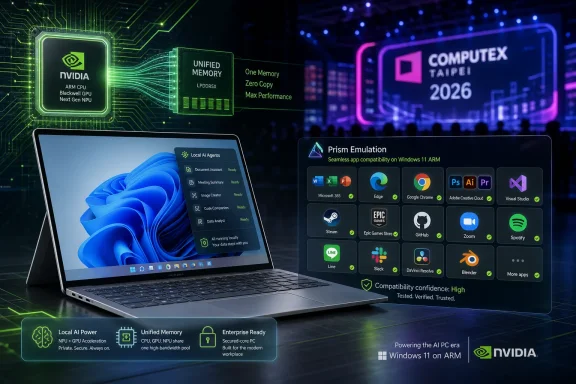
NVIDIA said at Computex 2026 in Taipei that its new Arm-based RTX Spark chip, internally known as N1X, will run Windows 11 applications through a Microsoft-optimized software stack, with the first systems including Microsoft’s Surface Laptop Ultra arriving later in 2026. That is the factual answer; the harder one is whether “runs everything” means “runs everything well.” For Windows users, this is not just another Arm PC announcement. It is NVIDIA trying to turn Windows compatibility from a defensive checkbox into the foundation for an AI-first PC category.
The most revealing thing about RTX Spark is not the silicon spec sheet. It is the order in which NVIDIA chose to tell the story.
Jensen Huang did not lead with Cinebench scores, battery-runtime charts, gaming frame rates, or thermals. He led with the claim that RTX Spark can run NVIDIA’s software stack, Windows applications, and the new class of local AI agents Microsoft and NVIDIA want to make feel inevitable. That tells us what problem the companies believe they must solve first: not raw horsepower, but trust.
Windows on Arm has spent years fighting the same question from buyers: Will my stuff work? Microsoft and Qualcomm made real progress, especially with Snapdragon X systems and Windows 11’s Prism emulation layer, but the category still carries a residue of doubt from earlier Surface Pro X-era compromises. NVIDIA appears to understand that a Windows laptop, no matter how futuristic, fails at the sales floor if the buyer worries that a plug-in, driver, game launcher, creative tool, VPN client, or obscure line-of-business app will break.
That is why Huang’s “every single application” phrasing matters. It is not a narrow technical claim so much as a market intervention. NVIDIA is attempting to drag Windows on Arm out of the compatibility cave and into the same psychological zone Apple reached with Rosetta 2: not perfect, not magic, but broadly good enough that most users stop thinking about the translation layer.
The risk is that Windows is not macOS. Apple controlled the hardware, operating system, developer transition, and customer expectations. Microsoft must carry decades of x86 baggage, third-party drivers, anti-cheat systems, enterprise agents, legacy installers, and niche professional workflows. NVIDIA’s claim is therefore bold enough to be meaningful and broad enough to invite trouble.
That changes the competitive map. Qualcomm’s Snapdragon X chips proved that Windows on Arm could be efficient, quiet, and credible for mainstream productivity. Apple Silicon proved that unified memory and tight CPU-GPU integration could reshape expectations for laptops. RTX Spark is NVIDIA’s answer to both, but with a different center of gravity: less “thin-and-light office machine,” more “portable AI workstation that still happens to run Windows.”
Microsoft’s Surface Laptop Ultra is the symbolic launch vehicle because Surface is where Microsoft makes arguments about what Windows hardware should become. The company has tried this before, sometimes brilliantly and sometimes awkwardly. Surface RT overreached. Surface Pro eventually defined a category. Surface Pro X pushed Windows on Arm before the ecosystem was ready. Surface Laptop Ultra looks like Microsoft trying to avoid repeating that mistake by waiting until the software, silicon, and marketing story can move together.
Still, the unanswered questions are enormous. We do not yet have independent CPU benchmarks, sustained GPU performance numbers, battery-life measurements under real AI workloads, or a clear picture of how much performance is lost when older x86 and x64 apps run through emulation. NVIDIA can plausibly claim that its full software stack runs on RTX Spark; that does not automatically tell a video editor, game developer, architect, musician, or sysadmin how the machine behaves after an hour of sustained load.
The laptop form factor is where grand silicon narratives meet physics. A chip can have an RTX 5070-class number of CUDA cores and still be limited by power, heat, memory bandwidth, firmware, and OEM cooling decisions. The Surface Laptop Ultra’s thermal claims are encouraging, but until reviewers can test shipping hardware, “can run” remains a different sentence from “can replace your current workstation.”
Chrome is native. Edge is native. Office is native. Creative and developer tools have been moving in the right direction. Major applications that once made Arm laptops feel like second-class Windows machines now run either natively or acceptably through emulation. Prism, Microsoft’s current emulation technology, is substantially better than the old Windows on Arm experience and has continued to expand instruction-set coverage.
That last point matters more than casual buyers may realize. Compatibility failures are often not caused by an app being “too powerful” for Arm. They happen because software expects specific x86 instruction extensions, hooks into drivers, uses virtualization features, or depends on low-level components that do not translate cleanly. Microsoft’s addition of broader AVX and AVX2 support to Windows 11’s Arm emulation story is therefore not a footnote; it is one of the reasons NVIDIA can make a compatibility pitch with a straighter face than it could have five years ago.
The Windows Latest report correctly frames this as a maturation story that Qualcomm helped create. Snapdragon PCs did not conquer the market overnight, but they forced Microsoft to keep improving the platform, pushed developers to ship Arm64 builds, and gave users enough real-world machines to expose the rough edges. NVIDIA benefits from that groundwork. It can enter the market not as the first brave explorer, but as the better-armed second wave.
That is also why RTX Spark may be more important than any single Surface device. If ASUS, Dell, HP, Lenovo, MSI, and other OEMs ship credible systems, Windows on Arm becomes less of a Qualcomm subcategory and more of a Windows platform strategy. Once more than one major silicon vendor is invested, developers have a stronger reason to care.
That is both Microsoft’s moat and its burden. Apple can break compatibility more aggressively because its ecosystem tolerates cleaner transitions. Microsoft cannot. A Windows PC is expected to behave like a Windows PC even when the user’s definition of “Windows PC” includes a 12-year-old installer, a USB peripheral with a cranky driver, and a workflow documented only in a forgotten SharePoint page.
RTX Spark does not erase those realities. Emulation can translate application code, but it cannot solve every driver dependency. Native Arm64 apps can be fast, but the long tail of Windows software is not maintained with equal enthusiasm. Games may launch, but kernel-level anti-cheat remains a recurring compatibility landmine. Developer workflows may look excellent until nested virtualization, Android emulation, container tooling, or device-specific SDKs enter the picture.
That does not make NVIDIA’s claim useless. It means buyers should read it in the same way IT pros read all platform-transition claims: as a strong statement of intent, not a warranty against edge cases. The center of the app universe is much healthier than it used to be. The edges are where Windows compatibility promises go to be tested.
For home users, those edges may not matter. If the daily routine is browser, Office, Teams, Spotify, Photoshop, Lightroom, a handful of games, and cloud services, RTX Spark systems may feel surprisingly normal. For enterprises, the question becomes more procedural: what must be validated before procurement, what software needs native Arm support, and which workloads should stay on x86 for another generation?
That is why Huang emphasized NVIDIA’s software stack. CUDA, TensorRT, RTX, DLSS, Omniverse-style graphics workflows, local model tooling, and AI development frameworks are not accessories to NVIDIA’s hardware business. They are the lock-in layer. If RTX Spark can bring a meaningful portion of that stack to thin laptops and compact desktops, NVIDIA gets to redefine the premium Windows PC around its own platform advantages.
This is where RTX Spark differs from Snapdragon X. Qualcomm’s pitch has been efficiency, battery life, integrated AI acceleration, and modern Windows mobility. NVIDIA’s pitch is that the PC becomes a local AI and graphics node, capable of running agents, models, creative workflows, rendering tasks, and developer tools that would otherwise spill into the cloud or require a discrete GPU workstation. It is less about replacing the office laptop and more about compressing the workstation into a new shape.
The unified-memory figure is particularly important. Up to 128GB of shared memory is not just a spec for bragging rights; it is a practical requirement for larger local AI models, complex 3D scenes, and creative workloads that are increasingly memory-bound. Apple has trained the market to understand unified memory as a premium advantage. NVIDIA is now applying that logic to Windows, but with an AI and CUDA vocabulary rather than a MacBook Pro one.
For developers and creators, the appeal is obvious. A Windows machine that runs local models, CUDA workflows, RTX graphics, and mainstream applications could be a serious alternative to juggling a laptop, a cloud GPU account, and a separate workstation. But again, the decisive word is “could.” Without shipping systems, measured thermals, and software validation, the promise is still ahead of the proof.
RTX Spark gives Microsoft a chance to reset that story at the high end. Instead of asking users to believe that a modest neural processor will transform the PC, Microsoft can point to NVIDIA-class local compute, large unified memory pools, and agents that operate across Windows applications. This is a more ambitious and more expensive vision, but it is also easier to understand: the computer has enough local horsepower to do AI work without constantly leaving the device.
The agent framing is important. Microsoft and NVIDIA are not merely talking about chatbots in a sidebar. They are describing PCs where agents can reason across files, control applications, generate assets, automate workflows, and potentially act as a new layer between the user and traditional software. In that model, app compatibility is not a legacy concern. It is essential infrastructure. An agent is only useful if the apps it must manipulate actually run.
This is the subtle reason the Windows app question matters so much. If RTX Spark were just a gaming chip or a creator chip, compatibility gaps would be annoying but containable. If it is the foundation for agentic Windows computing, then every broken app becomes a hole in the premise. A future where the PC “does the work” depends on the boring old Windows ecosystem continuing to function underneath.
Microsoft has learned this lesson the hard way. Users do not migrate because a company declares a new era. They migrate when the old tasks still work and the new tasks are compelling enough to justify the switch. RTX Spark is designed to satisfy both halves of that equation, but the second half will require more than keynote demos.
PC gaming is one of the least forgiving compatibility environments in computing. Games depend on graphics drivers, DRM layers, anti-cheat systems, launchers, overlays, input utilities, mod managers, and specific CPU instruction behavior. Even on ordinary x86 Windows systems, new GPUs and driver branches can produce strange failures. Add Arm translation to the stack and the number of variables increases.
The optimistic view is that NVIDIA has the driver expertise, developer relationships, and RTX ecosystem leverage to make gaming on RTX Spark far better than previous Windows on Arm efforts. If anyone can persuade game studios and middleware vendors to take Arm64 Windows seriously, NVIDIA is a strong candidate. DLSS and RTX support also give the company a powerful incentive to ensure marquee titles behave well.
The cautious view is that gaming performance will depend heavily on native ports, anti-cheat support, and thermal design. An emulated game that launches is not necessarily a game that performs competitively. A game that runs in a keynote demo is not necessarily representative of a Steam library. A laptop with impressive peak GPU specs may throttle differently from a desktop-class discrete card.
For WindowsForum readers, the practical advice is simple: do not buy first-generation RTX Spark hardware purely as a gaming laptop until independent reviews test the games you actually play. The platform may become excellent. It may even become the most credible Windows on Arm gaming effort so far. But PC gaming has a way of punishing universal claims.
But enterprise adoption does not begin with keynote excitement. It begins with application inventories, endpoint management, VPN compatibility, security agents, printer drivers, smart-card middleware, EDR tools, virtualization requirements, and support escalation paths. A single incompatible component can block deployment across an entire department.
The good news is that Windows on Arm is far more manageable now than it was during its awkward adolescence. Microsoft Intune, Windows Update, Microsoft 365, Edge, Teams, and modern cloud-native software all reduce the pain of architecture transitions. Many organizations have also moved enough workloads into browsers or virtualized environments that local CPU architecture matters less than it once did.
The bad news is that the remaining architecture-dependent software tends to be the stuff enterprises cannot easily replace. Engineering tools, medical software, financial plug-ins, hardware control systems, and legacy line-of-business applications often lag behind platform transitions. Those are exactly the environments where “it should emulate” is not a deployment plan.
RTX Spark will therefore enter business fleets unevenly. It may find early traction in AI development, creative departments, executive pilots, and specialized teams that can validate their own toolchains. Broad enterprise rollouts will take longer, not because the hardware is uninteresting, but because Windows compatibility at scale is a process, not a slogan.
The fall 2026 launch window gives Microsoft and NVIDIA a few months to turn announcement claims into a real ecosystem. That means drivers, firmware, app partnerships, developer tools, game support, benchmark transparency, and clear messaging about what is native, what is emulated, and what is not supported. The worst outcome would be a powerful chip buried under vague compatibility language and inconsistent OEM execution.
NVIDIA also has to manage expectations created by its own success. When buyers see RTX branding, they expect gaming. When developers see CUDA, they expect serious compute. When creators see 128GB unified memory, they expect workstation-class workflows. When ordinary users hear “runs everything,” they expect their apps to behave normally. That is a lot of promises for a first-generation Windows PC platform to carry.
Microsoft, meanwhile, has to prove that Windows itself is ready for a more heterogeneous future. The PC market is no longer a simple x86 story with occasional Arm experiments. It is becoming a competition among CPU architectures, GPU stacks, NPUs, local AI runtimes, and cloud-connected agents. Windows can benefit from that diversity, but only if the user experience feels coherent.
The best version of this future is genuinely exciting. A Windows laptop that runs mainstream apps, accelerates creative work, hosts local models, supports CUDA development, and sips power more intelligently than traditional mobile workstations would be a meaningful new category. The worst version is familiar: impressive silicon, muddled messaging, uneven compatibility, and early adopters left explaining the caveats.
For most users, the practical question will not be whether RTX Spark can technically launch Windows applications. It will be whether the experience is boring in the best possible way. Do apps install without architecture drama? Do updates arrive normally? Do plug-ins work? Does battery life survive real workloads? Do fans stay reasonable? Do games and creative suites perform consistently after the first ten minutes?
That is where the first reviews will matter. Synthetic benchmarks will tell part of the story, but the more interesting tests will be messy and human. A music producer loading old VSTs. A developer running containers and Android tools. A designer moving between Adobe apps and 3D rendering. A gamer opening a library full of launchers and anti-cheat systems. A sysadmin enrolling the machine into a managed fleet.
If those tests go well, RTX Spark could become the moment Windows on Arm stops needing an asterisk at the high end. If they go poorly, NVIDIA’s ambitious language will make the disappointment sharper. The platform is mature enough to be taken seriously, which also means it is mature enough to be judged seriously.
 NVIDIA Is Selling Compatibility Before Performance
The most revealing thing about RTX Spark is not the silicon spec sheet. It is the order in which NVIDIA chose to tell the story.Jensen Huang did not lead with Cinebench scores, battery-runtime charts, gaming frame rates, or thermals. He led with the claim that RTX Spark can run NVIDIA’s software stack, Windows applications, and the new class of local AI agents Microsoft and NVIDIA want to make feel inevitable. That tells us what problem the companies believe they must solve first: not raw horsepower, but trust.
Windows on Arm has spent years fighting the same question from buyers: Will my stuff work? Microsoft and Qualcomm made real progress, especially with Snapdragon X systems and Windows 11’s Prism emulation layer, but the category still carries a residue of doubt from earlier Surface Pro X-era compromises. NVIDIA appears to understand that a Windows laptop, no matter how futuristic, fails at the sales floor if the buyer worries that a plug-in, driver, game launcher, creative tool, VPN client, or obscure line-of-business app will break.
That is why Huang’s “every single application” phrasing matters. It is not a narrow technical claim so much as a market intervention. NVIDIA is attempting to drag Windows on Arm out of the compatibility cave and into the same psychological zone Apple reached with Rosetta 2: not perfect, not magic, but broadly good enough that most users stop thinking about the translation layer.
The risk is that Windows is not macOS. Apple controlled the hardware, operating system, developer transition, and customer expectations. Microsoft must carry decades of x86 baggage, third-party drivers, anti-cheat systems, enterprise agents, legacy installers, and niche professional workflows. NVIDIA’s claim is therefore bold enough to be meaningful and broad enough to invite trouble.
The Chip Is Real, but the Benchmarks Are Still Missing
On paper, RTX Spark is exactly the kind of part Windows laptops have lacked. It combines an Arm CPU complex with Blackwell-class RTX graphics, CUDA support, fifth-generation Tensor cores, unified memory options that can climb to 128GB, and up to a petaflop of AI compute. The headline is not simply “NVIDIA made a Windows Arm chip.” The headline is that NVIDIA is bringing its graphics and AI platform into the main processor conversation.That changes the competitive map. Qualcomm’s Snapdragon X chips proved that Windows on Arm could be efficient, quiet, and credible for mainstream productivity. Apple Silicon proved that unified memory and tight CPU-GPU integration could reshape expectations for laptops. RTX Spark is NVIDIA’s answer to both, but with a different center of gravity: less “thin-and-light office machine,” more “portable AI workstation that still happens to run Windows.”
Microsoft’s Surface Laptop Ultra is the symbolic launch vehicle because Surface is where Microsoft makes arguments about what Windows hardware should become. The company has tried this before, sometimes brilliantly and sometimes awkwardly. Surface RT overreached. Surface Pro eventually defined a category. Surface Pro X pushed Windows on Arm before the ecosystem was ready. Surface Laptop Ultra looks like Microsoft trying to avoid repeating that mistake by waiting until the software, silicon, and marketing story can move together.
Still, the unanswered questions are enormous. We do not yet have independent CPU benchmarks, sustained GPU performance numbers, battery-life measurements under real AI workloads, or a clear picture of how much performance is lost when older x86 and x64 apps run through emulation. NVIDIA can plausibly claim that its full software stack runs on RTX Spark; that does not automatically tell a video editor, game developer, architect, musician, or sysadmin how the machine behaves after an hour of sustained load.
The laptop form factor is where grand silicon narratives meet physics. A chip can have an RTX 5070-class number of CUDA cores and still be limited by power, heat, memory bandwidth, firmware, and OEM cooling decisions. The Surface Laptop Ultra’s thermal claims are encouraging, but until reviewers can test shipping hardware, “can run” remains a different sentence from “can replace your current workstation.”
Windows on Arm Has Finally Earned a Second Hearing
The most important context for RTX Spark is that NVIDIA is not arriving in the Windows on Arm market of 2019. That version of the platform was defined by caveats, missing native apps, weak performance, and the sense that Microsoft wanted the future more than users did. The current version is much harder to dismiss.Chrome is native. Edge is native. Office is native. Creative and developer tools have been moving in the right direction. Major applications that once made Arm laptops feel like second-class Windows machines now run either natively or acceptably through emulation. Prism, Microsoft’s current emulation technology, is substantially better than the old Windows on Arm experience and has continued to expand instruction-set coverage.
That last point matters more than casual buyers may realize. Compatibility failures are often not caused by an app being “too powerful” for Arm. They happen because software expects specific x86 instruction extensions, hooks into drivers, uses virtualization features, or depends on low-level components that do not translate cleanly. Microsoft’s addition of broader AVX and AVX2 support to Windows 11’s Arm emulation story is therefore not a footnote; it is one of the reasons NVIDIA can make a compatibility pitch with a straighter face than it could have five years ago.
The Windows Latest report correctly frames this as a maturation story that Qualcomm helped create. Snapdragon PCs did not conquer the market overnight, but they forced Microsoft to keep improving the platform, pushed developers to ship Arm64 builds, and gave users enough real-world machines to expose the rough edges. NVIDIA benefits from that groundwork. It can enter the market not as the first brave explorer, but as the better-armed second wave.
That is also why RTX Spark may be more important than any single Surface device. If ASUS, Dell, HP, Lenovo, MSI, and other OEMs ship credible systems, Windows on Arm becomes less of a Qualcomm subcategory and more of a Windows platform strategy. Once more than one major silicon vendor is invested, developers have a stronger reason to care.
“Runs Everything” Is a Promise Windows Has Never Fully Kept
The phrase “runs every Windows app” sounds simple only if you ignore how Windows actually became Windows. The platform’s strength has always been its sprawl. It runs new apps, old apps, corporate apps, unsigned utilities, weird hardware control panels, background services, game launchers, shell extensions, audio plug-ins, accounting packages, scanners, label printers, industrial tools, and software nobody has recompiled since the Obama administration.That is both Microsoft’s moat and its burden. Apple can break compatibility more aggressively because its ecosystem tolerates cleaner transitions. Microsoft cannot. A Windows PC is expected to behave like a Windows PC even when the user’s definition of “Windows PC” includes a 12-year-old installer, a USB peripheral with a cranky driver, and a workflow documented only in a forgotten SharePoint page.
RTX Spark does not erase those realities. Emulation can translate application code, but it cannot solve every driver dependency. Native Arm64 apps can be fast, but the long tail of Windows software is not maintained with equal enthusiasm. Games may launch, but kernel-level anti-cheat remains a recurring compatibility landmine. Developer workflows may look excellent until nested virtualization, Android emulation, container tooling, or device-specific SDKs enter the picture.
That does not make NVIDIA’s claim useless. It means buyers should read it in the same way IT pros read all platform-transition claims: as a strong statement of intent, not a warranty against edge cases. The center of the app universe is much healthier than it used to be. The edges are where Windows compatibility promises go to be tested.
For home users, those edges may not matter. If the daily routine is browser, Office, Teams, Spotify, Photoshop, Lightroom, a handful of games, and cloud services, RTX Spark systems may feel surprisingly normal. For enterprises, the question becomes more procedural: what must be validated before procurement, what software needs native Arm support, and which workloads should stay on x86 for another generation?
NVIDIA’s Real Weapon Is Not Arm, but CUDA
The Arm CPU is the architectural headline, but CUDA is the strategic lever. NVIDIA is not merely trying to sell Microsoft a faster laptop chip. It is trying to make the Windows PC part of the same accelerated-computing continuum that already stretches from gaming GPUs to workstations to data centers.That is why Huang emphasized NVIDIA’s software stack. CUDA, TensorRT, RTX, DLSS, Omniverse-style graphics workflows, local model tooling, and AI development frameworks are not accessories to NVIDIA’s hardware business. They are the lock-in layer. If RTX Spark can bring a meaningful portion of that stack to thin laptops and compact desktops, NVIDIA gets to redefine the premium Windows PC around its own platform advantages.
This is where RTX Spark differs from Snapdragon X. Qualcomm’s pitch has been efficiency, battery life, integrated AI acceleration, and modern Windows mobility. NVIDIA’s pitch is that the PC becomes a local AI and graphics node, capable of running agents, models, creative workflows, rendering tasks, and developer tools that would otherwise spill into the cloud or require a discrete GPU workstation. It is less about replacing the office laptop and more about compressing the workstation into a new shape.
The unified-memory figure is particularly important. Up to 128GB of shared memory is not just a spec for bragging rights; it is a practical requirement for larger local AI models, complex 3D scenes, and creative workloads that are increasingly memory-bound. Apple has trained the market to understand unified memory as a premium advantage. NVIDIA is now applying that logic to Windows, but with an AI and CUDA vocabulary rather than a MacBook Pro one.
For developers and creators, the appeal is obvious. A Windows machine that runs local models, CUDA workflows, RTX graphics, and mainstream applications could be a serious alternative to juggling a laptop, a cloud GPU account, and a separate workstation. But again, the decisive word is “could.” Without shipping systems, measured thermals, and software validation, the promise is still ahead of the proof.
Microsoft Wants the AI PC to Escape the Copilot Key
Microsoft has spent the past few years trying to make the AI PC feel like a platform shift rather than a branding exercise. The results have been mixed. Copilot+ PCs introduced useful hardware requirements and some genuinely interesting on-device capabilities, but the public narrative often collapsed into a dedicated keyboard key, recall controversies, and confusion over what the NPU actually did for everyday users.RTX Spark gives Microsoft a chance to reset that story at the high end. Instead of asking users to believe that a modest neural processor will transform the PC, Microsoft can point to NVIDIA-class local compute, large unified memory pools, and agents that operate across Windows applications. This is a more ambitious and more expensive vision, but it is also easier to understand: the computer has enough local horsepower to do AI work without constantly leaving the device.
The agent framing is important. Microsoft and NVIDIA are not merely talking about chatbots in a sidebar. They are describing PCs where agents can reason across files, control applications, generate assets, automate workflows, and potentially act as a new layer between the user and traditional software. In that model, app compatibility is not a legacy concern. It is essential infrastructure. An agent is only useful if the apps it must manipulate actually run.
This is the subtle reason the Windows app question matters so much. If RTX Spark were just a gaming chip or a creator chip, compatibility gaps would be annoying but containable. If it is the foundation for agentic Windows computing, then every broken app becomes a hole in the premise. A future where the PC “does the work” depends on the boring old Windows ecosystem continuing to function underneath.
Microsoft has learned this lesson the hard way. Users do not migrate because a company declares a new era. They migrate when the old tasks still work and the new tasks are compelling enough to justify the switch. RTX Spark is designed to satisfy both halves of that equation, but the second half will require more than keynote demos.
Gaming Remains the Great Compatibility Stress Test
NVIDIA’s brand makes gaming impossible to avoid, even when the company frames RTX Spark as an AI and creator platform. A chip with Blackwell graphics, CUDA cores, DLSS support, and Windows branding will naturally make buyers ask whether it can play their games. The answer is likely to be “many of them, increasingly well,” but that is not the same as “all of them without compromises.”PC gaming is one of the least forgiving compatibility environments in computing. Games depend on graphics drivers, DRM layers, anti-cheat systems, launchers, overlays, input utilities, mod managers, and specific CPU instruction behavior. Even on ordinary x86 Windows systems, new GPUs and driver branches can produce strange failures. Add Arm translation to the stack and the number of variables increases.
The optimistic view is that NVIDIA has the driver expertise, developer relationships, and RTX ecosystem leverage to make gaming on RTX Spark far better than previous Windows on Arm efforts. If anyone can persuade game studios and middleware vendors to take Arm64 Windows seriously, NVIDIA is a strong candidate. DLSS and RTX support also give the company a powerful incentive to ensure marquee titles behave well.
The cautious view is that gaming performance will depend heavily on native ports, anti-cheat support, and thermal design. An emulated game that launches is not necessarily a game that performs competitively. A game that runs in a keynote demo is not necessarily representative of a Steam library. A laptop with impressive peak GPU specs may throttle differently from a desktop-class discrete card.
For WindowsForum readers, the practical advice is simple: do not buy first-generation RTX Spark hardware purely as a gaming laptop until independent reviews test the games you actually play. The platform may become excellent. It may even become the most credible Windows on Arm gaming effort so far. But PC gaming has a way of punishing universal claims.
Enterprise IT Will Care Less About Hype and More About Exceptions
For sysadmins, RTX Spark is both intriguing and exhausting. A powerful, efficient Windows laptop with local AI capabilities could be attractive for developers, data scientists, designers, executives, and field workers who handle sensitive data. Local inference may reduce cloud exposure for certain workflows, and high-end Arm systems could offer better battery life under some workloads than conventional mobile workstations.But enterprise adoption does not begin with keynote excitement. It begins with application inventories, endpoint management, VPN compatibility, security agents, printer drivers, smart-card middleware, EDR tools, virtualization requirements, and support escalation paths. A single incompatible component can block deployment across an entire department.
The good news is that Windows on Arm is far more manageable now than it was during its awkward adolescence. Microsoft Intune, Windows Update, Microsoft 365, Edge, Teams, and modern cloud-native software all reduce the pain of architecture transitions. Many organizations have also moved enough workloads into browsers or virtualized environments that local CPU architecture matters less than it once did.
The bad news is that the remaining architecture-dependent software tends to be the stuff enterprises cannot easily replace. Engineering tools, medical software, financial plug-ins, hardware control systems, and legacy line-of-business applications often lag behind platform transitions. Those are exactly the environments where “it should emulate” is not a deployment plan.
RTX Spark will therefore enter business fleets unevenly. It may find early traction in AI development, creative departments, executive pilots, and specialized teams that can validate their own toolchains. Broad enterprise rollouts will take longer, not because the hardware is uninteresting, but because Windows compatibility at scale is a process, not a slogan.
The First RTX Spark PCs Will Test More Than NVIDIA
Surface Laptop Ultra is being positioned as the halo machine, but the broader OEM roster matters just as much. Windows hardware succeeds through variety: premium clamshells, creator laptops, mobile workstations, compact desktops, convertibles, and price bands that eventually move from aspirational to attainable. If RTX Spark remains a boutique curiosity, it will not reshape Windows. If multiple vendors ship credible designs, developers and buyers will respond differently.The fall 2026 launch window gives Microsoft and NVIDIA a few months to turn announcement claims into a real ecosystem. That means drivers, firmware, app partnerships, developer tools, game support, benchmark transparency, and clear messaging about what is native, what is emulated, and what is not supported. The worst outcome would be a powerful chip buried under vague compatibility language and inconsistent OEM execution.
NVIDIA also has to manage expectations created by its own success. When buyers see RTX branding, they expect gaming. When developers see CUDA, they expect serious compute. When creators see 128GB unified memory, they expect workstation-class workflows. When ordinary users hear “runs everything,” they expect their apps to behave normally. That is a lot of promises for a first-generation Windows PC platform to carry.
Microsoft, meanwhile, has to prove that Windows itself is ready for a more heterogeneous future. The PC market is no longer a simple x86 story with occasional Arm experiments. It is becoming a competition among CPU architectures, GPU stacks, NPUs, local AI runtimes, and cloud-connected agents. Windows can benefit from that diversity, but only if the user experience feels coherent.
The best version of this future is genuinely exciting. A Windows laptop that runs mainstream apps, accelerates creative work, hosts local models, supports CUDA development, and sips power more intelligently than traditional mobile workstations would be a meaningful new category. The worst version is familiar: impressive silicon, muddled messaging, uneven compatibility, and early adopters left explaining the caveats.
The Compatibility Claim Is the Beginning of the Review, Not the End
The right way to read NVIDIA’s announcement is neither credulous nor cynical. RTX Spark is not vaporware, and Windows on Arm is no longer a punchline. At the same time, “runs all your apps” is a phrase that deserves testing app by app, driver by driver, game by game, and workload by workload.For most users, the practical question will not be whether RTX Spark can technically launch Windows applications. It will be whether the experience is boring in the best possible way. Do apps install without architecture drama? Do updates arrive normally? Do plug-ins work? Does battery life survive real workloads? Do fans stay reasonable? Do games and creative suites perform consistently after the first ten minutes?
That is where the first reviews will matter. Synthetic benchmarks will tell part of the story, but the more interesting tests will be messy and human. A music producer loading old VSTs. A developer running containers and Android tools. A designer moving between Adobe apps and 3D rendering. A gamer opening a library full of launchers and anti-cheat systems. A sysadmin enrolling the machine into a managed fleet.
If those tests go well, RTX Spark could become the moment Windows on Arm stops needing an asterisk at the high end. If they go poorly, NVIDIA’s ambitious language will make the disappointment sharper. The platform is mature enough to be taken seriously, which also means it is mature enough to be judged seriously.
The Real Upgrade Is Confidence, If NVIDIA Can Earn It
The most concrete lesson from the RTX Spark reveal is that the next Windows platform battle will be fought over confidence as much as capability.- NVIDIA’s claim that RTX Spark can run Windows applications rests on a much stronger Windows on Arm foundation than existed during earlier Microsoft experiments.
- The lack of independent benchmarks means performance, thermals, gaming behavior, and battery life remain open questions until shipping hardware is tested.
- Prism emulation and broader instruction-set support make app compatibility more credible, but drivers, anti-cheat systems, virtualization, and legacy enterprise tools can still create hard limits.
- RTX Spark’s biggest strategic advantage is not simply that it is Arm-based, but that it brings NVIDIA’s CUDA, RTX, and AI software stack into a new class of Windows PCs.
- Surface Laptop Ultra will serve as the symbolic test case, but the platform’s success depends on broad OEM execution and developer follow-through.
- Buyers should treat “runs everything” as a promising claim to verify against their own software, not as permission to ignore compatibility planning.
References
- Primary source: Windows Latest
Published: Tue, 02 Jun 2026 00:54:01 GMT
NVIDIA reveals if RTX Spark (N1X) can run all your Windows 11 apps
Jensen Huang says Microsoft and NVIDIA have worked closely to make sure Windows apps run properly on N1X-powered PCs. www.windowslatest.com
- Related coverage: axios.com
Microsoft debuts Nvidia-powered Microsoft Surface Ultra laptop
Microsoft is trying again to redefine the PC for the AI era.www.axios.com
- Related coverage: windowscentral.com
Once left in the dust, Surface could be on the forefront of "a new era of PC" | Windows Central
Microsoft and NVIDIA teased a major hardware reveal that points to the long‑rumored N1X chip and a possible shift in Surface’s trajectory.www.windowscentral.com - Related coverage: tomshardware.com
Nvidia and Microsoft tease "a new era of PC" ahead of Computex 2026 — coordinated social media posts could indicate that rumored N1X laptops will be Windows on Arm systems | Tom's Hardware
An Nvidia-powered Arm PC running Windows could inspire new local AI experiences beyond Copilot+.www.tomshardware.com - Related coverage: tuttotech.net
Surface Laptop Ultra ufficiale: il laptop ultra potente di Microsoft con NVIDIA RTX Spark
Microsoft e NVIDIA hanno presentato il Surface Laptop Ultra al Computex 2026: chip RTX Spark con architettura unificata, fino a 128 GB di RAM condivisa e 1 petaflop di potenza AI in meno di 18 mm di spessore.www.tuttotech.net - Related coverage: arstechnica.com
Nvidia RTX Spark comes to Windows PCs with Arm CPU, RTX GPU, and unified memory - Ars Technica
Nvidia's new chips will power laptop workstations and mini desktop PCs at first.arstechnica.com
- Official source: blogs.windows.com
Introducing a powerful new chapter for Windows PCs, accelerated by NVIDIA RTX Spark
Today at NVIDIA GTC, Microsoft and NVIDIA announced the world’s most powerful and efficient thin-and-light Windows PCs ever. Accelerated by NVIDIA RTX Sparkblogs.windows.com - Related coverage: notebookcheck.com
Microsoft zeigt Surface Laptop Ultra, mit super hellem Mini-LED-Display und Nvidia RTX Spark - Notebookcheck News
Nach der RTX Spark Präsentation durch Jensen Huang auf der Computex 2026 haben sich einige Hersteller mit ersten Informationen und Bildern zu ihren darauf basierenden Laptops und Mini-PCs an die 0ffentlichkeit gewagt. Auch Microsoft mischt mit einem Surface Laptop Ultra beim neuen Nvidia... www.notebookcheck.com
- Related coverage: techtimes.com
Nvidia RTX Spark Superchip: Windows PC Chip With Full CUDA Stack Targets Dell, Microsoft This Fall
Nvidia RTX Spark Superchip launched at Computex 2026 as Nvidia’s first Windows PC processor, co-developed with Microsoft, pairing a Blackwell GPU with 6,144 CUDA cores and 128 GB unified memory in awww.techtimes.com - Related coverage: investor.nvidia.com
NVIDIA Corporation - NVIDIA and Microsoft Reinvent Windows PCs for the Age of Personal AI
RTX Spark — a 1-Petaflop Superchip, the Full CUDA and RTX Ecosystem, and Windows-Native Agents — a New Beginning for Personal Computers News Summary: NVIDIA RTX Spark powers the world’s first Windows PCs purpose-built for personal agents, featuring 1 petaflop of AI performance, industry-leading...investor.nvidia.com - Related coverage: tomsguide.com
Nvidia N1X CPU appears in new benchmark — but it doesn't show its true potential | Tom's Guide
Nvidia's rumored N1X CPU has shown up in another benchmark, confirming it's now being tested on Windows, but it still doesn't show its true potential.www.tomsguide.com - Related coverage: docs.nvidia.com
- Related coverage: nvidianews.nvidia.com
