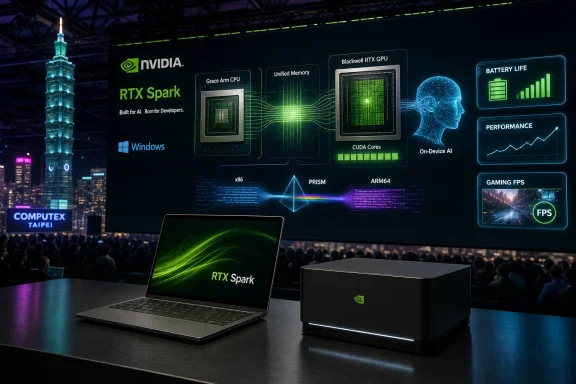
NVIDIA used Computex 2026 in Taipei to announce RTX Spark, a Windows-on-Arm PC platform built with MediaTek that combines a Grace Arm CPU, Blackwell-class RTX graphics, unified memory, and Microsoft-backed software work for laptops and compact desktops. The announcement is huge because it gives Windows on Arm something it has never really had: a heavyweight graphics vendor treating the platform as a first-class performance target, not an experiment. But the more interesting story is not that NVIDIA has arrived. It is that Qualcomm and Microsoft made the runway long enough for NVIDIA to land.
For years, Windows on Arm has been described as the future in the same slightly apologetic tone used for technologies that never quite become the present. Surface RT poisoned the well early. Later Snapdragon PCs were efficient but underpowered, often sold on battery life while asking users to forgive missing drivers, slow emulation, and a software catalog that felt permanently unfinished. The Snapdragon X Elite changed that conversation, and Microsoft’s Prism emulation layer made the change usable outside benchmark slides.
RTX Spark does not erase that history. It validates it.
The Windows-on-Arm pitch has always been clean in theory: better efficiency, thinner systems, longer battery life, instant-on behavior, and enough performance for mainstream work. The problem was that PC buyers do not live in theory. They live in driver installers, Adobe workflows, game launchers, VPN clients, anti-cheat systems, CAD utilities, browser tabs, and that one ancient x64 app nobody in the office admits is mission-critical until it breaks.
Qualcomm’s Snapdragon X series gave Windows on Arm credible CPU performance and battery life. Microsoft gave it a more serious compatibility story through Prism, scheduler work, power-profile tuning, and a renewed push for native ARM64 apps. That combination moved the platform from “interesting if you know the caveats” to “safe enough for normal users.”
NVIDIA’s RTX Spark aims at the next objection: serious graphics and local AI compute. A Windows Arm laptop with a powerful integrated Blackwell GPU and a CUDA story is not merely another ultraportable. It is a direct challenge to the old assumption that Arm PCs are for Office, browsers, and battery-life marketing, while “real work” belongs to x86 workstations.
That is why the launch matters. NVIDIA is not entering a barren market. It is entering one that Qualcomm and Microsoft have spent the last several years making less embarrassing, less fragile, and more commercially legible.
That distinction matters because Windows users are deeply conditioned to distrust architecture transitions. They remember software that did not run, accessories that had no drivers, and enterprise tools that vendors promised would be updated “soon.” Battery life alone was never going to overcome that distrust. Performance had to arrive first.
Snapdragon X Elite did not make every Windows-on-Arm problem disappear, but it changed the direction of the argument. Suddenly, the question was not whether Arm could be fast enough for Windows. It was whether the ecosystem could catch up to silicon that was already credible.
That is a much healthier problem to have. Weak hardware makes developers wait. Strong hardware gives them a reason to port, test, and support.
But Prism is one of the reasons NVIDIA can now talk about RTX Spark as a Windows PC platform rather than a developer science project. The layer translates x86 and x64 code so legacy Windows applications can run on Arm systems, often well enough that ordinary users do not need to know what instruction set their software was compiled for. It is not magic, and native ARM64 software remains the better answer, but it narrows the danger zone.
That danger zone used to define the platform. Every Windows-on-Arm recommendation came with a paragraph of caveats. Check your printer driver. Check your VPN. Check your DAW plug-ins. Check your games. Check your anti-cheat. Check the app you use twice a year but absolutely need when tax season arrives.
Prism does not eliminate the checklist, but it shortens it. More importantly, it gives developers time. A platform transition only works when users can survive the middle period between legacy software and native software, and Microsoft has finally built a bridge that looks strong enough for mainstream traffic.
That is why the appearance of more ARM64 builds matters more than the usual “app compatibility is improving” line suggests. Discord running natively on Windows on Arm is not just a convenience for gamers and communities. Adobe Illustrator gaining a native ARM64 beta, with performance improvements reportedly around 30 percent in some workflows, is not just a nice bullet point for creative users. These are signals to the market that Windows on Arm has enough installed base, enough performance, and enough vendor confidence to justify real engineering work.
The Windows ecosystem is different from Apple’s. Apple can move its developers with a mix of control, incentives, and deadline pressure. Microsoft has to coax a much messier universe of independent software vendors, driver makers, hardware partners, enterprise vendors, and game studios. That makes every native app more meaningful because it is rarely the product of a single top-down decree.
The platform’s progress is also uneven by design. Browsers, productivity tools, communications apps, and creative applications have moved faster than games and low-level utilities. That is not surprising. Anything that touches drivers, kernel components, copy protection, anti-cheat, virtualization, or specialized hardware will always be harder to migrate.
Still, the direction is unmistakable. The Windows-on-Arm app story has moved from “what works?” to “what still does not?” That shift is subtle, but for PC buying decisions it is enormous.
They will find the weird edge case. They will run the launcher that embeds the obsolete dependency. They will install the game with the kernel-level anti-cheat module that assumes x86. They will compare frame pacing, shader compilation, overlay behavior, controller support, mod tools, capture software, and driver updates. They will not care that the platform is elegant if their preferred game refuses to launch.
This is where NVIDIA’s entrance becomes especially important. Qualcomm’s integrated graphics improved the baseline, but it did not turn Windows on Arm into a serious gaming story. NVIDIA brings not only GPU hardware but developer relationships, drivers, DLSS, RTX branding, and the political weight to push game studios and anti-cheat vendors toward support.
Kernel-level anti-cheat has been one of the most visible pain points for Windows-on-Arm gaming. It is not enough for a game executable to run under emulation if the security component blocks launch or refuses to load on Arm. Microsoft has worked on the plumbing, and some vendors have made progress, but the problem requires coordination across companies that are understandably cautious about anything touching anti-cheat integrity.
RTX Spark raises the stakes. If NVIDIA wants Arm Windows systems to be seen as credible gaming-capable PCs, anti-cheat support cannot remain a footnote. The hardware may be powerful enough, but the platform only wins if the whole game stack comes along.
But RTX Spark is not just a chip story. It is a software distribution story. NVIDIA is bringing its GPU stack, AI libraries, developer tools, and Windows relationships into a market that has historically struggled to persuade developers that Arm PCs were worth targeting.
That matters most for AI workloads. The industry has spent the last two years trying to convince users that “AI PC” means something more than a better webcam blur or a chatbot shortcut key. Local inference, agentic workflows, and on-device model execution all require memory bandwidth, GPU acceleration, software frameworks, and developer adoption. A powerful Arm CPU alone does not create that market.
NVIDIA understands this better than almost anyone. CUDA’s dominance was never only about fast GPUs. It was about making NVIDIA hardware the default assumption for developers building GPU-accelerated software. RTX Spark brings that same instinct to Windows on Arm.
If it works, the result could be a class of Windows machines that are not merely efficient laptops with compatibility tricks, but local AI workstations that happen to fit into mainstream PC form factors.
NVIDIA changes that perception. So does MediaTek’s presence in the RTX Spark collaboration. A platform looks more real when multiple silicon vendors are fighting over it.
That competition helps Microsoft in several ways. It pushes hardware differentiation. It gives OEMs more options. It pressures Qualcomm to keep improving CPU, GPU, NPU, and driver support. It gives developers a larger potential audience for native ARM64 ports. It also makes Windows itself the center of gravity rather than any single chip vendor.
For Microsoft, that is the ideal outcome. The company does not need Qualcomm to win every design. It needs Windows on Arm to become ordinary enough that Dell, Lenovo, HP, ASUS, Microsoft’s own Surface team, and others can build systems for different segments without users feeling they are buying into an experiment.
The irony is that NVIDIA’s arrival may be one of the best things that could happen to Qualcomm’s Windows ambitions. A larger Arm PC ecosystem makes Qualcomm’s early investment look less like a bet and more like groundwork.
That is enticing, but it also broadens the validation burden. Enterprise IT will want to know whether endpoint security agents run natively, whether VPN clients behave, whether management tools report correctly, whether DLP and EDR products support Arm, whether device drivers exist for specialized hardware, and whether line-of-business apps depend on x86 assumptions buried deep in installers or plug-ins.
The more powerful the machine, the more likely users are to ask it to do weird things. A lightweight Snapdragon laptop can be positioned as a travel device. A high-end RTX Spark laptop will invite comparisons with mobile workstations, MacBook Pros, and desktop replacement systems. That means the compatibility expectations rise accordingly.
There is also a procurement angle. Enterprises do not buy architectures; they buy support lifecycles, warranty terms, deployment images, security baselines, and predictable management. Microsoft and its OEM partners will need to make Arm devices fit into existing Windows management practices with as little drama as possible.
The good news is that this is no longer a theoretical conversation. IT departments can test real Snapdragon X systems today, observe Prism behavior, evaluate native app coverage, and build pilot groups before RTX Spark hardware arrives in volume. The foundation is already there, and that is precisely the point.
RTX Spark sharpens the proposition. If a Windows laptop can offer a powerful Arm CPU, a serious RTX GPU, unified memory, and local AI acceleration, the device becomes more than a thin client for cloud models. It becomes a local compute node for developers, creators, researchers, and power users who want to run models, automate workflows, edit media, and experiment without sending every task to a remote server.
That does not mean cloud AI goes away. It means the PC gets a more credible role in the stack. Some tasks belong in the cloud because they require massive models, shared infrastructure, or centralized data. Others belong locally because latency, privacy, cost, offline availability, or workflow integration matter more.
Microsoft’s interest in “agentic” Windows experiences fits here. The company wants the PC to become an active participant in user workflows, not merely a screen for cloud services. NVIDIA wants the GPU to be the engine under that new interaction model. Qualcomm wants Arm efficiency and NPU capability to remain central to mobile PCs.
Those interests do not perfectly align, but they all point toward the same conclusion: the next Windows platform fight is not just x86 versus Arm. It is where computation happens, how much of it happens locally, and which company owns the developer path to make it useful.
Compatibility remains a moving target. Native app availability is better, but not universal. Emulation is stronger, but not equal to native execution. Games are improving, but anti-cheat and driver-level dependencies can still break the experience. Peripheral support is better than in the Surface RT era, but specialized hardware remains a risk. Enterprise software vendors may support Windows 11 broadly while still treating Arm as a secondary test path.
The difference in 2026 is that these caveats no longer define the entire platform. They are increasingly workload-specific rather than universal. A student, writer, executive, developer, or creative professional may now find that most of the daily stack works well enough, with only a few remaining exceptions. That is a very different buying calculation from the old days when every app felt like a gamble.
NVIDIA’s RTX Spark will not make those exceptions disappear overnight. In some ways, it will expose more of them because users will expect more from a high-performance machine. A premium Arm workstation-class laptop cannot hide behind “good enough for travel” positioning.
But that pressure is healthy. Platforms mature when expectations rise.
Qualcomm absorbed years of skepticism to get here. It had to prove that a custom Arm CPU could compete in Windows laptops. It had to convince OEMs to ship systems that were not merely curiosities. It had to work with Microsoft on the low-level operating-system details that turn silicon capability into user experience. It had to endure comparisons with Apple Silicon, Intel Core, AMD Ryzen, and every previous failed Windows Arm attempt.
Microsoft had to do its part as well. Prism, native app evangelism, scheduler improvements, power management, developer guidance, and Windows tooling all contributed to the current moment. None of that is as glamorous as a keynote demo, but without it RTX Spark would be much harder to sell.
NVIDIA is arriving with enormous credibility, but it is not starting from zero. It is stepping onto a platform that has already been de-risked by others. That does not diminish NVIDIA’s announcement. It explains why the announcement can be so ambitious.
For years, Windows on Arm has been described as the future in the same slightly apologetic tone used for technologies that never quite become the present. Surface RT poisoned the well early. Later Snapdragon PCs were efficient but underpowered, often sold on battery life while asking users to forgive missing drivers, slow emulation, and a software catalog that felt permanently unfinished. The Snapdragon X Elite changed that conversation, and Microsoft’s Prism emulation layer made the change usable outside benchmark slides.
RTX Spark does not erase that history. It validates it.
 NVIDIA Brings the Missing Half of the Windows-on-Arm Argument
The Windows-on-Arm pitch has always been clean in theory: better efficiency, thinner systems, longer battery life, instant-on behavior, and enough performance for mainstream work. The problem was that PC buyers do not live in theory. They live in driver installers, Adobe workflows, game launchers, VPN clients, anti-cheat systems, CAD utilities, browser tabs, and that one ancient x64 app nobody in the office admits is mission-critical until it breaks.Qualcomm’s Snapdragon X series gave Windows on Arm credible CPU performance and battery life. Microsoft gave it a more serious compatibility story through Prism, scheduler work, power-profile tuning, and a renewed push for native ARM64 apps. That combination moved the platform from “interesting if you know the caveats” to “safe enough for normal users.”
NVIDIA’s RTX Spark aims at the next objection: serious graphics and local AI compute. A Windows Arm laptop with a powerful integrated Blackwell GPU and a CUDA story is not merely another ultraportable. It is a direct challenge to the old assumption that Arm PCs are for Office, browsers, and battery-life marketing, while “real work” belongs to x86 workstations.
That is why the launch matters. NVIDIA is not entering a barren market. It is entering one that Qualcomm and Microsoft have spent the last several years making less embarrassing, less fragile, and more commercially legible.
Qualcomm Turned Windows on Arm From a Curiosity Into a Benchmark Fight
The Snapdragon X Elite announcement in 2023 was the first moment in years when Windows on Arm sounded like a performance platform rather than a compromise platform. Qualcomm’s custom Oryon cores were the key. Instead of leaning on the familiar mobile-phone formula and asking Windows users to accept scaled-up phone silicon, Qualcomm tried to build a PC-class Arm CPU that could go after Intel, AMD, and Apple on the same stage.That distinction matters because Windows users are deeply conditioned to distrust architecture transitions. They remember software that did not run, accessories that had no drivers, and enterprise tools that vendors promised would be updated “soon.” Battery life alone was never going to overcome that distrust. Performance had to arrive first.
Snapdragon X Elite did not make every Windows-on-Arm problem disappear, but it changed the direction of the argument. Suddenly, the question was not whether Arm could be fast enough for Windows. It was whether the ecosystem could catch up to silicon that was already credible.
That is a much healthier problem to have. Weak hardware makes developers wait. Strong hardware gives them a reason to port, test, and support.
Prism Made Compatibility Boring, Which Is Exactly What Microsoft Needed
Microsoft’s Prism emulation layer is not glamorous in the way a new GPU architecture is glamorous. It does not photograph well on a keynote slide. It is infrastructure, and infrastructure only gets attention when it fails.But Prism is one of the reasons NVIDIA can now talk about RTX Spark as a Windows PC platform rather than a developer science project. The layer translates x86 and x64 code so legacy Windows applications can run on Arm systems, often well enough that ordinary users do not need to know what instruction set their software was compiled for. It is not magic, and native ARM64 software remains the better answer, but it narrows the danger zone.
That danger zone used to define the platform. Every Windows-on-Arm recommendation came with a paragraph of caveats. Check your printer driver. Check your VPN. Check your DAW plug-ins. Check your games. Check your anti-cheat. Check the app you use twice a year but absolutely need when tax season arrives.
Prism does not eliminate the checklist, but it shortens it. More importantly, it gives developers time. A platform transition only works when users can survive the middle period between legacy software and native software, and Microsoft has finally built a bridge that looks strong enough for mainstream traffic.
Native Apps Are the Real Measure of Maturity
Emulation keeps a platform alive. Native apps make it feel inevitable.That is why the appearance of more ARM64 builds matters more than the usual “app compatibility is improving” line suggests. Discord running natively on Windows on Arm is not just a convenience for gamers and communities. Adobe Illustrator gaining a native ARM64 beta, with performance improvements reportedly around 30 percent in some workflows, is not just a nice bullet point for creative users. These are signals to the market that Windows on Arm has enough installed base, enough performance, and enough vendor confidence to justify real engineering work.
The Windows ecosystem is different from Apple’s. Apple can move its developers with a mix of control, incentives, and deadline pressure. Microsoft has to coax a much messier universe of independent software vendors, driver makers, hardware partners, enterprise vendors, and game studios. That makes every native app more meaningful because it is rarely the product of a single top-down decree.
The platform’s progress is also uneven by design. Browsers, productivity tools, communications apps, and creative applications have moved faster than games and low-level utilities. That is not surprising. Anything that touches drivers, kernel components, copy protection, anti-cheat, virtualization, or specialized hardware will always be harder to migrate.
Still, the direction is unmistakable. The Windows-on-Arm app story has moved from “what works?” to “what still does not?” That shift is subtle, but for PC buying decisions it is enormous.
Gaming Remains the Test Microsoft Cannot Fake
The hardest audience for Windows on Arm may not be enterprise IT. It may be PC gamers, because gamers are the Windows ecosystem’s most unforgiving compatibility testers.They will find the weird edge case. They will run the launcher that embeds the obsolete dependency. They will install the game with the kernel-level anti-cheat module that assumes x86. They will compare frame pacing, shader compilation, overlay behavior, controller support, mod tools, capture software, and driver updates. They will not care that the platform is elegant if their preferred game refuses to launch.
This is where NVIDIA’s entrance becomes especially important. Qualcomm’s integrated graphics improved the baseline, but it did not turn Windows on Arm into a serious gaming story. NVIDIA brings not only GPU hardware but developer relationships, drivers, DLSS, RTX branding, and the political weight to push game studios and anti-cheat vendors toward support.
Kernel-level anti-cheat has been one of the most visible pain points for Windows-on-Arm gaming. It is not enough for a game executable to run under emulation if the security component blocks launch or refuses to load on Arm. Microsoft has worked on the plumbing, and some vendors have made progress, but the problem requires coordination across companies that are understandably cautious about anything touching anti-cheat integrity.
RTX Spark raises the stakes. If NVIDIA wants Arm Windows systems to be seen as credible gaming-capable PCs, anti-cheat support cannot remain a footnote. The hardware may be powerful enough, but the platform only wins if the whole game stack comes along.
RTX Spark Is Really a Software Ecosystem Bet Wearing a Silicon Jacket
The headline specifications are easy to admire: a Grace Arm CPU, Blackwell-class RTX GPU, up to 6,144 CUDA cores, unified memory, and a design aimed at Windows laptops and compact desktops. That sounds like a traditional NVIDIA flex, and in part it is. The company is doing what it does best: turning architectural ambition into a product category with a memorable name.But RTX Spark is not just a chip story. It is a software distribution story. NVIDIA is bringing its GPU stack, AI libraries, developer tools, and Windows relationships into a market that has historically struggled to persuade developers that Arm PCs were worth targeting.
That matters most for AI workloads. The industry has spent the last two years trying to convince users that “AI PC” means something more than a better webcam blur or a chatbot shortcut key. Local inference, agentic workflows, and on-device model execution all require memory bandwidth, GPU acceleration, software frameworks, and developer adoption. A powerful Arm CPU alone does not create that market.
NVIDIA understands this better than almost anyone. CUDA’s dominance was never only about fast GPUs. It was about making NVIDIA hardware the default assumption for developers building GPU-accelerated software. RTX Spark brings that same instinct to Windows on Arm.
If it works, the result could be a class of Windows machines that are not merely efficient laptops with compatibility tricks, but local AI workstations that happen to fit into mainstream PC form factors.
Microsoft Gets the Competition It Always Needed
Microsoft’s renewed Windows-on-Arm push has often looked like a two-company act: Microsoft on the operating system side, Qualcomm on the silicon side. That partnership was necessary, but it also created a perception problem. If Windows on Arm depended too heavily on Qualcomm, skeptics could dismiss the platform as one vendor’s ambitious detour rather than a structural shift in PC computing.NVIDIA changes that perception. So does MediaTek’s presence in the RTX Spark collaboration. A platform looks more real when multiple silicon vendors are fighting over it.
That competition helps Microsoft in several ways. It pushes hardware differentiation. It gives OEMs more options. It pressures Qualcomm to keep improving CPU, GPU, NPU, and driver support. It gives developers a larger potential audience for native ARM64 ports. It also makes Windows itself the center of gravity rather than any single chip vendor.
For Microsoft, that is the ideal outcome. The company does not need Qualcomm to win every design. It needs Windows on Arm to become ordinary enough that Dell, Lenovo, HP, ASUS, Microsoft’s own Surface team, and others can build systems for different segments without users feeling they are buying into an experiment.
The irony is that NVIDIA’s arrival may be one of the best things that could happen to Qualcomm’s Windows ambitions. A larger Arm PC ecosystem makes Qualcomm’s early investment look less like a bet and more like groundwork.
Enterprise IT Will See Opportunity and Risk in the Same Spec Sheet
For sysadmins and IT buyers, RTX Spark introduces a more complicated Windows-on-Arm conversation. The first Snapdragon X systems were easy to categorize: excellent mobility machines for users whose workflows lived mostly in browsers, Office, Teams, remote desktops, and supported native apps. RTX Spark potentially stretches Arm Windows into creative, engineering, development, and AI workloads.That is enticing, but it also broadens the validation burden. Enterprise IT will want to know whether endpoint security agents run natively, whether VPN clients behave, whether management tools report correctly, whether DLP and EDR products support Arm, whether device drivers exist for specialized hardware, and whether line-of-business apps depend on x86 assumptions buried deep in installers or plug-ins.
The more powerful the machine, the more likely users are to ask it to do weird things. A lightweight Snapdragon laptop can be positioned as a travel device. A high-end RTX Spark laptop will invite comparisons with mobile workstations, MacBook Pros, and desktop replacement systems. That means the compatibility expectations rise accordingly.
There is also a procurement angle. Enterprises do not buy architectures; they buy support lifecycles, warranty terms, deployment images, security baselines, and predictable management. Microsoft and its OEM partners will need to make Arm devices fit into existing Windows management practices with as little drama as possible.
The good news is that this is no longer a theoretical conversation. IT departments can test real Snapdragon X systems today, observe Prism behavior, evaluate native app coverage, and build pilot groups before RTX Spark hardware arrives in volume. The foundation is already there, and that is precisely the point.
The AI PC Finally Gets a Reason to Exist Locally
The “AI PC” label has been overused to the point of exhaustion. In many systems, it has meant little more than an NPU capable of running selected background effects efficiently. Useful, perhaps, but not exactly a revolution.RTX Spark sharpens the proposition. If a Windows laptop can offer a powerful Arm CPU, a serious RTX GPU, unified memory, and local AI acceleration, the device becomes more than a thin client for cloud models. It becomes a local compute node for developers, creators, researchers, and power users who want to run models, automate workflows, edit media, and experiment without sending every task to a remote server.
That does not mean cloud AI goes away. It means the PC gets a more credible role in the stack. Some tasks belong in the cloud because they require massive models, shared infrastructure, or centralized data. Others belong locally because latency, privacy, cost, offline availability, or workflow integration matter more.
Microsoft’s interest in “agentic” Windows experiences fits here. The company wants the PC to become an active participant in user workflows, not merely a screen for cloud services. NVIDIA wants the GPU to be the engine under that new interaction model. Qualcomm wants Arm efficiency and NPU capability to remain central to mobile PCs.
Those interests do not perfectly align, but they all point toward the same conclusion: the next Windows platform fight is not just x86 versus Arm. It is where computation happens, how much of it happens locally, and which company owns the developer path to make it useful.
The Old Windows-on-Arm Caveats Are Shrinking, Not Vanishing
It would be easy to overcorrect and declare Windows on Arm solved. That would be premature.Compatibility remains a moving target. Native app availability is better, but not universal. Emulation is stronger, but not equal to native execution. Games are improving, but anti-cheat and driver-level dependencies can still break the experience. Peripheral support is better than in the Surface RT era, but specialized hardware remains a risk. Enterprise software vendors may support Windows 11 broadly while still treating Arm as a secondary test path.
The difference in 2026 is that these caveats no longer define the entire platform. They are increasingly workload-specific rather than universal. A student, writer, executive, developer, or creative professional may now find that most of the daily stack works well enough, with only a few remaining exceptions. That is a very different buying calculation from the old days when every app felt like a gamble.
NVIDIA’s RTX Spark will not make those exceptions disappear overnight. In some ways, it will expose more of them because users will expect more from a high-performance machine. A premium Arm workstation-class laptop cannot hide behind “good enough for travel” positioning.
But that pressure is healthy. Platforms mature when expectations rise.
Qualcomm Deserves Credit for Making NVIDIA’s Move Look Obvious
The natural temptation is to frame RTX Spark as the moment Windows on Arm gets serious. That is only half true. RTX Spark is the moment a broader audience may notice that Windows on Arm has already become serious.Qualcomm absorbed years of skepticism to get here. It had to prove that a custom Arm CPU could compete in Windows laptops. It had to convince OEMs to ship systems that were not merely curiosities. It had to work with Microsoft on the low-level operating-system details that turn silicon capability into user experience. It had to endure comparisons with Apple Silicon, Intel Core, AMD Ryzen, and every previous failed Windows Arm attempt.
Microsoft had to do its part as well. Prism, native app evangelism, scheduler improvements, power management, developer guidance, and Windows tooling all contributed to the current moment. None of that is as glamorous as a keynote demo, but without it RTX Spark would be much harder to sell.
NVIDIA is arriving with enormous credibility, but it is not starting from zero. It is stepping onto a platform that has already been de-risked by others. That does not diminish NVIDIA’s announcement. It explains why the announcement can be so ambitious.
The Spark Era Will Be Judged by the Boring Details
The practical test for RTX Spark and the wider Windows-on-Arm ecosystem will not be a single keynote demo or benchmark chart. It will be the boring details users encounter after the box is opened.- Windows on Arm is now credible because Snapdragon X systems proved that Arm PCs can deliver real performance and battery life without asking users to live entirely in a walled garden.
- Prism remains essential because the Windows software catalog is too large, old, and weird to transition cleanly through native ports alone.
- Native ARM64 apps are the strongest sign of platform health because they show developers believe the installed base is worth supporting.
- Gaming will remain the harshest compatibility test because anti-cheat, drivers, launchers, overlays, and performance expectations leave little room for architectural excuses.
- RTX Spark matters because NVIDIA brings GPU performance, CUDA gravity, and developer influence to a Windows-on-Arm market that previously lacked a high-end graphics champion.
- Qualcomm and Microsoft deserve the foundation credit because NVIDIA’s 2026 launch depends on years of silicon, emulation, scheduling, and ecosystem work that made Windows on Arm feel less experimental.
References
- Primary source: Windows Latest
Published: Tue, 16 Jun 2026 19:49:12 GMT
NVIDIA's RTX Spark launch is huge, but Qualcomm and Microsoft built the Windows ARM foundation
NVIDIA's RTX Spark is the ARM-based chip aiming to take on Apple, but it wouldn't be possible without foundational work by Qualcomm. www.windowslatest.com
- Related coverage: tomshardware.com
AMD challenges Nvidia's DGX Spark with $3,999 Ryzen AI Halo with Windows 11 support — Strix Halo desktop undercuts Nvidia by $700, packs 128GB of unified memory | Tom's Hardware
The AI mini PC supports both Linux and Windows 11.www.tomshardware.com - Related coverage: nvidia.com
NVIDIA DGX Spark: AI Supercomputer on Your Desk
Build and run autonomous AI agents securely and locally with up to 200 billion parameters. 128GB of unified system memory. Preloaded with the NVIDIA AI software stack. On your desktop.www.nvidia.com - Official source: blogs.windows.com
Computex 2026: Empowering a billion users with Windows across the ecosystem
Computex has always been one of the most important moments of the year for the PC industry — a stage where our partners come together to show what is next for hardware, silicon and the experiences they unlock. This year our partner ecosystem is shablogs.windows.com - Related coverage: techspot.com
Nvidia RTX Spark CPU is now official: "superchip" will power Windows laptops and desktops | TechSpot
Ryan Shrout is a longtime technology analyst and industry veteran who has spent over two decades covering PC hardware, graphics, and semiconductors. He previously led technical marketing...www.techspot.com - Related coverage: arstechnica.com
Nvidia RTX Spark comes to Windows PCs with Arm CPU, RTX GPU, and unified memory - Ars Technica
Nvidia's new chips will power laptop workstations and mini desktop PCs at first.arstechnica.com
- Related coverage: ai-tldr.dev
NVIDIA RTX Spark Unveiled at Computex 2026 —… | AI/TLDR
NVIDIA finally builds its own PC chip — a Grace Arm CPU bonded to a Blackwell RTX GPU with 128 GB of shared memory and a petaflop of FP4 throughput.ai-tldr.dev - Related coverage: windowscentral.com
NVIDIA CEO Jensen Huang promises new 'RTX Spark' Windows on Arm chips will run every Windows app ever made | Windows Central
In an attempt to quell people's concerns around app compatibility with Windows on Arm, NVIDIA's CEO says that its new RTX Spark chips won't have any app compatibility problems.www.windowscentral.com - Related coverage: nextwavesinsight.com
NVIDIA RTX Spark Windows ARM: Grace-Blackwell Superchip
The NVIDIA RTX Spark Windows ARM superchip brings 1 petaflop of AI compute, 128 GB unified memory, and Blackwell GPU architecture to laptops in Fall 2026.nextwavesinsight.com - Related coverage: techcrunch.com
Nvidia chases $200B CPU market with AI agent PCs from Microsoft, Dell, and HP | TechCrunch
If Nvidia has cracked a way to bring AI agents easily, safely, and usefully to the masses, it could — and should — be big.techcrunch.com - Related coverage: theguardian.com
Nvidia launches ‘superchip’ putting AI power into laptops and PCs | Nvidia | The Guardian
Firm says its RTX Spark PC chip for Microsoft Windows will let AI agents replace the mouse and keyboardwww.theguardian.com - Related coverage: semicurrent.com
Nvidia's RTX Spark brings a Blackwell GPU and on-device AI to laptops - Semi-Current
Nvidia RTX Spark is a Windows laptop/desktop chip with a Blackwell GPU that handles 1440p gaming or on-device 120B AI, with machines from six OEMs due this fall.www.semicurrent.com - Related coverage: techtimes.com
Nvidia RTX Spark Superchip: Windows PC Chip With Full CUDA Stack Targets Dell, Microsoft This Fall
Nvidia RTX Spark Superchip launched at Computex 2026 as Nvidia’s first Windows PC processor, co-developed with Microsoft, pairing a Blackwell GPU with 6,144 CUDA cores and 128 GB unified memory in awww.techtimes.com - Related coverage: pcgamer.com
Nvidia sets out roadmap for RTX Spark, its new PC platform, which also gives us a better idea of when to expect next-gen RTX GPUs | PC Gamer
Rubin in 2028, Feynman in 2030.www.pcgamer.com - Related coverage: easternherald.com
Nvidia RTX Spark Laptops Unveiled at Computex 2026 by Major PC Makers
ASUS, Dell, HP, Lenovo, Microsoft, and MSI revealed their first Nvidia RTX Spark laptops and mini PCs at Computex 2026, with consumer launches expected this fall.easternherald.com - Related coverage: axios.com
Microsoft debuts Nvidia-powered Microsoft Surface Ultra laptop
Microsoft is trying again to redefine the PC for the AI era.www.axios.com
- Related coverage: signal65.com
- Related coverage: images.nvidia.com
</rdf:Alt> </dc:title> <dc:description> <rdf:Alt> <rdf:li xml:lang="x-default"/> </rdf:Alt> </dc:description> <dc:creator> <rdf:Seq> <rdf:li>Nick St
</rdf:Alt> </dc:description> <dc:creator> <rdf:Seq> <rdf:li>Nick Stamimages.nvidia.com
- Related coverage: docs.nvidia.com
- Related coverage: nvidianews.nvidia.com
- Related coverage: qualcomm.com
Qualcomm Unleashes Snapdragon X Elite: The AI Super-Charged Platform to Revolutionize the PC | Qualcomm
Summary and imagery of the new Qualcomm chip, the Snapdragon X Elite mobile platform. Includes links to product details, product brief and a quote from GM Kedar Kondap.www.qualcomm.com - Related coverage: beebom.com
Qualcomm Snapdragon X Elite with Oryon Cores Announced for Windows PCs | Beebom
The Snapdragon X Elite is revolutionary in many ways. It brings newly-designed Nuvia cores and a powerful Adreno GPU and Hexagon NPU.beebom.com - Official source: devblogs.microsoft.com
A Step Forward for Gaming on Arm Devices - DirectX Developer Blog
This year at Microsoft Build 2024 we announced a new set of Windows devices, Copilot+ PCs. Copilot+ PCs are a new class of Windows 11 PCs, includingdevblogs.microsoft.com - Related coverage: notebookcheck.net
New Snapdragon X Elite compute platform for Windows laptops: Qualcomm gets serious about competing with Intel & AMD - Notebookcheck News
Update: Singlecore performance comparison released | For years, Qualcomm has tried to break into the Intel/AMD duopoly of the Windows laptop world - without much success. Attempting to finally break the mold, Qualcomm's newest CPU platform, the Nuvia based Snapdragon X Elite with Oryon... www.notebookcheck.net