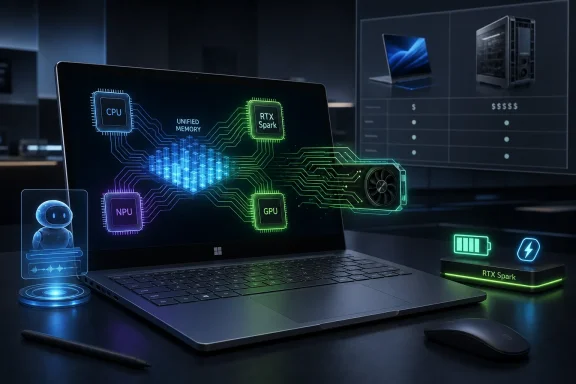
Nvidia unveiled RTX Spark on June 1, 2026, as an Arm-based Grace Blackwell “superchip” for Windows laptops and compact desktops, with Microsoft’s Surface Laptop Ultra among the first announced systems and availability from major PC makers expected later this year. The headline is not simply that Nvidia has entered the mainstream PC CPU fight. It is that Windows finally has a credible answer to the idea that the best high-end mobile workstation must be a MacBook Pro. But the answer arrives with a familiar Windows caveat: the silicon looks thrilling, while the software ecosystem now has to prove it can keep up.
For more than five years, Apple Silicon has defined what premium laptop buyers expect from a modern machine: long battery life, unified memory, quiet performance, strong media engines, and a developer platform that feels coherent rather than bolted together. Windows PCs have had faster gaming GPUs, broader hardware choice, and better enterprise manageability, but they have rarely had all of those qualities in one elegant package. RTX Spark is Nvidia’s attempt to make the Windows PC feel like one machine again.
Nvidia has been the most important PC performance company for decades, but it has usually sat beside the CPU rather than replacing it. Intel or AMD supplied the general-purpose engine, Nvidia supplied the graphics muscle, and the Windows laptop was designed around the thermal, electrical, and driver compromises of that split. RTX Spark changes that relationship.
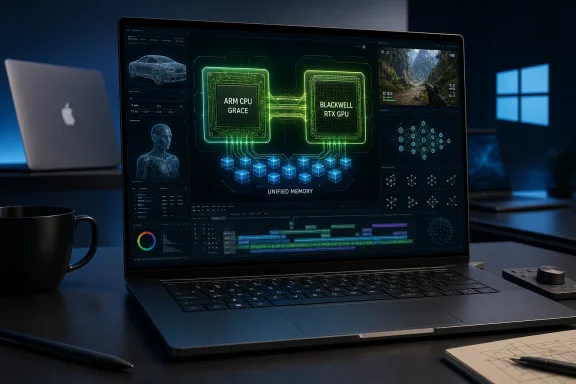
The chip combines a 20-core Arm-based Grace CPU with a Blackwell RTX GPU, fifth-generation Tensor Cores, and unified memory that can scale as high as 128GB. Nvidia is no longer asking laptop makers to reserve motherboard space, power budget, and cooling capacity for a discrete GPU alone. It is offering a vertically integrated platform that looks more like Apple’s M-series playbook than the traditional Wintel design.
That matters because the premium laptop market has been moving away from peak benchmark theater and toward sustained capability. Buyers who edit video, build software, train models, run virtualized environments, or render 3D scenes do not only care what a chip can do for 90 seconds. They care whether the machine remains fast on battery, whether memory is shared efficiently, whether fans scream under moderate load, and whether the laptop feels like a workstation or a science project.
Nvidia’s pitch is audacious: RTX Spark can reportedly run large AI models locally, handle enormous 3D scenes, edit 12K 4:2:2 video, and still play demanding games at high frame rates. Some of those claims need independent testing before they become more than launch-stage bravado. But the architecture points toward a real shift: Nvidia wants the Windows laptop to become a local AI workstation, creator machine, and gaming PC in one thin chassis.
Windows OEMs have spent years trying to answer that with familiar ingredients: Intel Core or AMD Ryzen CPUs, Nvidia discrete GPUs, high-refresh OLED panels, and increasingly aggressive cooling designs. Those machines can be brutally fast, especially when plugged in. But they often behave like two different computers depending on whether the charger is connected, and the battery-life gap has remained a daily annoyance for many buyers who want workstation performance without workstation rituals.
RTX Spark is Nvidia admitting that the MacBook Pro fight cannot be won with a faster GPU alone. The Windows ecosystem needs a platform-level answer, not another spec-sheet escalation. A unified memory pool matters because modern creative and AI workloads increasingly move large assets between CPU, GPU, and accelerator blocks. Every copy, every boundary, and every driver handoff becomes friction.
Apple has enjoyed the cleanest story here: buy the chip tier and memory tier you need, then let macOS and Apple’s pro apps use the hardware in a relatively predictable way. Nvidia’s counterargument is that Windows can now have a similar architectural story while keeping the advantages Apple does not offer: CUDA, RTX, DLSS, broader game support, workstation-class graphics software, and a hardware ecosystem that is not limited to one vendor’s laptop lineup.
That is the real MacBook Pro rivalry. It is not whether a Surface Laptop Ultra can win one benchmark on one day. It is whether Windows can offer the same feeling of integrated confidence without giving up the platform breadth that made Windows dominant in the first place.
The Surface Laptop Ultra, as described so far, is aimed squarely at the premium creator and developer tier: a 15-inch mini-LED touchscreen, up to 128GB of unified memory, a large haptic trackpad, HDMI, USB-C, USB-A, an SD card reader, and a design brief that clearly values professional workflows over minimal-port fashion. That port selection alone feels like a quiet rebuke to years of premium-laptop austerity. Creators still use cameras, displays, capture devices, external drives, and peripherals; pretending everything is one cable away from perfection has never matched the reality of a production desk.
The mini-LED display is equally important. Microsoft has built beautiful Surface screens before, but the MacBook Pro’s display has been one of its strongest practical advantages: bright HDR, strong contrast, and a panel that feels designed for people who actually stare at footage and timelines all day. If the Surface Laptop Ultra’s claimed brightness and panel quality hold up, Microsoft is finally treating the screen as part of the workstation story rather than a luxury checkbox.
Still, the Surface Laptop Ultra will carry a burden no spec sheet can lift by itself. Microsoft’s recent Surface strategy has been uneven, pulled between consumer elegance, enterprise manageability, repairability promises, Arm experiments, and Copilot branding. A flagship Nvidia-powered Surface has to do more than look like a MacBook Pro rival. It has to convince professionals that Microsoft can sustain the platform long enough for software vendors, driver teams, and IT departments to trust it.
Unified memory has become a defining feature of Apple Silicon because it lets the system treat memory less like a set of fenced-off territories. In traditional Windows creator laptops, system RAM and VRAM are separate resources. That works well for many games and conventional applications, but it becomes less elegant as assets grow and workflows become more heterogeneous. AI models, high-resolution video, 3D environments, and multimodal applications all benefit when large pools of memory can be used flexibly.
A configuration with up to 128GB of unified memory is particularly striking because it addresses a pain point that discrete laptop GPUs rarely solve cleanly. Even high-end mobile GPUs often ship with VRAM limits that are fine for games but restrictive for local AI workloads or large professional scenes. A laptop that can expose a much larger shared pool to CPU and GPU tasks changes what “mobile workstation” can mean.
There will be limits, and they will matter. Unified memory is not magic; bandwidth, latency, allocation policy, operating system behavior, and application support all determine whether the theoretical advantage becomes practical speed. Apple’s success came not just from hardware design but from controlling the operating system, developer tools, and first-party media frameworks. Nvidia and Microsoft have a more complicated job because Windows must serve decades of software assumptions.
But the direction is right. Windows laptops have needed a memory architecture that feels designed for modern hybrid workloads rather than retrofitted around them. RTX Spark is the first Windows PC platform in years that appears to attack the problem at the right level.
That is a much more interesting proposition. Local AI matters when latency, privacy, cost, or offline access matter. Developers want to test models without renting every experiment from a cloud provider. Enterprises want agents that can interact with documents, applications, and workflows under stricter control. Creators want generative and assistive tools that do not turn every edit into a network transaction.
Microsoft’s language around agentic AI and new Windows primitives suggests the company understands that hardware is only part of the challenge. If local agents are going to operate across applications and files, Windows needs permission models, sandboxing, identity, logging, and capability boundaries that are more serious than a consumer chatbot bolted to the taskbar. The term agent becomes dangerous the moment software can take action rather than merely answer.
Nvidia has the accelerator story. Microsoft has the operating system surface area. The question is whether they can jointly build a model that feels powerful without feeling reckless. Enterprise administrators will not accept magical assistants that quietly crawl file shares, invoke applications, or automate workflows without auditable controls. If RTX Spark makes local agents practical, Windows security architecture becomes the main event.
But RTX Spark is not simply a gaming laptop chip. In fact, the most interesting RTX Spark systems may not look like gaming laptops at all. The Surface Laptop Ultra, Dell XPS-style creator machines, Asus ProArt devices, Lenovo Yoga-class systems, and compact desktops are aimed at buyers who want GPU acceleration without the gamer aesthetic or the thermal compromises that often come with it.
That distinction matters for WindowsForum readers because it suggests a widening of the high-performance PC category. For years, if you wanted serious GPU power in a laptop, you often had to buy something thick, loud, RGB-lit, or workstation-priced. RTX Spark could let OEMs build machines that are professional first and gaming-capable second.
The risk is expectation management. Nvidia’s RTX brand carries gaming assumptions, and buyers will expect compatibility with anti-cheat systems, game launchers, drivers, external displays, capture tools, and performance overlays. An Arm-based Windows platform complicates that, especially for legacy software and kernel-level game components. Nvidia and Microsoft can solve many of these problems, but they cannot wish away the long tail of Windows software.
RTX Spark changes the perception of Arm on Windows because it attaches the architecture to a performance story rather than a compromise story. Instead of asking users to accept Arm for better battery life while hoping their apps behave, Nvidia is presenting Arm as the foundation for a high-end workstation-class Windows machine. That is a very different sales pitch.
The CPU itself still needs scrutiny. A 20-core Grace design sounds formidable, but real-world CPU performance will depend on core mix, clocks, cache, power behavior, compiler support, and how Windows schedules work across the chip. Apple’s advantage has never been only that its cores are Arm-based; it is that Apple’s CPU cores have been exceptionally strong, and macOS is tuned around them.
Windows also needs to continue improving x86 compatibility and native Arm app availability. Creative software vendors have incentives to optimize for RTX Spark if the hardware ships in meaningful volume, but incentives are not the same as finished software. Adobe’s promise to optimize Photoshop and Premiere is important because it signals that large vendors are paying attention. The proof will come when plug-ins, codecs, extensions, drivers, and background tools behave like first-class citizens rather than edge cases.
CUDA gives Nvidia a huge advantage. Developers building AI and GPU-accelerated software already understand Nvidia’s stack, and many workflows assume it. That is a major difference between RTX Spark and previous Windows-on-Arm experiments that had to argue from first principles. Nvidia does not need to invent a developer ecosystem from scratch; it needs to bring its existing ecosystem into a new PC form factor without breaking the parts professionals rely on.
Still, compatibility will be the watchword. A Windows laptop for creators is not just Photoshop and Premiere. It is color calibration tools, printer utilities, camera tethering apps, DAWs, VST plug-ins, CAD packages, render engines, storage drivers, VPN clients, endpoint security agents, and ten-year-old helper utilities nobody remembers until they fail. The more premium the laptop, the less tolerance buyers have for “coming soon.”
The same is true for IT. A Surface Laptop Ultra may excite executives and creative departments, but enterprise deployment depends on firmware update policies, driver packaging, Autopilot behavior, device management, repair channels, security baselines, and long-term support promises. Apple has earned a place in many enterprises partly because its hardware-software stack is predictable. Microsoft and Nvidia have to make RTX Spark predictable, not merely impressive.
The promise is clear. An integrated Arm-based platform should be more efficient at idle and light workloads than a traditional high-performance laptop with a discrete GPU waiting in the wings. If Nvidia can let the system sip power during writing, browsing, email, and video calls, then ramp aggressively for rendering, gaming, and local inference, Windows laptops gain a MacBook-like behavioral model without sacrificing RTX-class acceleration.
The ambiguity is equally clear. Performance laptops often have excellent battery life until the moment users do the thing they bought them to do. Local AI inference, 3D rendering, high-frame-rate gaming, and 12K editing are not gentle tasks. If RTX Spark offers long battery life during office work but drains quickly during sustained GPU loads, that is not a failure; it is physics. But it must be marketed honestly.
Apple’s advantage has been that its pro laptops remain surprisingly usable under serious battery-powered workloads, even when performance drops from wall-powered peaks. Surface Laptop Ultra will be judged by that standard. Reviewers should test it unplugged, under sustained loads, with real applications, external media, and realistic screen brightness. Anything less will miss the point of the machine.
Each vendor will likely interpret RTX Spark differently. Asus can aim at ProArt creators. Dell can position it against MacBook Pro and mobile workstation buyers. HP can fold it into its creator and enterprise workstation lines. Lenovo can chase developers and design professionals. MSI can blur the line between studio and gaming hardware. Microsoft gets to define the aspirational Windows version.
This is where Windows has an advantage Apple cannot easily copy. Apple’s integration is elegant, but the hardware menu is narrow. Windows OEMs can experiment with screen sizes, repairability, ports, cooling systems, convertible designs, pen support, compact desktops, and workstation certifications. If RTX Spark becomes a shared platform rather than a one-off chip, the ecosystem can explore form factors Apple will not.
The danger is fragmentation. Windows OEMs have a habit of taking a promising platform and scattering it across confusing SKUs, uneven cooling designs, inconsistent driver support, and price tiers that obscure the original idea. RTX Spark needs flagship discipline. A thin machine that throttles too aggressively, a cheap panel paired with expensive silicon, or a driver cadence that varies by vendor would weaken the whole story.
That is not automatically a problem. Professional buyers pay for machines that save time, replace desktops, or enable work on location. A laptop that can handle large local AI models, GPU-accelerated creative workloads, and high-end gaming in one chassis has a plausible premium-market argument. The issue is whether the price buys reliability and maturity or merely early-adopter status.
Apple’s high-end MacBook Pros are expensive, but they are also known quantities. Buyers understand the trade-offs: excellent battery life and media workflows, limited gaming, expensive memory upgrades, few repair options, and macOS ecosystem constraints. RTX Spark machines will enter with a different bargain: more GPU ecosystem breadth, Windows compatibility, local AI ambition, and potentially better port flexibility, balanced against Arm transition uncertainty.
If pricing lands too close to mobile workstations without workstation predictability, buyers may hesitate. If pricing undercuts comparable MacBook Pro configurations while delivering credible performance and battery life, Nvidia and Microsoft will have something far more dangerous than a halo device. They will have a reason for premium Windows buyers to stop apologizing for choosing Windows.
Windows on Arm has improved, but enterprise environments are full of assumptions. Endpoint detection tools, VPN clients, smart card middleware, device control agents, backup utilities, and compliance software often burrow deep into the system. If these tools are not native, performant, and supported on RTX Spark systems, IT departments will classify the machines as special-case devices for special-case users.
That may still be enough at first. Creative teams, AI developers, executives, and technical leads often receive specialized hardware. But Microsoft’s broader ambition for agentic Windows PCs requires trust at scale. Local AI agents interacting with business data will demand policy controls that are legible to administrators, not just magical to users.
The Surface brand can help here if Microsoft treats Surface Laptop Ultra as an enterprise product rather than a boutique creator machine. Firmware lifecycle commitments, documented deployment guidance, repairability, management templates, and clear security boundaries will matter. The MacBook Pro became an enterprise staple partly because it stopped feeling exotic. RTX Spark has to make the same journey.
Cloud AI has made Nvidia fabulously powerful, but it has also taught users that advanced AI happens somewhere else. RTX Spark brings that compute narrative back to the desk, the studio, the hotel room, and the developer’s backpack. Local inference will not replace cloud training or large-scale deployment, but it can change how professionals prototype, automate, and interact with private data.
Apple is the other pole. Its hardware has made a generation of creators comfortable with the idea that one tightly integrated chip can define the laptop experience. Nvidia is now saying Windows can have that too, without giving up the software and hardware diversity that professionals expect from PCs.
Intel and AMD are not bystanders, of course. Both have strong roadmaps, NPUs, integrated graphics ambitions, and deep relationships across the PC market. Qualcomm also remains a serious Windows-on-Arm player. But RTX Spark gives Nvidia something none of those companies can easily replicate: the combination of high-end GPU credibility, CUDA gravity, AI developer mindshare, and consumer RTX recognition.
That means testing native Arm applications and emulated x86 workloads. It means comparing plugged-in and battery performance. It means measuring fan noise, skin temperature, idle drain, sleep behavior, external monitor handling, dock compatibility, and performance over long renders. It means running real AI models locally, not just vendor-approved demos.
It also means testing the boring things. Does the SD card reader perform well? Do USB-A audio interfaces behave? Do color tools work? Can a developer run containers, compilers, databases, and AI tooling without stepping on compatibility landmines? Does Windows Update deliver drivers cleanly? Does the machine wake from sleep like a premium laptop should?
The MacBook Pro became a benchmark not because every buyer loves macOS, but because it made many of these questions feel settled. RTX Spark will be taken seriously when it makes Windows feel settled in the same way.
For more than five years, Apple Silicon has defined what premium laptop buyers expect from a modern machine: long battery life, unified memory, quiet performance, strong media engines, and a developer platform that feels coherent rather than bolted together. Windows PCs have had faster gaming GPUs, broader hardware choice, and better enterprise manageability, but they have rarely had all of those qualities in one elegant package. RTX Spark is Nvidia’s attempt to make the Windows PC feel like one machine again.
 Nvidia Stops Being the Add-In Card and Starts Becoming the PC
Nvidia has been the most important PC performance company for decades, but it has usually sat beside the CPU rather than replacing it. Intel or AMD supplied the general-purpose engine, Nvidia supplied the graphics muscle, and the Windows laptop was designed around the thermal, electrical, and driver compromises of that split. RTX Spark changes that relationship.The chip combines a 20-core Arm-based Grace CPU with a Blackwell RTX GPU, fifth-generation Tensor Cores, and unified memory that can scale as high as 128GB. Nvidia is no longer asking laptop makers to reserve motherboard space, power budget, and cooling capacity for a discrete GPU alone. It is offering a vertically integrated platform that looks more like Apple’s M-series playbook than the traditional Wintel design.
That matters because the premium laptop market has been moving away from peak benchmark theater and toward sustained capability. Buyers who edit video, build software, train models, run virtualized environments, or render 3D scenes do not only care what a chip can do for 90 seconds. They care whether the machine remains fast on battery, whether memory is shared efficiently, whether fans scream under moderate load, and whether the laptop feels like a workstation or a science project.
Nvidia’s pitch is audacious: RTX Spark can reportedly run large AI models locally, handle enormous 3D scenes, edit 12K 4:2:2 video, and still play demanding games at high frame rates. Some of those claims need independent testing before they become more than launch-stage bravado. But the architecture points toward a real shift: Nvidia wants the Windows laptop to become a local AI workstation, creator machine, and gaming PC in one thin chassis.
The MacBook Pro Target Is Obvious Because Apple Changed the Rules
The reason every RTX Spark laptop will be compared to the MacBook Pro is not because Apple invented high-performance notebooks. It is because Apple redefined the premium laptop as a tightly integrated compute appliance where CPU, GPU, neural acceleration, media engines, and memory architecture are treated as one system.Windows OEMs have spent years trying to answer that with familiar ingredients: Intel Core or AMD Ryzen CPUs, Nvidia discrete GPUs, high-refresh OLED panels, and increasingly aggressive cooling designs. Those machines can be brutally fast, especially when plugged in. But they often behave like two different computers depending on whether the charger is connected, and the battery-life gap has remained a daily annoyance for many buyers who want workstation performance without workstation rituals.
RTX Spark is Nvidia admitting that the MacBook Pro fight cannot be won with a faster GPU alone. The Windows ecosystem needs a platform-level answer, not another spec-sheet escalation. A unified memory pool matters because modern creative and AI workloads increasingly move large assets between CPU, GPU, and accelerator blocks. Every copy, every boundary, and every driver handoff becomes friction.
Apple has enjoyed the cleanest story here: buy the chip tier and memory tier you need, then let macOS and Apple’s pro apps use the hardware in a relatively predictable way. Nvidia’s counterargument is that Windows can now have a similar architectural story while keeping the advantages Apple does not offer: CUDA, RTX, DLSS, broader game support, workstation-class graphics software, and a hardware ecosystem that is not limited to one vendor’s laptop lineup.
That is the real MacBook Pro rivalry. It is not whether a Surface Laptop Ultra can win one benchmark on one day. It is whether Windows can offer the same feeling of integrated confidence without giving up the platform breadth that made Windows dominant in the first place.
Surface Laptop Ultra Is Microsoft’s Most Serious Hardware Statement in Years
Microsoft’s Surface Laptop Ultra is the symbolic center of the launch because Surface has always been where Microsoft tells the PC industry what kind of Windows machine it wants to exist. Sometimes the industry listens. Sometimes it politely nods and keeps selling black rectangles with function keys.The Surface Laptop Ultra, as described so far, is aimed squarely at the premium creator and developer tier: a 15-inch mini-LED touchscreen, up to 128GB of unified memory, a large haptic trackpad, HDMI, USB-C, USB-A, an SD card reader, and a design brief that clearly values professional workflows over minimal-port fashion. That port selection alone feels like a quiet rebuke to years of premium-laptop austerity. Creators still use cameras, displays, capture devices, external drives, and peripherals; pretending everything is one cable away from perfection has never matched the reality of a production desk.
The mini-LED display is equally important. Microsoft has built beautiful Surface screens before, but the MacBook Pro’s display has been one of its strongest practical advantages: bright HDR, strong contrast, and a panel that feels designed for people who actually stare at footage and timelines all day. If the Surface Laptop Ultra’s claimed brightness and panel quality hold up, Microsoft is finally treating the screen as part of the workstation story rather than a luxury checkbox.
Still, the Surface Laptop Ultra will carry a burden no spec sheet can lift by itself. Microsoft’s recent Surface strategy has been uneven, pulled between consumer elegance, enterprise manageability, repairability promises, Arm experiments, and Copilot branding. A flagship Nvidia-powered Surface has to do more than look like a MacBook Pro rival. It has to convince professionals that Microsoft can sustain the platform long enough for software vendors, driver teams, and IT departments to trust it.
Unified Memory Is the Feature Windows Needed to Take Seriously
The most important RTX Spark specification may not be the CUDA core count. It may be the memory model.Unified memory has become a defining feature of Apple Silicon because it lets the system treat memory less like a set of fenced-off territories. In traditional Windows creator laptops, system RAM and VRAM are separate resources. That works well for many games and conventional applications, but it becomes less elegant as assets grow and workflows become more heterogeneous. AI models, high-resolution video, 3D environments, and multimodal applications all benefit when large pools of memory can be used flexibly.
A configuration with up to 128GB of unified memory is particularly striking because it addresses a pain point that discrete laptop GPUs rarely solve cleanly. Even high-end mobile GPUs often ship with VRAM limits that are fine for games but restrictive for local AI workloads or large professional scenes. A laptop that can expose a much larger shared pool to CPU and GPU tasks changes what “mobile workstation” can mean.
There will be limits, and they will matter. Unified memory is not magic; bandwidth, latency, allocation policy, operating system behavior, and application support all determine whether the theoretical advantage becomes practical speed. Apple’s success came not just from hardware design but from controlling the operating system, developer tools, and first-party media frameworks. Nvidia and Microsoft have a more complicated job because Windows must serve decades of software assumptions.
But the direction is right. Windows laptops have needed a memory architecture that feels designed for modern hybrid workloads rather than retrofitted around them. RTX Spark is the first Windows PC platform in years that appears to attack the problem at the right level.
The AI PC Finally Gets a Workload That Is Not a Demo
The phrase “AI PC” has been abused into near-uselessness. For much of the past two years, it has meant an NPU strong enough to satisfy a marketing requirement, a Copilot key, and a promise that future software will justify today’s purchase. RTX Spark is different because Nvidia’s AI pitch is not primarily about background blur, summarization widgets, or small convenience features. It is about running serious local models and agentic workflows on hardware that fits in a laptop.That is a much more interesting proposition. Local AI matters when latency, privacy, cost, or offline access matter. Developers want to test models without renting every experiment from a cloud provider. Enterprises want agents that can interact with documents, applications, and workflows under stricter control. Creators want generative and assistive tools that do not turn every edit into a network transaction.
Microsoft’s language around agentic AI and new Windows primitives suggests the company understands that hardware is only part of the challenge. If local agents are going to operate across applications and files, Windows needs permission models, sandboxing, identity, logging, and capability boundaries that are more serious than a consumer chatbot bolted to the taskbar. The term agent becomes dangerous the moment software can take action rather than merely answer.
Nvidia has the accelerator story. Microsoft has the operating system surface area. The question is whether they can jointly build a model that feels powerful without feeling reckless. Enterprise administrators will not accept magical assistants that quietly crawl file shares, invoke applications, or automate workflows without auditable controls. If RTX Spark makes local agents practical, Windows security architecture becomes the main event.
Gaming Is the Familiar Hook, but Not the Whole Point
Nvidia knows how to sell performance to PC users, and gaming will be the easiest part of the RTX Spark story to understand. A Blackwell RTX GPU with thousands of CUDA cores, Tensor Cores, DLSS support, Reflex, and the broader RTX stack gives buyers a recognizable reason to care. The claim of high-end 1440p gaming above 100 frames per second is exactly the kind of number that travels well through product pages and YouTube thumbnails.But RTX Spark is not simply a gaming laptop chip. In fact, the most interesting RTX Spark systems may not look like gaming laptops at all. The Surface Laptop Ultra, Dell XPS-style creator machines, Asus ProArt devices, Lenovo Yoga-class systems, and compact desktops are aimed at buyers who want GPU acceleration without the gamer aesthetic or the thermal compromises that often come with it.
That distinction matters for WindowsForum readers because it suggests a widening of the high-performance PC category. For years, if you wanted serious GPU power in a laptop, you often had to buy something thick, loud, RGB-lit, or workstation-priced. RTX Spark could let OEMs build machines that are professional first and gaming-capable second.
The risk is expectation management. Nvidia’s RTX brand carries gaming assumptions, and buyers will expect compatibility with anti-cheat systems, game launchers, drivers, external displays, capture tools, and performance overlays. An Arm-based Windows platform complicates that, especially for legacy software and kernel-level game components. Nvidia and Microsoft can solve many of these problems, but they cannot wish away the long tail of Windows software.
Arm on Windows Gets Its Biggest Vote of Confidence Yet
Windows on Arm has had a long, frustrating history of almost-there moments. Qualcomm’s recent Snapdragon X push made the platform more credible for mainstream productivity, battery life, and thin-and-light laptops. But it did not fully address the high-performance creator and gaming tiers where Nvidia’s ecosystem has the strongest pull.RTX Spark changes the perception of Arm on Windows because it attaches the architecture to a performance story rather than a compromise story. Instead of asking users to accept Arm for better battery life while hoping their apps behave, Nvidia is presenting Arm as the foundation for a high-end workstation-class Windows machine. That is a very different sales pitch.
The CPU itself still needs scrutiny. A 20-core Grace design sounds formidable, but real-world CPU performance will depend on core mix, clocks, cache, power behavior, compiler support, and how Windows schedules work across the chip. Apple’s advantage has never been only that its cores are Arm-based; it is that Apple’s CPU cores have been exceptionally strong, and macOS is tuned around them.
Windows also needs to continue improving x86 compatibility and native Arm app availability. Creative software vendors have incentives to optimize for RTX Spark if the hardware ships in meaningful volume, but incentives are not the same as finished software. Adobe’s promise to optimize Photoshop and Premiere is important because it signals that large vendors are paying attention. The proof will come when plug-ins, codecs, extensions, drivers, and background tools behave like first-class citizens rather than edge cases.
The Software Stack Is Where This Launch Will Either Mature or Stall
The PC industry loves hardware leaps because they are easy to photograph and easy to compare. Software maturity is slower, messier, and less glamorous. RTX Spark’s success will depend on whether Windows, Nvidia drivers, Microsoft’s AI frameworks, creative applications, developer tools, and enterprise management systems converge quickly enough to make the platform feel finished.CUDA gives Nvidia a huge advantage. Developers building AI and GPU-accelerated software already understand Nvidia’s stack, and many workflows assume it. That is a major difference between RTX Spark and previous Windows-on-Arm experiments that had to argue from first principles. Nvidia does not need to invent a developer ecosystem from scratch; it needs to bring its existing ecosystem into a new PC form factor without breaking the parts professionals rely on.
Still, compatibility will be the watchword. A Windows laptop for creators is not just Photoshop and Premiere. It is color calibration tools, printer utilities, camera tethering apps, DAWs, VST plug-ins, CAD packages, render engines, storage drivers, VPN clients, endpoint security agents, and ten-year-old helper utilities nobody remembers until they fail. The more premium the laptop, the less tolerance buyers have for “coming soon.”
The same is true for IT. A Surface Laptop Ultra may excite executives and creative departments, but enterprise deployment depends on firmware update policies, driver packaging, Autopilot behavior, device management, repair channels, security baselines, and long-term support promises. Apple has earned a place in many enterprises partly because its hardware-software stack is predictable. Microsoft and Nvidia have to make RTX Spark predictable, not merely impressive.
Battery Life Is the Claim That Needs the Harshest Testing
“All-day battery life” is one of the most elastic phrases in the laptop business. It can mean a realistic workday of mixed professional use, or it can mean a controlled video playback loop with radios tamed, brightness reduced, and nothing resembling the workload shown in the launch video. RTX Spark’s power range, reportedly from single-digit watts up to around 80W, suggests both promise and ambiguity.The promise is clear. An integrated Arm-based platform should be more efficient at idle and light workloads than a traditional high-performance laptop with a discrete GPU waiting in the wings. If Nvidia can let the system sip power during writing, browsing, email, and video calls, then ramp aggressively for rendering, gaming, and local inference, Windows laptops gain a MacBook-like behavioral model without sacrificing RTX-class acceleration.
The ambiguity is equally clear. Performance laptops often have excellent battery life until the moment users do the thing they bought them to do. Local AI inference, 3D rendering, high-frame-rate gaming, and 12K editing are not gentle tasks. If RTX Spark offers long battery life during office work but drains quickly during sustained GPU loads, that is not a failure; it is physics. But it must be marketed honestly.
Apple’s advantage has been that its pro laptops remain surprisingly usable under serious battery-powered workloads, even when performance drops from wall-powered peaks. Surface Laptop Ultra will be judged by that standard. Reviewers should test it unplugged, under sustained loads, with real applications, external media, and realistic screen brightness. Anything less will miss the point of the machine.
PC Makers Now Have a New Premium Template
Nvidia says RTX Spark systems are coming from Asus, Dell, HP, Lenovo, Microsoft, MSI, and eventually Acer and Gigabyte. That breadth is important because one flagship Surface would be a curiosity; a broad OEM wave could become a category.Each vendor will likely interpret RTX Spark differently. Asus can aim at ProArt creators. Dell can position it against MacBook Pro and mobile workstation buyers. HP can fold it into its creator and enterprise workstation lines. Lenovo can chase developers and design professionals. MSI can blur the line between studio and gaming hardware. Microsoft gets to define the aspirational Windows version.
This is where Windows has an advantage Apple cannot easily copy. Apple’s integration is elegant, but the hardware menu is narrow. Windows OEMs can experiment with screen sizes, repairability, ports, cooling systems, convertible designs, pen support, compact desktops, and workstation certifications. If RTX Spark becomes a shared platform rather than a one-off chip, the ecosystem can explore form factors Apple will not.
The danger is fragmentation. Windows OEMs have a habit of taking a promising platform and scattering it across confusing SKUs, uneven cooling designs, inconsistent driver support, and price tiers that obscure the original idea. RTX Spark needs flagship discipline. A thin machine that throttles too aggressively, a cheap panel paired with expensive silicon, or a driver cadence that varies by vendor would weaken the whole story.
Price May Decide Whether This Is a Platform or a Trophy
The Surface Laptop Ultra has no announced price yet, but nobody should expect a bargain. A 15-inch mini-LED Surface with Nvidia’s new superchip, up to 128GB of unified memory, premium build, and professional positioning will likely live in the same psychological neighborhood as high-end MacBook Pro configurations and mobile workstations.That is not automatically a problem. Professional buyers pay for machines that save time, replace desktops, or enable work on location. A laptop that can handle large local AI models, GPU-accelerated creative workloads, and high-end gaming in one chassis has a plausible premium-market argument. The issue is whether the price buys reliability and maturity or merely early-adopter status.
Apple’s high-end MacBook Pros are expensive, but they are also known quantities. Buyers understand the trade-offs: excellent battery life and media workflows, limited gaming, expensive memory upgrades, few repair options, and macOS ecosystem constraints. RTX Spark machines will enter with a different bargain: more GPU ecosystem breadth, Windows compatibility, local AI ambition, and potentially better port flexibility, balanced against Arm transition uncertainty.
If pricing lands too close to mobile workstations without workstation predictability, buyers may hesitate. If pricing undercuts comparable MacBook Pro configurations while delivering credible performance and battery life, Nvidia and Microsoft will have something far more dangerous than a halo device. They will have a reason for premium Windows buyers to stop apologizing for choosing Windows.
The Enterprise Angle Is Not Glamorous, but It Is Decisive
For WindowsForum’s sysadmin audience, the RTX Spark announcement is less about whether a Surface can dunk on a MacBook in a launch demo and more about whether this new class of machine can be deployed without creating another support island. Premium hardware becomes painful when it requires bespoke images, unusual driver workflows, unsupported security tools, or app compatibility exceptions.Windows on Arm has improved, but enterprise environments are full of assumptions. Endpoint detection tools, VPN clients, smart card middleware, device control agents, backup utilities, and compliance software often burrow deep into the system. If these tools are not native, performant, and supported on RTX Spark systems, IT departments will classify the machines as special-case devices for special-case users.
That may still be enough at first. Creative teams, AI developers, executives, and technical leads often receive specialized hardware. But Microsoft’s broader ambition for agentic Windows PCs requires trust at scale. Local AI agents interacting with business data will demand policy controls that are legible to administrators, not just magical to users.
The Surface brand can help here if Microsoft treats Surface Laptop Ultra as an enterprise product rather than a boutique creator machine. Firmware lifecycle commitments, documented deployment guidance, repairability, management templates, and clear security boundaries will matter. The MacBook Pro became an enterprise staple partly because it stopped feeling exotic. RTX Spark has to make the same journey.
Nvidia’s Real Competition Is Not Intel or AMD Alone
It is tempting to frame RTX Spark as Nvidia attacking Intel and AMD. That is partly true. If Nvidia can sell the central compute platform in premium Windows machines, it captures value that historically flowed through CPU vendors. But the more important competition is against cloud dependency and Apple’s integrated model.Cloud AI has made Nvidia fabulously powerful, but it has also taught users that advanced AI happens somewhere else. RTX Spark brings that compute narrative back to the desk, the studio, the hotel room, and the developer’s backpack. Local inference will not replace cloud training or large-scale deployment, but it can change how professionals prototype, automate, and interact with private data.
Apple is the other pole. Its hardware has made a generation of creators comfortable with the idea that one tightly integrated chip can define the laptop experience. Nvidia is now saying Windows can have that too, without giving up the software and hardware diversity that professionals expect from PCs.
Intel and AMD are not bystanders, of course. Both have strong roadmaps, NPUs, integrated graphics ambitions, and deep relationships across the PC market. Qualcomm also remains a serious Windows-on-Arm player. But RTX Spark gives Nvidia something none of those companies can easily replicate: the combination of high-end GPU credibility, CUDA gravity, AI developer mindshare, and consumer RTX recognition.
The First Reviews Must Ignore the Hype and Test the New Contract
The launch claims are big enough that reviewers should resist the usual benchmark buffet. RTX Spark needs to be evaluated against the contract it is implicitly making with buyers: that a Windows laptop can now behave like a unified high-end workstation rather than a collection of powerful parts.That means testing native Arm applications and emulated x86 workloads. It means comparing plugged-in and battery performance. It means measuring fan noise, skin temperature, idle drain, sleep behavior, external monitor handling, dock compatibility, and performance over long renders. It means running real AI models locally, not just vendor-approved demos.
It also means testing the boring things. Does the SD card reader perform well? Do USB-A audio interfaces behave? Do color tools work? Can a developer run containers, compilers, databases, and AI tooling without stepping on compatibility landmines? Does Windows Update deliver drivers cleanly? Does the machine wake from sleep like a premium laptop should?
The MacBook Pro became a benchmark not because every buyer loves macOS, but because it made many of these questions feel settled. RTX Spark will be taken seriously when it makes Windows feel settled in the same way.
The RTX Spark Era Begins With Promises Windows Users Can Actually Measure
This launch is exciting because its claims are concrete enough to be tested and broad enough to matter. Nvidia and Microsoft are not merely promising a smarter assistant or a faster benchmark. They are offering a different shape for the premium Windows PC.- RTX Spark gives Windows laptops a credible unified-memory, Arm-based, GPU-heavy platform aimed directly at Apple Silicon’s strongest territory.
- Surface Laptop Ultra is Microsoft’s clearest attempt in years to define a no-excuses flagship for creators, developers, AI users, and premium laptop buyers.
- The platform’s AI claims will matter only if Windows can provide secure, manageable agent frameworks instead of another layer of loosely governed automation.
- Gaming performance may attract attention, but professional software compatibility will decide whether RTX Spark becomes a durable workstation platform.
- Battery life, thermals, and sustained unplugged performance should be treated as first-order review criteria, not secondary lifestyle details.
- Enterprise adoption will depend on driver maturity, Arm-native management tools, security controls, and Microsoft’s willingness to support the platform like infrastructure rather than fashion.
References
- Primary source: How-To Geek
Published: Mon, 01 Jun 2026 14:48:12 GMT
Nvidia's RTX Spark finally delivers the MacBook Pro rival Windows needed
The Surface Laptop Ultra will be Microsoft's rival to the MacBook Pro. www.howtogeek.com
- Related coverage: axios.com
Microsoft debuts Nvidia-powered Microsoft Surface Ultra laptop
Microsoft is trying again to redefine the PC for the AI era.www.axios.com
- Related coverage: nvidia.com
NVIDIA RTX Spark — Slim Laptops & Small Desktops
The fusion of NVIDIA AI and RTX graphics in slim laptops and small desktops. For creators, developers, and gamers.www.nvidia.com - Related coverage: tomshardware.com
- Related coverage: techspot.com
Nvidia RTX Spark CPU is now official: "superchip" will power Windows laptops and desktops | TechSpot
Ryan Shrout is a longtime technology analyst and industry veteran who has spent over two decades covering PC hardware, graphics, and semiconductors. He previously led technical marketing...www.techspot.com - Related coverage: macrumors.com
Nvidia Challenges Apple Silicon With New RTX Spark PC Chip
Nvidia is entering the consumer PC chip business for the first time and has thrown down the gauntlet to Apple, describing its new RTX Spark processor as "the most efficient PC chip ever built". Nvidia says its RTX Spark Superchip is purpose-built to run AI agents that can work proactively across...www.macrumors.com
- Related coverage: windowslatest.com
Microsoft builds its ultimate MacBook Pro rival with the NVIDIA powered Surface Laptop Ultra
Microsoft launches the Surface Laptop Ultra with an NVIDIA RTX Spark chip and 128GB unified memory to challenge Apple MacBook Pro dominance. www.windowslatest.com
- Related coverage: gizmochina.com
Microsoft announces Surface Laptop Ultra with NVIDIA RTX Spark and its brightest display yet
Microsoft Surface Laptop Ultra launches with 2000-nit display, NVIDIA RTX Spark, 128GB RAM, and big Windows 11 upgrades. www.gizmochina.com
- Related coverage: gadgets360.com
Microsoft Surface Laptop Ultra Announced With Blackwell RTX GPU, Nvidia RTX Spark Superchip | Technology News
Microsoft Surface Laptop Ultra was announced on Sunday as the company’s most powerful Surface laptop ever built.www.gadgets360.com - Related coverage: dataconomy.com
Microsoft introduces powerhouse Surface Laptop Ultra with NVIDIA RTX Spark
Microsoft has introduced the Surface Laptop Ultra, the latest iteration of its Surface line, featuring NVIDIA's RTX Spark system-on-a-chip, aimeddataconomy.com - Related coverage: tuttotech.net
Surface Laptop Ultra ufficiale: il laptop ultra potente di Microsoft con NVIDIA RTX Spark
Microsoft e NVIDIA hanno presentato il Surface Laptop Ultra al Computex 2026: chip RTX Spark con architettura unificata, fino a 128 GB di RAM condivisa e 1 petaflop di potenza AI in meno di 18 mm di spessore.www.tuttotech.net - Related coverage: tweakers.net
Microsofts krachtigste Surface Laptop heeft RTX Spark-cpu en 15"-miniledscherm
Microsoft heeft de Surface Laptop Ultra aangekondigd. Deze is uitgerust met een krachtige Nvidia RTX Spark-processor. Ook heeft de laptop een nieuw 15"-miniledscherm van eigen stal. Veel informatie ontbreekt nog, waaronder een prijs en releasedatum.tweakers.net
- Related coverage: tomsguide.com
Microsoft’s Surface Laptop Ultra packs an Nvidia Spark chip — and it could be a MacBook Pro killer | Tom's Guide
During Computex 2026, we got our first details of the new Microsoft Surface Laptop Ultra. Here's everything you need to know.www.tomsguide.com - Related coverage: fudzilla.com
- Related coverage: signal65.com
- Related coverage: ltec-biz.com
25R 0698 15AI Computer Nvidia GB10 Grace Blackwell in NVIDIA DGX Spark Package and Main PCB detailed analysis
PDF documentwww.ltec-biz.com
- Related coverage: tdsynnex.com
- Related coverage: docs.nvidia.com
- Related coverage: static.rainfocus.com
S74680 DGX Spark Your Personal AI Supercomputer 1742663788098001fVwr
PDF documentstatic.rainfocus.com
- Related coverage: images.nvidia.com
</rdf:Alt> </dc:title> <dc:description> <rdf:Alt> <rdf:li xml:lang="x-default"/> </rdf:Alt> </dc:description> <dc:creator> <rdf:Seq> <rdf:li>Nick St
</rdf:Alt> </dc:description> <dc:creator> <rdf:Seq> <rdf:li>Nick Stamimages.nvidia.com