

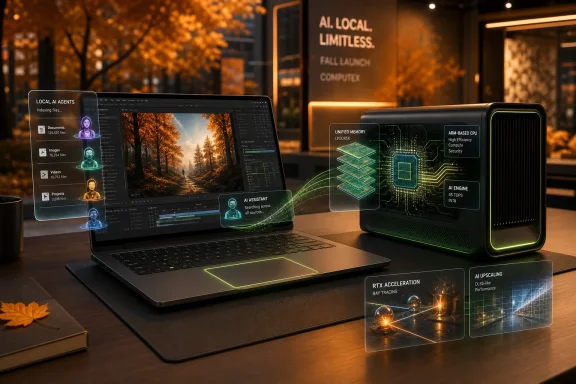
MediaTek and NVIDIA announced RTX Spark at Computex 2026 as an Arm-based Windows 11 PC platform combining a MediaTek-influenced CPU design, NVIDIA Blackwell-class RTX graphics, up to 128GB of unified memory, and local AI performance for laptops and compact desktops arriving this fall. The headline is not simply that NVIDIA wants into the PC processor business. It is that Windows is getting another serious attempt at a vertically optimized, AI-first hardware stack outside the Intel-and-AMD default. If Microsoft, NVIDIA, and MediaTek can make the software layer feel boringly reliable, RTX Spark could become the most consequential Windows-on-Arm test since Qualcomm’s Snapdragon X launch.
For decades, NVIDIA’s role in the Windows PC was glamorous but bounded. It sold the GPU, owned the gaming frame-rate conversation, powered professional visualization, and increasingly supplied the accelerator behind AI workloads. But the rest of the machine—the CPU, platform controller, memory hierarchy, and power behavior—belonged to someone else.
RTX Spark changes that power map. NVIDIA is now pitching a complete PC compute platform, not just a graphics option that an OEM bolts beside an Intel or AMD processor. The company’s language around “personal AI agents” is predictably grand, but the underlying move is concrete: bring NVIDIA’s AI and graphics stack closer to the CPU, closer to memory, and closer to Windows itself.
That matters because the AI PC story has been muddled. Intel, AMD, and Qualcomm have all described neural processing units as the next mandatory PC block, while most users still struggle to name the local AI workload they cannot live without. NVIDIA is making a different bet. Rather than treating AI acceleration as one small tile on a general-purpose client SoC, it is putting RTX-class graphics and AI horsepower at the center of the machine.
MediaTek’s role is equally important, even if NVIDIA will absorb most of the oxygen. MediaTek brings low-power SoC design experience, connectivity integration, and the kind of platform discipline required to make thin laptops behave like consumer electronics rather than portable space heaters. For Windows users, that is the part that separates a compelling demo from a daily driver.
RTX Spark reframes the category around a more understandable proposition: a Windows machine with enough local compute and memory to run heavier AI models, creator workflows, and games without always reaching for a cloud endpoint. That is a cleaner story than “this laptop has 45 TOPS,” because users already understand RTX as shorthand for acceleration they can feel. The question becomes whether NVIDIA can extend that trust from graphics into the whole PC.
The unified memory figure is central to the pitch. Up to 128GB of shared system memory gives AI developers and creative professionals room to run larger local workloads than the typical thin-and-light laptop can support. It also lets NVIDIA talk about the PC as a local inference box, not merely a client waiting for Azure, OpenAI, or another cloud service to do the hard work.
But the risk is obvious. Local AI remains an uneven experience across Windows applications. Some workloads benefit enormously from GPU acceleration, some are still glued to cloud APIs, and some are demos in search of a user habit. RTX Spark gives the ecosystem a much larger target to build against, but hardware cannot by itself create the killer workflow.
RTX Spark gives MediaTek a shortcut into the high end. Instead of trying to sell PC buyers on MediaTek as the main brand, the platform arrives under NVIDIA’s halo and Microsoft’s blessing. That is a strategically elegant arrangement: MediaTek supplies much of the platform craft, NVIDIA supplies the performance mythology, and OEMs get a new premium story to tell.
The collaboration also reflects a broader industry shift. PC silicon is moving away from interchangeable components and toward tightly coupled platforms where CPU, GPU, memory, firmware, power management, and AI software are designed as one experience. Apple proved the commercial power of that approach with Apple Silicon. Qualcomm adapted the playbook for Windows-on-Arm. NVIDIA and MediaTek are now attempting a version built around RTX identity and AI acceleration.
For MediaTek, the upside is bigger than one chip. If RTX Spark systems ship from major vendors and land credibly in reviews, MediaTek becomes part of the premium Windows conversation almost overnight. If the platform stumbles on compatibility, battery life, driver behavior, or pricing, the old hierarchy will reassert itself quickly.
Qualcomm’s Snapdragon X machines helped move the conversation forward by making Arm laptops feel less like science projects. Battery life improved, performance became competitive in many everyday tasks, and native app support expanded. But gaming and high-end creator workflows remained difficult terrain, precisely the areas where NVIDIA has the strongest brand.
That is why RTX Spark is interesting. NVIDIA is not entering Windows-on-Arm from the productivity-notebook end of the pool. It is coming in through graphics, CUDA-adjacent developer mindshare, AI acceleration, and creator software. If it can make that stack work on Arm Windows with minimal caveats, it changes the perceived limits of the category.
The “if” is doing a lot of work. Windows gamers are a compatibility tribunal with little patience for architectural excuses. Creators are not kinder; they care whether plug-ins load, exports finish, color pipelines behave, and external hardware works. Sysadmins care whether deployment tools, endpoint security agents, VPN clients, and line-of-business software survive contact with a new platform. RTX Spark’s success will depend less on keynote claims than on this tedious, essential substrate.
The danger is that gamers compare products brutally. A thin RTX Spark laptop will not be judged against an abstract AI future; it will be judged against current GeForce laptops, AMD Strix-class systems, Intel-based designs, handheld PCs, and desktops that cost less and run everything. If NVIDIA promises too much, the brand advantage becomes a liability.
There is also the question of what “RTX graphics” means in a fully integrated SoC context. A discrete GPU with its own memory and thermal budget is one thing. A unified-memory, power-constrained laptop platform is another. NVIDIA can do extraordinary things with efficiency, but physics still collects its tax.
The more credible gaming argument may be sustained performance per watt rather than absolute frame-rate dominance. If RTX Spark can make a 14mm laptop play modern titles smoothly at sane settings while also serving as a serious AI and creator machine, that is a real product category. If it is marketed as a no-compromise gaming monster, disappointment will arrive right on schedule.
RTX Spark fits that agenda neatly. NVIDIA can argue that personal agents should not always wait on a data center, Microsoft can argue that Windows is becoming more proactive and context-aware, and OEMs can argue that premium hardware now has a fresh purpose. Everyone gets a strategic story.
But local AI also creates new governance problems. A personal agent that can search files, automate applications, summarize private material, and act across a system is not just a faster chatbot. It is a new layer of authority inside the PC. For WindowsForum readers, that should trigger healthy skepticism about permissions, auditability, data retention, and the ability to disable features cleanly.
The best version of RTX Spark is not a machine that constantly guesses what the user wants. It is a machine with enough local intelligence to help when invited, stay quiet when not needed, and make its boundaries visible. Microsoft has learned the hard way that trust is easy to lose when AI features feel surveillant or irreversible.
Arm architecture remains the first checkpoint. Organizations with modern cloud-managed environments may be able to absorb another architecture more easily than those with legacy agents and bespoke desktop software. But even in progressive shops, endpoint protection, device management, print drivers, hardware tokens, VPNs, compliance tools, and accessibility software all need validation.
There is also lifecycle risk. Intel and AMD platforms benefit from deeply established enterprise support channels and predictable fleet behavior. NVIDIA and MediaTek will need to prove that firmware updates, drivers, Windows servicing, docking behavior, sleep states, and peripheral compatibility are not afterthoughts. In business computing, the best platform is often the one nobody notices.
Still, RTX Spark could appeal to specialized enterprise users quickly. AI developers, data scientists, media teams, simulation users, and software engineers who need local acceleration may see value before the average office worker does. The first commercial foothold may not be the whole fleet; it may be the high-end workstation replacement that happens to look like a laptop.
The AI PC is Microsoft’s attempt to change that story. Copilot, Recall-like memory concepts, local semantic search, agentic workflows, and developer-facing AI APIs all point toward a Windows experience where the operating system is more than a launcher for applications. RTX Spark gives Microsoft a hardware platform with enough headroom to make those ambitions less constrained.
The challenge is that Microsoft must thread a narrow needle. If AI features are too timid, the hardware looks excessive. If they are too invasive, users rebel. If they require subscriptions or cloud accounts for the best experience, the local AI pitch becomes muddled. If they work only on a subset of premium machines, developers hesitate to depend on them.
Windows has survived because it is broad, messy, and adaptable. AI-first hardware wants the opposite: a controlled, optimized path from silicon to application. RTX Spark will test whether Microsoft can support both instincts at once.
But NVIDIA changes the competitive conversation because it enters from strength. Intel and AMD are trying to convince the market that their integrated NPUs and GPUs can meet the AI moment. Qualcomm is trying to convince the market that Arm efficiency and improving compatibility are enough. NVIDIA can argue that the AI moment already belongs to its software and GPU ecosystem, and that the PC should be redesigned around that fact.
That is a more aggressive claim. It puts pressure on every rival to explain why their AI PC is not merely adequate, but preferable. It also pressures OEMs, which now have another premium platform to juggle in already crowded product lines.
The likely near-term result is segmentation. Intel and AMD will remain the default for mainstream and enterprise PCs. Qualcomm will continue pushing thin, efficient Windows-on-Arm systems. RTX Spark will chase high-margin creator, developer, AI, and premium gaming-adjacent devices. The fight is not for every laptop at first; it is for the machines that define what buyers think a modern PC can be.
The software burden is larger than the silicon announcement. NVIDIA must deliver stable drivers across a new class of Windows systems. Microsoft must ensure Windows 11 behaves smoothly on the platform. OEMs must tune thermals, displays, batteries, keyboards, firmware, and sleep behavior. Developers must decide whether the installed base is worth optimizing for.
This is where many ambitious PC platforms become ordinary. The keynote shows the machine doing the one thing it was built to do. The review unit reveals whether it wakes from sleep, handles a conference call, drives two monitors, runs the weird accounting app, updates cleanly, and lasts through a travel day. Users experience platforms as accumulations of small failures or small successes.
NVIDIA has earned trust in graphics software over many years, but a whole PC platform is different. MediaTek has shipped vast quantities of efficient silicon, but premium Windows buyers will judge the result by a different standard. RTX Spark has the right ingredients; now it has to survive the daily indignities of Windows computing.
That variety can help. A compact desktop can lean into local AI development without pretending to be an all-day laptop. A premium creator notebook can focus on video, rendering, and generative tools. A thin gaming-capable laptop can test whether RTX branding carries into a new integrated form factor. Surface can try to turn the platform into a polished showcase.
But variety can also blur the message. If one OEM ships a loud machine, another ships an expensive one, and a third ships a gorgeous device with limited compatibility, the platform’s reputation will be set by the weakest early impressions. NVIDIA and Microsoft will need tight launch coordination, not just logos on stage.
Pricing may be the hidden determinant. If RTX Spark systems land as ultra-premium halo products, expectations will be unforgiving and adoption slower. If they arrive close enough to high-end Intel, AMD, and Qualcomm laptops, the platform has a chance to look like a genuine choice rather than a luxury experiment.
Personal agents could be useful if they become workflows rather than mascots. A local agent that can index project files, summarize meetings, prepare edits, generate code scaffolding, automate repetitive desktop tasks, and hand work between applications without leaking data would be meaningful. A sidebar that produces generic prose and occasionally opens the wrong setting would not.
The hardware can enable the former, but it does not guarantee it. The industry has spent the last two years confusing chatbot availability with workflow transformation. RTX Spark gives developers more local power and memory; it does not automatically solve interface design, permissions, context management, or user trust.
For Windows enthusiasts, this is the most interesting part. The PC’s strength has always been that it lets users assemble their own workflows from disparate tools. If local AI agents can respect that modularity while reducing drudgery, the PC may feel newly powerful. If they try to replace user agency with opaque automation, they will become another feature people disable after setup.
 NVIDIA Is No Longer Content to Ride Shotgun in the PC
For decades, NVIDIA’s role in the Windows PC was glamorous but bounded. It sold the GPU, owned the gaming frame-rate conversation, powered professional visualization, and increasingly supplied the accelerator behind AI workloads. But the rest of the machine—the CPU, platform controller, memory hierarchy, and power behavior—belonged to someone else.RTX Spark changes that power map. NVIDIA is now pitching a complete PC compute platform, not just a graphics option that an OEM bolts beside an Intel or AMD processor. The company’s language around “personal AI agents” is predictably grand, but the underlying move is concrete: bring NVIDIA’s AI and graphics stack closer to the CPU, closer to memory, and closer to Windows itself.
That matters because the AI PC story has been muddled. Intel, AMD, and Qualcomm have all described neural processing units as the next mandatory PC block, while most users still struggle to name the local AI workload they cannot live without. NVIDIA is making a different bet. Rather than treating AI acceleration as one small tile on a general-purpose client SoC, it is putting RTX-class graphics and AI horsepower at the center of the machine.
MediaTek’s role is equally important, even if NVIDIA will absorb most of the oxygen. MediaTek brings low-power SoC design experience, connectivity integration, and the kind of platform discipline required to make thin laptops behave like consumer electronics rather than portable space heaters. For Windows users, that is the part that separates a compelling demo from a daily driver.
The AI PC Needed a GPU Company to Make the Argument Legible
The phrase AI PC has suffered from too much marketing and too little frictionless utility. Microsoft’s Copilot+ PC branding leaned heavily on NPUs and local inference, but the first wave of features did not obviously transform the workday for many buyers. The industry promised a new category, then shipped a familiar laptop with a new sticker.RTX Spark reframes the category around a more understandable proposition: a Windows machine with enough local compute and memory to run heavier AI models, creator workflows, and games without always reaching for a cloud endpoint. That is a cleaner story than “this laptop has 45 TOPS,” because users already understand RTX as shorthand for acceleration they can feel. The question becomes whether NVIDIA can extend that trust from graphics into the whole PC.
The unified memory figure is central to the pitch. Up to 128GB of shared system memory gives AI developers and creative professionals room to run larger local workloads than the typical thin-and-light laptop can support. It also lets NVIDIA talk about the PC as a local inference box, not merely a client waiting for Azure, OpenAI, or another cloud service to do the hard work.
But the risk is obvious. Local AI remains an uneven experience across Windows applications. Some workloads benefit enormously from GPU acceleration, some are still glued to cloud APIs, and some are demos in search of a user habit. RTX Spark gives the ecosystem a much larger target to build against, but hardware cannot by itself create the killer workflow.
MediaTek Gets Its Premium Windows Opening
MediaTek has long been formidable in phones, connectivity, TV silicon, Chromebooks, and embedded platforms, but the premium Windows PC market has been a harder door to open. Intel and AMD still dominate the mental model of what a serious Windows machine is. Qualcomm has spent years trying to prove that Arm-based Windows laptops can be fast, efficient, and compatible enough for mainstream buyers.RTX Spark gives MediaTek a shortcut into the high end. Instead of trying to sell PC buyers on MediaTek as the main brand, the platform arrives under NVIDIA’s halo and Microsoft’s blessing. That is a strategically elegant arrangement: MediaTek supplies much of the platform craft, NVIDIA supplies the performance mythology, and OEMs get a new premium story to tell.
The collaboration also reflects a broader industry shift. PC silicon is moving away from interchangeable components and toward tightly coupled platforms where CPU, GPU, memory, firmware, power management, and AI software are designed as one experience. Apple proved the commercial power of that approach with Apple Silicon. Qualcomm adapted the playbook for Windows-on-Arm. NVIDIA and MediaTek are now attempting a version built around RTX identity and AI acceleration.
For MediaTek, the upside is bigger than one chip. If RTX Spark systems ship from major vendors and land credibly in reviews, MediaTek becomes part of the premium Windows conversation almost overnight. If the platform stumbles on compatibility, battery life, driver behavior, or pricing, the old hierarchy will reassert itself quickly.
Windows on Arm Gets a Second Front
RTX Spark is also a Windows-on-Arm story, and that makes it more complicated than a normal chip launch. The modern Windows ecosystem still carries decades of x86 assumptions in applications, drivers, games, anti-cheat systems, enterprise tooling, and peripheral support. Microsoft has improved Arm support significantly, but every new platform has to prove that the invisible parts of Windows behave.Qualcomm’s Snapdragon X machines helped move the conversation forward by making Arm laptops feel less like science projects. Battery life improved, performance became competitive in many everyday tasks, and native app support expanded. But gaming and high-end creator workflows remained difficult terrain, precisely the areas where NVIDIA has the strongest brand.
That is why RTX Spark is interesting. NVIDIA is not entering Windows-on-Arm from the productivity-notebook end of the pool. It is coming in through graphics, CUDA-adjacent developer mindshare, AI acceleration, and creator software. If it can make that stack work on Arm Windows with minimal caveats, it changes the perceived limits of the category.
The “if” is doing a lot of work. Windows gamers are a compatibility tribunal with little patience for architectural excuses. Creators are not kinder; they care whether plug-ins load, exports finish, color pipelines behave, and external hardware works. Sysadmins care whether deployment tools, endpoint security agents, VPN clients, and line-of-business software survive contact with a new platform. RTX Spark’s success will depend less on keynote claims than on this tedious, essential substrate.
The Gaming Pitch Is Powerful but Dangerous
NVIDIA knows how to sell performance to gamers. RTX, DLSS, ray tracing, frame generation, Reflex, and Studio drivers have given the company a vocabulary that buyers understand. Bringing that language into thin-and-light Windows systems is a natural move, especially if RTX Spark can deliver respectable gaming without the acoustic and thermal compromises of traditional gaming laptops.The danger is that gamers compare products brutally. A thin RTX Spark laptop will not be judged against an abstract AI future; it will be judged against current GeForce laptops, AMD Strix-class systems, Intel-based designs, handheld PCs, and desktops that cost less and run everything. If NVIDIA promises too much, the brand advantage becomes a liability.
There is also the question of what “RTX graphics” means in a fully integrated SoC context. A discrete GPU with its own memory and thermal budget is one thing. A unified-memory, power-constrained laptop platform is another. NVIDIA can do extraordinary things with efficiency, but physics still collects its tax.
The more credible gaming argument may be sustained performance per watt rather than absolute frame-rate dominance. If RTX Spark can make a 14mm laptop play modern titles smoothly at sane settings while also serving as a serious AI and creator machine, that is a real product category. If it is marketed as a no-compromise gaming monster, disappointment will arrive right on schedule.
Local AI Is the Feature and the Escape Hatch
The industry’s local AI push is partly about user experience and partly about economics. Cloud inference is expensive, latency-sensitive, and dependent on network quality. Running more work locally can improve responsiveness, protect some data from leaving the device, and reduce recurring service costs for vendors. It also gives PC makers a reason to sell more expensive hardware after years of incremental upgrades.RTX Spark fits that agenda neatly. NVIDIA can argue that personal agents should not always wait on a data center, Microsoft can argue that Windows is becoming more proactive and context-aware, and OEMs can argue that premium hardware now has a fresh purpose. Everyone gets a strategic story.
But local AI also creates new governance problems. A personal agent that can search files, automate applications, summarize private material, and act across a system is not just a faster chatbot. It is a new layer of authority inside the PC. For WindowsForum readers, that should trigger healthy skepticism about permissions, auditability, data retention, and the ability to disable features cleanly.
The best version of RTX Spark is not a machine that constantly guesses what the user wants. It is a machine with enough local intelligence to help when invited, stay quiet when not needed, and make its boundaries visible. Microsoft has learned the hard way that trust is easy to lose when AI features feel surveillant or irreversible.
Enterprise IT Will Ask the Boring Questions First
Consumer launches thrive on aspiration. Enterprise adoption begins with a spreadsheet full of blockers. RTX Spark systems may look exciting to developers and executives, but IT departments will ask whether they can image them, manage them, secure them, repair them, and support them at scale.Arm architecture remains the first checkpoint. Organizations with modern cloud-managed environments may be able to absorb another architecture more easily than those with legacy agents and bespoke desktop software. But even in progressive shops, endpoint protection, device management, print drivers, hardware tokens, VPNs, compliance tools, and accessibility software all need validation.
There is also lifecycle risk. Intel and AMD platforms benefit from deeply established enterprise support channels and predictable fleet behavior. NVIDIA and MediaTek will need to prove that firmware updates, drivers, Windows servicing, docking behavior, sleep states, and peripheral compatibility are not afterthoughts. In business computing, the best platform is often the one nobody notices.
Still, RTX Spark could appeal to specialized enterprise users quickly. AI developers, data scientists, media teams, simulation users, and software engineers who need local acceleration may see value before the average office worker does. The first commercial foothold may not be the whole fleet; it may be the high-end workstation replacement that happens to look like a laptop.
Microsoft Gets Another Chance to Make Windows Feel New
Microsoft’s role in this launch should not be underestimated. Windows needs hardware ambition. For years, the PC market has been sustained by compatibility, enterprise inertia, gaming, and price competition. Those are powerful advantages, but they do not always make Windows feel like the future.The AI PC is Microsoft’s attempt to change that story. Copilot, Recall-like memory concepts, local semantic search, agentic workflows, and developer-facing AI APIs all point toward a Windows experience where the operating system is more than a launcher for applications. RTX Spark gives Microsoft a hardware platform with enough headroom to make those ambitions less constrained.
The challenge is that Microsoft must thread a narrow needle. If AI features are too timid, the hardware looks excessive. If they are too invasive, users rebel. If they require subscriptions or cloud accounts for the best experience, the local AI pitch becomes muddled. If they work only on a subset of premium machines, developers hesitate to depend on them.
Windows has survived because it is broad, messy, and adaptable. AI-first hardware wants the opposite: a controlled, optimized path from silicon to application. RTX Spark will test whether Microsoft can support both instincts at once.
Intel, AMD, and Qualcomm Now Have a Different Rival
RTX Spark does not instantly displace x86. Intel and AMD have enormous advantages in compatibility, OEM relationships, enterprise trust, gaming maturity, and platform breadth. Qualcomm has a head start in modern Windows-on-Arm laptops and a strong efficiency narrative. The PC market does not turn on one Computex announcement.But NVIDIA changes the competitive conversation because it enters from strength. Intel and AMD are trying to convince the market that their integrated NPUs and GPUs can meet the AI moment. Qualcomm is trying to convince the market that Arm efficiency and improving compatibility are enough. NVIDIA can argue that the AI moment already belongs to its software and GPU ecosystem, and that the PC should be redesigned around that fact.
That is a more aggressive claim. It puts pressure on every rival to explain why their AI PC is not merely adequate, but preferable. It also pressures OEMs, which now have another premium platform to juggle in already crowded product lines.
The likely near-term result is segmentation. Intel and AMD will remain the default for mainstream and enterprise PCs. Qualcomm will continue pushing thin, efficient Windows-on-Arm systems. RTX Spark will chase high-margin creator, developer, AI, and premium gaming-adjacent devices. The fight is not for every laptop at first; it is for the machines that define what buyers think a modern PC can be.
The Spec Sheet Is Impressive, but the Software Bill Comes Due Later
The early RTX Spark numbers are designed to impress: Blackwell-class GPU technology, a 20-core Arm CPU design associated with NVIDIA’s Grace lineage and MediaTek collaboration, up to 128GB of unified memory, and claims of very high local AI throughput. Those are serious ingredients for a compact Windows machine. They also raise serious expectations.The software burden is larger than the silicon announcement. NVIDIA must deliver stable drivers across a new class of Windows systems. Microsoft must ensure Windows 11 behaves smoothly on the platform. OEMs must tune thermals, displays, batteries, keyboards, firmware, and sleep behavior. Developers must decide whether the installed base is worth optimizing for.
This is where many ambitious PC platforms become ordinary. The keynote shows the machine doing the one thing it was built to do. The review unit reveals whether it wakes from sleep, handles a conference call, drives two monitors, runs the weird accounting app, updates cleanly, and lasts through a travel day. Users experience platforms as accumulations of small failures or small successes.
NVIDIA has earned trust in graphics software over many years, but a whole PC platform is different. MediaTek has shipped vast quantities of efficient silicon, but premium Windows buyers will judge the result by a different standard. RTX Spark has the right ingredients; now it has to survive the daily indignities of Windows computing.
The Fall Launch Will Be a Platform Trial, Not a Victory Lap
The first RTX Spark systems are expected from major PC makers, including Microsoft Surface and several large OEMs. That breadth is significant because it suggests the platform is not a boutique experiment. It also means the launch will be messy in the usual PC way: different chassis, different thermal envelopes, different price points, and different interpretations of what RTX Spark is for.That variety can help. A compact desktop can lean into local AI development without pretending to be an all-day laptop. A premium creator notebook can focus on video, rendering, and generative tools. A thin gaming-capable laptop can test whether RTX branding carries into a new integrated form factor. Surface can try to turn the platform into a polished showcase.
But variety can also blur the message. If one OEM ships a loud machine, another ships an expensive one, and a third ships a gorgeous device with limited compatibility, the platform’s reputation will be set by the weakest early impressions. NVIDIA and Microsoft will need tight launch coordination, not just logos on stage.
Pricing may be the hidden determinant. If RTX Spark systems land as ultra-premium halo products, expectations will be unforgiving and adoption slower. If they arrive close enough to high-end Intel, AMD, and Qualcomm laptops, the platform has a chance to look like a genuine choice rather than a luxury experiment.
The Real Test Is Whether Agents Become Workflows
The most ambitious claim around RTX Spark is not that it will make laptops faster. It is that it will help turn the PC from a tool into something closer to a collaborator. That language deserves scrutiny because the PC has always been a tool precisely because users can understand and control it.Personal agents could be useful if they become workflows rather than mascots. A local agent that can index project files, summarize meetings, prepare edits, generate code scaffolding, automate repetitive desktop tasks, and hand work between applications without leaking data would be meaningful. A sidebar that produces generic prose and occasionally opens the wrong setting would not.
The hardware can enable the former, but it does not guarantee it. The industry has spent the last two years confusing chatbot availability with workflow transformation. RTX Spark gives developers more local power and memory; it does not automatically solve interface design, permissions, context management, or user trust.
For Windows enthusiasts, this is the most interesting part. The PC’s strength has always been that it lets users assemble their own workflows from disparate tools. If local AI agents can respect that modularity while reducing drudgery, the PC may feel newly powerful. If they try to replace user agency with opaque automation, they will become another feature people disable after setup.
The RTX Spark Era Begins With Practical Questions
RTX Spark is a strategic announcement wrapped in a product launch. It signals NVIDIA’s intent to become a first-class PC platform company, MediaTek’s arrival in the premium Windows conversation, and Microsoft’s desire to make AI-native Windows hardware feel inevitable. The practical takeaways are sharper than the slogans.- RTX Spark is aimed at premium Windows 11 laptops and compact desktops, not low-cost commodity PCs.
- The platform’s biggest technical promise is the combination of RTX-class acceleration, Arm efficiency, and up to 128GB of unified memory for local AI and creator workloads.
- Gaming performance will matter, but the more defensible pitch is efficient sustained performance in thin systems rather than desktop replacement dominance.
- Windows-on-Arm compatibility, driver maturity, enterprise tooling, and peripheral support will determine whether the platform feels mainstream or experimental.
- MediaTek’s contribution gives NVIDIA a more credible low-power SoC foundation than a GPU-first company could easily build alone.
- The first wave of systems this fall will be judged less by peak AI demos than by battery life, thermals, software reliability, price, and everyday Windows behavior.
References
- Primary source: xiaomitoday.com
Published: 2026-06-02T04:44:17.453065

MediaTek and NVIDIA Introduce RTX Spark SoC for Next-Gen Windows 11 AI PCs - XiaomiToday
MediaTek and NVIDIA unveil RTX Spark SoC for Windows 11 AI PCs, combining efficient CPUs and RTX AI tech for gaming, creators, and thin xiaomitoday.com
- Related coverage: axios.com

Microsoft debuts Nvidia-powered Microsoft Surface Ultra laptop
Microsoft is trying again to redefine the PC for the AI era.www.axios.com
- Related coverage: nvidianews.nvidia.com

NVIDIA and Microsoft Reinvent Windows PCs for the Age of Personal AI
NVIDIA today unveiled NVIDIA RTX Spark™, a new superchip that reinvents Windows PCs for the era of personal AI agents — offering a new class of computer that moves from tool to teammate.nvidianews.nvidia.com
- Related coverage: mediatek.com

MediaTek | RTX Spark | Next Era of Windows PCs
Explore MediaTek and NVIDIA's new collaboration, RTX Spark, powering Windows PCs designed for slim laptops and ultra-efficient desktops.www.mediatek.com
- Related coverage: investor.nvidia.com

NVIDIA and Microsoft Reinvent Windows PCs for the Age of Personal AI
RTX Spark — a 1-Petaflop Superchip, the Full CUDA and RTX Ecosystem, and Windows-Native Agents — a New Beginning for Personal Computers News Summary: NVIDIA RTX Spark powers the world’s first Windows PCs purpose-built for personal agents, featuring 1 petaflop of AI performance, industry-leading...investor.nvidia.com
- Related coverage: tomshardware.com

Nvidia unveils RTX Spark Superchip for laptops and desktop PCs at Computex 2026 – new platform promises to turn Windows into an agentic AI OS with Arm CPU, Blackwell GPU, and 128GB unified memory
Over 30 laptops and 10 desktops coming this fall with "the most efficent platform ever built"www.tomshardware.com
- Official source: blogs.windows.com

Introducing a powerful new chapter for Windows PCs, accelerated by NVIDIA RTX Spark
Today at NVIDIA GTC, Microsoft and NVIDIA announced the world’s most powerful and efficient thin-and-light Windows PCs ever. Accelerated by NVIDIA RTX Spark blogs.windows.com
- Related coverage: techcrunch.com

Nvidia chases $200B CPU market with AI agent PCs from Microsoft, Dell, and HP | TechCrunch
If Nvidia has cracked a way to bring AI agents easily, safely, and usefully to the masses, it could — and should — be big. techcrunch.com
- Related coverage: business-standard.com
- Related coverage: techspot.com
- Related coverage: forbes.com

Nvidia Has Best Trading Day In Months
The new line of Windows laptops and desktops will be the first ever to run solely on an Nvidia-made chip, the RTX Spark, as the AI giant looks to take on rivals Intel and AMD. www.forbes.com
- Related coverage: pcworld.com

Nvidia's RTX Spark chip 'reinvents' laptops for agentic AI
Nvidia launched its RTX Spark platform, "purpose-built for personal agents," in advance of Computex Sunday night, pairing an N1X CPU along with its own Blackwell RTX GPU. Does it reinvent the PC for agentic AI, or is it just another gaming laptop? www.pcworld.com
- Related coverage: windowscentral.com
- Related coverage: signal65.com
