

Morgan Stanley has reaffirmed Nvidia as its top semiconductor pick after meeting chief executive Jensen Huang, retaining an Overweight rating and a US$288 price target as analyst Joseph Moore argues that broader AI demand can keep revenue accelerating even as quarterly sales approach US$100 billion. The recommendation is less a conventional bullish call than a wager that Nvidia can turn its extraordinary hyperscale boom into a durable, diversified computing franchise. With data center revenue up 92 percent year over year, the immediate numbers support that confidence. The harder question is whether Nvidia can widen its customer base fast enough to defend a market value above US$4.7 trillion.
The answer matters beyond Nvidia shareholders. If Morgan Stanley is right, AI infrastructure is entering a phase in which deployment cost, networking, software and inference economics matter more than possession of the fastest individual accelerator—and that would reinforce Nvidia’s position throughout the enterprise technology stack. If the bank is wrong, widening use of custom chips, export restrictions and more disciplined cloud spending could expose how much of today’s valuation still depends on a narrow group of exceptionally aggressive buyers.
As reported by News Ghana and separately summarized by Investing.com, Morgan Stanley’s central claim is that Nvidia’s next stage of growth will not depend solely on the large cloud providers that established the market for generative-AI infrastructure. Demand is reportedly spreading across AI laboratories, enterprise customers, neocloud operators and sovereign AI projects, while networking equipment and CPUs create additional sales opportunities within existing hyperscale accounts.
That distinction is crucial. A supplier dependent on a few customers making enormous purchases can post spectacular growth, but it also inherits those customers’ budget cycles, bargaining power and internal technology strategies. A supplier serving a larger number of customers across multiple infrastructure layers has a better chance of turning a capital-spending cycle into something closer to a platform economy.
The concern has never been that Nvidia lacks demand today. The concern is that its strongest customers are also among the few organizations with the money, engineering talent and incentive to reduce their dependence on Nvidia tomorrow. Large technology companies can continue buying Nvidia systems while simultaneously developing custom accelerators for stable, high-volume workloads where flexibility matters less than cost.
Morgan Stanley’s wider-demand thesis is therefore a response to Nvidia’s most persistent structural risk: customer concentration. Enterprise adoption, specialist cloud providers and sovereign infrastructure programs do not merely add revenue. They diversify the reasons customers buy Nvidia hardware and reduce the chance that one hyperscaler’s budget pause, architecture change or custom-chip success can reshape the entire company’s outlook.
But “broader demand” can be deceptive if it simply describes more buyers participating in the same short-lived rush. The bullish case requires more than an expanding customer list. It requires those customers to deploy applications that generate sustained economic value, renew capacity, consume more inference and remain within Nvidia’s ecosystem after the initial buildout.
That is why the company’s current scale is both evidence and burden. Data center revenue rising 92 percent from a year earlier demonstrates that the market is still absorbing enormous amounts of infrastructure. Guidance of roughly US$91 billion for the next quarter, excluding China, suggests that export restrictions have not prevented the overall business from advancing. Yet each new record creates a larger base from which Nvidia must grow, and Joseph Moore’s suggestion that growth can continue accelerating as quarterly sales approach US$100 billion is a remarkably demanding proposition.
At smaller scale, a new AI lab or sovereign computing project can move the needle. Near US$100 billion per quarter, Nvidia needs many such projects, recurring purchases from existing customers and successful adoption of new product categories at the same time. Morgan Stanley is effectively arguing that the addressable market is expanding faster than Nvidia’s revenue base, even after that base has become one of the largest in the technology industry.
That claim should not be interpreted as a universal reduction in every AI bill. “Some workloads” carries considerable weight: model architecture, context length, utilization, latency targets, software optimization, power prices and deployment scale can all affect realized savings. A benchmark or optimized configuration is not a purchase-order guarantee.
Still, the strategic direction is clear. Training created Nvidia’s initial generative-AI windfall because increasingly large models demanded vast clusters of accelerators. Inference could become the longer-lasting market because every production query, generated image, software agent and automated workflow consumes compute after a model has been trained.
The economics of inference are harsher than the economics of a celebrated model-training run. Training can be treated as a major research investment, while inference is a recurring operating expense attached to each user interaction. Once AI services reach millions of users—or autonomous agents begin generating long sequences of requests—small differences in cost per token, power consumption and latency can determine whether a product is profitable.
Nvidia’s official Vera Rubin material emphasizes this system-level efficiency rather than treating the GPU as an isolated component. The company’s pitch combines processors, networking, memory movement and software into a rack-scale architecture engineered around sustained throughput. Nvidia is selling the idea that the most expensive chip can still produce the cheapest usable unit of AI output if the surrounding system keeps that chip busy and reduces bottlenecks elsewhere.
A recent McKinsey analysis of inference economics similarly argued that value is shifting toward integrated hardware-and-software platforms as operators optimize for cost across the entire workload. That is the environment Nvidia wants: one in which customers compare complete systems and production outcomes, rather than accelerator prices alone.
This is also how Nvidia answers the custom-chip threat. A hyperscaler’s internal accelerator may be less expensive for a predictable workload, but the chip is only one part of the cost. Toolchains, model compatibility, networking, scheduling, developer support, utilization and the time required to put a new service into production all matter.
Nvidia does not need to prove that no custom accelerator can ever outperform its hardware. It needs to prove that its platform remains the lowest-risk, most flexible and economically credible option across enough workloads. Morgan Stanley’s contention that Nvidia delivers some of the lowest costs per AI token is therefore more important than a claim of absolute benchmark leadership.
Vera Rubin and Rubin Ultra nevertheless occupy different points on Nvidia’s roadmap:
The roadmap matters because Nvidia’s valuation assumes that the company can repeatedly replace its own leading products before competitors do. Customers building expensive AI facilities also need confidence that today’s power, cooling and networking investments can support tomorrow’s hardware without disruptive redesigns.
Morgan Stanley is pushing back on reports that Rubin Ultra could slip, saying the platform remains on track for launch next year. Other reporting has raised questions about elements of the next-generation system, illustrating the gap between a product’s announced schedule and the complex work of manufacturing, integrating and deploying rack-scale infrastructure.
The disagreement is not a minor detail. Nvidia has converted product cadence into a competitive weapon, encouraging customers to plan around regular improvements in compute and efficiency. If that cadence holds, buyers can justify continued spending with the expectation that each generation will lower the cost of producing AI output. If it falters, customers gain more time to evaluate alternatives, extend existing hardware or direct workloads toward internal silicon.
This breadth changes the competitive calculation. A rival no longer needs merely to build an accelerator with attractive specifications. It must persuade customers that the accelerator can be installed, programmed, monitored, secured and kept highly utilized without creating costs elsewhere in the infrastructure.
That is particularly relevant to enterprise customers. AI laboratories and hyperscalers employ teams capable of rebuilding software around novel hardware. Most enterprises do not. They want infrastructure supported by established server vendors, cloud providers, management tools, software frameworks and consulting partners, with a predictable path from testing to production.
For these organizations, time is part of total cost. A technically efficient chip can become expensive if applications require extensive rewriting, developers are difficult to hire or production incidents take longer to diagnose. Nvidia’s ecosystem translates years of developer familiarity and vendor integration into a form of operational insurance.
The same logic applies to neocloud providers. These companies sell access to accelerated infrastructure and must keep costly systems occupied. Hardware that attracts developers, supports a wide range of models and can be marketed under a familiar platform may carry less utilization risk than a cheaper but less broadly supported alternative.
Sovereign AI projects introduce another layer. Governments and nationally aligned infrastructure operators may care about data residency, domestic capacity and strategic control, but they still need a functioning software ecosystem. Nvidia can benefit even when the motivation for a project is political rather than purely commercial, provided export rules permit the required systems to be delivered.
Networking and CPU sales deepen the relationship inside each account. If Nvidia supplies more of the data path, it can optimize the system as a whole, capture a larger share of project spending and make individual components harder to replace. The company’s goal is not simply to sell more pieces; it is to establish an architecture around which customers design their AI facilities.
That architecture creates lock-in, although not necessarily in the simplistic sense of preventing customers from leaving. The more practical lock-in is accumulated optimization: applications tuned for a software stack, engineers trained on its tools, facilities designed around its systems and financial models based on its performance characteristics. Moving away remains possible, but the burden of proving that a replacement is better becomes progressively higher.
For Nvidia, this is a more durable advantage than temporary scarcity. Supply shortages can support prices, but they eventually ease. An ecosystem that reduces deployment risk can continue attracting customers even when alternative chips are readily available.
Custom silicon is attractive because hyperscalers operate at a scale where removing a supplier’s margin can produce enormous savings. They can optimize a processor for a narrower set of internal workloads, align it with proprietary software and deploy it across infrastructure they already control. They also have enough demand to justify the engineering expense.
But custom chips do not automatically displace general-purpose accelerators. AI workloads are changing quickly, and a design optimized for one generation of models may be less suitable for the next. Training, fine-tuning, long-context inference, recommendation systems and agentic workloads impose different demands on compute, memory and networking.
The likely outcome is heterogeneous rather than winner-take-all. Hyperscalers may direct predictable internal workloads to their own chips while continuing to use Nvidia systems for frontier training, rapidly evolving models, external cloud customers and tasks that benefit from broad software compatibility. Nvidia can lose share within individual workloads while still growing if the total volume of AI compute expands quickly enough.
That nuance is essential when assessing Morgan Stanley’s thesis. The bank does not need custom silicon to fail. It needs the overall market to grow, Nvidia’s platform to remain economically competitive and new customer groups to offset any workload-specific displacement among the largest cloud providers.
The risk is that custom chips improve faster than Nvidia’s customer diversification. If the biggest buyers become more selective while enterprise and sovereign deployments mature slowly, Nvidia could face a period in which unit demand remains substantial but growth expectations reset. At a market value above US$4.7 trillion, “substantial” may not be enough.
There is also a strategic tension within Nvidia’s system approach. The more of the infrastructure stack Nvidia supplies, the more revenue it can capture—but the more urgently customers may seek a second source. Buyers generally prefer competition among suppliers, especially when a single vendor controls critical hardware, software and networking choices.
Nvidia must therefore make integration valuable enough that customers accept dependence without feeling trapped by it. That balance will be tested as AI infrastructure shifts from experimental budgets to recurring operating plans scrutinized by finance departments.
This makes the guidance more resilient in one sense. The company is not presenting China revenue as necessary to reach the stated level, reducing the immediate risk that an export-policy change alone causes the forecast to miss. Morgan Stanley can consequently argue that demand elsewhere is sufficient to sustain momentum.
But excluding China from guidance does not erase the strategic cost of restricted access. A market Nvidia cannot fully serve is a market where customers, governments and domestic suppliers have stronger incentives to develop alternatives. Over time, export controls may do more than reduce sales; they may accelerate the creation of separate hardware and software ecosystems.
The danger is not limited to direct competition inside China. Technology developed under constraint can eventually influence pricing and procurement elsewhere, especially in countries that prioritize availability, sovereignty or independence from U.S.-controlled supply chains. Nvidia’s global leadership gives it a formidable starting position, but geopolitical fragmentation can narrow the portion of the world addressable by one standardized platform.
For enterprise IT departments, this creates planning uncertainty. Multinational organizations may encounter different accelerator availability, cloud offerings and compliance requirements across regions. Applications built around a globally uniform infrastructure assumption could become harder to operate if AI hardware markets continue to divide.
The near-term numbers say Nvidia can grow without China. The long-term question is whether it can preserve a broadly shared developer platform while national policies push the underlying hardware market toward regionalization.
The multiple creates an intriguing contrast. Judged against Nvidia’s own history, 23 times forward earnings can appear restrained. Judged against the scale of the earnings already embedded in the calculation, it still represents confidence that the company can protect unusually high profitability while continuing to expand.
A below-average historical multiple does not automatically mean a stock is inexpensive. Multiples fall when companies become larger, growth becomes harder or investors perceive greater cyclicality. Nvidia’s earnings forecast has expanded so dramatically that the denominator makes the valuation look less extreme, but those projected earnings must still arrive.
Morgan Stanley’s US$288 target is also more conservative than the broader analyst consensus near US$309. Both figures reflect confidence in continued earnings growth, yet the distance between them highlights legitimate uncertainty over how much of Nvidia’s opportunity should be capitalized today.
The debate is no longer whether AI will require significant computing infrastructure. It is whether infrastructure demand will grow at the pace and profitability needed to support Nvidia’s valuation. Those are very different propositions.
AI can transform software, industrial systems and knowledge work while some infrastructure suppliers still disappoint investors. A technology can be revolutionary without every participant maintaining peak margins. The internet changed the economy, but that did not make every network-equipment valuation sustainable.
Nvidia has stronger defenses than many suppliers from earlier infrastructure booms. It produces substantial cash, controls a widely adopted software ecosystem and sells into workloads with expanding computational demands. Morgan Stanley also believes growing cash generation can attract value-oriented investors interested in recurring financial output rather than only a high-growth narrative.
That investor broadening could reduce the stock’s dependence on momentum. Yet value-oriented buyers are often less forgiving when capital spending weakens, margins compress or product schedules slip. Winning them requires Nvidia to become more predictable precisely as its industry remains exposed to rapid technical change and geopolitical intervention.
The stock’s apparent valuation moderation therefore rests on a difficult conversion: Nvidia must transform extraordinary growth into expected growth without allowing “expected” to become “slowing.” Near US$100 billion in quarterly sales, that is one of the hardest transitions any technology company can attempt.
The relevance emerges inside organizations where Windows endpoints, identity systems, business applications and developer workstations connect to AI services running in cloud or private infrastructure. If Vera Rubin materially lowers inference costs, features that are currently too expensive for broad deployment may become viable across larger employee populations.
That could include internal assistants, document processing, software-development tools, security analysis and automated workflow agents. The important change would not be one dramatic capability but a lower marginal cost for invoking AI repeatedly throughout ordinary business processes.
However, lower infrastructure cost does not guarantee lower enterprise cost. Organizations may consume more tokens as prices fall, much as cheaper storage encouraged companies to retain more data. Savings at the hardware layer can be absorbed by higher usage, larger models, longer context windows and additional compliance controls.
IT departments should therefore resist procurement arguments based solely on headline performance or theoretical cost-per-token reductions. The relevant calculation is the cost of delivering a governed service at the latency, reliability and data-protection level the organization requires.
Utilization is likely to be decisive. Expensive AI systems create value when workloads keep them productive. An enterprise that buys for peak ambition but operates at low average utilization may achieve worse economics than one using a seemingly more expensive cloud service that can scale with demand.
Software portability also deserves scrutiny. Nvidia’s platform breadth can accelerate deployment, but deeper optimization may increase switching costs. IT leaders need to decide where platform-specific tuning creates justified savings and where an abstraction layer is worth preserving even at some performance cost.
The best enterprise architecture may not be ideologically committed to either Nvidia or custom silicon. It may route workloads according to their requirements: flexible development and fast-changing models on broadly supported accelerators, predictable high-volume tasks on specialized systems, and sensitive workloads where governance or regional controls dictate the location.
Morgan Stanley’s thesis strengthens the case for evaluating Nvidia as a complete operating platform rather than a box of GPUs. It does not eliminate the need for architectural discipline. If anything, the growing reach of the platform makes that discipline more important.
Vera Rubin being in full production gives Morgan Stanley a tangible basis for its optimism. The platform has moved beyond a roadmap slide, even if the pace and economics of customer deployment still need to be proven in real production environments.
Rubin Ultra is the more delicate part of the story. Morgan Stanley says it remains on track for next year, pushing back against reports of possible delay. The bank is effectively treating Nvidia management’s roadmap confidence as evidence that the company’s competitive momentum will continue.
Investors and infrastructure buyers should distinguish between silicon progress and complete-system availability. Modern AI platforms are not delivered as isolated chips; they depend on tightly coordinated components and facilities capable of supplying extraordinary power and cooling. A bottleneck anywhere in that chain can affect the deployment customers actually experience.
This makes roadmap execution relevant even to organizations that do not plan to buy the first Rubin Ultra systems. A delay can keep earlier hardware in service longer, change cloud capacity pricing and alter the point at which certain workloads become economically practical. Conversely, a smooth transition could accelerate depreciation pressure on existing infrastructure.
The broader issue is trust. Customers planning facilities and multiyear AI services need Nvidia’s roadmap to be ambitious, but they also need it to be credible. A platform vendor wins not only by announcing the future first, but by giving customers enough certainty to build around it.
The problem is that several of the most important variables are difficult for outsiders to measure. Public announcements can establish that customers are buying infrastructure, but they reveal less about utilization, application revenue and returns on invested capital. A data center under construction is visible; the economic productivity of the agents eventually running inside it is not.
The shift from training to inference should create recurring demand, but it also exposes Nvidia to price sensitivity. Training the most advanced model can be a strategic race in which cost is secondary. Serving billions of queries is an operations business where every fraction of a cent attracts scrutiny.
A 90 percent cost reduction for some workloads would be powerful if it expands usage while preserving Nvidia’s revenue and margins. It would be less attractive to shareholders if customers capture most of the savings and require fewer systems to serve a stable amount of demand. The bullish case assumes that lower unit costs stimulate enough additional consumption to outweigh efficiency.
That assumption is plausible. Cheaper computing has historically created new applications, and AI developers are already designing systems that perform more steps per task, consult larger contexts and run continuously rather than waiting for a human prompt. Agentic software could consume far more inference than today’s chat interfaces.
It is not guaranteed. Enterprises may limit AI usage because of security, reliability, regulation or weak returns rather than compute cost. If those constraints dominate, more efficient hardware could reduce infrastructure requirements without producing the expected explosion in demand.
Morgan Stanley is ultimately betting that AI compute remains elastic: make each useful output cheaper, and customers will request so many more outputs that total spending continues to rise. Nvidia’s market value assumes that this dynamic operates at unprecedented scale.
The answer matters beyond Nvidia shareholders. If Morgan Stanley is right, AI infrastructure is entering a phase in which deployment cost, networking, software and inference economics matter more than possession of the fastest individual accelerator—and that would reinforce Nvidia’s position throughout the enterprise technology stack. If the bank is wrong, widening use of custom chips, export restrictions and more disciplined cloud spending could expose how much of today’s valuation still depends on a narrow group of exceptionally aggressive buyers.
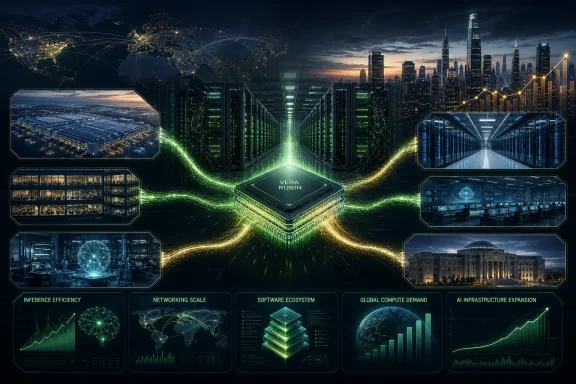 Morgan Stanley Is Betting on Breadth, Not Another Shortage
As reported by News Ghana and separately summarized by Investing.com, Morgan Stanley’s central claim is that Nvidia’s next stage of growth will not depend solely on the large cloud providers that established the market for generative-AI infrastructure. Demand is reportedly spreading across AI laboratories, enterprise customers, neocloud operators and sovereign AI projects, while networking equipment and CPUs create additional sales opportunities within existing hyperscale accounts.That distinction is crucial. A supplier dependent on a few customers making enormous purchases can post spectacular growth, but it also inherits those customers’ budget cycles, bargaining power and internal technology strategies. A supplier serving a larger number of customers across multiple infrastructure layers has a better chance of turning a capital-spending cycle into something closer to a platform economy.
The concern has never been that Nvidia lacks demand today. The concern is that its strongest customers are also among the few organizations with the money, engineering talent and incentive to reduce their dependence on Nvidia tomorrow. Large technology companies can continue buying Nvidia systems while simultaneously developing custom accelerators for stable, high-volume workloads where flexibility matters less than cost.
Morgan Stanley’s wider-demand thesis is therefore a response to Nvidia’s most persistent structural risk: customer concentration. Enterprise adoption, specialist cloud providers and sovereign infrastructure programs do not merely add revenue. They diversify the reasons customers buy Nvidia hardware and reduce the chance that one hyperscaler’s budget pause, architecture change or custom-chip success can reshape the entire company’s outlook.
But “broader demand” can be deceptive if it simply describes more buyers participating in the same short-lived rush. The bullish case requires more than an expanding customer list. It requires those customers to deploy applications that generate sustained economic value, renew capacity, consume more inference and remain within Nvidia’s ecosystem after the initial buildout.
That is why the company’s current scale is both evidence and burden. Data center revenue rising 92 percent from a year earlier demonstrates that the market is still absorbing enormous amounts of infrastructure. Guidance of roughly US$91 billion for the next quarter, excluding China, suggests that export restrictions have not prevented the overall business from advancing. Yet each new record creates a larger base from which Nvidia must grow, and Joseph Moore’s suggestion that growth can continue accelerating as quarterly sales approach US$100 billion is a remarkably demanding proposition.
At smaller scale, a new AI lab or sovereign computing project can move the needle. Near US$100 billion per quarter, Nvidia needs many such projects, recurring purchases from existing customers and successful adoption of new product categories at the same time. Morgan Stanley is effectively arguing that the addressable market is expanding faster than Nvidia’s revenue base, even after that base has become one of the largest in the technology industry.
Vera Rubin Turns the Product Cycle Into an Economic Argument
Nvidia’s Vera Rubin platform sits at the center of that argument because it moves the conversation away from raw accelerator performance and toward the cost of operating AI services. Nvidia says Vera Rubin is in full production, and Morgan Stanley points to the platform’s potential to reduce inference costs by as much as 90 percent for some workloads.That claim should not be interpreted as a universal reduction in every AI bill. “Some workloads” carries considerable weight: model architecture, context length, utilization, latency targets, software optimization, power prices and deployment scale can all affect realized savings. A benchmark or optimized configuration is not a purchase-order guarantee.
Still, the strategic direction is clear. Training created Nvidia’s initial generative-AI windfall because increasingly large models demanded vast clusters of accelerators. Inference could become the longer-lasting market because every production query, generated image, software agent and automated workflow consumes compute after a model has been trained.
The economics of inference are harsher than the economics of a celebrated model-training run. Training can be treated as a major research investment, while inference is a recurring operating expense attached to each user interaction. Once AI services reach millions of users—or autonomous agents begin generating long sequences of requests—small differences in cost per token, power consumption and latency can determine whether a product is profitable.
Nvidia’s official Vera Rubin material emphasizes this system-level efficiency rather than treating the GPU as an isolated component. The company’s pitch combines processors, networking, memory movement and software into a rack-scale architecture engineered around sustained throughput. Nvidia is selling the idea that the most expensive chip can still produce the cheapest usable unit of AI output if the surrounding system keeps that chip busy and reduces bottlenecks elsewhere.
A recent McKinsey analysis of inference economics similarly argued that value is shifting toward integrated hardware-and-software platforms as operators optimize for cost across the entire workload. That is the environment Nvidia wants: one in which customers compare complete systems and production outcomes, rather than accelerator prices alone.
This is also how Nvidia answers the custom-chip threat. A hyperscaler’s internal accelerator may be less expensive for a predictable workload, but the chip is only one part of the cost. Toolchains, model compatibility, networking, scheduling, developer support, utilization and the time required to put a new service into production all matter.
Nvidia does not need to prove that no custom accelerator can ever outperform its hardware. It needs to prove that its platform remains the lowest-risk, most flexible and economically credible option across enough workloads. Morgan Stanley’s contention that Nvidia delivers some of the lowest costs per AI token is therefore more important than a claim of absolute benchmark leadership.
Vera Rubin and Rubin Ultra nevertheless occupy different points on Nvidia’s roadmap:
| Platform | Current status | Timing stated in the report | Strategic role | Central claim |
|---|---|---|---|---|
| Vera Rubin | In full production | Current production cycle | Expand training and inference capacity through an integrated platform | Up to 90 percent lower inference cost for some workloads |
| Rubin Ultra | Next-generation platform | Launch next year | Preserve Nvidia’s performance and system-roadmap cadence | Morgan Stanley says it remains on track despite reports of possible slippage |
Morgan Stanley is pushing back on reports that Rubin Ultra could slip, saying the platform remains on track for launch next year. Other reporting has raised questions about elements of the next-generation system, illustrating the gap between a product’s announced schedule and the complex work of manufacturing, integrating and deploying rack-scale infrastructure.
The disagreement is not a minor detail. Nvidia has converted product cadence into a competitive weapon, encouraging customers to plan around regular improvements in compute and efficiency. If that cadence holds, buyers can justify continued spending with the expectation that each generation will lower the cost of producing AI output. If it falters, customers gain more time to evaluate alternatives, extend existing hardware or direct workloads toward internal silicon.
Nvidia’s Moat Now Extends Far Beyond the GPU
Calling Nvidia a chip company has become increasingly inadequate. The company still earns its advantage from semiconductor design, but the product sold to major AI operators is becoming a coordinated computing environment that spans CPUs, GPUs, interconnects, networking, systems software and deployment tooling.This breadth changes the competitive calculation. A rival no longer needs merely to build an accelerator with attractive specifications. It must persuade customers that the accelerator can be installed, programmed, monitored, secured and kept highly utilized without creating costs elsewhere in the infrastructure.
That is particularly relevant to enterprise customers. AI laboratories and hyperscalers employ teams capable of rebuilding software around novel hardware. Most enterprises do not. They want infrastructure supported by established server vendors, cloud providers, management tools, software frameworks and consulting partners, with a predictable path from testing to production.
For these organizations, time is part of total cost. A technically efficient chip can become expensive if applications require extensive rewriting, developers are difficult to hire or production incidents take longer to diagnose. Nvidia’s ecosystem translates years of developer familiarity and vendor integration into a form of operational insurance.
The same logic applies to neocloud providers. These companies sell access to accelerated infrastructure and must keep costly systems occupied. Hardware that attracts developers, supports a wide range of models and can be marketed under a familiar platform may carry less utilization risk than a cheaper but less broadly supported alternative.
Sovereign AI projects introduce another layer. Governments and nationally aligned infrastructure operators may care about data residency, domestic capacity and strategic control, but they still need a functioning software ecosystem. Nvidia can benefit even when the motivation for a project is political rather than purely commercial, provided export rules permit the required systems to be delivered.
Networking and CPU sales deepen the relationship inside each account. If Nvidia supplies more of the data path, it can optimize the system as a whole, capture a larger share of project spending and make individual components harder to replace. The company’s goal is not simply to sell more pieces; it is to establish an architecture around which customers design their AI facilities.
That architecture creates lock-in, although not necessarily in the simplistic sense of preventing customers from leaving. The more practical lock-in is accumulated optimization: applications tuned for a software stack, engineers trained on its tools, facilities designed around its systems and financial models based on its performance characteristics. Moving away remains possible, but the burden of proving that a replacement is better becomes progressively higher.
For Nvidia, this is a more durable advantage than temporary scarcity. Supply shortages can support prices, but they eventually ease. An ecosystem that reduces deployment risk can continue attracting customers even when alternative chips are readily available.
Custom Silicon Is a Warning, Not Yet a Verdict
Morgan Stanley acknowledges that technology companies are expanding their use of custom-designed chips. The bank nevertheless argues that Nvidia continues to command a dominant share of AI computing workloads because its integrated systems remain competitive on the metric customers increasingly care about: the cost of useful AI output.Custom silicon is attractive because hyperscalers operate at a scale where removing a supplier’s margin can produce enormous savings. They can optimize a processor for a narrower set of internal workloads, align it with proprietary software and deploy it across infrastructure they already control. They also have enough demand to justify the engineering expense.
But custom chips do not automatically displace general-purpose accelerators. AI workloads are changing quickly, and a design optimized for one generation of models may be less suitable for the next. Training, fine-tuning, long-context inference, recommendation systems and agentic workloads impose different demands on compute, memory and networking.
The likely outcome is heterogeneous rather than winner-take-all. Hyperscalers may direct predictable internal workloads to their own chips while continuing to use Nvidia systems for frontier training, rapidly evolving models, external cloud customers and tasks that benefit from broad software compatibility. Nvidia can lose share within individual workloads while still growing if the total volume of AI compute expands quickly enough.
That nuance is essential when assessing Morgan Stanley’s thesis. The bank does not need custom silicon to fail. It needs the overall market to grow, Nvidia’s platform to remain economically competitive and new customer groups to offset any workload-specific displacement among the largest cloud providers.
The risk is that custom chips improve faster than Nvidia’s customer diversification. If the biggest buyers become more selective while enterprise and sovereign deployments mature slowly, Nvidia could face a period in which unit demand remains substantial but growth expectations reset. At a market value above US$4.7 trillion, “substantial” may not be enough.
There is also a strategic tension within Nvidia’s system approach. The more of the infrastructure stack Nvidia supplies, the more revenue it can capture—but the more urgently customers may seek a second source. Buyers generally prefer competition among suppliers, especially when a single vendor controls critical hardware, software and networking choices.
Nvidia must therefore make integration valuable enough that customers accept dependence without feeling trapped by it. That balance will be tested as AI infrastructure shifts from experimental budgets to recurring operating plans scrutinized by finance departments.
China Has Been Removed From the Guidance, Not From the Risk
The roughly US$91 billion next-quarter guidance excluding China is one of the strongest facts supporting the bullish case. It indicates that Nvidia expects extraordinary demand even without relying on data center compute revenue from a market that has historically represented a major technology opportunity.This makes the guidance more resilient in one sense. The company is not presenting China revenue as necessary to reach the stated level, reducing the immediate risk that an export-policy change alone causes the forecast to miss. Morgan Stanley can consequently argue that demand elsewhere is sufficient to sustain momentum.
But excluding China from guidance does not erase the strategic cost of restricted access. A market Nvidia cannot fully serve is a market where customers, governments and domestic suppliers have stronger incentives to develop alternatives. Over time, export controls may do more than reduce sales; they may accelerate the creation of separate hardware and software ecosystems.
The danger is not limited to direct competition inside China. Technology developed under constraint can eventually influence pricing and procurement elsewhere, especially in countries that prioritize availability, sovereignty or independence from U.S.-controlled supply chains. Nvidia’s global leadership gives it a formidable starting position, but geopolitical fragmentation can narrow the portion of the world addressable by one standardized platform.
For enterprise IT departments, this creates planning uncertainty. Multinational organizations may encounter different accelerator availability, cloud offerings and compliance requirements across regions. Applications built around a globally uniform infrastructure assumption could become harder to operate if AI hardware markets continue to divide.
The near-term numbers say Nvidia can grow without China. The long-term question is whether it can preserve a broadly shared developer platform while national policies push the underlying hardware market toward regionalization.
A US$4.7 Trillion Company Must Make Exceptional Growth Look Routine
Nvidia shares gained about 4 percent over the past week and remain firmly higher since January, according to the source report. The company’s market value now exceeds US$4.7 trillion, while the stock trades at around 23 times forward earnings, below its decade average.The multiple creates an intriguing contrast. Judged against Nvidia’s own history, 23 times forward earnings can appear restrained. Judged against the scale of the earnings already embedded in the calculation, it still represents confidence that the company can protect unusually high profitability while continuing to expand.
A below-average historical multiple does not automatically mean a stock is inexpensive. Multiples fall when companies become larger, growth becomes harder or investors perceive greater cyclicality. Nvidia’s earnings forecast has expanded so dramatically that the denominator makes the valuation look less extreme, but those projected earnings must still arrive.
Morgan Stanley’s US$288 target is also more conservative than the broader analyst consensus near US$309. Both figures reflect confidence in continued earnings growth, yet the distance between them highlights legitimate uncertainty over how much of Nvidia’s opportunity should be capitalized today.
The debate is no longer whether AI will require significant computing infrastructure. It is whether infrastructure demand will grow at the pace and profitability needed to support Nvidia’s valuation. Those are very different propositions.
AI can transform software, industrial systems and knowledge work while some infrastructure suppliers still disappoint investors. A technology can be revolutionary without every participant maintaining peak margins. The internet changed the economy, but that did not make every network-equipment valuation sustainable.
Nvidia has stronger defenses than many suppliers from earlier infrastructure booms. It produces substantial cash, controls a widely adopted software ecosystem and sells into workloads with expanding computational demands. Morgan Stanley also believes growing cash generation can attract value-oriented investors interested in recurring financial output rather than only a high-growth narrative.
That investor broadening could reduce the stock’s dependence on momentum. Yet value-oriented buyers are often less forgiving when capital spending weakens, margins compress or product schedules slip. Winning them requires Nvidia to become more predictable precisely as its industry remains exposed to rapid technical change and geopolitical intervention.
The stock’s apparent valuation moderation therefore rests on a difficult conversion: Nvidia must transform extraordinary growth into expected growth without allowing “expected” to become “slowing.” Near US$100 billion in quarterly sales, that is one of the hardest transitions any technology company can attempt.
The Enterprise Opportunity Will Be Won in Operations
For Windows users, the immediate effect of Morgan Stanley’s call is limited. A new data center platform does not suddenly make a conventional Windows PC faster, and Nvidia’s AI infrastructure economics should not be confused with the pricing or performance of consumer graphics hardware.The relevance emerges inside organizations where Windows endpoints, identity systems, business applications and developer workstations connect to AI services running in cloud or private infrastructure. If Vera Rubin materially lowers inference costs, features that are currently too expensive for broad deployment may become viable across larger employee populations.
That could include internal assistants, document processing, software-development tools, security analysis and automated workflow agents. The important change would not be one dramatic capability but a lower marginal cost for invoking AI repeatedly throughout ordinary business processes.
However, lower infrastructure cost does not guarantee lower enterprise cost. Organizations may consume more tokens as prices fall, much as cheaper storage encouraged companies to retain more data. Savings at the hardware layer can be absorbed by higher usage, larger models, longer context windows and additional compliance controls.
IT departments should therefore resist procurement arguments based solely on headline performance or theoretical cost-per-token reductions. The relevant calculation is the cost of delivering a governed service at the latency, reliability and data-protection level the organization requires.
Utilization is likely to be decisive. Expensive AI systems create value when workloads keep them productive. An enterprise that buys for peak ambition but operates at low average utilization may achieve worse economics than one using a seemingly more expensive cloud service that can scale with demand.
Software portability also deserves scrutiny. Nvidia’s platform breadth can accelerate deployment, but deeper optimization may increase switching costs. IT leaders need to decide where platform-specific tuning creates justified savings and where an abstraction layer is worth preserving even at some performance cost.
The best enterprise architecture may not be ideologically committed to either Nvidia or custom silicon. It may route workloads according to their requirements: flexible development and fast-changing models on broadly supported accelerators, predictable high-volume tasks on specialized systems, and sensitive workloads where governance or regional controls dictate the location.
Morgan Stanley’s thesis strengthens the case for evaluating Nvidia as a complete operating platform rather than a box of GPUs. It does not eliminate the need for architectural discipline. If anything, the growing reach of the platform makes that discipline more important.
Action checklist for admins
- Inventory planned AI workloads by training, fine-tuning, batch inference, interactive inference and agentic use rather than grouping them under a single “AI” budget.
- Benchmark complete applications with realistic context lengths, latency targets and concurrency instead of relying on peak accelerator specifications.
- Model total cost across hardware or cloud rental, networking, power, cooling, storage, software support, staffing and expected utilization.
- Require vendors to document the assumptions behind any claimed inference-cost reduction, especially when the claim applies only to selected workloads.
- Test model and application portability before adopting platform-specific optimizations that would be expensive to unwind.
- Include regional availability, export controls, data residency and supplier concentration in infrastructure risk reviews.
Product Cadence Is Now a Credibility Test
Nvidia has trained customers and investors to expect a rapid sequence of new architectures. That cadence supports spending because buyers can see a path toward better performance and lower unit costs. It also creates execution pressure across semiconductor manufacturing, networking, cooling, power delivery, server integration and software readiness.Vera Rubin being in full production gives Morgan Stanley a tangible basis for its optimism. The platform has moved beyond a roadmap slide, even if the pace and economics of customer deployment still need to be proven in real production environments.
Rubin Ultra is the more delicate part of the story. Morgan Stanley says it remains on track for next year, pushing back against reports of possible delay. The bank is effectively treating Nvidia management’s roadmap confidence as evidence that the company’s competitive momentum will continue.
Investors and infrastructure buyers should distinguish between silicon progress and complete-system availability. Modern AI platforms are not delivered as isolated chips; they depend on tightly coordinated components and facilities capable of supplying extraordinary power and cooling. A bottleneck anywhere in that chain can affect the deployment customers actually experience.
This makes roadmap execution relevant even to organizations that do not plan to buy the first Rubin Ultra systems. A delay can keep earlier hardware in service longer, change cloud capacity pricing and alter the point at which certain workloads become economically practical. Conversely, a smooth transition could accelerate depreciation pressure on existing infrastructure.
The broader issue is trust. Customers planning facilities and multiyear AI services need Nvidia’s roadmap to be ambitious, but they also need it to be credible. A platform vendor wins not only by announcing the future first, but by giving customers enough certainty to build around it.
The Bull Case Is Strongest Where It Is Most Difficult to Measure
Morgan Stanley’s argument has a coherent internal logic. Nvidia’s customer base is widening, its data center business is still expanding rapidly, next-quarter guidance remains enormous without China, and Vera Rubin promises to improve the economics of the workload most likely to dominate long-term AI consumption.The problem is that several of the most important variables are difficult for outsiders to measure. Public announcements can establish that customers are buying infrastructure, but they reveal less about utilization, application revenue and returns on invested capital. A data center under construction is visible; the economic productivity of the agents eventually running inside it is not.
The shift from training to inference should create recurring demand, but it also exposes Nvidia to price sensitivity. Training the most advanced model can be a strategic race in which cost is secondary. Serving billions of queries is an operations business where every fraction of a cent attracts scrutiny.
A 90 percent cost reduction for some workloads would be powerful if it expands usage while preserving Nvidia’s revenue and margins. It would be less attractive to shareholders if customers capture most of the savings and require fewer systems to serve a stable amount of demand. The bullish case assumes that lower unit costs stimulate enough additional consumption to outweigh efficiency.
That assumption is plausible. Cheaper computing has historically created new applications, and AI developers are already designing systems that perform more steps per task, consult larger contexts and run continuously rather than waiting for a human prompt. Agentic software could consume far more inference than today’s chat interfaces.
It is not guaranteed. Enterprises may limit AI usage because of security, reliability, regulation or weak returns rather than compute cost. If those constraints dominate, more efficient hardware could reduce infrastructure requirements without producing the expected explosion in demand.
Morgan Stanley is ultimately betting that AI compute remains elastic: make each useful output cheaper, and customers will request so many more outputs that total spending continues to rise. Nvidia’s market value assumes that this dynamic operates at unprecedented scale.
What the US$288 Call Really Asks Investors and IT Buyers to Believe
Morgan Stanley’s recommendation is supported by unusually strong current performance, but its deepest assumptions concern what comes next. The practical case can be reduced to a handful of propositions that investors and technology planners should test against each new earnings report, platform rollout and procurement cycle.- Nvidia retains Morgan Stanley’s Overweight rating and position as the bank’s top semiconductor pick, with a US$288 price target.
- Data center revenue is up 92 percent year over year, while next-quarter guidance is roughly US$91 billion excluding China.
- The growth thesis depends increasingly on AI labs, enterprises, neoclouds and sovereign projects joining hyperscalers as durable customers.
- Vera Rubin is in full production and could reduce inference costs by as much as 90 percent for some workloads, but realized savings will depend on deployment conditions.
- Morgan Stanley says Rubin Ultra remains on track for next year despite reports questioning its schedule.
- At above US$4.7 trillion and around 23 times forward earnings, Nvidia must sustain both product execution and an extraordinary level of customer spending.
References
- Primary source: NewsGhana
Published: 2026-07-12T10:57:07.970100
Loading…
www.newsghana.com.gh - Related coverage: nvidianews.nvidia.com
NVIDIA Vera Rubin Opens Agentic AI Frontier | NVIDIA Newsroom
NVIDIA today announced the NVIDIA Vera Rubin platform is opening the next frontier of agentic AI, with seven new chips now in full production to scale the world’s largest AI factories.nvidianews.nvidia.com - Related coverage: developer.nvidia.com
Inside the NVIDIA Vera Rubin Platform: Six New Chips, One AI Supercomputer | NVIDIA Technical Blog
Update March 16, 2026: The NVIDIA Vera Rubin platform now has a seventh chip. Learn more about NVIDIA Groq 3 LPX: The Low-Latency Inference Accelerator for the…developer.nvidia.com
- Related coverage: nvidia.com
NVIDIA Vera Rubin NVL72
NVIDIA Vera Rubin NVL72 is a rack-scale AI supercomputer unifying 72 Rubin GPUs and 36 Vera CPUs to power agentic reasoning AI and the AI industrial revolution.www.nvidia.com - Related coverage: blogs.nvidia.com
NVIDIA Rubin Platform, Open Models, Autonomous Driving: NVIDIA Presents Blueprint for the Future at CES | NVIDIA Blog
NVIDIA founder and CEO Jensen Huang opened CES in Las Vegas with Rubin — NVIDIA’s first extreme-codesigned AI platform — plus open models for healthcare, robotics and autonomy, and a Mercedes-Benz CLA showcasing AI-defined driving.blogs.nvidia.com - Related coverage: investor.nvidia.com
NVIDIA Corporation - NVIDIA Unveils Vera, the CPU for Agents
1.8x Faster Than x86 Processors to Drive Diverse Workloads Across Industries, Generating More Data Center Token Revenue News Summary: NVIDIA launches high-performance, energy-efficient NVIDIA Vera CPUs to drive diverse workloads across industries, including agentic AI, reinforcement learning and...investor.nvidia.com
- Related coverage: investing.com
Loading…
www.investing.com - Related coverage: images.nvidia.com
- Related coverage: nvidia.cn
Loading…
www.nvidia.cn - Related coverage: 39718632.fs1.hubspotusercontent-na1.net
- Related coverage: tomshardware.com
Nvidia CEO confirms Vera Rubin NVL72 is now in production — Jensen Huang uses CES keynote to announce the milestone | Tom's Hardware
Blackwell's successor is expected to arrive in the second half of 2026www.tomshardware.com - Related coverage: cincodias.elpais.com
Loading…
cincodias.elpais.com - Related coverage: pcgamer.com
Loading…
www.pcgamer.com - Related coverage: windowscentral.com
SSD shortages might hit hard in 2026 thanks to NVIDIA, AI | Windows Central
NVIDIA's new Vera Rubin AI server systems are projected to require hundreds of millions of TB of NAND storage. Yes, that will seriously affect global SSD prices.www.windowscentral.com - Related coverage: axios.com
Loading…
www.axios.com - Related coverage: techradar.com
Loading…
www.techradar.com - Related coverage: perspectives.nvidia.com
Loading…
perspectives.nvidia.com