

NVIDIA has published a deployment guide for tying video analytics into enterprise workflow tools, using its Video Search and Summarization (VSS) stack, Retrieval-Augmented Generation (RAG) Blueprint, and NemoClaw agent framework. The goal is straightforward: turn video findings into structured reports, tickets, notifications, or escalations instead of leaving them as standalone summaries.
As described in NVIDIA’s July 16 post, the workflow starts with a user—or an automated job—defining what to look for in a video: the scenario, events, objects, and optional reference material to consult. VSS then processes live or archived footage, while the RAG component retrieves relevant internal documents such as operating procedures, manuals, policies, or regulations.
NemoClaw serves as the orchestration layer. It passes user intent and retrieved organizational context into the video-analysis pipeline, then produces a timestamped report that can include detected events, narrative findings, cited reference material, and recommended next steps. NVIDIA’s example uses meal-preparation video and nutrition guidance, then automatically opens a Jira ticket for the resulting actions.
The practical distinction is that this is not simply semantic search over surveillance or production footage. NVIDIA is positioning the stack as a bridge between video understanding and operational systems.
The company says the same output can be used to create or assign tickets, package evidence for compliance review, identify recurring patterns across multiple runs, or route anomalies into escalation workflows. For an industrial deployment, that could mean inspection video is checked against OEM maintenance procedures before a work order is drafted. In a security or facilities environment, it could mean a detected event is summarized and forwarded with the relevant policy context attached.
That approach also introduces an obvious constraint: the quality of the downstream action will depend on both the video model’s interpretation and the accuracy of the documents indexed by the RAG system. Administrators should treat automated ticket creation and escalation as controlled workflow steps, with review and authorization rules appropriate to the consequences.
The VSS stack brings up several components, including Redis, Elasticsearch, long-video summarization services, NVIDIA inference microservices, and the VSS agent. The RAG Blueprint is deployed separately and exposes a server endpoint and knowledge collection to the agent. NemoClaw is then configured with a sandbox policy that permits access to the VSS agent.
NVIDIA notes that its inference services may take five to 15 minutes to load after deployment. The company’s published architecture also keeps human-in-the-loop prompts available before analysis and report creation, while allowing those parameters to be supplied programmatically for batch jobs.
For Windows administrators, the stack is most likely to land on Linux GPU servers, virtualized infrastructure, or container hosts rather than a typical desktop PC; Windows remains relevant as the management endpoint, developer workstation, or destination for downstream business systems.
Organizations considering the design should begin with one tightly scoped video-to-ticket workflow and validate its report quality, permissions, retention rules, and escalation logic before automating broader actions.
As described in NVIDIA’s July 16 post, the workflow starts with a user—or an automated job—defining what to look for in a video: the scenario, events, objects, and optional reference material to consult. VSS then processes live or archived footage, while the RAG component retrieves relevant internal documents such as operating procedures, manuals, policies, or regulations.
NemoClaw serves as the orchestration layer. It passes user intent and retrieved organizational context into the video-analysis pipeline, then produces a timestamped report that can include detected events, narrative findings, cited reference material, and recommended next steps. NVIDIA’s example uses meal-preparation video and nutrition guidance, then automatically opens a Jira ticket for the resulting actions.
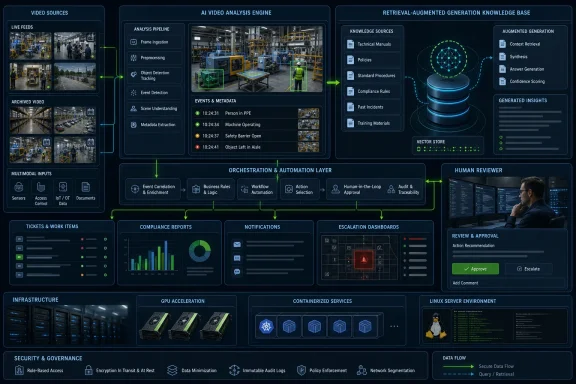 More than video search
The practical distinction is that this is not simply semantic search over surveillance or production footage. NVIDIA is positioning the stack as a bridge between video understanding and operational systems.The company says the same output can be used to create or assign tickets, package evidence for compliance review, identify recurring patterns across multiple runs, or route anomalies into escalation workflows. For an industrial deployment, that could mean inspection video is checked against OEM maintenance procedures before a work order is drafted. In a security or facilities environment, it could mean a detected event is summarized and forwarded with the relevant policy context attached.
That approach also introduces an obvious constraint: the quality of the downstream action will depend on both the video model’s interpretation and the accuracy of the documents indexed by the RAG system. Administrators should treat automated ticket creation and escalation as controlled workflow steps, with review and authorization rules appropriate to the consequences.
Deployment requirements
NVIDIA’s reference deployment uses Docker Compose and requires an NVIDIA GPU with at least 24GB of VRAM. The published configuration identifies VSS Agent version 3.2.0 and supports hardware profiles including H100, L40S, RTX Pro cards, DGX Spark, and certain NVIDIA edge platforms.The VSS stack brings up several components, including Redis, Elasticsearch, long-video summarization services, NVIDIA inference microservices, and the VSS agent. The RAG Blueprint is deployed separately and exposes a server endpoint and knowledge collection to the agent. NemoClaw is then configured with a sandbox policy that permits access to the VSS agent.
NVIDIA notes that its inference services may take five to 15 minutes to load after deployment. The company’s published architecture also keeps human-in-the-loop prompts available before analysis and report creation, while allowing those parameters to be supplied programmatically for batch jobs.
For Windows administrators, the stack is most likely to land on Linux GPU servers, virtualized infrastructure, or container hosts rather than a typical desktop PC; Windows remains relevant as the management endpoint, developer workstation, or destination for downstream business systems.
Organizations considering the design should begin with one tightly scoped video-to-ticket workflow and validate its report quality, permissions, retention rules, and escalation logic before automating broader actions.
References
- Primary source: NVIDIA Developer
Published: 2026-07-16T16:03:35+00:00
Loading…
developer.nvidia.com