

The Workload Outgrew the Departmental Machine
For years, academic computing had a familiar rhythm. A grant arrived, a lab bought a server, a graduate student learned just enough Linux to keep the thing alive, and a cluster lived under a desk or in a server room until the project ended or the hardware aged out. That model was messy but workable when the workloads were smaller, the components cheaper, and the consequences of downtime mostly local.
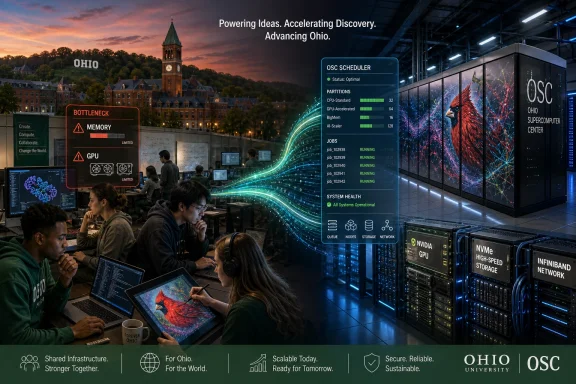
That era is fading quickly. Ohio University’s turn toward the Ohio Supercomputer Center captures a broader shift in research computing: data-heavy science and AI-assisted creative work no longer fit neatly inside the procurement habits of individual departments. The same university can have a mathematics student training molecular machine-learning models, undergraduates simulating heart-cell behavior, and digital artists generating AI-driven imagery for a supercomputer enclosure. Those projects do not look similar from the outside, but they share the same dependency: access to scalable compute that does not collapse under real workloads.
The quoted advice from Robert Foreman, Ohio University’s Campus Champion for OSC, is unusually direct for university technology communications: “If you have HPC needs, OSC should be your first stop.” That is less a slogan than a governance position. It says the campus should stop treating high performance computing as a special purchase and start treating it as a shared utility.
For IT departments, that distinction matters. A shared computing center is not just a bigger box. It comes with scheduling, user support, storage policies, software environments, security practices, and an operational model designed for churn. The hardest part of research computing is often not buying performance; it is keeping performance usable after the excitement of the purchase order is gone.
OSC Is Becoming the State’s Research Utility
The Ohio Supercomputer Center’s pitch is almost deliberately unglamorous: shared infrastructure, advanced modeling, simulation, analysis, and expertise. That may sound like institutional boilerplate, but it is the exact combination universities need when compute demand stops being episodic. The point is not merely that OSC has systems individual departments do not. The point is that OSC absorbs a class of operational risk that small research groups are poorly designed to carry.
Ohio University’s examples show why this model has staying power. A mathematics PhD student working with more than 330,000 molecular conformations does not just need a faster desktop. He needs repeatable compute access, a place to run experiments at scale, and a path to train and evaluate models within the practical calendar of a dissertation. “Reasonable timeframe” is doing a lot of work here. In graduate research, a computation that takes weeks instead of days is not an inconvenience; it can reshape what questions are even askable.
That is the quiet power of HPC access. It does not simply accelerate existing work. It changes the boundary of ambition. A student who can run a larger model, test more parameters, or iterate on a bigger dataset may produce a different dissertation than one constrained by local hardware.
There is also a budgetary reality underneath the academic language. Memory and GPUs have become strategic inputs across science, AI, visualization, and engineering. When every lab wants the same scarce components, the old model of piecemeal hardware accumulation starts to look less like independence and more like inefficiency. OSC gives Ohio University a way to pool demand without forcing every department to become a miniature data-center operator.
The GPU Crunch Is an Administrative Problem, Not Just a Hardware Problem
Foreman’s comment about the cost of memory and GPUs gets to the economic heart of the story. It is easy to describe compute demand as a technical problem: researchers need more cores, more accelerators, more RAM, more storage. But the sharper problem is administrative. Universities are full of research groups that can justify buying hardware once but cannot sustain the staff, lifecycle planning, monitoring, patching, and user support that follow.
The grant-funded mini-cluster has always carried hidden costs. Someone has to decide where it sits, how it is cooled, who gets access, what software gets installed, how backups work, how user accounts are managed, and what happens when a disk fails during a deadline. Those decisions are not glamorous enough for a proposal abstract, but they are where many local systems start to decay.
This is why the phrase “operational cost” deserves more attention than it usually gets. A lab can budget for a server and still underestimate the human work required to run it. Worse, the burden often lands on graduate students, postdocs, or a departmental IT generalist who becomes the accidental steward of a system whose users expect production reliability.
Shared HPC reverses that pattern. It does not eliminate complexity, but it concentrates it in an organization built to manage it. That is the same logic behind campus identity systems, enterprise storage, learning management platforms, and networking backbones. At some point, infrastructure becomes too important to be improvised.
Molecular Machine Learning Shows Why “Bigger” Is Not the Whole Story
Muhammad Shahzeb Ali’s dissertation work is the cleanest example of why Ohio University’s OSC relationship matters. Molecular machine learning is exactly the kind of research area that punishes insufficient computing. Models need to be trained, evaluated, compared, and rerun. Datasets do not merely sit there; they become a landscape researchers must traverse repeatedly.
Working with more than 330,000 molecular conformations is not a casual desktop exercise. It demands throughput, data management, and time discipline. If every experiment has to be narrowed to fit a workstation, the research question itself starts bending around the machine. That is bad science by attrition.
HPC access gives researchers room to make fewer compromises. It lets them run broader comparisons, test more ambitious model configurations, and make decisions based on evidence rather than machine limits. In AI-adjacent fields, this is especially important because failed runs and unpromising experiments are part of the work. A system that only supports the final polished computation is not enough.
There is a second-order benefit as well. Students who learn to work in shared HPC environments learn the habits of modern computational research: job submission, remote workflows, environment management, resource allocation, and reproducibility. Those skills transfer directly into national labs, industry research teams, pharmaceutical modeling, financial engineering, and advanced manufacturing. The compute is the immediate need; the workflow literacy is the durable outcome.
Heart Simulations Make the Case for Campus-Wide Access
The atrial fibrillation work at Ohio University makes a different but equally important argument. Here, mathematics faculty and students are collaborating with cardiologist Alexander Hattoum and Professor Todd Young to model the electrical behavior of heart cells. The goal is not to build a bigger benchmark. It is to understand chaotic patterns associated with the most common heart rhythm disorder.
This is where shared HPC becomes more than a convenience for already-computational fields. Medical modeling sits at the intersection of biology, mathematics, clinical insight, and simulation. It requires enough compute to explore systems that are difficult to observe directly, but it also requires an institutional bridge between disciplines that may not traditionally share tools.
Undergraduates using OSC to simulate large-scale heart-cell activity is a particularly strong signal. Access to HPC is often imagined as a privilege reserved for senior researchers and specialized labs. Ohio University’s example suggests a more democratic model: students can encounter advanced computing as part of the research process before they enter graduate school or industry.
That matters for workforce development. If universities want students to participate in data-intensive science, they cannot limit exposure to toy examples on local machines. They need environments where students experience the friction and power of real systems. HPC is not just a back-end utility; it is a teaching environment.
Digital Art Is Not a Sideshow to the Science
The Digital Art + Technology example may look like an odd companion to molecular prediction and cardiac simulation, but it is arguably the most revealing part of the story. Students working with Basil Masri Zada have used OSC resources to create AI-driven artwork, including design work connected to Cardinal, an OSC supercomputer. That is not a novelty item tacked onto a science press release. It reflects how compute demand has escaped the old boundaries of STEM.
Generative AI has made high-end computing relevant to artists, designers, architects, media students, and humanists. These users may not describe their work in the language of numerical simulation, but they still need accelerators, model access, storage, and workflow support. The same infrastructure that supports molecular machine learning can also support creative experimentation, provided the institution is willing to treat creative computing as legitimate demand.
This is where universities face a cultural choice. They can reserve advanced computing for traditional research domains and leave other students to consumer tools, subscription platforms, and whatever local hardware they can assemble. Or they can recognize that the future workforce will include artists and designers who understand AI systems not merely as web apps but as computational environments.
The latter approach is more interesting. It also makes better use of shared infrastructure. A statewide supercomputing center should not be understood only as a place for big science. It can become a common platform where disciplines encounter each other through the practical constraints of computation.
Shared Infrastructure Is Also a Check on Shadow IT
There is a WindowsForum angle here that goes beyond Ohio. Every sysadmin has seen what happens when unmet demand turns into shadow infrastructure. A lab buys machines outside the normal lifecycle. A department runs aging hardware because no one has budget authority to replace it. A researcher stores sensitive data on whatever system is available because the official option is too slow or too hard to access.
Shared HPC does not magically solve those problems, but it gives IT leaders a better answer than “no.” When researchers have a credible path to high-end compute, they are less likely to build fragile alternatives. When the campus can point to OSC as the preferred route for HPC workloads, it can also set expectations around security, support, and sustainability.
This is especially important as AI workloads spread. GPU servers are expensive, power-hungry, and operationally finicky. They attract users who want speed and flexibility, but they also create patching, driver, dependency, and access-control headaches. A poorly managed GPU box can become both a bottleneck and a risk.
The institutional lesson is straightforward: demand denied does not disappear. It routes around central IT. Ohio University’s approach, at least as described here, is to route that demand into a shared environment before it fragments into one-off systems.
The Local Cluster Is Becoming Harder to Defend
There are still reasons for local research hardware. Some projects need specialized instruments attached to compute systems. Some workloads require low-latency access to local data. Some researchers need development sandboxes before moving jobs to a larger system. A campus that treats OSC as the only answer would be making the same mistake as a campus that treats OSC as an afterthought.
But the default case for buying a small independent cluster is weaker than it used to be. Hardware prices are only one part of it. The larger issue is that modern research systems are not static assets. They are software stacks, user communities, scheduler configurations, data pipelines, security surfaces, and support commitments.
A departmental cluster may look cheaper if the spreadsheet stops at acquisition. It looks different when the analysis includes power, cooling, maintenance, staff time, refresh cycles, downtime, and the opportunity cost of researchers troubleshooting infrastructure instead of doing research. This is the familiar cloud argument, but with an academic twist: the alternative is not always a hyperscaler. Sometimes it is a public, regional, mission-oriented supercomputing center.
That distinction matters. Commercial cloud can be powerful, but it can also produce unpredictable bills and governance challenges. A center like OSC offers a different bargain: shared capacity, research-oriented support, and a community model aligned with academic use. For many university workloads, that may be the more sustainable middle path.
The Real Win Is Not Peak Performance
Supercomputing coverage often gravitates toward rankings, specs, and peak performance. That is understandable but incomplete. The Ohio University story is less about bragging rights than access patterns. Who gets to use advanced computing? How early in their education do they encounter it? How much institutional friction stands between an idea and a large-scale computation?
Foreman’s line that OSC is “accessible to anyone and everyone” should be read as an aspiration as much as a description. Accessibility in HPC is never just about accounts. It is about documentation, training, onboarding, software support, campus champions, and the confidence to tell a student or faculty member that their problem belongs on a bigger system.
The Campus Champion role is important because shared infrastructure still needs local translation. Researchers do not always know when a workload has crossed the threshold into HPC territory. They may not know how to estimate resource needs or adapt code to a scheduler. They may not even know that the service exists until someone on campus makes the connection.
That human layer is easy to underestimate. A supercomputer center without advocates can become a distant facility known only to insiders. A campus champion turns it into a practical option.
Ohio’s Data-Center Debate Gives the Story a Sharper Edge
The timing is hard to ignore. Ohio, like many states, is wrestling with the costs and consequences of data-center growth, particularly as AI drives demand for compute, electricity, land, and incentives. Against that backdrop, OSC represents a different kind of computing infrastructure: public-facing, research-oriented, and tied to education rather than only private platform scale.
That does not make supercomputing free of resource questions. HPC systems consume power, require cooling, and depend on expensive hardware. But the public value proposition is clearer when the workloads include doctoral research, undergraduate training, medical simulation, and creative education. A shared academic center can make a stronger civic claim than a private facility whose main public benefit is often framed through jobs, taxes, or downstream economic development.
This contrast should not be overstated. Universities also need commercial cloud services, and private data centers are part of the modern digital economy. But the Ohio University example is a reminder that not all compute growth is the same. Some of it expands the capacity of public institutions to teach, discover, and train.
For policymakers, that distinction should matter. If states are going to debate who pays for compute infrastructure, they should also ask who benefits from it. Shared research computing has a different answer than hyperscale AI expansion.
The Ohio University Lesson Is a Playbook, Not a Press Release
The practical lesson for other campuses is not “send everything to OSC” or its equivalent. It is to build a coherent path for escalating workloads. Desktop, lab workstation, local server, campus service, regional HPC, national facility, and commercial cloud should not be disconnected choices. They should be part of a ladder that researchers can climb without becoming infrastructure experts.
Ohio University appears to be strengthening one rung of that ladder by leaning on OSC. That is sensible because the hardest transition is often the move from local convenience to shared discipline. Once researchers learn how to package jobs, manage environments, and use shared resources responsibly, they are better prepared for larger systems elsewhere.
The model also helps IT leaders speak more honestly about cost. Instead of pretending every lab can own its way out of compute scarcity, the university can acknowledge that some infrastructure is better shared. That is not a retreat from capability. It is a more mature definition of capability.
The risk, as always, is that demand may grow faster than support. If more students, artists, engineers, clinicians, and faculty members move toward OSC-backed workflows, the need for training and user assistance will rise with them. Shared infrastructure succeeds only if the front door remains usable.
Cardinal’s Artwork Points to a Bigger Identity Shift
The Cardinal endcap project is symbolically richer than it first appears. A supercomputer decorated by AI-assisted student artwork is a neat story, but it also collapses the distance between machine and user. The students are not merely consuming compute; they are helping shape the visual identity of the infrastructure that enables it.
That matters because HPC has long suffered from an aura of remoteness. It can feel like a realm for specialists, locked behind jargon and queue systems. Bringing digital art students into the orbit of a supercomputing center makes the machine less abstract. It becomes a campus resource with cultural presence, not just a rack of hardware in Columbus.
The same logic applies to undergraduates simulating heart cells or graduate students training molecular models. The more disciplines that touch HPC, the less it feels like an exotic add-on. It becomes part of the academic commons.
That commons will be contested. Compute cycles are finite. Support staff are finite. Budgets are finite. But the answer to scarcity should not be to narrow the user base prematurely. It should be to build governance that can prioritize serious work while still allowing new communities to enter.
The Compute Bill Is Teaching Universities New Habits
The old academic computing habit was ownership. The new habit is orchestration. Universities need to know when to buy, when to share, when to rent, and when to partner. Ohio University’s growing reliance on OSC is an example of that shift in miniature.
This does not mean every research group will welcome the change. Local hardware offers control, immediacy, and psychological comfort. A researcher who owns a machine does not have to wait in a queue or adapt to a shared environment. Those benefits are real, and in some cases they are decisive.
But control has costs. It can strand capacity in one lab while another lab waits. It can leave security and maintenance uneven. It can turn graduate students into system administrators. It can make compute access depend on who wrote the right grant two years ago.
Shared HPC is not perfect, but it attacks those inequities directly. It says access should not depend entirely on a department’s ability to buy and babysit hardware. That is a more scalable premise for a university whose computing needs now span medicine, mathematics, AI, and art.
What Ohio’s Researchers Are Really Buying by Not Buying Servers
The most concrete message from Ohio University’s OSC use is that shared computing changes both the economics and the educational reach of advanced research. The immediate benefit is more capacity, but the deeper benefit is institutional discipline.
- Ohio University researchers are using OSC for workloads that exceed practical desktop or local-system limits, including molecular machine learning and cardiac simulation.
- Rising memory and GPU costs are making small, grant-funded clusters harder to justify as a default strategy.
- The operational burden of local research hardware often outlasts the grant money that paid for the purchase.
- OSC gives students exposure to HPC workflows that are increasingly relevant in research labs, industry, and AI-heavy creative fields.
- Digital art use cases show that advanced computing is no longer confined to traditional STEM departments.
- The campus champion model is essential because researchers need local guidance to turn a distant supercomputing center into a routine tool.
The next phase of university computing will not be won by the campus with the most isolated clusters or the biggest single cloud bill. It will be won by institutions that can match workloads to the right layer of infrastructure, teach students how to use that infrastructure responsibly, and stop pretending that advanced computing is a niche service for a few technical departments. Ohio University’s growing reliance on OSC is a small story with a large implication: the future of research computing is shared, interdisciplinary, and operationally sober.
References
- Ohio University Researchers Turn to Ohio Supercomputer Center as Computing Demands Grow HPCwire · 2026-05-29T02:40:12.274878