

On June 2, 2026, BuzzFeed resurfaced a Reddit-driven list of frightening everyday sounds, and one entry about Oklahoma tornado sirens captured the strange bargain of life in Tornado Alley: when the warning starts, survival depends less on drama than on practiced routine. The story is not really about a neighbor drinking beer while relaying storm updates from aboveground, though that image is hard to forget. It is about the way danger becomes local knowledge, and how Americans build informal systems around formal alerts when the formal systems are not enough. A siren is supposed to be a public warning; in tornado country, it is also a test of architecture, trust, preparation, and nerve.
Outdoor warning sirens occupy a peculiar place in American disaster culture. They are official, loud, and unmistakable, but they are not complete instructions. They tell a community that something has crossed a threshold of concern; they do not tell every household whether the storm will turn left, whether the warning will expire, whether the local shelter is open, or whether the safest interior room is already occupied by sleeping children and a nervous dog.
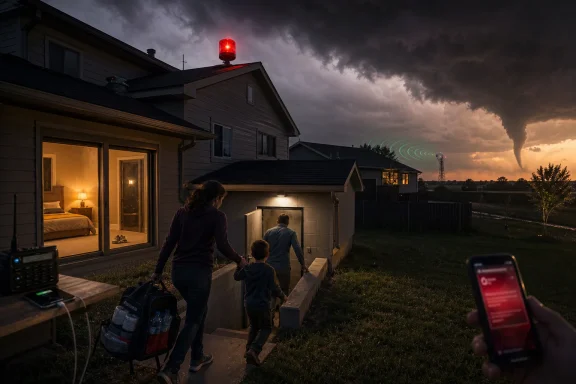
That is why the Oklahoma anecdote lands with such force. The family had a bag packed for tornado season, knew the neighbor had a backyard shelter, and moved when the sirens sounded. The comedy of the beer-holding neighbor shouting updates into the shelter only sharpens the underlying seriousness: in the moment that mattered, the plan was not improvised.
The detail about basements is just as important. Much of the public imagination of tornado safety is built around the basement as the obvious refuge, but many homes in tornado-prone areas do not have one. Soil conditions, water tables, cost, construction norms, and local housing stock all shape whether a basement exists. Disaster advice that assumes one can therefore feel strangely theoretical to the very people most likely to need it.
A siren, then, does not simply announce weather. It exposes the gap between the danger a community faces and the sheltering infrastructure it actually has.
That is what makes pre-packed bags and known shelter routes so rational. In calm weather, a bag may look like overreaction. Under a warning, it becomes time bought in advance.
The Oklahoma account describes a family that had already made the hardest decisions before the sky turned hostile. They knew what to grab, where to go, and whose shelter they would use. That kind of preparation is unglamorous, but it is the difference between a warning becoming action and a warning becoming confusion.
The neighbor standing aboveground with updates is both helpful and reckless, and that tension is familiar in storm country. Every tornado outbreak produces the same split between those who shelter immediately and those who step outside to look. The human desire to verify danger with one’s own eyes is powerful. Unfortunately, tornadoes are precisely the kind of danger that punish verification delays.
Tornado sirens belong in that category, but they also suffer from a special problem: repetition. In places with frequent severe weather, warnings can become part of the seasonal soundtrack. A siren that once produced immediate fear can, over years, become something residents interpret through habit, rumor, radar apps, porch observation, and local bravado.
That normalization is understandable. False alarms, near misses, and warnings that cover broad geographic areas can teach people to wait. But the lesson is dangerous because the storm that finally matters may sound exactly like the storm that missed last week.
This is the central contradiction of public alerting. A warning system has to be sensitive enough to save lives, which means it will sometimes warn people who are not ultimately hit. But every miss spends a little public trust. The technical problem is meteorology; the civic problem is attention.
A backyard shelter transforms a warning from an abstract command into a feasible action. Without it, a family in a slab-built house may be left choosing between an interior closet, a bathroom, a hallway, or a neighbor’s stronger structure. With it, the plan becomes concrete: grab the bag, move quickly, close the door, wait.
This is where disaster preparedness becomes deeply unequal. Some households can afford shelters, reinforced safe rooms, weather radios, backup power, and insurance deductibles. Others rely on community shelters, public buildings, apartment stairwells, or the goodwill of neighbors. The weather may be indiscriminate, but resilience is not.
The neighbor’s shelter effectively became shared infrastructure. That matters. Much of American emergency preparedness is discussed as an individual responsibility, but the most resilient communities are often those where private preparation spills over into collective protection. A shelter with extra room is not just a home improvement; in the right neighborhood, it is a survival node.
People want confirmation. They check a radar loop. They ask whether the siren is a test. They look for local reports. They wonder whether the warning includes their exact street. These are rational impulses, but tornado warnings operate on a hostile clock.
The real lesson from the Oklahoma account is that alerts are only as good as the decision tree they trigger. A siren should not start a family debate. It should start a rehearsed sequence.
That sequence can be simple. Shoes on. Phones charged. Kids gathered. Pets if possible. Emergency bag in hand. Shelter now. The point is not panic; the point is removing negotiation from the moment when negotiation is most costly.
That is why the siren matters. It is not the sound of the tornado. It is the sound that tells you not to wait for the tornado’s own voice.
Still, the urge to look is persistent. Part of it is practical; people want to know what is happening. Part of it is cultural; storms are spectacular. Part of it is denial; seeing nothing can feel like proof of safety, even when rain-wrapped tornadoes or nighttime storms make visual confirmation unreliable.
The beer-holding neighbor embodies this contradiction. He is useful because he is communicating. He is foolish because he is exposed. In a different telling, that detail could be comic relief; in a worse storm, it could be the line everyone remembers with regret.
That psychological step is underrated. Many people live in hazard zones while quietly refusing to imagine the hazard reaching them. Wildfire, flooding, hurricanes, earthquakes, and tornadoes all punish that refusal. Preparedness begins when a household admits that the bad thing does not only happen elsewhere.
The bag also recognizes the chaos of sheltering with children. Adults can run on adrenaline and confusion; children need shoes, medication, comfort items, and supervision. A warning that arrives at night or during dinner does not wait for a parent to think clearly.
In that sense, the bag is not paranoia. It is preloaded calm.
The internet is full of exaggeration, but it is also full of lived expertise. A homeowner who knows the sound of water in a wall, a mechanic who knows brake squeal, a lab worker who fears a suddenly silent fume hood, and a Tornado Alley parent who keeps a go-bag ready are all describing pattern recognition. They are telling readers which sensory inputs deserve immediate respect.
That kind of folk knowledge should be handled carefully. Not every viral warning is accurate, and not every scary sound means catastrophe. But the broader instinct is sound: humans survive by learning which signals should interrupt normal life.
The best public safety messaging meets that instinct halfway. It does not merely issue instructions. It teaches people why the instruction exists, what the first 30 seconds should look like, and what mistakes commonly get people hurt.
Emergency sirens suffer from the same human limitation, only with higher stakes. If every alert feels equally urgent, people stop treating any single alert as decisive. If warnings are too vague, users seek alternate channels. If the system has trained them that waiting usually works out, they will wait.
The comparison is not perfect, but it is useful. Good alerting is not about maximum volume. It is about credibility, clarity, timing, and actionability. A warning should tell the recipient what has changed and what to do next.
That is where tornado preparedness and IT operations unexpectedly overlap. Whether the threat is a rotating storm or a ransomware outbreak, the worst time to design the response is after the alarm begins.
Where is the shelter? Who grabs the children? What happens if one adult is not home? Which neighbor has a shelter? Are shoes kept near beds during storm season? Is there a weather radio if cellular networks fail? Are medications and documents accessible? These are ordinary questions until they become urgent ones.
The Oklahoma family had already answered the most important question: where do we go? That made the siren actionable. Without that answer, the same siren could have produced argument, delay, or denial.
Preparedness is often portrayed as rugged individualism, but this story points in another direction. The most practical plan may depend on the people next door.
A tornado siren in Oklahoma is not just a noise; it is a civic agreement compressed into sound, asking thousands of people to trust the warning, trust their preparation, and move before the sky makes the decision for them. The BuzzFeed entry endures because it captures that agreement at street level, with a family underground, a neighbor above, and a storm somewhere close enough to turn routine into consequence. As warning systems become more precise and personal devices become louder participants in public safety, the hard part will remain stubbornly human: teaching people to act on the first credible signal, not the last possible proof.
 The Siren Is the Sound of a System Passing the Burden Downward
Outdoor warning sirens occupy a peculiar place in American disaster culture. They are official, loud, and unmistakable, but they are not complete instructions. They tell a community that something has crossed a threshold of concern; they do not tell every household whether the storm will turn left, whether the warning will expire, whether the local shelter is open, or whether the safest interior room is already occupied by sleeping children and a nervous dog.That is why the Oklahoma anecdote lands with such force. The family had a bag packed for tornado season, knew the neighbor had a backyard shelter, and moved when the sirens sounded. The comedy of the beer-holding neighbor shouting updates into the shelter only sharpens the underlying seriousness: in the moment that mattered, the plan was not improvised.
The detail about basements is just as important. Much of the public imagination of tornado safety is built around the basement as the obvious refuge, but many homes in tornado-prone areas do not have one. Soil conditions, water tables, cost, construction norms, and local housing stock all shape whether a basement exists. Disaster advice that assumes one can therefore feel strangely theoretical to the very people most likely to need it.
A siren, then, does not simply announce weather. It exposes the gap between the danger a community faces and the sheltering infrastructure it actually has.
Tornado Alley Runs on Preparedness Because Certainty Arrives Too Late
Tornadoes are cruelly specific disasters. A storm can devastate one side of a town while leaving the other side looking almost untouched. Radar, spotters, wireless alerts, and meteorological modeling have improved enormously, but the final decision inside a home still tends to arrive as a blunt calculation: move now, or gamble that this one will pass.That is what makes pre-packed bags and known shelter routes so rational. In calm weather, a bag may look like overreaction. Under a warning, it becomes time bought in advance.
The Oklahoma account describes a family that had already made the hardest decisions before the sky turned hostile. They knew what to grab, where to go, and whose shelter they would use. That kind of preparation is unglamorous, but it is the difference between a warning becoming action and a warning becoming confusion.
The neighbor standing aboveground with updates is both helpful and reckless, and that tension is familiar in storm country. Every tornado outbreak produces the same split between those who shelter immediately and those who step outside to look. The human desire to verify danger with one’s own eyes is powerful. Unfortunately, tornadoes are precisely the kind of danger that punish verification delays.
The Most Dangerous Sound May Be the One People Learn to Normalize
The BuzzFeed list works because it collects sounds that bypass rational analysis: a smoke alarm at 3 a.m., running water inside a wall, brakes grinding, a medical monitor flatlining, ice cracking beneath your feet. These are not merely noises. They are compressed warnings, each carrying a story about what happens next if nobody reacts.Tornado sirens belong in that category, but they also suffer from a special problem: repetition. In places with frequent severe weather, warnings can become part of the seasonal soundtrack. A siren that once produced immediate fear can, over years, become something residents interpret through habit, rumor, radar apps, porch observation, and local bravado.
That normalization is understandable. False alarms, near misses, and warnings that cover broad geographic areas can teach people to wait. But the lesson is dangerous because the storm that finally matters may sound exactly like the storm that missed last week.
This is the central contradiction of public alerting. A warning system has to be sensitive enough to save lives, which means it will sometimes warn people who are not ultimately hit. But every miss spends a little public trust. The technical problem is meteorology; the civic problem is attention.
The Backyard Shelter Is the Real Hero of the Story
The most consequential character in the Oklahoma anecdote is not the siren, the storm, or the beer-holding neighbor. It is the storm shelter.A backyard shelter transforms a warning from an abstract command into a feasible action. Without it, a family in a slab-built house may be left choosing between an interior closet, a bathroom, a hallway, or a neighbor’s stronger structure. With it, the plan becomes concrete: grab the bag, move quickly, close the door, wait.
This is where disaster preparedness becomes deeply unequal. Some households can afford shelters, reinforced safe rooms, weather radios, backup power, and insurance deductibles. Others rely on community shelters, public buildings, apartment stairwells, or the goodwill of neighbors. The weather may be indiscriminate, but resilience is not.
The neighbor’s shelter effectively became shared infrastructure. That matters. Much of American emergency preparedness is discussed as an individual responsibility, but the most resilient communities are often those where private preparation spills over into collective protection. A shelter with extra room is not just a home improvement; in the right neighborhood, it is a survival node.
Warning Technology Has Improved, but Human Behavior Remains the Weak Link
Modern severe weather alerts are layered. Sirens, smartphone warnings, weather apps, television meteorologists, NOAA Weather Radio, social media, local emergency management accounts, and neighborhood text threads all compete to translate atmospheric risk into human action. In theory, redundancy is good. In practice, too many signals can also produce delay.People want confirmation. They check a radar loop. They ask whether the siren is a test. They look for local reports. They wonder whether the warning includes their exact street. These are rational impulses, but tornado warnings operate on a hostile clock.
The real lesson from the Oklahoma account is that alerts are only as good as the decision tree they trigger. A siren should not start a family debate. It should start a rehearsed sequence.
That sequence can be simple. Shoes on. Phones charged. Kids gathered. Pets if possible. Emergency bag in hand. Shelter now. The point is not panic; the point is removing negotiation from the moment when negotiation is most costly.
The Culture of Looking Up Can Be Hard to Kill
Tornadoes have generated their own folklore of sound. Survivors often compare them to freight trains. Others describe roaring, rumbling, pressure changes, or an eerie calm. The trouble is that by the time a tornado has an unmistakable sound, it may already be too close.That is why the siren matters. It is not the sound of the tornado. It is the sound that tells you not to wait for the tornado’s own voice.
Still, the urge to look is persistent. Part of it is practical; people want to know what is happening. Part of it is cultural; storms are spectacular. Part of it is denial; seeing nothing can feel like proof of safety, even when rain-wrapped tornadoes or nighttime storms make visual confirmation unreliable.
The beer-holding neighbor embodies this contradiction. He is useful because he is communicating. He is foolish because he is exposed. In a different telling, that detail could be comic relief; in a worse storm, it could be the line everyone remembers with regret.
The Bag Packed Beforehand Is a Quiet Form of Intelligence
Emergency kits often get treated as checkbox preparedness: flashlight, batteries, water, medications, documents, chargers, first-aid supplies. But the packed bag in this story carries a deeper significance. It shows that the family accepted the risk before the siren forced them to.That psychological step is underrated. Many people live in hazard zones while quietly refusing to imagine the hazard reaching them. Wildfire, flooding, hurricanes, earthquakes, and tornadoes all punish that refusal. Preparedness begins when a household admits that the bad thing does not only happen elsewhere.
The bag also recognizes the chaos of sheltering with children. Adults can run on adrenaline and confusion; children need shoes, medication, comfort items, and supervision. A warning that arrives at night or during dinner does not wait for a parent to think clearly.
In that sense, the bag is not paranoia. It is preloaded calm.
The Internet Turns Warnings Into Campfire Stories, and That Has Value
A BuzzFeed roundup built from Reddit comments is not a disaster manual, and it should not be mistaken for one. But these collections do something official guidance often cannot: they make risk memorable. A government page may tell you to seek shelter during a tornado warning. A stranger’s story about sprinting to a neighbor’s storm shelter while sirens wail gives that instruction emotional weight.The internet is full of exaggeration, but it is also full of lived expertise. A homeowner who knows the sound of water in a wall, a mechanic who knows brake squeal, a lab worker who fears a suddenly silent fume hood, and a Tornado Alley parent who keeps a go-bag ready are all describing pattern recognition. They are telling readers which sensory inputs deserve immediate respect.
That kind of folk knowledge should be handled carefully. Not every viral warning is accurate, and not every scary sound means catastrophe. But the broader instinct is sound: humans survive by learning which signals should interrupt normal life.
The best public safety messaging meets that instinct halfway. It does not merely issue instructions. It teaches people why the instruction exists, what the first 30 seconds should look like, and what mistakes commonly get people hurt.
Windows Users Should Recognize the Alert Fatigue Problem
A WindowsForum audience knows alert fatigue from another domain. Software updates, security prompts, permission dialogs, expired certificates, antivirus popups, backup warnings, and admin center notifications all compete for attention. Some are urgent. Some are routine. Some are badly worded. Over time, users learn to dismiss the noise.Emergency sirens suffer from the same human limitation, only with higher stakes. If every alert feels equally urgent, people stop treating any single alert as decisive. If warnings are too vague, users seek alternate channels. If the system has trained them that waiting usually works out, they will wait.
The comparison is not perfect, but it is useful. Good alerting is not about maximum volume. It is about credibility, clarity, timing, and actionability. A warning should tell the recipient what has changed and what to do next.
That is where tornado preparedness and IT operations unexpectedly overlap. Whether the threat is a rotating storm or a ransomware outbreak, the worst time to design the response is after the alarm begins.
The Household Runbook Beats the Heroic Improvisation
Enterprises write incident response plans because improvisation does not scale under pressure. Homes in disaster-prone regions need their own lighter version of the same idea. The plan does not have to be elaborate, but it has to exist.Where is the shelter? Who grabs the children? What happens if one adult is not home? Which neighbor has a shelter? Are shoes kept near beds during storm season? Is there a weather radio if cellular networks fail? Are medications and documents accessible? These are ordinary questions until they become urgent ones.
The Oklahoma family had already answered the most important question: where do we go? That made the siren actionable. Without that answer, the same siren could have produced argument, delay, or denial.
Preparedness is often portrayed as rugged individualism, but this story points in another direction. The most practical plan may depend on the people next door.
The Oklahoma Anecdote Leaves Five Lessons Hiding in Plain Sound
The viral story is funny because the neighbor’s behavior is absurdly human, but it is useful because the family’s behavior is disciplined. The contrast gives the anecdote its staying power: belowground, a household follows a plan; aboveground, a man narrates the storm like a local broadcast with a beverage in hand.- A tornado siren should trigger immediate sheltering behavior, not a fresh round of debate about whether the storm looks serious.
- A packed emergency bag is most valuable because it moves decisions out of the warning window and into calmer hours.
- A neighborhood storm shelter can function as shared life-safety infrastructure when many nearby homes lack basements.
- Outdoor sirens are only one layer of warning, and households should not depend on hearing them indoors during severe weather.
- The familiar sound of repeated warnings can become dangerous if near misses train people to wait for visual proof.
- The safest storm plan is the one boring enough to execute quickly when everyone is tired, scared, or distracted.
A tornado siren in Oklahoma is not just a noise; it is a civic agreement compressed into sound, asking thousands of people to trust the warning, trust their preparation, and move before the sky makes the decision for them. The BuzzFeed entry endures because it captures that agreement at street level, with a family underground, a neighbor above, and a storm somewhere close enough to turn routine into consequence. As warning systems become more precise and personal devices become louder participants in public safety, the hard part will remain stubbornly human: teaching people to act on the first credible signal, not the last possible proof.
References
- Primary source: BuzzFeed
Published: 2026-06-02T12:31:06.319159
Terrifying Noises You Should Never Ignore
“That Windows update restart sound…right when you didn’t save anything.”www.buzzfeed.com

