

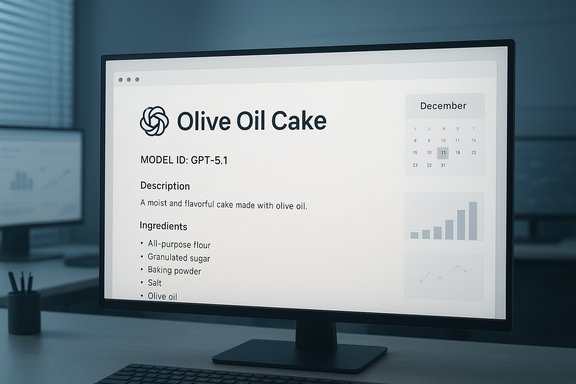
OpenAI’s next-generation update appears to be moving from rumor into active field testing: observers have spotted a model labeled “Olive Oil Cake” inside Notion that displays the OpenAI logo and a unique identifier distinct from GPT‑5.1 — a concrete signal that partners are trialing an unreleased GPT‑5.2 build even as prediction markets and press reports zero in on a possible December release window.
Notion’s internal early-access programs and OpenAI’s recent cadence of staged partner rollouts make this leak significant in context. Notion has formalized early access and beta arrangements that allow the company to pilot AI features and models before they are broadly available, which aligns with the platform’s historical pattern of being an early integration partner for OpenAI models. Meanwhile, mainstream tech outlets have reported a rapid acceleration inside OpenAI — an internal “code red” and a push to release a performance-focused GPT‑5.2 sooner than previously planned. Several publications flagged December 9 as an initial target, and prediction markets such as Polymarket have shifted odds toward December 11, suggesting the market is pricing a near-term release even without an official announcement. This article summarizes what is publicly observable right now, evaluates the reliability of the signals, and analyzes what Windows users, IT teams, and product integrators should expect and prepare for if GPT‑5.2 is indeed imminent.
Caution: specific performance numbers you see in some blog posts or trackers (e.g., precise benchmark deltas) are often vendor‑reported or extrapolated from limited tests. Treat any quoted percentages or leaderboard positions as provisional until validated by independent benchmarkers.
Source: TestingCatalog Notion tests unreleased GPT-5.2 model as OpenAI launch nears
 Background
Notion’s internal early-access programs and OpenAI’s recent cadence of staged partner rollouts make this leak significant in context. Notion has formalized early access and beta arrangements that allow the company to pilot AI features and models before they are broadly available, which aligns with the platform’s historical pattern of being an early integration partner for OpenAI models. Meanwhile, mainstream tech outlets have reported a rapid acceleration inside OpenAI — an internal “code red” and a push to release a performance-focused GPT‑5.2 sooner than previously planned. Several publications flagged December 9 as an initial target, and prediction markets such as Polymarket have shifted odds toward December 11, suggesting the market is pricing a near-term release even without an official announcement. This article summarizes what is publicly observable right now, evaluates the reliability of the signals, and analyzes what Windows users, IT teams, and product integrators should expect and prepare for if GPT‑5.2 is indeed imminent.What we actually know right now
- A Notion internals observation shows a model option labeled “Olive Oil Cake” that displays the OpenAI logo and a model identifier different from GPT‑5.1. That listing is the most tangible external indicator of a new model instance beyond pure rumor. However, Notion’s model label alone does not prove lineage — it does indicate active partner testing.
- Multiple outlets, citing sources familiar with OpenAI’s plans, report OpenAI accelerated work on GPT‑5.2 and considered a December 9 release; these reports framed GPT‑5.2 as a performance and reasoning-focused update rather than a major architectural pivot. The Verge’s reporting on an internal “code red” is the most widely cited example of this narrative.
- Prediction markets have reacted. Polymarket markets tied to the next “frontier model” release now show strong odds clustered around December 11 across several active markets, a market signal that the community expects a model announcement in the immediate window. Betting trends can reflect insider information, coordinated speculation, or simple herd behavior — they are a signal, not proof.
- OpenAI has not made a public announcement confirming GPT‑5.2’s name, release date, or technical specifications. All public discussion remains based on a mix of press reports, prediction-market movements, and partner sightings. Treat the existing clues as early-stage corroboration that still requires vendor confirmation.
Why Notion’s “Olive Oil Cake” matters
Notion’s role as an early integration partner
Notion has a documented Early Access / LEAP program that formalizes how it pilots AI features and model variants with selected customers and partners. That institutional setup makes it a plausible first surface for new model trials. Notion’s own product and developer materials show active collaboration with OpenAI on agentic and long‑context workflows, which is why a Notion listing carries more weight than a random social post.What the “Olive Oil Cake” sighting does — and doesn’t — prove
- It demonstrates that Notion has an internal model entry displaying the OpenAI logo and a different identifier than GPT‑5.1, which is a stronger signal than anonymous hearsay.
- It does not prove the model’s final public name, specs, or parity with any benchmark claims. Internal model IDs are often temporary, and platform UIs can expose experimental labels or placeholders that don’t map one‑to‑one to final marketing names. Treat the sighting as evidence of active partner testing, not final model confirmation.
The release date chatter: rumors, markets, and media
The rumor timeline
- Recent reporting — led by outlets that referenced sources inside OpenAI — proposed a fast-tracked GPT‑5.2 launch originally aimed at December 9 as OpenAI responded to competitive pressure from Google’s Gemini 3 and Anthropic. This narrative centers on a company-wide “code red” to prioritize core model performance and reliability.
- As public trading and chatter evolved, prediction markets shifted probabilities toward December 11 in several active markets, and smaller outlets echoed that updated expectation. Markets can move faster than official newsrooms because they react to pieces of evidence and sentiment in real time.
How much weight to give Polymarket and social signals
- Polymarket’s odds are a useful barometer of community expectations. Several Polymarket markets now show a high percentage probability for a mid‑December release date, with heavy volume concentrated on December 11 outcomes. That demonstrates strong market conviction — whether from public signals or private information.
- Markets are noisy. They reflect the aggregate of bettors’ information, incentives, and biases. A market moving in one direction can become self‑reinforcing as traders pile on. Use market movements as context, not as conclusive proof of company action.
What GPT‑5.2 is rumored to be (technical claims and plausibility)
Multiple reports characterize GPT‑5.2 as an incremental, performance-first refresh rather than a radical architectural change. The emphasis is expected to be on:- Improved reasoning and lower hallucination rates.
- Faster, more efficient inference (latency and token efficiency).
- Stability and reliability for real-world integrations, rather than headline new features.
Caution: specific performance numbers you see in some blog posts or trackers (e.g., precise benchmark deltas) are often vendor‑reported or extrapolated from limited tests. Treat any quoted percentages or leaderboard positions as provisional until validated by independent benchmarkers.
Practical implications for Windows users, IT admins, and developers
For Windows end users and productivity workflows
- Expect early availability of GPT‑5.2 in productivity surfaces that prioritize early testing: Notion, Microsoft Copilot (including Copilot Studio for enterprise evaluation), and other integrations where Microsoft and Notion act as early partners. That means you may see new model behavior first inside Office, Visual Studio Code extensions, or Notion AI features before ChatGPT Plus or the general API.
- New model behavior can change tone, output style, and instruction following. Recent mid-cycle updates (e.g., GPT‑5.1) deliberately adjusted warmth and persona defaults; GPT‑5.2 may shift the assistant’s style again. Users who rely on consistent tone in templates and automation should instrument tests before changing production workflows.
For IT admins and enterprise teams
- Treat preview exposures as experimental. Microsoft and other partners label experimental models as such inside admin consoles and Copilot Studio. Don’t promote preview models into production without passing explicit validation gates for accuracy, latency, cost, and data handling.
- Validate data routing and residency. Preview models sometimes route data outside your configured tenant boundary; confirm contractual and technical data‑handling guarantees before sending regulated or sensitive content. This is especially important for enterprises bound by data residency or sectoral compliance rules.
- Maintain the ability to pin or freeze models in production. Enterprise controls that let administrators lock a production workflow to a specific model flavor are essential to avoid unexpected behavior from a sudden model swap. If Notion or Copilot surfaces expose new model choices, inclusion of model freeze or pinning features is a must.
For developers and integrators
- Create a non‑production sandbox and test the new model on representative workloads (long transcripts, multi‑file repos, and policy‑sensitive prompts).
- Run A/B comparisons (GPT‑5.1 vs. experimental GPT‑5.2) to measure hallucination rate, latency, token costs, and behavior drift.
- Ensure CI gates for any agentic actions (apply_patch, shell commands) and require human review for effectful operations.
Risks and open questions (critical analysis)
Provenance vs. behavior: the “Olive Oil Cake” ambiguity
A Notion UI entry is stronger evidence than pure rumor, but model label exposure is not the same as vendor confirmation. The model may be an internal test build, a fine‑tuned derivative, or a placeholder. Do not treat an internal label as a contractual or technical guarantee of public availability or feature parity.Regression and stability risk
Preview builds frequently contain regressions that do not appear in GA releases. Early partner testing helps surface these issues, but the behavior you see in Notion or Copilot today could differ from what shops receive via the final API or ChatGPT commercial releases. Enterprises should assume risk of behavioral deltas and validate accordingly.Data governance and legal exposure
Using experimental models in production can have legal and compliance costs — telemetry, retention, and training policies differ between preview and GA models. Confirm whether test inputs are used for retraining and whether logs may leave controlled geographies. If uncertain, treat preview channels as non‑confidential.Overreliance on markets and leaks
Polymarket and social chatter are helpful signals but not replacements for vendor documentation. Markets can front‑run announcements and amplify half‑truths; leaks may be outdated or misattributed. Only vendor docs and product pages are definitive.How to prepare: a practical checklist for WindowsForum readers
- Isolate experiments: Use a dedicated non‑production tenant, workspace, or account for preview tests. Avoid sending PII, customer data, or production secrets to experimental endpoints.
- Validate data flow: Determine exactly where model calls route and whether logs are retained for retraining. Ask partners (Notion, Microsoft) for retention guarantees or opt‑out mechanisms.
- Run representative benchmarks: Create an evaluation suite that covers typical Windows‑centric workflows — email drafting, meeting summarization, code refactoring across repos, and long‑document research synthesis. Compare outputs side‑by‑side across models.
- Gate agentic features: If your workflows allow models to write files, run shell commands, or merge code, require explicit human approval and CI validations before merging into production branches.
- Instrument observability: Add logging, telemetry, and anomaly detection for model-driven automations so you can detect hallucination spikes, drift, or unexpected costs quickly.
- Policy and user training: Update acceptable‑use policies and user guidance to reflect the differences between stable GA models and preview integrations. Educate staff about the limits of preview features.
What to watch for next (concrete signals)
- An official OpenAI blog post, product update, or system card that names GPT‑5.2 and outlines specific model variants and limits. Until that appears, public signals remain provisional.
- Notion or Microsoft release notes updating their AI surfaces with a new model name or a public early access sign‑up. Notion’s LEAP program language and prior OpenAI/Notion collaboration posts make them likely early announcement surfaces.
- API endpoint naming in developer docs (for example, a gpt‑5.2‑chat‑latest alias) that allows developers to pin or opt into the new model. Historically OpenAI has used chat‑latest conventions during rollout windows.
- Broader coverage from established outlets (major tech press) confirming details with multiple sources; these will be the most reliable pre‑announcement corroboration.
Final assessment
The Notion “Olive Oil Cake” sighting is the clearest external sign so far that OpenAI has a pre‑release model instance in partner testing, and prediction markets reflect strong market expectations for a mid‑December announcement. Those signals combined make a compelling case that something is imminent. However, they do not replace vendor confirmation: the public technical specifications, pricing, availability tiers, and enterprise controls will only be authoritative once OpenAI publishes them. For Windows users, IT teams, and developers, the sensible posture is one of prepared caution: instrument tests in sandboxes, validate data routing and retention, require gating for any agentic or effectful automations, and insist on model‑pinning controls for production workloads. If GPT‑5.2 delivers meaningfully better reasoning and reliability as reported, the result will be valuable — but the path to production should be measured and governed, not rushed.Quick reference: what to do today
- Create a dedicated sandbox tenant and enable early‑access features only for a handful of trusted testers.
- Confirm Notion/Microsoft data routing and retention terms before sending any regulated content.
- Build a short benchmark suite that mirrors your everyday Windows workflows to measure latency, hallucination, and token costs.
- Ensure your production systems can pin a model or roll back if an experimental model is exposed to users.
Source: TestingCatalog Notion tests unreleased GPT-5.2 model as OpenAI launch nears
