

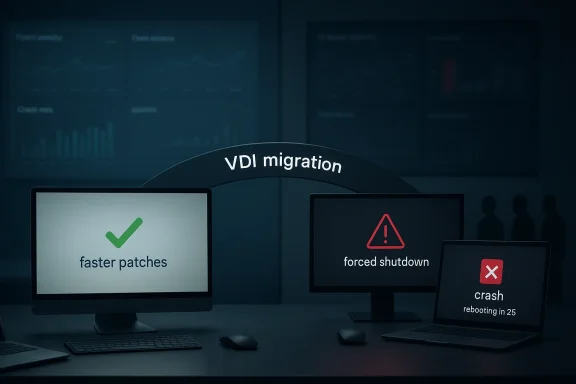
Enterprise PCs are not simply aging badly; they are increasingly being judged against a higher bar that Apple spent years training the market to expect. Omnissa’s telemetry-backed State of Digital Workspace findings suggest that, in managed fleets, macOS devices are updated faster, experience fewer crashes, and suffer fewer forced shutdowns than Windows endpoints, while Apple hardware also lingers longer in service. That is a sharp reminder that the enterprise desktop story is no longer just about compatibility and price; it is about trust, patch velocity, and whether IT can keep the fleet both current and predictable. The broader implication is uncomfortable for Microsoft: Windows still dominates the installed base, but dominance is not the same thing as affection.
Omnissa’s report lands in a moment when enterprise IT is already under pressure from multiple directions. Windows 10 reached end of support on October 14, 2025, and Microsoft has been urging organizations either to move to Windows 11 or to pay for extended security coverage while they finish the migration. That timing matters, because every lifecycle deadline forces IT teams to choose between replacing hardware, stretching the old fleet, or shifting more users into virtual desktops.
The report itself should be read with vendor caution, of course. Omnissa sells endpoint management, virtual desktops, and digital employee experience tooling, so it has a commercial interest in proving that fleets are messy and that better management software is the answer. Still, vendor bias does not automatically make telemetry meaningless; it just means the conclusions should be checked against broader platform evidence. On the patching question, Apple’s own enterprise documentation shows why the company can plausibly move updates through managed channels with less friction, while Microsoft’s model remains more fragmented across Windows Update, policy layers, and mixed management modes.
The most striking part of the Omnissa argument is not that Macs are perfect. It is that they appear to be easier to keep current, and that matters enormously in regulated industries and hybrid work environments. A fleet that updates faster is a fleet that spends less time in an exposed state, less time waiting for reboots, and less time becoming the sort of problem that reaches the help desk after the damage is done. That is especially relevant now that Apple, Google, and Microsoft all compete not only on endpoints but on the manageability story wrapped around those endpoints.
What the report really captures is a shift in enterprise expectations. Buyers no longer assume Windows is the safest default simply because it is the traditional corporate standard. They are comparing operating systems the way consumer buyers compare phones: by how often they break, how much maintenance they demand, and whether the user experience feels like a chore. That is a competitive problem for Microsoft, but it is also a management problem for IT teams that still inherit mixed fleets and legacy processes.
At the same time, Apple turned the Mac from a premium niche choice into a credible managed-workforce platform. Apple’s enterprise update tooling has become more explicit, more enforceable, and more MDM-friendly over time, including declarative management and enforced minimum OS versions during automated enrollment. That makes patching less of a negotiation and more of a policy outcome. The difference is subtle in a demo and enormous in a 50,000-device deployment.
Microsoft, meanwhile, has been steadily modernizing Windows management, but the ecosystem remains more complicated. IT still deals with a mix of on-premises WSUS habits, cloud policies, co-management, legacy application constraints, and a much larger compatibility surface. Microsoft’s own lifecycle notices for Windows 10 underline the scale of the migration effort now underway, and that in turn increases the importance of how manageable Windows 11 really is once it arrives. A platform can be powerful and still be operationally exhausting.
There is also a psychological backdrop here. Windows has accumulated years of public complaints about update quality, reboot timing, and reliability regressions. Those complaints are not always fair, but they have become part of the brand memory. As a result, every vendor report that says Macs are easier to patch or Windows machines are less stable lands in a market that is already predisposed to believe it. That does not make the data wrong; it makes the comparison sticky.
The reason likely has less to do with raw quality and more to do with control architecture. Apple offers centralized and increasingly declarative update management, while Windows organizations often split responsibilities across local policies, cloud policy stacks, and older servicing infrastructure. When an update path is fragmented, every extra step becomes a place where timing, UX friction, or compatibility checks can slow adoption. In other words, the problem is often governance, not just code.
Windows can absolutely be managed at scale, but its management story is still more layered. Microsoft’s own lifecycle notice for Windows 10 now forces organizations to confront end-of-support deadlines, and that usually means staggered upgrades, compatibility checks, and a lot of device triage. The result is often a slower real-world patch cadence, even when IT is trying to move quickly.
This is where the enterprise angle differs from consumer comparison charts. A consumer might describe a crash as annoyance; an enterprise describes it as productivity loss, support load, and failed workflows. In a managed environment, every reboot is a small tax, and every hang is a possible incident. If Windows feels more interruptive, then the cost of ownership rises even when the purchase price looks attractive.
The Mac advantage here is less about perfection and more about perceived coherence. Apple’s enterprise stack lets IT set expectations more cleanly, and users generally encounter fewer design contradictions between the OS, the update service, and the management policy. In Windows environments, more knobs often mean more flexibility, but they also mean more points of failure and more points of blame.
Windows fleets often refresh earlier because compatibility, performance, and policy deadlines force the issue. Macs, by contrast, may stay in service longer because they remain usable, patchable, and broadly acceptable for more years. That is an important distinction: an asset can be kept longer when the operating system continues to feel stable and supported enough for the business.
That has consequences for procurement. IT departments may start viewing the Mac as a lower-drama asset even if the upfront price is higher. At scale, lower drama can be worth more than lower sticker cost because it translates into fewer emergency refreshes, fewer compatibility surprises, and fewer policy exceptions. Operational calm is a real line item, even if it is rarely labeled that way.
The significance here is that ARM is no longer a theoretical future for enterprise endpoints. Apple has already normalized it on the Mac, and the rest of the market now has to prove that x86 compatibility still deserves a central place in the desktop conversation. That is especially true when organizations are trying to reduce power consumption, support mobile workstyles, and simplify device cooling and lifecycle management.
This does not mean Qualcomm or other ARM vendors automatically win the Windows-side battle. It means the market is paying closer attention to architecture as a business decision, not merely a technical one. Enterprises want fewer chargers, fewer thermal complaints, and fewer reasons to treat mobile performance as a compromise. The more Apple demonstrates that ARM can be mainstream in managed work, the more pressure it puts on everyone else.
This is not the old “everyone gets a thin client and loves it” dream. Modern VDI is more about isolating complexity than eliminating it. It lets IT preserve app access while delaying or smoothing hardware replacement, and it gives organizations a way to keep older or less standardized endpoints useful during a transition. That is why VDI often rises when endpoint confidence falls.
Omnissa clearly wants to position itself as the company that helps enterprises manage this transition. That commercial posture is obvious, but it also reflects a real market need. If Windows refresh cycles are painful and Mac adoption is uneven, VDI can reduce the blast radius while IT figures out the endpoint mix. Contingency architecture is now part of the normal desktop strategy.
The exact market shares are less important than the strategic pattern. Browser choice is no longer just a user preference; it is a security architecture decision. As more work moves into web apps, IT wants control at the browser layer because that is where policy can be applied without reimaging every machine or rewriting every app.
This is also where Apple’s and Google’s ecosystems intersect with Microsoft’s. Chrome remains dominant globally, and Edge has grown steadily in enterprise contexts, but the browser market itself is becoming more fragmented inside the workplace than outside it. That fragmentation is a sign that organizations are trying to claw back control from users and from cloud apps.
That matters because government buying tends to validate security credibility for the rest of the market. Once a device family is seen as acceptable in a high-control environment, it becomes easier for corporate buyers to argue that the same family belongs in enterprise fleets. Certification does not equal universal adoption, but it is often enough to change the conversation.
For Microsoft, this is both a challenge and an opportunity. Windows remains deeply entrenched in government, but any shift toward alternate endpoints or virtualization in public-sector settings chips away at the assumption that Windows is the only serious government desktop. The more buyers believe they can mix ecosystems safely, the less monopolistic the old PC logic becomes.
Organizations should expect three things to matter more over the next 12 months: patch speed, endpoint reliability, and the browser as a security boundary. Those are the places where user frustration becomes measurable business risk. They are also the places where vendors can still differentiate themselves in ways that matter to procurement teams.
Source: theregister.com Enterprise PCs are unreliable, unpatched, and unloved
 Overview
Omnissa’s report lands in a moment when enterprise IT is already under pressure from multiple directions. Windows 10 reached end of support on October 14, 2025, and Microsoft has been urging organizations either to move to Windows 11 or to pay for extended security coverage while they finish the migration. That timing matters, because every lifecycle deadline forces IT teams to choose between replacing hardware, stretching the old fleet, or shifting more users into virtual desktops.The report itself should be read with vendor caution, of course. Omnissa sells endpoint management, virtual desktops, and digital employee experience tooling, so it has a commercial interest in proving that fleets are messy and that better management software is the answer. Still, vendor bias does not automatically make telemetry meaningless; it just means the conclusions should be checked against broader platform evidence. On the patching question, Apple’s own enterprise documentation shows why the company can plausibly move updates through managed channels with less friction, while Microsoft’s model remains more fragmented across Windows Update, policy layers, and mixed management modes.
The most striking part of the Omnissa argument is not that Macs are perfect. It is that they appear to be easier to keep current, and that matters enormously in regulated industries and hybrid work environments. A fleet that updates faster is a fleet that spends less time in an exposed state, less time waiting for reboots, and less time becoming the sort of problem that reaches the help desk after the damage is done. That is especially relevant now that Apple, Google, and Microsoft all compete not only on endpoints but on the manageability story wrapped around those endpoints.
What the report really captures is a shift in enterprise expectations. Buyers no longer assume Windows is the safest default simply because it is the traditional corporate standard. They are comparing operating systems the way consumer buyers compare phones: by how often they break, how much maintenance they demand, and whether the user experience feels like a chore. That is a competitive problem for Microsoft, but it is also a management problem for IT teams that still inherit mixed fleets and legacy processes.
Background
For years, the enterprise PC market was defined by inertia. Windows PCs were ubiquitous, Macs were often tolerated for executives or creatives, and endpoint management was mostly a matter of keeping corporate policy attached to a machine long enough for it to survive procurement cycles. But the post-pandemic workplace changed that rhythm. Remote work, SaaS identity, zero-trust security, and hybrid device ownership made the endpoint more visible, more exposed, and more central to productivity than it used to be.At the same time, Apple turned the Mac from a premium niche choice into a credible managed-workforce platform. Apple’s enterprise update tooling has become more explicit, more enforceable, and more MDM-friendly over time, including declarative management and enforced minimum OS versions during automated enrollment. That makes patching less of a negotiation and more of a policy outcome. The difference is subtle in a demo and enormous in a 50,000-device deployment.
Microsoft, meanwhile, has been steadily modernizing Windows management, but the ecosystem remains more complicated. IT still deals with a mix of on-premises WSUS habits, cloud policies, co-management, legacy application constraints, and a much larger compatibility surface. Microsoft’s own lifecycle notices for Windows 10 underline the scale of the migration effort now underway, and that in turn increases the importance of how manageable Windows 11 really is once it arrives. A platform can be powerful and still be operationally exhausting.
There is also a psychological backdrop here. Windows has accumulated years of public complaints about update quality, reboot timing, and reliability regressions. Those complaints are not always fair, but they have become part of the brand memory. As a result, every vendor report that says Macs are easier to patch or Windows machines are less stable lands in a market that is already predisposed to believe it. That does not make the data wrong; it makes the comparison sticky.
Patching Velocity Is the Story Hidden Inside the Story
Omnissa’s headline finding is that macOS devices are updated 1.5 times faster than Windows devices. The numbers matter less as a precise universal truth than as a directional signal: in managed fleets, Apple machines appear to spend less time waiting for administrative action before they get patched. That is a major deal because modern patching is about reducing exposure windows, not just ticking a compliance box.The reason likely has less to do with raw quality and more to do with control architecture. Apple offers centralized and increasingly declarative update management, while Windows organizations often split responsibilities across local policies, cloud policy stacks, and older servicing infrastructure. When an update path is fragmented, every extra step becomes a place where timing, UX friction, or compatibility checks can slow adoption. In other words, the problem is often governance, not just code.
Centralization Matters
On Apple devices, administrators can delay, enforce, and even require minimum software versions during enrollment or operation. Apple’s documentation shows how MDM can control release timing, enforce software versions, and query update availability directly from Apple’s lookup services. That makes the process legible to administrators and predictable to end users, which is exactly what enterprise patching needs.Windows can absolutely be managed at scale, but its management story is still more layered. Microsoft’s own lifecycle notice for Windows 10 now forces organizations to confront end-of-support deadlines, and that usually means staggered upgrades, compatibility checks, and a lot of device triage. The result is often a slower real-world patch cadence, even when IT is trying to move quickly.
- Centralized control generally reduces user resistance.
- Declarative management shortens the path from policy to enforcement.
- Complex policy layers can delay Windows patch rollouts.
- End-of-support deadlines accelerate migration but also create operational strain.
- Timing is part of security, not just convenience.
Reliability and User Experience
Omnissa also says Windows users experience materially more forced shutdowns, app crashes, and hangs than Mac users in its observed fleet. Even if those ratios are specific to the company’s customer base, the direction of travel is telling. Reliability is becoming a competitive feature, and it is one that users notice immediately because they do not need a dashboard to feel it.This is where the enterprise angle differs from consumer comparison charts. A consumer might describe a crash as annoyance; an enterprise describes it as productivity loss, support load, and failed workflows. In a managed environment, every reboot is a small tax, and every hang is a possible incident. If Windows feels more interruptive, then the cost of ownership rises even when the purchase price looks attractive.
Why Forced Shutdowns Hurt More at Work
A forced shutdown is not just a technical event. It interrupts sessions, corrupts work-in-progress, and often creates a support ticket that is expensive relative to the original problem. When the desktop is a delivery platform for line-of-business apps, a restart can also trigger a chain reaction of reauthentication, sync recovery, and application relaunch. That is why reliability metrics often become an indirect labor-cost metric.The Mac advantage here is less about perfection and more about perceived coherence. Apple’s enterprise stack lets IT set expectations more cleanly, and users generally encounter fewer design contradictions between the OS, the update service, and the management policy. In Windows environments, more knobs often mean more flexibility, but they also mean more points of failure and more points of blame.
- Fewer forced reboots mean fewer interrupted workflows.
- Fewer hangs reduce help-desk volume.
- Fewer app crashes improve confidence in desktop continuity.
- Better update predictability makes users more willing to accept change.
- Reliability compounds across an entire workday.
Fleet Age and Replacement Pressure
Omnissa’s fleet-age data is especially interesting because it suggests Windows devices are turned over faster in managed environments than Macs, but Macs have a longer tail of active use. Ninety percent of Windows machines in its care are under three years old, and only two percent make it to a sixth year. For Macs, 65 percent are under three years old, while 11.5 percent remain in use six years after purchase. That sounds contradictory until you remember that replacement cadence and usable lifespan are not the same thing.Windows fleets often refresh earlier because compatibility, performance, and policy deadlines force the issue. Macs, by contrast, may stay in service longer because they remain usable, patchable, and broadly acceptable for more years. That is an important distinction: an asset can be kept longer when the operating system continues to feel stable and supported enough for the business.
The Economics of Keeping Devices Longer
Every extra year of device life is not automatically savings. If support overhead, security risk, or productivity loss rises faster than depreciation falls, the business case collapses. Apple’s longer tail in Omnissa’s data suggests that some organizations are comfortable keeping Macs around because the experience remains acceptable later in life than it does for Windows hardware.That has consequences for procurement. IT departments may start viewing the Mac as a lower-drama asset even if the upfront price is higher. At scale, lower drama can be worth more than lower sticker cost because it translates into fewer emergency refreshes, fewer compatibility surprises, and fewer policy exceptions. Operational calm is a real line item, even if it is rarely labeled that way.
- Longer usable life can reduce replacement churn.
- Stable update channels extend the value of older machines.
- Faster refresh cycles may signal hidden maintenance costs.
- Procurement decisions increasingly factor in support burden.
- Total cost of ownership now includes user frustration.
The ARM and Apple Silicon Angle
Omnissa’s report also highlights the growing presence of Apple silicon in corporate fleets and interprets that as evidence of appetite for ARM-based architectures. That is a fair inference, but it should not be overread. Enterprise buyers are not switching architectures out of ideology; they are switching when the performance-per-watt, battery life, and manageability story becomes persuasive enough to survive app compatibility scrutiny.The significance here is that ARM is no longer a theoretical future for enterprise endpoints. Apple has already normalized it on the Mac, and the rest of the market now has to prove that x86 compatibility still deserves a central place in the desktop conversation. That is especially true when organizations are trying to reduce power consumption, support mobile workstyles, and simplify device cooling and lifecycle management.
Why Performance Per Watt Matters
A lot of enterprise IT decisions are made in a language of duty cycles and battery anxiety, not benchmark theater. If a laptop lasts longer, runs cooler, and requires less intervention, users become more tolerant of change and IT becomes more tolerant of longer refresh intervals. That is why Apple silicon has been so strategically important: it reframes the Mac from “preferred by some users” to “easier to run as a corporate standard.”This does not mean Qualcomm or other ARM vendors automatically win the Windows-side battle. It means the market is paying closer attention to architecture as a business decision, not merely a technical one. Enterprises want fewer chargers, fewer thermal complaints, and fewer reasons to treat mobile performance as a compromise. The more Apple demonstrates that ARM can be mainstream in managed work, the more pressure it puts on everyone else.
- Battery life now influences fleet satisfaction.
- Cooler-running devices reduce support friction.
- ARM success on Macs normalizes the architecture for enterprise buyers.
- Compatibility remains the main hurdle for Windows on ARM.
- Architecture choice is becoming a workplace policy issue.
Virtual Desktops Are Back in Fashion for a Reason
One of the more revealing numbers in Omnissa’s report is 36 percent year-over-year growth in virtual desktops. The company ties that to Windows 10 end-of-life and the need for newer OS-ready hardware, but the deeper story is that VDI is becoming a pressure-release valve for organizations that cannot cleanly replatform everything at once. When endpoint modernization is painful, virtual desktops become the migration bridge.This is not the old “everyone gets a thin client and loves it” dream. Modern VDI is more about isolating complexity than eliminating it. It lets IT preserve app access while delaying or smoothing hardware replacement, and it gives organizations a way to keep older or less standardized endpoints useful during a transition. That is why VDI often rises when endpoint confidence falls.
VDI as a Safety Valve
If local devices are flaky or hard to patch, moving the work to a virtual desktop can reduce the number of variables the user has to trust. The machine at the desk becomes a window rather than the whole platform, and that can be a lifesaver in regulated or distributed environments. It is also why virtual desktops often surge during migration windows, even though they are rarely the final destination.Omnissa clearly wants to position itself as the company that helps enterprises manage this transition. That commercial posture is obvious, but it also reflects a real market need. If Windows refresh cycles are painful and Mac adoption is uneven, VDI can reduce the blast radius while IT figures out the endpoint mix. Contingency architecture is now part of the normal desktop strategy.
- VDI can hide hardware inconsistency.
- It helps bridge OS migrations.
- It reduces dependency on local app compatibility.
- It is often adopted when refresh windows tighten.
- Virtualization is a workaround and a strategy at the same time.
Browser Control Is the New Security Battleground
Omnissa’s report says Edge has reached 41 percent browser share in its observed enterprise fleet, just behind Chrome, while “Other” browsers and niche enterprise browsers such as Island and Talon also show up with meaningful presence. That matters because the browser is increasingly the last controlled surface before users touch SaaS data, internal apps, and identity prompts. In many enterprises, the browser is now the new desktop.The exact market shares are less important than the strategic pattern. Browser choice is no longer just a user preference; it is a security architecture decision. As more work moves into web apps, IT wants control at the browser layer because that is where policy can be applied without reimaging every machine or rewriting every app.
Why Enterprise Browsers Are Growing
Niche enterprise browsers exist because IT wants to manage the presentation layer more tightly. They can help enforce data controls, isolate sessions, and constrain exfiltration in ways that standard consumer browsers do not. That makes them particularly attractive in regulated industries, government, and any environment where browser-based SaaS is carrying sensitive work.This is also where Apple’s and Google’s ecosystems intersect with Microsoft’s. Chrome remains dominant globally, and Edge has grown steadily in enterprise contexts, but the browser market itself is becoming more fragmented inside the workplace than outside it. That fragmentation is a sign that organizations are trying to claw back control from users and from cloud apps.
- Browser policy is increasingly part of endpoint security.
- Specialized browsers signal a desire for tighter control.
- Enterprise adoption does not mirror consumer browser market share.
- Web apps shift security decisions higher up the stack.
- The browser has become a managed endpoint.
Government and Public-Sector Buying Can Still Move Markets
Omnissa’s report points to unusual growth in desktop adoption among government buyers and a surge in Google Pixel handsets in its telemetry. Even if the exact percentages are specific to Omnissa’s customer base, the underlying idea is important: public-sector procurement can reshape vendor trajectories quickly when a device enters an approved products list or clears a compliance gate. Google has publicly said its Pixel phones were added to the Department of Defense Information Network Approved Products List, which creates a meaningful procurement signal.That matters because government buying tends to validate security credibility for the rest of the market. Once a device family is seen as acceptable in a high-control environment, it becomes easier for corporate buyers to argue that the same family belongs in enterprise fleets. Certification does not equal universal adoption, but it is often enough to change the conversation.
Procurement as a Market Accelerator
Public-sector approval has a ripple effect because it lowers the perceived risk of procurement for adjacent industries. Security-minded organizations, especially in healthcare and critical infrastructure, watch these approvals closely because they treat them as proof points rather than mere paperwork. That helps explain why a device like Pixel can gain momentum faster than you would expect from consumer share alone.For Microsoft, this is both a challenge and an opportunity. Windows remains deeply entrenched in government, but any shift toward alternate endpoints or virtualization in public-sector settings chips away at the assumption that Windows is the only serious government desktop. The more buyers believe they can mix ecosystems safely, the less monopolistic the old PC logic becomes.
- Government approvals can unlock broader enterprise interest.
- Compliance validation lowers perceived adoption risk.
- Security certifications often influence adjacent sectors.
- Procurement decisions shape architecture roadmaps.
- Public-sector trust scales into private-sector interest.
Strengths and Opportunities
The strongest takeaway from Omnissa’s report is that enterprise IT is finally treating endpoint experience as a strategic control surface rather than a nuisance. That creates real room for innovation in device management, patch orchestration, browser policy, and virtual desktop delivery. It also gives buyers more ways to shape risk instead of merely absorbing it.- Faster Mac patching can lower exposure windows.
- Better declarative management can simplify compliance.
- ARM adoption may improve battery life and reduce support load.
- VDI growth gives IT a migration bridge during OS refreshes.
- Browser-layer controls can strengthen data protection.
- Public-sector approvals can accelerate adoption of secure devices.
- Telemetry-driven management can spot issues earlier.
Risks and Concerns
The biggest caution is that vendor telemetry can overstate certainty. Omnissa sees the fleets that use its tools, not the whole world, and customers who buy digital workspace software are already more likely to care about manageability than the average enterprise. That means the report is directionally useful, but not a universal census.- Telemetry may not represent the broader market.
- Managed fleets are not the same as unmanaged ones.
- Vendor analysis can echo the product marketing narrative.
- Migration enthusiasm can hide compatibility debt.
- Faster updates can still fail if validation is poor.
- More control layers can also mean more complexity.
- Virtual desktops can defer, not solve, endpoint problems.
Looking Ahead
The next phase of the enterprise desktop battle will be defined less by operating system loyalty and more by management maturity. Microsoft still has enormous advantages in software compatibility and installed base, but Apple has turned manageability into a serious competitive asset, and Google has made hardware trust a public-sector talking point. That means the market is moving toward a world where the best-managed fleet, not the biggest ecosystem, wins the day.Organizations should expect three things to matter more over the next 12 months: patch speed, endpoint reliability, and the browser as a security boundary. Those are the places where user frustration becomes measurable business risk. They are also the places where vendors can still differentiate themselves in ways that matter to procurement teams.
- Watch whether Windows 11 patch confidence improves after the Windows 10 end-of-support rush.
- Track whether Apple silicon continues to expand in regulated enterprises.
- Monitor whether VDI growth remains a transition tool or becomes a long-term architectural choice.
- Watch browser policy adoption as SaaS security tightens.
- Look for more public-sector hardware approvals that reshape enterprise buying.
Source: theregister.com Enterprise PCs are unreliable, unpatched, and unloved
