

Microsoft Turns Driver Quality Into an Ecosystem Discipline
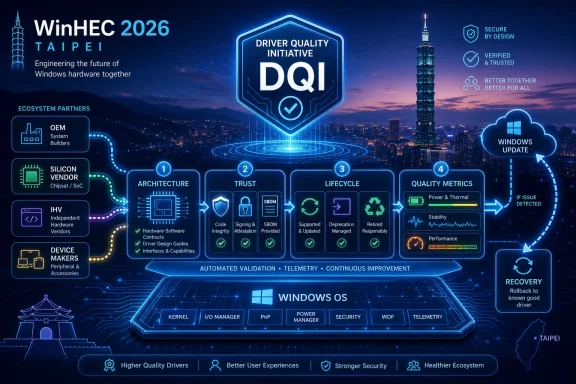
The most important word in Microsoft’s announcement is not “driver.” It is “initiative.” That phrasing matters because Microsoft is not presenting DQI as a single Windows feature, a new logo program, or a one-off certification update. It is describing a coordinated operating model for the hardware ecosystem, built around architecture, trust, lifecycle management, and broader quality measurement.
That is a revealing shift. For years, Windows driver quality has been discussed as if it were mainly a technical problem: a bad kernel driver, a flaky Wi-Fi package, a graphics regression, an audio stack oddity, a peripheral that works until a cumulative update lands. But the user does not experience those failures as supply-chain complexity. The user experiences them as “Windows broke my PC.”
Microsoft’s framing at WinHEC 2026 suggests the company wants to move that accountability upstream. A driver that crashes, drains a laptop, runs hot, or behaves unpredictably after an update is no longer merely a partner issue or a support ticket. It becomes a measurable part of the Windows platform’s quality story.
That is the right instinct. Windows is too broad, too long-lived, and too dependent on third-party hardware integration for Microsoft to solve reliability only from inside the OS. If the platform is going to feel more like an appliance and less like a negotiated truce among vendors, the driver ecosystem has to be governed more like infrastructure.
The Kernel Is Still Where Windows Pays for Its Openness
Microsoft’s first DQI pillar, architecture, goes straight at the oldest and most sensitive part of the Windows reliability bargain: kernel-mode code. Windows earned its dominance partly by being extraordinarily accommodating to hardware and software partners. That flexibility helped create a vast PC ecosystem, but it also gave third-party code a privileged place inside the operating system’s most critical boundary.
When kernel-mode drivers behave, the model works beautifully. Hardware acceleration, low-latency device access, storage stacks, network adapters, graphics pipelines, audio devices, and specialized enterprise peripherals all depend on precise coordination between Windows and vendor code. When kernel-mode drivers fail, the result is often not a clean app crash but a system-level event that looks catastrophic to the customer.
DQI’s architecture pillar makes clear that Microsoft wants fewer partners writing privileged code when a safer option exists. The company says it is investing in hardening kernel-mode drivers while also enabling more third-party kernel-mode driver transitions to user-mode drivers or Microsoft-authored class drivers. That is not a small philosophical adjustment. It is a gradual rebalancing of Windows’ historic compatibility pact.
User-mode drivers are not magic. They can still be buggy, slow, power-hungry, or incompatible. But moving more driver logic outside the kernel changes the blast radius. A failure in user mode is generally easier to contain, recover from, diagnose, and update than a failure in code that has direct access to kernel memory and system-critical execution paths.
This is why Microsoft’s mention of performance investments for PCIe devices with DMA support and future Wi-Fi stack work matters. The old argument against user-mode drivers was often performance. If Microsoft wants partners to leave the kernel, it must make the safer path viable for real devices, not just theoretically cleaner for architecture diagrams.
Class Drivers Are Microsoft’s Quiet Power Move
The other half of the architecture pillar may prove just as consequential: Microsoft-authored class drivers. In plain English, Microsoft wants more device categories to rely on standardized in-box Windows drivers rather than bespoke vendor packages for every implementation. The company specifically called out SoundWire Device Class for Audio, an I3C class driver, NCM USB Ethernet, and ongoing enhancements to existing first-party class drivers in Windows 11.
This is where the initiative becomes more than a lecture to partners. If Microsoft wants to reduce the amount of fragile third-party driver code in the ecosystem, it has to provide credible common plumbing. A good class driver can turn an entire category of devices from a vendor-by-vendor support problem into a platform capability.
The upside is obvious for users and administrators. Fewer custom drivers can mean fewer update surprises, fewer abandoned packages, fewer duplicate utilities, and fewer security risks hiding in old device support code. A laptop dock, audio component, embedded controller, or networking peripheral that works through a well-maintained class driver is less likely to become e-waste when the OEM moves on.
The tradeoff is that vendors lose some surface area for differentiation. That may be acceptable in categories where the driver should simply make the device work. It becomes more contentious when hardware makers see software control panels, tuning layers, telemetry, and companion services as part of the product. Microsoft’s challenge will be drawing that line without turning every device category into a lowest-common-denominator experience.
Trust Becomes a Gate, Not a Handshake
The trust pillar is Microsoft’s way of saying that “partner” cannot simply mean “someone with a driver to submit.” The company says it is raising the bar for trusted partners and trusted drivers through stronger partner verification, expanded automated analysis, and updated Windows Hardware Compatibility Program requirements. That is bureaucratic language for a meaningful tightening of the pipeline.
The practical reason is straightforward. Driver signing is only as valuable as the process behind it. If the ecosystem can submit low-quality or poorly maintained drivers that technically satisfy old requirements, Windows users still inherit the risk. Trust has to include identity, accountability, code quality, security posture, and post-release behavior.
Automated analysis is especially important because the scale of the Windows driver ecosystem is beyond what manual review can handle. Microsoft says thousands of partners contribute to tens of thousands of active driver families across the Windows install base. At that scale, even a small failure rate becomes a large number of affected machines.
The harder question is how much friction Microsoft can add before partners complain that Windows hardware development is becoming too slow or opaque. Stricter gates are easy to praise after a bad driver incident and easy to resent when they delay a product launch. DQI will succeed only if the rules are predictable enough that vendors can engineer toward them rather than plead around them.
Lifecycle Hygiene Is the Unflashy Fix Windows Needed
The lifecycle pillar may be the least glamorous part of DQI, but it is arguably the one Windows administrators will feel most directly. Microsoft says it is improving driver lifecycle management through better Windows Update catalog hygiene, including deprecating outdated or low-quality drivers, advancing SBOM alignment, and enabling faster issue analysis through driver symbols.
Catalog hygiene sounds dull until a machine receives the wrong driver, an obsolete package is offered to a device that should have aged out of it, or a fleet inherits inconsistent driver states because old packages remain available in the background. Windows Update is not just a patching mechanism; for many users and many devices, it is the de facto driver distribution system. If that catalog is messy, Windows quality is messy.
Deprecating low-quality or outdated drivers is therefore more than tidying. It is an assertion that historical availability should not equal ongoing trust. A driver that was acceptable for a past configuration may be inappropriate for modern Windows security baselines, current firmware, or newer hardware revisions. Leaving it in circulation because it once worked is how ecosystems accumulate risk.
SBOM alignment adds a supply-chain dimension. Software bills of materials have become a compliance and security expectation because organizations need to know what components are present, where they came from, and how they may be affected by vulnerabilities. Applying that pressure to drivers is overdue. Drivers are software too, even when the industry talks about them as if they are hardware accessories.
Driver symbols are the other practical piece. Faster issue analysis depends on being able to understand what failed, where, and why. If Microsoft and partners cannot rapidly inspect crashes or performance regressions, quality initiatives become postures rather than operations. Better symbols do not prevent bugs, but they shorten the distance between failure and diagnosis.
Microsoft Expands the Definition of a Bad Driver
The quality measures pillar is where Microsoft’s announcement becomes most interesting. DQI expands driver quality measurement beyond crashes to include stability, functionality, performance, and power and thermal impact. That is a more realistic definition of quality, and it reflects how people actually judge their PCs.
A driver does not have to blue-screen a machine to be bad. It can shave hours off battery life, keep a laptop fan screaming during light work, break sleep, misreport device state, introduce latency, degrade gaming performance, destabilize Bluetooth, or cause intermittent failures that are maddening precisely because they do not produce a clean crash dump. If quality metrics only capture catastrophic failure, they miss much of the lived Windows experience.
Power and thermal behavior are particularly important in the current PC market. Windows now runs across traditional desktops, thin-and-light laptops, gaming rigs, mobile workstations, handhelds, and AI PCs built around increasingly complex silicon platforms. A driver that wastes power is no longer just inefficient; it can undermine the entire value proposition of modern hardware.
Functionality also deserves equal billing with stability. A driver that does not crash but fails under common real-world scenarios is still a quality problem. That matters for cameras, audio devices, docks, wireless radios, touchpads, storage controllers, sensors, and every other component users only notice when it stops behaving normally.
This broader measurement model will likely make some partners uncomfortable. Crash rates are relatively clean. Power behavior, thermal impact, intermittent functionality, and performance regressions can be harder to attribute, especially across firmware versions, OS builds, device configurations, and background workloads. But difficulty is not an excuse to ignore the metrics that actually shape customer trust.
WinHEC Returns as a Repair Shop for the PC Ecosystem
The venue is part of the story. Microsoft says WinHEC 2026 in Taipei was its first WinHEC since 2018, bringing together OEMs, silicon partners, IHVs, ODMs, and Windows engineers. That gap is striking. In the years since the last WinHEC, the PC industry has absorbed Windows 11, pandemic-era hardware demand swings, supply-chain shocks, AI acceleration, security hardening, and a renewed debate over what should be allowed to run in the kernel.
A revived WinHEC makes sense if Microsoft wants more than compliance. Driver quality is not improved only by publishing stricter requirements. It improves when the people designing silicon, boards, firmware, devices, validation pipelines, and OS components understand each other’s constraints early enough to avoid preventable failures.
Microsoft’s description of the event leans heavily on hands-on work. The company says Day 1 covered themes including the evolving landscape, Windows 11 quality, and the future vision for Windows. Breakout tracks covered driver quality, platform fundamentals, device experiences, Windows Server, and ecosystem advancement. Day 2 moved into labs on authoring and hardening drivers, hardware compatibility testing, and AI-assisted crash analysis.
That last phrase is worth watching. AI-assisted crash analysis could be genuinely useful if it helps engineers triage failures faster, cluster related incidents, identify signatures, and connect symptoms to driver versions or hardware conditions. It could also become another dashboard that produces confidence without accountability. The difference will be whether it shortens real engineering loops or merely decorates them.
The most telling detail may be Microsoft’s “Connection Corner,” an open forum where partners could engage directly with the engineers building the tools. That sounds like conference choreography, but in ecosystems this complicated, informal access can be more valuable than a keynote. The problems that break PCs often live between organizational boundaries.
The CrowdStrike Shadow Still Hangs Over Windows Resiliency
Microsoft says DQI builds on the learnings and infrastructure established through the Windows Resiliency Initiative. That connection is important because WRI was Microsoft’s broader effort to harden Windows after a period in which the industry was forced to confront the danger of privileged third-party code at massive scale. Even without naming every incident, the industry context is impossible to miss.
The Windows ecosystem has long tolerated a paradox. Customers want openness, compatibility, peripheral choice, hardware diversity, endpoint security, gaming anti-cheat, specialized enterprise agents, and vendor innovation. But every extension point carries risk, and the deepest extension points can fail in ways that look like the operating system itself has collapsed.
WRI started from the premise that resilience is not just prevention. It is also containment and recovery. Microsoft has already been moving toward mechanisms that reduce reliance on kernel code and improve recovery when something goes wrong. DQI extends that logic into the broader driver supply chain.
This is the correct direction, but it is also politically delicate. Antivirus vendors, hardware makers, silicon companies, peripheral manufacturers, and enterprise software providers have spent years building products around Windows’ extension model. Asking them to move code out of the kernel, accept stricter signing requirements, provide better diagnostics, and submit to broader quality metrics is effectively asking them to change how they ship.
Microsoft can make that transition easier with tools, class drivers, performance improvements, and clear roadmaps. It cannot make the pain disappear. Some categories will move smoothly. Others will resist until the old model becomes more expensive than adapting.
Cloud Recovery Changes the Meaning of a Driver Mistake
DQI also lands alongside Microsoft’s newer recovery work, including cloud-initiated approaches for rolling back faulty drivers distributed through Windows Update. That pairing matters because driver quality has two halves: stop bad drivers before release, and limit damage when a bad driver escapes.
No validation system is perfect. The Windows hardware matrix is too large, and the combinations of firmware, drivers, peripherals, OS builds, security settings, and user behavior are too varied. If Microsoft promises that DQI will eliminate bad drivers, it will fail. If it can reduce the frequency, narrow the blast radius, and accelerate recovery, it may materially improve Windows trust.
Cloud-initiated rollback also changes incentives. If Microsoft can identify a driver with quality problems and replace it on affected devices without waiting for every user, admin, or hardware partner to act manually, Windows Update becomes less of a one-way bet. That does not remove the need for careful release governance, but it gives Microsoft a more active role in remediation.
Enterprise IT will still want controls. A cloud rollback may be welcome on consumer systems and unmanaged devices, but managed environments need auditability, policy integration, and predictable change windows. A driver recovery action that saves one fleet from failure could disrupt another if it is not properly coordinated with management tools.
That is the recurring tension in modern Windows. Consumers need invisible repair. Enterprises need governed repair. Microsoft has to build mechanisms that can do both without forcing one model onto the other.
OEM Applause Is Not the Same as Field Proof
Microsoft’s blog includes supportive quotes from Dell, AMD, Acer, and HP. That is expected at WinHEC, and it is not meaningless. The companies named are exactly the kinds of partners Microsoft needs if DQI is going to matter. They sit close to the hardware, the drivers, the customer experience, and the support burden.
But partner enthusiasm at a conference is not field evidence. The real test will come in release data, update outcomes, support cases, and whether users notice fewer weird failures over time. Quality initiatives tend to sound most impressive at launch, before they collide with product deadlines, legacy device support, and the economics of maintaining old hardware.
That skepticism should not be mistaken for cynicism. Microsoft has identified the right problem. It is also putting pressure on the right layers: architecture, trust, lifecycle, and measurement. The question is whether it can sustain the program long enough for incentives to change.
The phrase “incentive-based distribution,” mentioned in Microsoft’s description of partner feedback, is especially important. If higher-quality drivers receive better distribution treatment, faster approvals, or more favorable exposure through Windows Update, partners will pay attention. If the incentives are vague, DQI risks becoming another quality framework that responsible vendors follow and weaker vendors route around.
Administrators Should Read DQI as a Warning and an Opportunity
For Windows administrators, DQI is not merely a consumer reliability story. It points to a future in which driver provenance, lifecycle state, symbols, SBOM data, and quality telemetry become more important parts of fleet management. That is a healthy direction, but it also means admins should expect driver management to become more policy-driven and less forgiving of old assumptions.
Many organizations still treat drivers as a background concern until they fail. That model is increasingly risky. Modern Windows security features can expose old driver weaknesses, and hardware enablement now intersects with endpoint protection, virtualization-based security, firmware posture, update rings, and compliance reporting. A driver is not just a device enabler; it is part of the attack surface and reliability baseline.
DQI may also improve the admin experience by reducing the amount of manual driver firefighting. Better catalog hygiene and richer quality signals could make Windows Update for Business, Autopatch-style workflows, and OEM update channels easier to trust. But organizations will still need testing rings, rollback plans, and visibility into which drivers are landing where.
The biggest operational change may be cultural. If Microsoft’s metrics expand beyond crashes, IT teams should also expand their own definition of driver incidents. Battery drain after a driver update, thermal regressions on a laptop model, sleep failures after a dock firmware package, or degraded camera behavior after a platform update should be treated as quality signals, not anecdotes.
Developers and Hardware Vendors Are Being Nudged Toward a Smaller Blast Radius
For driver developers and hardware vendors, the message is blunt: the Windows kernel is becoming a more expensive place to live. That does not mean kernel-mode drivers are going away. Many device classes and low-level functions will still require kernel participation. But the burden of justification is rising.
Microsoft’s safer path is clear. Use class drivers where possible. Move logic to user mode where performance and architecture allow it. Submit to stronger analysis. Provide better symbols. Align with SBOM expectations. Watch quality metrics after release. Treat power, thermals, functionality, and stability as first-class engineering requirements rather than after-sales support categories.
That may sound onerous, but the alternative is worse. Vendors that rely on fragile kernel components, opaque update practices, and minimal lifecycle maintenance are likely to find Windows less accommodating over time. The platform is moving toward explicit quality contracts.
The smartest vendors will treat DQI as a roadmap rather than a compliance burden. If Microsoft is willing to invest in user-mode performance, first-party class drivers, better diagnostics, and clearer distribution incentives, partners can reduce maintenance cost while improving customer outcomes. The ones that cling to privileged code for convenience may eventually discover that convenience has become a liability.
The AI PC Needs Boring Drivers More Than Flashy Demos
There is an irony in Microsoft using WinHEC to talk about driver quality at a moment when the PC industry would rather talk about AI. Every vendor wants to discuss neural processing units, Copilot experiences, local inference, creative workflows, developer acceleration, and next-generation silicon. DQI is a reminder that none of that matters if the device cannot sleep properly, resume cleanly, manage thermals, or keep a camera and audio stack stable during a meeting.
AI PCs multiply the importance of driver discipline. New silicon blocks, firmware paths, power states, memory behaviors, and acceleration APIs add more places where platform integration can go wrong. If the baseline is unstable, AI features become another source of suspicion rather than a reason to upgrade.
This is why Microsoft’s emphasis on platform fundamentals is not a sideshow. Power, thermal behavior, storage reliability, display quality, audio, camera, connectivity, and peripherals are the everyday experience of Windows. Users may buy a laptop for its AI sticker, but they judge it by whether the fan stays quiet, the battery estimate is believable, the webcam works, and the device does not become strange after Patch Tuesday.
The PC industry has a habit of selling the future before it has fully stabilized the present. DQI is Microsoft telling its partners that the future needs a better foundation. That may be less glamorous than a keynote demo, but it is more important.
The New Windows Bargain Is Less Freedom, More Reliability
There is an unavoidable tradeoff at the heart of DQI. A more reliable Windows ecosystem will probably be a more constrained Windows ecosystem. Stronger driver verification, more Microsoft-authored class drivers, more pressure to leave kernel mode, catalog cleanup, and incentive-based distribution all shift power toward Microsoft as platform governor.
Some enthusiasts will be uneasy about that. Windows’ openness has always been part of its identity, even when that openness created mess. The ability to attach nearly anything, install vendor tooling, support strange legacy hardware, and keep old workflows alive is why Windows remains indispensable in homes, labs, factories, studios, hospitals, schools, and enterprises.
But openness without quality control no longer scales. A billion-user platform cannot depend on everyone doing the right thing voluntarily. Nor can Microsoft keep absorbing blame for failures caused by deeply privileged third-party code while refusing to impose stronger rules on that code.
The better way to understand DQI is not as a retreat from openness, but as a renegotiation of it. Windows can remain broad and partner-driven while insisting that the most dangerous integration points meet a higher bar. That is not anti-ecosystem. It is ecosystem maintenance.
The WinHEC Signal Windows Users Should Actually Care About
The practical meaning of DQI is not that driver problems disappear next month. It is that Microsoft is trying to make driver quality more measurable, recoverable, and enforceable across the Windows hardware chain. That is a slower story than a new feature, but it may matter more to daily Windows use.
- Microsoft is pushing more driver functionality toward user mode and standardized class drivers to reduce the damage caused by failures in privileged code.
- Windows driver approval is becoming more dependent on stronger partner verification, automated analysis, and updated compatibility requirements.
- Microsoft is treating driver lifecycle hygiene as a quality and security issue, including the removal or deprecation of outdated and low-quality packages.
- Driver quality measurement is expanding beyond crashes to include functionality, performance, stability, power draw, and thermal behavior.
- The revived WinHEC gives Microsoft a forum to align hardware partners earlier, but the success of DQI will depend on post-release results rather than conference agreement.
- IT administrators should expect driver management to become more visible, policy-driven, and tied to supply-chain and reliability signals.
The old Windows bargain asked users to accept occasional rough edges in exchange for unmatched hardware breadth. The new bargain Microsoft is sketching at WinHEC 2026 is more ambitious: keep the breadth, but make the ecosystem prove its code deserves to participate. If DQI becomes a durable operating model rather than a conference slogan, the payoff will not be dramatic in the way a new Start menu or AI feature is dramatic. It will be quieter: fewer mystery crashes, fewer broken updates, fewer hot laptops, fewer abandoned drivers, and a Windows platform that feels less like a miracle held together by vendor goodwill and more like engineering discipline finally catching up with ecosystem scale.