

On May 14, 2026, Microsoft announced a Windows 11 Driver Quality Initiative at WinHEC 2026, saying it will work with hardware partners to raise driver reliability, security, performance, power, and thermal standards across the Windows ecosystem. The immediate story is not another rounded corner, Copilot entry point, or File Explorer polish pass. It is Microsoft acknowledging that the quality of Windows is only partly controlled by Windows itself. The company is now trying to fix one of the oldest truths of the PC: a bad driver can make a good operating system look broken.
That admission matters because Windows 11’s reputation problem has never been only about menus, animations, or the Start button. For enthusiasts and administrators, the more damaging failures are the ones that turn up as blue screens, fan ramps, battery drain, Wi-Fi drops, GPU driver rollbacks, sleep-state weirdness, and “it was fine before Windows Update” support tickets. Microsoft’s new driver push is an attempt to move the quality debate from the visible shell to the plumbing underneath it.
For much of Windows 11’s life, Microsoft’s public Windows messaging has been surface-forward. The company talked about visual consistency, AI integration, modernized inbox apps, Copilot, the Microsoft Store, Settings migrations, and the slow replacement of decades-old control surfaces. Those things matter, but they are not the layer where many real-world Windows failures begin.
Drivers are the contract between Windows and the chaotic diversity of PC hardware. They sit between the operating system and GPUs, storage controllers, network adapters, cameras, fingerprint readers, sensors, docks, audio chips, touchpads, printers, and firmware-defined platform features. When that contract is wrong, the symptom rarely announces itself as “driver quality failure.” It appears as a machine that runs hot in a backpack, a laptop that loses three hours of battery life, a workstation that blue-screens under load, or a gamer who discovers that Windows Update has replaced a freshly installed graphics driver with an older OEM package.
That is why the Driver Quality Initiative is more significant than its bureaucratic name suggests. Microsoft is not merely promising better driver paperwork. It is saying that Windows quality must be measured across the ecosystem, not just inside the OS team’s codebase.
The timing is also hard to ignore. Microsoft has spent the post-Windows 10 era trying to convince users that Windows 11 is the modern Windows: more secure, more polished, more AI-aware, and better suited to new hardware. But the lived experience of Windows is still shaped by silicon vendors, OEM preload choices, peripheral makers, BIOS updates, Windows Update targeting, and legacy driver assumptions that date back years.
A faster Start menu is welcome. A Start menu cannot save a laptop whose platform driver mishandles power states.
Kernel-mode drivers are powerful because they need to be. Some hardware interactions require low-level access, tight latency, and privileged control. But that same privilege creates a large blast radius. A flaw in ordinary application code may crash the app. A flaw in kernel-mode driver code can crash Windows, corrupt memory, undermine security boundaries, or destabilize the entire platform.
This is not an abstract concern after the past few years. The industry has seen, in brutal fashion, how kernel-level mistakes can turn into fleet-wide outages. Security software is the most famous example, but the lesson applies more broadly: the more code that runs deep in the OS, the more Windows depends on other companies’ engineering discipline.
Microsoft’s stated preference for user-mode drivers reflects a long-running direction in Windows architecture. User-mode driver frameworks can isolate faults more effectively, allowing a driver or service to fail without necessarily taking down the system. Microsoft-authored class drivers can also reduce duplication by giving hardware makers a standard, supported path instead of encouraging each vendor to ship custom kernel code for common device categories.
The tension is that Windows owes much of its market power to the very openness that makes this problem hard. The PC ecosystem thrives because vendors can build unusual hardware, add features, and differentiate products without waiting for Microsoft to bless every design decision. Clamp down too aggressively and Microsoft risks making Windows feel less like Windows. Move too slowly and the platform keeps absorbing failures caused by code Microsoft did not write.
The Driver Quality Initiative is Microsoft trying to thread that needle. It is not abolishing third-party kernel drivers. It is trying to make them rarer where they are unnecessary, better tested where they remain necessary, and less likely to turn ordinary device bugs into operating-system failures.
A driver can be bad without crashing the machine. It can wake a device too often, block a low-power state, mishandle idle transitions, leak resources, spike DPC latency, keep an NPU or radio active, trip thermal limits, or quietly degrade performance. The user does not see a stop code. They see a laptop that used to last nine hours now lasting six, or a fan profile that sounds like a hair dryer during a video call.
Microsoft now says quality signals will expand to include stability, functionality, performance, power, and thermal impact. That is the right move because modern PCs are no longer judged only by whether they boot and avoid blue screens. They are judged by whether they sleep reliably, resume instantly, stay cool, maintain consistent frame pacing, survive conference calls, and behave predictably on battery.
This is especially important for the new generation of AI PCs and thin-and-light systems. Hardware is becoming more specialized, not less. NPUs, hybrid CPU architectures, advanced power controllers, dynamic refresh displays, presence sensors, USB4 docks, and increasingly complex firmware coordination all create more places where driver quality can affect the user experience without producing a traditional crash.
The old Windows reliability bargain was mostly binary: does the machine crash or not? The new one is continuous: does the system feel stable, efficient, and predictable across workloads? Microsoft’s revised driver-quality framing suggests the company understands that difference.
It also gives administrators a more realistic vocabulary. In enterprise IT, a driver that reduces battery life by 20 percent across a laptop fleet is not a cosmetic issue. A driver that overheats a device in a meeting room or breaks dock behavior after sleep is not a minor annoyance. It is a support cost, a productivity hit, and a trust problem.
The Windows Update driver model has always involved trade-offs. For mainstream users, automatic driver delivery prevents broken installs and keeps hardware functional. For enthusiasts, it can feel like a hostile takeover. The complaint is familiar: a user installs a newer GPU, audio, chipset, or peripheral driver from the vendor, only for Windows Update to replace it later with an older OEM-targeted package.
That is more than a power-user irritation. Graphics drivers in particular are tightly tied to game support, creator-app fixes, performance tuning, and bug workarounds. A rollback can mean lost features, broken control panels, changed profiles, or unexpected instability. Even when Windows Update is acting according to its targeting rules, the result can look irrational from the user’s seat.
Microsoft’s reported plan to improve display-driver targeting and avoid downgrading graphics drivers matters because it addresses a specific trust failure. Users can tolerate automation when it is invisible and correct. They rebel when automation silently undoes their explicit choice.
The same applies to Microsoft’s plan to deprecate outdated or low-quality drivers from the Windows Update Catalog. A large catalog is not necessarily a good catalog. If stale drivers remain eligible for delivery long after better replacements exist, Windows Update becomes a museum with deployment privileges. Cleaning that pipeline is not glamorous work, but it may do more for perceived Windows quality than another settings-page redesign.
For administrators, the question will be governance. Better default targeting is welcome, but fleets need predictable controls, reporting, rollback paths, and documentation. If Microsoft raises the driver bar without making the policy surface clear, IT departments will still be left explaining mysterious hardware behavior to users after patch cycles.
That complexity is why Microsoft’s ecosystem language is both honest and evasive. It is honest because Windows quality really is shared. Microsoft cannot single-handedly make every Bluetooth module, touchpad, fingerprint sensor, GPU switcher, or docking controller behave perfectly across every PC. It is evasive because users do not experience the ecosystem as a committee. They experience “Windows.”
OEMs also have incentives that do not always align with long-term driver maintenance. A new laptop launch gets engineering attention. A three-year-old model with a smaller installed base may not. Business-class machines typically fare better than bargain consumer devices, but even premium hardware can suffer when firmware and driver updates lag behind Windows feature changes.
Silicon vendors sit in a different but equally important position. AMD, Intel, Nvidia, Qualcomm, Realtek, MediaTek, Synaptics, and many others shape the daily Windows experience through drivers and platform software. Their work can make Windows feel fast and modern, or unstable and inconsistent. Microsoft’s initiative depends on these companies treating driver quality as a continuing obligation rather than a launch milestone.
The presence of partner quotes at WinHEC is not just corporate theater. Microsoft needs the industry to accept shared accountability. If the Driver Quality Initiative becomes only a Microsoft dashboard exercise, it will fail. If it becomes a certification pressure system that vendors cannot ignore, it has a chance.
There is also an uncomfortable possibility: stricter driver standards may expose weak vendor maintenance. Some older devices may lose access to certain automatic driver paths. Some hardware makers may decide that updating drivers to meet the new bar is not worth the cost. Better security and reliability often arrive with a bill, and legacy hardware owners are frequently the ones asked to pay it.
This is why Microsoft’s emphasis on trust, partner verification, automated analysis, and updated Windows Hardware Compatibility Program requirements matters. Signing alone is not enough if the pipeline signs weak code, trusts outdated submissions, or allows old drivers to remain useful to attackers. The question is not whether a driver has a signature. The question is whether the driver should still be trusted.
Windows has been moving toward stronger code integrity and kernel protections for years. Features such as virtualization-based security, hypervisor-protected code integrity, memory integrity, and vulnerable driver blocklists all reflect the same direction: Microsoft wants the kernel to become a more controlled environment. DQI fits that trajectory.
The challenge is compatibility. Windows has a uniquely long tail of hardware, utilities, industrial systems, lab devices, gaming peripherals, and business applications that rely on old assumptions. Security hardening can break things that technically still work. Microsoft has to decide when preserving compatibility becomes indistinguishable from preserving risk.
That is why the company’s “trusted partners and trusted drivers” language deserves scrutiny. It suggests a Windows future where driver distribution is more reputation-based, more telemetry-informed, and more tightly linked to Microsoft’s hardware programs. For most users, that will be good. For niche hardware communities, repair shops, industrial operators, and enthusiasts with older devices, it may feel like yet another door closing.
Still, the direction is hard to argue against. The kernel cannot remain a permissive commons forever. The cost of bad drivers is now measured not only in blue screens, but in security incidents, fleet outages, battery complaints, and lost confidence in Windows as a modern platform.
That perception mattered. As Microsoft chased cloud growth, subscriptions, developer platforms, and then AI, Windows sometimes looked like a mature asset being optimized around the edges rather than a platform with a clear engineering campaign. Windows 11’s early years reinforced that impression for some users: strict hardware requirements, visual redesigns, periodic update friction, and a sense that the company was more excited about Copilot than about the fundamentals.
A renewed WinHEC focus does not magically fix that. But it does suggest Microsoft understands that the Windows franchise still depends on hardware excellence. In 2026, the PC is again a contested platform: Arm-based Windows machines are improving, Apple continues to define expectations around battery life and thermals, and AI PCs require tighter coordination between silicon, firmware, drivers, and OS scheduling.
Windows cannot win that contest with shell polish alone. It needs platform behavior that feels engineered end to end. That means fewer mystery wakes, fewer driver regressions, fewer vendor utilities fighting Windows settings, fewer thermally confused laptops, and fewer update surprises.
Microsoft’s driver push therefore belongs in the same bucket as its recent performance and reliability messaging around Windows 11. The company appears to be trying to reframe Windows quality as a system-wide program rather than a series of UI touch-ups. That is the correct diagnosis. The open question is execution.
Because Windows users have heard quality promises before. Every major Windows era comes with assurances about reliability, compatibility, performance, and manageability. What makes DQI interesting is that it targets one of the places where those promises often break down: the boundary between Microsoft’s code and everyone else’s.
Laptop users stand to gain the most. Modern mobile PCs are dense thermal and power systems masquerading as consumer electronics. A platform driver that mishandles idle states or keeps a component awake can erase the gains from efficient silicon. A thermal driver that reacts poorly can make a fast machine feel sluggish or loud. A camera, audio, or wireless driver that behaves badly can turn the basic workday into a troubleshooting session.
Gamers and creators also have a stake, especially around graphics-driver targeting. Microsoft does not need to replace Nvidia, AMD, or Intel’s driver ecosystems. It does need to stop Windows Update from becoming an uninvited participant in driver version management. If a user deliberately installs a newer GPU driver, Windows should have an extraordinarily good reason before overriding that choice.
Enterprises will judge the initiative differently. They will want fewer incidents, clearer compatibility signals, and better lifecycle information. Driver quality is not just an endpoint issue; it affects deployment rings, help-desk volume, device procurement, and patch confidence. If DQI gives IT more reliable signals about which drivers are safe to deploy, it could reduce one of the messiest parts of Windows fleet management.
Developers and hardware vendors may face more friction. Higher certification standards, stronger analysis, and stricter lifecycle enforcement mean more work before release and more accountability afterward. But that is also the point. The PC ecosystem has often externalized driver quality costs onto users and administrators. Microsoft is now trying to push more of that cost back into the engineering pipeline.
That does not mean every rule should be immediate or absolute. Microsoft has to manage a massive compatibility base, and sudden enforcement can strand users. But a phased program still needs visible consequences. Outdated drivers should lose distribution paths. Poorly behaving drivers should be measurable and demoted. Vendors should receive clear telemetry, deadlines, and pressure to fix quality regressions.
The most promising part of the announcement is the move from crash-centric metrics to broader experience metrics. Once Microsoft treats thermal and power behavior as first-class quality signals, it can start ranking drivers by what users actually feel. That creates a better feedback loop: not merely “did this driver blue-screen?” but “did this driver make the PC worse?”
The risk is opacity. Microsoft has an unfortunate habit of hiding important decisions behind update logic, compatibility holds, safeguard IDs, and vague release notes. If DQI changes which drivers users receive, Microsoft must explain those changes better than it often explains Windows Update behavior today.
That is especially true for enthusiasts. Power users are not opposed to automation because they enjoy manual driver archaeology. They are opposed to automation that overrides them without consent or explanation. A quality reset that improves defaults while respecting informed user choice would earn goodwill. A quality reset that simply centralizes more opaque control in Windows Update would not.
Microsoft’s Windows 11 quality reset is therefore less about drivers as a technical category than about accountability as a platform principle. For years, Windows has absorbed the consequences of a vast ecosystem while letting users sort out who was really at fault. With DQI, Microsoft is admitting that the distinction no longer matters enough. If a driver ruins the Windows experience, Windows takes the blame — and Microsoft now seems prepared to make the ecosystem carry more of the burden before the user ever sees the failure.
Source: Windows Latest Microsoft’s Windows 11 quality reset now targets bad drivers behind crashes, overheating and poor battery life
That admission matters because Windows 11’s reputation problem has never been only about menus, animations, or the Start button. For enthusiasts and administrators, the more damaging failures are the ones that turn up as blue screens, fan ramps, battery drain, Wi-Fi drops, GPU driver rollbacks, sleep-state weirdness, and “it was fine before Windows Update” support tickets. Microsoft’s new driver push is an attempt to move the quality debate from the visible shell to the plumbing underneath it.
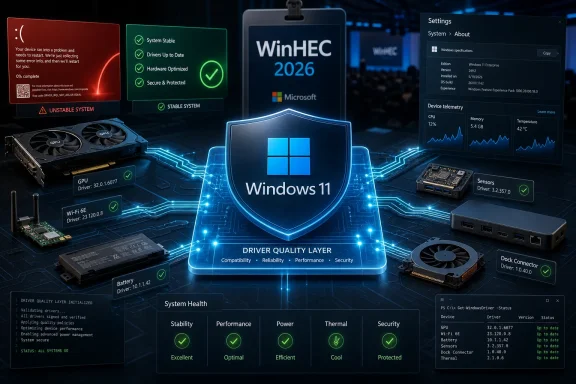 Microsoft Finally Aims Below the Desktop
For much of Windows 11’s life, Microsoft’s public Windows messaging has been surface-forward. The company talked about visual consistency, AI integration, modernized inbox apps, Copilot, the Microsoft Store, Settings migrations, and the slow replacement of decades-old control surfaces. Those things matter, but they are not the layer where many real-world Windows failures begin.Drivers are the contract between Windows and the chaotic diversity of PC hardware. They sit between the operating system and GPUs, storage controllers, network adapters, cameras, fingerprint readers, sensors, docks, audio chips, touchpads, printers, and firmware-defined platform features. When that contract is wrong, the symptom rarely announces itself as “driver quality failure.” It appears as a machine that runs hot in a backpack, a laptop that loses three hours of battery life, a workstation that blue-screens under load, or a gamer who discovers that Windows Update has replaced a freshly installed graphics driver with an older OEM package.
That is why the Driver Quality Initiative is more significant than its bureaucratic name suggests. Microsoft is not merely promising better driver paperwork. It is saying that Windows quality must be measured across the ecosystem, not just inside the OS team’s codebase.
The timing is also hard to ignore. Microsoft has spent the post-Windows 10 era trying to convince users that Windows 11 is the modern Windows: more secure, more polished, more AI-aware, and better suited to new hardware. But the lived experience of Windows is still shaped by silicon vendors, OEM preload choices, peripheral makers, BIOS updates, Windows Update targeting, and legacy driver assumptions that date back years.
A faster Start menu is welcome. A Start menu cannot save a laptop whose platform driver mishandles power states.
The Kernel Is Where Windows Trust Gets Expensive
The most important part of Microsoft’s new driver language is architectural. The company says it wants more driver functionality to move away from third-party kernel-mode code where possible, either into user-mode drivers or Microsoft-authored class drivers. That sounds dry until you translate it into operational reality: Microsoft wants fewer outside components running with the power to crash the whole machine.Kernel-mode drivers are powerful because they need to be. Some hardware interactions require low-level access, tight latency, and privileged control. But that same privilege creates a large blast radius. A flaw in ordinary application code may crash the app. A flaw in kernel-mode driver code can crash Windows, corrupt memory, undermine security boundaries, or destabilize the entire platform.
This is not an abstract concern after the past few years. The industry has seen, in brutal fashion, how kernel-level mistakes can turn into fleet-wide outages. Security software is the most famous example, but the lesson applies more broadly: the more code that runs deep in the OS, the more Windows depends on other companies’ engineering discipline.
Microsoft’s stated preference for user-mode drivers reflects a long-running direction in Windows architecture. User-mode driver frameworks can isolate faults more effectively, allowing a driver or service to fail without necessarily taking down the system. Microsoft-authored class drivers can also reduce duplication by giving hardware makers a standard, supported path instead of encouraging each vendor to ship custom kernel code for common device categories.
The tension is that Windows owes much of its market power to the very openness that makes this problem hard. The PC ecosystem thrives because vendors can build unusual hardware, add features, and differentiate products without waiting for Microsoft to bless every design decision. Clamp down too aggressively and Microsoft risks making Windows feel less like Windows. Move too slowly and the platform keeps absorbing failures caused by code Microsoft did not write.
The Driver Quality Initiative is Microsoft trying to thread that needle. It is not abolishing third-party kernel drivers. It is trying to make them rarer where they are unnecessary, better tested where they remain necessary, and less likely to turn ordinary device bugs into operating-system failures.
Driver Quality Is No Longer Just a Crash Counter
Microsoft’s other important shift is definitional. Historically, driver quality has often been discussed in terms of crashes: blue screens, bug checks, hangs, and obvious failures. That made sense because crashes are measurable, dramatic, and easy to rank. But it also left a large category of miserable Windows behavior outside the headline metric.A driver can be bad without crashing the machine. It can wake a device too often, block a low-power state, mishandle idle transitions, leak resources, spike DPC latency, keep an NPU or radio active, trip thermal limits, or quietly degrade performance. The user does not see a stop code. They see a laptop that used to last nine hours now lasting six, or a fan profile that sounds like a hair dryer during a video call.
Microsoft now says quality signals will expand to include stability, functionality, performance, power, and thermal impact. That is the right move because modern PCs are no longer judged only by whether they boot and avoid blue screens. They are judged by whether they sleep reliably, resume instantly, stay cool, maintain consistent frame pacing, survive conference calls, and behave predictably on battery.
This is especially important for the new generation of AI PCs and thin-and-light systems. Hardware is becoming more specialized, not less. NPUs, hybrid CPU architectures, advanced power controllers, dynamic refresh displays, presence sensors, USB4 docks, and increasingly complex firmware coordination all create more places where driver quality can affect the user experience without producing a traditional crash.
The old Windows reliability bargain was mostly binary: does the machine crash or not? The new one is continuous: does the system feel stable, efficient, and predictable across workloads? Microsoft’s revised driver-quality framing suggests the company understands that difference.
It also gives administrators a more realistic vocabulary. In enterprise IT, a driver that reduces battery life by 20 percent across a laptop fleet is not a cosmetic issue. A driver that overheats a device in a meeting room or breaks dock behavior after sleep is not a minor annoyance. It is a support cost, a productivity hit, and a trust problem.
Windows Update Has Been Both Cure and Culprit
No Windows driver conversation can avoid Windows Update. Microsoft’s update pipeline is one of the platform’s great strengths: it can deliver drivers to millions of systems without users knowing the model number of their Wi-Fi card or visiting a vendor support site from 2009. It is also one of the platform’s recurring sources of user resentment.The Windows Update driver model has always involved trade-offs. For mainstream users, automatic driver delivery prevents broken installs and keeps hardware functional. For enthusiasts, it can feel like a hostile takeover. The complaint is familiar: a user installs a newer GPU, audio, chipset, or peripheral driver from the vendor, only for Windows Update to replace it later with an older OEM-targeted package.
That is more than a power-user irritation. Graphics drivers in particular are tightly tied to game support, creator-app fixes, performance tuning, and bug workarounds. A rollback can mean lost features, broken control panels, changed profiles, or unexpected instability. Even when Windows Update is acting according to its targeting rules, the result can look irrational from the user’s seat.
Microsoft’s reported plan to improve display-driver targeting and avoid downgrading graphics drivers matters because it addresses a specific trust failure. Users can tolerate automation when it is invisible and correct. They rebel when automation silently undoes their explicit choice.
The same applies to Microsoft’s plan to deprecate outdated or low-quality drivers from the Windows Update Catalog. A large catalog is not necessarily a good catalog. If stale drivers remain eligible for delivery long after better replacements exist, Windows Update becomes a museum with deployment privileges. Cleaning that pipeline is not glamorous work, but it may do more for perceived Windows quality than another settings-page redesign.
For administrators, the question will be governance. Better default targeting is welcome, but fleets need predictable controls, reporting, rollback paths, and documentation. If Microsoft raises the driver bar without making the policy surface clear, IT departments will still be left explaining mysterious hardware behavior to users after patch cycles.
The OEM Layer Is Where Promises Get Messy
Microsoft can set rules, but OEMs and silicon vendors live with the details. Every laptop model is a bundle of compromises: thermal design, firmware, driver stack, preloaded utilities, custom hotkeys, power profiles, camera tuning, audio enhancements, security components, and sometimes vendor-specific services that overlap awkwardly with Windows features.That complexity is why Microsoft’s ecosystem language is both honest and evasive. It is honest because Windows quality really is shared. Microsoft cannot single-handedly make every Bluetooth module, touchpad, fingerprint sensor, GPU switcher, or docking controller behave perfectly across every PC. It is evasive because users do not experience the ecosystem as a committee. They experience “Windows.”
OEMs also have incentives that do not always align with long-term driver maintenance. A new laptop launch gets engineering attention. A three-year-old model with a smaller installed base may not. Business-class machines typically fare better than bargain consumer devices, but even premium hardware can suffer when firmware and driver updates lag behind Windows feature changes.
Silicon vendors sit in a different but equally important position. AMD, Intel, Nvidia, Qualcomm, Realtek, MediaTek, Synaptics, and many others shape the daily Windows experience through drivers and platform software. Their work can make Windows feel fast and modern, or unstable and inconsistent. Microsoft’s initiative depends on these companies treating driver quality as a continuing obligation rather than a launch milestone.
The presence of partner quotes at WinHEC is not just corporate theater. Microsoft needs the industry to accept shared accountability. If the Driver Quality Initiative becomes only a Microsoft dashboard exercise, it will fail. If it becomes a certification pressure system that vendors cannot ignore, it has a chance.
There is also an uncomfortable possibility: stricter driver standards may expose weak vendor maintenance. Some older devices may lose access to certain automatic driver paths. Some hardware makers may decide that updating drivers to meet the new bar is not worth the cost. Better security and reliability often arrive with a bill, and legacy hardware owners are frequently the ones asked to pay it.
The Security Story Is Hiding Inside the Reliability Story
Microsoft is packaging DQI partly as a reliability effort, but security is inseparable from the driver conversation. Kernel drivers are not merely crash risks. They are attractive targets and dangerous weak points because they operate at high privilege. A vulnerable signed driver can become a tool for attackers, even when the driver was originally built for legitimate hardware or software.This is why Microsoft’s emphasis on trust, partner verification, automated analysis, and updated Windows Hardware Compatibility Program requirements matters. Signing alone is not enough if the pipeline signs weak code, trusts outdated submissions, or allows old drivers to remain useful to attackers. The question is not whether a driver has a signature. The question is whether the driver should still be trusted.
Windows has been moving toward stronger code integrity and kernel protections for years. Features such as virtualization-based security, hypervisor-protected code integrity, memory integrity, and vulnerable driver blocklists all reflect the same direction: Microsoft wants the kernel to become a more controlled environment. DQI fits that trajectory.
The challenge is compatibility. Windows has a uniquely long tail of hardware, utilities, industrial systems, lab devices, gaming peripherals, and business applications that rely on old assumptions. Security hardening can break things that technically still work. Microsoft has to decide when preserving compatibility becomes indistinguishable from preserving risk.
That is why the company’s “trusted partners and trusted drivers” language deserves scrutiny. It suggests a Windows future where driver distribution is more reputation-based, more telemetry-informed, and more tightly linked to Microsoft’s hardware programs. For most users, that will be good. For niche hardware communities, repair shops, industrial operators, and enthusiasts with older devices, it may feel like yet another door closing.
Still, the direction is hard to argue against. The kernel cannot remain a permissive commons forever. The cost of bad drivers is now measured not only in blue screens, but in security incidents, fleet outages, battery complaints, and lost confidence in Windows as a modern platform.
WinHEC’s Return Signals a Windows Hardware Reset
The WinHEC setting is part of the story. Microsoft’s old Windows Hardware Engineering Conference was once a central venue for telling the hardware ecosystem where Windows was going. Its reduced visibility over the years mirrored a broader sense that Windows hardware coordination had become less central to Microsoft’s public identity.That perception mattered. As Microsoft chased cloud growth, subscriptions, developer platforms, and then AI, Windows sometimes looked like a mature asset being optimized around the edges rather than a platform with a clear engineering campaign. Windows 11’s early years reinforced that impression for some users: strict hardware requirements, visual redesigns, periodic update friction, and a sense that the company was more excited about Copilot than about the fundamentals.
A renewed WinHEC focus does not magically fix that. But it does suggest Microsoft understands that the Windows franchise still depends on hardware excellence. In 2026, the PC is again a contested platform: Arm-based Windows machines are improving, Apple continues to define expectations around battery life and thermals, and AI PCs require tighter coordination between silicon, firmware, drivers, and OS scheduling.
Windows cannot win that contest with shell polish alone. It needs platform behavior that feels engineered end to end. That means fewer mystery wakes, fewer driver regressions, fewer vendor utilities fighting Windows settings, fewer thermally confused laptops, and fewer update surprises.
Microsoft’s driver push therefore belongs in the same bucket as its recent performance and reliability messaging around Windows 11. The company appears to be trying to reframe Windows quality as a system-wide program rather than a series of UI touch-ups. That is the correct diagnosis. The open question is execution.
Because Windows users have heard quality promises before. Every major Windows era comes with assurances about reliability, compatibility, performance, and manageability. What makes DQI interesting is that it targets one of the places where those promises often break down: the boundary between Microsoft’s code and everyone else’s.
The First Winners Should Be Laptops, Not Benchmark Charts
If DQI works, the benefits may show up first in places that are hard to market. Fewer blue screens will be easy enough to count, but the bigger win may be fewer “soft failures” that never produce a crash dump. A machine that sleeps correctly, stays cool, and holds battery life after an update is a quieter victory.Laptop users stand to gain the most. Modern mobile PCs are dense thermal and power systems masquerading as consumer electronics. A platform driver that mishandles idle states or keeps a component awake can erase the gains from efficient silicon. A thermal driver that reacts poorly can make a fast machine feel sluggish or loud. A camera, audio, or wireless driver that behaves badly can turn the basic workday into a troubleshooting session.
Gamers and creators also have a stake, especially around graphics-driver targeting. Microsoft does not need to replace Nvidia, AMD, or Intel’s driver ecosystems. It does need to stop Windows Update from becoming an uninvited participant in driver version management. If a user deliberately installs a newer GPU driver, Windows should have an extraordinarily good reason before overriding that choice.
Enterprises will judge the initiative differently. They will want fewer incidents, clearer compatibility signals, and better lifecycle information. Driver quality is not just an endpoint issue; it affects deployment rings, help-desk volume, device procurement, and patch confidence. If DQI gives IT more reliable signals about which drivers are safe to deploy, it could reduce one of the messiest parts of Windows fleet management.
Developers and hardware vendors may face more friction. Higher certification standards, stronger analysis, and stricter lifecycle enforcement mean more work before release and more accountability afterward. But that is also the point. The PC ecosystem has often externalized driver quality costs onto users and administrators. Microsoft is now trying to push more of that cost back into the engineering pipeline.
Microsoft’s Quality Reset Has Teeth Only If It Changes Defaults
The weakest version of DQI would be a set of recommendations vendors can ignore. Windows history is full of good guidance that became optional reading once product deadlines arrived. If Microsoft wants driver quality to improve materially, the initiative must affect what gets signed, what gets shipped, what gets offered through Windows Update, and what gets flagged as unacceptable.That does not mean every rule should be immediate or absolute. Microsoft has to manage a massive compatibility base, and sudden enforcement can strand users. But a phased program still needs visible consequences. Outdated drivers should lose distribution paths. Poorly behaving drivers should be measurable and demoted. Vendors should receive clear telemetry, deadlines, and pressure to fix quality regressions.
The most promising part of the announcement is the move from crash-centric metrics to broader experience metrics. Once Microsoft treats thermal and power behavior as first-class quality signals, it can start ranking drivers by what users actually feel. That creates a better feedback loop: not merely “did this driver blue-screen?” but “did this driver make the PC worse?”
The risk is opacity. Microsoft has an unfortunate habit of hiding important decisions behind update logic, compatibility holds, safeguard IDs, and vague release notes. If DQI changes which drivers users receive, Microsoft must explain those changes better than it often explains Windows Update behavior today.
That is especially true for enthusiasts. Power users are not opposed to automation because they enjoy manual driver archaeology. They are opposed to automation that overrides them without consent or explanation. A quality reset that improves defaults while respecting informed user choice would earn goodwill. A quality reset that simply centralizes more opaque control in Windows Update would not.
The Driver Reset Is Really a Trust Test for Windows 11
The practical near-term message is that Microsoft is trying to make Windows 11 less vulnerable to the worst habits of the PC driver ecosystem. That will not be solved in one update, and it will not make every old peripheral behave. But it does give users and administrators a useful lens for judging whether Microsoft’s renewed Windows focus is real.- Microsoft is expanding driver quality beyond crash frequency to include stability, functionality, performance, power behavior, and thermal impact.
- The company wants more driver work to move away from third-party kernel-mode code where user-mode drivers or Microsoft class drivers can do the job.
- Windows Update driver cleanup and better lifecycle management could reduce stale or low-quality driver delivery, but only if Microsoft makes targeting decisions clearer.
- Graphics-driver downgrades remain a major trust problem, and Microsoft’s promised targeting improvements need to protect users who deliberately install newer vendor drivers.
- OEMs and silicon vendors will determine whether DQI becomes a real quality reset or just another Microsoft certification slogan.
- Older and niche hardware may face more pressure as Microsoft tightens trust, signing, and compatibility expectations around the Windows driver pipeline.
Microsoft’s Windows 11 quality reset is therefore less about drivers as a technical category than about accountability as a platform principle. For years, Windows has absorbed the consequences of a vast ecosystem while letting users sort out who was really at fault. With DQI, Microsoft is admitting that the distinction no longer matters enough. If a driver ruins the Windows experience, Windows takes the blame — and Microsoft now seems prepared to make the ecosystem carry more of the burden before the user ever sees the failure.
Source: Windows Latest Microsoft’s Windows 11 quality reset now targets bad drivers behind crashes, overheating and poor battery life
