

Microsoft used WinHEC 2026 in mid-May to introduce a Windows Driver Quality Initiative for Windows 11 that broadens driver judging beyond crashes, adds power and thermal behavior to the scorecard, and pairs that prevention push with cloud-triggered rollback for faulty Windows Update drivers. The immediate headline is battery life, because a bad driver can turn a sleeping laptop into a warm, half-drained brick. The larger story is that Microsoft is finally treating drivers not as plumbing beneath the operating system, but as one of the main reasons users decide whether Windows feels reliable. That is overdue, but it is also one of the more practical Windows quality moves the company has made in years.
For decades, Windows’ greatest strength has also been its most stubborn weakness: it runs on almost everything. That bargain gives users choice, OEMs room to differentiate, and enterprises the ability to buy hardware at scale without living inside one vendor’s walled garden. It also means Windows must trust a vast supply chain of firmware, chipsets, GPUs, audio stacks, Wi-Fi modules, touchpads, printers, docks, and thermal controllers, many of which arrive through third-party drivers.
Microsoft’s new Driver Quality Initiative is best understood as an attempt to stop treating that supply chain as a collection of isolated submissions. The company says it is raising the bar across architecture, trust, lifecycle management, and quality measurement. That sounds like conference-stage vocabulary until you translate it into user pain: fewer kernel-mode landmines, fewer outdated packages hanging around in Windows Update, more pressure on partners, and a broader definition of what “good enough” means.
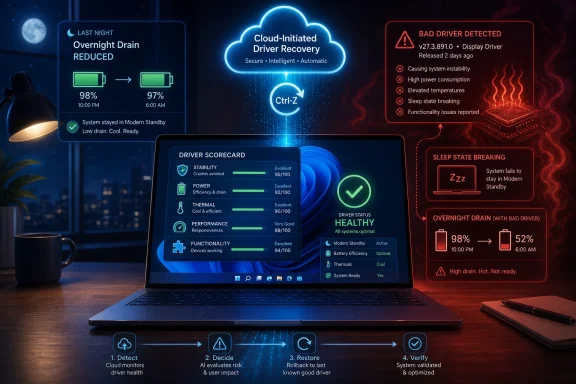
The important phrase in Microsoft’s pitch is not “driver quality.” It is the decision to measure quality beyond crashes. A driver that never blue-screens a system can still be a bad citizen if it keeps a device awake, burns battery during standby, spikes heat under light load, breaks a feature path, or quietly drags performance below what the hardware can deliver. By adding performance, functionality, power, and thermal impact to the scorecard, Microsoft is admitting that the old pass/fail model was too narrow.
That matters most on laptops. Modern Windows notebooks are intricate power-management machines, constantly negotiating between the operating system, firmware, silicon, sensors, radios, storage, displays, and background services. If one driver ignores the deal, the whole product looks broken. Users do not blame the ACPI stack, the Wi-Fi driver, or an OEM utility; they blame Windows.
That inconsistency is not always caused by one villain. Sometimes the culprit is a driver that wakes too often. Sometimes it is a peripheral stack that does not enter the right low-power state. Sometimes it is firmware, a management engine component, a radio, a dock, an audio device, or a vendor service glued to a driver package. The user experience, however, is singular: a machine that should be ready for work is dead, hot, or both.
By making power and thermal behavior part of driver quality, Microsoft is moving a familiar complaint into the realm of measurable accountability. This is a subtle but significant shift. If a driver’s job is merely to avoid crashing, then battery drain can be treated as an unfortunate edge case. If the driver’s job is to support the real customer experience, then wasting power is a product failure.
That framing also reflects how Windows devices are now sold. A premium Windows laptop is judged against MacBooks, iPads, Chromebooks, and phones that have trained buyers to expect instant resume and predictable idle behavior. Microsoft cannot win that comparison with a faster Start menu animation or another AI button if the machine loses 30 percent overnight because some component refused to sleep.
The reported fix centers on more precise targeting for graphics drivers, moving away from broad hardware matching that can sweep in machines it should not touch. That may sound like bureaucratic plumbing, but it is exactly the sort of plumbing that decides whether Windows Update feels trustworthy. If the service cannot distinguish between a driver that should be updated and one that should be left alone, users learn to fear the update mechanism itself.
For enthusiasts, the annoyance is obvious. You install a newer GPU package to fix a game bug, unlock a feature, or stabilize performance, only to find Windows has reinstalled an older OEM-blessed version. For IT departments, the issue is more strategic. Driver drift can break validation, complicate support, and make a fleet less predictable. For developers and creators, graphics drivers are not optional decoration; they affect rendering, compute workloads, display reliability, and app compatibility.
This is where Microsoft’s driver push becomes more than a consumer convenience story. The company is trying to clean up the inputs to Windows Update, not merely improve the error message after something goes wrong. Deprecating outdated or low-quality drivers is not glamorous, but it is the kind of maintenance a mature platform has to do if it wants automated updates to be accepted rather than resisted.
That is a meaningful architectural change because the existing remediation path has often been too slow. A hardware partner may need to submit a replacement. Users may need to discover the problem, identify the driver, uninstall it, roll it back, or hunt for another package. Enterprises may need to block, script, reimage, or escalate. Meanwhile, affected systems remain unstable, degraded, or unusable.
The cloud rollback model shifts responsibility toward Microsoft’s central update machinery. That is appropriate, because Windows Update is the channel users experience. If the driver arrived through Windows Update, the fix should not require an ordinary laptop owner to learn Device Manager archaeology or a help desk to improvise a recovery plan across models and regions.
There are limits. Cloud-Initiated Driver Recovery applies to drivers distributed through Windows Update, and it depends on Microsoft having a suitable approved driver to roll back to. It will not magically fix every vendor installer, every firmware flaw, every broken peripheral suite, or every case where a machine is too damaged to receive the recovery instruction. But a limited undo button is still better than a world where the main rollback mechanism is forum lore.
The push to harden kernel-mode drivers and enable more third-party drivers to move toward user mode reflects a lesson Windows has had to relearn repeatedly. The more code that runs with kernel privileges, the larger the blast radius when something goes wrong. Driver quality is therefore not only about stability. It is about containment.
This is especially relevant after years in which endpoint security tools, anti-cheat systems, hardware utilities, and performance software have all argued for deep system access. Some of those arguments are legitimate. Some are the result of old design habits. The platform owner’s job is to decide when compatibility has become an excuse for fragility.
A future Windows ecosystem with fewer risky kernel dependencies will not arrive overnight. Hardware partners need APIs, migration paths, performance assurances, and commercial incentives. Enterprises need compatibility. Users need their devices to keep working. Still, the direction is correct: the best driver crash is the one that happens outside the kernel, where Windows has a fighting chance to recover gracefully.
Users have grown wary of updates not because they dislike security patches, but because updates too often feel like a trade: accept protection and new features, but risk regressions, changed defaults, driver churn, or an unexpected reboot. Administrators know this tension intimately. The safest device is patched; the most predictable device is sometimes the one you have not touched yet. Microsoft’s job is to collapse that gap.
Driver quality is a logical place to start because drivers sit at the boundary between Microsoft and everyone else. When a GPU driver is downgraded, a Wi-Fi driver causes latency spikes, a storage controller misbehaves, or a sleep-state component drains a laptop, the user experiences it as Windows unreliability. The OEM may have submitted the package, the silicon vendor may own the code, and Microsoft may merely operate the distribution channel, but the Windows brand takes the hit.
That is why the initiative’s “ecosystem-wide” language matters. Microsoft cannot simply scold partners from Redmond and call the job done. It has to change incentives, improve telemetry, tighten publishing gates, clean the catalog, and make recovery faster when mistakes pass through. Trust is rebuilt not by promising perfection, but by making failure less frequent and less catastrophic.
In a consumer setting, a cloud-triggered rollback can be framed as relief. In an enterprise, it becomes part of change management. A driver rollback may fix crashes but affect a validated workflow, a specialized peripheral, a compliance-sensitive imaging process, or a line-of-business application that depends on a specific driver behavior. The right answer is not to avoid rollback; it is to expose it properly through management tooling.
Microsoft has the pieces to do this well. Windows Update for Business, Intune, deployment rings, safeguard holds, reporting, and driver management policies already give organizations a vocabulary for staged change. The question is whether Cloud-Initiated Driver Recovery and the broader quality initiative will integrate cleanly into that vocabulary or arrive as another opaque service-side action that admins must reconstruct after the fact.
The best version of this plan gives enterprises confidence that Microsoft is reducing risk without stealing the steering wheel. That means clear telemetry, documented rollback events, sensible controls, and predictable interaction with existing update policies. A recovery system that works silently may delight home users; a recovery system that works silently in a regulated fleet may generate tickets.
Still, skepticism should not blind us to the significance of the shift. Microsoft is not merely saying “drivers should be better.” It is changing what counts as quality, cleaning up driver lifecycle behavior, addressing the GPU downgrade problem, and building an automated rollback path for bad Windows Update drivers. Those are concrete levers.
The real test will be whether the new signals have teeth. If a driver harms battery life but ships anyway, the initiative is branding. If outdated packages remain broadly available because partners prefer inertia, catalog hygiene is theater. If rollback triggers too late, or only after a problem becomes newsworthy, Cloud-Initiated Driver Recovery becomes a press-release feature rather than an operational improvement.
But the direction is rational. Windows does not need a driver utopia to feel better. It needs fewer egregious regressions, faster reversals, more precise targeting, and fewer cases where users must become forensic technicians to restore a working machine.
That may create friction. OEMs have their own validation cycles, support obligations, customization layers, and business incentives. A laptop maker may prefer a known older driver because it passed internal certification for a specific model. A silicon vendor may ship a newer package that fixes broad issues but has not been blessed for every OEM image. Microsoft sits in the middle, mediating between freshness, specificity, stability, and scale.
The GPU downgrade problem illustrates that tension. An OEM-approved driver is not necessarily the best driver for a user’s current workload. A vendor’s latest driver is not necessarily validated for every laptop’s thermal design, mux behavior, display path, or power profile. Windows Update needs to be precise enough to respect those differences instead of flattening them under a broad hardware ID match.
If Microsoft’s new policies work, they will make the driver ecosystem less forgiving of lazy targeting and stale packages. That is good for users, but it asks more of partners. The Windows hardware ecosystem benefits from openness; it also suffers when openness becomes entropy.
Microsoft’s language around trusted partners, signing-stage enforcement, software bills of materials alignment, and faster issue analysis through symbols points to a more disciplined supply chain. That is not as immediately relatable as “your battery lasts longer,” but it may prove just as important. Windows is too large a target to allow weak driver governance to persist as a background risk.
The challenge is that security tightening often collides with compatibility. Remove or block too aggressively, and users with older hardware or specialized devices feel abandoned. Move too slowly, and the platform carries avoidable risk. Microsoft has been here before with printers, kernel protections, legacy components, and hardware requirements. Every cleanup campaign produces winners, losers, and angry forum threads.
The right standard is not zero disruption. It is justified disruption with clear timelines, fallbacks, and communication. If a driver is outdated, insecure, power-hungry, or broadly unreliable, keeping it alive indefinitely is not customer service. It is technical debt with a friendly face.
Microsoft’s driver plan is promising because it attacks that pattern. Better measurement should reduce the number of bad drivers that ship. Better catalog hygiene should reduce stale or low-quality packages. Better targeting should reduce unwanted replacements. Cloud rollback should reduce the amount of manual recovery required when prevention fails.
This is the model Windows needs more broadly: prevent, contain, recover. Not every update can be perfect. Not every hardware combination can be predicted. Not every partner will submit flawless code. But the platform can be designed so that the common failure modes are less destructive and easier to reverse.
That is a more mature vision than pretending Windows can be simplified into an appliance. The PC ecosystem is messy because it is powerful, flexible, and economically diverse. The goal is not to eliminate the mess. The goal is to keep the mess from reaching users as often.
That kind of trust compounds. A reliable update pipeline makes security patching easier. Predictable driver behavior makes support cheaper. Better power management makes Windows laptops more competitive. Faster rollback reduces the reputational damage of the inevitable bad release. Each improvement is small on its own, but together they change the emotional contract between Windows and its users.
The catch is that trust also collapses quickly. If Microsoft overpromises, hides rollback behavior, or lets high-profile driver failures slip through unchanged, the initiative will be dismissed as another quality slogan. Windows users have long memories because many of them have had to fix the same classes of problems repeatedly across releases.
So the company’s burden is execution, not announcement. It must prove that driver quality is now a living operational discipline rather than a WinHEC theme. That proof will show up not in a blog post, but in fewer hot laptops, fewer downgraded GPUs, fewer broken peripherals, and fewer forum threads that begin with “Windows Update did it again.”
Microsoft’s plan to improve Windows 11 drivers is falling into place because it finally connects the pieces that users experience as one problem: bad drivers ship, stale drivers linger, Windows Update sometimes makes the wrong call, and recovery is too manual. If the company follows through, Windows 11 will not become magically immune to hardware weirdness, but it may become better at preventing, identifying, and undoing the failures that make PCs feel capricious. For a platform built on hardware choice, that is not housekeeping; it is the foundation of whether the next generation of Windows PCs can feel trustworthy again.
 Microsoft Is Moving the Driver Fight Upstream
For decades, Windows’ greatest strength has also been its most stubborn weakness: it runs on almost everything. That bargain gives users choice, OEMs room to differentiate, and enterprises the ability to buy hardware at scale without living inside one vendor’s walled garden. It also means Windows must trust a vast supply chain of firmware, chipsets, GPUs, audio stacks, Wi-Fi modules, touchpads, printers, docks, and thermal controllers, many of which arrive through third-party drivers.Microsoft’s new Driver Quality Initiative is best understood as an attempt to stop treating that supply chain as a collection of isolated submissions. The company says it is raising the bar across architecture, trust, lifecycle management, and quality measurement. That sounds like conference-stage vocabulary until you translate it into user pain: fewer kernel-mode landmines, fewer outdated packages hanging around in Windows Update, more pressure on partners, and a broader definition of what “good enough” means.
The important phrase in Microsoft’s pitch is not “driver quality.” It is the decision to measure quality beyond crashes. A driver that never blue-screens a system can still be a bad citizen if it keeps a device awake, burns battery during standby, spikes heat under light load, breaks a feature path, or quietly drags performance below what the hardware can deliver. By adding performance, functionality, power, and thermal impact to the scorecard, Microsoft is admitting that the old pass/fail model was too narrow.
That matters most on laptops. Modern Windows notebooks are intricate power-management machines, constantly negotiating between the operating system, firmware, silicon, sensors, radios, storage, displays, and background services. If one driver ignores the deal, the whole product looks broken. Users do not blame the ACPI stack, the Wi-Fi driver, or an OEM utility; they blame Windows.
Battery Drain Was Always a Reliability Bug
The TechRadar framing is right to highlight laptop battery life, because “low-quality driver” can sound abstract until a machine comes out of a bag hot enough to worry about. Standby drain is one of those uniquely infuriating PC problems because it violates an expectation learned from phones and tablets: when a device is asleep, it should mostly stay asleep. Windows laptops have improved enormously, but the ecosystem still has a reputation for inconsistency.That inconsistency is not always caused by one villain. Sometimes the culprit is a driver that wakes too often. Sometimes it is a peripheral stack that does not enter the right low-power state. Sometimes it is firmware, a management engine component, a radio, a dock, an audio device, or a vendor service glued to a driver package. The user experience, however, is singular: a machine that should be ready for work is dead, hot, or both.
By making power and thermal behavior part of driver quality, Microsoft is moving a familiar complaint into the realm of measurable accountability. This is a subtle but significant shift. If a driver’s job is merely to avoid crashing, then battery drain can be treated as an unfortunate edge case. If the driver’s job is to support the real customer experience, then wasting power is a product failure.
That framing also reflects how Windows devices are now sold. A premium Windows laptop is judged against MacBooks, iPads, Chromebooks, and phones that have trained buyers to expect instant resume and predictable idle behavior. Microsoft cannot win that comparison with a faster Start menu animation or another AI button if the machine loses 30 percent overnight because some component refused to sleep.
The GPU Downgrade Mess Shows Why Catalog Hygiene Matters
The other recent driver story, Windows Update replacing newer graphics drivers with older ones, is not just a gamer complaint. It is a perfect example of why driver lifecycle management is hard and why Microsoft’s “catalog hygiene” language deserves attention. Windows Update is supposed to keep PCs functional and safe, but when it downgrades a GPU driver that a user deliberately installed from AMD, Nvidia, Intel, or an OEM, it turns automation into sabotage.The reported fix centers on more precise targeting for graphics drivers, moving away from broad hardware matching that can sweep in machines it should not touch. That may sound like bureaucratic plumbing, but it is exactly the sort of plumbing that decides whether Windows Update feels trustworthy. If the service cannot distinguish between a driver that should be updated and one that should be left alone, users learn to fear the update mechanism itself.
For enthusiasts, the annoyance is obvious. You install a newer GPU package to fix a game bug, unlock a feature, or stabilize performance, only to find Windows has reinstalled an older OEM-blessed version. For IT departments, the issue is more strategic. Driver drift can break validation, complicate support, and make a fleet less predictable. For developers and creators, graphics drivers are not optional decoration; they affect rendering, compute workloads, display reliability, and app compatibility.
This is where Microsoft’s driver push becomes more than a consumer convenience story. The company is trying to clean up the inputs to Windows Update, not merely improve the error message after something goes wrong. Deprecating outdated or low-quality drivers is not glamorous, but it is the kind of maintenance a mature platform has to do if it wants automated updates to be accepted rather than resisted.
Cloud Rollback Gives Windows Update a Needed Undo Button
Cloud-Initiated Driver Recovery is the more dramatic companion to the Driver Quality Initiative. The premise is simple: if a bad driver shipped through Windows Update is identified after the fact, Microsoft can initiate a recovery action from the cloud and roll affected devices back to a previously known-good driver without waiting for the hardware partner or the end user to manually clean up the mess. In principle, Windows Update gets a Ctrl-Z key.That is a meaningful architectural change because the existing remediation path has often been too slow. A hardware partner may need to submit a replacement. Users may need to discover the problem, identify the driver, uninstall it, roll it back, or hunt for another package. Enterprises may need to block, script, reimage, or escalate. Meanwhile, affected systems remain unstable, degraded, or unusable.
The cloud rollback model shifts responsibility toward Microsoft’s central update machinery. That is appropriate, because Windows Update is the channel users experience. If the driver arrived through Windows Update, the fix should not require an ordinary laptop owner to learn Device Manager archaeology or a help desk to improvise a recovery plan across models and regions.
There are limits. Cloud-Initiated Driver Recovery applies to drivers distributed through Windows Update, and it depends on Microsoft having a suitable approved driver to roll back to. It will not magically fix every vendor installer, every firmware flaw, every broken peripheral suite, or every case where a machine is too damaged to receive the recovery instruction. But a limited undo button is still better than a world where the main rollback mechanism is forum lore.
The Kernel Is Still the Dangerous Neighborhood
Microsoft’s architecture pillar is where the company’s driver plan intersects with a larger industry trend: reducing the amount of third-party code running in the most privileged parts of the operating system. Kernel-mode drivers are powerful because they sit close to the hardware and the OS core. They are also dangerous for the same reason. A bug there is not just an app crash; it can be a system crash, a security hole, or a fleet-wide incident.The push to harden kernel-mode drivers and enable more third-party drivers to move toward user mode reflects a lesson Windows has had to relearn repeatedly. The more code that runs with kernel privileges, the larger the blast radius when something goes wrong. Driver quality is therefore not only about stability. It is about containment.
This is especially relevant after years in which endpoint security tools, anti-cheat systems, hardware utilities, and performance software have all argued for deep system access. Some of those arguments are legitimate. Some are the result of old design habits. The platform owner’s job is to decide when compatibility has become an excuse for fragility.
A future Windows ecosystem with fewer risky kernel dependencies will not arrive overnight. Hardware partners need APIs, migration paths, performance assurances, and commercial incentives. Enterprises need compatibility. Users need their devices to keep working. Still, the direction is correct: the best driver crash is the one that happens outside the kernel, where Windows has a fighting chance to recover gracefully.
Microsoft Is Also Trying to Rebuild Trust After Years of Update Fatigue
The driver initiative lands in a broader Windows 11 quality campaign. Microsoft has been talking more openly in 2026 about fundamentals: reliability, performance, app stability, update experience, and the general sense that Windows should feel less like a product constantly negotiating with itself. That messaging is not accidental. Windows 11 has suffered from a perception problem that cannot be fixed with another coat of Fluent Design.Users have grown wary of updates not because they dislike security patches, but because updates too often feel like a trade: accept protection and new features, but risk regressions, changed defaults, driver churn, or an unexpected reboot. Administrators know this tension intimately. The safest device is patched; the most predictable device is sometimes the one you have not touched yet. Microsoft’s job is to collapse that gap.
Driver quality is a logical place to start because drivers sit at the boundary between Microsoft and everyone else. When a GPU driver is downgraded, a Wi-Fi driver causes latency spikes, a storage controller misbehaves, or a sleep-state component drains a laptop, the user experiences it as Windows unreliability. The OEM may have submitted the package, the silicon vendor may own the code, and Microsoft may merely operate the distribution channel, but the Windows brand takes the hit.
That is why the initiative’s “ecosystem-wide” language matters. Microsoft cannot simply scold partners from Redmond and call the job done. It has to change incentives, improve telemetry, tighten publishing gates, clean the catalog, and make recovery faster when mistakes pass through. Trust is rebuilt not by promising perfection, but by making failure less frequent and less catastrophic.
Enterprises Will Like the Direction and Worry About the Control Plane
For managed environments, better driver quality is welcome, but the cloud recovery model raises the usual enterprise question: who decides, and how visible is the decision? IT pros generally want bad drivers blocked or rolled back quickly. They also want auditability, rings, deferrals, reporting, and a way to understand why a device changed state.In a consumer setting, a cloud-triggered rollback can be framed as relief. In an enterprise, it becomes part of change management. A driver rollback may fix crashes but affect a validated workflow, a specialized peripheral, a compliance-sensitive imaging process, or a line-of-business application that depends on a specific driver behavior. The right answer is not to avoid rollback; it is to expose it properly through management tooling.
Microsoft has the pieces to do this well. Windows Update for Business, Intune, deployment rings, safeguard holds, reporting, and driver management policies already give organizations a vocabulary for staged change. The question is whether Cloud-Initiated Driver Recovery and the broader quality initiative will integrate cleanly into that vocabulary or arrive as another opaque service-side action that admins must reconstruct after the fact.
The best version of this plan gives enterprises confidence that Microsoft is reducing risk without stealing the steering wheel. That means clear telemetry, documented rollback events, sensible controls, and predictable interaction with existing update policies. A recovery system that works silently may delight home users; a recovery system that works silently in a regulated fleet may generate tickets.
Enthusiasts Should Be Cautiously Optimistic, Not Naive
Windows enthusiasts have reason to be skeptical. Many have spent years disabling automatic driver updates, using vendor tools, hiding updates, running DDU, editing policies, or keeping offline installers ready because Windows Update made one too many “helpful” decisions. A promise to improve driver quality will not erase that history.Still, skepticism should not blind us to the significance of the shift. Microsoft is not merely saying “drivers should be better.” It is changing what counts as quality, cleaning up driver lifecycle behavior, addressing the GPU downgrade problem, and building an automated rollback path for bad Windows Update drivers. Those are concrete levers.
The real test will be whether the new signals have teeth. If a driver harms battery life but ships anyway, the initiative is branding. If outdated packages remain broadly available because partners prefer inertia, catalog hygiene is theater. If rollback triggers too late, or only after a problem becomes newsworthy, Cloud-Initiated Driver Recovery becomes a press-release feature rather than an operational improvement.
But the direction is rational. Windows does not need a driver utopia to feel better. It needs fewer egregious regressions, faster reversals, more precise targeting, and fewer cases where users must become forensic technicians to restore a working machine.
OEMs Are Being Put on Notice Without Being Publicly Blamed
One of the more interesting parts of Microsoft’s approach is its diplomacy. The company has to say it is working “with partners,” because it is. But the subtext is clear: hardware partners can no longer treat Windows Update as a dumping ground for stale, broad, minimally validated packages. If driver quality now includes power, thermals, functionality, and performance, the submission bar rises.That may create friction. OEMs have their own validation cycles, support obligations, customization layers, and business incentives. A laptop maker may prefer a known older driver because it passed internal certification for a specific model. A silicon vendor may ship a newer package that fixes broad issues but has not been blessed for every OEM image. Microsoft sits in the middle, mediating between freshness, specificity, stability, and scale.
The GPU downgrade problem illustrates that tension. An OEM-approved driver is not necessarily the best driver for a user’s current workload. A vendor’s latest driver is not necessarily validated for every laptop’s thermal design, mux behavior, display path, or power profile. Windows Update needs to be precise enough to respect those differences instead of flattening them under a broad hardware ID match.
If Microsoft’s new policies work, they will make the driver ecosystem less forgiving of lazy targeting and stale packages. That is good for users, but it asks more of partners. The Windows hardware ecosystem benefits from openness; it also suffers when openness becomes entropy.
The Security Angle Is Hiding in Plain Sight
Driver quality and driver security are inseparable. A low-quality driver can crash a system. A vulnerable driver can undermine it. Attackers have repeatedly abused signed but vulnerable drivers in bring-your-own-vulnerable-driver attacks, where legitimate driver trust becomes a path to deeper compromise. Any initiative that improves driver trust, lifecycle management, and deprecation of bad packages has security consequences.Microsoft’s language around trusted partners, signing-stage enforcement, software bills of materials alignment, and faster issue analysis through symbols points to a more disciplined supply chain. That is not as immediately relatable as “your battery lasts longer,” but it may prove just as important. Windows is too large a target to allow weak driver governance to persist as a background risk.
The challenge is that security tightening often collides with compatibility. Remove or block too aggressively, and users with older hardware or specialized devices feel abandoned. Move too slowly, and the platform carries avoidable risk. Microsoft has been here before with printers, kernel protections, legacy components, and hardware requirements. Every cleanup campaign produces winners, losers, and angry forum threads.
The right standard is not zero disruption. It is justified disruption with clear timelines, fallbacks, and communication. If a driver is outdated, insecure, power-hungry, or broadly unreliable, keeping it alive indefinitely is not customer service. It is technical debt with a friendly face.
Windows Needs Fewer Heroic Workarounds
A healthy operating system does not require ordinary users to know which registry value disables driver searching, which hidden tool can block a specific update, which Device Manager tab exposes rollback, or which vendor utility can reinstall a GPU package after Windows changes it. Those workarounds are useful, and WindowsForum readers know them well. But their existence is also evidence of a system that has pushed too much complexity onto the wrong people.Microsoft’s driver plan is promising because it attacks that pattern. Better measurement should reduce the number of bad drivers that ship. Better catalog hygiene should reduce stale or low-quality packages. Better targeting should reduce unwanted replacements. Cloud rollback should reduce the amount of manual recovery required when prevention fails.
This is the model Windows needs more broadly: prevent, contain, recover. Not every update can be perfect. Not every hardware combination can be predicted. Not every partner will submit flawless code. But the platform can be designed so that the common failure modes are less destructive and easier to reverse.
That is a more mature vision than pretending Windows can be simplified into an appliance. The PC ecosystem is messy because it is powerful, flexible, and economically diverse. The goal is not to eliminate the mess. The goal is to keep the mess from reaching users as often.
The Real Win Is a Windows Update People Stop Fighting
If Microsoft succeeds, the most important result will not be a single benchmark improvement or one fewer blue screen. It will be a change in user behavior. People will stop racing to disable driver updates on fresh installs. Admins will become less reluctant to let Windows Update handle certain classes of drivers. Laptop owners will see fewer mysterious standby drains. Gamers and creators will spend less time wondering whether Windows replaced the driver they chose.That kind of trust compounds. A reliable update pipeline makes security patching easier. Predictable driver behavior makes support cheaper. Better power management makes Windows laptops more competitive. Faster rollback reduces the reputational damage of the inevitable bad release. Each improvement is small on its own, but together they change the emotional contract between Windows and its users.
The catch is that trust also collapses quickly. If Microsoft overpromises, hides rollback behavior, or lets high-profile driver failures slip through unchanged, the initiative will be dismissed as another quality slogan. Windows users have long memories because many of them have had to fix the same classes of problems repeatedly across releases.
So the company’s burden is execution, not announcement. It must prove that driver quality is now a living operational discipline rather than a WinHEC theme. That proof will show up not in a blog post, but in fewer hot laptops, fewer downgraded GPUs, fewer broken peripherals, and fewer forum threads that begin with “Windows Update did it again.”
The Driver Cleanup Finally Aims at the Pain Users Actually Feel
Microsoft’s latest driver moves are not flashy, but they are unusually aligned with real Windows pain. The practical read is straightforward:- Windows 11 driver quality is being judged more broadly, including stability, functionality, performance, power use, and thermal behavior.
- Low-quality and outdated drivers are being pushed out of the acceptable pipeline rather than merely tolerated as legacy clutter.
- Microsoft is working to stop Windows Update from replacing newer graphics drivers with older, broadly targeted packages.
- Cloud-Initiated Driver Recovery is designed to roll back faulty Windows Update drivers without requiring users or hardware partners to perform manual cleanup.
- The biggest near-term beneficiaries should be laptop users, gamers, creators, and IT teams that have been burned by unpredictable driver behavior.
- The plan still depends on partner cooperation, precise targeting, useful telemetry, and Microsoft’s willingness to block or reverse bad submissions quickly.
Microsoft’s plan to improve Windows 11 drivers is falling into place because it finally connects the pieces that users experience as one problem: bad drivers ship, stale drivers linger, Windows Update sometimes makes the wrong call, and recovery is too manual. If the company follows through, Windows 11 will not become magically immune to hardware weirdness, but it may become better at preventing, identifying, and undoing the failures that make PCs feel capricious. For a platform built on hardware choice, that is not housekeeping; it is the foundation of whether the next generation of Windows PCs can feel trustworthy again.
References
- Primary source: TechRadar
Published: Tue, 19 May 2026 11:30:44 GMT
Microsoft's plan to fix Windows 11 drivers is falling into place — and that includes some great news for your laptop's battery life | TechRadar
Fixing bad drivers draining your laptop's battery lifewww.techradar.com - Related coverage: windowscentral.com
Microsoft will soon let you pause Windows 11 updates indefinitely and automatically roll back faulty drivers — solving half of my problems with the OS | Windows Central
Windows Update’s new rollback feature rescues systems from crashes and instability.www.windowscentral.com - Related coverage: tomsguide.com
Microsoft will soon automatically uninstall bad Windows drivers and this new tool could be a game changer for your PC | Tom's Guide
Microsoft has released a new Windows 11 tool that lets it remove faulty drivers after updates.www.tomsguide.com - Official source: blogs.windows.com
Raising the bar together. Introducing the Driver Quality Initiative at WinHEC 2026
There are moments in this industry when you can feel the ecosystem lean in. This week in Taipei was one of them. For two days at WinHEC 2026 (Windows Hardware Engineering Conference) — Microsoft’s first WinHEC since 2018 — we had the privilegeblogs.windows.com - Related coverage: tomshardware.com
Microsoft launches Cloud‑Initiated Driver Recovery for remote rollback of faulty updates — no user action or OEM intervention will be needed to handle broken drivers delivered via Windows Update | Tom's Hardware
CIDR is rolling out now for validation and testing.www.tomshardware.com - Official source: support.microsoft.com
Automatically get recommended and updated hardware drivers - Microsoft Support
Use Windows Update to automatically get updated and recommended drivers for hardware devices on a Windows device.support.microsoft.com
- Related coverage: windowslatest.com
Microsoft confirms Windows 11 has been downgrading graphics drivers, reveals when a fix is coming
Microsoft has quietly confirmed that Windows Update has been downgrading user-installed graphics drivers, but it's being fixed. www.windowslatest.com
- Related coverage: techspot.com
Microsoft is finally fixing Windows Update's habit of downgrading your GPU drivers without asking | TechSpot
Microsoft is changing its policy to try to fix one of the longest-running issues Windows users have experienced with Windows Update (WU). In a few months, Redmond's...www.techspot.com - Related coverage: windowsnews.ai
Microsoft Confirms Windows Update Downgrades GPU Drivers, Plans CHID Targeting Fix by Late 2026 - Windows News
Microsoft finally acknowledges Windows Update downgrades GPU drivers and plans a CHID targeting fix for late 2026, restoring user control over graphics...windowsnews.ai - Related coverage: techrepublic.com
Microsoft Sets Timeline to End Windows 11 Updates for Older Printers
Microsoft is phasing out new printer driver updates via Windows Update for older printers in Windows 11 starting in 2026, pushing users toward Mopria.www.techrepublic.com
- Related coverage: pcwelt.de
Microsoft testet automatische Treiber-Reparatur für Windows - PC-WELT
Microsoft führt den automatischen Austausch fehlerhafter Treiber ein. Für ein stabileres Windows, ohne dass Windows-Anwender oder Hardware-Hersteller die Treiber manuell ersetzen müssen.www.pcwelt.de - Related coverage: theregister.com
Microsoft puts stability in the driver's seat with new initiative
User interface tweaks are nice, but reliable drivers matter morewww.theregister.com - Related coverage: techrounder.com
how to fix nvidia gpu performance drop and low fps in windows 11 24h2 and 25h2
PDF documentwww.techrounder.com
- Related coverage: pcworld.com
Windows Update is getting automatic rollbacks for faulty drivers | PCWorld
A new feature called Cloud-Initiated Driver Recovery will remotely revert problematic drivers without any manual intervention required.www.pcworld.com - Official source: techcommunity.microsoft.com
Hardware Dev Center | Microsoft Community Hub
 techcommunity.microsoft.com
- Related coverage: technetbooks.com
Microsoft Windows Cloud Initiated Driver Recovery System Automates Faulty Update Rollbacks | Technetbook
Microsoft announces Cloud Initiated Driver Recovery for Windows to automatically fix system crashes and blue screens caused by faulty driver updates.www.technetbooks.com
- Related coverage: betanews.com
Microsoft introduces Cloud-Initiated Driver Recovery for Windows Update - BetaNews
Microsoft has come up with a way of addressing the issue of problematic drivers. Known as Cloud-Initiated Driver Recovery for Windows Update the new system isbetanews.com
- Related coverage: windows.gadgethacks.com
Windows 11 automatic driver rollback explained: what it does and its limits << Windows Tips :: Gadget Hacks
Windows 11 automatic driver rollback explained: what it does and its limits Microsoft is adding a Windows 11 automatic driver rollback feature that can... windows.gadgethacks.com
- Related coverage: windowsforum.com
Microsoft Cloud-Initiated Driver Recovery: Roll Back Bad Windows Update Drivers | Windows Forum
Microsoft announced Cloud-Initiated Driver Recovery for Windows Update on May 13, 2026, giving its driver shiproom a cloud-controlled way to roll back...windowsforum.com - Related coverage: technobezz.com
Microsoft Announces Cloud Initiated Driver Recovery to Automatically Roll Back Bad Windows Updates | Technobezz
Microsoft's new Cloud-Initiated Driver Recovery automatically rolls back faulty Windows Update drivers to fix crashes without user intervention.www.technobezz.com - Official source: download.microsoft.com
