

Microsoft announced the Driver Quality Initiative at WinHEC 2026 in Taipei on May 14, laying out a Windows 11 driver-reliability program that will clean up Windows Update’s driver catalog, harden kernel-mode drivers, tighten partner verification, and expand quality measurements beyond crash rates. It is an overdue admission that Windows reliability is not just a Windows problem. It is an ecosystem problem, and for years users have paid the price when that ecosystem treated drivers as plumbing nobody wanted to see. The interesting part is not that Microsoft has found another quality slogan; it is that Redmond is finally aiming at the machinery that makes a working PC stop working after an otherwise routine update.
Every Windows veteran has a version of the same story. A machine is stable on Monday, Windows Update runs overnight, and by Tuesday the Wi-Fi adapter has vanished, the audio stack is crackling, or the GPU driver has been replaced by something older, flatter, and visibly worse. The user experiences this as Windows breaking the PC, even when the immediate culprit is a third-party driver.
That distinction has always mattered more to Microsoft than to users. If Windows is the system that fetched the package, ranked it, installed it, and rebooted into it, then Windows owns the failure in the public imagination. The Driver Quality Initiative matters because Microsoft is no longer pretending that the handoff between Windows, OEMs, silicon vendors, and peripheral makers is invisible.
The company’s framing is careful, as corporate engineering announcements usually are. Microsoft says drivers sit at the center of the Windows experience and that thousands of partners contribute tens of thousands of active driver families across the install base. That is both a strength and the root of the mess: Windows supports a hardware universe no vertically integrated platform would tolerate, but the cost of that openness has been an update pipeline full of aging, overlapping, and sometimes poorly targeted packages.
The phrase that should catch every admin’s eye is “Windows Update catalog hygiene.” That sounds mundane, but it is the heart of the issue. A driver catalog is not useful merely because it is large; it is useful when it is current, correctly ranked, safely scoped, and aggressively retired when it becomes a liability.
The trouble begins when the catalog behaves less like a curated service and more like a museum of old assumptions. A driver that was correct for one device revision, one OEM image, or one point in a product lifecycle can become wrong years later. If Windows Update still ranks that package highly enough, it can displace a better driver already installed by the vendor’s own updater or support utility.
This has been especially visible with graphics drivers, where version age, OEM customization, hardware IDs, and feature support all collide. A gamer may install a newer GPU package to fix stutter in one title or enable a new control-panel feature, only for Windows Update to later decide that an older cataloged driver is the “right” match. To the user, it looks like Windows decided to downgrade the machine.
Microsoft’s new driver-quality language implicitly concedes that the old model was too permissive. Deprecating outdated or low-quality drivers is not a flashy feature, but it is potentially more important than another Settings redesign or taskbar tweak. Removing bad choices from the update pipeline is often more effective than teaching users how to recover from them.
The Driver Quality Initiative shifts the emphasis toward lifecycle management. That means Microsoft is not just asking whether a driver was acceptable when submitted; it is asking whether the driver remains acceptable after Windows changes, firmware evolves, security baselines tighten, and real-world telemetry reveals problems. That is the right question.
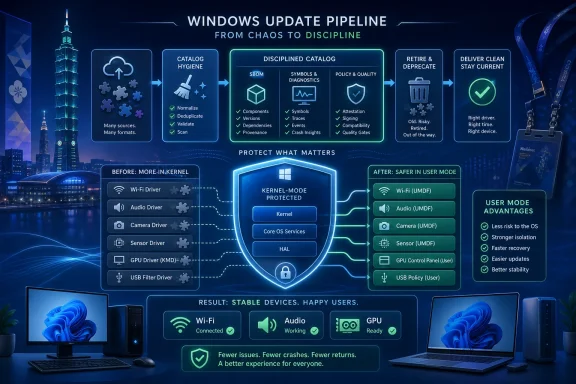
The lifecycle pillar includes catalog cleanup, SBOM alignment, and faster issue analysis through driver symbols. The jargon is dense, but the practical idea is straightforward: Microsoft wants partners to make drivers more traceable, diagnosable, and retireable. If a driver fails in the field, the ecosystem should be able to identify what failed, where it came from, which systems are affected, and how quickly the broken version can be replaced or suppressed.
That is a more modern view of driver quality. It treats the driver as part of a living software supply chain, not as a static blob thrown over the wall after a lab test. In a world of monthly Windows servicing, firmware updates, AI PCs, evolving security requirements, and increasingly complex power-management behavior, that change is not optional.
Kernel-mode drivers have the access needed to talk directly to hardware and low-level system components. They also have the privilege needed to crash the machine, create security exposure, or destabilize Windows in ways ordinary applications cannot. The more third-party code that lives in the kernel, the larger the blast radius when something goes wrong.
This became impossible to ignore after major security and reliability incidents in recent years reminded the industry how fragile kernel-level trust can be. Microsoft’s driver initiative is not merely about preventing an annoying GPU downgrade. It is also about reducing the amount of privileged third-party code that Windows must trust by default.
Moving more driver functionality into user mode will not solve every problem. Some device classes still need low-level access, and performance-sensitive hardware is not always simple to abstract. But the direction is correct: fewer fragile kernel dependencies, more first-party class drivers where they make sense, and stronger containment when third-party components misbehave.
That matters because the PC is not a single product. It is a negotiated truce among motherboard firmware, chipsets, wireless modules, display panels, storage controllers, GPUs, docks, printers, cameras, audio stacks, power profiles, OEM utilities, and Windows servicing. When that truce breaks, the failure usually lands in the user’s lap as “Windows is buggy.”
Microsoft’s announcement leans heavily on shared accountability. That phrase can sound like corporate wallpaper, but in the Windows ecosystem it has teeth if Microsoft follows through. The company controls access to Windows Update distribution, compatibility branding, partner verification, and the quality signals that decide whether a driver gets broad deployment or gets stopped before it spreads.
The risk is that Microsoft turns WinHEC into a morale event rather than an enforcement mechanism. The opportunity is that it becomes the place where driver quality stops being a private negotiation between Microsoft and individual vendors and becomes a public expectation for participating in the Windows platform.
A bad driver can increase battery drain. It can produce intermittent Bluetooth failures, display flicker, input lag, thermal spikes, sleep-resume weirdness, poor Wi-Fi roaming, audio latency, or a subtle performance regression that only appears under load. None of these necessarily looks like a catastrophic failure, but together they define whether a Windows laptop feels premium or cursed.
By adding stability, functionality, performance, and power and thermal impact to the quality picture, Microsoft is moving closer to how users actually experience driver failures. A laptop that wakes hot in a backpack because of a driver power bug is not “fine” because it did not blue-screen. A workstation that loses 15 percent of GPU performance after a cataloged driver replacement is not healthy because Event Viewer stayed quiet.
This is where Microsoft’s telemetry advantage could become genuinely useful. Windows sees enough machines, configurations, and failure patterns to detect when a driver is suspicious across the fleet. The challenge is turning those signals into fast, conservative action without creating new update chaos.
A driver package may match a broad hardware ID even if it is not the best choice for a specific OEM system. Another package may be newer but less broadly distributed. A vendor utility may install a driver outside the Windows Update path, while Windows Update later applies its own ranking rules and decides to replace it. The result is a system that technically followed policy and practically betrayed the user.
This is why catalog hygiene must include more than deleting obviously ancient packages. Microsoft needs better scoping, better version awareness, better coordination with OEM release channels, and more caution about replacing newer vendor-installed software. The company’s reported work on GPU driver downgrade behavior suggests it understands at least part of this problem.
For enthusiasts, this has always been a sore point because driver updates are not interchangeable. A graphics driver can alter game performance, display behavior, hardware acceleration, power use, and compatibility with creative applications. Treating it as a generic Windows Update component ignores how actively users and vendors manage that stack.
A single bad driver pushed broadly can become a help-desk event. Wi-Fi failures strand remote users. Docking-station bugs disrupt hybrid work. Display-driver regressions hit conference rooms and executives first, because fate has a sense of humor. Even when rollback is possible, the labor cost is real.
Microsoft’s driver push therefore has to win over two audiences. Consumers need fewer surprise breakages. IT departments need enough evidence to trust the pipeline again. The second group will be harder to convince, because admins remember every update category that was marketed as safer than it felt in practice.
If DQI succeeds, the enterprise payoff could be significant. Cleaner catalog contents, stronger partner verification, richer quality telemetry, and faster rollback mechanisms would reduce the need for blanket distrust of Windows Update drivers. But Microsoft will have to prove that with months of boring reliability, not one conference announcement.
Microsoft has been tightening driver trust in multiple ways, including stronger code integrity requirements and changes affecting older signing models. That creates friction for some legacy software and hardware, but the direction is clear. Windows can no longer afford a driver ecosystem where old privileged code remains trusted simply because it once passed through an acceptable process.
This is the same broader industry lesson that has reshaped browsers, mobile operating systems, and cloud platforms. Trust has to expire. Permissions have to narrow. Components that cannot justify privileged access need to be moved, contained, or removed.
For Windows, that is harder than for more tightly controlled platforms because backward compatibility is part of the product’s identity. The trick is not to abandon compatibility, but to stop confusing compatibility with permanent immunity from scrutiny. DQI is Microsoft’s attempt to draw that line more aggressively.
That means Microsoft cannot outsource blame to the ecosystem. If Windows Update installs the wrong driver, the failure belongs partly to the system that selected and distributed it. If users cannot easily understand why a driver appeared or how to prevent a replacement, that is a Windows design problem. If driver names in update history are opaque, that is a Microsoft communication problem.
The most credible part of DQI is that it implicitly accepts this. Catalog hygiene, automated analysis, updated compatibility requirements, and better quality measures are platform-owner responsibilities. Microsoft is not just asking vendors to behave; it is redesigning the incentives and gates through which vendor code reaches users.
Still, the company should be judged by outcomes, not rhetoric. Windows users have heard many versions of “quality is our priority.” The difference this time will be whether fewer people wake up to broken hardware after Patch Tuesday, a feature update, or a silent background driver install.
That makes DQI a difficult initiative to market but an important one to execute. Microsoft has spent much of the Windows 11 era promoting visible experiences: centered UI, AI features, Copilot integrations, redesigned inbox apps, and new hardware categories. Meanwhile, many users have wanted the basics to feel less fragile.
Driver quality is one of those basics. It is not glamorous, but it underwrites everything else Microsoft wants Windows to become. AI PCs still need stable NPUs, GPUs, cameras, microphones, storage, and wireless radios. Gaming handhelds still need careful graphics, input, thermal, and power behavior. Commercial laptops still need docks, biometric devices, VPN adapters, and sleep states that do not turn into roulette.
The PC ecosystem cannot build a premium future on top of a driver pipeline users distrust. If Microsoft wants Windows 11 and its successors to feel modern, it has to make the old plumbing boring again.
A more curated driver catalog should reduce those mistakes. Better symbols and SBOM alignment should speed diagnosis. Stronger verification should keep weaker packages out. Expanded quality metrics should catch regressions that crash telemetry misses. But the central question is whether Windows Update will become more restrained when the evidence is ambiguous.
Restraint means not replacing a newer vendor driver just because a cataloged package ranks well enough. It means staged rollouts that stop quickly when signals turn bad. It means respecting OEM-specific configurations. It means giving managed environments predictable controls and giving consumers clearer recovery paths when hardware breaks.
The best version of DQI would make Windows Update less like an eager mechanic and more like a disciplined maintenance system. It should intervene when necessary, decline when uncertain, and recover quickly when wrong.
The near-term signal will be whether Microsoft removes or suppresses drivers that have no business being offered broadly. The medium-term signal will be whether driver regressions are detected and rolled back faster. The long-term signal will be whether IT departments become less inclined to block Windows Update drivers by default.
This is the compact version of what matters now:
Source: Windows Latest Microsoft is killing bad drivers in Windows Update, admits Windows 11 PCs have been breaking for years
 Microsoft Finally Names the Thing Users Have Been Complaining About
Every Windows veteran has a version of the same story. A machine is stable on Monday, Windows Update runs overnight, and by Tuesday the Wi-Fi adapter has vanished, the audio stack is crackling, or the GPU driver has been replaced by something older, flatter, and visibly worse. The user experiences this as Windows breaking the PC, even when the immediate culprit is a third-party driver.That distinction has always mattered more to Microsoft than to users. If Windows is the system that fetched the package, ranked it, installed it, and rebooted into it, then Windows owns the failure in the public imagination. The Driver Quality Initiative matters because Microsoft is no longer pretending that the handoff between Windows, OEMs, silicon vendors, and peripheral makers is invisible.
The company’s framing is careful, as corporate engineering announcements usually are. Microsoft says drivers sit at the center of the Windows experience and that thousands of partners contribute tens of thousands of active driver families across the install base. That is both a strength and the root of the mess: Windows supports a hardware universe no vertically integrated platform would tolerate, but the cost of that openness has been an update pipeline full of aging, overlapping, and sometimes poorly targeted packages.
The phrase that should catch every admin’s eye is “Windows Update catalog hygiene.” That sounds mundane, but it is the heart of the issue. A driver catalog is not useful merely because it is large; it is useful when it is current, correctly ranked, safely scoped, and aggressively retired when it becomes a liability.
The Driver Catalog Became a Museum With Install Privileges
Windows Update’s driver catalog has long operated like a compatibility archive with distribution powers. It contains packages from OEMs, independent hardware vendors, silicon partners, and Microsoft itself, and it exists so Windows can make hardware work without sending users on a scavenger hunt through support pages. That convenience is real, especially on clean installs and for commodity peripherals.The trouble begins when the catalog behaves less like a curated service and more like a museum of old assumptions. A driver that was correct for one device revision, one OEM image, or one point in a product lifecycle can become wrong years later. If Windows Update still ranks that package highly enough, it can displace a better driver already installed by the vendor’s own updater or support utility.
This has been especially visible with graphics drivers, where version age, OEM customization, hardware IDs, and feature support all collide. A gamer may install a newer GPU package to fix stutter in one title or enable a new control-panel feature, only for Windows Update to later decide that an older cataloged driver is the “right” match. To the user, it looks like Windows decided to downgrade the machine.
Microsoft’s new driver-quality language implicitly concedes that the old model was too permissive. Deprecating outdated or low-quality drivers is not a flashy feature, but it is potentially more important than another Settings redesign or taskbar tweak. Removing bad choices from the update pipeline is often more effective than teaching users how to recover from them.
Driver Quality Is Now a Lifecycle Problem, Not a Signing Ceremony
For years, the public conversation around Windows drivers has leaned heavily on signing and certification. Is the driver signed? Did it pass the compatibility program? Is it delivered through Windows Update? Those are important gates, but they are not enough to guarantee that a package remains safe, performant, or appropriate over time.The Driver Quality Initiative shifts the emphasis toward lifecycle management. That means Microsoft is not just asking whether a driver was acceptable when submitted; it is asking whether the driver remains acceptable after Windows changes, firmware evolves, security baselines tighten, and real-world telemetry reveals problems. That is the right question.
The lifecycle pillar includes catalog cleanup, SBOM alignment, and faster issue analysis through driver symbols. The jargon is dense, but the practical idea is straightforward: Microsoft wants partners to make drivers more traceable, diagnosable, and retireable. If a driver fails in the field, the ecosystem should be able to identify what failed, where it came from, which systems are affected, and how quickly the broken version can be replaced or suppressed.
That is a more modern view of driver quality. It treats the driver as part of a living software supply chain, not as a static blob thrown over the wall after a lab test. In a world of monthly Windows servicing, firmware updates, AI PCs, evolving security requirements, and increasingly complex power-management behavior, that change is not optional.
Kernel Drivers Are Where Reliability and Security Collide
The most consequential part of Microsoft’s plan may be the architecture pillar. Microsoft says it is investing in hardening kernel-mode drivers and enabling third-party kernel-mode drivers to move either into user mode or toward Microsoft-authored class drivers where possible. That is technical language for a very old truth: code running in the kernel can ruin everyone’s day.Kernel-mode drivers have the access needed to talk directly to hardware and low-level system components. They also have the privilege needed to crash the machine, create security exposure, or destabilize Windows in ways ordinary applications cannot. The more third-party code that lives in the kernel, the larger the blast radius when something goes wrong.
This became impossible to ignore after major security and reliability incidents in recent years reminded the industry how fragile kernel-level trust can be. Microsoft’s driver initiative is not merely about preventing an annoying GPU downgrade. It is also about reducing the amount of privileged third-party code that Windows must trust by default.
Moving more driver functionality into user mode will not solve every problem. Some device classes still need low-level access, and performance-sensitive hardware is not always simple to abstract. But the direction is correct: fewer fragile kernel dependencies, more first-party class drivers where they make sense, and stronger containment when third-party components misbehave.
WinHEC’s Return Is a Signal to the Hardware Ecosystem
Microsoft’s decision to revive WinHEC after an eight-year gap is not incidental. WinHEC was historically where Microsoft and the PC hardware ecosystem aligned on what Windows expected from silicon, firmware, drivers, and devices. Bringing it back in Taipei, surrounded by OEMs, ODMs, silicon vendors, and independent hardware vendors, is a statement that Windows quality cannot be fixed from Redmond alone.That matters because the PC is not a single product. It is a negotiated truce among motherboard firmware, chipsets, wireless modules, display panels, storage controllers, GPUs, docks, printers, cameras, audio stacks, power profiles, OEM utilities, and Windows servicing. When that truce breaks, the failure usually lands in the user’s lap as “Windows is buggy.”
Microsoft’s announcement leans heavily on shared accountability. That phrase can sound like corporate wallpaper, but in the Windows ecosystem it has teeth if Microsoft follows through. The company controls access to Windows Update distribution, compatibility branding, partner verification, and the quality signals that decide whether a driver gets broad deployment or gets stopped before it spreads.
The risk is that Microsoft turns WinHEC into a morale event rather than an enforcement mechanism. The opportunity is that it becomes the place where driver quality stops being a private negotiation between Microsoft and individual vendors and becomes a public expectation for participating in the Windows platform.
Measuring More Than Crashes Is the Right Kind of Boring
One of the smarter pieces of the Driver Quality Initiative is Microsoft’s plan to expand quality measurements beyond crashes. Blue screens are obvious. They generate dumps, they show up in telemetry, and they are hard for vendors to dismiss. But many of the driver failures users hate most do not produce a neat crash signature.A bad driver can increase battery drain. It can produce intermittent Bluetooth failures, display flicker, input lag, thermal spikes, sleep-resume weirdness, poor Wi-Fi roaming, audio latency, or a subtle performance regression that only appears under load. None of these necessarily looks like a catastrophic failure, but together they define whether a Windows laptop feels premium or cursed.
By adding stability, functionality, performance, and power and thermal impact to the quality picture, Microsoft is moving closer to how users actually experience driver failures. A laptop that wakes hot in a backpack because of a driver power bug is not “fine” because it did not blue-screen. A workstation that loses 15 percent of GPU performance after a cataloged driver replacement is not healthy because Event Viewer stayed quiet.
This is where Microsoft’s telemetry advantage could become genuinely useful. Windows sees enough machines, configurations, and failure patterns to detect when a driver is suspicious across the fleet. The challenge is turning those signals into fast, conservative action without creating new update chaos.
The GPU Downgrade Problem Shows Why Ranking Matters
The Windows Update driver problem is not merely that bad drivers exist. It is that Windows has sometimes been too confident about which driver belongs on which machine. Driver ranking, hardware IDs, OEM customizations, and device targeting can produce outcomes that look irrational to users but are perfectly explainable inside the machinery.A driver package may match a broad hardware ID even if it is not the best choice for a specific OEM system. Another package may be newer but less broadly distributed. A vendor utility may install a driver outside the Windows Update path, while Windows Update later applies its own ranking rules and decides to replace it. The result is a system that technically followed policy and practically betrayed the user.
This is why catalog hygiene must include more than deleting obviously ancient packages. Microsoft needs better scoping, better version awareness, better coordination with OEM release channels, and more caution about replacing newer vendor-installed software. The company’s reported work on GPU driver downgrade behavior suggests it understands at least part of this problem.
For enthusiasts, this has always been a sore point because driver updates are not interchangeable. A graphics driver can alter game performance, display behavior, hardware acceleration, power use, and compatibility with creative applications. Treating it as a generic Windows Update component ignores how actively users and vendors manage that stack.
Admins Have Been Voting With Policy for Years
Enterprise IT has already rendered its verdict on driver updates through behavior. Many administrators treat Windows Update driver delivery as something to be controlled, delayed, or disabled, especially on managed fleets where predictability beats convenience. That caution did not emerge from superstition; it emerged from support tickets.A single bad driver pushed broadly can become a help-desk event. Wi-Fi failures strand remote users. Docking-station bugs disrupt hybrid work. Display-driver regressions hit conference rooms and executives first, because fate has a sense of humor. Even when rollback is possible, the labor cost is real.
Microsoft’s driver push therefore has to win over two audiences. Consumers need fewer surprise breakages. IT departments need enough evidence to trust the pipeline again. The second group will be harder to convince, because admins remember every update category that was marketed as safer than it felt in practice.
If DQI succeeds, the enterprise payoff could be significant. Cleaner catalog contents, stronger partner verification, richer quality telemetry, and faster rollback mechanisms would reduce the need for blanket distrust of Windows Update drivers. But Microsoft will have to prove that with months of boring reliability, not one conference announcement.
The Security Subtext Is Bigger Than the Convenience Story
It would be easy to frame DQI entirely as a quality-of-life improvement, but the security angle may be just as important. Drivers operate close to the hardware and often in privileged contexts, which makes them attractive targets and dangerous liabilities. Weak signing histories, abandoned drivers, and poorly maintained kernel components are not just stability risks; they are security risks.Microsoft has been tightening driver trust in multiple ways, including stronger code integrity requirements and changes affecting older signing models. That creates friction for some legacy software and hardware, but the direction is clear. Windows can no longer afford a driver ecosystem where old privileged code remains trusted simply because it once passed through an acceptable process.
This is the same broader industry lesson that has reshaped browsers, mobile operating systems, and cloud platforms. Trust has to expire. Permissions have to narrow. Components that cannot justify privileged access need to be moved, contained, or removed.
For Windows, that is harder than for more tightly controlled platforms because backward compatibility is part of the product’s identity. The trick is not to abandon compatibility, but to stop confusing compatibility with permanent immunity from scrutiny. DQI is Microsoft’s attempt to draw that line more aggressively.
Microsoft’s Own Role Deserves Scrutiny Too
Microsoft’s announcement emphasizes partner collaboration, and that is fair. OEMs and hardware vendors write many of the drivers that cause pain. But Microsoft is not merely the referee. It designed the update channels, ranking systems, compatibility programs, telemetry loops, and user experience around driver delivery.That means Microsoft cannot outsource blame to the ecosystem. If Windows Update installs the wrong driver, the failure belongs partly to the system that selected and distributed it. If users cannot easily understand why a driver appeared or how to prevent a replacement, that is a Windows design problem. If driver names in update history are opaque, that is a Microsoft communication problem.
The most credible part of DQI is that it implicitly accepts this. Catalog hygiene, automated analysis, updated compatibility requirements, and better quality measures are platform-owner responsibilities. Microsoft is not just asking vendors to behave; it is redesigning the incentives and gates through which vendor code reaches users.
Still, the company should be judged by outcomes, not rhetoric. Windows users have heard many versions of “quality is our priority.” The difference this time will be whether fewer people wake up to broken hardware after Patch Tuesday, a feature update, or a silent background driver install.
The Best Fix Is the One Users Never Notice
There is a paradox at the center of driver quality: success is invisible. Nobody praises Windows Update for not replacing a working Wi-Fi driver. Nobody writes a forum post because their laptop slept correctly, their GPU stayed current, or their printer continued behaving like a printer. Reliability is a negative-space achievement.That makes DQI a difficult initiative to market but an important one to execute. Microsoft has spent much of the Windows 11 era promoting visible experiences: centered UI, AI features, Copilot integrations, redesigned inbox apps, and new hardware categories. Meanwhile, many users have wanted the basics to feel less fragile.
Driver quality is one of those basics. It is not glamorous, but it underwrites everything else Microsoft wants Windows to become. AI PCs still need stable NPUs, GPUs, cameras, microphones, storage, and wireless radios. Gaming handhelds still need careful graphics, input, thermal, and power behavior. Commercial laptops still need docks, biometric devices, VPN adapters, and sleep states that do not turn into roulette.
The PC ecosystem cannot build a premium future on top of a driver pipeline users distrust. If Microsoft wants Windows 11 and its successors to feel modern, it has to make the old plumbing boring again.
The Real Test Is Whether Windows Update Learns Restraint
Microsoft’s hardest challenge may be cultural rather than technical. Windows Update has spent years becoming more automatic, more central, and harder for ordinary users to reason about. That has security benefits, but it also means mistakes propagate with enormous reach.A more curated driver catalog should reduce those mistakes. Better symbols and SBOM alignment should speed diagnosis. Stronger verification should keep weaker packages out. Expanded quality metrics should catch regressions that crash telemetry misses. But the central question is whether Windows Update will become more restrained when the evidence is ambiguous.
Restraint means not replacing a newer vendor driver just because a cataloged package ranks well enough. It means staged rollouts that stop quickly when signals turn bad. It means respecting OEM-specific configurations. It means giving managed environments predictable controls and giving consumers clearer recovery paths when hardware breaks.
The best version of DQI would make Windows Update less like an eager mechanic and more like a disciplined maintenance system. It should intervene when necessary, decline when uncertain, and recover quickly when wrong.
The Promise Microsoft Now Has to Keep
Microsoft has put enough specifics on the table that users and admins can measure whether this is real. The Driver Quality Initiative is not a single toggle or one patch; it is a set of changes to architecture, trust, lifecycle management, and quality measurement. That makes it harder to evaluate immediately, but easier to judge over time.The near-term signal will be whether Microsoft removes or suppresses drivers that have no business being offered broadly. The medium-term signal will be whether driver regressions are detected and rolled back faster. The long-term signal will be whether IT departments become less inclined to block Windows Update drivers by default.
This is the compact version of what matters now:
- Microsoft is treating bad drivers as a Windows ecosystem failure, not merely as isolated vendor mistakes.
- Windows Update catalog cleanup could prevent outdated or low-quality drivers from being offered to machines where they are likely to cause harm.
- Stronger lifecycle management matters because a driver that was acceptable at submission can become risky after Windows, firmware, or hardware conditions change.
- Moving more driver work out of the kernel should improve reliability and reduce the security blast radius of third-party code.
- Enterprises will not trust the new model until Microsoft demonstrates months of predictable behavior across real fleets.
- The most important result for consumers would be simple: fewer routine updates that quietly make working hardware worse.
Source: Windows Latest Microsoft is killing bad drivers in Windows Update, admits Windows 11 PCs have been breaking for years
