

On May 12, 2026, Microsoft introduced Cloud-Initiated Driver Recovery, a Windows Update capability designed to remotely roll back faulty drivers on affected PCs when Microsoft identifies a bad driver release through testing, telemetry, or reliability signals. The feature sounds narrow, almost bureaucratic, but it targets one of Windows’ most persistent reputational problems: the moment a routine update turns into a blue screen, a boot loop, or a long evening in Device Manager. Microsoft is not promising an end to driver-related crashes. It is promising something more revealing: that Windows Update needs an undo button controlled from the cloud.
For decades, Windows users have been told that drivers are both the strength and the curse of the PC platform. The same openness that lets Windows run on a chaotic universe of chipsets, GPUs, Wi-Fi adapters, docks, audio devices, webcams, storage controllers, printers, and oddball enterprise peripherals also means that the operating system is never just Microsoft’s code. It is Microsoft’s code plus everyone else’s kernel-adjacent ambition.
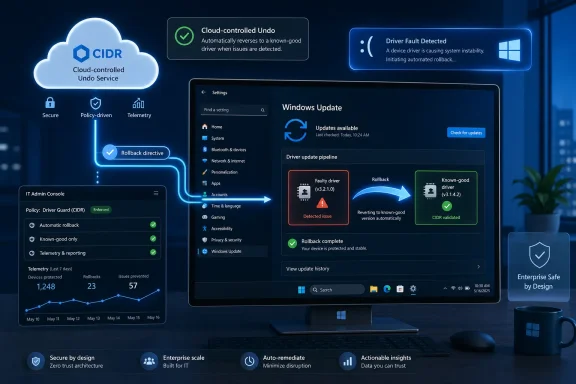
Cloud-Initiated Driver Recovery, or CIDR, is Microsoft’s attempt to make that reality less brittle. When a driver distributed through Windows Update is found to be problematic, Microsoft can trigger a recovery action from the Hardware Dev Center Driver Shiproom and move affected devices back to a previously known-good driver available in Microsoft’s catalog. The process rides through Windows Update rather than a separate rescue utility, which matters because it keeps remediation inside the same servicing machinery that caused the problem.
That is the important shift. Microsoft is not merely improving detection or asking hardware partners to publish cleaner packages. It is adding a post-release control plane for driver quality, one that assumes some failures will escape the lab and that recovery has to be as scalable as distribution.
The company’s framing is cautious, as it should be. CIDR applies to drivers delivered through Windows Update, not to every driver a user manually installs from an OEM website, a GPU vendor’s control panel, a motherboard support page, or a random ZIP file found in a forum thread. If Microsoft’s catalog does not contain a suitable stable driver for a device, the automatic rollback does not happen. The escape hatch only works when there is somewhere safe to escape to.
That is unfair in many individual cases, but fair in the only way consumers and administrators ultimately care about: Windows is the platform that accepted the driver, loaded it, trusted it, and put it in a position to wreck the session. The difference between “Microsoft broke my PC” and “a vendor-supplied driver distributed through Microsoft’s update channel caused a kernel crash” is meaningful to engineers. It is meaningless to someone staring at a recovery screen before a meeting.
This is why CIDR is more than a convenience feature. It is an admission that driver quality cannot be treated as a one-way publishing event. The Windows ecosystem is too broad, too hardware-dependent, and too exposed to configuration weirdness for every driver regression to be caught before release.
Microsoft has spent years trying to tighten the front door. Hardware Lab Kit testing, attestation signing, Driver Shiproom rules, telemetry-based measures, blocklists, and staged deployment all exist to prevent obviously bad packages from going broad. Yet the persistent complaint from users and IT departments is not that Microsoft has no testing process. It is that the process still sometimes lets the wrong thing through, and once it does, the burden of repair lands on the least prepared person in the chain.
CIDR changes the placement of that burden. Instead of requiring the user to locate Device Manager, identify the affected device, choose a rollback option, or boot into recovery, Microsoft can use its update infrastructure to push the system back toward a known-good state. That does not erase the outage. It can shorten the tail of it.
CIDR depends on Microsoft knowing which driver version is bad, which machines are affected, and which earlier or alternate driver version is safe enough to restore. That sounds simple until you remember how Windows driver targeting actually works. A driver package is not merely “for a Wi-Fi card” or “for a GPU.” It may be targeted by hardware IDs, compatible IDs, computer hardware IDs, operating system versions, device metadata, firmware dependencies, and vendor-specific quirks.
The rollback story only works if Windows Update can distinguish between a driver that is bad everywhere and a driver that is bad only on a specific slice of hardware. A graphics driver might be fine on most laptops but unstable on one OEM’s thermal design. A storage driver might behave correctly on clean installs but fail on systems upgraded across several Windows releases. An audio driver might crash only with a particular enhancement stack or Bluetooth coexistence condition.
Microsoft’s existing Driver Shiproom model already uses telemetry and quality gates to decide whether drivers should be published. CIDR extends that logic beyond the publication decision. The system can now treat a bad driver not as a static mistake but as a recoverable state.
That is a subtler and more useful architecture than a universal “roll back everything” button. The wrong rollback can be as damaging as the wrong update. A driver restored blindly might fix one crash while reintroducing a security issue, breaking a device feature, or causing a compatibility regression that the newer driver had solved. CIDR’s usefulness will depend less on the existence of rollback and more on the precision of Microsoft’s targeting.
Anyone who has administered Windows fleets knows the reality has been messier. Windows has long had local driver rollback mechanisms, recovery environments, system restore concepts, update uninstall options, and administrative controls. But those tools are fragmented, inconsistent, and often reactive at the individual-machine level. They are useful when a technician is already investigating a problem. They are not the same thing as a cloud-triggered remediation path for a driver regression spreading across a hardware population.
That distinction is crucial. CIDR is not just about one PC recovering. It is about Microsoft seeing a pattern and acting on the pattern. If crash reports spike after a driver release on a specific device family, the fix can be distributed through the servicing channel rather than waiting for each user, help desk, or OEM support script to discover the same failure independently.
For home users, the best version of this feature is one they never consciously notice. A faulty driver arrives, Microsoft identifies the blast radius, Windows Update replaces it, and the machine stops crashing. The user may see update history, a notification, or nothing memorable at all. In consumer computing, invisible recovery is often the highest compliment.
For administrators, invisibility is more complicated. Enterprise IT does not merely want Microsoft to fix problems quickly; it wants to know what changed, when it changed, why it changed, and whether the remediation collides with internal validation policies. A cloud-triggered rollback can be a blessing during a widespread incident and a governance headache if it feels like an unscheduled change to a managed device baseline.
Security agents, storage filters, endpoint management tools, GPU drivers, VPN clients, firmware updaters, and hardware support packages all live close enough to the operating system to cause disproportionate damage when they fail. Microsoft’s platform strategy has increasingly been to harden Windows while keeping the partner ecosystem intact. That is a difficult balance because Windows’ commercial strength is also its attack surface and reliability risk.
CIDR fits into a post-2024 industry mood in which recovery speed matters almost as much as prevention. No serious platform vendor can credibly promise that every bad update will be caught before release. The stronger promise is that the platform can detect, contain, and reverse damage quickly enough to keep a failure from becoming an operational crisis.
Still, the boundaries matter. CIDR covers drivers distributed by Windows Update. It does not magically roll back every kernel-mode component, every security product update, every vendor service, or every manually installed package. If a third-party updater bypasses Microsoft’s driver publishing process, it bypasses this recovery path too.
That limitation may frustrate users, but it is also a reason the feature can exist. Microsoft can only automate rollback where it has the metadata, distribution control, and catalog history to do so safely. The messy outside world of vendor installers and support utilities remains just as messy.
But a safety net also raises expectations. If Microsoft can identify a faulty driver and roll it back, users will reasonably ask why the driver shipped in the first place. If a driver repeatedly needs recovery, administrators will ask whether the vendor’s validation process is adequate. If Microsoft’s telemetry catches failures that OEMs missed, the partner dashboard becomes less of a formality and more of a scoreboard.
There is also an incentive shift. Windows Update has become a central driver distribution path because it is convenient, trusted, and integrated into system servicing. OEMs and independent hardware vendors want that reach. CIDR makes the reach safer for users, but it also gives Microsoft more leverage over driver quality because the recovery mechanism sits inside Microsoft’s infrastructure.
That leverage is not necessarily bad. The Windows hardware ecosystem has often needed a stronger referee. A driver that passes a vendor’s narrow internal tests may still fail in the real-world combinatorial mess of docks, sleep states, virtualization features, memory integrity settings, enterprise images, and upgrade histories. Microsoft is one of the few actors with enough telemetry to see those failures at scale.
The danger is opacity. If Microsoft blocks, rolls back, or suppresses a driver, partners and administrators need clear signals. A quiet cloud rollback may be elegant for consumers, but enterprise operations thrive on auditability. The feature’s success will depend partly on how well Microsoft communicates recovery actions through existing admin surfaces, update history, partner dashboards, and support channels.
Those limits should be understood as design boundaries, not failures. A universal driver rollback robot would be terrifying. Windows machines run medical devices, factory controllers, trading workstations, gaming rigs, school laptops, conference room systems, and domain-joined fleets with compliance requirements. Automatically swapping drivers without regard to source, policy, or device role would create a different kind of reliability problem.
The more interesting question is how Microsoft decides when a driver is bad enough to recover. A crash spike is obvious in theory, but reality contains many ambiguous cases. A driver may increase crashes slightly while fixing a severe security vulnerability. A driver may break a small group of machines while improving stability for a larger group. A rollback may restore reliability but reopen an issue that had regulatory or security implications.
This is where Microsoft’s language around “problematic” drivers will need operational clarity. Users want the machine fixed. Administrators want the decision explained. Vendors want to know whether the rollback reflects a confirmed defect, a telemetry anomaly, a targeting error, or a temporary containment action.
The absence of a stable catalog version is another practical constraint. If Windows Update has no suitable prior driver for the affected hardware, CIDR cannot do the miracle. That may become an incentive for vendors to maintain cleaner version histories in Microsoft’s ecosystem, but it also means users of niche devices, older hardware, or vendor-specific packages may not benefit equally.
Microsoft has spent the last several years giving commercial customers more control over driver and firmware updates through Windows Update for Business and related deployment services. That was an acknowledgment that enterprises do not want every driver update at the same cadence as security fixes. CIDR now adds a recovery layer to that same strategic direction: drivers should be serviced, but the servicing system must be able to correct itself.
The administrative question is whether CIDR behaves as an emergency remediation, a normal update action, or something in between. If a managed fleet has driver approvals, deferral rings, or staged deployments, does a cloud-initiated rollback respect those policies? If an organization has deliberately approved the newer driver because it fixes a business-critical issue, can Microsoft still roll it back for a subset of devices? If a rollback occurs, will Intune, Windows Update for Business reporting, or endpoint management tools show it clearly enough for incident review?
Microsoft will likely frame CIDR as a reliability improvement that reduces help desk load. That is plausible. But enterprises will evaluate it as a change-management feature. The difference matters because admins are not only responsible for uptime; they are responsible for explaining uptime.
There is also a security dimension. Attackers have abused vulnerable drivers for years, and Microsoft has tightened driver blocklisting and kernel protections in response. A rollback system must avoid restoring a driver that is stable but vulnerable. Stability cannot be the only definition of “known good.”
In practice, the best outcome would be a hierarchy of safety: Microsoft blocks known-dangerous drivers, rolls back known-bad Windows Update drivers, gives administrators visibility into the action, and allows policy-aware handling for managed fleets. Anything less will still help consumers, but it will leave IT pros asking whether the cure introduced another undocumented moving part.
That does not make the feature irrelevant to enthusiasts. Windows Update has a long history of installing drivers users did not explicitly ask for, sometimes replacing a vendor-provided package with one Microsoft considers appropriate. When that replacement is wrong, the resulting frustration is intense because the user did not choose the risk. CIDR could reduce the duration of those misfires.
Still, power users will continue to prefer manual control in certain categories, especially GPUs. Nvidia, AMD, and Intel graphics drivers often arrive with game-specific optimizations, control panel changes, creator-workload fixes, and known-issue lists that enthusiasts track closely. A Windows Update rollback might fix a crash for mainstream users while annoying someone who deliberately installed a newer package for a specific game or application.
The real benefit for enthusiasts may be indirect. If Microsoft’s rollback capability pressures vendors to keep better catalog submissions and cleaner targeting metadata, Windows Update should become less likely to offer the wrong driver to the wrong machine. That is less exciting than an emergency rescue feature, but more valuable over time.
There is a cultural angle too. Many veteran Windows users treat driver updates with suspicion because they have been burned before. CIDR will not erase that memory overnight. But if the feature quietly prevents enough bad updates from lingering, it could make Windows Update feel less like a slot machine for hardware stability.
That is a healthier model for Windows. The operating system now lives in a world of continuous updates, cloud-managed devices, hybrid work, security hardening, firmware churn, and hardware diversity that dwarfs the old boxed-software era. Reliability cannot depend on every actor making perfect decisions before deployment. It has to depend on feedback loops.
CIDR joins a broader family of recovery-minded Windows features, including cloud-assisted recovery concepts for machines that cannot boot properly. The common idea is that Windows should not strand users when the update pipeline misbehaves. The system should be able to ask the cloud what went wrong and receive a remediation path.
That philosophy will make some users uneasy. A cloud-directed operating system can feel less owned by the person sitting in front of the machine. Microsoft’s challenge is to make cloud recovery feel like a seatbelt rather than a steering wheel.
Transparency is the difference. If Windows silently changes drivers with no understandable record, trust will erode. If Windows clearly reports that a driver was rolled back because Microsoft identified a reliability issue on matching hardware, users and administrators are more likely to accept the intervention.
Source: extremetech.com Microsoft Is Finally Tackling One of the Biggest Reasons Behind the BSOD
 Microsoft Is Building an Escape Hatch Into the Driver Pipeline
For decades, Windows users have been told that drivers are both the strength and the curse of the PC platform. The same openness that lets Windows run on a chaotic universe of chipsets, GPUs, Wi-Fi adapters, docks, audio devices, webcams, storage controllers, printers, and oddball enterprise peripherals also means that the operating system is never just Microsoft’s code. It is Microsoft’s code plus everyone else’s kernel-adjacent ambition.Cloud-Initiated Driver Recovery, or CIDR, is Microsoft’s attempt to make that reality less brittle. When a driver distributed through Windows Update is found to be problematic, Microsoft can trigger a recovery action from the Hardware Dev Center Driver Shiproom and move affected devices back to a previously known-good driver available in Microsoft’s catalog. The process rides through Windows Update rather than a separate rescue utility, which matters because it keeps remediation inside the same servicing machinery that caused the problem.
That is the important shift. Microsoft is not merely improving detection or asking hardware partners to publish cleaner packages. It is adding a post-release control plane for driver quality, one that assumes some failures will escape the lab and that recovery has to be as scalable as distribution.
The company’s framing is cautious, as it should be. CIDR applies to drivers delivered through Windows Update, not to every driver a user manually installs from an OEM website, a GPU vendor’s control panel, a motherboard support page, or a random ZIP file found in a forum thread. If Microsoft’s catalog does not contain a suitable stable driver for a device, the automatic rollback does not happen. The escape hatch only works when there is somewhere safe to escape to.
The BSOD Was Never Just an Operating System Problem
The Blue Screen of Death has always been a branding disaster for Windows because it presents itself as an operating system failure even when the culprit is lower-level third-party code. A crash screen does not explain the driver ecosystem, interrupt handling, power states, firmware tables, or vendor validation. It tells the user that Windows died.That is unfair in many individual cases, but fair in the only way consumers and administrators ultimately care about: Windows is the platform that accepted the driver, loaded it, trusted it, and put it in a position to wreck the session. The difference between “Microsoft broke my PC” and “a vendor-supplied driver distributed through Microsoft’s update channel caused a kernel crash” is meaningful to engineers. It is meaningless to someone staring at a recovery screen before a meeting.
This is why CIDR is more than a convenience feature. It is an admission that driver quality cannot be treated as a one-way publishing event. The Windows ecosystem is too broad, too hardware-dependent, and too exposed to configuration weirdness for every driver regression to be caught before release.
Microsoft has spent years trying to tighten the front door. Hardware Lab Kit testing, attestation signing, Driver Shiproom rules, telemetry-based measures, blocklists, and staged deployment all exist to prevent obviously bad packages from going broad. Yet the persistent complaint from users and IT departments is not that Microsoft has no testing process. It is that the process still sometimes lets the wrong thing through, and once it does, the burden of repair lands on the least prepared person in the chain.
CIDR changes the placement of that burden. Instead of requiring the user to locate Device Manager, identify the affected device, choose a rollback option, or boot into recovery, Microsoft can use its update infrastructure to push the system back toward a known-good state. That does not erase the outage. It can shorten the tail of it.
The Cloud Is Not the Trick; The Catalog Is
The word “cloud” in a Windows feature name tends to invite suspicion, and not without reason. Microsoft has spent the last several Windows cycles turning local operating system functions into cloud-mediated services, sometimes usefully and sometimes with an enthusiasm that exceeds user demand. In this case, however, the cloud is not the flashy part of the design. The driver catalog is.CIDR depends on Microsoft knowing which driver version is bad, which machines are affected, and which earlier or alternate driver version is safe enough to restore. That sounds simple until you remember how Windows driver targeting actually works. A driver package is not merely “for a Wi-Fi card” or “for a GPU.” It may be targeted by hardware IDs, compatible IDs, computer hardware IDs, operating system versions, device metadata, firmware dependencies, and vendor-specific quirks.
The rollback story only works if Windows Update can distinguish between a driver that is bad everywhere and a driver that is bad only on a specific slice of hardware. A graphics driver might be fine on most laptops but unstable on one OEM’s thermal design. A storage driver might behave correctly on clean installs but fail on systems upgraded across several Windows releases. An audio driver might crash only with a particular enhancement stack or Bluetooth coexistence condition.
Microsoft’s existing Driver Shiproom model already uses telemetry and quality gates to decide whether drivers should be published. CIDR extends that logic beyond the publication decision. The system can now treat a bad driver not as a static mistake but as a recoverable state.
That is a subtler and more useful architecture than a universal “roll back everything” button. The wrong rollback can be as damaging as the wrong update. A driver restored blindly might fix one crash while reintroducing a security issue, breaking a device feature, or causing a compatibility regression that the newer driver had solved. CIDR’s usefulness will depend less on the existence of rollback and more on the precision of Microsoft’s targeting.
Windows Update Gets the Undo Button Users Assumed It Already Had
Many nontechnical users assume Windows Update already works this way. If Microsoft can install a driver automatically, surely it can uninstall a bad one automatically. If Windows can detect that something went wrong, surely it can put things back.Anyone who has administered Windows fleets knows the reality has been messier. Windows has long had local driver rollback mechanisms, recovery environments, system restore concepts, update uninstall options, and administrative controls. But those tools are fragmented, inconsistent, and often reactive at the individual-machine level. They are useful when a technician is already investigating a problem. They are not the same thing as a cloud-triggered remediation path for a driver regression spreading across a hardware population.
That distinction is crucial. CIDR is not just about one PC recovering. It is about Microsoft seeing a pattern and acting on the pattern. If crash reports spike after a driver release on a specific device family, the fix can be distributed through the servicing channel rather than waiting for each user, help desk, or OEM support script to discover the same failure independently.
For home users, the best version of this feature is one they never consciously notice. A faulty driver arrives, Microsoft identifies the blast radius, Windows Update replaces it, and the machine stops crashing. The user may see update history, a notification, or nothing memorable at all. In consumer computing, invisible recovery is often the highest compliment.
For administrators, invisibility is more complicated. Enterprise IT does not merely want Microsoft to fix problems quickly; it wants to know what changed, when it changed, why it changed, and whether the remediation collides with internal validation policies. A cloud-triggered rollback can be a blessing during a widespread incident and a governance headache if it feels like an unscheduled change to a managed device baseline.
The CrowdStrike Shadow Hangs Over Every Recovery Feature
Microsoft does not have to say “CrowdStrike” for the industry to hear it. The July 2024 outage, caused by a defective content update from a security vendor, sent Windows machines into widespread failure and forced organizations into painful recovery work. CIDR is not the same kind of mechanism, and it should not be oversold as a cure for that category of incident. But the broader lesson is impossible to miss: modern Windows reliability depends on the behavior of components that Microsoft does not fully author.Security agents, storage filters, endpoint management tools, GPU drivers, VPN clients, firmware updaters, and hardware support packages all live close enough to the operating system to cause disproportionate damage when they fail. Microsoft’s platform strategy has increasingly been to harden Windows while keeping the partner ecosystem intact. That is a difficult balance because Windows’ commercial strength is also its attack surface and reliability risk.
CIDR fits into a post-2024 industry mood in which recovery speed matters almost as much as prevention. No serious platform vendor can credibly promise that every bad update will be caught before release. The stronger promise is that the platform can detect, contain, and reverse damage quickly enough to keep a failure from becoming an operational crisis.
Still, the boundaries matter. CIDR covers drivers distributed by Windows Update. It does not magically roll back every kernel-mode component, every security product update, every vendor service, or every manually installed package. If a third-party updater bypasses Microsoft’s driver publishing process, it bypasses this recovery path too.
That limitation may frustrate users, but it is also a reason the feature can exist. Microsoft can only automate rollback where it has the metadata, distribution control, and catalog history to do so safely. The messy outside world of vendor installers and support utilities remains just as messy.
OEMs Gain a Safety Net, but Also Lose Some Excuses
Hardware vendors should welcome CIDR, at least publicly. A bad Windows Update driver can become a support nightmare for OEMs, especially when customers do not distinguish between Microsoft, the chip vendor, and the brand stamped on the laptop lid. Automatic rollback gives Microsoft and its partners a way to stop the bleeding while a corrected package is prepared.But a safety net also raises expectations. If Microsoft can identify a faulty driver and roll it back, users will reasonably ask why the driver shipped in the first place. If a driver repeatedly needs recovery, administrators will ask whether the vendor’s validation process is adequate. If Microsoft’s telemetry catches failures that OEMs missed, the partner dashboard becomes less of a formality and more of a scoreboard.
There is also an incentive shift. Windows Update has become a central driver distribution path because it is convenient, trusted, and integrated into system servicing. OEMs and independent hardware vendors want that reach. CIDR makes the reach safer for users, but it also gives Microsoft more leverage over driver quality because the recovery mechanism sits inside Microsoft’s infrastructure.
That leverage is not necessarily bad. The Windows hardware ecosystem has often needed a stronger referee. A driver that passes a vendor’s narrow internal tests may still fail in the real-world combinatorial mess of docks, sleep states, virtualization features, memory integrity settings, enterprise images, and upgrade histories. Microsoft is one of the few actors with enough telemetry to see those failures at scale.
The danger is opacity. If Microsoft blocks, rolls back, or suppresses a driver, partners and administrators need clear signals. A quiet cloud rollback may be elegant for consumers, but enterprise operations thrive on auditability. The feature’s success will depend partly on how well Microsoft communicates recovery actions through existing admin surfaces, update history, partner dashboards, and support channels.
The Feature’s Limits Are Not Fine Print; They Are the Whole Story
CIDR is useful precisely because it is constrained. It works for drivers delivered through Windows Update. It requires a known-good alternative in Microsoft’s catalog. It depends on Microsoft detecting or confirming that a driver is problematic. It does not replace local troubleshooting, OEM utilities, vendor hotfixes, or the judgment of administrators who deliberately pin or approve driver versions.Those limits should be understood as design boundaries, not failures. A universal driver rollback robot would be terrifying. Windows machines run medical devices, factory controllers, trading workstations, gaming rigs, school laptops, conference room systems, and domain-joined fleets with compliance requirements. Automatically swapping drivers without regard to source, policy, or device role would create a different kind of reliability problem.
The more interesting question is how Microsoft decides when a driver is bad enough to recover. A crash spike is obvious in theory, but reality contains many ambiguous cases. A driver may increase crashes slightly while fixing a severe security vulnerability. A driver may break a small group of machines while improving stability for a larger group. A rollback may restore reliability but reopen an issue that had regulatory or security implications.
This is where Microsoft’s language around “problematic” drivers will need operational clarity. Users want the machine fixed. Administrators want the decision explained. Vendors want to know whether the rollback reflects a confirmed defect, a telemetry anomaly, a targeting error, or a temporary containment action.
The absence of a stable catalog version is another practical constraint. If Windows Update has no suitable prior driver for the affected hardware, CIDR cannot do the miracle. That may become an incentive for vendors to maintain cleaner version histories in Microsoft’s ecosystem, but it also means users of niche devices, older hardware, or vendor-specific packages may not benefit equally.
Admins Will Want Control, Not Just Rescue
For IT departments, driver servicing is already a tense subject. Drivers are not ordinary patches. They can affect boot reliability, network connectivity, BitLocker recovery events, docking behavior, graphics stability, sleep and resume, and peripheral support. A bad driver can remove the very remote-management path needed to fix it.Microsoft has spent the last several years giving commercial customers more control over driver and firmware updates through Windows Update for Business and related deployment services. That was an acknowledgment that enterprises do not want every driver update at the same cadence as security fixes. CIDR now adds a recovery layer to that same strategic direction: drivers should be serviced, but the servicing system must be able to correct itself.
The administrative question is whether CIDR behaves as an emergency remediation, a normal update action, or something in between. If a managed fleet has driver approvals, deferral rings, or staged deployments, does a cloud-initiated rollback respect those policies? If an organization has deliberately approved the newer driver because it fixes a business-critical issue, can Microsoft still roll it back for a subset of devices? If a rollback occurs, will Intune, Windows Update for Business reporting, or endpoint management tools show it clearly enough for incident review?
Microsoft will likely frame CIDR as a reliability improvement that reduces help desk load. That is plausible. But enterprises will evaluate it as a change-management feature. The difference matters because admins are not only responsible for uptime; they are responsible for explaining uptime.
There is also a security dimension. Attackers have abused vulnerable drivers for years, and Microsoft has tightened driver blocklisting and kernel protections in response. A rollback system must avoid restoring a driver that is stable but vulnerable. Stability cannot be the only definition of “known good.”
In practice, the best outcome would be a hierarchy of safety: Microsoft blocks known-dangerous drivers, rolls back known-bad Windows Update drivers, gives administrators visibility into the action, and allows policy-aware handling for managed fleets. Anything less will still help consumers, but it will leave IT pros asking whether the cure introduced another undocumented moving part.
Gamers and Enthusiasts Will Keep Living Outside the Guardrails
Windows enthusiasts may be the least surprised by CIDR and the least protected by it. The people most likely to chase new graphics drivers, beta chipset packages, modded INF files, motherboard utilities, USB audio firmware, and vendor control panels are also the people most likely to step outside Windows Update’s managed path. CIDR does not save you from every driver you install in pursuit of a frame-rate bump or a missing feature toggle.That does not make the feature irrelevant to enthusiasts. Windows Update has a long history of installing drivers users did not explicitly ask for, sometimes replacing a vendor-provided package with one Microsoft considers appropriate. When that replacement is wrong, the resulting frustration is intense because the user did not choose the risk. CIDR could reduce the duration of those misfires.
Still, power users will continue to prefer manual control in certain categories, especially GPUs. Nvidia, AMD, and Intel graphics drivers often arrive with game-specific optimizations, control panel changes, creator-workload fixes, and known-issue lists that enthusiasts track closely. A Windows Update rollback might fix a crash for mainstream users while annoying someone who deliberately installed a newer package for a specific game or application.
The real benefit for enthusiasts may be indirect. If Microsoft’s rollback capability pressures vendors to keep better catalog submissions and cleaner targeting metadata, Windows Update should become less likely to offer the wrong driver to the wrong machine. That is less exciting than an emergency rescue feature, but more valuable over time.
There is a cultural angle too. Many veteran Windows users treat driver updates with suspicion because they have been burned before. CIDR will not erase that memory overnight. But if the feature quietly prevents enough bad updates from lingering, it could make Windows Update feel less like a slot machine for hardware stability.
Microsoft’s Reliability Strategy Is Becoming More Honest
The most encouraging part of CIDR is not the rollback itself. It is the realism behind it. Microsoft is no longer acting as though better pre-release validation alone can tame the Windows hardware ecosystem. It is building mechanisms that assume failure will happen after release and that the platform must recover centrally.That is a healthier model for Windows. The operating system now lives in a world of continuous updates, cloud-managed devices, hybrid work, security hardening, firmware churn, and hardware diversity that dwarfs the old boxed-software era. Reliability cannot depend on every actor making perfect decisions before deployment. It has to depend on feedback loops.
CIDR joins a broader family of recovery-minded Windows features, including cloud-assisted recovery concepts for machines that cannot boot properly. The common idea is that Windows should not strand users when the update pipeline misbehaves. The system should be able to ask the cloud what went wrong and receive a remediation path.
That philosophy will make some users uneasy. A cloud-directed operating system can feel less owned by the person sitting in front of the machine. Microsoft’s challenge is to make cloud recovery feel like a seatbelt rather than a steering wheel.
Transparency is the difference. If Windows silently changes drivers with no understandable record, trust will erode. If Windows clearly reports that a driver was rolled back because Microsoft identified a reliability issue on matching hardware, users and administrators are more likely to accept the intervention.
The New Undo Button Only Works If Windows Tells the Truth
The practical lesson from CIDR is not that blue screens are over. It is that Microsoft is finally treating bad Windows Update drivers as something the servicing platform itself must remediate, not merely something users and OEMs must clean up afterward.- Cloud-Initiated Driver Recovery applies to faulty drivers distributed through Windows Update, not to every driver installed manually from a vendor or OEM source.
- Microsoft can use the existing Windows Update pipeline to restore an affected device to a previously known-good driver from its catalog.
- Automatic rollback depends on Microsoft having a suitable stable driver available for the specific hardware and targeting scenario.
- The feature should reduce the pain of widespread driver regressions, but it will not eliminate driver-related BSODs or replace vendor testing.
- Enterprise value will depend heavily on reporting, policy interaction, and whether administrators can see and explain recovery actions.
- The long-term win is not just faster rollback, but better pressure on the Windows driver ecosystem to maintain cleaner metadata, safer targeting, and more accountable releases.
Source: extremetech.com Microsoft Is Finally Tackling One of the Biggest Reasons Behind the BSOD
