

Microsoft is preparing Cloud-Initiated Driver Recovery for Windows 11, a Windows Update-backed recovery system that can automatically roll back faulty drivers and replace them with known-good versions, with validation starting now and a targeted release by September 2026. The feature is narrow, but the implications are not. Microsoft is admitting that driver delivery is no longer just an update problem; it is a fleet reliability problem that needs a cloud-side kill switch.
That makes CIDR less exciting as a convenience feature than as a governance mechanism. For home users, it promises fewer mysterious boot loops after a driver update. For IT administrators, it changes the risk calculation around letting Windows Update handle more of the driver stack. For hardware vendors, it raises the bar: a driver that passes into distribution may now be pulled back just as programmatically as it was pushed out.
Windows has always treated drivers as special, even when the user experience pretends otherwise. A bad app crashes. A bad driver can take the kernel, the display stack, storage, networking, or the boot path with it. That is why a routine-looking optional driver update can become the difference between “everything is fine” and “this machine no longer starts.”
Cloud-Initiated Driver Recovery, or CIDR, is Microsoft’s attempt to put a recovery loop around that risk. If a driver distributed through Windows Update is found to cause instability, Microsoft can initiate a recovery action through its driver evaluation and distribution systems. That action can instruct affected machines to roll back to a previously known-good version and deliver the replacement through the same Windows Update plumbing that installed the problematic driver in the first place.
The important phrase is through Windows Update. CIDR is not a universal undo button for every driver on a PC. It applies to drivers Microsoft distributes and controls through its update pipeline, not to every graphics, chipset, printer, or audio package a user downloads from a vendor website. That boundary matters because it keeps Microsoft from reaching into software it did not ship, but it also limits the feature’s usefulness in the very places enthusiasts most often install their own drivers.
Still, this is a meaningful architectural change. Today, when a faulty driver lands through Windows Update, users may need to roll it back manually, administrators may need to block it with policy, and OEMs may need to coordinate a revised package. CIDR moves more of that remediation upstream, where Microsoft can react centrally rather than waiting for every affected device owner to discover the same failure.
But the deeper issue is distribution asymmetry. Microsoft and its partners can push a driver to a huge number of machines quickly, while recovery often happens slowly, manually, and unevenly. Users search forums. Administrators file support tickets. OEMs publish advisories. Someone eventually identifies the bad package, but by then the damage has already spread.
CIDR is designed to correct that asymmetry. If Microsoft’s telemetry, shiproom process, or partner feedback identifies a driver as faulty, the same centralized system that enabled broad deployment can also enable targeted rollback. In theory, this turns driver recovery from a support scramble into an update transaction.
That is the right direction, but it is not magic. A rollback system only helps machines that can still receive and process the recovery instruction. If a driver has already rendered a machine unbootable or broken network connectivity badly enough, cloud-initiated remediation may arrive too late. The most dangerous driver failures are precisely the ones that can sever the path to repair.
That limitation does not make CIDR useless. It makes it a mitigation rather than a guarantee. Microsoft is reducing the window during which bad drivers remain active across the installed base, not eliminating the need for pre-release testing, staged rollout, recovery partitions, safe mode, or administrator caution.
That incident became a kind of folk warning among enthusiasts: do not assume a driver is safe simply because Windows Update offers it. For many users, the update was not something they had actively sought from AMD’s site or selected during a GPU driver install. It arrived through the operating system’s trusted maintenance channel, which made the resulting failure feel less like an experiment gone wrong and more like a breach of the implicit contract between Windows and the user.
The damage from such incidents is larger than the number of machines affected. Every bad driver that slips through Microsoft’s channel trains a portion of the Windows audience to distrust automatic driver delivery. Enthusiasts disable driver updates. Administrators restrict them. Support teams become wary of policies that would otherwise simplify fleet maintenance.
CIDR is Microsoft trying to buy back some of that trust. The company is not saying bad drivers will never ship. It is saying that when they do, Windows Update should be able to correct its own mistake more quickly and with less human intervention. That is a more modest claim, but probably a more believable one.
Windows Autopatch has already put this tension on display. Microsoft recently acknowledged and fixed a bug that caused restricted driver updates to be installed on some Autopatch-managed devices despite administrative policies intended to prevent that behavior. That kind of incident is exactly why administrators treat vendor promises about automation with caution. The policy plane and the update plane must agree, or the automation becomes the problem.
CIDR could help enterprises by shortening exposure to a bad driver that has already entered the environment. A central rollback is far better than asking administrators to script device-specific removals or wait for a corrected package to propagate. It also fits Microsoft’s broader direction: Windows servicing is increasingly managed as a cloud-coordinated system rather than a local patching ritual.
But enterprises will want answers that go beyond the press-release version. They will ask how CIDR interacts with Intune rings, Windows Autopatch policies, driver deferrals, compliance reporting, and device groups with strict validation requirements. They will want to know whether a recovery action is visible, auditable, delayable, and reversible. They will also want to know how Microsoft defines “known good” in a mixed fleet where a driver may be good for one model, questionable for another, and catastrophic for a third.
That is where CIDR’s success will be judged. Not by whether it can roll back a driver in a demo, but by whether administrators can understand and trust the decision path when it happens at scale.
According to the description of the feature, a problematic driver can be addressed through a cloud recovery action initiated from Microsoft’s driver shiproom process. A targeted recovery request is created, instructions are delivered through Windows Update packages, and a stable replacement driver is installed. That makes the driver pipeline less like a one-way publishing system and more like a managed lifecycle.
This matters because driver quality is not static. A driver can look fine in lab testing and fail only when exposed to a specific firmware revision, motherboard implementation, peripheral mix, regional device population, or enterprise configuration. The Windows ecosystem is too diverse for pre-release certification to catch every bad interaction. Microsoft’s practical answer is to combine staged deployment, telemetry, and now automated rollback.
That does not absolve OEMs and component vendors. Microsoft is reportedly encouraging partners to keep monitoring driver quality metrics in the Hardware Dev Center dashboard and to respond quickly to shiproom feedback. That is the right stance. CIDR should not become an excuse for sloppy validation on the theory that Microsoft can clean up the mess later.
If anything, it may make poor driver quality more visible. A cloud-initiated rollback is not just a fix; it is a signal that a package failed in the field badly enough to trigger central intervention. Vendors may find that faster remediation also means faster accountability.
CIDR will not roll back manually installed drivers from vendor websites because Microsoft does not control those packages in the same way. That is a limitation, but also a safeguard. Few power users would welcome Windows silently replacing a carefully chosen GPU driver, especially on systems tuned for gaming, content creation, machine learning, or workstation workloads.
This boundary also helps explain what CIDR is really for. It is not aimed at the user who reads release notes before installing a graphics driver. It is aimed at the vast middle of the Windows ecosystem: laptops, desktops, office fleets, school devices, kiosks, and consumer PCs where drivers arrive through Windows Update because that is the safest default for most people most of the time.
That default is only sustainable if Microsoft can recover from mistakes. Driver automation cannot be judged only by its success path. It has to be judged by the failure path: what happens when the wrong package lands on the wrong hardware? CIDR is Microsoft’s attempt to make that failure path less brutal.
Windows users have spent years complaining that updates happen on Microsoft’s schedule, with Microsoft’s explanations, and sometimes against the user’s preferences. A hidden driver rollback may be technically beneficial and still leave power users wondering what changed and why. If a machine behaves differently after a recovery action, the user needs a trail to follow.
Microsoft should therefore treat transparency as part of the feature, not as documentation garnish. Windows Update history should clearly show that a driver recovery occurred. Administrators should be able to report on it. Event logs should include enough detail to correlate the rollback with symptoms. The system can be automatic without being mysterious.
This is especially important because driver state affects troubleshooting. If a user or technician is trying to reproduce a crash, validate a fix, or compare systems, a silent rollback changes the evidence. A successful repair that leaves no obvious trace can still create confusion. In enterprise environments, that confusion becomes ticket volume.
The best version of CIDR is not one users never know exists. It is one users rarely need to think about, but can inspect when they do.
Microsoft’s answer over the last decade has been to make servicing more telemetry-driven. Gradual rollout, safeguard holds, compatibility blocks, Autopatch, and cloud-managed deployment all reflect the same logic: do not rely solely on pre-release certainty when post-release signals can guide exposure. CIDR fits neatly into that model.
The optimistic view is that this makes Windows more resilient. A bad driver can be detected, contained, and reversed faster than before. The pessimistic view is that Microsoft is normalizing a world where the public rollout is part of the test matrix. Both views can be true.
The distinction comes down to discipline. If CIDR is used as a backstop after serious validation, it is a valuable safety mechanism. If it becomes a crutch for pushing driver changes faster with the assumption that rollback will catch failures, it will deepen the mistrust it is meant to repair.
Windows users do not object to Microsoft using cloud intelligence to protect their machines. They object to being made unwilling participants in opaque experiments. CIDR will need to prove, over time, which category it belongs to.
A recovery system must know which devices received the bad driver, which ones are vulnerable to the failure, which replacement driver is appropriate, and whether the affected machines are in a state where rollback is safe. It must avoid downgrading machines that need the newer driver for a different fix. It must respect policy boundaries. It must handle devices that are offline, asleep, domain-joined, co-managed, or sitting behind corporate update controls.
That is a lot of state to model. In the consumer world, a broad rollback may be acceptable if the replacement is stable. In enterprise, the same action may need to pass through rings, reporting, and change-management expectations. Microsoft has to satisfy both worlds without building a feature so cautious that it cannot act quickly when a driver is actively breaking machines.
The September 2026 target also gives OEMs and hardware partners time to adapt their own processes. If driver recovery becomes part of the lifecycle, vendors will need to watch post-release metrics more closely and respond to Microsoft’s feedback faster. Driver publication will not end at approval. It will continue through field performance.
The practical implications are straightforward:
Windows has spent years becoming more automatic, sometimes to the frustration of the people who know enough to want control. Cloud-Initiated Driver Recovery will test whether Microsoft can make automation feel less like coercion and more like protection. If the company pairs fast rollback with clear reporting and policy respect, CIDR could become one of those quiet platform features nobody celebrates until the day it prevents a fleet-wide mess. If it arrives as another opaque background mechanism, it will merely confirm the fear that Windows Update has learned to fix itself without learning to explain itself.
Source: Club386 Windows 11 will soon automatically roll back faulty driver updates | Club386
That makes CIDR less exciting as a convenience feature than as a governance mechanism. For home users, it promises fewer mysterious boot loops after a driver update. For IT administrators, it changes the risk calculation around letting Windows Update handle more of the driver stack. For hardware vendors, it raises the bar: a driver that passes into distribution may now be pulled back just as programmatically as it was pushed out.
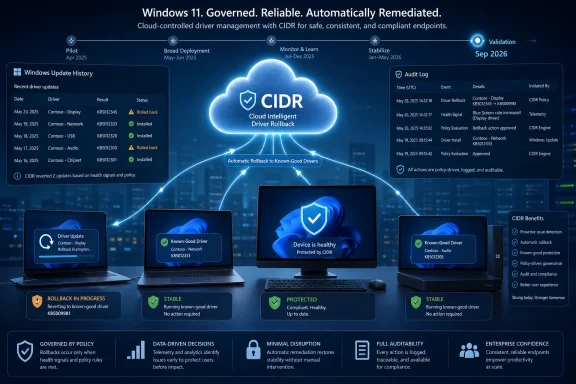 Microsoft Turns Driver Rollback Into a Cloud Operation
Windows has always treated drivers as special, even when the user experience pretends otherwise. A bad app crashes. A bad driver can take the kernel, the display stack, storage, networking, or the boot path with it. That is why a routine-looking optional driver update can become the difference between “everything is fine” and “this machine no longer starts.”Cloud-Initiated Driver Recovery, or CIDR, is Microsoft’s attempt to put a recovery loop around that risk. If a driver distributed through Windows Update is found to cause instability, Microsoft can initiate a recovery action through its driver evaluation and distribution systems. That action can instruct affected machines to roll back to a previously known-good version and deliver the replacement through the same Windows Update plumbing that installed the problematic driver in the first place.
The important phrase is through Windows Update. CIDR is not a universal undo button for every driver on a PC. It applies to drivers Microsoft distributes and controls through its update pipeline, not to every graphics, chipset, printer, or audio package a user downloads from a vendor website. That boundary matters because it keeps Microsoft from reaching into software it did not ship, but it also limits the feature’s usefulness in the very places enthusiasts most often install their own drivers.
Still, this is a meaningful architectural change. Today, when a faulty driver lands through Windows Update, users may need to roll it back manually, administrators may need to block it with policy, and OEMs may need to coordinate a revised package. CIDR moves more of that remediation upstream, where Microsoft can react centrally rather than waiting for every affected device owner to discover the same failure.
The Real Failure Was Never Just the Bad Driver
Windows Update driver problems tend to look like isolated mistakes. A storage driver breaks boot. A network driver knocks machines offline. A display driver causes crashes under a certain GPU and firmware combination. The temptation is to blame the individual package and move on.But the deeper issue is distribution asymmetry. Microsoft and its partners can push a driver to a huge number of machines quickly, while recovery often happens slowly, manually, and unevenly. Users search forums. Administrators file support tickets. OEMs publish advisories. Someone eventually identifies the bad package, but by then the damage has already spread.
CIDR is designed to correct that asymmetry. If Microsoft’s telemetry, shiproom process, or partner feedback identifies a driver as faulty, the same centralized system that enabled broad deployment can also enable targeted rollback. In theory, this turns driver recovery from a support scramble into an update transaction.
That is the right direction, but it is not magic. A rollback system only helps machines that can still receive and process the recovery instruction. If a driver has already rendered a machine unbootable or broken network connectivity badly enough, cloud-initiated remediation may arrive too late. The most dangerous driver failures are precisely the ones that can sever the path to repair.
That limitation does not make CIDR useless. It makes it a mitigation rather than a guarantee. Microsoft is reducing the window during which bad drivers remain active across the installed base, not eliminating the need for pre-release testing, staged rollout, recovery partitions, safe mode, or administrator caution.
The AMD SCSIAdapter Episode Still Haunts Windows Update
The reason this feature resonates is that Windows users have already lived through the failure mode. One of the clearest examples was the AMD SCSIAdapter 9.3.0.221 driver distributed through Windows Update in 2021, which was widely reported to cause blue screens and boot failures on some systems. The error many users saw, INACCESSIBLE_BOOT_DEVICE, was not a cosmetic glitch. It meant Windows could no longer reach the storage path it needed to start normally.That incident became a kind of folk warning among enthusiasts: do not assume a driver is safe simply because Windows Update offers it. For many users, the update was not something they had actively sought from AMD’s site or selected during a GPU driver install. It arrived through the operating system’s trusted maintenance channel, which made the resulting failure feel less like an experiment gone wrong and more like a breach of the implicit contract between Windows and the user.
The damage from such incidents is larger than the number of machines affected. Every bad driver that slips through Microsoft’s channel trains a portion of the Windows audience to distrust automatic driver delivery. Enthusiasts disable driver updates. Administrators restrict them. Support teams become wary of policies that would otherwise simplify fleet maintenance.
CIDR is Microsoft trying to buy back some of that trust. The company is not saying bad drivers will never ship. It is saying that when they do, Windows Update should be able to correct its own mistake more quickly and with less human intervention. That is a more modest claim, but probably a more believable one.
Enterprise IT Will Read This as a Control-Plane Story
For home users, the appeal is obvious: fewer late-night recovery sessions, fewer device manager rollbacks, fewer “why did my PC break after rebooting?” mysteries. For enterprise IT, the story is more complicated. Automatic remediation is welcome, but automatic anything in the driver layer demands scrutiny.Windows Autopatch has already put this tension on display. Microsoft recently acknowledged and fixed a bug that caused restricted driver updates to be installed on some Autopatch-managed devices despite administrative policies intended to prevent that behavior. That kind of incident is exactly why administrators treat vendor promises about automation with caution. The policy plane and the update plane must agree, or the automation becomes the problem.
CIDR could help enterprises by shortening exposure to a bad driver that has already entered the environment. A central rollback is far better than asking administrators to script device-specific removals or wait for a corrected package to propagate. It also fits Microsoft’s broader direction: Windows servicing is increasingly managed as a cloud-coordinated system rather than a local patching ritual.
But enterprises will want answers that go beyond the press-release version. They will ask how CIDR interacts with Intune rings, Windows Autopatch policies, driver deferrals, compliance reporting, and device groups with strict validation requirements. They will want to know whether a recovery action is visible, auditable, delayable, and reversible. They will also want to know how Microsoft defines “known good” in a mixed fleet where a driver may be good for one model, questionable for another, and catastrophic for a third.
That is where CIDR’s success will be judged. Not by whether it can roll back a driver in a demo, but by whether administrators can understand and trust the decision path when it happens at scale.
The Hardware Dev Center Becomes a Recovery Console
Microsoft’s Hardware Dev Center has long been part of the driver submission and distribution workflow. Hardware vendors submit packages, Microsoft evaluates them, and approved drivers can move through Windows Update with targeting rules, shipping labels, and gradual rollout controls. CIDR adds another role to that machinery: recovery orchestration.According to the description of the feature, a problematic driver can be addressed through a cloud recovery action initiated from Microsoft’s driver shiproom process. A targeted recovery request is created, instructions are delivered through Windows Update packages, and a stable replacement driver is installed. That makes the driver pipeline less like a one-way publishing system and more like a managed lifecycle.
This matters because driver quality is not static. A driver can look fine in lab testing and fail only when exposed to a specific firmware revision, motherboard implementation, peripheral mix, regional device population, or enterprise configuration. The Windows ecosystem is too diverse for pre-release certification to catch every bad interaction. Microsoft’s practical answer is to combine staged deployment, telemetry, and now automated rollback.
That does not absolve OEMs and component vendors. Microsoft is reportedly encouraging partners to keep monitoring driver quality metrics in the Hardware Dev Center dashboard and to respond quickly to shiproom feedback. That is the right stance. CIDR should not become an excuse for sloppy validation on the theory that Microsoft can clean up the mess later.
If anything, it may make poor driver quality more visible. A cloud-initiated rollback is not just a fix; it is a signal that a package failed in the field badly enough to trigger central intervention. Vendors may find that faster remediation also means faster accountability.
Enthusiasts Still Have Their Own Driver Reality
There is a reason many Windows enthusiasts get their GPU drivers directly from Nvidia, AMD, or Intel. The newest game-ready release, workstation optimization, beta fix, or chipset package often lands first through the vendor’s own installer. For that audience, Windows Update is not the primary driver channel. It is the background channel that sometimes helps and sometimes interferes.CIDR will not roll back manually installed drivers from vendor websites because Microsoft does not control those packages in the same way. That is a limitation, but also a safeguard. Few power users would welcome Windows silently replacing a carefully chosen GPU driver, especially on systems tuned for gaming, content creation, machine learning, or workstation workloads.
This boundary also helps explain what CIDR is really for. It is not aimed at the user who reads release notes before installing a graphics driver. It is aimed at the vast middle of the Windows ecosystem: laptops, desktops, office fleets, school devices, kiosks, and consumer PCs where drivers arrive through Windows Update because that is the safest default for most people most of the time.
That default is only sustainable if Microsoft can recover from mistakes. Driver automation cannot be judged only by its success path. It has to be judged by the failure path: what happens when the wrong package lands on the wrong hardware? CIDR is Microsoft’s attempt to make that failure path less brutal.
Automatic Repair Is Not the Same as User Trust
There is an uncomfortable trade-off at the heart of CIDR. The feature promises to fix problems without user intervention, which is exactly what many users want when a driver update goes wrong. But the same invisibility that makes the repair convenient can also make the system feel opaque.Windows users have spent years complaining that updates happen on Microsoft’s schedule, with Microsoft’s explanations, and sometimes against the user’s preferences. A hidden driver rollback may be technically beneficial and still leave power users wondering what changed and why. If a machine behaves differently after a recovery action, the user needs a trail to follow.
Microsoft should therefore treat transparency as part of the feature, not as documentation garnish. Windows Update history should clearly show that a driver recovery occurred. Administrators should be able to report on it. Event logs should include enough detail to correlate the rollback with symptoms. The system can be automatic without being mysterious.
This is especially important because driver state affects troubleshooting. If a user or technician is trying to reproduce a crash, validate a fix, or compare systems, a silent rollback changes the evidence. A successful repair that leaves no obvious trace can still create confusion. In enterprise environments, that confusion becomes ticket volume.
The best version of CIDR is not one users never know exists. It is one users rarely need to think about, but can inspect when they do.
Microsoft Is Betting That Telemetry Can Beat Fragmentation
Windows driver reliability is hard because Windows hardware is fragmented by design. The operating system runs on boutique gaming rigs, low-cost laptops, corporate desktops, rugged tablets, engineering workstations, and machines with years of firmware drift. That diversity is the platform’s strength and its permanent support burden.Microsoft’s answer over the last decade has been to make servicing more telemetry-driven. Gradual rollout, safeguard holds, compatibility blocks, Autopatch, and cloud-managed deployment all reflect the same logic: do not rely solely on pre-release certainty when post-release signals can guide exposure. CIDR fits neatly into that model.
The optimistic view is that this makes Windows more resilient. A bad driver can be detected, contained, and reversed faster than before. The pessimistic view is that Microsoft is normalizing a world where the public rollout is part of the test matrix. Both views can be true.
The distinction comes down to discipline. If CIDR is used as a backstop after serious validation, it is a valuable safety mechanism. If it becomes a crutch for pushing driver changes faster with the assumption that rollback will catch failures, it will deepen the mistrust it is meant to repair.
Windows users do not object to Microsoft using cloud intelligence to protect their machines. They object to being made unwilling participants in opaque experiments. CIDR will need to prove, over time, which category it belongs to.
The September 2026 Target Gives Microsoft Time to Get the Plumbing Right
Microsoft is aiming CIDR at validation and testing now, with a target release by September 2026. That timeline is significant because the hard part is not merely issuing a rollback command. The hard part is targeting it safely.A recovery system must know which devices received the bad driver, which ones are vulnerable to the failure, which replacement driver is appropriate, and whether the affected machines are in a state where rollback is safe. It must avoid downgrading machines that need the newer driver for a different fix. It must respect policy boundaries. It must handle devices that are offline, asleep, domain-joined, co-managed, or sitting behind corporate update controls.
That is a lot of state to model. In the consumer world, a broad rollback may be acceptable if the replacement is stable. In enterprise, the same action may need to pass through rings, reporting, and change-management expectations. Microsoft has to satisfy both worlds without building a feature so cautious that it cannot act quickly when a driver is actively breaking machines.
The September 2026 target also gives OEMs and hardware partners time to adapt their own processes. If driver recovery becomes part of the lifecycle, vendors will need to watch post-release metrics more closely and respond to Microsoft’s feedback faster. Driver publication will not end at approval. It will continue through field performance.
The Rollback Button Finally Moves Upstream
The most concrete value of CIDR is that it moves recovery closer to the source of the problem. Instead of each user discovering a bad driver locally, Microsoft can act centrally when the evidence warrants it. That is how modern software distribution should work, provided the controls are visible and accountable.The practical implications are straightforward:
- Windows 11 devices that receive drivers through Windows Update should eventually be able to get automated rollback actions when Microsoft identifies a faulty driver package.
- CIDR will not apply to manually installed vendor drivers, including many enthusiast GPU driver installs from Nvidia, AMD, or Intel.
- The feature should reduce the time users and administrators spend manually uninstalling bad Windows Update drivers, but it will not save every machine from every boot-breaking failure.
- Enterprise administrators should watch closely for how CIDR reports recovery actions and how it respects existing driver update policies.
- Hardware vendors will face stronger pressure to monitor driver quality after release, because recovery actions make field failures harder to ignore.
Windows has spent years becoming more automatic, sometimes to the frustration of the people who know enough to want control. Cloud-Initiated Driver Recovery will test whether Microsoft can make automation feel less like coercion and more like protection. If the company pairs fast rollback with clear reporting and policy respect, CIDR could become one of those quiet platform features nobody celebrates until the day it prevents a fleet-wide mess. If it arrives as another opaque background mechanism, it will merely confirm the fear that Windows Update has learned to fix itself without learning to explain itself.
Source: Club386 Windows 11 will soon automatically roll back faulty driver updates | Club386
