

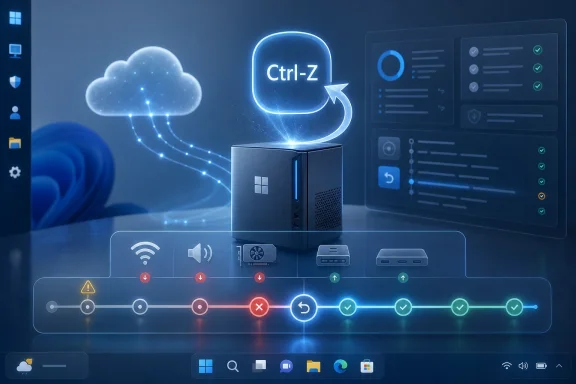
Microsoft is preparing Cloud-Initiated Driver Recovery for Windows Update, a cloud-controlled rollback system announced in May 2026 that lets Microsoft automatically remove a faulty driver delivered through Windows Update and replace it with a previously working version on affected Windows PCs. The idea is simple enough to sound overdue: if Windows Update caused the driver problem, Windows Update should also be able to undo it. The larger story is that Microsoft is trying to turn one of Windows’ oldest reliability weak spots into a managed service. That is progress, but it also concentrates more judgment in Redmond’s cloud at a time when users and administrators are already debating how much control Windows should keep for itself.
Driver updates have always been one of the strangest parts of Windows Update because they sit between three parties that do not share the same incentives. Microsoft owns the update pipe, hardware vendors build and submit the driver packages, and users are left holding the bag when a storage controller, GPU, Wi-Fi adapter, audio device, fingerprint reader, dock, or printer stops behaving after an otherwise routine update.
Cloud-Initiated Driver Recovery is Microsoft’s answer to that triangle. When a driver distributed through Windows Update is identified as unhealthy during flighting or gradual rollout, Microsoft can initiate a recovery request from the cloud. Windows Update can then remove the problematic package and restore a known-good alternative without waiting for a user to open Device Manager or an OEM to publish a replacement.
That may sound like a minor convenience feature, but it represents a meaningful change in posture. The traditional Windows driver model gave users tools to repair damage after the fact; this system gives Microsoft a mechanism to repair damage at scale. In other words, Windows Update is no longer just the delivery channel for the possible mistake. It becomes the rollback channel, too.
The important limitation is right there in the premise. This applies to drivers delivered through Windows Update. It is not a magic repair wand for every broken vendor utility, beta GPU package, motherboard tool, sideloaded INF, or enthusiast driver installed outside the Windows Update pipeline.
The built-in rollback mechanism has existed for years, but it has never been a full answer. Windows can keep a backup driver package for a device and Device Manager can revert to it, but that presumes the user can identify the right device, the rollback option is available, and the machine is still usable enough to operate. It is a local tool for a distributed failure.
Enterprise administrators have had better controls, especially through rings, approvals, and modern management tooling, but even there rollback has remained awkward. Microsoft’s own guidance has historically pushed IT teams toward cautious deployment rings rather than promising easy driver rollback through policy. That is sensible engineering advice, but it is not much comfort once a bad driver escapes the first ring and starts turning help desks into triage centers.
Cloud-Initiated Driver Recovery attacks that operational gap. Microsoft already monitors driver rollout health and can pause a driver during gradual rollout if telemetry suggests trouble. The new piece is remediation: not merely stopping the spread, but helping affected machines move backward to a working state.
That system is designed to prevent blast radius. A risky driver may be throttled through a cautious release curve, while lower-risk packages may move faster. Microsoft can pause distribution when quality checks fail or when shiproom administrators see concerning telemetry. The language is bureaucratic, but the principle is familiar to anyone who ships software at scale: do not push a risky change to everyone at once if you can learn from a smaller cohort first.
The weakness is that prevention systems are never perfect. Some failures only emerge in the messy combinatorics of real hardware, old firmware, vendor utilities, third-party security software, power states, docking stations, display chains, and region-specific device variants. A driver that looks healthy in one slice of the population can still be toxic to another.
That is why Cloud-Initiated Driver Recovery matters. It acknowledges that pausing a rollout is not enough for users already affected. If Microsoft’s telemetry can identify a bad release, the same update infrastructure should be able to send the fix, or at least restore a known-good state, without turning every affected customer into their own support technician.
For many users, that is a good trade. A laptop owner who suddenly loses Wi-Fi or audio after an update is unlikely to care about the metaphysics of local control if the machine quietly fixes itself overnight. For managed fleets, a Microsoft-triggered rollback could reduce incident volume and spare administrators from building emergency scripts for every driver regression.
But control shifts matter because Windows is not a phone OS with a narrow hardware matrix. It is a platform that runs on consumer laptops, gaming rigs, embedded devices, medical carts, lab equipment, point-of-sale machines, developer workstations, factory PCs, and domain-joined enterprise endpoints. A cloud-initiated rollback that is obvious good news on a home laptop might be something an administrator wants to stage, audit, defer, or block in a regulated environment.
The question is not whether Microsoft should have a rollback mechanism. It should. The question is how visible and governable that mechanism will be when it intersects with enterprise policy, vendor support agreements, and edge cases where the “known-good” driver is known-good for Microsoft’s telemetry but not for a local workflow.
In theory, each party has a role. The vendor fixes its driver. Microsoft updates the Windows Update offering. The user receives the corrected package. In practice, the user may sit through days or weeks of instability, or may search for manual remedies that introduce their own risk.
Cloud-Initiated Driver Recovery does not remove vendors from responsibility. Microsoft is still telling partners to maintain driver quality and to submit updated packages through the normal process. But it does reduce the ability of the ecosystem to treat broken machines as an acceptable waiting room while the vendor prepares a forward fix.
That subtle shift could improve incentives. If a bad driver can be rolled back quickly, vendors may face less public disaster from a botched release, but also more immediate visibility inside Microsoft’s shiproom process. A driver that triggers cloud recovery is not just another support ticket. It becomes an event in the Windows Update reliability pipeline.
That invisibility is particularly valuable because driver repair is not a skill ordinary users should be expected to possess. Device Manager is a powerful tool, but it is also a museum of Windows’ assumption that users may need to understand hardware categories, package versions, and rollback states. For a mainstream consumer, “roll back the driver” is not a normal instruction. It is a sentence from another era of personal computing.
Automatic rollback also helps in cases where the broken component makes self-help difficult. A network driver can cut off access to updated vendor packages. A display driver can make the system hard to operate. A storage or chipset issue can create intermittent behavior that users misdiagnose as hardware failure. If Windows Update can restore a working package in the background, it prevents a software regression from becoming a support odyssey.
Still, users should not confuse automated recovery with a substitute for backups or restore discipline. Driver rollback is narrow. It may fix a bad device package, but it will not rescue corrupted personal files, undo every update problem, or repair every boot failure.
This is especially important for organizations using Microsoft Intune, Windows Autopatch, or other update management tools. Driver updates are not merely convenience packages in those environments. They can be tied to firmware dependencies, dock compatibility, security hardening, device certification, and vendor support matrices. Rolling back one driver may restore stability while reintroducing a known limitation an administrator had deliberately moved past.
The ideal enterprise implementation would make Cloud-Initiated Driver Recovery observable. Administrators should be able to see that a recovery occurred, identify the driver package involved, review the replacement version, and understand whether a reboot was required. They should also have policy controls for highly sensitive fleets where automatic rollback is not acceptable without approval.
Microsoft has spent years trying to make Windows servicing more cloud-orchestrated. That effort has produced real improvements, but it has also trained administrators to watch for opaque behavior hidden behind reassuring labels. If Cloud-Initiated Driver Recovery is transparent, it becomes a reliability feature. If it is silent and hard to audit, it becomes another thing IT has to explain after the fact.
A driver rollback feature is not part of that AI push, but it will be judged inside the same trust climate. Users who already worry about Windows doing too much without asking may not immediately cheer a cloud-triggered mechanism that changes drivers automatically. Users who have been burned by bad drivers may ask why this did not exist years ago.
Both reactions can be true. Windows needs more autonomous recovery because the PC ecosystem is too large and weird for manual repair to scale. Windows also needs to earn confidence that its autonomous systems are restrained, documented, and reversible.
The irony is that Microsoft’s cloud is both the cause of anxiety and the obvious tool for solving the problem. Windows Update telemetry is one of the few systems with enough reach to detect a driver regression across millions of machines quickly. The same scale that makes centralized control unnerving is what makes centralized recovery useful.
That distinction matters because driver problems often blur together for users. A GPU driver from Windows Update, a GPU driver from Nvidia or AMD’s own app, a chipset package from an OEM utility, and a firmware capsule delivered through servicing may all look like “Windows updated something and now my PC is broken.” The recovery mechanism will only be as helpful as its scope allows.
There is also the question of what counts as “known-good.” A previous driver may restore basic functionality but lack a fix that the newer driver introduced. A rollback could repair one symptom while reintroducing another. Microsoft’s telemetry may be broad, but local correctness is sometimes specific.
The safest interpretation is that Cloud-Initiated Driver Recovery gives Microsoft a better emergency brake and reverse gear. It does not eliminate the need for careful driver validation, vendor accountability, enterprise rings, or user backups. It reduces the time between a bad driver being detected and affected systems being repaired.
This is a rational evolution. The old model assumed that a PC in trouble would be repaired locally by a user, administrator, recovery partition, OEM utility, or reinstallation. The modern model assumes that failure may be widespread, telemetry-visible, and best addressed through a coordinated cloud response.
That is how modern software operations work. If a bad deployment breaks a web service, the operator rolls it back. If a mobile app release is defective, the platform and developer can pull or supersede it. Windows, because it is both local operating system and distributed service, has always struggled to fit that pattern neatly. Driver recovery is one place where the service model makes obvious sense.
The challenge is that PCs are not stateless clients. They are personal and organizational machines with local dependencies, attached hardware, and long support histories. A cloud recovery service has to be aggressive enough to matter and conservative enough not to become another source of surprise.
Source: PCMag Windows Updates Will Soon Be Able to Automatically Fix Botched Driver Updates
 Microsoft Is Giving Windows Update a Ctrl-Z Button
Driver updates have always been one of the strangest parts of Windows Update because they sit between three parties that do not share the same incentives. Microsoft owns the update pipe, hardware vendors build and submit the driver packages, and users are left holding the bag when a storage controller, GPU, Wi-Fi adapter, audio device, fingerprint reader, dock, or printer stops behaving after an otherwise routine update.Cloud-Initiated Driver Recovery is Microsoft’s answer to that triangle. When a driver distributed through Windows Update is identified as unhealthy during flighting or gradual rollout, Microsoft can initiate a recovery request from the cloud. Windows Update can then remove the problematic package and restore a known-good alternative without waiting for a user to open Device Manager or an OEM to publish a replacement.
That may sound like a minor convenience feature, but it represents a meaningful change in posture. The traditional Windows driver model gave users tools to repair damage after the fact; this system gives Microsoft a mechanism to repair damage at scale. In other words, Windows Update is no longer just the delivery channel for the possible mistake. It becomes the rollback channel, too.
The important limitation is right there in the premise. This applies to drivers delivered through Windows Update. It is not a magic repair wand for every broken vendor utility, beta GPU package, motherboard tool, sideloaded INF, or enthusiast driver installed outside the Windows Update pipeline.
The Old Driver Model Made the User the Last Responder
Anyone who has supported Windows machines for long enough knows the pattern. A driver update arrives, something fails, and the user begins a ritual of Device Manager spelunking, rollback buttons, hidden update tools, OEM downloads, safe mode, restore points, and forum archaeology. If the affected device is networking, graphics, storage, or input, even getting to the repair interface can become part of the problem.The built-in rollback mechanism has existed for years, but it has never been a full answer. Windows can keep a backup driver package for a device and Device Manager can revert to it, but that presumes the user can identify the right device, the rollback option is available, and the machine is still usable enough to operate. It is a local tool for a distributed failure.
Enterprise administrators have had better controls, especially through rings, approvals, and modern management tooling, but even there rollback has remained awkward. Microsoft’s own guidance has historically pushed IT teams toward cautious deployment rings rather than promising easy driver rollback through policy. That is sensible engineering advice, but it is not much comfort once a bad driver escapes the first ring and starts turning help desks into triage centers.
Cloud-Initiated Driver Recovery attacks that operational gap. Microsoft already monitors driver rollout health and can pause a driver during gradual rollout if telemetry suggests trouble. The new piece is remediation: not merely stopping the spread, but helping affected machines move backward to a working state.
Gradual Rollout Was the Warning System; Recovery Is the Missing Half
Microsoft’s Windows driver distribution system already contains more safety machinery than most home users ever see. Drivers submitted for Windows Update can move through approval, throttling, monitoring, and gradual rollout phases. Microsoft can expose a driver to a small portion of the eligible population, watch telemetry, and then increase distribution if signals remain healthy.That system is designed to prevent blast radius. A risky driver may be throttled through a cautious release curve, while lower-risk packages may move faster. Microsoft can pause distribution when quality checks fail or when shiproom administrators see concerning telemetry. The language is bureaucratic, but the principle is familiar to anyone who ships software at scale: do not push a risky change to everyone at once if you can learn from a smaller cohort first.
The weakness is that prevention systems are never perfect. Some failures only emerge in the messy combinatorics of real hardware, old firmware, vendor utilities, third-party security software, power states, docking stations, display chains, and region-specific device variants. A driver that looks healthy in one slice of the population can still be toxic to another.
That is why Cloud-Initiated Driver Recovery matters. It acknowledges that pausing a rollout is not enough for users already affected. If Microsoft’s telemetry can identify a bad release, the same update infrastructure should be able to send the fix, or at least restore a known-good state, without turning every affected customer into their own support technician.
The Cloud Fix Is Also a Control Shift
There is a philosophical edge to this feature that Microsoft will probably not emphasize in marketing language. Cloud-Initiated Driver Recovery makes Windows more self-healing, but it also makes Windows more centrally directed. A cloud signal from Microsoft can tell a PC to undo a driver change because Microsoft has determined that the newer package is bad enough to retract.For many users, that is a good trade. A laptop owner who suddenly loses Wi-Fi or audio after an update is unlikely to care about the metaphysics of local control if the machine quietly fixes itself overnight. For managed fleets, a Microsoft-triggered rollback could reduce incident volume and spare administrators from building emergency scripts for every driver regression.
But control shifts matter because Windows is not a phone OS with a narrow hardware matrix. It is a platform that runs on consumer laptops, gaming rigs, embedded devices, medical carts, lab equipment, point-of-sale machines, developer workstations, factory PCs, and domain-joined enterprise endpoints. A cloud-initiated rollback that is obvious good news on a home laptop might be something an administrator wants to stage, audit, defer, or block in a regulated environment.
The question is not whether Microsoft should have a rollback mechanism. It should. The question is how visible and governable that mechanism will be when it intersects with enterprise policy, vendor support agreements, and edge cases where the “known-good” driver is known-good for Microsoft’s telemetry but not for a local workflow.
Hardware Vendors Lose a Convenient Bottleneck
The PCMag report highlights one of the most practical changes: Microsoft will no longer always need to wait for a hardware partner to publish a corrected driver before affected users can recover. That matters because the current chain of responsibility can become maddeningly slow. Microsoft distributes the driver, the OEM or component vendor owns the package, and the user experiences the failure.In theory, each party has a role. The vendor fixes its driver. Microsoft updates the Windows Update offering. The user receives the corrected package. In practice, the user may sit through days or weeks of instability, or may search for manual remedies that introduce their own risk.
Cloud-Initiated Driver Recovery does not remove vendors from responsibility. Microsoft is still telling partners to maintain driver quality and to submit updated packages through the normal process. But it does reduce the ability of the ecosystem to treat broken machines as an acceptable waiting room while the vendor prepares a forward fix.
That subtle shift could improve incentives. If a bad driver can be rolled back quickly, vendors may face less public disaster from a botched release, but also more immediate visibility inside Microsoft’s shiproom process. A driver that triggers cloud recovery is not just another support ticket. It becomes an event in the Windows Update reliability pipeline.
For Home Users, the Best Fix Is the One They Never Notice
The most appealing version of this feature is boring. A bad driver starts rolling out, telemetry flags trouble, Microsoft stops distribution, affected machines receive a recovery request, and users never know why their Bluetooth stack, audio device, or trackpad avoided a week of misery. Good infrastructure often looks like nothing happening.That invisibility is particularly valuable because driver repair is not a skill ordinary users should be expected to possess. Device Manager is a powerful tool, but it is also a museum of Windows’ assumption that users may need to understand hardware categories, package versions, and rollback states. For a mainstream consumer, “roll back the driver” is not a normal instruction. It is a sentence from another era of personal computing.
Automatic rollback also helps in cases where the broken component makes self-help difficult. A network driver can cut off access to updated vendor packages. A display driver can make the system hard to operate. A storage or chipset issue can create intermittent behavior that users misdiagnose as hardware failure. If Windows Update can restore a working package in the background, it prevents a software regression from becoming a support odyssey.
Still, users should not confuse automated recovery with a substitute for backups or restore discipline. Driver rollback is narrow. It may fix a bad device package, but it will not rescue corrupted personal files, undo every update problem, or repair every boot failure.
Enterprise IT Will Want the Knobs, Not Just the Promise
For IT pros, the promise of cloud-initiated rollback is attractive but incomplete without administrative clarity. Enterprises already operate on staged deployment rings, maintenance windows, compliance reporting, driver approval processes, and support baselines. A centrally triggered rollback can be a lifesaver, but only if administrators know what happened, which devices were affected, and how it interacts with policy.This is especially important for organizations using Microsoft Intune, Windows Autopatch, or other update management tools. Driver updates are not merely convenience packages in those environments. They can be tied to firmware dependencies, dock compatibility, security hardening, device certification, and vendor support matrices. Rolling back one driver may restore stability while reintroducing a known limitation an administrator had deliberately moved past.
The ideal enterprise implementation would make Cloud-Initiated Driver Recovery observable. Administrators should be able to see that a recovery occurred, identify the driver package involved, review the replacement version, and understand whether a reboot was required. They should also have policy controls for highly sensitive fleets where automatic rollback is not acceptable without approval.
Microsoft has spent years trying to make Windows servicing more cloud-orchestrated. That effort has produced real improvements, but it has also trained administrators to watch for opaque behavior hidden behind reassuring labels. If Cloud-Initiated Driver Recovery is transparent, it becomes a reliability feature. If it is silent and hard to audit, it becomes another thing IT has to explain after the fact.
The Feature Arrives in the Shadow of Windows’ Trust Problem
This announcement lands at a delicate time for Windows. Microsoft is pushing AI features, cloud accounts, Copilot integration, Recall-style experiences, and more aggressive service-connected behavior into Windows 11 while a vocal segment of the enthusiast community complains that the operating system feels less like a neutral platform and more like a client for Microsoft’s broader strategy.A driver rollback feature is not part of that AI push, but it will be judged inside the same trust climate. Users who already worry about Windows doing too much without asking may not immediately cheer a cloud-triggered mechanism that changes drivers automatically. Users who have been burned by bad drivers may ask why this did not exist years ago.
Both reactions can be true. Windows needs more autonomous recovery because the PC ecosystem is too large and weird for manual repair to scale. Windows also needs to earn confidence that its autonomous systems are restrained, documented, and reversible.
The irony is that Microsoft’s cloud is both the cause of anxiety and the obvious tool for solving the problem. Windows Update telemetry is one of the few systems with enough reach to detect a driver regression across millions of machines quickly. The same scale that makes centralized control unnerving is what makes centralized recovery useful.
This Is Not a Cure for Every Botched Update
Cloud-Initiated Driver Recovery should be understood as a targeted mechanism, not a universal undo button. It is about problematic drivers delivered through Windows Update. It is not primarily about cumulative update bugs, application compatibility, third-party driver installers, firmware failures, or the many other ways a Windows system can become unstable.That distinction matters because driver problems often blur together for users. A GPU driver from Windows Update, a GPU driver from Nvidia or AMD’s own app, a chipset package from an OEM utility, and a firmware capsule delivered through servicing may all look like “Windows updated something and now my PC is broken.” The recovery mechanism will only be as helpful as its scope allows.
There is also the question of what counts as “known-good.” A previous driver may restore basic functionality but lack a fix that the newer driver introduced. A rollback could repair one symptom while reintroducing another. Microsoft’s telemetry may be broad, but local correctness is sometimes specific.
The safest interpretation is that Cloud-Initiated Driver Recovery gives Microsoft a better emergency brake and reverse gear. It does not eliminate the need for careful driver validation, vendor accountability, enterprise rings, or user backups. It reduces the time between a bad driver being detected and affected systems being repaired.
Windows Update Is Becoming a Recovery Platform
The deeper trend is that Windows Update is no longer just an updating mechanism. It is becoming a recovery platform. Quick Machine Recovery already points in that direction by allowing certain unbootable systems to use a connected recovery environment to look for remediations through Windows Update. Cloud-Initiated Driver Recovery extends the idea into the driver pipeline.This is a rational evolution. The old model assumed that a PC in trouble would be repaired locally by a user, administrator, recovery partition, OEM utility, or reinstallation. The modern model assumes that failure may be widespread, telemetry-visible, and best addressed through a coordinated cloud response.
That is how modern software operations work. If a bad deployment breaks a web service, the operator rolls it back. If a mobile app release is defective, the platform and developer can pull or supersede it. Windows, because it is both local operating system and distributed service, has always struggled to fit that pattern neatly. Driver recovery is one place where the service model makes obvious sense.
The challenge is that PCs are not stateless clients. They are personal and organizational machines with local dependencies, attached hardware, and long support histories. A cloud recovery service has to be aggressive enough to matter and conservative enough not to become another source of surprise.
The Real Win Is Fewer Users Learning Device Manager by Accident
The concrete value of Cloud-Initiated Driver Recovery is not that it makes Windows Update flawless. It is that it shortens the distance between Microsoft detecting a bad driver and users getting back to a working machine. That is a narrower claim, but a more believable one.- Microsoft can initiate rollback for faulty drivers delivered through Windows Update without requiring users to manually uninstall and reinstall packages.
- The system depends on a working alternative driver being available, so recovery may not happen in every case.
- Hardware partners remain responsible for driver quality and for submitting corrected packages through normal channels.
- Home users benefit most when the rollback is invisible, especially for devices that make manual troubleshooting difficult.
- Enterprise administrators will need reporting and policy controls so automatic recovery does not become an unaudited change.
- The feature strengthens Windows Update as both a delivery and remediation platform, but it does not replace backups, deployment rings, or vendor validation.
Source: PCMag Windows Updates Will Soon Be Able to Automatically Fix Botched Driver Updates
