

Microsoft Moves the Driver Rollback Button Into the Cloud
Windows drivers have always lived in the awkward middle ground between Microsoft’s platform and someone else’s hardware. A GPU driver, Wi-Fi driver, storage controller driver, or firmware-adjacent package may arrive through Windows Update, but the code often originates with a silicon vendor, OEM, or independent hardware partner. When that package breaks something, the user rarely cares which company authored the INF file; they see Windows Update as the delivery truck and Microsoft as the name on the side.
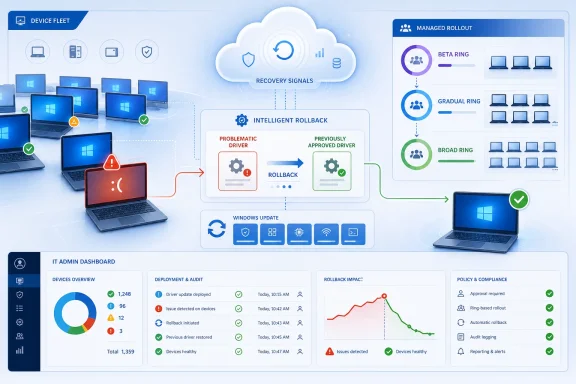
Cloud-Initiated Driver Recovery is Microsoft’s answer to that accountability gap. When Microsoft identifies a driver quality issue during its Driver Shiproom evaluation process, it can create a recovery request tied to the specific driver and shipping labels. Windows Update then delivers a rollback instruction to affected devices, checks for an approved replacement, removes the rejected driver, and installs either the previously used version or the next best approved version available through Windows Update.
That sounds almost mundane, which is partly why it matters. Microsoft is not asking users to find Device Manager, hunt down a device class, choose “Roll Back Driver,” and hope Windows kept a usable copy. Nor is it requiring the hardware partner to first publish a new driver package before remediation begins. The rollback path becomes part of the same cloud update machinery that distributed the bad driver in the first place.
The caveat is important: the feature is designed for drivers distributed through Windows Update, not every driver installed from an OEM utility, setup executable, gaming peripheral launcher, or vendor support app. If an approved Driver Shiproom replacement cannot be found, Microsoft says Cloud-Initiated Driver Recovery will not be attempted on that device. This is a safety rail, but also a reminder that recovery automation only works where Microsoft has enough metadata, policy control, and known-good alternatives to act confidently.
The Old Model Was Too Slow for a Billion-PC Supply Chain
Until now, the remediation story for a bad Windows Update driver has been uncomfortably manual. Microsoft could pause or reject a driver, and the hardware partner could submit a replacement, but affected users might still be left with the broken package already installed. In the worst cases, the practical advice became familiar: uninstall the driver, hide the update, wait for the OEM, or hope Windows Update eventually serves something better.
That model made more sense when driver distribution was slower, more fragmented, and less cloud-managed. It makes less sense in an era where Windows Update, Intune, Windows Autopatch, OEM publishing systems, and Microsoft telemetry all participate in a large-scale deployment loop. A driver can move gradually through rings, show unhealthy signals, and be paused; what was missing was a clean way to use that same infrastructure to undo the damage already done.
Cloud-Initiated Driver Recovery closes that loop. It treats a bad driver less like a static mistake and more like a failed deployment that can be rolled back. That distinction is familiar to anyone who runs cloud services, feature flags, or staged software releases, but it has been harder to apply to Windows client devices because PCs are heterogeneous, intermittently online, policy-bound, and full of hardware-specific dependencies.
The driver world is especially unforgiving because a bad package can create failures that look unrelated to the package itself. Display glitches, sleep problems, Bluetooth dropouts, storage timeouts, network instability, and boot failures can all originate in driver changes. The longer the bad driver sits on the machine, the more expensive the troubleshooting becomes, especially in businesses where the person using the device is not the person managing it.
Microsoft’s new mechanism does not make driver quality problems disappear. It does, however, acknowledge that the right fix is often not “wait for the next release.” Sometimes the right fix is to put back the last known working thing, quickly, consistently, and without making every affected user rediscover the same workaround.
Shiproom Becomes More Than a Gatekeeper
The term “Driver Shiproom” sounds like internal Microsoft bureaucracy because, in a sense, it is. But the shiproom’s role has become increasingly central to how drivers reach Windows devices. Drivers marked for Microsoft approval, flighting, automatic delivery, or gradual rollout are not simply thrown over the wall; they move through a process designed to watch quality signals and avoid collisions with major OS update moments.
That is the world into which Cloud-Initiated Driver Recovery fits. Microsoft already has mechanisms for deciding when a driver should ship, pause, or be rejected. The new capability adds the missing enforcement action on the client side: if a driver is rejected during flighting or gradual rollout, the rollback can be triggered through Windows Update.
This matters because gradual rollout is only as good as the response once telemetry turns ugly. A staged release can reduce blast radius, but it cannot help the machines already hit unless the deployment system can take corrective action. Cloud-Initiated Driver Recovery gives Microsoft a way to convert a shiproom decision into a device-level repair.
It also raises the stakes for Microsoft’s quality evaluation. A false positive could remove a driver that was functioning acceptably for some users. A false negative could leave broken machines untouched. The company’s decision to require an approved replacement driver before attempting recovery is one way to reduce risk, but it does not eliminate the complexity of matching hardware IDs, OS versions, device states, and prior driver histories.
For hardware partners, this is both a safety net and a loss of some practical control. Microsoft says partners will continue to receive notifications through existing shiproom communication channels when a driver is rejected during flighting or gradual rollout. But the recovery action itself is no longer solely dependent on the partner publishing a new package. Microsoft is inserting itself more directly into the remediation path because it owns the distribution channel and increasingly owns the user’s expectation of reliability.
Windows Update Is Becoming a Recovery Service, Not Just a Delivery Service
The broader pattern is hard to miss. Microsoft has been expanding the idea of Windows Update from a patch pipeline into a remediation platform. Quick Machine Recovery, available on Windows 11 24H2 builds in the 26100.4700 range and later, uses a connected Windows Recovery Environment to look for cloud remediations when devices encounter critical boot failures. Cloud-Initiated Driver Recovery applies a similar philosophy to drivers: the cloud that delivered the change should also help unwind it.
That is a meaningful evolution for Windows. Historically, recovery was local: restore points, last known good configuration, Safe Mode, Device Manager, WinRE, push-button reset, and the increasingly fragile muscle memory of “uninstall the last thing.” Those tools still matter, but they presume either a capable user or an administrator with time, access, and enough information to identify the culprit.
Cloud-driven recovery changes that operating model. The PC becomes part of a feedback loop in which Microsoft can observe deployment health, classify an issue, and distribute a corrective instruction. That is closer to the way cloud platforms run than to the way traditional desktop operating systems were maintained.
There is obvious upside here. If a wireless driver update breaks connectivity for a subset of devices, a cloud rollback could prevent a help desk surge. If a display driver causes crashes during gradual rollout, affected PCs can be steered back to a known-good package before the problem becomes a forum megathread. If a storage or chipset driver degrades stability, Microsoft can react without waiting for every OEM support page to catch up.
But the shift also deserves scrutiny. The more Windows Update becomes a remediation authority, the more administrators will want clear reporting, controls, auditability, and documentation. A remotely initiated rollback may be exactly what a home user needs. In a regulated enterprise, the same action may need to appear in change logs, endpoint management dashboards, compliance records, and incident reviews.
The CrowdStrike Shadow Still Hangs Over Windows Recovery
Microsoft’s announcement does not need to mention CrowdStrike for the comparison to be obvious. The July 2024 CrowdStrike incident, which took down millions of Windows systems worldwide after a faulty security content update, exposed a brutal truth about modern endpoint computing: a small trusted component can become a global outage vector. Microsoft’s recovery push since then has been about reducing the time between “bad update” and “machine usable again.”
Cloud-Initiated Driver Recovery is narrower than that incident. It targets drivers distributed through Windows Update and relies on Microsoft’s driver publishing and approval ecosystem. CrowdStrike’s failure involved third-party security content outside the ordinary Windows Update driver flow. Still, both stories live in the same operational universe: endpoint reliability is now a fleet problem, not merely a device problem.
That distinction matters for IT pros. A single broken endpoint can be reimaged. Ten broken endpoints can be handled with scripts and overtime. Ten thousand broken endpoints create logistics, communications, business continuity, executive escalation, and sometimes physical access problems. Recovery has to be designed for scale before the failure happens, not improvised afterward.
Microsoft’s recent recovery investments suggest the company has internalized that lesson. Connected recovery environments, cloud remediation, staged driver rollouts, and now cloud-initiated driver rollback all point toward a more service-like Windows. The goal is not merely to prevent bad updates, because that goal is impossible. The goal is to make failure less durable.
This is where the feature’s timing is notable. Microsoft plans to manually validate and test Cloud-Initiated Driver Recovery on selected shipping labels between May and August 2026. The feature is targeted to be automatically included when a driver is rejected during flighting or gradual rollout starting in September 2026. That staged approach suggests Microsoft knows the rollback mechanism itself must earn trust before it becomes an automatic part of the driver release pipeline.
Home Users Get Relief, But Not Control
For ordinary Windows users, the feature’s best quality may be its invisibility. If it works as intended, the user may never know a driver was rejected, rolled back, and replaced. The PC simply stops misbehaving after Windows Update applies the recovery action.
That is a good outcome, because driver troubleshooting remains one of the least user-friendly parts of Windows. Device Manager exposes details that are meaningful to technicians but cryptic to everyone else. Vendor driver packages often carry confusing version numbers that differ from the version shown in Windows. Optional driver updates may appear without enough context for users to know whether they should install them.
The new recovery feature does not solve the discoverability problem, but it reduces the need for users to solve it themselves. If Windows Update installed the problematic driver, Windows Update can also become the channel that backs it out. That is a cleaner user story than asking people to search forums for a hardware ID and decide whether a random CAB file is safer than the current driver.
Still, home users may also have the least visibility into what happened. If a driver silently rolls back, a gamer might wonder why a performance fix disappeared. A creator might notice that a peripheral feature regressed. A laptop owner might see a vendor utility reporting one driver version while Windows reports another. Recovery is good; opaque recovery can still be confusing.
Microsoft’s challenge will be to explain these events without overwhelming users. A terse Windows Update history entry may be enough for enthusiasts but not for everyone. If the company hides too much, it feeds the old suspicion that Windows Update changes things behind the user’s back. If it exposes too much, it turns recovery into yet another scary-looking maintenance event.
Enterprise IT Will Ask Who Approved the Undo
The enterprise reaction will be more complicated. Most administrators want bad drivers removed quickly. They also want to know exactly what changed, when it changed, which devices were affected, whether the change complied with policy, and how to prevent surprises during critical business windows.
Driver management has become more sophisticated in Microsoft Intune and Windows Autopatch, with driver update policies supporting automatic and manual approval workflows. Many organizations deliberately slow driver adoption because drivers are close to the hardware and hard to test comprehensively. A rollback system can reduce risk, but only if it respects the organization’s control plane.
The announcement as described focuses on the Windows Update pipeline and Driver Shiproom process, not on every enterprise management nuance. That leaves practical questions administrators will want answered before September 2026. Will admins be able to report on Cloud-Initiated Driver Recovery events centrally? Will recovery actions be visible in Windows Update for Business reports, Intune, Autopatch dashboards, event logs, or Graph-accessible inventory? Can organizations opt out, defer, or ring these remediations separately from driver approvals?
The most likely answer is that Microsoft will frame recovery as a quality and safety action rather than a normal driver deployment. That would make sense operationally; if a driver is known bad, delaying rollback may preserve change-control purity at the cost of user downtime. But in enterprise environments, even emergency changes need governance. The fastest fix is not always the most defensible fix.
There is also the matter of bespoke driver stacks. Some organizations pin specific versions for certified workflows, medical devices, manufacturing equipment, point-of-sale systems, or graphics workstations. If those drivers arrive through Windows Update and later become subject to a cloud recovery action, admins will need confidence that targeting is precise. A rollback that fixes consumer laptops but destabilizes a certified workstation image would be a different kind of quality failure.
Hardware Partners Lose the Luxury of Slow Remediation
For OEMs and independent hardware vendors, Cloud-Initiated Driver Recovery is a pressure valve and a warning light. The pressure valve is obvious: if a bad driver slips into Windows Update flighting, Microsoft can help reduce user impact before the partner completes a replacement package. That can prevent reputational damage from spreading across support channels.
The warning light is subtler. Microsoft is effectively saying that driver quality cannot depend solely on partner response time. If telemetry shows a driver is bad enough to reject, the platform owner reserves the ability to initiate recovery. The partner remains important, but not as the only actor capable of stopping the bleeding.
This reflects the reality of Windows hardware diversity. Microsoft needs partners to support countless device combinations, but Microsoft is the one blamed when Windows Update breaks a machine. The company’s incentive is to build central mechanisms that reduce dependency on any single partner’s emergency process. That is especially true for drivers distributed automatically, where the user may never have knowingly chosen the vendor’s package.
There may also be competitive implications. Hardware partners that already maintain disciplined driver pipelines, fast validation, and clean rollback candidates will benefit from the system. Partners that treat Windows Update publishing as a fire-and-forget channel may find Microsoft’s shiproom decisions more consequential. A cloud rollback process rewards vendors that keep known-good packages available and properly targeted.
The phrase “shipping labels” is technical, but it matters here. Windows Update driver distribution is not just about a binary blob; it is about targeting metadata, hardware IDs, delivery options, and publication state. Recovery depends on that metadata being accurate. Bad targeting can cause a bad driver to ship; good targeting is what allows Microsoft to unwind it safely.
Security Gains Come With a Trust Bill
Drivers are a security boundary as much as a compatibility layer. Kernel-mode drivers can crash the system, expose vulnerabilities, weaken platform protections, or become part of an attack chain. Microsoft has spent years tightening driver signing, vulnerable driver blocklists, memory integrity requirements, and hardware certification expectations because the Windows driver ecosystem is one of the oldest and messiest parts of the platform.
A cloud rollback mechanism can improve security outcomes if it removes problematic drivers faster. A driver with a stability flaw may also have a security flaw. A driver blocked by newer hardening rules may need to be replaced quickly. A package that causes crashes under specific security configurations may need a targeted retreat before users disable protections to regain functionality.
But remote remediation always carries a trust bill. Users and administrators must trust that Microsoft’s recovery request is legitimate, correctly targeted, and delivered securely. They must trust that the replacement driver is actually safer or more stable. They must trust that the mechanism cannot be abused to downgrade systems into a vulnerable state.
Microsoft’s safeguard that recovery will not proceed without an approved Driver Shiproom replacement is therefore more than operational hygiene. It is a security requirement. A rollback system that can install older code must be careful not to become a downgrade attack surface or an accidental reintroduction path for known-bad packages.
The tension is familiar across modern software maintenance. The safest version is not always the newest version, and the newest version is not always the most stable. Recovery systems need enough policy intelligence to choose the least bad option under pressure. For Windows drivers, that means balancing crash rates, compatibility signals, vulnerability status, hardware applicability, and deployment history.
The Edge Cases Will Define the Reputation
The first time Cloud-Initiated Driver Recovery saves a fleet from a bad Wi-Fi or graphics driver, admins will praise it. The first time it rolls back a driver that a user intentionally installed to fix a niche problem, forums will light up. Both outcomes can be true because Windows is not one environment; it is millions of overlapping environments pretending to be a single platform.
One edge case is the enthusiast PC. Gamers and workstation users often install vendor drivers directly from Nvidia, AMD, Intel, Realtek, Logitech, or motherboard utilities. If the problematic driver did not come through Windows Update, Microsoft’s new recovery mechanism may not apply. If Windows Update later sees a matching approved package, the interaction between vendor-installed drivers and Microsoft’s rollback logic could become a point of confusion.
Another edge case is offline or intermittently connected devices. Cloud-initiated recovery depends on Windows Update delivering the instruction. A laptop in a drawer, a field device on a metered connection, or a kiosk behind restrictive network policy may not receive the recovery quickly. That does not make the feature useless, but it means administrators cannot treat it as a substitute for local recovery planning.
A third edge case is driver dependency. Some drivers ship as part of a broader hardware experience, with services, control panels, firmware update tools, or companion apps. Rolling back the driver package may fix the kernel component while leaving a mismatched user-mode utility in place. Microsoft’s Windows Update driver model is cleaner than many vendor installers, but the real world is rarely tidy.
The final edge case is perception. If Microsoft can remotely roll back a driver, some users will ask what else it can remotely undo. The technical answer is constrained by Windows Update, policy, signing, and driver approval systems. The emotional answer is harder: Windows users have a long memory of surprise updates, forced reboots, and changed defaults. Microsoft will need to make the feature feel like a rescue rope, not another invisible hand on the machine.
Microsoft Is Choosing Managed Reliability Over Local Purity
There is an ideological line running through this announcement. One side values local control: the PC as a user-owned machine where changes are visible, reversible, and initiated by the person or organization responsible for the device. The other side values managed reliability: the PC as an endpoint in a cloud-supervised fleet where telemetry and centralized remediation reduce downtime.
Microsoft is plainly moving toward the second model, though not without concessions. Windows Update already stages rollouts, uses safeguard holds, delivers out-of-band fixes, and supports enterprise policy layers. Cloud-Initiated Driver Recovery extends that model from “do not offer the bad thing” to “remove the bad thing if it already landed.”
That is the right direction for many users. The average person does not want to become a driver archaeologist because a chipset update broke sleep. The average help desk does not want to talk hundreds of users through Device Manager. The average security team does not want users disabling updates because one driver incident taught them that patching is dangerous.
But managed reliability must remain accountable. Microsoft cannot simply declare the cloud smarter than the endpoint and expect trust to follow. It needs event visibility, administrator controls, accurate messaging, and a conservative replacement strategy. The feature’s success will depend less on the happy-path demo than on how well it handles messy, policy-bound, partially updated machines.
The phrase previously working version will do a lot of work in the marketing. In practice, “working” is contextual. A version that worked for most users may not work for a particular dock, BIOS revision, regional device variant, or enterprise image. Microsoft’s telemetry can narrow that uncertainty, but it cannot abolish it.
The September Switch Will Test More Than Drivers
Microsoft’s planned rollout schedule is cautious in the right way. Manual validation and testing on selected shipping labels from May through August 2026 gives the company time to test the recovery workflow before automatic inclusion begins. Targeting automatic inclusion for rejected drivers during flighting or gradual rollout starting in September 2026 is the real operational milestone.
That September target matters because it turns Cloud-Initiated Driver Recovery from a special procedure into part of the normal driver quality system. Once automatic inclusion begins, a rejected driver is not merely stopped; it can carry a recovery consequence for devices that already received it. That makes the driver pipeline more self-healing.
It will also generate data. Microsoft will learn which classes of drivers most often require recovery, how quickly devices respond, how often replacement matching fails, how many users see regressions, and where enterprise policy friction appears. If the company is smart, it will use that data to refine both driver publishing requirements and administrator reporting.
The feature may also influence partner behavior. OEMs and IHVs will have an incentive to keep fallback packages clean, approved, and appropriately targeted. They may become more careful about flighting criteria and staged rollout signals. A recovery mechanism is not just a safety net; it changes the incentives of everyone walking above it.
For Windows enthusiasts, the question will be whether Microsoft exposes enough detail to satisfy curiosity and troubleshooting needs. For sysadmins, the question will be whether the action is observable and governable. For Microsoft, the question will be whether it can deliver the benefits of cloud remediation without reinforcing every old complaint about Windows Update autonomy.
The Practical Meaning for WindowsForum Readers
The most useful way to read this announcement is not as a magic undo button, but as a new layer in Microsoft’s reliability stack. It will not cover every driver, every device, or every failure mode. It should, however, reduce the lifespan of certain bad Windows Update driver deployments.
- Cloud-Initiated Driver Recovery applies to drivers distributed through Windows Update and depends on Microsoft finding an approved replacement through its Driver Shiproom process.
- The rollback instruction is delivered through the existing Windows Update pipeline, so Microsoft is not requiring a new client agent or separate OEM recovery tool.
- The feature is intended to replace a rejected driver with either the previously installed version or the next best approved version available through Windows Update.
- Microsoft plans manual validation between May and August 2026, with automatic inclusion targeted for rejected drivers during flighting or gradual rollout starting in September 2026.
- Enterprise administrators should watch for reporting, policy, and audit details before treating the feature as a complete answer to driver rollback planning.
- Users who install drivers directly from vendor tools should not assume this mechanism will recover every bad driver outside the Windows Update distribution path.
Cloud-Initiated Driver Recovery is not the end of bad Windows drivers, and it is not proof that Windows Update has suddenly become infallible. It is something more realistic: an admission that bad drivers will keep happening, paired with a mechanism to make them less sticky when they do. If Microsoft can make the rollback path fast, transparent, and respectful of enterprise control, September 2026 may mark the point where Windows driver updates start behaving less like one-way bets and more like managed deployments with an escape hatch.