

Microsoft used WinHEC 2026 in Taipei to announce a Driver Quality Initiative for Windows that expands driver evaluation beyond crashes to include performance, power use, thermals, reliability, security, and recovery when bad drivers ship through Windows Update. The admission matters because it reframes a familiar Windows 11 complaint: many broken PCs were not obviously “crashing,” they were quietly wasting battery, running hot, stuttering, or refusing to sleep properly. For users, that means Microsoft is finally treating degraded experience as a driver failure, not merely as unfortunate background noise. For administrators, it means the Windows driver pipeline is becoming less permissive, more cloud-controlled, and potentially more accountable.
The most important part of Microsoft’s WinHEC message is not that bad drivers exist. Anyone who has managed a fleet of laptops, owned a temperamental gaming notebook, or watched a supposedly sleeping Windows machine cook itself in a backpack already knew that.
The important part is that Microsoft is changing what counts as a bad driver. Historically, the Windows ecosystem has had a strong bias toward binary failure: did the machine blue-screen, did the device fail to enumerate, did the driver block boot, did a crash bucket spike after release? Those are measurable, obvious, and supportable events. They are also a narrow slice of what users experience as a broken PC.
A driver that prevents a laptop from entering a deep sleep state may never crash the OS. A driver that keeps waking a device on Modern Standby may never trigger a dramatic error dialog. A driver that burns extra CPU in the background, introduces audio latency, causes micro-stutter, or runs a component hotter than necessary can pass through ordinary notions of “stable” while still making the machine feel worse every day.
That is the loophole Microsoft is now trying to close. The company’s new Driver Quality Initiative says, in effect, that a driver can be defective even when Windows survives it. That is a subtle but meaningful shift for a platform whose hardware diversity is both its greatest strength and its permanent maintenance bill.
That breadth is why Windows won the PC market. It is also why driver quality is never merely a Microsoft problem or merely an OEM problem. When the device misbehaves, the user experiences one thing: “Windows is bad.” The root cause may sit with an audio driver, a Wi-Fi card, a GPU package, firmware, an OEM customization layer, or Windows Update’s ranking logic, but the blame lands on the thing with the Start menu.
For years, the Windows driver model has been good at identifying catastrophic failures. Kernel-mode drivers that crash machines leave evidence. Devices that fail install checks produce errors. Security-blocked drivers can be flagged. But much of the lived Windows 11 frustration sits in greyer territory: the system technically works, but worse than it should.
That grey territory is where battery drain lives. It is where laptops lose 20 percent overnight despite the lid being closed. It is where fans spin in a meeting room. It is where a Bluetooth headset crackles, a game stutters every few seconds, a graphics driver silently regresses, or a machine that was fine yesterday suddenly behaves like a lower-tier product after Windows Update.
By bringing performance, power, and thermal behavior into driver evaluation, Microsoft is admitting that telemetry has to reflect experience, not just survivability. A PC that does not crash but misses its sleep targets is still failing the customer. A driver that makes a thin-and-light notebook warm and sluggish is still bad, even if it never produces a blue screen.
Microsoft has spent years trying to pull more driver work into user mode where possible. User-mode drivers are easier to isolate. If they fail, they can often be restarted without taking the operating system down with them. That architecture does not solve every device category, and it does not magically modernize legacy driver stacks, but it reflects the direction of travel: Windows wants fewer third-party components running with the power to wreck the entire machine.
The Driver Quality Initiative appears to sit alongside that broader architectural push. Microsoft describes the effort around pillars such as architecture, trust, lifecycle, and quality measures. The language is corporate, but the underlying direction is plain enough: reduce risky kernel dependency, improve signing and trust, manage drivers after release instead of treating shipment as the finish line, and measure outcomes that users actually notice.
This matters for security as much as reliability. Windows has spent recent years hardening against vulnerable drivers, especially in the bring-your-own-vulnerable-driver class of attacks. A driver is not just a performance component; it can also be a privileged software artifact that attackers abuse. A quality program that treats drivers as living, measurable, revocable components is overdue.
But Windows Update has also become a source of suspicion. Enthusiasts have long complained that Windows can replace manually installed GPU drivers with older or OEM-ranked versions. Laptop owners have seen carefully tuned graphics or chipset packages overwritten by catalog drivers that may be technically compatible but practically inferior. Admins have learned that “driver update” can mean improvement, regression, or an afternoon of explaining why a model line suddenly behaves differently.
Microsoft’s recent work on graphics driver targeting is relevant here. The company has reportedly acknowledged cases where Windows Update’s driver ranking and targeting logic can result in GPU driver downgrades, particularly on OEM devices. A planned move toward more specific hardware identification, using combinations such as hardware IDs and computer hardware IDs, is meant to reduce mistaken targeting for new display driver submissions.
That fix is not the same as the broader Driver Quality Initiative, but the themes rhyme. Microsoft is trying to make Windows Update smarter about which driver belongs on which machine, and faster at backing out when the answer is wrong. The distinction matters because driver quality is not only about whether a driver is good in the abstract. It is about whether that exact driver is good for that exact device configuration at that exact point in its lifecycle.
A graphics driver that performs well on one laptop design may behave badly on another because of firmware, mux behavior, power profiles, panel configuration, thermal limits, or OEM customization. A Wi-Fi driver that is fine in a reference design may be miserable in a cramped chassis with aggressive power management. Windows Update cannot solve those differences with a simple “newer is better” rule, and it cannot earn trust if its ranking logic keeps surprising users.
That sounds like a modest operational feature. In practice, it is a philosophical reversal. For decades, driver remediation has often meant forcing the user, the admin, or the OEM to unwind the problem: open Device Manager, roll back, block the update, download a package from a support page, run DDU for graphics drivers, hide a Windows Update entry, or wait for the vendor to publish a fixed package.
Cloud rollback says Microsoft accepts responsibility for the distribution channel after the moment of delivery. If Windows Update shipped the bad payload, Windows Update needs a way to retreat. The rollback feature is reportedly being tested with hardware partners from May through August 2026, with broader use targeted afterward. As always with Windows servicing promises, the proof will be in the messy edge cases.
There are obvious limits. A rollback system depends on Microsoft detecting the problem, classifying it correctly, having a known-good driver to return to, and ensuring the rollback does not create a different failure. It will not fix every vendor utility, firmware bug, misconfigured OEM image, or user-installed package outside the update pipeline. It also raises uncomfortable questions about transparency: users and admins will want to know when a driver was rolled back, why, and whether a future update will reintroduce the same issue.
Still, automatic rollback is the missing half of automatic updates. If a platform insists on pushing driver changes at scale, it must also have a first-class undo mechanism at scale. Otherwise, every bad driver turns into unpaid labor for the people least equipped to diagnose it.
Modern Standby made that frustration more visible. In theory, connected standby-like behavior lets a Windows laptop sleep more like a phone: maintaining some background activity while preserving battery. In practice, Windows laptops vary wildly. Some sip power. Others wake unexpectedly, fail to reach low-power states, or remain active because some device, driver, or service keeps the platform from settling down.
When that happens, the user rarely sees “your Wi-Fi driver blocked deep idle for three hours.” They see a dead battery. They blame Windows, the laptop vendor, or themselves. Administrators see support tickets that sound subjective until they become a pattern across a model line.
Performance regressions are even harder to prove. Micro-stutter, audio dropouts, high DPC latency, degraded graphics performance, or abnormal fan behavior often live below the threshold of a simple crash report. They show up in forums, Reddit threads, help desks, and return rates before they appear in a clean engineering dashboard. If Microsoft’s new quality signals can pull those failures into the formal driver approval process, it will close a long-standing gap between telemetry and reality.
The danger is that Microsoft may overpromise what measurement can do. Power behavior is complex. Thermals depend on chassis design, firmware policy, ambient temperature, workloads, and battery health. Performance varies with background tasks, security settings, GPU scheduling, display modes, and vendor control panels. A stricter driver process can reduce bad actors, but it cannot make the Windows ecosystem as vertically controlled as a MacBook.
But the new initiative also changes leverage. If performance, power, and thermals become formal quality measures, then vendors cannot hide behind “it doesn’t crash.” An OEM image that ships with a flaky device stack, or a vendor driver that behaves badly under common power transitions, becomes a measurable problem rather than a vague support complaint.
That could be especially important for the next phase of Windows hardware. Microsoft is pushing AI PCs, Arm-based systems, NPUs, improved battery life, and a more mobile-class expectation for laptops. Those ambitions collapse quickly if the driver ecosystem continues to leak power in the background. A Copilot+ PC with great silicon and poor platform integration is still a bad laptop.
The Windows-on-Arm angle is particularly sensitive. Qualcomm-based PCs have been sold partly on battery life and standby behavior. Intel and AMD are also fighting hard on efficiency. In that market, a bad driver is not a footnote; it can erase a generation of silicon gains in the user’s mind. If Microsoft wants Windows laptops to compete on endurance, it cannot allow third-party drivers to burn the advantage away invisibly.
There is also a commercial pressure point. OEMs differentiate with value-add software, device-specific features, and custom drivers. Some of that work is useful. Some of it is fragile. A stricter Windows driver regime may force vendors to invest more in maintenance after launch, not just qualification before shipment.
Many organizations already treat drivers with more caution than ordinary quality updates. They stage rings, validate on pilot hardware, pin versions for sensitive workloads, and coordinate with OEM management tools. Microsoft’s driver rollback system could reduce the blast radius of a bad Windows Update driver, but it cannot replace internal validation for fleets with specialized hardware, compliance requirements, or uptime-sensitive users.
The most useful version of this system would make driver health more observable. IT teams should be able to see which models are affected, which driver was rolled back, what symptom triggered the action, and whether endpoints are now on the expected known-good version. A rollback that fixes one department while confusing inventory and compliance tooling in another will create a different kind of support burden.
There is also the question of cadence. Driver fixes often move through OEM channels, Windows Update, vendor utilities, and enterprise deployment tools at different speeds. Microsoft’s initiative may improve the Windows Update lane, but enterprises still have to decide whether that lane is the authoritative source for every driver category. For some, especially GPU, docking, storage, networking, and biometric drivers, the answer may remain “not without testing.”
That is not a criticism of the initiative so much as a reminder of Windows reality. Microsoft can improve the road. It cannot remove every pothole from every vehicle’s route.
That tension has defined the Windows 10 and Windows 11 update era. Microsoft moved toward a servicing model that assumes automatic updates are necessary for security and reliability. Enthusiasts responded by hunting for group policies, registry keys, update blockers, metered-connection tricks, and driver-specific workarounds. Neither side is entirely wrong.
A higher-quality driver pipeline could reduce the need for those workarounds, but it will not eliminate the desire for explicit control. Gamers, creators, and workstation users often choose a driver version for a reason. They may install a hotfix driver for a game, a studio driver for an application, or a vendor package that exposes features not present in the Windows Update variant. If Windows later decides a catalog driver ranks higher, trust erodes quickly.
Microsoft’s targeting improvements for display drivers are therefore just as important as its rollback work. Rollback fixes a bad outcome after deployment. Better targeting prevents a bad match before deployment. Enthusiasts will judge Microsoft not by the initiative’s name, but by whether Windows stops undoing their deliberate driver choices.
The company would also help itself by being more transparent in the UI. Windows should make it clearer when a driver update is optional, when it is replacing a manually installed driver, when it is OEM-specific, and when a rollback has occurred. The more invisible the system remains, the more every driver change feels like an ambush.
That is a practical and overdue standard. A Windows laptop that sleeps properly is not exciting. A graphics driver that stays at the right version is not a headline. A Wi-Fi driver that does not spike latency after an update does not inspire applause. These are boring outcomes, but operating systems are judged by the boring days they protect.
The difficulty is that Microsoft must now police a category of failure users have been trained to diagnose anecdotally. “My battery life got worse” can be true, but it can also reflect workload changes, battery aging, new background apps, browser behavior, firmware updates, or security features. To turn that into a driver quality signal at Windows scale, Microsoft needs rigorous data and careful thresholds.
False positives would be costly. Block too many drivers and vendors complain that Microsoft is slowing fixes. Roll back too aggressively and users may lose needed functionality. Measure too timidly and the initiative becomes a press release wrapped around the same old pipeline.
The opportunity is equally large. If Microsoft can combine better telemetry, stricter partner requirements, safer architecture, smarter targeting, and reliable rollback, it can make Windows feel less arbitrary. That is the thing users have wanted all along. Not perfection. Predictability.
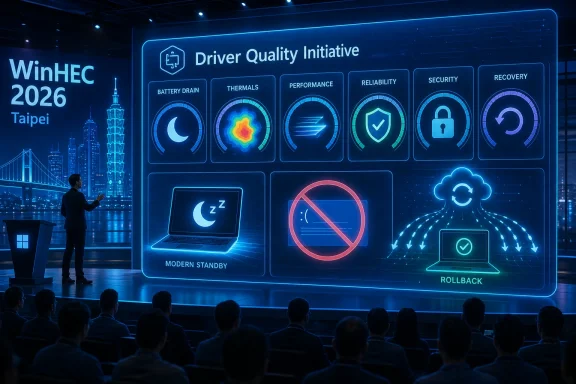 Microsoft Finally Names the Failure Windows Users Already Diagnosed
The most important part of Microsoft’s WinHEC message is not that bad drivers exist. Anyone who has managed a fleet of laptops, owned a temperamental gaming notebook, or watched a supposedly sleeping Windows machine cook itself in a backpack already knew that.The important part is that Microsoft is changing what counts as a bad driver. Historically, the Windows ecosystem has had a strong bias toward binary failure: did the machine blue-screen, did the device fail to enumerate, did the driver block boot, did a crash bucket spike after release? Those are measurable, obvious, and supportable events. They are also a narrow slice of what users experience as a broken PC.
A driver that prevents a laptop from entering a deep sleep state may never crash the OS. A driver that keeps waking a device on Modern Standby may never trigger a dramatic error dialog. A driver that burns extra CPU in the background, introduces audio latency, causes micro-stutter, or runs a component hotter than necessary can pass through ordinary notions of “stable” while still making the machine feel worse every day.
That is the loophole Microsoft is now trying to close. The company’s new Driver Quality Initiative says, in effect, that a driver can be defective even when Windows survives it. That is a subtle but meaningful shift for a platform whose hardware diversity is both its greatest strength and its permanent maintenance bill.
The Crash Was Never the Whole Customer Experience
Windows has always lived at the intersection of operating system ambition and hardware entropy. The same OS has to run on bargain laptops, liquid-cooled desktops, corporate workstations, handheld gaming PCs, USB docks, docking monitors, printers, wireless chipsets, fingerprint readers, audio codecs, RGB controllers, firmware update tools, and obscure peripherals that may receive one driver update and then vanish into the supply chain.That breadth is why Windows won the PC market. It is also why driver quality is never merely a Microsoft problem or merely an OEM problem. When the device misbehaves, the user experiences one thing: “Windows is bad.” The root cause may sit with an audio driver, a Wi-Fi card, a GPU package, firmware, an OEM customization layer, or Windows Update’s ranking logic, but the blame lands on the thing with the Start menu.
For years, the Windows driver model has been good at identifying catastrophic failures. Kernel-mode drivers that crash machines leave evidence. Devices that fail install checks produce errors. Security-blocked drivers can be flagged. But much of the lived Windows 11 frustration sits in greyer territory: the system technically works, but worse than it should.
That grey territory is where battery drain lives. It is where laptops lose 20 percent overnight despite the lid being closed. It is where fans spin in a meeting room. It is where a Bluetooth headset crackles, a game stutters every few seconds, a graphics driver silently regresses, or a machine that was fine yesterday suddenly behaves like a lower-tier product after Windows Update.
By bringing performance, power, and thermal behavior into driver evaluation, Microsoft is admitting that telemetry has to reflect experience, not just survivability. A PC that does not crash but misses its sleep targets is still failing the customer. A driver that makes a thin-and-light notebook warm and sluggish is still bad, even if it never produces a blue screen.
The Kernel Is Where Small Mistakes Become Platform Problems
The driver problem is especially nasty because many third-party drivers sit close to the heart of Windows. Kernel-mode drivers exist for good reasons: performance, low-level hardware access, and compatibility with decades of device expectations. But that privilege comes with a cost. A bad kernel driver can destabilize the whole system, widen the attack surface, or degrade performance in ways users cannot easily diagnose.Microsoft has spent years trying to pull more driver work into user mode where possible. User-mode drivers are easier to isolate. If they fail, they can often be restarted without taking the operating system down with them. That architecture does not solve every device category, and it does not magically modernize legacy driver stacks, but it reflects the direction of travel: Windows wants fewer third-party components running with the power to wreck the entire machine.
The Driver Quality Initiative appears to sit alongside that broader architectural push. Microsoft describes the effort around pillars such as architecture, trust, lifecycle, and quality measures. The language is corporate, but the underlying direction is plain enough: reduce risky kernel dependency, improve signing and trust, manage drivers after release instead of treating shipment as the finish line, and measure outcomes that users actually notice.
This matters for security as much as reliability. Windows has spent recent years hardening against vulnerable drivers, especially in the bring-your-own-vulnerable-driver class of attacks. A driver is not just a performance component; it can also be a privileged software artifact that attackers abuse. A quality program that treats drivers as living, measurable, revocable components is overdue.
Windows Update Became the Driver Manager Nobody Fully Trusted
The other half of the story is Windows Update. Microsoft wants Windows Update to be the trusted distribution channel for drivers, and in many enterprise and consumer scenarios that is exactly what it should be. Centralized driver delivery can reduce chaos, make fresh installs usable, patch vulnerabilities, and spare normal users from downloading random vendor utilities.But Windows Update has also become a source of suspicion. Enthusiasts have long complained that Windows can replace manually installed GPU drivers with older or OEM-ranked versions. Laptop owners have seen carefully tuned graphics or chipset packages overwritten by catalog drivers that may be technically compatible but practically inferior. Admins have learned that “driver update” can mean improvement, regression, or an afternoon of explaining why a model line suddenly behaves differently.
Microsoft’s recent work on graphics driver targeting is relevant here. The company has reportedly acknowledged cases where Windows Update’s driver ranking and targeting logic can result in GPU driver downgrades, particularly on OEM devices. A planned move toward more specific hardware identification, using combinations such as hardware IDs and computer hardware IDs, is meant to reduce mistaken targeting for new display driver submissions.
That fix is not the same as the broader Driver Quality Initiative, but the themes rhyme. Microsoft is trying to make Windows Update smarter about which driver belongs on which machine, and faster at backing out when the answer is wrong. The distinction matters because driver quality is not only about whether a driver is good in the abstract. It is about whether that exact driver is good for that exact device configuration at that exact point in its lifecycle.
A graphics driver that performs well on one laptop design may behave badly on another because of firmware, mux behavior, power profiles, panel configuration, thermal limits, or OEM customization. A Wi-Fi driver that is fine in a reference design may be miserable in a cramped chassis with aggressive power management. Windows Update cannot solve those differences with a simple “newer is better” rule, and it cannot earn trust if its ranking logic keeps surprising users.
Cloud Rollback Is Microsoft’s Admission That Shipping Is Not the End
The most immediately practical companion to the initiative is Cloud-Initiated Driver Recovery. The idea is straightforward: when Microsoft identifies a problematic driver delivered through Windows Update, it can trigger a recovery action from the cloud and replace that driver with a previously known-good version without requiring the user or hardware partner to perform manual cleanup.That sounds like a modest operational feature. In practice, it is a philosophical reversal. For decades, driver remediation has often meant forcing the user, the admin, or the OEM to unwind the problem: open Device Manager, roll back, block the update, download a package from a support page, run DDU for graphics drivers, hide a Windows Update entry, or wait for the vendor to publish a fixed package.
Cloud rollback says Microsoft accepts responsibility for the distribution channel after the moment of delivery. If Windows Update shipped the bad payload, Windows Update needs a way to retreat. The rollback feature is reportedly being tested with hardware partners from May through August 2026, with broader use targeted afterward. As always with Windows servicing promises, the proof will be in the messy edge cases.
There are obvious limits. A rollback system depends on Microsoft detecting the problem, classifying it correctly, having a known-good driver to return to, and ensuring the rollback does not create a different failure. It will not fix every vendor utility, firmware bug, misconfigured OEM image, or user-installed package outside the update pipeline. It also raises uncomfortable questions about transparency: users and admins will want to know when a driver was rolled back, why, and whether a future update will reintroduce the same issue.
Still, automatic rollback is the missing half of automatic updates. If a platform insists on pushing driver changes at scale, it must also have a first-class undo mechanism at scale. Otherwise, every bad driver turns into unpaid labor for the people least equipped to diagnose it.
Battery Drain Was the Symptom of a Bigger Measurement Gap
The TweakTown framing — that Microsoft has admitted Windows 11 drivers secretly drained batteries for years — captures the irritation, but the underlying problem is broader than battery life. Battery drain is simply the easiest degraded-state failure for laptop owners to notice. A machine goes into a bag with 72 percent charge and comes out dead, hot, or both. No technical explanation is required for the user to understand something is wrong.Modern Standby made that frustration more visible. In theory, connected standby-like behavior lets a Windows laptop sleep more like a phone: maintaining some background activity while preserving battery. In practice, Windows laptops vary wildly. Some sip power. Others wake unexpectedly, fail to reach low-power states, or remain active because some device, driver, or service keeps the platform from settling down.
When that happens, the user rarely sees “your Wi-Fi driver blocked deep idle for three hours.” They see a dead battery. They blame Windows, the laptop vendor, or themselves. Administrators see support tickets that sound subjective until they become a pattern across a model line.
Performance regressions are even harder to prove. Micro-stutter, audio dropouts, high DPC latency, degraded graphics performance, or abnormal fan behavior often live below the threshold of a simple crash report. They show up in forums, Reddit threads, help desks, and return rates before they appear in a clean engineering dashboard. If Microsoft’s new quality signals can pull those failures into the formal driver approval process, it will close a long-standing gap between telemetry and reality.
The danger is that Microsoft may overpromise what measurement can do. Power behavior is complex. Thermals depend on chassis design, firmware policy, ambient temperature, workloads, and battery health. Performance varies with background tasks, security settings, GPU scheduling, display modes, and vendor control panels. A stricter driver process can reduce bad actors, but it cannot make the Windows ecosystem as vertically controlled as a MacBook.
OEMs and Silicon Vendors Now Have Less Room to Hide
Microsoft’s public messaging emphasizes partnership, and that is politically necessary. Windows depends on AMD, Intel, Qualcomm, Nvidia, Realtek, MediaTek, Synaptics, laptop OEMs, peripheral makers, and countless smaller device vendors. Microsoft cannot simply declare driver quality solved from Redmond and expect the supply chain to salute.But the new initiative also changes leverage. If performance, power, and thermals become formal quality measures, then vendors cannot hide behind “it doesn’t crash.” An OEM image that ships with a flaky device stack, or a vendor driver that behaves badly under common power transitions, becomes a measurable problem rather than a vague support complaint.
That could be especially important for the next phase of Windows hardware. Microsoft is pushing AI PCs, Arm-based systems, NPUs, improved battery life, and a more mobile-class expectation for laptops. Those ambitions collapse quickly if the driver ecosystem continues to leak power in the background. A Copilot+ PC with great silicon and poor platform integration is still a bad laptop.
The Windows-on-Arm angle is particularly sensitive. Qualcomm-based PCs have been sold partly on battery life and standby behavior. Intel and AMD are also fighting hard on efficiency. In that market, a bad driver is not a footnote; it can erase a generation of silicon gains in the user’s mind. If Microsoft wants Windows laptops to compete on endurance, it cannot allow third-party drivers to burn the advantage away invisibly.
There is also a commercial pressure point. OEMs differentiate with value-add software, device-specific features, and custom drivers. Some of that work is useful. Some of it is fragile. A stricter Windows driver regime may force vendors to invest more in maintenance after launch, not just qualification before shipment.
Enterprise IT Gets a Better Safety Net, Not a Free Pass
For enterprise administrators, the announcement is good news only if it comes with control and visibility. Automatic rollback sounds wonderful in a consumer context. In a managed fleet, it becomes a change-management event. Admins need reporting, policy hooks, documentation, and compatibility guarantees, not just a cloud-side correction that silently changes device state.Many organizations already treat drivers with more caution than ordinary quality updates. They stage rings, validate on pilot hardware, pin versions for sensitive workloads, and coordinate with OEM management tools. Microsoft’s driver rollback system could reduce the blast radius of a bad Windows Update driver, but it cannot replace internal validation for fleets with specialized hardware, compliance requirements, or uptime-sensitive users.
The most useful version of this system would make driver health more observable. IT teams should be able to see which models are affected, which driver was rolled back, what symptom triggered the action, and whether endpoints are now on the expected known-good version. A rollback that fixes one department while confusing inventory and compliance tooling in another will create a different kind of support burden.
There is also the question of cadence. Driver fixes often move through OEM channels, Windows Update, vendor utilities, and enterprise deployment tools at different speeds. Microsoft’s initiative may improve the Windows Update lane, but enterprises still have to decide whether that lane is the authoritative source for every driver category. For some, especially GPU, docking, storage, networking, and biometric drivers, the answer may remain “not without testing.”
That is not a criticism of the initiative so much as a reminder of Windows reality. Microsoft can improve the road. It cannot remove every pothole from every vehicle’s route.
The Enthusiast Bargain Gets Renegotiated Again
Windows enthusiasts have a different problem: they want both automation and sovereignty. They want Windows to install the basic drivers needed to make a fresh system work, but they do not want Windows Update to replace a tuned GPU driver, overwrite a chipset package, or reintroduce an older OEM build after a clean install.That tension has defined the Windows 10 and Windows 11 update era. Microsoft moved toward a servicing model that assumes automatic updates are necessary for security and reliability. Enthusiasts responded by hunting for group policies, registry keys, update blockers, metered-connection tricks, and driver-specific workarounds. Neither side is entirely wrong.
A higher-quality driver pipeline could reduce the need for those workarounds, but it will not eliminate the desire for explicit control. Gamers, creators, and workstation users often choose a driver version for a reason. They may install a hotfix driver for a game, a studio driver for an application, or a vendor package that exposes features not present in the Windows Update variant. If Windows later decides a catalog driver ranks higher, trust erodes quickly.
Microsoft’s targeting improvements for display drivers are therefore just as important as its rollback work. Rollback fixes a bad outcome after deployment. Better targeting prevents a bad match before deployment. Enthusiasts will judge Microsoft not by the initiative’s name, but by whether Windows stops undoing their deliberate driver choices.
The company would also help itself by being more transparent in the UI. Windows should make it clearer when a driver update is optional, when it is replacing a manually installed driver, when it is OEM-specific, and when a rollback has occurred. The more invisible the system remains, the more every driver change feels like an ambush.
The New Quality Bar Will Be Judged by the Boring Days It Creates
Microsoft’s strongest argument is not that drivers will become perfect. They will not. The Windows ecosystem is too broad, and the economics of hardware support are too uneven. The better argument is that driver failures should become less mysterious, less persistent, and less likely to survive because they avoided crashing the OS.That is a practical and overdue standard. A Windows laptop that sleeps properly is not exciting. A graphics driver that stays at the right version is not a headline. A Wi-Fi driver that does not spike latency after an update does not inspire applause. These are boring outcomes, but operating systems are judged by the boring days they protect.
The difficulty is that Microsoft must now police a category of failure users have been trained to diagnose anecdotally. “My battery life got worse” can be true, but it can also reflect workload changes, battery aging, new background apps, browser behavior, firmware updates, or security features. To turn that into a driver quality signal at Windows scale, Microsoft needs rigorous data and careful thresholds.
False positives would be costly. Block too many drivers and vendors complain that Microsoft is slowing fixes. Roll back too aggressively and users may lose needed functionality. Measure too timidly and the initiative becomes a press release wrapped around the same old pipeline.
The opportunity is equally large. If Microsoft can combine better telemetry, stricter partner requirements, safer architecture, smarter targeting, and reliable rollback, it can make Windows feel less arbitrary. That is the thing users have wanted all along. Not perfection. Predictability.
The Driver Blame Game Now Has a Scoreboard
The useful way to read Microsoft’s announcement is not as a confession that every Windows 11 battery problem was caused by drivers. It is an acknowledgment that the old definition of driver quality missed too many failures that users actually felt.- Microsoft is expanding driver evaluation beyond crashes to include performance, power consumption, thermal behavior, stability, functionality, reliability, and security.
- The Driver Quality Initiative makes it harder for a driver to be considered acceptable simply because it does not blue-screen the machine.
- Cloud-Initiated Driver Recovery is designed to let Microsoft roll back problematic Windows Update drivers to known-good versions without manual user or OEM intervention.
- Windows Update’s driver targeting, especially around graphics drivers on OEM systems, remains a separate but related trust problem that Microsoft is also trying to improve.
- Enterprise administrators should treat automatic rollback as a useful safety net, not a substitute for staged deployment, reporting, and fleet validation.
- Enthusiasts will judge the effort by whether Windows stops replacing carefully chosen drivers with worse catalog matches.
References
- Primary source: TweakTown
Published: Mon, 18 May 2026 18:08:06 GMT
Microsoft admits Windows 11 drivers have secretly drained battery life for years
Microsoft admits Windows 11 drivers have been silently draining battery life and hurting performance for years, and now its time to fix them. www.tweaktown.com
- Related coverage: windowscentral.com
Microsoft and its partners are rebuilding how Windows 11 talks to hardware to save your PC from itself | Windows Central
The new Driver Quality Initiative will isolate drivers to stop a single glitch from crashing your system.www.windowscentral.com - Related coverage: tomsguide.com
Microsoft will soon automatically uninstall bad Windows drivers and this new tool could be a game changer for your PC | Tom's Guide
Microsoft has released a new Windows 11 tool that lets it remove faulty drivers after updates.www.tomsguide.com - Related coverage: windowslatest.com
Microsoft admits Windows 11 drivers were quietly killing your battery and performance without crashing, closes the loophole
Microsoft is finally penalizing Windows drivers that cause poor battery life and overheating, expanding quality checks beyond just BSODs. www.windowslatest.com
- Related coverage: tomshardware.com
Microsoft is working on a fix to downgraded GPU drivers in Windows Update — new system uses multiple IDs | Tom's Hardware
Microsoft finally confirms that Windows 11 downgrades GPU drivers on OEM devices, and is planning to launch a partial fix by Q4 2026.www.tomshardware.com - Official source: blogs.windows.com
Raising the bar together. Introducing the Driver Quality Initiative at WinHEC 2026
There are moments in this industry when you can feel the ecosystem lean in. This week in Taipei was one of them. For two days at WinHEC 2026 (Windows Hardware Engineering Conference) — Microsoft’s first WinHEC since 2018 — we had the privilegeblogs.windows.com
- Related coverage: pcworld.com
Windows Update is getting automatic rollbacks for faulty drivers | PCWorld
A new feature called Cloud-Initiated Driver Recovery will remotely revert problematic drivers without any manual intervention required.www.pcworld.com - Related coverage: windows.gadgethacks.com
Windows 11 automatic driver rollback explained: what it does and its limits << Windows Tips :: Gadget Hacks
Windows 11 automatic driver rollback explained: what it does and its limits Microsoft is adding a Windows 11 automatic driver rollback feature that can... windows.gadgethacks.com
- Related coverage: techspot.com
Windows is getting a cloud feature that fixes bad drivers before they wreck your PC | TechSpot
According to an official Microsoft blog post, the cloud-based recovery process will be initiated if a driver is identified as problematic during evaluation. In such cases, the...www.techspot.com - Related coverage: windowsforum.com
Microsoft WinHEC 2026: Windows Driver Quality Now Measured by Battery, Heat, More | Windows Forum
Microsoft used WinHEC 2026 in Taipei in mid-May to tell PC makers and component vendors that Windows driver quality will no longer be judged mainly by...windowsforum.com - Related coverage: thewincentral.com
Microsoft Fixes Hidden Windows 11 Driver Battery and Performance Issue - WinCentral
Microsoft says some Windows 11 drivers were silently hurting battery life and PC performance without crashing systems. - Read in Windows 11 News on WinCentral thewincentral.com
- Related coverage: ww1.microchip.com
PAC193X Microsoft Windows 10 and Windows 11 Device Driver Users Guide DS50002666
PDF documentww1.microchip.com
- Related coverage: techbriefly.com
Microsoft adds automatic rollback system for faulty Windows drivers - TechBriefly
Microsoft is adding Cloud-Initiated Driver Recovery to Windows Update, automatically reverting faulty drivers to keep Windows 11 systems stable.techbriefly.com - Official source: developer.microsoft.com
Windows Hardware Developer Documentation - Windows drivers | Microsoft Learn
Design, develop, and deploy hardware and device drivers for Windows PCs and other devices.developer.microsoft.com - Related coverage: pcwelt.de
Microsoft testet automatische Treiber-Reparatur für Windows - PC-WELT
Microsoft führt den automatischen Austausch fehlerhafter Treiber ein. Für ein stabileres Windows, ohne dass Windows-Anwender oder Hardware-Hersteller die Treiber manuell ersetzen müssen.www.pcwelt.de - Related coverage: technetbooks.com
Microsoft Windows Cloud Initiated Driver Recovery System Automates Faulty Update Rollbacks | Technetbook
Microsoft announces Cloud Initiated Driver Recovery for Windows to automatically fix system crashes and blue screens caused by faulty driver updates.www.technetbooks.com
- Official source: techcommunity.microsoft.com
Hardware Dev Center | Microsoft Community Hub
 techcommunity.microsoft.com
- Related coverage: dataconomy.com
Microsoft adds automatic driver rollback system to Windows
Microsoft has introduced "Cloud-Initiated Driver Recovery" (CIDR) for Windows Update, a system designed to automatically roll back faulty drivers withoutdataconomy.com - Related coverage: theregister.com
Microsoft gives Windows Update a Ctrl-Z for bad drivers
Cloud-powered undo will roll back dodgy code without users or hardware partners lifting a fingerwww.theregister.com - Official source: download.microsoft.com
