

Microsoft used WinHEC 2026 in Taipei in mid-May to tell PC makers and component vendors that Windows driver quality will no longer be judged mainly by crashes, because faulty third-party drivers have been draining batteries, raising heat, and slowing PCs without technically “failing.” That is the admission behind the PCWorld and Windows Latest reports: the Windows ecosystem has had a measurement problem, not merely a bug problem. For users, the result has been familiar and maddening — laptops that wake hot in a bag, audio that crackles, games that stutter, and “stable” systems that feel anything but stable. For Microsoft, the uncomfortable lesson is that Windows Update could keep a PC alive while still making it worse.
The most important part of Microsoft’s new Driver Quality Initiative is not that the company has discovered bad drivers. Windows users, OEM support desks, and enterprise endpoint teams discovered those years ago, one inexplicable battery drain incident at a time.
What is new is the definition of failure. Microsoft is now saying, in effect, that a driver can be bad even if it does not blue-screen the machine. That sounds obvious outside Redmond, but it cuts against the way Windows driver health has traditionally been measured at ecosystem scale.
A graphics driver that drops frames, a Bluetooth driver that keeps a laptop awake, or an audio driver that introduces crackling may not produce a clean crash signature. It may not leave the sort of Windows Error Reporting evidence that makes triage easy. It may simply make the PC worse every day until the user blames Windows, the laptop vendor, the battery, or themselves.
That is the blind spot PCWorld is pointing at. Microsoft’s tooling could treat “does not crash” as a rough proxy for “good enough,” while users experienced the result as degraded performance, heat, and battery life. The difference between those two realities is where Windows 11’s reputation has been bleeding trust.
But the modern laptop experience is defined as much by power behavior as by crash behavior. A machine that wakes reliably but loses 30 percent of its battery in a backpack has failed the user even if Event Viewer looks boring. A PC that never blue-screens but micro-stutters through video calls has failed the user even if the driver vendor’s dashboard says the release is healthy.
Microsoft’s shift is therefore less about discovering a new category of bug than admitting that the old scoring system was too narrow. The company says the new driver quality push will measure stability, functionality, performance, and power and thermal impact. That last phrase is the quiet revolution.
Power and thermals are not decorative metrics. They are the difference between a premium ultraportable that feels premium and one that behaves like a tiny space heater. They are also the difference between a fleet of business laptops that can survive a meeting day and one that turns IT into a rolling battery-anxiety help desk.
In practice, many users learned a different ritual. They closed the lid, put the machine in a bag, and later pulled out a warm laptop with a mysteriously depleted battery. The blame game became almost impossible for normal people to resolve because the visible symptom was “Windows ate my battery,” while the underlying cause could be a firmware issue, a network device, a graphics stack, an audio driver, an OEM utility, or some unlucky combination.
A single misbehaving driver can keep a system from entering deeper low-power states or can repeatedly wake components that should be idle. That does not have to look like a dramatic failure. It can look like a laptop doing just enough background work to turn standby into slow-motion battery theft.
This is why Microsoft’s revised driver quality lens matters. If the ecosystem only penalizes drivers that crash, it misses the drivers that quietly sabotage the sleep model. If it tests and scores power impact before broad distribution, it has at least a chance of catching the kind of defect users only discover after a few weeks of real travel, docking, undocking, lid-closing, and bag-carrying.
But automatic driver delivery has a legitimacy problem when the system installs a bad driver, replaces a newer graphics package with an older one, or resurrects a vendor driver the user thought they had escaped. Enthusiasts know the dance: install the preferred AMD, Intel, or NVIDIA package, reboot, and later discover Windows has made a different decision.
Microsoft has separately acknowledged driver ranking and catalog issues that can cause Windows Update to offer older or less appropriate graphics drivers in some circumstances. That is not identical to the battery-drain problem, but it belongs to the same family of ecosystem failures. The user does not care whether the root cause is hardware IDs, catalog hygiene, OEM submission practices, or Microsoft’s ranking logic. The user sees Windows changing a driver and then the PC behaving worse.
The new Driver Quality Initiative promises better lifecycle management, including catalog cleanup, deprecating outdated or low-quality drivers, and stronger signals for partners. That is necessary, but it also puts Microsoft in a politically awkward position. The company must make Windows Update more assertive about rejecting bad drivers while proving it will not become more arbitrary in the process.
That is good operational design. It is also an admission that the current failure path is too slow. A bad driver can ship, spread, and cause real-world damage before the average user has any idea what changed.
For enterprises, cloud-initiated recovery could be valuable if it integrates cleanly with existing deployment rings, update controls, and audit expectations. Admins do not want mystery meat remediation any more than they want mystery meat breakage. They need to know what changed, why it changed, which devices were affected, and how to pause or stage recovery when business-critical hardware is involved.
For consumers, the calculus is simpler. If Windows Update installed the driver, Windows Update should be able to back it out. The machine should not require a forum archaeology session, a Device Manager expedition, or a clean install because a component vendor shipped something that passed the wrong tests.
But the driver ecosystem is not a single-company machine. OEMs customize platforms. Silicon vendors ship fast-moving packages. Independent hardware vendors build components and peripherals that need deep system access. ODMs assemble designs with firmware and thermal characteristics that vary by chassis. Microsoft can set the rules, but it does not write every driver that damages the Windows experience.
That is why WinHEC matters as a venue. Microsoft brought the hardware engineering crowd into the same conversation and framed driver quality as a shared obligation. The company’s four-part structure — architecture, trust, lifecycle, and quality measures — is a way of saying that the problem spans how drivers are built, who is allowed to ship them, how long they remain in circulation, and how they are judged after release.
The hard part will be incentives. Vendors are rewarded for shipping hardware, enabling features, and supporting new silicon on launch timelines. They are not always rewarded visibly for the boring work of shaving standby drain, reducing DPC latency, or preventing a rare resume bug on a two-year-old laptop. Microsoft’s task is to make those boring metrics impossible to ignore.
Kernel-mode code has extraordinary privileges. That is why it can deliver performance and hardware access, and why it can also crash the machine or widen the blast radius of a defect. The broader industry got a painful reminder of this in recent years as endpoint and security software failures showed how a trusted low-level component can become a global operational incident.
Microsoft cannot simply ban third-party kernel drivers without breaking the Windows hardware model. The breadth of supported devices is one of Windows’ defining advantages. But the company can narrow the cases where custom kernel code is necessary, improve class drivers, and make user-mode paths more viable for devices that do not need to live in the most dangerous part of the OS.
That will take years, not months. Driver architecture changes move at the speed of hardware generations, certification cycles, and vendor engineering budgets. Still, the direction is right: the best driver failure is the one that cannot take the system with it.
Microsoft’s new language makes driver power behavior part of the customer promise. If a laptop vendor ships a premium machine whose standby experience collapses because of a network, audio, or graphics driver, that is no longer an invisible edge case. It is a quality failure.
This matters especially as PC makers sell AI PCs and Copilot+ PCs on responsiveness, mobility, and all-day use. Local AI features, NPUs, better cameras, and richer audio stacks all increase the importance of coordinated platform engineering. A supposedly intelligent PC that cannot sleep properly is not intelligent in the way users actually notice.
There is also a competitive shadow here. Apple’s MacBooks have trained many buyers to expect strong standby behavior and predictable battery life. Windows laptops vary far more widely. Microsoft does not need every PC to behave identically, but it does need the baseline to stop feeling like a dice roll.
Better Microsoft telemetry and automated rollback could reduce the time between detection and mitigation. But enterprise environments also need transparency. A driver rollback that makes sense for consumers could collide with a validated line-of-business configuration, a regulated environment, or a carefully staged deployment ring.
The useful future is not one where Microsoft silently fixes everything from the cloud. The useful future is one where Microsoft exposes clearer driver health data, documents rollback actions, and lets organizations align automated recovery with their own risk controls. Autonomy without visibility is just another kind of surprise.
There is also a procurement lesson. Enterprises should treat driver quality as part of vendor evaluation, not merely a support nuisance after purchase. If two laptop lines look similar on CPU, memory, and price, the one with better driver lifecycle discipline may be the cheaper machine over three years.
Microsoft’s driver-quality reforms do not automatically solve that cultural problem. A stricter catalog is not the same thing as user agency. A rollback system is not the same thing as respecting a user’s decision to pin a known-good driver.
Still, the reforms could reduce the number of times enthusiasts need to intervene. If Windows Update becomes better at avoiding outdated, inappropriate, or power-hostile drivers, fewer users will feel the need to disable driver updates entirely. That is good for security and good for sanity.
The danger is overcorrection. If Microsoft blocks or rolls back drivers too aggressively, power users will see the new system as another paternalistic layer. The company needs to distinguish between preventing ecosystem harm and flattening legitimate advanced use cases.
The driver issue is a perfect test of whether that reset is real. It is unglamorous. It requires collaboration with partners. It involves telemetry, certification, update policy, old catalog entries, and obscure hardware behavior. It is exactly the sort of thing that does not fit neatly into a keynote demo.
That is why it matters more than another Copilot button. The credibility of Windows is built in the moments when nothing interesting happens: the lid closes, the laptop sleeps, the battery remains intact, the meeting starts, the audio works, and the GPU driver stays where the user left it.
If Microsoft can improve those moments, users will notice even if they never know the acronym DQI. If it cannot, the new initiative will become another entry in the long Windows tradition of promising that the next servicing model will finally tame the chaos.
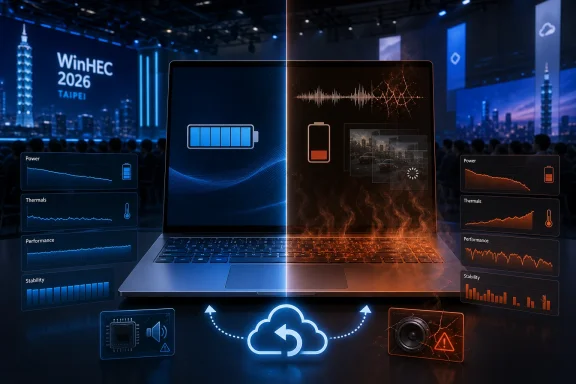 Microsoft Finally Names the Driver Problem Users Already Knew
The most important part of Microsoft’s new Driver Quality Initiative is not that the company has discovered bad drivers. Windows users, OEM support desks, and enterprise endpoint teams discovered those years ago, one inexplicable battery drain incident at a time.What is new is the definition of failure. Microsoft is now saying, in effect, that a driver can be bad even if it does not blue-screen the machine. That sounds obvious outside Redmond, but it cuts against the way Windows driver health has traditionally been measured at ecosystem scale.
A graphics driver that drops frames, a Bluetooth driver that keeps a laptop awake, or an audio driver that introduces crackling may not produce a clean crash signature. It may not leave the sort of Windows Error Reporting evidence that makes triage easy. It may simply make the PC worse every day until the user blames Windows, the laptop vendor, the battery, or themselves.
That is the blind spot PCWorld is pointing at. Microsoft’s tooling could treat “does not crash” as a rough proxy for “good enough,” while users experienced the result as degraded performance, heat, and battery life. The difference between those two realities is where Windows 11’s reputation has been bleeding trust.
The Crash Was Never the Only Failure Mode
Windows has long had a blunt but useful way to identify catastrophic driver problems: collect crash data, rank offenders, and push fixes or blocks when a driver is clearly associated with system failures. That model matters, and nobody should pretend otherwise. Kernel-mode drivers can still bring the whole operating system down.But the modern laptop experience is defined as much by power behavior as by crash behavior. A machine that wakes reliably but loses 30 percent of its battery in a backpack has failed the user even if Event Viewer looks boring. A PC that never blue-screens but micro-stutters through video calls has failed the user even if the driver vendor’s dashboard says the release is healthy.
Microsoft’s shift is therefore less about discovering a new category of bug than admitting that the old scoring system was too narrow. The company says the new driver quality push will measure stability, functionality, performance, and power and thermal impact. That last phrase is the quiet revolution.
Power and thermals are not decorative metrics. They are the difference between a premium ultraportable that feels premium and one that behaves like a tiny space heater. They are also the difference between a fleet of business laptops that can survive a meeting day and one that turns IT into a rolling battery-anxiety help desk.
Modern Standby Made the Weakest Driver Everyone’s Problem
The battery-life angle is particularly explosive because it intersects with one of the most controversial pieces of the Windows laptop experience: Modern Standby. In theory, a modern Windows laptop should behave more like a phone. Close the lid, let it remain lightly connected or quickly resumable, and avoid the old ritual of waiting for a full sleep-and-wake cycle.In practice, many users learned a different ritual. They closed the lid, put the machine in a bag, and later pulled out a warm laptop with a mysteriously depleted battery. The blame game became almost impossible for normal people to resolve because the visible symptom was “Windows ate my battery,” while the underlying cause could be a firmware issue, a network device, a graphics stack, an audio driver, an OEM utility, or some unlucky combination.
A single misbehaving driver can keep a system from entering deeper low-power states or can repeatedly wake components that should be idle. That does not have to look like a dramatic failure. It can look like a laptop doing just enough background work to turn standby into slow-motion battery theft.
This is why Microsoft’s revised driver quality lens matters. If the ecosystem only penalizes drivers that crash, it misses the drivers that quietly sabotage the sleep model. If it tests and scores power impact before broad distribution, it has at least a chance of catching the kind of defect users only discover after a few weeks of real travel, docking, undocking, lid-closing, and bag-carrying.
Windows Update Became the Messenger Everyone Shot
The uncomfortable complication is that Windows Update is both part of the solution and part of the resentment. For years, Microsoft has encouraged users to let Windows manage drivers automatically. That is the only practical model for most people, and it is also essential for security and fleet hygiene.But automatic driver delivery has a legitimacy problem when the system installs a bad driver, replaces a newer graphics package with an older one, or resurrects a vendor driver the user thought they had escaped. Enthusiasts know the dance: install the preferred AMD, Intel, or NVIDIA package, reboot, and later discover Windows has made a different decision.
Microsoft has separately acknowledged driver ranking and catalog issues that can cause Windows Update to offer older or less appropriate graphics drivers in some circumstances. That is not identical to the battery-drain problem, but it belongs to the same family of ecosystem failures. The user does not care whether the root cause is hardware IDs, catalog hygiene, OEM submission practices, or Microsoft’s ranking logic. The user sees Windows changing a driver and then the PC behaving worse.
The new Driver Quality Initiative promises better lifecycle management, including catalog cleanup, deprecating outdated or low-quality drivers, and stronger signals for partners. That is necessary, but it also puts Microsoft in a politically awkward position. The company must make Windows Update more assertive about rejecting bad drivers while proving it will not become more arbitrary in the process.
A Rollback Button From the Cloud Is a Confession
The planned Cloud-Initiated Driver Recovery feature may become one of the most consequential pieces of this effort. The idea is straightforward: when telemetry shows a driver has gone bad after distribution, Microsoft can trigger a rollback to a known-working version rather than waiting for every user, admin, or OEM to diagnose the problem manually.That is good operational design. It is also an admission that the current failure path is too slow. A bad driver can ship, spread, and cause real-world damage before the average user has any idea what changed.
For enterprises, cloud-initiated recovery could be valuable if it integrates cleanly with existing deployment rings, update controls, and audit expectations. Admins do not want mystery meat remediation any more than they want mystery meat breakage. They need to know what changed, why it changed, which devices were affected, and how to pause or stage recovery when business-critical hardware is involved.
For consumers, the calculus is simpler. If Windows Update installed the driver, Windows Update should be able to back it out. The machine should not require a forum archaeology session, a Device Manager expedition, or a clean install because a component vendor shipped something that passed the wrong tests.
The Ecosystem Problem Is Bigger Than Microsoft
It is tempting to frame this as Microsoft finally fixing Microsoft’s mess, and there is truth in that. Windows owns the update channel, the certification regime, and the user-facing experience. When something goes wrong, the Windows logo is what people stare at.But the driver ecosystem is not a single-company machine. OEMs customize platforms. Silicon vendors ship fast-moving packages. Independent hardware vendors build components and peripherals that need deep system access. ODMs assemble designs with firmware and thermal characteristics that vary by chassis. Microsoft can set the rules, but it does not write every driver that damages the Windows experience.
That is why WinHEC matters as a venue. Microsoft brought the hardware engineering crowd into the same conversation and framed driver quality as a shared obligation. The company’s four-part structure — architecture, trust, lifecycle, and quality measures — is a way of saying that the problem spans how drivers are built, who is allowed to ship them, how long they remain in circulation, and how they are judged after release.
The hard part will be incentives. Vendors are rewarded for shipping hardware, enabling features, and supporting new silicon on launch timelines. They are not always rewarded visibly for the boring work of shaving standby drain, reducing DPC latency, or preventing a rare resume bug on a two-year-old laptop. Microsoft’s task is to make those boring metrics impossible to ignore.
Kernel Drivers Are Still the Loaded Gun on the Table
One of the deeper threads in Microsoft’s driver push is architectural: reducing reliance on third-party kernel-mode drivers where possible and moving more functionality into user mode or Microsoft-authored class drivers. This is not just a performance story. It is also a security and resiliency story.Kernel-mode code has extraordinary privileges. That is why it can deliver performance and hardware access, and why it can also crash the machine or widen the blast radius of a defect. The broader industry got a painful reminder of this in recent years as endpoint and security software failures showed how a trusted low-level component can become a global operational incident.
Microsoft cannot simply ban third-party kernel drivers without breaking the Windows hardware model. The breadth of supported devices is one of Windows’ defining advantages. But the company can narrow the cases where custom kernel code is necessary, improve class drivers, and make user-mode paths more viable for devices that do not need to live in the most dangerous part of the OS.
That will take years, not months. Driver architecture changes move at the speed of hardware generations, certification cycles, and vendor engineering budgets. Still, the direction is right: the best driver failure is the one that cannot take the system with it.
For PC Makers, Battery Life Is No Longer Just a Spec Sheet Claim
The new driver scoring approach could change how OEMs think about quality. Battery life has always been a marketing number, but it is often presented as a platform achievement: processor efficiency, display technology, battery capacity, and OS tuning. Drivers tend to hide behind that story until something goes wrong.Microsoft’s new language makes driver power behavior part of the customer promise. If a laptop vendor ships a premium machine whose standby experience collapses because of a network, audio, or graphics driver, that is no longer an invisible edge case. It is a quality failure.
This matters especially as PC makers sell AI PCs and Copilot+ PCs on responsiveness, mobility, and all-day use. Local AI features, NPUs, better cameras, and richer audio stacks all increase the importance of coordinated platform engineering. A supposedly intelligent PC that cannot sleep properly is not intelligent in the way users actually notice.
There is also a competitive shadow here. Apple’s MacBooks have trained many buyers to expect strong standby behavior and predictable battery life. Windows laptops vary far more widely. Microsoft does not need every PC to behave identically, but it does need the baseline to stop feeling like a dice roll.
Admins Need Signals, Not Just Promises
For IT departments, the announcement should be read as a welcome start rather than a reason to relax. Driver problems are among the most annoying endpoint failures because they sit between vendors. The OEM blames Microsoft, Microsoft blames the driver, the driver vendor blames firmware, and the admin still has 400 laptops with broken docks.Better Microsoft telemetry and automated rollback could reduce the time between detection and mitigation. But enterprise environments also need transparency. A driver rollback that makes sense for consumers could collide with a validated line-of-business configuration, a regulated environment, or a carefully staged deployment ring.
The useful future is not one where Microsoft silently fixes everything from the cloud. The useful future is one where Microsoft exposes clearer driver health data, documents rollback actions, and lets organizations align automated recovery with their own risk controls. Autonomy without visibility is just another kind of surprise.
There is also a procurement lesson. Enterprises should treat driver quality as part of vendor evaluation, not merely a support nuisance after purchase. If two laptop lines look similar on CPU, memory, and price, the one with better driver lifecycle discipline may be the cheaper machine over three years.
Enthusiasts Will Believe the Fix When Windows Stops Fighting Them
For Windows enthusiasts, driver control is personal. Gamers, creators, and workstation users often install vendor drivers directly because they need game optimizations, GPU compute fixes, low-latency audio behavior, or specific device features. When Windows Update second-guesses those choices, it feels less like maintenance and more like trespass.Microsoft’s driver-quality reforms do not automatically solve that cultural problem. A stricter catalog is not the same thing as user agency. A rollback system is not the same thing as respecting a user’s decision to pin a known-good driver.
Still, the reforms could reduce the number of times enthusiasts need to intervene. If Windows Update becomes better at avoiding outdated, inappropriate, or power-hostile drivers, fewer users will feel the need to disable driver updates entirely. That is good for security and good for sanity.
The danger is overcorrection. If Microsoft blocks or rolls back drivers too aggressively, power users will see the new system as another paternalistic layer. The company needs to distinguish between preventing ecosystem harm and flattening legitimate advanced use cases.
Microsoft’s Quality Reset Has Reached the Hardware Layer
The driver announcement fits into a broader 2026 Windows quality reset. Microsoft has been talking more openly this year about performance, reliability, update control, and the need to fix fundamentals. That messaging follows years of user frustration that Windows 11 was collecting AI features while basic rough edges persisted.The driver issue is a perfect test of whether that reset is real. It is unglamorous. It requires collaboration with partners. It involves telemetry, certification, update policy, old catalog entries, and obscure hardware behavior. It is exactly the sort of thing that does not fit neatly into a keynote demo.
That is why it matters more than another Copilot button. The credibility of Windows is built in the moments when nothing interesting happens: the lid closes, the laptop sleeps, the battery remains intact, the meeting starts, the audio works, and the GPU driver stays where the user left it.
If Microsoft can improve those moments, users will notice even if they never know the acronym DQI. If it cannot, the new initiative will become another entry in the long Windows tradition of promising that the next servicing model will finally tame the chaos.
The Battery-Drain Story Leaves Microsoft With a Narrower Escape Route
The practical lesson from this episode is not that every Windows 11 battery complaint was caused by a faulty third-party driver. The lesson is that Microsoft has accepted a broader definition of driver harm, and that changes what users and admins should expect from Windows Update, OEMs, and hardware vendors.- Microsoft’s new Driver Quality Initiative expands driver evaluation beyond crashes to include performance, power, and thermal impact.
- Faulty drivers can damage real-world battery life by preventing systems from reaching efficient low-power states, even when Windows does not crash.
- Cloud-Initiated Driver Recovery is designed to roll back problematic drivers after release, but enterprises will need visibility and control around that process.
- Windows Update’s driver catalog and ranking behavior remain central to user trust because automatic delivery is only acceptable when the results are reliably better.
- OEMs and component vendors now face more pressure to treat standby behavior, thermals, latency, and lifecycle maintenance as first-order quality metrics.
- Enthusiasts should watch whether Microsoft’s stricter driver gatekeeping improves stability without reducing legitimate control over specialized hardware configurations.
References
- Primary source: PCWorld
Published: Mon, 18 May 2026 15:22:00 GMT
Microsoft admits faulty drivers were killing Windows 11 battery life for years | PCWorld
Microsoft is changing how Windows evaluates third-party drivers as bad ones were silently draining batteries and tanking performance for years.www.pcworld.com - Related coverage: windowscentral.com
Microsoft and its partners are rebuilding how Windows 11 talks to hardware to save your PC from itself | Windows Central
The new Driver Quality Initiative will isolate drivers to stop a single glitch from crashing your system.www.windowscentral.com - Related coverage: tomsguide.com
Microsoft will soon automatically uninstall bad Windows drivers and this new tool could be a game changer for your PC | Tom's Guide
Microsoft has released a new Windows 11 tool that lets it remove faulty drivers after updates.www.tomsguide.com - Related coverage: windowslatest.com
Microsoft admits Windows 11 drivers were quietly killing your battery and performance without crashing, closes the loophole
Microsoft is finally penalizing Windows drivers that cause poor battery life and overheating, expanding quality checks beyond just BSODs. www.windowslatest.com
- Related coverage: tomshardware.com
Microsoft is working on a fix to downgraded GPU drivers in Windows Update — new system uses multiple IDs | Tom's Hardware
Microsoft finally confirms that Windows 11 downgrades GPU drivers on OEM devices, and is planning to launch a partial fix by Q4 2026.www.tomshardware.com - Related coverage: techspot.com
Microsoft is finally fixing Windows Update's habit of downgrading your GPU drivers without asking | TechSpot
Microsoft is changing its policy to try to fix one of the longest-running issues Windows users have experienced with Windows Update (WU). In a few months, Redmond's...www.techspot.com
- Related coverage: thewincentral.com
Microsoft Fixes Hidden Windows 11 Driver Battery and Performance Issue - WinCentral
Microsoft says some Windows 11 drivers were silently hurting battery life and PC performance without crashing systems. - Read in Windows 11 News on WinCentral thewincentral.com
- Related coverage: portaltela.com
Microsoft corrige bug que instala drivers desatualizados no Windows 11
A Microsoft confirmou que o Windows 11 vinha substituindo drivers de placa de vídeo recém-instalados por versões antigas, em reconhecimento feito na WinHEC ...www.portaltela.com - Related coverage: notebookcheck.net
Windows 11 boot failures officially blamed on a chain of bad updates - Notebookcheck News
Microsoft says Windows 11’s January 2026 KB5074109 update is triggering boot failures mainly on a limited set of physical (mostly commercial) PCs that were left in an “improper state.” www.notebookcheck.net
- Official source: microsoft.com
laptop-illustration
Online conversation. Successful confident african american man, executive, company manager, ceo, sits on modern office, has business negotiation with colleagues by video call using laptop, smilingwww.microsoft.com
- Official source: blogs.windows.com
Raising the bar together. Introducing the Driver Quality Initiative at WinHEC 2026
There are moments in this industry when you can feel the ecosystem lean in. This week in Taipei was one of them. For two days at WinHEC 2026 (Windows Hardware Engineering Conference) — Microsoft’s first WinHEC since 2018 — we had the privilegeblogs.windows.com - Official source: learn.microsoft.com
MB Device-based Reset and Recovery - Windows drivers | Microsoft Learn
MB Device-based Reset and Recoverylearn.microsoft.com - Official source: techcommunity.microsoft.com
Executive Summary: The Total Economic Impact Of Windows Autopatch
PDF documenttechcommunity.microsoft.com
