

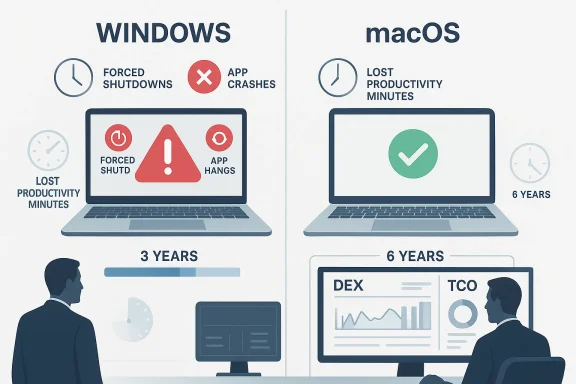
The latest wave of enterprise endpoint data is sharpening a familiar debate: Windows still owns the business desktop, but Apple is making a more convincing pitch than it has in years. A new Omnissa report, as cited by Windows Central and Neowin, says Windows devices in its telemetry suffered more forced shutdowns, more application crashes, and more app hangs than macOS, while Macs were viewed by some organizations as a longer-lived “asset investment” with a six-year lifespan versus three years for Windows endpoints. At the same time, Microsoft’s own recent Windows 11 turbulence, paired with Apple’s new low-cost MacBook Neo, is feeding a narrative that could matter far beyond consumer enthusiasm. Apple may not be about to topple Windows in the enterprise, but it is clearly trying to tighten the gap where it matters most: total cost of ownership, reliability, and user experience.
The fight between Windows and macOS in business has never really been about raw market share alone. Windows won the enterprise by becoming the default operating system for office productivity, management tooling, and line-of-business software, while Apple earned a smaller but durable foothold in creative, executive, and increasingly hybrid work environments. That balance has held for decades, yet it has also shifted every time one platform made the other look difficult to support, expensive to maintain, or unreliable at scale.
Microsoft’s recent Windows 11 era has created a fresh opening for rivals. In early 2026, Microsoft acknowledged the need to keep shipping Windows feature updates on a more targeted basis, including a Windows 11, version 26H1 release aimed at select new silicon rather than broad enterprise deployment. Separately, Microsoft support documents still show a strong preference for keeping devices updated automatically once they reach end of servicing, which underscores a long-running tension: Microsoft wants control over cadence, while many IT administrators want more predictable change management. That tension matters because enterprises do not judge operating systems in the abstract; they judge them by the number of tickets, restarts, crashes, and exceptions they create.
The broader context is that endpoint management has become more data-driven. Vendors now talk in terms of digital employee experience, telemetry, compliance posture, and device lifecycle economics rather than simply “the OS we run.” That framing is important because it moves the conversation away from brand loyalty and toward measurable business outcomes. If one platform needs fewer support interventions, lasts longer in service, and produces fewer workflow interruptions, it starts to look better on a CFO’s spreadsheet even if it has a smaller installed base.
Apple has been steadily preparing for that argument. The company has pushed deeper into enterprise identity, device management, and security features, while also making Macs easier for IT departments to deploy and manage. Meanwhile, the new MacBook Neo has given Apple a low-cost entry point that is getting attention precisely because it lowers one of the classic objections to Mac adoption: upfront price. Whether that device can influence enterprise buying is still an open question, but it adds fuel to a conversation that is no longer limited to design studios and developers.
The Omnissa report lands in the middle of that debate and gives it a hard-edged business frame. When a telemetry study says employees lose up to 24 minutes of productivity to crashes and recalibration, that is not a consumer inconvenience story anymore. It becomes a labor-efficiency story, a support-cost story, and a procurement story all at once.
That distinction matters. Endpoint telemetry does not measure every aspect of device quality, and it certainly does not prove that one operating system is inherently superior across all organizations. But it does measure pain points that have a direct business cost. When an app freezes, a reboot is required, or a user has to recover from a crash, the real expense is not just the incident itself. It is the attention reset, the delay, the help desk ticket, and the lost confidence in the platform.
That is one reason DEX, or digital employee experience, has become such an important metric. It converts the vague feeling of “this laptop is annoying” into something a business can model. Once that happens, device reliability stops being a perk and starts being a line item.
The Omnissa report’s “asset investment” language is especially telling. A six-year perceived lifespan for Macs compared with three years for Windows devices may not be a universal truth, but it reveals how some organizations think about Apple hardware: less as a disposable endpoint and more as a durable capital asset. In an inflation-sensitive procurement environment, that perception can matter as much as sticker price.
That dynamic is changing. Apple has improved its security story, simplified deployment, and reduced some management pain points that once kept Macs outside the mainstream. More importantly, businesses are starting to evaluate devices by total lifecycle expense rather than the invoice alone. If a Mac lasts longer, needs fewer support calls, and holds user satisfaction higher, the spread can narrow fast.
That said, if a CIO can justify Macs for a specific population with a demonstrably better experience, the old resistance becomes easier to overcome. The point is not that Apple has won the enterprise argument. The point is that Apple has made the argument credible.
Microsoft also has the benefit of enormous ecosystem reach. Its management stack, identity integrations, security tooling, and update channels are baked into how enterprises buy and support PCs. That makes switching expensive even when the alternate platform looks attractive. The switching cost is not just software rework; it is retraining, policy redesign, peripheral compatibility, and support documentation.
That leads to a hybrid model rather than a replacement model. Macs often enter an organization in pockets where their strengths are easiest to capture.
In regulated industries, Windows also benefits from deep vendor support and long-standing compliance routines. Apple can compete here, but it must prove not just that Macs are nice to use, but that they are operationally manageable under audit pressure. In those environments, good enough is not enough.
If Omnissa’s telemetry shows a 97.5% installation rate for Copilot on managed mobile devices, the most important question is not whether Copilot exists on the device. It is whether users actually rely on it when the work matters. Installation tells you about distribution; usage tells you about adoption; preference tells you about trust. Those are not the same thing.
AI adoption now intersects with security, data governance, and support. A company that blocks one tool often sees another emerge. A company that approves too many tools risks sprawl and leakage. In either case, the OS becomes less important than the broader identity and governance layer.
In other words, AI may be decoupling productivity apps from the OS faster than many vendors expected. That weakens old assumptions and gives Apple more room to compete on hardware quality and UX rather than on application dominance alone.
The device’s market impact in business will depend on far more than price. Performance characteristics, management support, application compatibility, and durability all matter. Still, low price matters because procurement conversations often begin with a number, not with a philosophical debate about user experience.
This is where the enterprise conversation gets interesting. A device does not need to run every heavy workload to be valuable. It only needs to satisfy the majority of users whose daily work is browser-based, messaging-heavy, and document-driven.
The real question is whether Neo is “good enough” for enough workers to matter. If it is, then Apple has a credible answer to the low-end PC market, and Windows vendors will have to compete on more than price.
Microsoft still has a huge advantage here because Windows endpoints sit naturally inside Microsoft’s management universe. But Apple has been steadily improving the administrative experience, and many organizations now manage Macs alongside Windows with less pain than they could a decade ago. That lowers the cost of trying a mixed strategy.
That shift benefits vendors that can make heterogeneity manageable. It does not necessarily favor the platform with the biggest market share.
That is why update control is such a sensitive issue. Enterprises want security, but they also want predictability. When they do not trust the cadence, they look for alternatives or add more control layers around Windows.
That expectation has real organizational consequences. If employees believe Apple devices are smoother, quieter, or more dependable, the IT department has to justify Windows on more than historical precedent. That is especially true in knowledge work where productivity gains are hard to measure but easy to feel.
That reputation eventually affects purchasing. Once employees start asking for a platform by name, the conversation changes from IT standardization to talent retention and productivity enablement.
That may be the quietest but most important change in the market. Apple does not have to persuade every company from scratch. It only has to make the move feel normal.
Microsoft, meanwhile, still has a straightforward path to defending its base: improve update reliability, reduce crash-prone regressions, and make the Windows experience feel more predictable to admins and end users. If the company can do that consistently, the appeal of switching weakens. If it cannot, Apple’s credibility grows every quarter.
Apple is not about to erase Windows from the enterprise, and Windows is not suddenly becoming irrelevant. But the old assumption that Macs are merely a niche prestige choice is getting weaker, especially when reliability, lifecycle economics, and employee experience are part of the buying decision. If Microsoft wants to keep Windows indispensable, it will need to prove that its platform is not just dominant, but consistently dependable.
Source: Windows Central Copilot dominates phones, but Apple might threaten Windows for businesses
 Background
The fight between Windows and macOS in business has never really been about raw market share alone. Windows won the enterprise by becoming the default operating system for office productivity, management tooling, and line-of-business software, while Apple earned a smaller but durable foothold in creative, executive, and increasingly hybrid work environments. That balance has held for decades, yet it has also shifted every time one platform made the other look difficult to support, expensive to maintain, or unreliable at scale.Microsoft’s recent Windows 11 era has created a fresh opening for rivals. In early 2026, Microsoft acknowledged the need to keep shipping Windows feature updates on a more targeted basis, including a Windows 11, version 26H1 release aimed at select new silicon rather than broad enterprise deployment. Separately, Microsoft support documents still show a strong preference for keeping devices updated automatically once they reach end of servicing, which underscores a long-running tension: Microsoft wants control over cadence, while many IT administrators want more predictable change management. That tension matters because enterprises do not judge operating systems in the abstract; they judge them by the number of tickets, restarts, crashes, and exceptions they create.
The broader context is that endpoint management has become more data-driven. Vendors now talk in terms of digital employee experience, telemetry, compliance posture, and device lifecycle economics rather than simply “the OS we run.” That framing is important because it moves the conversation away from brand loyalty and toward measurable business outcomes. If one platform needs fewer support interventions, lasts longer in service, and produces fewer workflow interruptions, it starts to look better on a CFO’s spreadsheet even if it has a smaller installed base.
Apple has been steadily preparing for that argument. The company has pushed deeper into enterprise identity, device management, and security features, while also making Macs easier for IT departments to deploy and manage. Meanwhile, the new MacBook Neo has given Apple a low-cost entry point that is getting attention precisely because it lowers one of the classic objections to Mac adoption: upfront price. Whether that device can influence enterprise buying is still an open question, but it adds fuel to a conversation that is no longer limited to design studios and developers.
The Omnissa report lands in the middle of that debate and gives it a hard-edged business frame. When a telemetry study says employees lose up to 24 minutes of productivity to crashes and recalibration, that is not a consumer inconvenience story anymore. It becomes a labor-efficiency story, a support-cost story, and a procurement story all at once.
What the Omnissa data actually suggests
The most important takeaway from the Omnissa findings is not that macOS is “better” than Windows in some universal sense. It is that in the dataset Omnissa observed, Windows endpoints showed more instability signals than Macs, including forced shutdowns, application crashes, and app hangs. In practical terms, that means the Windows experience may be generating more interruptions that users and IT teams can feel, even when the devices are technically functioning.That distinction matters. Endpoint telemetry does not measure every aspect of device quality, and it certainly does not prove that one operating system is inherently superior across all organizations. But it does measure pain points that have a direct business cost. When an app freezes, a reboot is required, or a user has to recover from a crash, the real expense is not just the incident itself. It is the attention reset, the delay, the help desk ticket, and the lost confidence in the platform.
Why telemetry matters more than opinion
A lot of enterprise OS debates are still driven by anecdotes: one developer loves a Mac, one finance team refuses to move off Excel add-ins, one help desk says Windows is harder to clean up. Telemetry changes that conversation because it aggregates what actually happened across managed devices. Even so, the sample is still only a slice of the market, and Omnissa’s own platform base naturally favors organizations that are already invested in managed endpoints.- Forced shutdowns matter because they often signal a hard failure rather than a graceful recovery.
- App crashes affect trust in line-of-business software.
- App hangs are especially costly because they can appear minor while quietly destroying productivity.
- Restarts and recovery cycles are easy to underestimate in budget planning.
- Repeated small failures can produce bigger morale problems than a single visible outage.
The productivity math behind “just a few minutes”
The report’s claim that bugs and crashes can cost up to 24 minutes of productivity is significant because enterprise leaders often dismiss endpoint issues as too small to matter. But in a large organization, even modest per-user friction becomes expensive quickly. If a worker loses 20 to 25 minutes a day to recoverable interruptions, the annual time loss becomes material enough to affect staffing assumptions and service desk capacity.That is one reason DEX, or digital employee experience, has become such an important metric. It converts the vague feeling of “this laptop is annoying” into something a business can model. Once that happens, device reliability stops being a perk and starts being a line item.
Apple’s enterprise pitch is changing
Apple’s biggest strategic advantage in the enterprise is not that it can replace Windows everywhere. It is that it can increasingly sell Macs as longer-lived, lower-friction assets for the users who do not need Windows-specific workflows. That framing is stronger than the old “creative professionals prefer Macs” story because it speaks to finance, procurement, and IT in the same language.The Omnissa report’s “asset investment” language is especially telling. A six-year perceived lifespan for Macs compared with three years for Windows devices may not be a universal truth, but it reveals how some organizations think about Apple hardware: less as a disposable endpoint and more as a durable capital asset. In an inflation-sensitive procurement environment, that perception can matter as much as sticker price.
The cost conversation is no longer just about purchase price
Historically, Windows PCs won on acquisition cost. Enterprises could buy them in volume, standardize the image, and refresh them on a predictable cycle. Macs were often treated as premium devices reserved for executives or roles that could justify the higher upfront price.That dynamic is changing. Apple has improved its security story, simplified deployment, and reduced some management pain points that once kept Macs outside the mainstream. More importantly, businesses are starting to evaluate devices by total lifecycle expense rather than the invoice alone. If a Mac lasts longer, needs fewer support calls, and holds user satisfaction higher, the spread can narrow fast.
- Lower support burden can offset higher hardware costs.
- Longer usable lifespan can reduce refresh frequency.
- Better user satisfaction can improve retention and onboarding.
- Stronger battery life and standby behavior can reduce remote-work friction.
- Less endpoint instability can lower hidden productivity losses.
IT departments care about consistency, not brand prestige
The enterprise rarely buys based on prestige. It buys based on whether a device can be provisioned, secured, patched, audited, and replaced at scale. Apple has made real progress here, but Windows still dominates because it is deeply wired into enterprise tooling, identity, application compatibility, and line-of-business inertia.That said, if a CIO can justify Macs for a specific population with a demonstrably better experience, the old resistance becomes easier to overcome. The point is not that Apple has won the enterprise argument. The point is that Apple has made the argument credible.
Windows still has the biggest structural advantages
Despite all of the friction, Windows remains the enterprise default for reasons that have very little to do with marketing and very much to do with systems architecture. It is still the platform where most legacy business applications are expected to run, where most vendors test first, and where most organizations already have operational playbooks. That kind of installed-base advantage is hard to dislodge.Microsoft also has the benefit of enormous ecosystem reach. Its management stack, identity integrations, security tooling, and update channels are baked into how enterprises buy and support PCs. That makes switching expensive even when the alternate platform looks attractive. The switching cost is not just software rework; it is retraining, policy redesign, peripheral compatibility, and support documentation.
Why Windows remains hard to replace
There is also a practical reality that Apple cannot ignore: many business-critical applications still have Windows-first assumptions. Even where web apps have reduced dependence on the desktop OS, specialized tools in finance, engineering, healthcare, government, and manufacturing still tie organizations to Windows. For many firms, the question is not “Mac or Windows?” but “where can we safely deploy Mac without creating exceptions?”That leads to a hybrid model rather than a replacement model. Macs often enter an organization in pockets where their strengths are easiest to capture.
- Software developers.
- Creative and media teams.
- Executives and frequent travelers.
- Hybrid workers who care about battery life and sleep reliability.
- Departments with strong employee preference and lower legacy dependency.
Government and regulated sectors still favor Windows
The Windows Central excerpt notes that Windows continues to dominate government institutions, with reported year-over-year growth. That is consistent with how public-sector IT tends to work: once a standardized platform is deeply embedded, replacement happens slowly and often only when forced by policy or refresh cycles.In regulated industries, Windows also benefits from deep vendor support and long-standing compliance routines. Apple can compete here, but it must prove not just that Macs are nice to use, but that they are operationally manageable under audit pressure. In those environments, good enough is not enough.
Copilot is everywhere, but AI is fragmenting anyway
One of the stranger findings in the Windows Central write-up is the coexistence of broad Copilot adoption and strong use of rival AI apps like ChatGPT and Gemini. That is not necessarily a contradiction. It may simply reflect how employees behave when the enterprise gives them one sanctioned tool but they choose another for personal productivity.If Omnissa’s telemetry shows a 97.5% installation rate for Copilot on managed mobile devices, the most important question is not whether Copilot exists on the device. It is whether users actually rely on it when the work matters. Installation tells you about distribution; usage tells you about adoption; preference tells you about trust. Those are not the same thing.
AI on endpoints is becoming a policy issue
The fact that workers also installed alternatives on iOS and Android devices is telling. Enterprises may prefer to standardize on a corporate assistant, but employees are increasingly multi-homing across AI tools. That creates a policy problem because the organization may own the device but not the employee’s workflow.AI adoption now intersects with security, data governance, and support. A company that blocks one tool often sees another emerge. A company that approves too many tools risks sprawl and leakage. In either case, the OS becomes less important than the broader identity and governance layer.
- Copilot may be the default on Microsoft-managed stacks.
- ChatGPT often wins on general-purpose flexibility.
- Gemini can appeal where Android and Google services are dominant.
- Employees often switch tools depending on task, not brand loyalty.
- Enterprises need policy frameworks, not just app installations.
Apple could benefit from AI heterogeneity
Apple does not need to “win” enterprise AI to benefit from this fragmentation. If workers are already using multiple assistants, then the operating system that provides the smoothest device experience and the longest battery life can still gain share, even if it is not the center of the AI conversation.In other words, AI may be decoupling productivity apps from the OS faster than many vendors expected. That weakens old assumptions and gives Apple more room to compete on hardware quality and UX rather than on application dominance alone.
The MacBook Neo changes the price perception
Apple’s new MacBook Neo is strategically important because it attacks one of the oldest barriers to Mac adoption: the idea that Macs are inherently too expensive for business deployment. With a starting price of $599, Apple is clearly signaling that it wants a broader audience than the premium laptop buyer segment. That pricing does not make Apple a budget PC vendor, but it does make the comparison with entry-level Windows laptops less automatic.The device’s market impact in business will depend on far more than price. Performance characteristics, management support, application compatibility, and durability all matter. Still, low price matters because procurement conversations often begin with a number, not with a philosophical debate about user experience.
What a sub-$600 Mac means for IT
If the MacBook Neo’s pricing holds and if the device can perform adequately for everyday productivity, Apple can reposition the Mac as something closer to a mass-market enterprise endpoint. That would be a notable shift. For years, IT leaders could dismiss Macs as premium consumer machines that happened to be usable at work. A low-cost Mac complicates that stance.This is where the enterprise conversation gets interesting. A device does not need to run every heavy workload to be valuable. It only needs to satisfy the majority of users whose daily work is browser-based, messaging-heavy, and document-driven.
- Lower entry price reduces procurement resistance.
- Familiar Apple design can ease user adoption.
- Battery life can matter more than raw benchmark leadership.
- Built-in device and account integration may reduce setup time.
- A standard low-cost Mac could simplify mixed fleets.
The compatibility ceiling still exists
Even with Parallels Desktop and other virtualization or compatibility layers, the MacBook Neo is not likely to replace Windows machines for users with demanding GPU workloads, specialized desktop apps, or legacy Windows dependencies. That is not a weakness unique to Neo; it is the perennial limit of Apple’s enterprise pitch.The real question is whether Neo is “good enough” for enough workers to matter. If it is, then Apple has a credible answer to the low-end PC market, and Windows vendors will have to compete on more than price.
Endpoint management is the real battleground
A lot of the Windows-versus-Mac discussion misses the most important layer: device management. Enterprises do not buy an operating system in isolation. They buy an ecosystem of enrollment, policy enforcement, patching, identity, compliance, and support. That is why reports from firms like Omnissa matter; they are often closest to the operational reality of mixed fleets.Microsoft still has a huge advantage here because Windows endpoints sit naturally inside Microsoft’s management universe. But Apple has been steadily improving the administrative experience, and many organizations now manage Macs alongside Windows with less pain than they could a decade ago. That lowers the cost of trying a mixed strategy.
Why mixed fleets are becoming normal
The traditional “single OS standard” is no longer realistic for many organizations. Remote work, specialized roles, employee preference, and SaaS adoption have made the average endpoint environment more diverse. IT teams therefore need tools that can manage different device classes without turning the help desk into a compatibility lab.That shift benefits vendors that can make heterogeneity manageable. It does not necessarily favor the platform with the biggest market share.
- Mixed fleets reduce dependence on one vendor’s roadmap.
- Endpoint tools increasingly focus on policy outcomes, not device purity.
- Remote and hybrid work increase the value of device independence.
- Identity and zero-trust controls can unify mixed environments.
- Better automation can reduce the penalty of platform diversity.
Update management remains a trust test
Microsoft’s approach to Windows updates remains a double-edged sword. On one hand, automatic servicing is crucial for security and ecosystem health. On the other hand, enterprises remember every update that caused a broken workflow, a failed reboot, or an IT scramble. The more recent the bug history, the more hesitant some organizations become.That is why update control is such a sensitive issue. Enterprises want security, but they also want predictability. When they do not trust the cadence, they look for alternatives or add more control layers around Windows.
Consumer behavior is leaking into the workplace
Another reason Apple’s position deserves attention is that consumer habits are increasingly shaping enterprise expectations. Workers who have used iPhones, iPads, and Macs at home often expect less friction at work. They may not be demanding a Mac because of brand loyalty alone; they may simply prefer the device behavior they already trust.That expectation has real organizational consequences. If employees believe Apple devices are smoother, quieter, or more dependable, the IT department has to justify Windows on more than historical precedent. That is especially true in knowledge work where productivity gains are hard to measure but easy to feel.
The user experience premium is real
User experience is one of those concepts that IT teams can underestimate because it sounds soft. In practice, it affects onboarding speed, app adoption, and morale. A laptop that wakes instantly, syncs reliably, and crashes less often saves tiny amounts of time all day long. Those tiny savings are how a platform earns a reputation for being “nice to use.”That reputation eventually affects purchasing. Once employees start asking for a platform by name, the conversation changes from IT standardization to talent retention and productivity enablement.
- Better UX can lower training overhead.
- Smoother devices can reduce shadow IT.
- Stronger battery life can improve mobile work.
- Fewer crashes can improve employee confidence.
- Positive word of mouth can influence future procurement.
The enterprise is not the consumer market, but it listens to it
The enterprise will not adopt Macs just because people like them at home. But consumer preference does shape the list of acceptable business alternatives. If enough employees are already comfortable in Apple’s ecosystem, the organization faces less resistance when introducing Macs into the fleet.That may be the quietest but most important change in the market. Apple does not have to persuade every company from scratch. It only has to make the move feel normal.
Strengths and Opportunities
The current moment gives Apple and mixed-fleet endpoint vendors several real openings, even if Windows remains the default enterprise operating system. The combination of reliability concerns, AI app sprawl, and changing lifecycle economics makes this a more competitive market than the one Microsoft enjoyed for most of the last decade.- Lower perceived failure rates for Macs can strengthen executive confidence.
- Longer device lifecycles can improve total cost of ownership.
- Sub-$600 entry pricing may broaden Apple’s addressable enterprise base.
- Digital employee experience metrics give buyers a framework beyond sticker price.
- Growing AI tool diversity reduces dependence on a single platform’s assistant.
- Hybrid work rewards laptops with strong battery life and standby reliability.
- Mixed-fleet management tools make incremental Mac adoption easier.
Risks and Concerns
The counterweight is just as strong. Windows still has unmatched application compatibility, deeper enterprise inertia, and a management ecosystem that many IT teams know better than any alternative. Mac growth can be real without being transformative, and the gap between pilot deployments and large-scale standardization remains wide.- Telemetry samples are not the same as market-wide truth.
- Windows still owns the application compatibility advantage.
- Upfront Mac support and procurement changes can be disruptive.
- Regulated industries may prefer the platform they already audit best.
- Low-cost Apple hardware may still be insufficient for heavy workloads.
- AI app fragmentation can create policy and security headaches.
- User preference can be noisy and hard to convert into hard ROI.
Looking Ahead
The next phase of this story will be less about slogans and more about actual procurement patterns. If Apple can keep reducing the friction of Mac deployment while Windows continues to absorb update-related criticism, the conversation in enterprise IT will move from “Should we ever buy Macs?” to “Where do Macs make the most sense?” That is a meaningful shift, even if it does not sound dramatic.Microsoft, meanwhile, still has a straightforward path to defending its base: improve update reliability, reduce crash-prone regressions, and make the Windows experience feel more predictable to admins and end users. If the company can do that consistently, the appeal of switching weakens. If it cannot, Apple’s credibility grows every quarter.
What to watch next
- Enterprise refresh decisions in 2026 and 2027, especially in hybrid-work organizations.
- Adoption of MacBook Neo beyond consumer buzz and into controlled business pilots.
- Windows 11 stability and update trust, especially after recent patch-cycle complaints.
- DEX and telemetry reporting from endpoint vendors with mixed-device visibility.
- AI policy decisions that determine whether Copilot, ChatGPT, or Gemini becomes the default work assistant.
Apple is not about to erase Windows from the enterprise, and Windows is not suddenly becoming irrelevant. But the old assumption that Macs are merely a niche prestige choice is getting weaker, especially when reliability, lifecycle economics, and employee experience are part of the buying decision. If Microsoft wants to keep Windows indispensable, it will need to prove that its platform is not just dominant, but consistently dependable.
Source: Windows Central Copilot dominates phones, but Apple might threaten Windows for businesses
