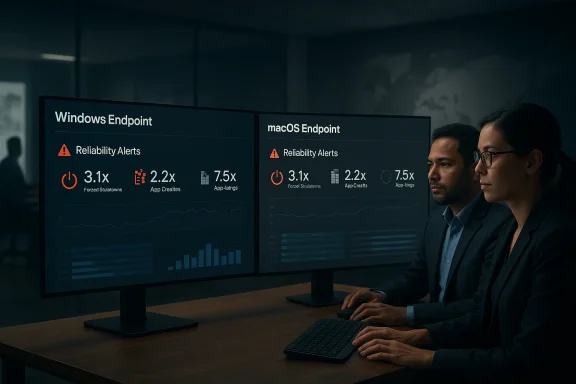
Omnissa’s latest enterprise telemetry is less a verdict on one operating system than a reminder that endpoint reliability has become a board-level issue. The company says Windows devices in its managed fleet saw 3.1x more forced shutdowns than macOS in 2025, alongside 2.2x more application crashes and 7.5x more app hangs, according to its State of Digital Workspace 2026 report. That is a sharp headline, but the real story is broader: in a year when AI tools, mixed-device fleets, and nonstop update cycles have raised the stakes for IT, the stability gap has become part of the enterprise desktop debate. Omnissa frames the findings as digital employee experience data rather than a Windows bug report, which makes the comparison more strategic — and more uncomfortable for Microsoft.
Omnissa’s report lands at a moment when Windows reliability is already under a brighter spotlight than usual. Enterprise administrators have spent much of the past year dealing with update friction, shutdown regressions, app hangs, and the recurring feeling that modern Windows is both more capable and more temperamental than older versions were. In that context, a telemetry study claiming that Windows devices are materially less stable than Macs will not be dismissed as marketing noise, even if it is not an official OS benchmark.
The distinction matters because Omnissa is not describing a controlled lab test. It is describing behavior across a very large managed endpoint base, with the usual caveats that come with enterprise telemetry: fleets differ, workloads differ, patching differs, and user expectations differ. Still, the scale of the dataset gives the report weight. Omnissa says the study is based on anonymized, aggregated telemetry from millions of managed endpoints collected between January and December 2025 across more than 17 industries, including healthcare, retail, financial services, education, government, and high tech.
That broad spread is important because it suggests the findings are not confined to one vertical or a narrow class of devices. A retail terminal, a hospital workstation, and a finance laptop all live very different lives, yet all of them are now judged on whether they stay available, boot cleanly, and keep apps responsive. In that sense, the report reflects a larger truth about enterprise computing: users do not care why the system failed if the system failed. They care that the interruption happened, and that their work stopped.
The report also uses AI adoption as part of the backdrop. Omnissa says AI assistant app usage grew nearly 1000% year over year in 2025, a signal that more endpoints are running more tools, more often, and with less tolerance for instability. That is not just a usage statistic; it is a reliability multiplier. The more workflows depend on live data, sync services, and browser-based AI assistants, the more even brief disruptions become operationally expensive.
The other reason this comparison resonates is that endpoint stability is no longer a back-office concern. When a device hangs, the interruption ripples outward: missed meetings, delayed approvals, broken sales calls, stalled creative work, and help desk tickets. Omnissa’s framing around employee refocus time — nearly 24 minutes to recover after a disruption, according to the company — is meant to show that reliability is not an abstract metric, but a productivity tax.
A forced shutdown is a particularly revealing metric because it usually indicates that something went wrong far enough to make a normal shutdown impossible or undesirable. It can be caused by app instability, hung services, power-state problems, or administrative intervention after a system becomes unresponsive. On its own, the metric does not tell you whether Windows is “bad”; it tells you that something in the ecosystem is producing more serious failures than macOS in the same telemetry base.
The challenge is interpretation. Different hardware vendors, application mixes, and security configurations can all move the numbers. Windows also runs across a much wider range of hardware, drivers, and enterprise images than macOS does, which makes cross-platform comparisons inherently messy. Still, when a report this large points in the same direction across multiple categories, it is hard to dismiss the signal entirely.
There is also a branding angle. An enterprise observability vendor gains attention by publishing findings that align with what admins have been feeling for years. That does not automatically make the data wrong; it means the report sits at the intersection of measurement and market positioning. Readers should treat the numbers as directionally meaningful rather than as a final scientific verdict.
The company’s claim that workers need nearly 24 minutes to refocus after a disruption is especially telling. It shifts the discussion from device management to cognitive overhead. Even if a forced shutdown only happens occasionally, its effect is multiplied by the cost of interruption, context switching, and recovery. In other words, stability is not just about uptime; it is about preserving attention.
That is why the report’s broader pitch is so effective. Omnissa argues that observability across endpoints, applications, and security telemetry is necessary because modern workplace friction rarely has a single cause. A crash may originate in the app, the OS, a driver, a policy, or even an AI assistant overlay that was supposed to make work easier.
That is why reports like Omnissa’s can influence buying decisions even without changing the underlying OS share picture. Macs may not replace Windows in most enterprises, but a reliability narrative can still affect procurement mixes, executive laptop choices, and the growing category of premium knowledge-worker devices.
That does not mean macOS is perfect. It means the average managed Mac may expose fewer layers of variability than the average managed Windows device. Fewer OEM permutations, fewer driver combinations, and tighter platform control can make a real difference when scaled across thousands of endpoints.
The report also dovetails with Apple’s broader total-cost-of-ownership messaging. If devices last longer, suffer fewer interruptions, and require fewer interventions, then the cost case improves even when upfront hardware prices remain higher. That does not make Macs cheap. It makes them easier to justify in roles where downtime is expensive.
That is why the Omnissa findings matter beyond the raw numbers. They give enterprise buyers a language for a feeling they already had. Once a perception is quantified, it becomes much harder for vendors to dismiss.
That is especially true in managed environments, where security controls, device health policies, and vendor utilities interact in complicated ways. The result is an ecosystem where the platform is often blamed for failures that are really the product of layered complexity. Unfortunately for Microsoft, users rarely make that distinction when their screen freezes.
This matters because enterprise IT is increasingly expected to absorb risk without interrupting employees. Security teams want tighter controls, app teams want more performance, and business leaders want fewer support incidents. Windows has to serve all three constituencies at once, and that balancing act can make reliability feel like a moving target.
That is why enterprise telemetry reports carry so much weight. They track the symptoms that organizations pay to eliminate. If Windows produces more of those symptoms than macOS, even under imperfect comparison conditions, the commercial implications are real.
When employees rely on AI copilots, browser-based tools, and multiple synced identity layers, the desktop stops being just a place where apps run. It becomes a coordination layer for cloud services, local compute, and policy enforcement. A hang in one component can cascade into sign-in issues, file-access delays, or workflow interruptions that are harder to diagnose than a traditional crash.
This is why endpoint observability is becoming a strategic investment rather than a luxury. Organizations need to know whether crashes are coming from the OS, the app layer, the browser, or a security policy that is silently interfering with behavior. Without that visibility, AI adoption can create more confusion than acceleration.
That is why the report’s numbers should be read as a symptom of a broader governance problem, not just an operating system judgment. The modern endpoint is a crowded place.
That matters because the PC market is no longer only about raw market share. It is about where organizations place premium devices, which platform gets the executive fleet, and which one becomes the default for knowledge workers. A few percentage points in reliability perception can influence those decisions more than many people realize.
For Microsoft, that means the challenge is not merely to “beat Mac” in some abstract sense. It is to keep Windows attractive enough that organizations do not begin quietly shifting the most valuable users to macOS. That shift can happen without a dramatic platform war; it can happen one procurement cycle at a time.
The harder truth is that Windows’ strengths create the very conditions that can hurt it. Broad hardware support is a massive advantage, but it also widens the failure matrix. Microsoft cannot remove that complexity, only manage it better. The question is whether it can make that management visible to users as stability rather than as surprise.
The broader market is also moving in a direction that favors clear winners on reliability. AI-assisted workflows, cloud-synced files, and mixed security stacks all punish uncertainty. In that world, the vendors that can make the desktop feel boring again will have an advantage. Boring, in enterprise IT, is a compliment.
Omnissa’s report captures that shift in a blunt, data-driven way. Windows may still be the default enterprise platform, but default is no longer enough. If Microsoft wants to defend the desktop for the next decade, it will need to prove that Windows can be not just powerful, but predictably dependable — and that may be the hardest product promise of all.
Source: Notebookcheck Windows devices saw 3.1x more forced shutdowns than macOS - Report
 Overview
Omnissa’s report lands at a moment when Windows reliability is already under a brighter spotlight than usual. Enterprise administrators have spent much of the past year dealing with update friction, shutdown regressions, app hangs, and the recurring feeling that modern Windows is both more capable and more temperamental than older versions were. In that context, a telemetry study claiming that Windows devices are materially less stable than Macs will not be dismissed as marketing noise, even if it is not an official OS benchmark.The distinction matters because Omnissa is not describing a controlled lab test. It is describing behavior across a very large managed endpoint base, with the usual caveats that come with enterprise telemetry: fleets differ, workloads differ, patching differs, and user expectations differ. Still, the scale of the dataset gives the report weight. Omnissa says the study is based on anonymized, aggregated telemetry from millions of managed endpoints collected between January and December 2025 across more than 17 industries, including healthcare, retail, financial services, education, government, and high tech.
That broad spread is important because it suggests the findings are not confined to one vertical or a narrow class of devices. A retail terminal, a hospital workstation, and a finance laptop all live very different lives, yet all of them are now judged on whether they stay available, boot cleanly, and keep apps responsive. In that sense, the report reflects a larger truth about enterprise computing: users do not care why the system failed if the system failed. They care that the interruption happened, and that their work stopped.
The report also uses AI adoption as part of the backdrop. Omnissa says AI assistant app usage grew nearly 1000% year over year in 2025, a signal that more endpoints are running more tools, more often, and with less tolerance for instability. That is not just a usage statistic; it is a reliability multiplier. The more workflows depend on live data, sync services, and browser-based AI assistants, the more even brief disruptions become operationally expensive.
Why this comparison resonates now
The Windows-versus-macOS comparison has always been as much about management philosophy as hardware. Windows remains the dominant enterprise platform by sheer volume, while macOS often wins on perceived polish, battery life, and consistency. In 2025 and early 2026, that contrast became more visible because organizations have had to think harder about device lifecycle, patch cadence, and employee experience.The other reason this comparison resonates is that endpoint stability is no longer a back-office concern. When a device hangs, the interruption ripples outward: missed meetings, delayed approvals, broken sales calls, stalled creative work, and help desk tickets. Omnissa’s framing around employee refocus time — nearly 24 minutes to recover after a disruption, according to the company — is meant to show that reliability is not an abstract metric, but a productivity tax.
- Windows still dominates enterprise fleets, but dominance does not guarantee trust.
- macOS’s lower-friction reputation has become a measurable sales point in managed environments.
- AI-heavy workflows magnify the cost of crashes, hangs, and forced shutdowns.
- Telemetry reports now shape procurement conversations as much as marketing claims do.
What Omnissa Is Actually Measuring
The most important thing to understand about Omnissa’s report is that it measures managed endpoint behavior, not a single Windows build, not a one-off bug, and not consumer PCs in the wild. That makes it useful for enterprise IT, but less useful as a pure consumer OS ranking. The data is still valuable precisely because it reflects real-world usage conditions rather than lab perfection.A forced shutdown is a particularly revealing metric because it usually indicates that something went wrong far enough to make a normal shutdown impossible or undesirable. It can be caused by app instability, hung services, power-state problems, or administrative intervention after a system becomes unresponsive. On its own, the metric does not tell you whether Windows is “bad”; it tells you that something in the ecosystem is producing more serious failures than macOS in the same telemetry base.
Metrics that matter most
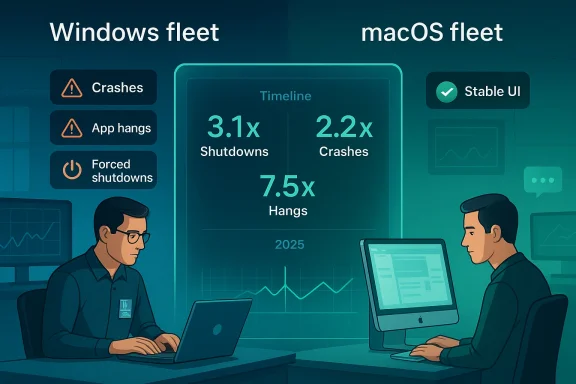
Omnissa says Windows systems saw 3.1 times more forced shutdowns, 2.2 times more crashes, and 7.5 times more app hangs than macOS. Those are not subtle differences, and they suggest a broader quality delta rather than a narrow failure mode. A system that hangs more often is a system that will eventually generate more forced shutdowns, more user frustration, and more help desk escalation.The challenge is interpretation. Different hardware vendors, application mixes, and security configurations can all move the numbers. Windows also runs across a much wider range of hardware, drivers, and enterprise images than macOS does, which makes cross-platform comparisons inherently messy. Still, when a report this large points in the same direction across multiple categories, it is hard to dismiss the signal entirely.
- Forced shutdowns usually imply a failure severe enough to interrupt workflow.
- Crashes capture application-level instability, not just OS faults.
- App hangs often reveal contention, driver issues, or service conflicts before a crash occurs.
- Managed endpoints are a more realistic enterprise sample than consumer anecdotes.
Enterprise telemetry versus public perception
Public perception often lags behind enterprise telemetry, but in this case the two are not far apart. Many IT teams already believe that Windows is more vulnerable to update-related regressions, driver edge cases, and application incompatibilities. Omnissa’s findings give those suspicions a numerical foundation, even if the numbers should not be treated as universal truth.There is also a branding angle. An enterprise observability vendor gains attention by publishing findings that align with what admins have been feeling for years. That does not automatically make the data wrong; it means the report sits at the intersection of measurement and market positioning. Readers should treat the numbers as directionally meaningful rather than as a final scientific verdict.
The Employee Experience Argument
Omnissa is not just talking about device health. It is talking about how device health affects the workday, which is a much more persuasive business argument. If employees lose momentum every time an app freezes or a device restarts, the lost time compounds across the organization. That is why a small reliability gap can matter more than a big feature launch.The company’s claim that workers need nearly 24 minutes to refocus after a disruption is especially telling. It shifts the discussion from device management to cognitive overhead. Even if a forced shutdown only happens occasionally, its effect is multiplied by the cost of interruption, context switching, and recovery. In other words, stability is not just about uptime; it is about preserving attention.
Why small failures add up
A single app hang can waste a few minutes. A shutdown that arrives in the middle of a sales presentation can waste far more. A cluster of such incidents across a team can quickly become an invisible drag on productivity, customer response times, and employee morale.That is why the report’s broader pitch is so effective. Omnissa argues that observability across endpoints, applications, and security telemetry is necessary because modern workplace friction rarely has a single cause. A crash may originate in the app, the OS, a driver, a policy, or even an AI assistant overlay that was supposed to make work easier.
- Interruptions compound because they break concentration, not just software.
- Employee experience is now a measurable IT outcome, not a soft HR concept.
- Recovery time is often longer than the failure itself.
- Reliability investment can pay back in fewer support tickets and fewer lost minutes.
The hidden cost of “good enough”
Many organizations tolerate a baseline level of Windows friction because they are locked into Microsoft ecosystems, business applications, and device management tooling. But “good enough” becomes less acceptable when workers are expected to switch constantly between meetings, browser tabs, AI copilots, and line-of-business apps. The tolerance for minor instability is shrinking.That is why reports like Omnissa’s can influence buying decisions even without changing the underlying OS share picture. Macs may not replace Windows in most enterprises, but a reliability narrative can still affect procurement mixes, executive laptop choices, and the growing category of premium knowledge-worker devices.
Why macOS Keeps Winning Mindshare
Apple has long benefited from a simple message: fewer moving parts, tighter hardware-software integration, and a reputation for behaving predictably. Omnissa’s telemetry appears to reinforce that story. If managed Macs are crashing less, hanging less, and forcing fewer shutdowns than Windows devices, then Apple’s reliability image is no longer just cultural mythology — it is an enterprise talking point.That does not mean macOS is perfect. It means the average managed Mac may expose fewer layers of variability than the average managed Windows device. Fewer OEM permutations, fewer driver combinations, and tighter platform control can make a real difference when scaled across thousands of endpoints.
Reliability as a procurement feature
What makes macOS especially attractive to some IT teams is that reliability is easier to sell than ideology. A CFO does not need to love Apple to appreciate fewer support calls. A security leader does not need to be a Mac evangelist to value a fleet that tends to patch quickly and stay stable afterward. In enterprise decision-making, less disruption often beats more flexibility.The report also dovetails with Apple’s broader total-cost-of-ownership messaging. If devices last longer, suffer fewer interruptions, and require fewer interventions, then the cost case improves even when upfront hardware prices remain higher. That does not make Macs cheap. It makes them easier to justify in roles where downtime is expensive.
- Tighter integration can reduce the variance that produces instability.
- Longer device lifespan can improve the economics of ownership.
- Lower support overhead matters when IT staffing is constrained.
- Consistency is often more valuable than raw configurability.
The enterprise perception gap
Even when Windows performs well, it often has a perception problem. Users remember the bad update, the restart loop, the broken printer driver, or the app that stopped responding during a deadline. Apple benefits from the fact that many of its failures are less visible to end users because the system tends to feel more predictable day to day.That is why the Omnissa findings matter beyond the raw numbers. They give enterprise buyers a language for a feeling they already had. Once a perception is quantified, it becomes much harder for vendors to dismiss.
Windows’ Reliability Problem Is Bigger Than One Report
It would be a mistake to read the Omnissa report as if it were a standalone indictment of Windows 11. The larger issue is that Windows has accumulated a series of reliability narratives that reinforce one another. Update regressions, restart anomalies, app compatibility issues, telemetry complaints, and security hardening side effects all feed the same basic concern: Windows is powerful, but it can also be fragile.That is especially true in managed environments, where security controls, device health policies, and vendor utilities interact in complicated ways. The result is an ecosystem where the platform is often blamed for failures that are really the product of layered complexity. Unfortunately for Microsoft, users rarely make that distinction when their screen freezes.
Recent history has not helped
The timing of Omnissa’s report is awkward for Microsoft because it follows a period in which Windows administrators have already been dealing with shutdown and hibernation regressions, cloud-file save issues, and other update-induced problems documented in the Windows ecosystem. Those incidents shape how any new reliability claim is received, even if the causes differ from report to report. The lesson is not that Windows is collapsing; it is that trust is fragile.This matters because enterprise IT is increasingly expected to absorb risk without interrupting employees. Security teams want tighter controls, app teams want more performance, and business leaders want fewer support incidents. Windows has to serve all three constituencies at once, and that balancing act can make reliability feel like a moving target.
- Security hardening can expose edge cases.
- Driver diversity increases the chance of incompatibility.
- Enterprise customizations can amplify update risk.
- Perception often hardens faster than root-cause analysis.
Why this is not just a consumer problem
Consumer users certainly notice crashes and hangs, but enterprises feel the pain differently. A home user may reboot, retry, and move on. A business user may open a ticket, miss a meeting, or lose work that cannot easily be re-created. The stakes are higher because the failures are multiplied across fleets and roles.That is why enterprise telemetry reports carry so much weight. They track the symptoms that organizations pay to eliminate. If Windows produces more of those symptoms than macOS, even under imperfect comparison conditions, the commercial implications are real.
The AI Layer Makes Stability More Important
One of the most interesting parts of Omnissa’s release is its emphasis on AI tool adoption. The company says AI assistant app usage grew nearly 1000% year over year in 2025, which suggests that work is becoming more interactive, more fragmented, and more dependent on background services. That shift is not cosmetic. It changes what “stable” means.When employees rely on AI copilots, browser-based tools, and multiple synced identity layers, the desktop stops being just a place where apps run. It becomes a coordination layer for cloud services, local compute, and policy enforcement. A hang in one component can cascade into sign-in issues, file-access delays, or workflow interruptions that are harder to diagnose than a traditional crash.
AI tools raise the cost of friction
AI assistants are often framed as productivity boosters, but they also add complexity. More network calls, more browser activity, more authentication prompts, and more live collaboration windows all create additional opportunities for something to stall. If the endpoint is already less stable, those additions can make the experience worse rather than better.This is why endpoint observability is becoming a strategic investment rather than a luxury. Organizations need to know whether crashes are coming from the OS, the app layer, the browser, or a security policy that is silently interfering with behavior. Without that visibility, AI adoption can create more confusion than acceleration.
- AI adoption increases workflow density on each device.
- More services mean more points of failure.
- Observability becomes essential when problems cross OS and cloud boundaries.
- User trust erodes quickly if AI tools feel unreliable.
The shadow of unsanctioned tools
Another subtle implication of the report is that AI adoption often outpaces IT governance. Employees do not wait for an official rollout if a tool seems useful. They install browser extensions, use personal accounts, or adopt shadow IT workflows that create fresh stability and security challenges. The more diverse the software mix, the harder it is to pin responsibility on one platform.That is why the report’s numbers should be read as a symptom of a broader governance problem, not just an operating system judgment. The modern endpoint is a crowded place.
Competitive Implications for Microsoft and Apple
From a competitive standpoint, the report gives Apple an easy narrative win and gives Microsoft a familiar headache. Apple can point to lower crash and shutdown rates as evidence that managed Macs are a safer bet for some workers. Microsoft, meanwhile, has to explain why its much larger ecosystem still produces more friction in enterprise telemetry.That matters because the PC market is no longer only about raw market share. It is about where organizations place premium devices, which platform gets the executive fleet, and which one becomes the default for knowledge workers. A few percentage points in reliability perception can influence those decisions more than many people realize.
The premium-device battle
The enterprise laptop market has split into two mental categories: commodity workhorse devices and premium experience devices. Windows remains dominant in the former, while Apple has made serious gains in the latter. If Omnissa’s findings hold up, they strengthen Apple’s hand in the premium category where reliability, battery life, and employee satisfaction matter most.For Microsoft, that means the challenge is not merely to “beat Mac” in some abstract sense. It is to keep Windows attractive enough that organizations do not begin quietly shifting the most valuable users to macOS. That shift can happen without a dramatic platform war; it can happen one procurement cycle at a time.
- Apple gains a clean reliability talking point.
- Microsoft faces another trust and servicing narrative.
- Premium fleet decisions are often driven by user experience, not only compatibility.
- Reliability gaps can influence executive and creative workflows disproportionately.
Microsoft’s response options
Microsoft’s answer cannot just be marketing. It has to come from improvements in update quality, driver stability, app compatibility, and visibility into system health. The company has already been signaling a greater focus on reliability in Windows 11, and that direction is sensible. But public promises only matter if the next year of servicing feels calmer than the last.The harder truth is that Windows’ strengths create the very conditions that can hurt it. Broad hardware support is a massive advantage, but it also widens the failure matrix. Microsoft cannot remove that complexity, only manage it better. The question is whether it can make that management visible to users as stability rather than as surprise.
Strengths and Opportunities
Omnissa’s report is uncomfortable for Microsoft, but it also clarifies where the industry is heading. Reliability, observability, and employee experience are increasingly central to endpoint strategy, and vendors that help organizations reduce friction are likely to gain traction. The findings also reinforce that macOS has a genuine enterprise story beyond design and branding.- Reliability now has a monetary case, not just a technical one.
- Endpoint observability vendors can turn telemetry into strategic advice.
- Apple’s managed-device story looks stronger when stability is the metric.
- Microsoft can use the pressure to justify long-overdue Windows quality work.
- Hybrid work makes every minute of disruption more expensive.
- AI adoption raises the value of stable, well-instrumented endpoints.
- Procurement teams now have a clearer framework for comparing fleets.
Risks and Concerns
The biggest risk is over-reading the report as if it were a universal ranking of operating system quality. Managed enterprise telemetry is valuable, but it is also shaped by fleet composition, software mix, and administrative policy. Another risk is that organizations may treat macOS as automatically superior without accounting for their own application requirements and support constraints.- Fleet differences can distort cross-platform comparisons.
- Managed data may not reflect consumer experience.
- Marketing spin can overstate what telemetry proves.
- Windows diversity makes reliability harder but not impossible to improve.
- Apple admiration can lead to underestimating management tradeoffs.
- Security hardening may continue to create edge-case regressions.
- AI complexity could make stability problems more frequent, not less.
Looking Ahead
The next phase of this debate will depend less on one report and more on whether enterprise users actually feel a difference over the next few servicing cycles. If Microsoft makes Windows materially calmer, fewer people will care about a telemetry gap. If the company stumbles again, Omnissa’s numbers will start looking less like an outlier and more like a pattern.The broader market is also moving in a direction that favors clear winners on reliability. AI-assisted workflows, cloud-synced files, and mixed security stacks all punish uncertainty. In that world, the vendors that can make the desktop feel boring again will have an advantage. Boring, in enterprise IT, is a compliment.
- Watch Microsoft’s servicing quality across the next several update cycles.
- Watch whether enterprise Macs expand beyond executive and creative teams.
- Watch whether telemetry vendors keep publishing reliability deltas like this one.
- Watch AI adoption’s impact on app hangs, login friction, and endpoint load.
- Watch procurement language shift from features to stability and employee experience.
Omnissa’s report captures that shift in a blunt, data-driven way. Windows may still be the default enterprise platform, but default is no longer enough. If Microsoft wants to defend the desktop for the next decade, it will need to prove that Windows can be not just powerful, but predictably dependable — and that may be the hardest product promise of all.
Source: Notebookcheck Windows devices saw 3.1x more forced shutdowns than macOS - Report