

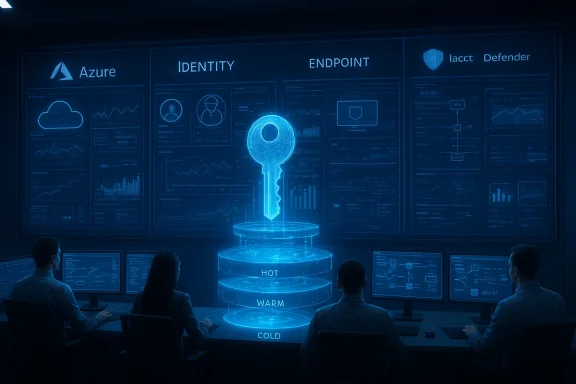
OMV’s security team says moving its core SOC to Microsoft Sentinel cut incident resolution time in half while unifying disparate telemetry under Microsoft Defender XDR—and the deployment reads like a textbook example of modern SOC consolidation: cloud-native SIEM, customer-managed encryption keys, automation with Logic Apps, and hot/warm/cold data tiering via Azure Data Explorer. The result, according to OMV’s cyber defense leadership, is faster investigations, fewer manual handoffs with external partners, and a single control plane that respects data privacy and regulatory needs. This article unpacks that transformation, verifies the technical claims where possible, analyzes the architectural trade-offs, and outlines practical guidance for organizations considering a similar move.
Large energy firms like OMV run complex, geographically distributed IT and OT estates. They operate regulated assets, have strict data-residency obligations, and face sophisticated attackers who exploit identity, email, endpoint, and cloud signals together. Traditional on-prem SIEMs struggle under the scale, cost, and operational burden of continuously ingesting telemetry across those domains.
Cloud-native SIEMs promise three immediate benefits:
Important operational notes for CMK deployments:
It’s critical to treat vendor and customer-reported metrics with the standard journalistic caution:
Specific platform advantages:
For organizations weighing a similar path, the message is clear: the technical ingredients are mature and can yield measurable operational gains, but success depends on disciplined engineering, careful cost and key-management planning, and governance that balances automation speed with safety and auditability. When those pieces are in place, the combination of Microsoft Sentinel, Defender XDR, Logic Apps automation, and tiered analytics can genuinely transform SOC effectiveness—turning a flood of alerts into fast, confident remediation.
Source: Microsoft OMV cuts incident resolution time in half, unifies security with Microsoft Sentinel | Microsoft Customer Stories
 Background: why energy companies move security to the cloud
Large energy firms like OMV run complex, geographically distributed IT and OT estates. They operate regulated assets, have strict data-residency obligations, and face sophisticated attackers who exploit identity, email, endpoint, and cloud signals together. Traditional on-prem SIEMs struggle under the scale, cost, and operational burden of continuously ingesting telemetry across those domains.Cloud-native SIEMs promise three immediate benefits:
- Elastic scale without heavy infrastructure procurement.
- Native integration with cloud identity and endpoint telemetry for faster correlation.
- Built-in SOAR (Security Orchestration, Automation, and Response) to automate repetitive workflows and reduce mean time to respond (MTTR).
Overview of OMV’s goals and constraints
OMV’s security program set a clear set of objectives for this project:- Seamless integration with Microsoft 365 E5 security telemetry and Defender XDR to unify alerts and investigations.
- Rapid scalability to handle growing telemetry volumes without long procurement cycles.
- Strong data privacy and regulatory compliance, including customer-managed encryption keys to meet internal and GDPR requirements.
- Reduced operational dependence on manual processes and external partners by automating SOC workflows.
The architecture in practical terms
Core components and integration pattern
OMV’s deployment combines:- Microsoft Sentinel as the cloud-native SIEM and orchestration layer.
- Microsoft Defender XDR (Defender for Endpoint, Defender for Office 365, Defender for Cloud Apps, etc. as the primary telemetry source and XDR engine.
- Azure Data Explorer (ADX) for scalable log ingestion, advanced analytics, and flexible data tiering (hot/warm/cold).
- Azure Key Vault and customer-managed keys (CMK) for encryption-at-rest control.
- Logic Apps (playbooks) embedded in Sentinel for automated incident response and workflow orchestration.
Data protection: customer-managed keys and practical caveats
A central requirement for OMV was customer-managed keys (CMK) to prove they keep control of cryptographic material used to encrypt telemetry and logs at rest—a frequent regulatory ask in energy and critical infrastructure sectors.Important operational notes for CMK deployments:
- CMK for Sentinel is implemented via Log Analytics dedicated clusters. In practice, a dedicated cluster with a minimum commitment tier is typically required for CMK-enabled Sentinel workspaces; this imposes a baseline consumption/ingestion commitment.
- Not all Sentinel data artifacts are encrypted with CMK. Operational content such as alerts and incidents, and data stored in the Sentinel data lake or transformed into data lake artifacts, may remain encrypted with Microsoft-managed keys depending on onboarding choices and data flows.
- CMK introduces management overhead: key rotation, access policies for the Key Vault, and careful planning to avoid unintentional service interruptions if a key is disabled or deleted.
Automation and operational modernization: Logic Apps, playbooks, and runbooks
A recurring theme in OMV’s account is automation: Sentinel’s Logic Apps playbooks automated workflows that previously required manual updates from external partners. The practical benefits of that automation include:- Faster containment actions (isolate device, revoke sessions, block accounts) through pre-approved automated responses.
- Reduced human error and faster enforcement of consistent playbooks across shifts and analysts.
- Integration with threat intelligence feeds and automated enrichment (e.g., resolve IP reputation, enrich incidents with asset context).
Measured outcomes and the “half the time” claim
OMV reports a 50% reduction in incident resolution time after adopting Sentinel and integrating Defender XDR, Logic Apps, and ADX. That’s a headline figure with strong operational implications: cutting MTTR by half can materially reduce attacker dwell time and limit impact.It’s critical to treat vendor and customer-reported metrics with the standard journalistic caution:
- The 50% reduction is a customer-reported improvement in OMV’s own environment.
- Independent verification of that specific percentage was not available from third-party public reporting at the time of writing.
- Outcomes like MTTR reduction depend heavily on SOC maturity, telemetry coverage, detection rule quality, and the extent of automation; results will vary across organizations.
Why Defender XDR + Sentinel matters here
OMV highlights the value of Defender XDR as the telemetry unifier: endpoints, identity, email, and cloud signals are correlated natively rather than stitched together from multiple vendors. That capability matters because advanced attackers typically chain techniques across identity and endpoint signals; a unified telemetry fabric shortens the investigative path.Specific platform advantages:
- Cross-signal correlation reduces alert fatigue and accelerates root-cause analysis.
- Defender’s managed hunting and Microsoft’s analyst services (when used) provide proactive hunts and on-demand expertise.
- Sentinel’s prebuilt connectors and content hub accelerate onboarding for many Microsoft and third-party sources.
Technical verification — what was checked and confirmed
Key technical claims made in OMV’s story were validated against platform documentation and product guidance:- Customer-managed keys in Sentinel require a dedicated Log Analytics cluster and bring operational constraints (e.g., dedicated cluster commitment tiers and CMK onboarding flows). This is an established platform behavior with explicit operational prerequisites.
- Sentinel integrates tightly with Defender XDR; Microsoft has been consolidating Sentinel into the Defender portal and supports onboarding Sentinel workspaces into Defender for unified SIEM/XDR management.
- Logic Apps (playbooks) are the native orchestration mechanism for Sentinel automation and are commonly used to automate response, enrich incidents, and integrate ticketing systems.
- Azure Data Explorer is a common choice for high-volume telemetry analytics and supports flexible data tiering to balance cost and query performance.
Strengths demonstrated by OMV’s deployment
- Unified telemetry lowers investigative overhead
- By feeding endpoint, identity, email, and cloud telemetry into a single analytic plane, OMV’s SOC reduces manual correlation and speeds triage.
- Automation reduces dependence on manual processes
- Logic Apps playbooks let OMV codify containment and enrichment steps, removing repetitive operational tasks and ensuring consistency.
- Regulatory and data privacy controls are preserved
- Customer-managed keys and careful design allow OMV to keep control of cryptographic material and show auditors concrete controls for GDPR compliance.
- Scalability and analytics
- Using Azure Data Explorer for tiered storage and query performance helps manage costs while preserving fast access to hot telemetry.
- Support and advisory integration
- Working with Microsoft’s Unified Support and designated engineering helped validate architecture and accelerate safe deployment—especially valuable for larger, regulated outfits.
Risks, trade-offs, and things that can go wrong
No deployment is free of trade-offs. OMV’s approach balances substantial benefits with tangible risks:- Vendor concentration and lock-in
- Consolidating telemetry, response, and advisory into a single vendor increases operational dependence on Microsoft tooling and processes. Exiting a single-vendor architecture later is costly and complex.
- CMK and data lake limitations
- Customer-managed keys do not uniformly apply to all Sentinel artifacts (for example, certain data lake artifacts may remain Microsoft-managed). Organizations must understand exactly which data flows are covered by CMK to satisfy auditors.
- Cost modeling and data retention economics
- Cloud SIEMs shift costs to consumption models. Data ingress, retention, and analytics can incur significant ongoing expenses if not actively managed with tiering and retention policies.
- Automation risks
- Automated containment needs rigorous approval models and testing. Overly aggressive playbooks can cause business disruption (e.g., isolating production control systems). Playbooks must include safeguards and rollback pathways.
- Operational complexity
- While automation reduces manual work, it requires robust engineering to build, test, and maintain playbooks, detection rules, and data mappings—effort that often lands on security engineering teams.
- Third-party telemetry and visibility gaps
- If key signals (e.g., network or specialized OT telemetry) are not available or not well integrated, correlation quality and detection fidelity will suffer despite platform consolidation.
Practical recommendations for SOCs considering the same path
- Start with a staged pilot
- Onboard a subset of high-value assets and verify detection fidelity and automation behavior before a full-scale migration.
- Model CMK and cluster requirements early
- CMK often requires dedicated clusters and commitment tiers; model these costs and operational requirements before committing.
- Prioritize telemetry coverage
- Ensure endpoints, identity, email, and critical cloud logs are feeding the SIEM; poor telemetry coverage will limit any SIEM’s effectiveness.
- Harden playbook governance
- Use least-privilege approvals, staged automation (alert enrichment → analyst approval → automated remediation), and emergency rollback procedures.
- Measure with operational KPIs
- Track the right KPIs: mean time to detect (MTTD), mean time to respond (MTTR), false positive rate, analyst hours per incident, and playbook success/failure rates.
- Cost governance: adopt tiering and retention plans
- Implement hot/warm/cold storage strategies and purge policies in Azure Data Explorer or Log Analytics to balance cost and investigatory needs.
- Clarify service terms and escalation paths
- If using vendor-managed services or escalation paths (e.g., Microsoft Incident Response), document SLAs, escalation matrices, and evidence-handling requirements.
- Keep an escape plan
- Maintain exportable forensic artifacts and documented interfaces in case you need to switch tooling or share evidence with regulators.
What OMV’s story signals for the market
OMV’s experience is a microcosm of a broader trend: enterprises with heavy Microsoft investment are consolidating security telemetry and operations into a Microsoft-centric stack to reduce friction and accelerate detection and response. This trend matters for multiple reasons:- Platform consolidation simplifies engineering and can dramatically shorten detection-to-remediation cycles.
- The combination of managed services (hunting, MXDR, incident response) and product integrations lowers the skills barrier for SOCs with limited headcount.
- Regulatory and privacy requirements are pushing enterprises to insist on customer-managed controls—forcing cloud vendors and customers to negotiate workable encryption and key management patterns for SIEM workloads.
Final assessment: who should follow OMV’s path?
This approach is most appropriate for:- Large enterprises with extensive Microsoft 365 E5 and Defender investments.
- Organizations that need to scale SOC operations quickly without massive headcount growth.
- Regulated industries that require demonstrable key control and traceable automation playbooks.
- Teams that can invest in security engineering to build and maintain playbooks, detections, and governance.
- Operate highly heterogeneous estates with critical non‑Microsoft telemetry that would be costly to ingest.
- Want to avoid single-vendor operational dependence or preserve a multi-vendor detection stack for resilience.
- Have limited security engineering capacity to manage playbooks, CMK lifecycle, and cost governance.
Conclusion
OMV’s Sentinel deployment reads as a modern SOC playbook: unify telemetry, automate trusted workflows, enforce data control with customer-managed keys, and use scalable analytics to shorten investigation cycles. The reported 50% reduction in incident-resolution time is a powerful indicator of the impact consolidation and automation can have—though that headline should be viewed as a customer-reported result that depends on specific SOC maturity, telemetry coverage, and playbook design.For organizations weighing a similar path, the message is clear: the technical ingredients are mature and can yield measurable operational gains, but success depends on disciplined engineering, careful cost and key-management planning, and governance that balances automation speed with safety and auditability. When those pieces are in place, the combination of Microsoft Sentinel, Defender XDR, Logic Apps automation, and tiered analytics can genuinely transform SOC effectiveness—turning a flood of alerts into fast, confident remediation.
Source: Microsoft OMV cuts incident resolution time in half, unifies security with Microsoft Sentinel | Microsoft Customer Stories
