

Schneider Electric’s new One Digital Grid Platform packages decades of EcoStruxure capability into an AI-enabled stack that promises to speed outage restoration, tighten model accuracy and give utilities an incremental path to grid modernization — all built on Microsoft Azure and presented as a hybrid-cloud, modular platform for planning, operations and asset management.
Background / Overview
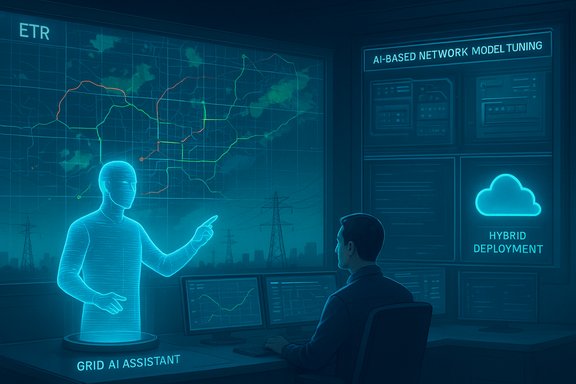
The One Digital Grid announcement was rolled out simultaneously at Enlit Europe in Bilbao and at Schneider Electric’s Innovation Summit North America in Las Vegas, positioning the platform as immediately available to utilities worldwide. Those launch materials show the platform combining core EcoStruxure elements — ADMS, DERMS and ArcFM — with new AI-driven modules such as Estimated Time of Restoration (ETR), Grid AI Assistant, and AI-based Network Model Tuning. Schneider and partner channels emphasise modular, hybrid deployment so utilities can modernize without wholesale rip-and-replace of legacy systems. This move ties neatly into a broader industry narrative: growing electricity demand from data centers, electrification and EVs is stressing distribution systems while distributed energy resources (DERs) and extreme weather increase operational complexity. Schneider frames One Digital Grid as a pragmatic, stepwise modernization path that leverages installed ADMS/DERMS investments and augments them with managed cloud AI. Independent coverage and industry commentary track the same themes.What One Digital Grid actually is
A modular platform built on EcoStruxure
At its core, One Digital Grid is a productisation of Schneider Electric’s existing grid software suite — EcoStruxure ADMS for distribution control and switching, DERMS for DER orchestration, and ArcFM for GIS and asset mapping — augmented with new AI services and an Azure-first hybrid deployment model. The platform is intentionally modular so utilities can adopt planning, operations, asset management or customer-engagement modules independently.Headline AI capabilities
- Estimated Time of Restoration (ETR): Combines live telemetry, weather forecasts, crew availability and historical outage patterns to produce and update customer-facing restoration estimates. The capability is presented as useful for storms, wildfires and controlled outages, and can ingest third-party situational feeds (for example, satellite-based risk feeds).
- Grid AI Assistant: An embedded operator ‘co-pilot’ inside ADMS that surfaces likely fault locations, prioritized remediation steps and decision-support to accelerate control-room workflows.
- AI-based Network Model Tuning: Automated reconciliation between GIS/topology, AMI/metering and operational telemetry to detect and correct model drift — a perennial operational pain point for utilities.
Cloud + on-prem hybrid design
Schneider positions the platform for hybrid operation: latency-sensitive control-plane functions can remain on-premises while analytics, model training and non-real-time services run in Microsoft Azure. Key Azure integrations called out by Schneider include Azure OpenAI Service, Defender for IoT, Microsoft Sentinel and Azure Arc for hybrid orchestration and governance. That architecture aims to combine OT determinism with cloud scale and managed AI services.Why the architecture matters (practical gains and dependencies)
The pitch is classic enterprise engineering: preserve mission-critical on-premises control loops while extending intelligence and scale through a managed cloud. That balance is sensible in brownfield utility environments where SCADA, GIS and workforce systems are heterogeneous.- Benefits the platform explicitly targets:
- Faster outage response and reduced customer-call volumes through ETR.
- Improved simulation fidelity and planning accuracy through automated model tuning.
- Reduced operator cognitive load and faster incident resolution via Grid AI Assistant.
- Cybersecurity primitives and governance via Azure security tooling.
- Key dependencies (real-world constraints):
- Data fidelity: All three headline AI capabilities scale with telemetry density, GIS accuracy and workforce-management visibility. If those inputs are sparse or stale, predictive outputs will be noisy.
- Latency & control-loop boundaries: Certain ADMS actions cannot tolerate cloud round trips; utility teams must define which functions remain local.
- Change management: Effective use requires operator trust, auditable human-in-the-loop controls and practice with advisory-mode outputs before public-facing communication.
The business case: Forrester TEI numbers and how to read them
Schneider’s launch materials prominently cite a Forrester Consulting Total Economic Impact (TEI) study commissioned by Schneider that reports headline outcomes for a composite ADMS customer: 184% ROI, $62 million in business benefits, $40 million net financial gain and a 16‑month payback, alongside operational metrics such as up to 20% fewer outage penalties, 65% time savings for control-room operators and 35% faster field crew resolution. These figures appear across Schneider press assets and multiple trade outlets. Important context and critical caveats:- The Forrester TEI is a vendor‑commissioned study that models a composite customer created from interviews and specific assumptions. Commissioned TEI studies are standard practice but are sensitive to baseline definitions, sample selection and which cost streams were included.
- Headline ROI and dollar figures are directional until a utility reviews the underlying TEI dataset, methodology and assumptions. Procurement teams should demand the full Forrester report and a transparent mapping of model assumptions to their own outage profiles and penalty schedules.
Technical verification — what’s explicitly validated in public materials
Multiple independent outlets and Schneider’s own pressroom confirm the central technical claims:- The platform runs on Microsoft Azure and integrates first‑party Azure services for AI and security.
- ETR, Grid AI Assistant, and AI-driven model tuning are core, named capabilities in the public announcement and trade coverage.
- Schneider publicly references ecosystem partners (for example, AiDASH for satellite and vegetation risk feeds) to enrich situational awareness for outage prediction.
Cybersecurity and governance: a necessary spotlight
Schneider’s architecture bundles Azure Defender for IoT, Microsoft Sentinel and Azure Arc as part of its security posture. That’s a strong baseline: industry-standard SIEM/SOAR and IoT defender tooling can provide centralized telemetry, detection and response across OT/IT boundaries. But a defensible security posture demands more than packaged tooling.Utilities should require:
- Zero-trust segmentation for OT networks and strict identity/IAM policies for any cloud-accessible control-plane elements.
- Independent security assessments that include OT/cloud interaction scenarios and threat-hunting playbooks.
- Service-level agreements (SLAs) and contractual audit rights for incident response that cover both Schneider and Azure responsibilities.
- Data escape and portability clauses so that critical models and telemetry are not locked into a single hyperscaler without an agreed off-ramp.
Operational rollout—recommended pilot path
Schneider’s own materials and independent analyst guidance converge on a conservative, phased rollout. A practical pilot playbook:- Select a contained feeder or service area with reasonably complete GIS, AMI telemetry and crew-logs.
- Deploy ETR and Grid AI Assistant in advisory mode for 60–90 days to collect prediction accuracy metrics and operator feedback.
- Measure baseline and pilot KPIs: mean absolute error (MAE) of ETR vs actual restoration, operator time-per-incident, call center volumes, and outage-penalty dollars.
- Add AI-based Network Model Tuning and run reconciliation cycles in parallel with manual GIS audits to quantify reconciliation time savings.
- Only expose customer-facing ETRs once accuracy and confidence thresholds are met and governance processes for manual override are in place.
Risks, unknowns and procurement checklist
Implementing One Digital Grid introduces technical and programmatic risks utilities must manage:- Data quality gap: AI outputs are only as reliable as the underlying data. Expect upfront effort and likely field audits to reconcile GIS, naming conventions and tagging semantics.
- Brownfield integration complexity: Legacy SCADA historians, multiple GIS versions and disparate workforce-management systems require normalization and integration engineering.
- Concentration risk: Bundling EcoStruxure + Azure + Azure OpenAI centralises capability but also concentrates supply-chain and systemic risk; require contractual portability and data-escape guarantees.
- Operational safety & explainability: Any AI output that influences switching or protective actions must be auditable, explainable and subject to human-in-the-loop approval.
- Regulatory and procurement constraints: Public power utilities and cooperatives often face procurement rules and data residency constraints that complicate managed cloud subscriptions.
- Request the full Forrester TEI dataset and methodology and map it to local outage/penalty profiles.
- Define KPIs and acceptance gates for pilot → scale transitions, including explicit rollback triggers.
- Require independent security and OT/cloud integration testing and quarterly third-party audits.
- Include contractual SLAs for incident response and data egress.
- Negotiate phased commercial terms that tie payments to verified pilot outcomes.
Competitive and market context
One Digital Grid formalises a broader industry trend: ADMS/DERMS incumbents are embedding AI and offering hybrid-cloud orchestration to bridge brownfield utilities into modern operations. The ADMS market is growing rapidly as renewed attention to distribution automation, DER integration and resilience accelerates investment. Schneider’s launch also parallels company-level strategic moves — including large data center deals and a strategic regional push — underscoring the firm’s pivot to capture AI-infrastructure-driven opportunity. For utilities deciding between turnkey stacks and best-of-breed analytics, the trade-offs are familiar:- Turnkey stack (Schneider + Azure): faster path to integrated features, single-vendor accountability, but potential lock-in and concentrated risk.
- Best-of-breed approach: more flexibility and vendor diversification, but heavier integration and operations burden.
What success looks like (and how to measure it)
Success for One Digital Grid deployments will be operational, measurable and incremental. Concrete KPIs to insist upon:- ETR accuracy: track MAE and p95 deviations vs actual restoration times during minor and major events.
- Reduction in customer call volume during events (percent decrease).
- Mean Time To Repair (MTTR) improvements for targeted feeders.
- Reduction in paid outage penalties (dollars per major event).
- Operator efficiency: measured minutes per incident or percentage time savings in control-room workflows.
Final assessment — strengths, trade-offs and practical verdict
Schneider Electric’s One Digital Grid Platform is a credible, pragmatic offering that productizes well-known EcoStruxure strengths with targeted AI overlays. Its principal strengths are:- Modularity and incremental adoption: preserves prior ADMS/DERMS investments and reduces the risk of a big-bang replacement.
- Operational focus: ETR, operator assistance, and model-tuning are practical, measurable features that address visible utility pain points.
- Enterprise cloud foundation: first‑party Azure integrations provide managed AI scale and a familiar security stack for many utilities.
- Vendor-commissioned business claims: headline ROI numbers are compelling but must be validated with the original Forrester dataset and against each utility’s baseline conditions. Treat them as directional until validated.
- Data and integration work: the real work is in data readiness, field audits, integration engineering and governance — not in flipping a switch.
- Security & governance: packaged security is necessary but not sufficient; utilities must own segmentation, patch governance and incident playbooks.
Practical next steps for utility leaders
- Run a targeted Proof of Value on a contained feeder with good telemetry and clear baseline metrics.
- Insist on the Forrester TEI dataset and map assumptions to local outage profiles before accepting headline ROI claims.
- Require third-party OT/cloud security testing and clear SLAs for Schneider + Azure responsibilities.
- Define explicit data-portability and exit terms to prevent hyperscaler lock-in.
- Embed human-in-the-loop governance for any customer-facing ETRs or actions that influence switching and protection.
Schneider Electric’s One Digital Grid is a consequential consolidation of ADMS/DERMS heritage with modern, Azure-based AI services. Its success will not be decided in marketing decks but in the field: real ETR accuracy during storms, measurable reductions in outage penalties, and secure, auditable human workflows that preserve grid safety while delivering faster, more transparent customer communications. Utilities that approach the platform with rigorous pilots, demanding transparency on economic assumptions, and a strong operational governance program will be best placed to capture the promised value.
Source: Daily Energy Insider Schneider Electric introduces AI-enabled platform for utilities - Daily Energy Insider
