

OpenAI’s decision to begin testing advertisements inside ChatGPT marks a watershed moment for consumer-facing conversational AI — one that promises to fund free access at scale while also forcing users, regulators, and competitors to confront hard questions about privacy, persuasion, and the future of trusted digital assistants. ttps://help.openai.com/en/articles/20001047-ads-in-chatgpt)
The practical reality is stark: large-scale, real-time conversational AI is expensive to run. Models that power ChatGPT require enormous compute, storage, and engineering support; OpenAI has repeatedly framed advertising as one way to subsidize free and lower-cost tiers while preserving higher-priced, ad-free subscriptions. The company officially set out its advertising approach in January 2026 and began a phased U.S. test in February 2026.
Public reporting places ChatGPT’s user base in the many-hundreds-of-millions range — figures that vary by metric (daily, weekly, monthly active users) and by whether API and embedded usage is included — but early 2026 estimates commonly cite roughly 800 million users as a headline figure. Valuations for OpenAI have also been reported widely in the press, but they differ across outlets and funding rounds; both the 800‑million user estimate and multi‑hundred‑billion dollar valuations should be treated as estimates, not definitive company filings.
Key takeaways from OpenAI’s statements:
OpenAI’s pivot to advertising is a practical reflection of mounting infrastructure costs and investor expectations. Reporters have described the company as seeking substantial revenue to service its growth and capital needs; the decision to run ads for free‑tier users while keeping revenue from subscriptions and enterprise contracts is a hybrid approach that mirrors media and search incumbents. OpenAI’s stated goal is to subsidize access rather than to convert the company into a pure advertising platform.
But business logic alone doesn’t settle the trust or technical risks. The economics of ad platforms favor optimizing for engagement and clicks — incentives that, if misaligned, can nudge product behavior over time. Several industry observers have warned that the combination of highly personalized conversational history and ad incentives creates unusual ethical and regulatory pressure.
Two practical policy prescriptions emerge:
What happens next will depend on three forces: product design fidelity (how well OpenAI separates ads from answers in practice), independent verification (audits and oversight that can confirm or refute the company’s claims), and market discipline (whether advertisers and partners accept the early model and whether rivals win users with an ad‑free pitch). Until those forces mature, the rollout should be viewed as an experiment with meaningful public risk — one that requires active scrutiny from technologists, lawmakers, and the people who rely on AI assistants every day.
Source: AOL.com ChatGPT will soon show ads based on user conversations
 Background: how we arrived at this moment
The practical reality is stark: large-scale, real-time conversational AI is expensive to run. Models that power ChatGPT require enormous compute, storage, and engineering support; OpenAI has repeatedly framed advertising as one way to subsidize free and lower-cost tiers while preserving higher-priced, ad-free subscriptions. The company officially set out its advertising approach in January 2026 and began a phased U.S. test in February 2026.Public reporting places ChatGPT’s user base in the many-hundreds-of-millions range — figures that vary by metric (daily, weekly, monthly active users) and by whether API and embedded usage is included — but early 2026 estimates commonly cite roughly 800 million users as a headline figure. Valuations for OpenAI have also been reported widely in the press, but they differ across outlets and funding rounds; both the 800‑million user estimate and multi‑hundred‑billion dollar valuations should be treated as estimates, not definitive company filings.
What OpenAI says the ads will (and will not) be
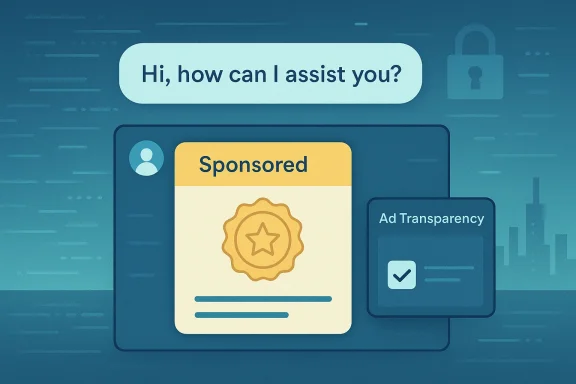
OpenAI’s own help center and product notes define the initial ad experiment with several clear boundaries: ads will be shown only to logged‑in adults in the U.S. on the Free and "Go" plans; paid plans (Plus, Pro, Business, Enterprise, Education) will remain ad‑free; ads will be visually separated and clearly labeled and will appear below the end of a ChatGPT response; and — crucially — OpenAI says ads will not influence model answers. The company also says advertisers will not receive users’ raw chats or sensitive identifiers.Key takeaways from OpenAI’s statements:
- Ads are a test in the U.S.; expansion will be phased and dependent on feedback.
- Ads appear below answers and are labeled as sponsored content; they are run on separate systems from the chat model.
- Paid tiers and accounts for minors (or predicted minors) are intended to be excluded from ads.
How the ad product is described to work (and where ambiguity remains)
At launch, OpenAI and reporting describe a contextual ad model rather than a conventional behavioral ad stack sold to third parties.- Primary targeting signal: the current chat thread — OpenAI will match relevant sponsored products or services to what’s being discussed in a conversation.
- Optional personalization: users can opt into personalized ads; if enabled, OpenAI may use additional internal signals (past chats, ad engagement) to make ads more relevant. Advertisers, however, do not get access to raw chats or personally identifying data.
- Advertiser visibility: during early tests, ad measurement is aggregate (views, clicks); there is no public self‑serve marketplace yet. Industry reporting suggests initial access will be invite‑only with high minimum commitments, though these commercial terms are not fully public.
The commercial logic: scale, margins, and the burn
Few companies have the scale of ChatGPT’s audience, and that scale is exactly what makes advertising attractive. A free model with hundreds of millions of users is a valuable ad surface if engagement remains high and if advertisers can reach users at moments of intent — the exact point when someone asks “what headphones should I buy?” or “best local plumber,” for instance.OpenAI’s pivot to advertising is a practical reflection of mounting infrastructure costs and investor expectations. Reporters have described the company as seeking substantial revenue to service its growth and capital needs; the decision to run ads for free‑tier users while keeping revenue from subscriptions and enterprise contracts is a hybrid approach that mirrors media and search incumbents. OpenAI’s stated goal is to subsidize access rather than to convert the company into a pure advertising platform.
But business logic alone doesn’t settle the trust or technical risks. The economics of ad platforms favor optimizing for engagement and clicks — incentives that, if misaligned, can nudge product behavior over time. Several industry observers have warned that the combination of highly personalized conversational history and ad incentives creates unusual ethical and regulatory pressure.
Industry reaction: a polarized field
The rollout has triggered immediate and vocal reactions across the AI industry, civil society, and former OpenAI employees.- Internal and alumni dissent: Former researcher Zoë Hitzig publicly resigned and published a guest essay expressing deep concern that advertising could steer OpenAI down the “Facebook path,” eroding prior commitments on data use and building incentives to manipulate users. Her critique centers on the unprecedented nature of conversational archives — people disclose intimate, vulnerable information in chat — and on the risk that advertising economics will change product priorities.
- Competitive positioning: Rival companies have seized the moment to differentiate. Some (for example Anthropic) are emphasizing ad‑free propositions in their marketing, while others (Perplexity) have backtracked from advertising experiments, arguing trust and accuracy are core product values that ads can undermine. The result is a visible market split: ad-supported scale vs. subscription-driven trust.
- Journalistic and public scrutiny: Reporters and privacy advocates are pressing for transparency about the ad product’s mechanics, how data is stored and used internally, and the safeguards that prevent advertisers from influencing recommendations or responses. Independent oversight and auditability have been proposed as remedies, but industry mechanisms for binding oversight remain nascent.
Trust, privacy, and the persuasion problem
At the heart of debate are two interlinked risks: erosion of user trust and the creation of a persuasion engine optimized by engagement.- Trust erosion
- Users have historically treated ChatGPT as a neutral assistant; the visible insertion of ads inside a conversational interface can change perceptions of neutrality. If answers start to carry sponsored cards or shopping CTAs, users may question whether the assistant’s recommendations are editorial or commercial. OpenAI has promised separation and labeling, but trust is fragile and accumulates over time.
- Persuasion dynamics
- Ads inserted at the moment of decision — when a user is about to make a choice — are powerful. Coupled with models that tailor tone, clarity, and even emotional resonance, an ad‑augmented assistant could become a potent persuasion channel. Critics warn that absent strict, auditable safeguards, optimization pressures will favor engagement and monetization over accuracy and user welfare. Zoë Hitzig’s resignation note crystallizes this concern: the “archive of human candor” collected in chats is not equivalent to browsing logs and carries different ethical weight.
Legal and regulatory lens
The ad rollout lands in an increasingly active regulatory environment. Policymakers in multiple jurisdictions are scrutinizing how AI firms use personal data, how models are trained, and how risk is managed for powerful systems.- Data protection: Even if advertisers never receive raw chats, the use of conversation content inside the platform for ad selection triggers questions under modern privacy laws about purpose limitation and user consent. Regulators will likely ask whether conversational data was collected for assistance but is now being repurposed for advertising.
- Consumer protection: Claims about ads not influencing responses, or about excluding minors and sensitive topics, create a compliance surface where demonstrable safeguards and enforcement mechanisms will matter. If an ad appears adjacent to advice on medical or legal matters, regulators will probe how brand safety and content controls were implemented.
- Competition and market power: The concentration of a massive conversational audience in an entity with both an ad product and subscription revenue raises questions about vertical leverage and how that power affects advertisers, publishers, and competing platforms. Antitrust authorities have shown interest in platform economics that blend attention markets with essential services.
UX and product design implications
Embedding ads inside conversation changes product design tradeoffs in subtle ways:- Interface design: Ads must be clearly labeled and visually separated to reduce confusion between paid placements and assistant answers. This is a modest technical challenge but a major UX one: labeling alone doesn’t guarantee users perceive separation.
- Contextual relevance vs. sensitivity: OpenAI says it will avoid showing ads in sensitive contexts, but correctly classifying sensitive conversations at scale (mental health, abuse, legal crisis) is a nontrivial detection problem. False positives and negatives both carry cost: overblocking reduces monetization; underblocking risks harm.
- Feedback loops: If the model or product optimizes for ad engagement (even indirectly), there is potential for feedback loops where model tone and suggestions evolve to increase click-throughs. Auditable separation of the ranking systems and rate-limited experiments are necessary to monitor for these effects.
What users and IT admins should know and do now
For individual users:- Expect ads if you are on the Free or Go plan and located in the initial test region. You can avoid them by upgrading to Plus, Pro, or an enterprise/Edu account.
- Use ad personalization settings to limit how much historical chat data contributes to ad selection; read and manage settings carefully.
- Restrict usage: Block free-tier use for sensitive corporate tasks and require enterprise or business plans for internal data handling to ensure ad-free operation and contractual privacy guarantees.
- Update policies: Refresh acceptable use policies to prevent confidential or sensitive information from being posted on free-tier accounts that may be subject to ad selection signals.
- Audit logs: Monitor for any unexpected data sharing or changes in assistant behavior that could indicate subtle shifts in the service’s behavior once ads are live.
- Be cautious in the first phase. Early access will be limited and likely expensive; the platform’s measurement and reporting will be rudimentary. Expect CPMs and minimum commitments that favor large brands initially.
Where verification and transparency must improve
OpenAI’s public assurances are necessary but not sufficient. The following transparency and governance steps would materially reduce risk and increase public confidence:- Independent audits of ad‑selection pipelines and model behavior to verify that ads do not influence responses.
- Clear public documentation of which conversational signals are used for ad selection and how long those signals are retained.
- External oversight or an independent review board with the power to audit and recommend binding safeguards, especially around sensitive categories.
- A roadmap for advertiser access and a timetable for self‑serve APIs or programmatic access, so the market can evaluate incentives and competitive impacts.
The competitive landscape and strategic implications
OpenAI’s move accelerates a wider industry divergence. Some firms will double-down on ad-supported scale; others will pitch ad‑free, subscription-first alternatives. Expect to see:- Increased marketing by ad‑free rivals (Anthropic, certain niche assistants) positioning privacy and trust as differentiators.
- Publishers and e-commerce partners testing integrations and revenue shares where conversational prompts feed sales.
- A media and ad tech scramble to integrate with conversational signals, creating new categories for measurement, attribution, and creative design.
Balancing accessibility and accountability
OpenAI’s pitch is compelling: advertising can subsidize continued free access to a powerful public utility. That framing resonates with critics who worry about paywalls for essential tools. At the same time, the specific technology — conversational models that retain context and can generate persuasive, personalized language — is unlike traditional ad environments. The ethical and social stakes are higher.Two practical policy prescriptions emerge:
- Protect sensitive contexts by default: require explicit, conservative thresholds to classify a conversation as sensitive and suppress ad placements automatically in those cases.
- Insist on independent, recurring audits: technical claims about separation and non‑influence are testable; regulators and civil society should demand regular audits with public summaries.
Conclusion: a historic pivot that must be managed publicly
OpenAI’s ad test is more than a product tweak — it is a structural change in how conversational AI will be funded and experienced by most users. The company has chosen a path that preserves an ad‑free experience for paid customers while opening the free surface to sponsored content that is meant to be contextual and clearly labeled. OpenAI’s public commitments and early technical descriptions are a start, but they are not the final word.What happens next will depend on three forces: product design fidelity (how well OpenAI separates ads from answers in practice), independent verification (audits and oversight that can confirm or refute the company’s claims), and market discipline (whether advertisers and partners accept the early model and whether rivals win users with an ad‑free pitch). Until those forces mature, the rollout should be viewed as an experiment with meaningful public risk — one that requires active scrutiny from technologists, lawmakers, and the people who rely on AI assistants every day.
Source: AOL.com ChatGPT will soon show ads based on user conversations
