

OpenAI has begun testing advertisements inside ChatGPT’s lowest-cost offerings — the free tier and the newly introduced ChatGPT Go — forcing a sudden, practical choice on users: pay to remove ads, accept ad-supported access, or migrate to an alternative assistant that promises ad‑free chat. /openai.com/index/our-approach-to-advertising-and-expanding-access//)
The economics of large, multimodal AI assistants are harsh: real‑time image, voice, and video capabilities at scale require massive compute, storage, and safety infrastructure. OpenAI’s public explanation frames the ad experiment as a way to broaden access without pushing every user to pay, while reserving ad‑free experiences for higher paid tiers. The company rolled ChatGPT Go — a lower‑cost $8/month tier — into the U.S. and announced that ads will be tested for Free and Go accounts, while Plus, Pro, Business and Enterprise timain ad‑free.
This shift matters because it reframes the consumer AI tradeoff: who pays for compute, and what do users give up when a platform monetizes through ads rather than subscription fees? The change has ripple effects beyond headline pricing: it affects privacy, enterprise procurement, user trust, and the competitive landscape for assistant vendors. Multiple vendors — Anthropic, Perplexity, Google, Microsofow offer differentiated paid tiers that promise higher limits, fresher models, or ad‑free experiences.
Competition benefits consumers in two ways: product differentiatons, unique agentic features) and pressure on pricing. But competition also fragments the landscape and complicates procurement: different assistants expose different privacy models, audit capabilities and model families. The net result is a more nuanced, but more complicated, user decision.
Conclusion: ads have arrived in chat — and the sane short‑term response is simple: check the vendor’s current pricing page, test the product in real use, and if ads are unacceptable, upgrade or switch to an ad‑free provider whose contractually‑enforced guarantees match your risk tolerance.
Source: AOL.com ChatGPT Ads Are Here: Here's How to Upgrade to Ad-Free or Switch to Another Chatbot
 Background / Overview
The economics of large, multimodal AI assistants are harsh: real‑time image, voice, and video capabilities at scale require massive compute, storage, and safety infrastructure. OpenAI’s public explanation frames the ad experiment as a way to broaden access without pushing every user to pay, while reserving ad‑free experiences for higher paid tiers. The company rolled ChatGPT Go — a lower‑cost $8/month tier — into the U.S. and announced that ads will be tested for Free and Go accounts, while Plus, Pro, Business and Enterprise timain ad‑free.This shift matters because it reframes the consumer AI tradeoff: who pays for compute, and what do users give up when a platform monetizes through ads rather than subscription fees? The change has ripple effects beyond headline pricing: it affects privacy, enterprise procurement, user trust, and the competitive landscape for assistant vendors. Multiple vendors — Anthropic, Perplexity, Google, Microsofow offer differentiated paid tiers that promise higher limits, fresher models, or ad‑free experiences.
What OpenAI changed — facts and verified specs
The new tiers and ad policy, verified
- ChatGPT Go: $8 per month, expanded access to messaging, images and uploads, but currently included in the ad test for Free and Go accounts.
- ChatGPT Plus: generally listed around $20 per month; offers access to extended GPT‑5 model families, higher message and upload limits, and advanced features.
- ChatGPT Pro: a higher‑capacity option (marketed at roughly $200/month in vendor materials), with fewer limits and access to more powerful GPT variants and agent features. Verify exact limits and model access at checkout because vendor matrices can change.
What the ads look like (testing phase)
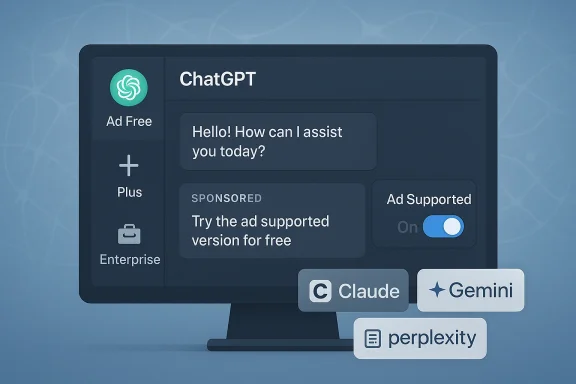
Independent coverage and first‑hand reports describe ads appearing as clearly labeled “sponsored” content or links beneath assistant responses. OpenAI says personalization controls will let users limit ad personalization and data use for ads, and OpenAI claims advertisers will only get aggregate performance metrics rather than raw chat transcripts. Nonetheless, the company’s ad approach has already provoked industry pushback and scrutiny.How to get rid of ads inside ChatGPT
If your objective is an ad‑free ChatGPT experience from OpenAI, there are three practical routes:- Upgrade to ChatGPT Plus or Pro (this is OpenAI’s prescribed path to an ad‑free pexact tier and billing terms in the upgrade flow before paying.
- Move to an enterprise contract (Business or Enterprise) where ad exclusions and data controls belong in the contract, backed by SLAs, audit rights and data‑handling commitments. Product pages and blog posts aren’t a substitute for contractual guarantees.
- Switch to an alternative assistant that advertises ad‑free operation on its free tier or on comparable paid terms (see the Alternatives section below).
- Don’t assume the presence or absence of ads is permanent: ad experiments can expand or contract based on revenue goals and regulatory pressure. Get the guarantees you need in writing when policies matter.
- If you care about the specific model (e.g., GPT‑5 vs. GPT‑5 Pro), check the fine print at purchase — model access and limits are often gated by vendor policy and can vary by region and billing cadence.
Alternatives: a verified comparison across major assistants
Below I summarize the current consumer and prosumer price points and the headline features that matter for users who want to escape ads or compare value. I cross‑checked each vendor’s public pricing and independent reporting where possible.Google — Google AI (Gemini): AI Pro and AI Ultra
- Google AI Pro: $19.99/month. Unlocks Gemini 2.5 Pro access in the Gemini app and in Workspace, Deep Research, a 2 TB storage bundle across Drive/Photos/Gmail, and expanded video/image credits. Google positions this as the mainstream paid tier for heavy users.
- Google AI Ultra: $249.99/month (often with introductory discounts). Highest limits, Deep Think access, 30 TB storage, Project Mariner and early agentic prototypes, plus media perks like YouTube Premium in some bundles. This is Google’s “VIP” product for creators, studios and heavy researchers.
Microsoft — Copilot and Microsoft 365 bundles
- Microsoft’s Copilot is embedded across Windows and Microsoft 365. Microsoft advertises multiple Copilot bundles — Copilot Chat in some apps may be available at no extra cost for eligible Microsoft 365 subscriptions, while higher business/enterprise tiers or add‑ons provide advanced agent features, Actions, and deeper app integrations. Pricing and packaging vary between Individual, Business and Enterprise offers; Microsoft’s pricing page lists the diverse options and current promotional pricing.
Anthropic — Claude Pro and Max
- Claude Pro: roughly $20/month (or $17/month with annual discount) for more usage, Claude Code, Research mode and expanded model choices.
- Claude Max: starts around $100/month for the Max 5x tier and $200/month for Max 20x tiers; Max grants substantially heavier usage, larger context windows, priority access and early features. Anthropic emphasizes privacy and enterprise suitability alongside its usage tiers.
Perplexity — Pro and Max (and Comet)
- Perplexity Pro: commonly reported at $20/month; Pro adds unlimited Pro searches, file uploads, image generation and Comet Plus access. Max is still positioned at roughly $200/month and unlocks background assistants and premium model access. Perplexity’s Comet browser initially launched as a Max‑only premium feature and later became free or widely available in iterations, with Comet Plus as a paid add‑on in some markets.
Grok (xAI) — SuperGrok / SuperGrok Heavy
- SuperGrok: typically reported at $30/month (or $300/year for annual billing); gives access to Grok 3/4, long context windows (up to 128K tokens), priority voice and the Imagine image model.
- SuperGrok Heavy: billed at much higher levels (e.g., $300/month) for heavier usage, earlier model access and extended tokens.
Quick decision guide (consumer & enterprise)
If you just want the one‑line answer:- Want low friction and to stay inside ChatGPT? Upgrade to ChatGPT Plus (or Pro if you need unlimited/very high limits) to avoid ads. Confirm the exact feature matrix before you pay.
- Want guaranteed ad‑free and enterprise auditability? Evaluate Anthropic Claude with a Team/Max contract or negotiate enterprise terms with explicit data handling clauses.
- Want search + agentic browsing and are research‑oriented? Consider Perplexity Pro/Max + Comet, but vet model access and recent UI billing changes.
- Want deep Google integration, storage and media perks? Google AI Pro or AI Ultra delivers Gemini in Workspace plus large storage bundles and video/Flow tools.
Cost calculus — how to pick by use case
People evaluate assistant subscriptions along four axes:- Model freshness and capability (which model family do you need?)
- Usage limits and token/context window (long documents, multiturn threads)
- Integrations (Workspace, Office, browser, plugins)
- Data, privacy and contractual guarantees
- If you use an assistant for occasional writing, brainstorming or images: the free tier or a modest $8–$20 plan is usually sufficient. But factor in ads if you choose the very cheapest option.
- If you use AI for client work, research or sensitive projectsse or “Max” style tiers with contractual assurances and audit logs (Claude Max, ChatGPT Enterprise, Google AI Ultra enterprise offerings).
- If you rely on long documents and agentic browsing: confirm context window and background assistant features (Perplexity Max, Grok SuperGrok Heavy).
- Start by listing the top three tasks you need (e.g., code review, client deliverables, video generation).
- Map each task to a feature (model family, context window, API access, workspace integration).
- Choose the cheapest tier that explicitly covers those features; insist on written guarantees for anything that affects compliance or client‑facing work.
- Revisit quarterly — model access and pricing change quickly in trivacy, trust and the ad question
- Risk: contextual targeting could use chat history or assistant prompts to match ads to conversation content. Mitigation: disable ad personalization where the vendor provides that setting; prefer paid tiers for blanket ad exclusion if privacy is essential.
- Risk: vendor consolidation of attention/data into ad revenue incentives may shift product roadmaps away from long‑term user value. Mitigation: for enterprise use, negotiate contractual data restrictions and audit rights.
- Risk: ads may accidentally appear in or near sensitive topics despite guardrails. Mitigation: test the service on representative queries before committing, and require contractual exceptions for regulated subjects.
Shortcomings and risks in vendor claims (what to watch for)
- Advertising promises are product claims, not legal guarantees. If you need contractual assurances (no ads, no model training on your data, auditable logs), demand them in a contract. OpenAI’s wording about ad exclusion for paid tiers is a policy statement pending contractual codification for enterprise deals.
- Pricing and model access are changing rapidly. What appears in news coverage or third‑party summaries can lag the vendor’s live checkout screen; always verify at purchase.
- Free and low‑cost tiers often route compute to cheaper or older models; the “ad‑free” experience doesn’t necessarily mean access to the top reasoning model unless your tier explicitly includes it. Check exact model names (e.g., GPT‑5 vs GPT‑5 Pro vs o3 Pro) in the vendor’s pricing docs.
- Some vendor perks (large storage, agentic tools, video generation) are region‑gated. Confirm availability by country and platform. Google’s AI Ultra and Gemini Deep Think, for example, vary by region and app.
What this moment means for the AI market
OpenAI’s ad experiment signals a maturing market where platforms are exploring multiple monetization paths — subscription, enterprise licensing, advodels. The practical effect for users is a shift from a single “universal” assistant to a set of productized experiences, each optimized for different tradeoffs: free + ads, inexpensive subscription, premium pro tiers, or enterprise contracts with guarantees.Competition benefits consumers in two ways: product differentiatons, unique agentic features) and pressure on pricing. But competition also fragments the landscape and complicates procurement: different assistants expose different privacy models, audit capabilities and model families. The net result is a more nuanced, but more complicated, user decision.
Final assessment and practical next steps
- If you simply cannot tolerate ads and want the lowest administrative friction, upgrade to ChatGPT Plus or equivalent OpenAI paid tier — but verify the feature list and model access at checkout.
- If your primary concerns are privacy and contractual guarantees, evaluate Anthropic Claude (Pro/Max and enterprise contracts) or negotiate enterprise terms with OpenAI/Google that explicitly exclude advertising and define data handling.
- If you need deep integration with search and browser workflows, Perplexity Pro/Max + Comet and Google AI Pro/Ultra are the obvious candidates; weigh which integration (browser vs Workspace vs Office) you actually use every day.
- 1.) Test the assistant with representative queries.
- 2.) Confirm model names and limits in the product checkout.
- 3.) If you’re an enterprise buyer, insist that ad, data retention, training, and audit clauses are written into the contract.
Conclusion: ads have arrived in chat — and the sane short‑term response is simple: check the vendor’s current pricing page, test the product in real use, and if ads are unacceptable, upgrade or switch to an ad‑free provider whose contractually‑enforced guarantees match your risk tolerance.
Source: AOL.com ChatGPT Ads Are Here: Here's How to Upgrade to Ad-Free or Switch to Another Chatbot
