

OpenAI and Microsoft have recut one of the defining alliances of the generative AI era, replacing a tightly controlled exclusive structure with a more flexible arrangement that lets OpenAI serve customers across rival clouds while keeping Azure first in line. The reset does not break the partnership; it reprices its strategic value, moving Microsoft from sole gatekeeper toward preferred infrastructure partner, major shareholder, and deeply integrated AI platform vendor. For Windows users, enterprise IT leaders, developers, and cloud investors, the real story is not that Microsoft lost OpenAI — it is that the AI cloud war has entered a more open, more expensive, and more competitive phase.
Microsoft’s relationship with OpenAI began as a bold infrastructure-and-research bet before generative AI became a mainstream enterprise priority. The 2019 investment gave OpenAI access to Azure-scale compute at a moment when training frontier models required more capital, GPUs, networking, and engineering discipline than most startups could realistically assemble. In return, Microsoft gained a privileged position in what would become the most visible AI product wave since the smartphone.
That early alignment paid off spectacularly after ChatGPT turned OpenAI into a household name and gave Microsoft the narrative advantage it had lacked in consumer technology for years. Azure OpenAI Service, GitHub Copilot, Microsoft 365 Copilot, Security Copilot, and later Copilot Studio all rested on the idea that Microsoft could turn frontier models into enterprise software distribution. The company’s advantage was never just model access; it was the ability to wrap models in identity, compliance, data governance, productivity workflows, and procurement channels.
The arrangement also created tension because OpenAI’s ambitions grew faster than any single cloud relationship could comfortably support. As AI demand shifted from experimentation to production workloads, OpenAI needed more compute, more distribution, and more commercial freedom. Enterprises increasingly wanted AI services where their data already lived, whether that was Azure, AWS, Google Cloud, Oracle, or a hybrid setup.
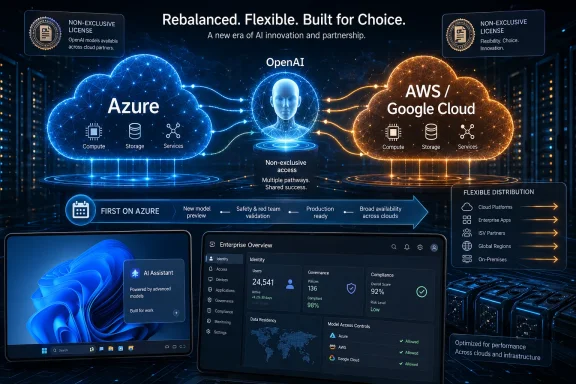
The October 2025 restructuring already hinted that the old exclusivity model was under strain. Microsoft’s investment stake in OpenAI’s for-profit arm was valued at roughly $135 billion, and OpenAI committed to a massive Azure spend, but the agreement also loosened parts of the compute relationship. The newly amended deal goes further by making Microsoft’s OpenAI IP license non-exclusive, ending Microsoft’s payments back to OpenAI, capping OpenAI’s future revenue-share payments to Microsoft, and allowing OpenAI to serve products across any cloud provider.
OpenAI can now serve all its products to customers across any cloud provider. Microsoft remains OpenAI’s primary cloud partner, and OpenAI products are still supposed to ship first on Azure unless Microsoft cannot, and chooses not to, support the required capabilities. That “first on Azure” language is important because it preserves a timing and integration advantage even as formal exclusivity fades.
The financial mechanics also changed. Microsoft will no longer pay a revenue share to OpenAI, while OpenAI’s revenue-share payments to Microsoft continue through 2030 at the same percentage but with an overall cap. That cap matters because it limits Microsoft’s long-tail upside if OpenAI’s revenue scales into much larger enterprise and consumer markets.
Enterprises do not adopt AI by clicking a model endpoint in isolation. They integrate it into identity systems, audit logs, data warehouses, compliance policies, app platforms, security operations, developer environments, and productivity suites. Microsoft owns an unusually broad surface area across those layers, from Entra ID and Purview to Microsoft 365, Teams, Fabric, Defender, Windows, GitHub, and Visual Studio.
That stack makes Azure sticky even when OpenAI becomes more portable. A bank or manufacturer already standardized on Microsoft 365 and Azure may still prefer the Microsoft-hosted path because procurement, support, data residency, and governance are simpler. In highly regulated industries, simpler is often stronger than cheaper.
AWS has a particularly compelling opportunity because many large enterprises already run their mission-critical workloads there. If OpenAI access becomes available in a way that fits AWS-native data pipelines, security policies, and procurement cycles, Amazon can argue that customers no longer need to shift AI workloads to Azure simply to access frontier OpenAI capabilities. That could make AWS more competitive in accounts where Azure had been gaining mindshare through OpenAI.
Google Cloud’s opportunity is different but still meaningful. Google already has Gemini, TPU infrastructure, deep AI research credibility, and strong data analytics products. If OpenAI becomes another high-demand model option within a Google Cloud-centered enterprise strategy, Google can position itself as a model choice platform rather than a single-model bet.
Microsoft has also been broadening model choice. By incorporating rival models into parts of its platform strategy, the company has signaled that it does not want Copilot, Azure AI, or developer tools to depend on OpenAI alone. That is strategically sensible because model leadership can rotate quickly, while enterprise distribution tends to compound over time.
If Microsoft executes well, the non-exclusive OpenAI license could become a catalyst rather than a defeat. The company can continue using OpenAI models where they are best, plug in alternatives where they are stronger or cheaper, and build differentiated value in orchestration, compliance, workflow automation, and user experience. That is a harder moat to explain, but potentially a more durable one.
Compute is the core issue. Frontier AI is not just software; it is a capital-intensive industrial system involving data centers, GPUs, custom silicon, power contracts, cooling, networking, and global deployment. No single cloud provider can satisfy unlimited demand without tradeoffs, especially as training and inference workloads both explode.
A multi-cloud OpenAI can better match customers to capacity and geography. It can serve regulated workloads where a customer’s preferred cloud already has the right compliance footprint. It can also negotiate from a stronger position when buying infrastructure, because dependency on one supplier weakens pricing power.
This does not mean enterprises will rush to scatter OpenAI workloads across every cloud. Most large organizations are trying to reduce complexity, not add to it. The more likely outcome is that enterprises will use multi-cloud availability as leverage while still standardizing around a small number of approved AI deployment patterns.
Microsoft’s challenge is to keep Azure as the path of least resistance. AWS and Google’s challenge is to prove that OpenAI on their clouds is not a second-class experience. OpenAI’s challenge is to keep product quality consistent enough that customers trust its brand independent of hosting location.
Developers may feel the impact sooner. If OpenAI services become easier to consume across multiple cloud environments, developers building AI applications can choose infrastructure based on existing architecture rather than contractual availability. That could reduce friction for startups and enterprise engineering teams already committed to AWS or Google Cloud.
Windows developers should watch how Microsoft responds inside Visual Studio, GitHub, Windows App SDK, Azure AI Foundry, and Copilot Runtime-style tooling. Microsoft’s best defense is to make AI development on its platform faster, safer, and more productive than the alternatives. Convenience can be a moat when it saves engineering time.
Anthropic’s relationship with AWS already gave Amazon a major frontier-model story. OpenAI’s broader availability could either strengthen AWS by adding another marquee model or complicate Anthropic’s differentiation inside Amazon’s ecosystem. Google faces a similar balancing act between promoting Gemini and allowing customers to use OpenAI where they insist on it.
Microsoft may actually benefit from this broader model competition if Azure becomes the best governance layer for all of it. The company can tell customers they do not have to bet the business on one lab. That message is powerful for enterprises worried about cost curves, safety incidents, model regressions, or sudden platform changes.
The counterargument is that Microsoft still keeps several valuable assets: first-on-Azure treatment, IP access through 2032, major shareholder exposure, Copilot distribution, Azure enterprise relationships, and the ability to stop paying revenue share to OpenAI. The revenue-share cap limits upside, but it also adds predictability and removes some open-ended complexity. Microsoft may be trading maximum theoretical control for a cleaner, more scalable partnership.
For Amazon, the bull case is sharper. If OpenAI can serve customers across AWS, Amazon gets a fresh opening to capture incremental AI inference and enterprise workloads that might otherwise have defaulted to Azure. The key risk is adoption speed: if Azure remains technically superior for OpenAI deployments, AWS may get headlines before it gets meaningful revenue.
Watch Microsoft’s Copilot roadmap especially closely. If Microsoft accelerates model diversity, improves agent orchestration, and makes Copilot more useful across Windows, Microsoft 365, GitHub, Dynamics, and security workflows, the company can reduce dependence on any single model provider. If Copilot remains too closely tied to OpenAI perception, the loss of exclusivity may feel more painful.
Key indicators over the next several quarters include:
The Microsoft-OpenAI reset marks the end of the simplest chapter in the AI cloud wars and the beginning of a more complex one. Microsoft remains deeply advantaged, but its advantage must now be earned through Azure performance, Copilot integration, enterprise trust, and platform breadth rather than exclusivity alone. OpenAI gains the freedom it needs to scale like an independent AI infrastructure company, while AWS and Google finally get a clearer shot at demand that once flowed overwhelmingly through Microsoft’s orbit. For the broader market, that means more competition, more choice, and more pressure on every player to prove that AI is not just a spectacular technology story, but a durable business.
Source: Invezz OpenAI-Microsoft reset may reshape AI cloud competition
 Background
Microsoft’s relationship with OpenAI began as a bold infrastructure-and-research bet before generative AI became a mainstream enterprise priority. The 2019 investment gave OpenAI access to Azure-scale compute at a moment when training frontier models required more capital, GPUs, networking, and engineering discipline than most startups could realistically assemble. In return, Microsoft gained a privileged position in what would become the most visible AI product wave since the smartphone.That early alignment paid off spectacularly after ChatGPT turned OpenAI into a household name and gave Microsoft the narrative advantage it had lacked in consumer technology for years. Azure OpenAI Service, GitHub Copilot, Microsoft 365 Copilot, Security Copilot, and later Copilot Studio all rested on the idea that Microsoft could turn frontier models into enterprise software distribution. The company’s advantage was never just model access; it was the ability to wrap models in identity, compliance, data governance, productivity workflows, and procurement channels.
The arrangement also created tension because OpenAI’s ambitions grew faster than any single cloud relationship could comfortably support. As AI demand shifted from experimentation to production workloads, OpenAI needed more compute, more distribution, and more commercial freedom. Enterprises increasingly wanted AI services where their data already lived, whether that was Azure, AWS, Google Cloud, Oracle, or a hybrid setup.
The October 2025 restructuring already hinted that the old exclusivity model was under strain. Microsoft’s investment stake in OpenAI’s for-profit arm was valued at roughly $135 billion, and OpenAI committed to a massive Azure spend, but the agreement also loosened parts of the compute relationship. The newly amended deal goes further by making Microsoft’s OpenAI IP license non-exclusive, ending Microsoft’s payments back to OpenAI, capping OpenAI’s future revenue-share payments to Microsoft, and allowing OpenAI to serve products across any cloud provider.
From Strategic Alliance to Flexible Federation
The key historical shift is that the partnership is no longer best understood as a closed pipeline from OpenAI research to Azure distribution. It is now closer to a federated AI infrastructure model, where Microsoft remains first and primary but no longer absolute. That distinction matters because cloud power increasingly depends on capacity, latency, enterprise proximity, and model choice — not just contractual exclusivity.What Actually Changed
The most important change is the removal of Microsoft’s exclusive grip on OpenAI’s models and products. Microsoft still keeps a license to OpenAI intellectual property for models and products through 2032, but that license is now non-exclusive. In plain English, Microsoft keeps access, but it no longer has the only privileged commercial lane.OpenAI can now serve all its products to customers across any cloud provider. Microsoft remains OpenAI’s primary cloud partner, and OpenAI products are still supposed to ship first on Azure unless Microsoft cannot, and chooses not to, support the required capabilities. That “first on Azure” language is important because it preserves a timing and integration advantage even as formal exclusivity fades.
The financial mechanics also changed. Microsoft will no longer pay a revenue share to OpenAI, while OpenAI’s revenue-share payments to Microsoft continue through 2030 at the same percentage but with an overall cap. That cap matters because it limits Microsoft’s long-tail upside if OpenAI’s revenue scales into much larger enterprise and consumer markets.
The Core Clauses
The amended framework can be boiled down to several practical changes:- Azure remains first, but not exclusive.
- OpenAI gains multi-cloud distribution across competing infrastructure platforms.
- Microsoft keeps OpenAI IP access through 2032.
- That IP access is now non-exclusive, reducing contractual moat.
- Microsoft stops paying OpenAI revenue share, simplifying the reverse flow.
- OpenAI keeps paying Microsoft through 2030, but under a total cap.
- Microsoft remains a major shareholder, preserving upside through equity exposure.
Why Azure Still Matters
The bear case on Microsoft is straightforward: if OpenAI can run everywhere, Azure loses the default cloud outlet that helped define Microsoft’s AI lead. But that interpretation is too narrow. Azure’s advantage is not merely contractual; it is operational, architectural, and deeply embedded in enterprise buying behavior.Enterprises do not adopt AI by clicking a model endpoint in isolation. They integrate it into identity systems, audit logs, data warehouses, compliance policies, app platforms, security operations, developer environments, and productivity suites. Microsoft owns an unusually broad surface area across those layers, from Entra ID and Purview to Microsoft 365, Teams, Fabric, Defender, Windows, GitHub, and Visual Studio.
That stack makes Azure sticky even when OpenAI becomes more portable. A bank or manufacturer already standardized on Microsoft 365 and Azure may still prefer the Microsoft-hosted path because procurement, support, data residency, and governance are simpler. In highly regulated industries, simpler is often stronger than cheaper.
Enterprise Gravity Is Real
Azure’s moat now depends less on exclusivity and more on execution. Microsoft has to prove that “first on Azure” means better performance, faster access, deeper integrations, and stronger governance. If it does, Azure remains the premium OpenAI deployment venue.- Microsoft 365 Copilot keeps OpenAI-derived intelligence close to daily knowledge work.
- GitHub Copilot keeps developers inside Microsoft’s AI tooling orbit.
- Azure AI Foundry provides a broader model catalog beyond OpenAI.
- Defender and Sentinel create a security-driven AI channel.
- Windows and Edge give Microsoft consumer and workplace touchpoints.
- Enterprise agreements make Azure easier to expand inside existing accounts.
AWS and Google Cloud Get Their Opening
The most obvious beneficiaries are Amazon Web Services and Google Cloud. OpenAI’s ability to serve products across any cloud provider gives AWS and Google a path to capture AI consumption that previously had to route more directly through Microsoft. For customers already committed to AWS or Google infrastructure, this could shorten the path from AI pilot to production deployment.AWS has a particularly compelling opportunity because many large enterprises already run their mission-critical workloads there. If OpenAI access becomes available in a way that fits AWS-native data pipelines, security policies, and procurement cycles, Amazon can argue that customers no longer need to shift AI workloads to Azure simply to access frontier OpenAI capabilities. That could make AWS more competitive in accounts where Azure had been gaining mindshare through OpenAI.
Google Cloud’s opportunity is different but still meaningful. Google already has Gemini, TPU infrastructure, deep AI research credibility, and strong data analytics products. If OpenAI becomes another high-demand model option within a Google Cloud-centered enterprise strategy, Google can position itself as a model choice platform rather than a single-model bet.
Multi-Cloud Becomes the Sales Pitch
The competitive message will be simple: enterprises can now bring OpenAI closer to where their workloads already live. That does not automatically mean AWS or Google will win massive share overnight, but it changes the procurement conversation.- AWS can bundle OpenAI access with existing data lakes, Bedrock-style model choice, and custom silicon.
- Google Cloud can pair OpenAI availability with BigQuery, Vertex AI, Gemini, and TPU economics.
- Oracle and other infrastructure players can compete for specialized capacity.
- Enterprises gain negotiation leverage against single-cloud lock-in.
- OpenAI gains resilience by reducing dependency on one provider’s capacity roadmap.
Microsoft’s Moat Moves Up the Stack
The OpenAI reset forces Microsoft to prove a more sophisticated point: the enduring value is not exclusive access to one model provider, but the ability to turn many models into useful enterprise systems. This is where Microsoft’s strategy has already been heading. Copilot is increasingly less about a single chatbot and more about embedding AI agents into business processes.Microsoft has also been broadening model choice. By incorporating rival models into parts of its platform strategy, the company has signaled that it does not want Copilot, Azure AI, or developer tools to depend on OpenAI alone. That is strategically sensible because model leadership can rotate quickly, while enterprise distribution tends to compound over time.
If Microsoft executes well, the non-exclusive OpenAI license could become a catalyst rather than a defeat. The company can continue using OpenAI models where they are best, plug in alternatives where they are stronger or cheaper, and build differentiated value in orchestration, compliance, workflow automation, and user experience. That is a harder moat to explain, but potentially a more durable one.
From Exclusivity to Orchestration
Microsoft’s next advantage must be built in layers:- Model access, including OpenAI and competing frontier models.
- Cloud infrastructure, including Azure GPUs, networking, storage, and AI accelerators.
- Enterprise data integration, spanning Microsoft 365, Fabric, Dynamics, and security tools.
- Agent orchestration, where tasks move across apps, users, and business systems.
- Governance and compliance, where Microsoft can turn risk management into a selling point.
OpenAI’s IPO Logic and Compute Hunger
For OpenAI, the amended agreement looks like a necessary step toward becoming a full-scale AI platform company rather than a Microsoft-dependent model supplier. If the company is preparing for a future public-market path, investors will want clearer commercial freedom, diversified infrastructure access, and fewer constraints tied to one strategic partner. The new deal helps answer those concerns.Compute is the core issue. Frontier AI is not just software; it is a capital-intensive industrial system involving data centers, GPUs, custom silicon, power contracts, cooling, networking, and global deployment. No single cloud provider can satisfy unlimited demand without tradeoffs, especially as training and inference workloads both explode.
A multi-cloud OpenAI can better match customers to capacity and geography. It can serve regulated workloads where a customer’s preferred cloud already has the right compliance footprint. It can also negotiate from a stronger position when buying infrastructure, because dependency on one supplier weakens pricing power.
More Capacity, Less Dependency
OpenAI’s new flexibility creates several strategic benefits:- Greater enterprise reach across existing customer cloud environments.
- Improved bargaining power with infrastructure providers.
- Reduced operational concentration risk if one cloud faces capacity constraints.
- More credible IPO positioning as an independent platform.
- More room for specialized hardware partnerships across GPUs, custom AI chips, and accelerators.
- Faster global deployment where regional cloud footprints differ.
Enterprise Buyers Will Reprice Optionality
For CIOs and CTOs, the amended Microsoft-OpenAI agreement changes the negotiation table. Buyers who previously treated OpenAI access as an Azure-led decision can now ask whether the same capabilities can be deployed closer to existing data, applications, and compliance controls. That creates new optionality and likely new pricing pressure.This does not mean enterprises will rush to scatter OpenAI workloads across every cloud. Most large organizations are trying to reduce complexity, not add to it. The more likely outcome is that enterprises will use multi-cloud availability as leverage while still standardizing around a small number of approved AI deployment patterns.
Microsoft’s challenge is to keep Azure as the path of least resistance. AWS and Google’s challenge is to prove that OpenAI on their clouds is not a second-class experience. OpenAI’s challenge is to keep product quality consistent enough that customers trust its brand independent of hosting location.
Procurement and Governance Shift
The enterprise buying process will likely become more deliberate. AI teams will compare latency, data movement costs, security controls, model availability, support terms, and integration depth before choosing where OpenAI workloads land.- Existing Azure customers may stay with Microsoft for simplicity.
- AWS-heavy customers may push for OpenAI access inside AWS-native workflows.
- Google Cloud customers may compare OpenAI against Gemini in the same architecture.
- Regulated industries will scrutinize auditability and data residency.
- Procurement teams will use multi-cloud access to negotiate discounts.
- Security teams will demand consistent controls across providers.
Consumer and Developer Implications
For consumers, the change may be less visible in the short term. ChatGPT, Copilot, and Windows AI features will not suddenly diverge because of a licensing amendment. Microsoft still has access to OpenAI models, and OpenAI still has every reason to keep its largest strategic partner close.Developers may feel the impact sooner. If OpenAI services become easier to consume across multiple cloud environments, developers building AI applications can choose infrastructure based on existing architecture rather than contractual availability. That could reduce friction for startups and enterprise engineering teams already committed to AWS or Google Cloud.
Windows developers should watch how Microsoft responds inside Visual Studio, GitHub, Windows App SDK, Azure AI Foundry, and Copilot Runtime-style tooling. Microsoft’s best defense is to make AI development on its platform faster, safer, and more productive than the alternatives. Convenience can be a moat when it saves engineering time.
Choice Without Fragmentation
The upside for developers is more choice. The downside is more fragmentation if APIs, deployment options, pricing, or model behavior vary across clouds.- More hosting options could reduce vendor lock-in.
- More model catalogs could improve application design.
- More pricing competition could lower inference costs over time.
- More integration paths could complicate DevOps and security.
- More regional options could help global app deployment.
- More enterprise approvals could slow teams that lack governance maturity.
Competitive Fallout Across the AI Stack
The reset will ripple far beyond Microsoft and OpenAI. Anthropic, Google DeepMind, Meta, xAI, Mistral, Cohere, and open-weight model communities all compete in a market where distribution matters almost as much as raw benchmark performance. If OpenAI becomes more cloud-portable, rival model providers must sharpen their own infrastructure and enterprise strategies.Anthropic’s relationship with AWS already gave Amazon a major frontier-model story. OpenAI’s broader availability could either strengthen AWS by adding another marquee model or complicate Anthropic’s differentiation inside Amazon’s ecosystem. Google faces a similar balancing act between promoting Gemini and allowing customers to use OpenAI where they insist on it.
Microsoft may actually benefit from this broader model competition if Azure becomes the best governance layer for all of it. The company can tell customers they do not have to bet the business on one lab. That message is powerful for enterprises worried about cost curves, safety incidents, model regressions, or sudden platform changes.
The Stack Is Splitting
AI competition is no longer a single race. It is splitting into several overlapping markets:- Frontier model development, where capability and safety dominate.
- Cloud infrastructure, where capacity and cost determine deployment.
- Enterprise AI platforms, where governance and workflow integration matter.
- Developer tooling, where speed and reliability win adoption.
- Consumer AI assistants, where brand and habit drive usage.
- Silicon and data centers, where capital expenditure becomes strategy.
Investor Read-Through: MSFT, AMZN, and the Cloud Trade
For Microsoft investors, the immediate concern is that the company’s AI premium becomes harder to justify if OpenAI is no longer a captive Azure demand engine. That concern is legitimate. Exclusivity was easy to understand, easy to model, and easy to sell as a durable moat.The counterargument is that Microsoft still keeps several valuable assets: first-on-Azure treatment, IP access through 2032, major shareholder exposure, Copilot distribution, Azure enterprise relationships, and the ability to stop paying revenue share to OpenAI. The revenue-share cap limits upside, but it also adds predictability and removes some open-ended complexity. Microsoft may be trading maximum theoretical control for a cleaner, more scalable partnership.
For Amazon, the bull case is sharper. If OpenAI can serve customers across AWS, Amazon gets a fresh opening to capture incremental AI inference and enterprise workloads that might otherwise have defaulted to Azure. The key risk is adoption speed: if Azure remains technically superior for OpenAI deployments, AWS may get headlines before it gets meaningful revenue.
The Market’s New Question
Investors should stop asking only who “owns” OpenAI access. The better question is which company converts AI demand into durable free cash flow.- Microsoft must prove Copilot and Azure AI can monetize beyond exclusivity.
- Amazon must prove AWS can attach OpenAI demand to existing enterprise workloads.
- Google must prove Gemini and OpenAI choice can coexist without confusing buyers.
- OpenAI must prove independence improves growth without weakening execution.
- NVIDIA and silicon suppliers may benefit regardless of which cloud wins.
- Enterprise customers may capture better pricing as cloud providers compete.
Strengths and Opportunities
The amended agreement creates a more flexible AI ecosystem while preserving enough structure to avoid a disorderly split. Microsoft keeps strategic exposure, OpenAI gains room to scale, and customers gain a more credible path to multi-cloud AI adoption.- OpenAI can meet enterprises where they already operate, reducing forced cloud migration friction.
- Microsoft retains first-release and integration advantages through Azure and Copilot.
- AWS and Google Cloud gain a real chance to compete for OpenAI-driven workloads.
- Enterprise buyers gain leverage in pricing, architecture, and vendor negotiations.
- Developers may benefit from broader deployment choices and less cloud-specific lock-in.
- Microsoft can focus its moat higher in the stack, around workflow, governance, identity, and agents.
- The AI market becomes healthier if model access is less dependent on one exclusive channel.
Risks and Concerns
The reset also introduces meaningful risks because exclusivity, for all its downsides, created clarity. A more open structure can increase complexity, blur accountability, and weaken the strategic certainty that investors and customers previously assigned to the Microsoft-OpenAI alliance.- Microsoft’s Azure moat becomes less contractually durable, which could pressure long-term valuation assumptions.
- OpenAI may face operational complexity from supporting consistent services across multiple clouds.
- Enterprise customers may encounter fragmented pricing, support, and compliance models.
- AWS and Google adoption may be slower than headlines imply if Azure remains the best-integrated path.
- Revenue-share caps may limit Microsoft’s upside if OpenAI revenue expands dramatically.
- Competitive tension may resurface if large third-party cloud deals test the boundaries of “primary” partnership language.
- AI infrastructure spending may intensify, increasing pressure on margins, power grids, and data center supply chains.
What to Watch Next
The next phase will be measured less by press statements and more by product behavior. If new OpenAI models appear first, fastest, and most deeply integrated on Azure, Microsoft can argue that the practical moat remains intact. If AWS or Google quickly offer compelling OpenAI deployments with strong enterprise uptake, the market will treat this as a real redistribution of AI cloud economics.Watch Microsoft’s Copilot roadmap especially closely. If Microsoft accelerates model diversity, improves agent orchestration, and makes Copilot more useful across Windows, Microsoft 365, GitHub, Dynamics, and security workflows, the company can reduce dependence on any single model provider. If Copilot remains too closely tied to OpenAI perception, the loss of exclusivity may feel more painful.
Key indicators over the next several quarters include:
- Which cloud gets the newest OpenAI models first in production-grade form.
- Whether AWS announces major enterprise OpenAI wins.
- How Microsoft prices Azure OpenAI and Copilot bundles.
- Whether Google positions OpenAI as complement or competitor to Gemini.
- Whether OpenAI’s multi-cloud expansion improves margins or increases complexity.
The Microsoft-OpenAI reset marks the end of the simplest chapter in the AI cloud wars and the beginning of a more complex one. Microsoft remains deeply advantaged, but its advantage must now be earned through Azure performance, Copilot integration, enterprise trust, and platform breadth rather than exclusivity alone. OpenAI gains the freedom it needs to scale like an independent AI infrastructure company, while AWS and Google finally get a clearer shot at demand that once flowed overwhelmingly through Microsoft’s orbit. For the broader market, that means more competition, more choice, and more pressure on every player to prove that AI is not just a spectacular technology story, but a durable business.
Source: Invezz OpenAI-Microsoft reset may reshape AI cloud competition
