

OpenAI’s blockbuster move to buy $38 billion in cloud compute from Amazon Web Services is more than a commercial transaction — it’s a strategic realignment that reframes the architecture, economics, and geopolitics of contemporary AI. In a single stroke the ChatGPT maker has signaled an end to absolute dependence on one cloud partner, reinforced the indispensable position of NVIDIA as the dominant supplier of AI accelerators, and reignited the cloud “proxy wars” among the hyperscalers that are quietly being fought through startup alliances, chip investments, and custom infrastructure projects. The deal’s scale, timeline, and technological choices make clear what many in the industry suspected: the era of single-vendor AI supply chains is over, but the era of single-vendor hardware dominance is not.
OpenAI’s partnership with Microsoft over the past several years redefined how large language models (LLMs) scale in the cloud era. Microsoft’s multibillion-dollar funding, deep Azure integration, and productization of AI through Microsoft 365 Copilot created a commercial model where a leading cloud provider could capture outsized returns from an AI platform. That model, however, had limitations: it concentrated risk, constrained strategic flexibility, and — as OpenAI’s recent restructuring demonstrated — created governance friction that ultimately limited OpenAI’s ability to pursue multiple suppliers freely.
The newly announced AWS agreement represents OpenAI’s first major, long-term cloud commitment outside the Microsoft-Azure axis. Structured as a multiyear, multibillion-dollar engagement spanning several years, the arrangement gives OpenAI immediate access to Amazon’s EC2 UltraServers and a massive inventory of NVIDIA accelerators. The contract is an explicit diversification play: OpenAI obtains capacity, AWS secures a marquee customer, and NVIDIA retains its central position in the hardware stack.
From an engineering perspective, choosing these GPUs reduces the friction for existing model architectures that are already tuned for NVIDIA’s software stack (CUDA, cuDNN, cuBLAS, and the wider ecosystem). From a supply-chain perspective, it reinforces the industry’s dependence on NVIDIA’s roadmap and manufacturing cadence.
That doesn’t mean alternatives are irrelevant. For some inference workloads, or for customers that optimize models for different runtimes, Trainium or TPUs can be cost-effective. Yet for frontier training and mixed workloads where porting cost, developer productivity, and established optimization libraries matter most, NVIDIA remains the default.
The AWS-OpenAI deal will reshape procurement, accelerate GPU demand, and reorient competitive bets across the cloud landscape. It does not end the cloud wars — it escalates them into the open, where compute contracts, chip roadmaps, and strategic investments determine who wins the next decade of AI innovation.
Source: StartupHub.ai https://www.startuphub.ai/ai-news/a...d-gambit-and-nvidias-unwavering-ai-supremacy/
 Background
OpenAI’s partnership with Microsoft over the past several years redefined how large language models (LLMs) scale in the cloud era. Microsoft’s multibillion-dollar funding, deep Azure integration, and productization of AI through Microsoft 365 Copilot created a commercial model where a leading cloud provider could capture outsized returns from an AI platform. That model, however, had limitations: it concentrated risk, constrained strategic flexibility, and — as OpenAI’s recent restructuring demonstrated — created governance friction that ultimately limited OpenAI’s ability to pursue multiple suppliers freely.The newly announced AWS agreement represents OpenAI’s first major, long-term cloud commitment outside the Microsoft-Azure axis. Structured as a multiyear, multibillion-dollar engagement spanning several years, the arrangement gives OpenAI immediate access to Amazon’s EC2 UltraServers and a massive inventory of NVIDIA accelerators. The contract is an explicit diversification play: OpenAI obtains capacity, AWS secures a marquee customer, and NVIDIA retains its central position in the hardware stack.
What the Deal Actually Is — The Technical and Commercial Terms
- The partnership is a multi-year agreement with a headline commitment of approximately $38 billion over the initial term.
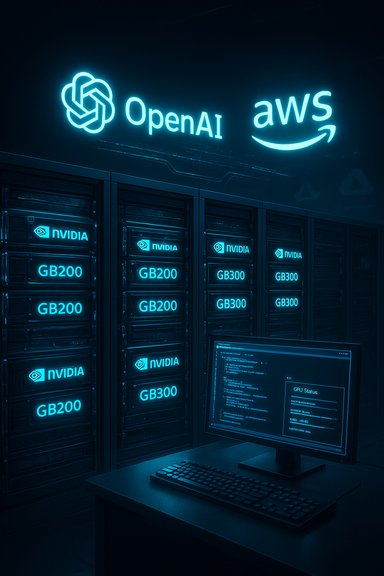
- The arrangement is built around Amazon EC2 UltraServers configured with large clusters of NVIDIA GB200 and GB300 accelerators — Blackwell-generation hardware designed for both training and inference at scale.
- OpenAI will begin using AWS compute immediately, with full deployment targeted by the end of 2026, and the capacity to expand further in 2027 and beyond.
- AWS said the deployment will consist of “hundreds of thousands” of NVIDIA GPUs, with additional access to tens of millions of CPUs for complementary workloads.
- The deal is explicitly non-exclusive: OpenAI continues to maintain broader infrastructure relationships across Azure, Google Cloud, Oracle, and specialized providers, reflecting a multi-cloud strategy rather than a single-provider lock-in.
Why the GB200/GB300 choice is notable
The adoption of NVIDIA’s GB200 and GB300 represents a commitment to the Blackwell architecture, the company’s most advanced data-center GPU family. These accelerators are optimized for mixed-precision training, huge memory capacities, and high interconnect bandwidth — characteristics that matter most when training extremely large models and delivering low-latency inference for global user bases.From an engineering perspective, choosing these GPUs reduces the friction for existing model architectures that are already tuned for NVIDIA’s software stack (CUDA, cuDNN, cuBLAS, and the wider ecosystem). From a supply-chain perspective, it reinforces the industry’s dependence on NVIDIA’s roadmap and manufacturing cadence.
Overview: The Multi-Cloud Gambit
OpenAI’s move is best understood as a deliberate distancing from a single-cloud dependency model. The organization’s compute needs have become so large and so specialized that no single cloud provider — even one deeply invested as Microsoft was — can reliably or economically meet every requirement on its own. A pragmatic multi-cloud posture delivers:- Capacity diversity to mitigate outages, hardware shortages, or geopolitical restrictions.
- Pricing leverage through competitive sourcing and negotiated volume discounts across providers.
- Architectural flexibility, enabling OpenAI to place workloads where they run best (training on one cloud, inference on another, experimental research on specialized providers).
- Political and strategic insulation from any single partner’s changing priorities or governance constraints.
Nvidia’s Unwavering Supremacy — Why GPUs Still Rule
The deal underscores a single, unambiguous technical reality: NVIDIA remains the dominant provider of accelerators for frontier AI workloads. Multiple factors explain why NVIDIA maintains such leverage:- Ecosystem depth — NVIDIA’s software stack, developer tools, and optimized libraries have become the de facto standard for model developers. Porting advanced models to alternate hardware is non-trivial and requires re-optimization, often at the cost of performance or development velocity.
- Performance-per-watt leadership — Blackwell-class chips deliver the memory, interconnect and compute density required for training modern transformer-based models at scale.
- Product breadth — NVIDIA offers both training and inference-grade accelerators across a spectrum of form factors, easing procurement and deployment.
- Supply relationships — as hyperscalers design custom server offerings (EC2 UltraServer, for example) around NVIDIA parts, the company’s influence flows into infrastructure architecture itself.
That doesn’t mean alternatives are irrelevant. For some inference workloads, or for customers that optimize models for different runtimes, Trainium or TPUs can be cost-effective. Yet for frontier training and mixed workloads where porting cost, developer productivity, and established optimization libraries matter most, NVIDIA remains the default.
The Cloud “Proxy Wars” — Hyperscaler Strategy Through Startups
The OpenAI-AWS deal sits inside a broader pattern where cloud providers use strategic investments in AI startups as weapons in a competitive market.- Microsoft: long-term, deep investment partner for OpenAI; equity, product integrations, and favorable Azure commitments produced enormous strategic upside.
- Amazon: major investor in Anthropic, which it has backed with multiple rounds and positioned as a primary Bedrock provider; the OpenAI agreement helps AWS signal it too can host the AI leaders.
- Google: has pursued its own ties with Anthropic and continues to champion TPU-centric stacks and Gemini models as competitive alternatives.
- These relationships effectively make startups an operational front in a larger battle for market share in enterprise AI procurement, developer mindshare, and long-term platform dominance.
Economics and the Sustainability Question
The headline $38 billion figure invites scrutiny. It’s important to separate the contractual headline from cashflow realities, accounting structures, and long-term financial sustainability.- The figure represents a committed multiyear spend that will be met by a mix of actual consumption, capacity reservations, and potential expansion clauses.
- OpenAI has signaled an appetite to commit large sums to infrastructure — company statements and reporting indicate infrastructure commitments that exceed hundreds of billions, driven by training and serving needs for multimodal models, video generation, and so-called “agentic” AI workloads.
- Microsoft’s long-term return on its OpenAI investment has been widely reported as exceptionally lucrative following corporate restructuring; the back-and-forth on rights, equity, and valuation underscores how intertwined strategic stakes and cash commitments have become.
- Revenue vs. capital intensity: OpenAI’s revenue growth must keep pace with the capital and operating expenses required to run these exascale systems. If compute costs rise faster than revenues, continuity depends on continued investor appetite or favorable vendor terms.
- Circular financing risk: Some deals may appear circular — cloud providers and chipmakers providing capacity in exchange for future revenue from startups still searching for profitability. This creates exposure if the revenue assumptions underlying the commitments don’t materialize.
- Macro market risk: If the enterprise AI market slows or regulatory constraints dampen adoption, the economics of these large, long-term commitments could deteriorate quickly.
Technical and Operational Risks
Large-scale, multi-cloud deployments are operationally complex and fraught with engineering risks:- Portability friction: Moving models, datasets, and training pipelines among clouds requires significant engineering investment; differences in networking, server accelerators, and storage architectures increase the migration cost.
- Latency and data gravity: Training and inference placement decisions must balance latency requirements with data locality; large datasets create “data gravity” that favors co-location.
- Supply and logistics: Procuring hundreds of thousands of GPUs is a logistical challenge; lead times, manufacturing constraints, and global trade dynamics can produce bottlenecks.
- Energy and sustainability: Petascale training consumes enormous power. Data center siting, cooling strategies, and access to renewable energy will be critical for both operational cost and regulatory compliance.
- Security and IP risk: Distributing proprietary models and weights across multiple providers can increase surface area for leakage or theft unless robust controls are in place.
Strategic Risks: Concentration Despite Diversification
Paradoxically, while OpenAI is diversifying cloud providers, its reliance on NVIDIA creates a different kind of concentration risk:- Single-hardware-path risk: If NVIDIA’s supply chain or roadmap were disrupted, many leading-edge models would face performance degradation or delayed rollouts.
- Innovation dependency: NVIDIA’s software and hardware choices influence model design. If competitors innovate divergent architectures (e.g., widespread efficacy for non-von Neumann accelerators, or radically different memory/compute trade-offs), the industry could face dislocation.
- Regulatory exposure: Export controls, sanctions, or government restrictions targeting advanced accelerators could hamper cross-border deployment and complicate global scaling plans.
What This Means for Startups, Enterprises, and Windows-Focused Developers
For startups and enterprises evaluating AI strategies the implications are concrete and immediate:- Greater choice — at a cost: Companies will be able to procure access to leading models across clouds, but multi-cloud support requires architectural sophistication and increases integration costs.
- Model hosting options expand: Services that provide model hosting (Bedrock, Azure Model Service, AWS SageMaker/UltraServer offerings) will have more competitive dynamics, potentially lowering marginal pricing for inference and fine-tuning.
- Tooling standardization will matter: Developers will prioritize frameworks that abstract away hardware differences (e.g., ONNX, containerized inference runtimes). For Windows developers and enterprise IT teams, integration into existing software stacks and management tooling will drive platform choices.
- Negotiation leverage: Expect enterprise procurement to drive aggressive enterprise pricing as cloud providers compete for high-volume, headline-making customers.
- Security and compliance: Multi-cloud deployments complicate compliance postures; enterprises will demand better cross-cloud identity, auditing, and encryption standards.
Scenarios to Watch — Short, Medium, and Long Term
- Short term (6–18 months)
- Rapid capacity ramp at AWS; OpenAI moves selected workloads and inference traffic to UltraServers.
- Pricing and capacity negotiations shape enterprise deals and model hosting economics.
- NVIDIA gains orders’ momentum, easing immediate supply constraints.
- Medium term (18–36 months)
- Competitive responses: Microsoft and Google refine differentiated services (software, integration, pricing).
- Custom silicon efforts mature; Trainium, next-gen TPUs, and AMD parts make localized cost/perf improvements for certain workloads.
- Regulatory and energy scrutiny intensifies around global training operations.
- Long term (3–7 years)
- Hardware pluralism becomes practical if alternative silicon and software ecosystems mature.
- Corporate strategies consolidate around hybrid-cloud patterns: on-prem for sensitive data, multi-cloud for redundancy and scale.
- New business models emerge: AI infrastructure marketplaces, pooled GPU capacity, and usage-based accelerators.
Strengths, Benefits, and Immediate Gains
- Resilience and capacity: OpenAI’s access to AWS’s global footprint reduces risk of capacity shortfalls for both training and inference.
- Performance continuity: Selecting NVIDIA Blackwell hardware ensures high performance for existing model architectures.
- Strategic independence: Diversifying cloud vendors gives OpenAI stronger negotiating position and operational flexibility.
- Competitive validation for AWS: Hosting OpenAI is a reputational and commercial win for AWS, strengthening its case to enterprise customers.
Risks, Unknowns, and Cautions
- Economic strain: Massive long-term commitments assume continued revenue growth; shortfalls could stress balance sheets and vendor relationships.
- Operational complexity: Multi-cloud orchestration, data governance, and security present engineering and policy challenges.
- Concentration on NVIDIA: Hardware dominance creates systemic risk that could be exposed by supply disruptions, geopolitical moves, or a disruptive new architecture.
- Regulatory oversight: Large-scale compute commitments and cross-border deployments may attract regulatory attention on national security, competition, or energy consumption grounds.
- Verifiability of some claims: Certain public narratives about valuations, internal returns, or multi-provider scale are subject to corporate reporting idiosyncrasies and may be reported differently across outlets; readers should treat headline valuations and “return” figures as approximations tied to recent restructuring disclosures rather than audited outcomes.
Final Analysis — What This Deal Really Signals
OpenAI’s AWS agreement is both pragmatic and symbolic. Pragmatic in that it ensures the compute availability required to train and operate the next generation of multimodal and agentic AI systems. Symbolic in that it crystallizes three enduring realities of contemporary AI infrastructure:- The hyperscalers will fight through strategic partnerships and investments; startups remain the operational epicenters for that conflict.
- NVIDIA’s hardware and software ecosystem remain the linchpin for high-end model development, even as alternatives gain traction in specialty niches.
- Multi-cloud deployment is now an operational imperative for top-tier AI builders — but it introduces new engineering and economic complexity that will favor organizations with deep ops experience and large balance sheets.
The AWS-OpenAI deal will reshape procurement, accelerate GPU demand, and reorient competitive bets across the cloud landscape. It does not end the cloud wars — it escalates them into the open, where compute contracts, chip roadmaps, and strategic investments determine who wins the next decade of AI innovation.
Source: StartupHub.ai https://www.startuphub.ai/ai-news/a...d-gambit-and-nvidias-unwavering-ai-supremacy/
