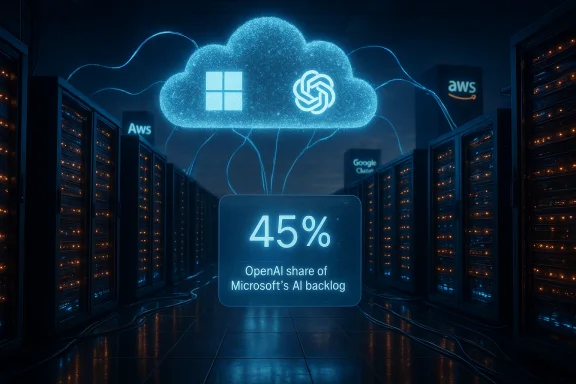
Microsoft’s recent earnings and partner disclosures have done something few quarterly reports manage: they turned a strategic narrative about cloud computing into an unmistakable, data-driven spotlight on how hyperscale clouds are now the literal backbone of modern digital services. In late January 2026 Microsoft disclosed that its commercial remaining performance obligations (RPO) surged to about $625 billion, and that OpenAI alone accounts for roughly 45% of that backlog — a concentration that crystallizes both the commercial opportunity and the operational strain cloud providers face today.
The past three years have shifted enterprise and platform spending in one direction: toward large-scale compute and managed AI services running on hyperscaler infrastructure. Cloud vendors have mobilized historic capital expenditures to match demand for GPUs, specialized networking, and data-center power. Microsoft’s January 28, 2026 fiscal update is the clearest, latest example: commercial bookings more than doubled year‑over‑year to $625 billion, and Microsoft management confirmed that multiyear commitments tied to AI customers — OpenAI foremost among them — are a major driver of that figure.
Why the pressure? Training and serving today’s large language models and other generative AI workloads are orders of magnitude more capital- and energy‑intensive than traditional cloud workloads. Customers require thousands of accelerator cards (GPUs or TPUs), dense high‑bandwidth networking, and specialized storage and data pipelines. Hyperscalers meet that demand by building and operating enormous, elastic infrastructures — but even those capabilities have been stretched by the sheer volume of long‑term commitments and immediate capacity needs. Microsoft’s disclosure that a single partner represents nearly half of its backlog gives a real-world sense of the scale and stickiness of AI‑driven cloud revenue — and of the capacity-management problem behind it.
Why is this concentration important for enterprises and for competition policy?
Key drivers for multi‑cloud/hybrid adoption:
At the macro level, the public cloud market poised to exceed $1 trillion by 2026 validates the strategic pivot enterprises and vendors made toward cloud‑native AI. At the market structure level, the top three providers’ control of roughly two‑thirds of infrastructure spending explains why those vendors are the primary actors in capacity allocation and in negotiating the future shape of AI services. And at the operational level, Microsoft’s disclosure that OpenAI accounts for ~45% of its RPO serves as a wake‑up call: long‑term AI partnerships can create enormous value, but they also require new approaches to capacity orchestration, contractual risk management and multi‑party governance.
This is not a moment to retreat from cloud or from AI. Rather, it is time for pragmatic engineering, smarter procurement, and clearer governance. Enterprises should plan for hybrid and multi‑cloud architectures as the most resilient path forward. Cloud providers must continue to invest, but also to design contracting and operational models that reduce single‑partner exposure while enabling the high‑density workloads that are driving this new era of digitization.
The market is enormous, the stakes are high, and the race for compute capacity — and the revenue that follows it — is far from over.
Source: Analytics Insight Azure and OpenAI Illustrate How Cloud Computing is the Backbone of Modern Digital Services
 Background: how we got here — AI, cloud scale and the backlog spike
The past three years have shifted enterprise and platform spending in one direction: toward large-scale compute and managed AI services running on hyperscaler infrastructure. Cloud vendors have mobilized historic capital expenditures to match demand for GPUs, specialized networking, and data-center power. Microsoft’s January 28, 2026 fiscal update is the clearest, latest example: commercial bookings more than doubled year‑over‑year to $625 billion, and Microsoft management confirmed that multiyear commitments tied to AI customers — OpenAI foremost among them — are a major driver of that figure. Why the pressure? Training and serving today’s large language models and other generative AI workloads are orders of magnitude more capital- and energy‑intensive than traditional cloud workloads. Customers require thousands of accelerator cards (GPUs or TPUs), dense high‑bandwidth networking, and specialized storage and data pipelines. Hyperscalers meet that demand by building and operating enormous, elastic infrastructures — but even those capabilities have been stretched by the sheer volume of long‑term commitments and immediate capacity needs. Microsoft’s disclosure that a single partner represents nearly half of its backlog gives a real-world sense of the scale and stickiness of AI‑driven cloud revenue — and of the capacity-management problem behind it.
Overview: the trillion‑dollar public cloud and the concentrated landscape
Two related macro facts set the context for these company-level dynamics.- First, the public cloud market is forecast to exceed $1 trillion in aggregate value by 2026 — a composite of infrastructure, platform, analytics and cloud application services that researchers such as Forrester have tracked and quantified. That projection frames AI and database/analytics spending as meaningful drivers of the market’s rapid expansion.
- Second, market share is heavily concentrated. The “Big Three” hyperscalers — AWS, Microsoft Azure and Google Cloud — together capture roughly two‑thirds of global cloud infrastructure spending, a proportion that has remained steady or inched higher as AI workloads have boosted hyperscaler revenues. That concentration is crucial because it determines who controls the largest pools of elastic compute and specialized GPU capacity.
Why OpenAI’s share of Microsoft’s backlog matters
1. Revenue visibility — and concentration risk
Having a large, long-term commitment on the books is great for revenue visibility: it gives Microsoft a pipeline of contracted cash flow stretching several years. But with ~45% of commercial RPO coming from one partner, investors and enterprise customers legitimately ask about concentration risk: what happens if OpenAI’s demand profile changes, if alternative procurement arrangements arise, or if contractual terms evolve? Microsoft has tried to address those concerns by pointing out the diversified nature of the remaining 55% of RPO, but the headline figure is still stark and new.2. Operational strain on capacity and capex
AI workloads are not only large in dollar terms; they also require specific hardware ecosystems. Microsoft’s capital expenditures have spiked as it expands GPU capacity and upgrades datacenter networks to support dense accelerator clusters. This is visible across cloud providers: big capex programs and hardware procurement are now the norm. Firms like CoreWeave and other “neoclouds” have also accelerated their GPU deployments to meet unmet demand, illustrating that traditional hyperscalers can be outpaced in some GPU‑specialist niches. The net result: capacity allocation becomes both a technical and a commercial negotiation among cloud provider, enterprise customers, and AI model builders.3. Strategic positioning and vendor lock‑in
Long-term infrastructure commitments — particularly those tied to model training and inference at scale — create deep integration between model providers and the cloud platform hosting them. That integration can translate into product differentiation (better managed services, optimized stacks) but also into vendor lock‑in for the model provider. Microsoft’s relationship with OpenAI — which now includes both investment and long-term commercial arrangements — is a case study in how cloud platforms can entangle strategic and commercial interests. Investors and regulators will watch this dynamic closely.The three hyperscalers and market concentration: what the numbers say
Industry trackers such as Synergy Research Group and independent coverage show the top three providers collectively command roughly 60–68% of infrastructure spending in the most recent quarters. Individual shares vary by quarter and measurement method, but the structural picture is consistent: AWS leads in absolute scale, Microsoft Azure sits as a strong No. 2 with a growing share of AI workloads, and Google Cloud is the fastest percentage‑grower among the three in many recent quarters.Why is this concentration important for enterprises and for competition policy?
- Scale equals leverage: hyperscalers can negotiate favorable supply relationships with chip vendors, secure data center locations and amortize enormous capex across many customers.
- Specialization emerges: neoclouds and GPU specialists can thrive in niches where hyperscalers are capacity-constrained or less flexible on contract terms.
- Regulatory scrutiny increases: concentration raises questions about market power, cross‑ownership and fairness where one cloud partner is also a close investor or strategic ally of a large cloud customer.
Multi‑cloud and hybrid strategies: not a retreat, but an evolution
Survey and analyst work show a consistent trend: enterprises are embracing multi‑cloud and hybrid approaches more than ever. Flexera and other industry studies find that the majority of large organizations already run workloads across multiple public clouds and private infrastructure, and that hybrid architectures are on the rise as a pragmatic response to resiliency, cost control, sovereignty and specialized workload needs. Analysts expect this pattern to accelerate as AI pushes new performance and compliance demands that may not be best met by a single vendor’s stack.Key drivers for multi‑cloud/hybrid adoption:
- Risk mitigation against outages or sudden price changes.
- Access to differentiated AI accelerators and specialized vendor services.
- Data gravity and sovereign data regulations that favor local or private cloud for sensitive workloads.
- Vendor negotiation leverage and gradual migration strategies.
Technical realities: GPUs, networking and elastic infrastructure
GPUs and accelerator scarcity
The industry-wide shortage and surging demand for accelerators has created a specialized market layer: GPU-as-a-Service and “neocloud” providers who focus on providing dense accelerator farms. The result is a bifurcation of the cloud market into:- Hyperscalers (AWS, Azure, GCP) that offer breadth and integrated services at massive scale.
- Neoclouds and GPU specialists (e.g., CoreWeave and others) that address rapid, high-density GPU demand and flexible contracting for AI workloads.
Networking and storage: not just “more compute”
AI clusters are sensitive to network latency and throughput; they require low-latency fabrics and high-performance storage architectures. Providers are investing heavily in specialized interconnects, NVMe-based AI storage tiers, RDMA fabrics and high-speed Ethernet to keep GPUs fed with data. The cost of these upgrades — in dollars and energy consumption — is driving the near‑term capex intensity we see across hyperscalers.Vendor strategies and responses — a comparative take
Microsoft
Microsoft is doubling down on integrating AI across its product lines while expanding Azure’s specialized hardware footprint. The company has emphasized the strategic value of long-term partnerships (OpenAI, Anthropic) while also investing in in-house silicon efforts and data center expansion. Microsoft frames its position as the leader in “cloud-based AI services” even as it faces the operational challenges of concentrated RPOs and elevated capex.Amazon (AWS)
AWS continues to emphasize breadth and global scale, offering a wide range of instance families (including GPU-accelerated instances) and continuing massive capex investments. The value proposition is global reach, deep ecosystems, and mature enterprise features. AWS has also signed its own large agreements with model providers, and in 2025 it announced significant partnerships to expand capacity for frontier AI workloads.Google Cloud
Google Cloud’s strength is in AI platforms, managed model services and custom accelerators (TPUs). In many quarters Google Cloud has posted the fastest percentage growth among the hyperscalers, driven by demand for AI services integrated with their data and model infrastructure. Google’s positioning centers on platform coherence for data‑centric AI workflows.Neoclouds and specialized players
The rise of CoreWeave and other GPU-focused clouds demonstrates that capacity constraints create opportunity. These players have secured large contracts and prefer flexible contracting models tailored to model training and inference, often at favorable cost and with preferential hardware access. That dynamic has changed procurement options for model builders.Risks and open questions
- Concentration risk at the hyperscaler-customer level. Microsoft’s 45% backlog concentration is the clearest single‑company signal that the market can create outsized exposure to a single partner. Concentration increases financial and operational risk for cloud providers and could attract regulatory attention.
- Capacity mismatch and supply-chain friction. Even with huge capex, the lag between ordered capacity (GPUs, networking gear) and fully operational capacity creates bottlenecks. That gap drives price volatility, special contracting, and the rise of niche providers.
- Margin pressure from capex and specialized services. Heavy investment to satisfy AI demand compresses near‑term margins. Firms must balance long-term contracts with the immediate cash flow burden of building capacity. Microsoft’s recent results show how capex and margin expectations can affect investor sentiment.
- Regulatory and competitive concerns. When infrastructure commitments, equity stakes and commercial partnerships intersect (for example, between cloud provider and model maker), governance questions follow. Regulators and large enterprise customers will scrutinize dependence-related risks.
- Vendor lock-in vs. portability. Deep integration of models and managed services increases friction for customers wanting portability. The tendency toward specialized stacks can hinder multi‑cloud portability unless standardized model and data formats are adopted more widely.
Practical guidance for enterprise architects and IT leadership
Enterprises should treat current cloud dynamics as a strategic procurement and architecture problem, not simply an operations problem. Consider these practical steps:- Inventory AI and non‑AI workloads, and classify them by sensitivity to latency, compliance and compute intensity.
- For GPU‑heavy workloads, identify multiple capacity suppliers (hyperscaler + neocloud) and negotiate flexible contracting terms.
- Design for portability where possible: use open model formats, containerized runtimes, and infrastructure‑as‑code to reduce migration friction.
- Implement robust cost governance and observability to track idle resources and GPU utilization.
- Prepare for hybrid cloud deployments that localize sensitive data while leveraging public cloud scale for model training and inference.
What cloud providers must do next
- Balance long‑term commitments with operational flexibility. Providers should structure contracts that allow efficient capacity planning without locking themselves into unsustainable deployment timelines.
- Expand partnerships with chip vendors and neoclouds. Strategic supply relationships and reseller ecosystems will be necessary to smooth accelerator pipelines.
- Invest in differentiated, higher‑margin AI services. As underlying infrastructure becomes more commoditized, value will accrue to higher‑level managed services: fine‑tuning platforms, model‑ops, governance tooling and specialized inference runtimes.
- Communicate transparently with investors and customers. Clear disclosure around concentration, capex intentions and capacity timelines reduces uncertainty and helps enterprise planning.
Final analysis: the cloud is the backbone — but its shape is changing
Microsoft’s earnings disclosure and the OpenAI backlog headline make a fundamental point obvious: cloud computing is no longer just infrastructure — it is the economic and operational foundation of the generative‑AI economy. The scale of commitments, the speed of GPU deployment, and the competitive mix of hyperscalers and neoclouds together are reshaping how organizations buy compute, how providers invest, and how regulators and investors evaluate risk.At the macro level, the public cloud market poised to exceed $1 trillion by 2026 validates the strategic pivot enterprises and vendors made toward cloud‑native AI. At the market structure level, the top three providers’ control of roughly two‑thirds of infrastructure spending explains why those vendors are the primary actors in capacity allocation and in negotiating the future shape of AI services. And at the operational level, Microsoft’s disclosure that OpenAI accounts for ~45% of its RPO serves as a wake‑up call: long‑term AI partnerships can create enormous value, but they also require new approaches to capacity orchestration, contractual risk management and multi‑party governance.
This is not a moment to retreat from cloud or from AI. Rather, it is time for pragmatic engineering, smarter procurement, and clearer governance. Enterprises should plan for hybrid and multi‑cloud architectures as the most resilient path forward. Cloud providers must continue to invest, but also to design contracting and operational models that reduce single‑partner exposure while enabling the high‑density workloads that are driving this new era of digitization.
The market is enormous, the stakes are high, and the race for compute capacity — and the revenue that follows it — is far from over.
Source: Analytics Insight Azure and OpenAI Illustrate How Cloud Computing is the Backbone of Modern Digital Services