

OpenAI’s ChatGPT appears to be quietly preparing an ad-supported turn: reverse‑engineers have found ad‑related strings in a recent Android beta (APK 1.2025.329), and multiple outlets now report that the company is building the plumbing to show commerce‑style, search‑linked ads inside the assistant.
OpenAI launched ChatGPT as a largely ad‑free conversational assistant in late 2022. Since then the product has grown into one of the most widely used AI services, with OpenAI executives publicly citing hundreds of millions of weekly users — a scale that makes sustainable free access expensive. Recent reverse‑engineering of a beta Android build revealed internal resource strings such as "ads feature," "bazaar content," "search ad," and "search ads carousel," a discovery first publicized by industry trackers and app analysts. Those findings have prompted broad coverage from consumer tech and trade press, which generally interpret the strings as early signals that OpenAI is prototyping in‑app advertising tied to the assistant’s web/search capabilities. This is product evidence, not a user‑facing launch: code strings in an APK indicate development work — and often feature flags or skeleton UI names — but they do not by themselves prove a public rollout or final design. Still, the presence of those identifiers, combined with OpenAI hiring patterns and executive comments that are more tolerant of ads than in the past, suggests that an ad strategy is being actively explored.
For users and organizations, the practical approach is preparation: audit ChatGPT dependencies, review memory and privacy settings, and expect admin controls that can disable ad experiments for managed environments. For OpenAI, the path to monetizing without undermining trust demands exceptional transparency, clear consent flows, and a durable ad‑free promise for paying customers. If those guardrails are built and honored, ads could subsidize broad access; if they aren’t, the move risks damaging the very trust that made ChatGPT a mainstream utility.
Source: bgr.com ChatGPT Will Soon Display Ads, New Leak Suggests - BGR
 Background / Overview
OpenAI launched ChatGPT as a largely ad‑free conversational assistant in late 2022. Since then the product has grown into one of the most widely used AI services, with OpenAI executives publicly citing hundreds of millions of weekly users — a scale that makes sustainable free access expensive. Recent reverse‑engineering of a beta Android build revealed internal resource strings such as "ads feature," "bazaar content," "search ad," and "search ads carousel," a discovery first publicized by industry trackers and app analysts. Those findings have prompted broad coverage from consumer tech and trade press, which generally interpret the strings as early signals that OpenAI is prototyping in‑app advertising tied to the assistant’s web/search capabilities. This is product evidence, not a user‑facing launch: code strings in an APK indicate development work — and often feature flags or skeleton UI names — but they do not by themselves prove a public rollout or final design. Still, the presence of those identifiers, combined with OpenAI hiring patterns and executive comments that are more tolerant of ads than in the past, suggests that an ad strategy is being actively explored. What the leak actually shows — technical read
APK strings and what they mean
The concrete artifact driving reporting is the ChatGPT Android beta labeled 1.2025.329. Analysts who unpacked the APK found short, descriptive strings and resource names that strongly imply an advertising subsystem is being engineered inside the mobile client:- ads feature — looks like a feature flag or module namespace for ad functionality.
- bazaar content — implies a marketplace or product‑card experience (internal teams often use a “bazaar” label for curated commerce fixtures).
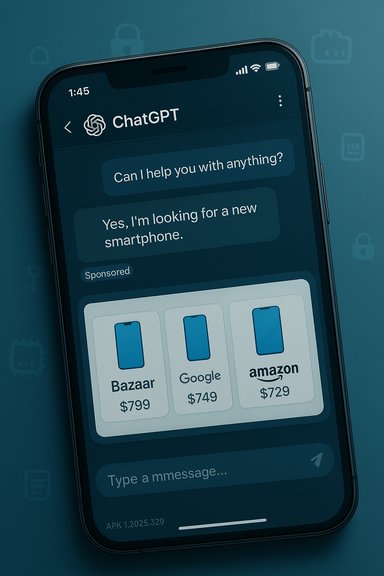
- search ad / search ads carousel — indicates ad placements tied to search‑style results, probably a horizontal carousel of sponsored cards.
How reliable is reverse engineering here?
APK inspection is a standard early‑warning technique: when engineers embed strings and component names, they usually reveal intent. That said, strings alone leave many unknowns — they don’t show final visuals, placement rules, attribution frameworks, or whether the ad stack is full‑scale or a narrow commerce experiment. The discovery is a high‑confidence signal that advertising capability is being built, but low on the timeline and behavioral certainty (who will see ads, how they’ll be labelled, and whether memories/personal data will be used remain open questions).Why OpenAI would add ads: business logic and pressures
The economics are straightforward and urgent. Running large, multimodal models at scale is an expensive infrastructure problem. Free, widely accessible AI services generate enormous load that subscription revenue alone may not cover as usage grows and new features (images, video, agents) increase compute costs.- OpenAI publicly cites very large user numbers: company leadership has described hundreds of millions of weekly users, a scale regularly referenced across coverage. Those usage figures are a big reason a diversified revenue approach is attractive.
- Advertising is a scalable monetization strategy that can subsidize free tiers without forcing broad price increases for paid subscribers. It also aligns with the product’s increasing commerce‑oriented features (shopping research, product comparisons, third‑party apps/agents).
How ads might be integrated into ChatGPT — product hypotheses
Based on the strings and how competitors approach the problem, the earliest ad experiences inside ChatGPT are likely to follow constrained, context‑aware formats:- Inline, labeled sponsored suggestions embedded into an answer when the user expresses explicit purchase intent.
- Shoppable product cards (a “bazaar”) with merchant names, prices, and click‑throughs to buy.
- Search ads carousel — a horizontal strip of sponsored cards that sit alongside organic content in a search‑style response.
- Sponsored follow‑ups or suggested actions when the assistant helps plan purchases or local service discovery.
Trust, UX and labeling: the essential design problems
If ads are blended into generative answers without careful design, they erode the product’s single most valuable asset: trust.- Clarity of labeling is paramount. When an AI synthesizes recommendations, users must be able to distinguish paid content clearly from organic answers. Labels must be prominent, persistent, and machine‑readable for audits.
- Separation of affordances (different card styles, explicit “Sponsored” badges, distinct CTAs) will help users scan results quickly.
- Frequency caps and relevance thresholds will determine whether ads feel helpful or intrusive.
- A simple opt‑out or paid‑ad‑free promise for subscribers must be credible: paying customers should not be forced to see the same ads the free tier gets.
Privacy and regulatory risks: memory, targeting, and data sharing
The biggest technical and ethical risks revolve around personalization.- ChatGPT now supports memory features that can retain user preferences and profile details across sessions. Using those memory signals for ad targeting would create a much stronger personalization profile than typical web cookies, and it raises acute consent and transparency questions.
- Any use of memories for ads should be opt‑in, explicit, and revocable. Defaulting to memory‑driven targeting would be a major privacy escalation.
- Advertisers and attribution partners will demand signals (clicks, conversions, hashed identifiers). OpenAI must define what it shares, how long it retains signals, and whether it will allow advertisers to influence ranking with payments or preferential listing.
Impact on publishers, the web and the “zero‑click” economy
Embedding monetized answers that resolve queries end‑to‑end increases the risk of zero‑click outcomes — users get the answer inside the assistant and never visit source sites. For publishers that rely on referral traffic, this is a real threat.- Search engines historically balanced organic results and sponsored placements; assistants that answer directly amplify the risk that publishers lose referral revenue.
- Potential responses include publisher licensing, revenue‑share models, or agreements to surface links and paid placements transparently. Those conversations are non‑trivial and will shape whether publishers cooperate or push back.
- If ads inside ChatGPT prioritize commerce conversions over broad web health, publishers may advocate for compensation mechanisms and data‑sharing rules. This will be a political as well as technical debate.
Cross‑checking the key claims
Independent confirmation matters. Three categories of evidence converge here:- APK analysis and reporting from industry trackers and app reverse‑engineers that specifically cited v1.2025.329 and the ad strings.
- Broader tech press coverage that repeated and contextualized the finding alongside OpenAI executive comments and hiring signals. Coverage by consumer tech outlets and mainstream press has proliferated in the last 48 hours.
- Company‑level signals: public comments from executives and hiring of ad‑experienced employees were already visible in reporting this year and add plausibility to a move toward advertising experiments. These signals do not confirm a product rollout, but they raise the odds that experiments will occur.
What Windows users, IT admins and communities should watch and do
For the Windows audience — power users, IT admins, and privacy‑minded readers — preparation and policy clarity matter.- Audit dependencies: Identify how and where ChatGPT is used in workflows and documentation. If ChatGPT integrations (desktop apps, browser extensions, plugins) are part of business processes, note where paid placements could affect outputs.
- Review privacy settings: Encourage users to review ChatGPT’s memory and personalization settings; push for an organizational stance on whether memory features are permitted on business accounts.
- Enterprise controls: Expect OpenAI to provide admin toggles to disable ad experiments for managed accounts. Prioritize gating such experiments for enterprise tenants.
- Monitor updates: Track beta channels and release notes. Early APK findings often precede server‑side gating; the next signal will be A/B tests or UI screenshots in controlled regions.
- Communicate to teams: If your organization relies on neutral outputs from ChatGPT for research or compliance, flag the arrival of any ads as a change risk and prepare validation checks for outputs that include recommendations or commerce links.
Strengths and possible benefits of a well‑executed ad model
A responsibly done ad integration can deliver benefits:- Ads tethered to commerce queries can improve discovery and shorten the path to purchase, offering genuine utility when clearly labeled.
- A successful ad model could subsidize free access and keep the basic product widely available for educational and low‑income users.
- Affiliate or referral models might be less invasive than full personalization if OpenAI focuses on session signals and non‑personalized relevance.
Risks and failure modes
- Trust erosion: Blurred lines between commercial and editorial content can degrade confidence in the assistant’s impartiality.
- Privacy overreach: Using memories for targeting without explicit consent could create serious regulatory and reputational damage.
- Publisher backlash: Heavy zero‑click behavior could provoke publishers to limit access or demand compensation.
- Dark UX patterns: Poorly surfaced or persistent ads in non‑commerce contexts will produce user annoyance and churn.
What to watch next — timeline signals and indicators
Watch for these concrete signs that an ad plan is moving from prototype to rollout:- Server‑side experiments visible in screenshots or user reports (A/B test screenshots, “Sponsored” badges appearing for some users).
- Official documentation updates: ad policy pages, privacy and memory consent dialogs, admin controls for managed accounts.
- Developer APIs or ad dashboards that allow advertisers to bid or manage campaigns inside ChatGPT.
- Public comments from OpenAI clarifying what data will — and will not — be used for personalization.
Conclusion
The APK evidence is a credible early signal that OpenAI is building the structural elements needed to show ads in ChatGPT — most likely focused initially on shopping and search contexts. That technical signal aligns with business pressures and hiring patterns that make some form of ad monetization plausible. Yet many crucial design and policy questions remain unanswered: the exact ad formats, labelling strategies, use of memories for targeting, and whether paid subscribers will be spared.For users and organizations, the practical approach is preparation: audit ChatGPT dependencies, review memory and privacy settings, and expect admin controls that can disable ad experiments for managed environments. For OpenAI, the path to monetizing without undermining trust demands exceptional transparency, clear consent flows, and a durable ad‑free promise for paying customers. If those guardrails are built and honored, ads could subsidize broad access; if they aren’t, the move risks damaging the very trust that made ChatGPT a mainstream utility.
Source: bgr.com ChatGPT Will Soon Display Ads, New Leak Suggests - BGR
