

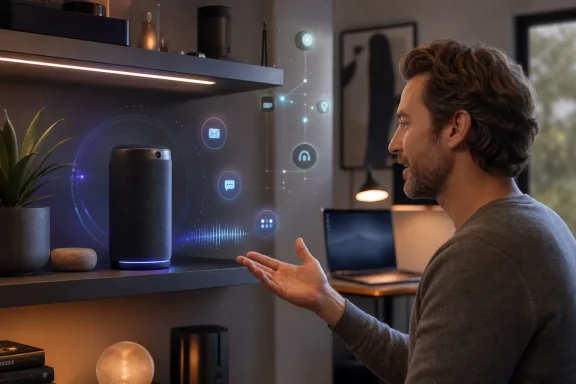
OpenAI is reportedly preparing a screenless, battery-powered smart speaker built around ChatGPT, GPT-Live voice interaction, cameras and environmental sensors, with an unveiling targeted for late 2026 and sales expected in 2027. Bloomberg first reported the plan, while ForkLog’s summary adds that the device is intended to be less a conventional Alexa-style endpoint than a mobile, increasingly personalized AI companion.
That distinction matters. Smart speakers have long been defined by short commands—set a timer, switch a light, play a track—but OpenAI’s reported ambition is a device that continuously understands context, remembers preferences and participates in more natural conversation. For Windows users already accustomed to treating ChatGPT as an app or browser service, it would represent a push to make OpenAI’s assistant present even when no PC, phone or monitor is in front of them.
OpenAI has not publicly announced the speaker, its specifications, price, supported smart-home platforms or regional availability. The reported roadmap remains subject to change, particularly as the company faces a new legal fight with Apple over its hardware effort.
The proposed speaker would reportedly use an advanced version of GPT-Live, the voice technology OpenAI introduced on July 8. In OpenAI’s description, GPT-Live uses a full-duplex architecture: it can listen and speak simultaneously rather than forcing a strict sequence of speech, transcription, response and playback.
That may sound like an incremental model update, but it addresses one of the core usability failures of existing voice assistants. Traditional smart speakers tend to be transactional because they struggle with interruptions, pauses, background conversation and lengthy context. GPT-Live is designed to track a dialogue continuously, decide when to speak or listen, and hand complicated reasoning or web-search work to a separate model in the background.
OpenAI says the initial GPT-Live rollout is powering ChatGPT Voice on the web, iOS and Android. Its stated limitations are important: GPT-Live does not currently support voice conversations with video or screen sharing in ChatGPT. A future speaker with its own camera and ambient sensors would therefore go beyond the public product OpenAI has launched so far.
According to Bloomberg’s reporting, the hardware would handle smart-home control, media playback, questions and message replies, while using ChatGPT’s capabilities to perform more involved tasks. The built-in battery would allow it to move from room to room, and mechanical elements could give it some form of motion or physical responsiveness.
The technology is plausible; the final product is not yet official. That is an important line for buyers and IT departments to keep in mind amid a wave of AI-device rumors.
That is also the point where a “helpful companion” becomes a high-stakes privacy product. A device able to read email, respond to messages and use a camera to interpret its surroundings would require much more than a simple microphone-permission prompt. Users will need clear control over what accounts can connect, which data is retained, whether household guests are captured by sensors, how recordings are handled, and how a mistaken action can be traced and reversed.
The current report does not establish how OpenAI would implement those controls. Nor does it say whether the device would process any voice, video or sensor data locally, what would be sent to OpenAI’s cloud, or whether a household could disable the camera while retaining voice features.
Those gaps are especially relevant for Windows enthusiasts and administrators who already use ChatGPT alongside Outlook, Microsoft 365, OneDrive and other personal or business services. A desktop chatbot is generally invoked deliberately. A room-to-room assistant designed to understand routines creates a different security boundary: a shared physical environment, always-connected services and potentially multiple people whose data may enter the system.
The smart-home angle adds another question. OpenAI would need to support the major platforms and standards that already anchor Windows-adjacent homes, including Matter-compatible devices, Microsoft-linked accounts and the mix of vendor apps that remain necessary even after Matter’s arrival. The value of the speaker will hinge less on its conversational style than on whether it can reliably operate a fragmented ecosystem without turning every command into an account-linking exercise.
That acquisition explains why this is more consequential than another branded accessory. OpenAI’s first public hardware release this month, the $230 Codex Micro, is a specialized macro pad created with Work Louder for users managing Codex coding agents. It is a real product, but it is also a niche developer control surface built on an existing hardware concept.
The reported speaker is a far more difficult proposition. It would require industrial design, acoustics, batteries, microphones, cameras, wireless reliability, smart-home interoperability, supply-chain execution, retail support and a privacy model that can survive scrutiny. It also needs a personality that feels useful rather than intrusive—an unusually subjective requirement for a mass-market device.
OpenAI appears to be betting that better conversation can overcome the fatigue surrounding earlier AI gadgets. The failure of products that promised ambient, always-available assistance has shown that novelty is not enough. A device must be trustworthy, fast, comprehensible and useful on a quiet Tuesday afternoon, not just impressive in a demonstration.
OpenAI has denied any interest in competitors’ trade secrets. The allegations remain unproven, and the case will be decided through the legal process rather than through statements from either company. Still, the lawsuit creates a practical issue for OpenAI: litigation can complicate staffing, documentation, supplier relationships and product schedules even before a court issues a ruling.
Bloomberg’s reported timeline already reflects that uncertainty. OpenAI is said to be aiming for a 2026 reveal and a 2027 release, rather than a firm launch date. That makes the announcement window—not the 2027 retail target—the next concrete milestone to watch.
For now, the reported smart speaker should be read as a serious but unannounced hardware program. GPT-Live gives OpenAI a credible voice foundation, and the io acquisition gives it the design resources to attempt a new category. Whether it becomes a useful home computer or another reminder that AI assistants work best on a screen will depend on the privacy controls, interoperability and reliability OpenAI has yet to show.
That distinction matters. Smart speakers have long been defined by short commands—set a timer, switch a light, play a track—but OpenAI’s reported ambition is a device that continuously understands context, remembers preferences and participates in more natural conversation. For Windows users already accustomed to treating ChatGPT as an app or browser service, it would represent a push to make OpenAI’s assistant present even when no PC, phone or monitor is in front of them.
OpenAI has not publicly announced the speaker, its specifications, price, supported smart-home platforms or regional availability. The reported roadmap remains subject to change, particularly as the company faces a new legal fight with Apple over its hardware effort.
 GPT-Live Is the Missing Piece—Not the Whole Product
The proposed speaker would reportedly use an advanced version of GPT-Live, the voice technology OpenAI introduced on July 8. In OpenAI’s description, GPT-Live uses a full-duplex architecture: it can listen and speak simultaneously rather than forcing a strict sequence of speech, transcription, response and playback.That may sound like an incremental model update, but it addresses one of the core usability failures of existing voice assistants. Traditional smart speakers tend to be transactional because they struggle with interruptions, pauses, background conversation and lengthy context. GPT-Live is designed to track a dialogue continuously, decide when to speak or listen, and hand complicated reasoning or web-search work to a separate model in the background.
OpenAI says the initial GPT-Live rollout is powering ChatGPT Voice on the web, iOS and Android. Its stated limitations are important: GPT-Live does not currently support voice conversations with video or screen sharing in ChatGPT. A future speaker with its own camera and ambient sensors would therefore go beyond the public product OpenAI has launched so far.
According to Bloomberg’s reporting, the hardware would handle smart-home control, media playback, questions and message replies, while using ChatGPT’s capabilities to perform more involved tasks. The built-in battery would allow it to move from room to room, and mechanical elements could give it some form of motion or physical responsiveness.
The technology is plausible; the final product is not yet official. That is an important line for buyers and IT departments to keep in mind amid a wave of AI-device rumors.
The Real Product Is Persistent Context
A portable speaker with a camera is not inherently novel. The unusual part of OpenAI’s reported design is its attempt to combine voice, sensor data, personal messages and email into a system that learns how its owner lives.That is also the point where a “helpful companion” becomes a high-stakes privacy product. A device able to read email, respond to messages and use a camera to interpret its surroundings would require much more than a simple microphone-permission prompt. Users will need clear control over what accounts can connect, which data is retained, whether household guests are captured by sensors, how recordings are handled, and how a mistaken action can be traced and reversed.
The current report does not establish how OpenAI would implement those controls. Nor does it say whether the device would process any voice, video or sensor data locally, what would be sent to OpenAI’s cloud, or whether a household could disable the camera while retaining voice features.
Those gaps are especially relevant for Windows enthusiasts and administrators who already use ChatGPT alongside Outlook, Microsoft 365, OneDrive and other personal or business services. A desktop chatbot is generally invoked deliberately. A room-to-room assistant designed to understand routines creates a different security boundary: a shared physical environment, always-connected services and potentially multiple people whose data may enter the system.
The smart-home angle adds another question. OpenAI would need to support the major platforms and standards that already anchor Windows-adjacent homes, including Matter-compatible devices, Microsoft-linked accounts and the mix of vendor apps that remain necessary even after Matter’s arrival. The value of the speaker will hinge less on its conversational style than on whether it can reliably operate a fragmented ecosystem without turning every command into an account-linking exercise.
Jony Ive’s Design Team Gives the Report Weight
The speaker is reportedly being developed under the design leadership of Jony Ive, Apple’s former chief design officer and the co-founder of io Products. OpenAI acquired io Products in 2025 in a deal valued at nearly $6.5 billion, positioning the company to build its own consumer hardware rather than remaining a model and software provider.That acquisition explains why this is more consequential than another branded accessory. OpenAI’s first public hardware release this month, the $230 Codex Micro, is a specialized macro pad created with Work Louder for users managing Codex coding agents. It is a real product, but it is also a niche developer control surface built on an existing hardware concept.
The reported speaker is a far more difficult proposition. It would require industrial design, acoustics, batteries, microphones, cameras, wireless reliability, smart-home interoperability, supply-chain execution, retail support and a privacy model that can survive scrutiny. It also needs a personality that feels useful rather than intrusive—an unusually subjective requirement for a mass-market device.
OpenAI appears to be betting that better conversation can overcome the fatigue surrounding earlier AI gadgets. The failure of products that promised ambient, always-available assistance has shown that novelty is not enough. A device must be trustworthy, fast, comprehensible and useful on a quiet Tuesday afternoon, not just impressive in a demonstration.
Apple’s Lawsuit Could Complicate the Calendar
On July 10, Apple sued OpenAI, io Products, OpenAI hardware chief Tang Tan and former Apple engineer Chang Liu in California federal court, alleging trade-secret misappropriation and breach of contract related to OpenAI’s emerging hardware business. The Associated Press reported that Apple alleges OpenAI encouraged recruited Apple employees to share confidential information, including in interview settings.OpenAI has denied any interest in competitors’ trade secrets. The allegations remain unproven, and the case will be decided through the legal process rather than through statements from either company. Still, the lawsuit creates a practical issue for OpenAI: litigation can complicate staffing, documentation, supplier relationships and product schedules even before a court issues a ruling.
Bloomberg’s reported timeline already reflects that uncertainty. OpenAI is said to be aiming for a 2026 reveal and a 2027 release, rather than a firm launch date. That makes the announcement window—not the 2027 retail target—the next concrete milestone to watch.
For now, the reported smart speaker should be read as a serious but unannounced hardware program. GPT-Live gives OpenAI a credible voice foundation, and the io acquisition gives it the design resources to attempt a new category. Whether it becomes a useful home computer or another reminder that AI assistants work best on a screen will depend on the privacy controls, interoperability and reliability OpenAI has yet to show.
References
- Primary source: ForkLog
Published: 2026-07-16T08:40:41+00:00
OpenAI to Launch AI-Powered Smart Speaker | ForkLog
OpenAI plans to enter the consumer electronics market with an AI-powered smart speaker designed as a home companion.forklog.com - Related coverage: techradar.com
OpenAI teams with Work Louder to launch Codex-native keyboard, weeks after CEO of Apps told staff 'not to be distracted by side quests’ | TechRadar
Do as I say, not as I do?www.techradar.com - Related coverage: kucoin.com
OpenAI's first hardware device will be a smart speaker, amid an Apple lawsuit. | KuCoin
Apple sued OpenAI and its chief hardware officer for stealing hardware trade secrets on July 10, and if the injunction is granted, the planned 2027 shipment datwww.kucoin.com - Related coverage: iphoneincanada.ca
OpenAI’s First Product Is Reportedly a Screenless AI Companion, Not a Phone | iPhone in Canada
OpenAI is preparing to launch its very first physical consumer device, and it is not a smartphone. According to a report from Bloomberg's Mark Gurman, people familiar with the project say the company is developing a movable, screenless smart speaker designed to act as an interactive...www.iphoneincanada.ca - Related coverage: tomshw.it
- Related coverage: hardwarezone.com.sg
OpenAI’s first AI device could be a portable ChatGPT-powered smart speaker | HardwareZone Singapore
Explore OpenAI's potential first AI hardware product: a portable ChatGPT-powered smart speaker with advanced features and personalization. www.hardwarezone.com.sg