
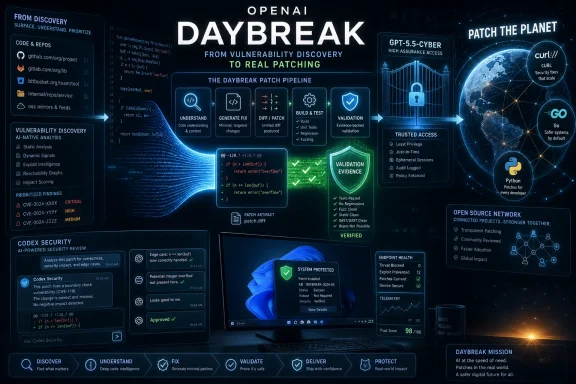
OpenAI announced on June 22, 2026, that it is expanding Daybreak, its cybersecurity program for AI-assisted vulnerability discovery and remediation, with an updated Codex Security plugin, a broader release of GPT-5.5-Cyber to trusted defenders, a partner program, and an open-source patching initiative called Patch the Planet. The announcement is less about another security scanner than about a shift in who gets access to frontier cyber models and what those models are expected to do. OpenAI’s thesis is blunt: AI has made finding bugs faster, so the scarce resource is no longer discovery but repair. For Windows admins, enterprise security teams, and open-source maintainers, that argument lands uncomfortably close to daily reality.
The traditional vulnerability economy has been built around discovery. Researchers find flaws, vendors validate them, CVEs are assigned, advisories are written, patches are built, and administrators decide how quickly they can absorb the blast radius of change. That system was already strained before large language models learned to read giant codebases, synthesize attack paths, and produce plausible exploit hypotheses.
Daybreak is OpenAI’s attempt to claim that the AI security race should not be measured by how many flaws a model can find. It should be measured by how many validated fixes make it into production. That is a more defensible story than “we built a better vulnerability machine,” and it is also a more ambitious one, because patching is where software engineering, risk management, politics, maintenance burden, and user trust collide.
The company says its models have already been applied to discover and generate patches for serious vulnerabilities in major browsers, network infrastructure, and operating systems, including FreeBSD and the Linux kernel. It also cites work across systems such as Firefox, V8, Safari, OpenBSD, FreeBSD, and HTTP/2 implementations. Those examples matter because they place Daybreak not in the toy-app security demo genre, but in the ecosystem where one bad patch can break millions of users and one missed bug can become infrastructure debt.
This is the core wager: if AI increases the speed of vulnerability discovery, then defensive organizations need AI at the remediation layer or they will simply drown in better alerts. The history of enterprise security tooling is littered with products that produced more findings than humans could act on. OpenAI is trying to position Daybreak as the opposite of that pattern — not another siren, but a mechanic.
Those numbers should be read with care. “Findings” are not the same thing as confirmed exploitable vulnerabilities, and “automatically determined to be fixed” is not the same thing as independently audited remediation. But the scale does show what OpenAI is trying to normalize: security review as a continuous, codebase-aware workflow rather than a quarterly panic, annual penetration test, or post-CVE fire drill.
The plugin is described as doing more than static analysis. It can build or infer a threat model, identify plausible vulnerabilities, determine whether affected code is reachable, gather validation evidence, develop targeted patches, and verify the result. That sequence is important because it maps to the frustrating middle of security work, where raw scanner output must become a decision a developer can actually trust.
In mature organizations, that work is often performed by a small group of application security engineers who know both exploitation and production software constraints. In less mature organizations, it may not happen at all. OpenAI’s pitch is effectively that Codex Security can put a security engineer beside every developer, or at least enough of one to reduce the time between “this looks scary” and “this patch is ready for review.”
The danger is that this metaphor can become too convenient. A security engineer is not just a tool that emits diffs; they understand institutional history, release risk, user behavior, compliance obligations, and the difference between technically correct and operationally sane. Codex Security may accelerate the labor, but if organizations treat it as a substitute for judgment, they will rediscover an old truth of automation: the machine can compress the workflow and still move the wrong work faster.
If the patch is good, the developer no longer starts from a blank page. If it is bad, the developer now has to review a confident, syntactically plausible change that may hide a deeper misunderstanding. Either way, AI patch generation moves security work into code review, where the quality of the diff matters more than the drama of the alert.
That is likely why OpenAI emphasizes validation evidence, affected code locations, attack-path tracing, and export into existing vulnerability management systems. The company appears to understand that a patch without evidence is just another guess. In enterprise environments, especially those managing Windows endpoints, hybrid infrastructure, or regulated workloads, evidence is the currency that moves work from backlog to deployment.
The plugin’s ability to triage findings from scanners, advisories, bug-bounty reports, and ticketing systems is also strategically important. Most organizations are not starting from zero; they are starting from a landfill of unresolved vulnerabilities, duplicate tickets, partial mitigations, expired exceptions, and alerts that nobody fully trusts. If Codex Security can reduce that backlog by validating reachability and producing credible fixes, it could become less a scanner than a translation layer between security and engineering.
That translation layer is where many previous security products have failed. They could tell an executive that risk existed, but they could not tell a developer exactly why the risk mattered in this codebase and what change would reduce it without causing another incident. OpenAI is betting that large models are finally good enough to bridge that gap.
That distinction matters because cybersecurity is the canonical dual-use domain for AI. The same model behavior that helps a defender validate exploitability in a lab can help an attacker validate exploitability against a target. The same reasoning that traces reachability through a codebase can help prioritize where to strike. There is no clean technical boundary between “offensive” and “defensive” capability; there is only authorization, context, governance, and consequence.
OpenAI reports that GPT-5.5-Cyber reached 85.6 percent on CyberGym in single-model evaluations, compared with 81.8 percent for GPT-5.5. It also says the model outperformed GPT-5.5 on ExploitGym, at 39.5 percent versus 25.95 percent, and on SEC-bench Pro, at 69.8 percent versus 63.1 percent. The benchmark names alone tell the story: this is not a model merely tuned to write safer code comments.
Those scores are impressive if the benchmarks reflect real-world difficulty, but they are also a governance problem. A model that is better at reproducing known vulnerabilities and generating proof-of-concept work is useful to defenders precisely because it approaches the capability attackers want. That is why OpenAI wraps GPT-5.5-Cyber in the language of trusted access, verified defenders, scoped controls, stronger monitoring, and human review.
The company’s framing is that most defenders should start with GPT-5.5 plus Trusted Access for Cyber and Codex Security. GPT-5.5-Cyber is positioned for narrower use cases where authorized teams need the most advanced capabilities and more permissive behavior. That distinction is sensible, but it also creates a new kind of cybersecurity class divide: organizations with approval and resources get access to the strongest defensive tools, while smaller teams may remain dependent on less capable systems, partner services, or public tooling.
That may be unavoidable. A fully open release of a model optimized for exploit validation would be reckless if the company’s own benchmark claims are meaningful. But limited access also concentrates power. If frontier cyber capability is becoming central to software defense, then the approval process becomes part of the security architecture of the internet.
The announcement says OpenAI has had ongoing dialogue with the U.S. government, including work with the Center for AI Standards and Innovation on pre-deployment testing for GPT-5.5 and GPT-5.5-Cyber, as well as work with the Office of the National Cyber Director and the Office of Science and Technology Policy around implementation of a recent executive order and associated industry standards. That is exactly the kind of sentence that should make both defenders and civil-liberties-minded technologists pay attention.
Government involvement can improve testing, accountability, and threat modeling. It can also create opacity around who gets access, what use is monitored, and how abuse or mistakes are handled. The hard question for Daybreak is not whether powerful cyber models should have governance; they should. The hard question is whether that governance will be legible enough for the wider security community to trust.
OpenAI says Patch the Planet was founded with Trail of Bits in collaboration with HackerOne, Calif, researchers, and maintainers. More than 30 open-source projects have committed to participate, with initial participants including cURL, Go, Python, Sigstore, and pyca/cryptography. That list is not decorative; these are projects that sit close to the bloodstream of the software supply chain.
The program funds expert security researchers and gives participating projects ChatGPT Pro, conditional access to Codex Security, and API credits for development, maintainer automation, and release workflows. The key phrase is not “AI” but “expert security researchers.” OpenAI appears to have learned the lesson maintainers have been shouting for years: dumping machine-generated reports into an issue tracker is not help.
The announcement says each engagement begins with consultation between researchers and maintainers. Maintainers define priorities, preferences, and disclosure processes, while researchers validate and deduplicate vulnerabilities and patches before they reach the project. That workflow is designed to prevent Patch the Planet from becoming another well-intentioned burden imposed on volunteer maintainers.
This is the right instinct. Open-source projects do not need a thousand more noisy reports from automated systems that do not understand project constraints. They need high-quality, reproducible findings, minimally disruptive patches, tests, coordination, and time. If AI can help researchers arrive with better evidence and better diffs, it could meaningfully reduce maintainer load. If it arrives as a flood, it will be treated as spam with a better logo.
The durable value may be the reusable workflows rather than the individual patches. Fuzzing harnesses, variant analysis, differential testing, and spec-based tests can keep paying dividends after a single engagement ends. In that sense, Patch the Planet could be most useful when it leaves maintainers with better security infrastructure, not just a short burst of fixes.
The program also raises questions about prioritization. Which projects get help first? Which maintainers have the time and process maturity to participate? Which vulnerabilities are worth AI-assisted remediation before downstream vendors are ready to ship updates? The internet’s dependency graph is not a neat list sorted by importance; it is a messy, political, underfunded map of shared risk.
For Windows users and administrators, this matters even when the projects named are not Windows-only. Windows environments depend heavily on open-source libraries in browsers, developer tooling, cloud agents, VPN clients, endpoint products, and internal applications. The distinction between “open-source security” and “enterprise Windows security” has been false for years; Daybreak simply makes the dependency more visible.
For customers, this may be the most likely way Daybreak shows up in daily operations. Most organizations will not directly obtain GPT-5.5-Cyber access or rebuild their security workflows around OpenAI APIs. They will encounter AI-assisted triage, patch validation, code review, and detection engineering through the products they already use.
That could be powerful if the integrations are disciplined. A security vendor with access to organization-specific telemetry, code repositories, vulnerability history, and change-management systems could use a frontier model in ways a generic chatbot never could. It could correlate findings, suppress false positives, draft fixes, and explain risk in the language of the customer’s environment.
It could also deepen vendor lock-in and make security decision-making harder to audit. If a model inside a vendor platform recommends suppressing one finding, escalating another, and generating a patch for a third, customers will need to know what evidence supports those actions. “The AI said so” is not a control. It is a liability with a friendly interface.
The partner model therefore places pressure on security vendors to expose reasoning, provenance, confidence, and test results without overwhelming users. It also places pressure on OpenAI to define abuse-prevention standards that survive the messy reality of downstream products. The announcement gestures at safeguards, monitoring, and responsible deployment; the market will discover whether those words become enforceable practice.
This is where Daybreak stops being a developer-tool story and becomes a national resilience story. Critical infrastructure operators face a different patching problem from consumer software companies. They run long-lived systems, regulated environments, fragile operational technology, and software stacks where downtime can carry physical consequences.
For those operators, AI-assisted patching is attractive but dangerous. A model that can validate vulnerability reachability and propose a fix may save time during an active risk window. But a bad remediation path in a water system, hospital network, energy operator, or transportation environment can be more harmful than a delayed patch. The human oversight OpenAI emphasizes is not a formality; it is the control that prevents the cure from becoming the outage.
The promise is that Daybreak could help defenders develop better evidence faster. Instead of asking whether a CVE exists somewhere in the environment, a team might ask whether vulnerable code is actually reachable in this deployment, what compensating controls apply, what patch is safest, and how to test it before a maintenance window. That is the kind of workflow that could materially improve operational security.
The risk is that crisis conditions reward speed over understanding. In the middle of a high-profile vulnerability event, organizations already struggle to distinguish public panic from actual exposure. Adding AI-generated analysis can help if it is evidence-rich and reviewable. It can hurt if it adds a new layer of machine confidence to an already noisy emergency.
The practical question is not whether AI belongs in security workflows. It is where the review gates belong. A model that drafts a patch for an internal .NET service is useful; a model that automatically deploys that patch across production without change control is a future incident report. A model that triages scanner noise is useful; a model that silently suppresses true positives because they look unreachable is a governance failure.
Enterprise Windows environments also sit at the intersection of proprietary and open-source dependencies. A vulnerability in a Python package, Go service, cryptographic library, browser engine, VPN appliance, or HTTP/2 implementation can become a Windows endpoint issue through ordinary software use. Patch the Planet’s focus on projects such as cURL, Go, Python, Sigstore, and pyca/cryptography therefore has downstream consequences for organizations that may never think of themselves as open-source shops.
Sysadmins should also expect the language of “reachability” to become central. Not every vulnerable component is exploitable in every environment, and not every patch carries the same urgency. AI systems that can reason across code, configuration, network exposure, identity boundaries, and compensating controls could improve patch prioritization. But only if they are fed accurate context and constrained by policy.
That last condition is often the hardest. Many organizations do not have clean asset inventories, current software bills of materials, reliable ownership maps, or consistent change records. AI does not magically fix missing operational data. It may, however, make the cost of poor data more visible, because the model’s output will only be as trustworthy as the environment it can see.
OpenAI is trying to get ahead of that critique by emphasizing human control. Humans decide which findings to investigate, which changes to apply, and what information to share. That is the right answer, but it is incomplete. The real test is whether humans remain meaningfully in control when the system is operating at “machine speed.”
A reviewer facing one AI-generated patch can think carefully. A reviewer facing 200 AI-generated patches across a release train may become a rubber stamp. A security lead facing a backlog reduced by model triage may accept the convenience without sampling the misses. The danger is not that AI will remove humans from the loop overnight; it is that it will leave humans in the loop formally while making dissent operationally expensive.
For enterprises, the mitigation is boring but essential. AI-generated security findings should carry evidence. AI-generated patches should carry tests. Suppressed findings should be sampled. High-risk changes should route through the same change-management discipline as human-written fixes. Model behavior should be logged, reviewable, and periodically challenged by independent assessment.
That may sound like slowing down the very acceleration Daybreak promises. In reality, it is what makes acceleration survivable. The goal is not to patch at machine speed in every case. The goal is to use machine speed where the evidence is strong, the blast radius is known, and rollback is possible — and to slow down where those conditions are absent.
For Windows users and IT professionals, the immediate lesson is to watch the remediation layer. The next generation of security tooling will not merely tell you what is vulnerable. It will tell you whether the vulnerability matters in your environment, propose a fix, write tests, export evidence, and ask for approval. That is a meaningful change in the daily work of software defense.
 OpenAI Wants to Move the Cybersecurity Fight From Finding Bugs to Fixing Them
The traditional vulnerability economy has been built around discovery. Researchers find flaws, vendors validate them, CVEs are assigned, advisories are written, patches are built, and administrators decide how quickly they can absorb the blast radius of change. That system was already strained before large language models learned to read giant codebases, synthesize attack paths, and produce plausible exploit hypotheses.Daybreak is OpenAI’s attempt to claim that the AI security race should not be measured by how many flaws a model can find. It should be measured by how many validated fixes make it into production. That is a more defensible story than “we built a better vulnerability machine,” and it is also a more ambitious one, because patching is where software engineering, risk management, politics, maintenance burden, and user trust collide.
The company says its models have already been applied to discover and generate patches for serious vulnerabilities in major browsers, network infrastructure, and operating systems, including FreeBSD and the Linux kernel. It also cites work across systems such as Firefox, V8, Safari, OpenBSD, FreeBSD, and HTTP/2 implementations. Those examples matter because they place Daybreak not in the toy-app security demo genre, but in the ecosystem where one bad patch can break millions of users and one missed bug can become infrastructure debt.
This is the core wager: if AI increases the speed of vulnerability discovery, then defensive organizations need AI at the remediation layer or they will simply drown in better alerts. The history of enterprise security tooling is littered with products that produced more findings than humans could act on. OpenAI is trying to position Daybreak as the opposite of that pattern — not another siren, but a mechanic.
Codex Security Is Being Sold as the Missing Engineer in the Room
The updated Codex Security plugin is the most practical part of the announcement because it sits where software teams already feel pain: inside code review, triage, threat modeling, and patch generation. OpenAI says Codex Security has scanned more than 30 million commits across more than 30,000 codebases since its March research preview. Human reviewers have marked more than 70,000 findings as fixed, while more than 500,000 findings were automatically determined to be fixed.Those numbers should be read with care. “Findings” are not the same thing as confirmed exploitable vulnerabilities, and “automatically determined to be fixed” is not the same thing as independently audited remediation. But the scale does show what OpenAI is trying to normalize: security review as a continuous, codebase-aware workflow rather than a quarterly panic, annual penetration test, or post-CVE fire drill.
The plugin is described as doing more than static analysis. It can build or infer a threat model, identify plausible vulnerabilities, determine whether affected code is reachable, gather validation evidence, develop targeted patches, and verify the result. That sequence is important because it maps to the frustrating middle of security work, where raw scanner output must become a decision a developer can actually trust.
In mature organizations, that work is often performed by a small group of application security engineers who know both exploitation and production software constraints. In less mature organizations, it may not happen at all. OpenAI’s pitch is effectively that Codex Security can put a security engineer beside every developer, or at least enough of one to reduce the time between “this looks scary” and “this patch is ready for review.”
The danger is that this metaphor can become too convenient. A security engineer is not just a tool that emits diffs; they understand institutional history, release risk, user behavior, compliance obligations, and the difference between technically correct and operationally sane. Codex Security may accelerate the labor, but if organizations treat it as a substitute for judgment, they will rediscover an old truth of automation: the machine can compress the workflow and still move the wrong work faster.
The Scanner That Writes Patches Changes the Politics of Code Review
Security tooling has traditionally had an adversarial relationship with development teams. It files tickets, blocks builds, assigns severity, and leaves the actual repair to engineers who may be trying to ship features, stabilize a release, or avoid a regression. A tool that proposes a patch changes the social contract.If the patch is good, the developer no longer starts from a blank page. If it is bad, the developer now has to review a confident, syntactically plausible change that may hide a deeper misunderstanding. Either way, AI patch generation moves security work into code review, where the quality of the diff matters more than the drama of the alert.
That is likely why OpenAI emphasizes validation evidence, affected code locations, attack-path tracing, and export into existing vulnerability management systems. The company appears to understand that a patch without evidence is just another guess. In enterprise environments, especially those managing Windows endpoints, hybrid infrastructure, or regulated workloads, evidence is the currency that moves work from backlog to deployment.
The plugin’s ability to triage findings from scanners, advisories, bug-bounty reports, and ticketing systems is also strategically important. Most organizations are not starting from zero; they are starting from a landfill of unresolved vulnerabilities, duplicate tickets, partial mitigations, expired exceptions, and alerts that nobody fully trusts. If Codex Security can reduce that backlog by validating reachability and producing credible fixes, it could become less a scanner than a translation layer between security and engineering.
That translation layer is where many previous security products have failed. They could tell an executive that risk existed, but they could not tell a developer exactly why the risk mattered in this codebase and what change would reduce it without causing another incident. OpenAI is betting that large models are finally good enough to bridge that gap.
GPT-5.5-Cyber Is the Part of the Story That Cuts Both Ways
The most sensitive part of Daybreak is GPT-5.5-Cyber, a more capable and more permissive model for advanced, authorized cybersecurity work. OpenAI says the full version is being released through a continued limited release to trusted defenders after an initial permissive-only preview. In plain English, this is a model designed to refuse less often in legitimate cyber workflows while still being gated behind approval, monitoring, and controls.That distinction matters because cybersecurity is the canonical dual-use domain for AI. The same model behavior that helps a defender validate exploitability in a lab can help an attacker validate exploitability against a target. The same reasoning that traces reachability through a codebase can help prioritize where to strike. There is no clean technical boundary between “offensive” and “defensive” capability; there is only authorization, context, governance, and consequence.
OpenAI reports that GPT-5.5-Cyber reached 85.6 percent on CyberGym in single-model evaluations, compared with 81.8 percent for GPT-5.5. It also says the model outperformed GPT-5.5 on ExploitGym, at 39.5 percent versus 25.95 percent, and on SEC-bench Pro, at 69.8 percent versus 63.1 percent. The benchmark names alone tell the story: this is not a model merely tuned to write safer code comments.
Those scores are impressive if the benchmarks reflect real-world difficulty, but they are also a governance problem. A model that is better at reproducing known vulnerabilities and generating proof-of-concept work is useful to defenders precisely because it approaches the capability attackers want. That is why OpenAI wraps GPT-5.5-Cyber in the language of trusted access, verified defenders, scoped controls, stronger monitoring, and human review.
The company’s framing is that most defenders should start with GPT-5.5 plus Trusted Access for Cyber and Codex Security. GPT-5.5-Cyber is positioned for narrower use cases where authorized teams need the most advanced capabilities and more permissive behavior. That distinction is sensible, but it also creates a new kind of cybersecurity class divide: organizations with approval and resources get access to the strongest defensive tools, while smaller teams may remain dependent on less capable systems, partner services, or public tooling.
Limited Access Is a Safety Feature and a Market Strategy
OpenAI is not merely deciding who can use GPT-5.5-Cyber; it is deciding who becomes an early node in a new security ecosystem. Trusted Access for Cyber acts as both a safety regime and a distribution channel. It gives the company a way to say that advanced cyber capability is not being thrown over the wall, while also letting it build relationships with governments, critical infrastructure operators, and large security vendors.That may be unavoidable. A fully open release of a model optimized for exploit validation would be reckless if the company’s own benchmark claims are meaningful. But limited access also concentrates power. If frontier cyber capability is becoming central to software defense, then the approval process becomes part of the security architecture of the internet.
The announcement says OpenAI has had ongoing dialogue with the U.S. government, including work with the Center for AI Standards and Innovation on pre-deployment testing for GPT-5.5 and GPT-5.5-Cyber, as well as work with the Office of the National Cyber Director and the Office of Science and Technology Policy around implementation of a recent executive order and associated industry standards. That is exactly the kind of sentence that should make both defenders and civil-liberties-minded technologists pay attention.
Government involvement can improve testing, accountability, and threat modeling. It can also create opacity around who gets access, what use is monitored, and how abuse or mistakes are handled. The hard question for Daybreak is not whether powerful cyber models should have governance; they should. The hard question is whether that governance will be legible enough for the wider security community to trust.
Patch the Planet Aims at the Open-Source Bottleneck Everyone Pretends Not to See
The most interesting part of the announcement may be Patch the Planet, because it targets a structural weakness that no amount of enterprise licensing can solve. Open source powers browsers, operating systems, containers, package managers, developer tooling, cryptography libraries, cloud platforms, and the countless dependencies that hold modern software together. It is also maintained, too often, by small teams with too little time.OpenAI says Patch the Planet was founded with Trail of Bits in collaboration with HackerOne, Calif, researchers, and maintainers. More than 30 open-source projects have committed to participate, with initial participants including cURL, Go, Python, Sigstore, and pyca/cryptography. That list is not decorative; these are projects that sit close to the bloodstream of the software supply chain.
The program funds expert security researchers and gives participating projects ChatGPT Pro, conditional access to Codex Security, and API credits for development, maintainer automation, and release workflows. The key phrase is not “AI” but “expert security researchers.” OpenAI appears to have learned the lesson maintainers have been shouting for years: dumping machine-generated reports into an issue tracker is not help.
The announcement says each engagement begins with consultation between researchers and maintainers. Maintainers define priorities, preferences, and disclosure processes, while researchers validate and deduplicate vulnerabilities and patches before they reach the project. That workflow is designed to prevent Patch the Planet from becoming another well-intentioned burden imposed on volunteer maintainers.
This is the right instinct. Open-source projects do not need a thousand more noisy reports from automated systems that do not understand project constraints. They need high-quality, reproducible findings, minimally disruptive patches, tests, coordination, and time. If AI can help researchers arrive with better evidence and better diffs, it could meaningfully reduce maintainer load. If it arrives as a flood, it will be treated as spam with a better logo.
The Five-Day Sprint Is a Proof Point, Not a Verdict
OpenAI says an initial five-day sprint across multiple projects surfaced hundreds of issues for review, merged dozens of patches, and built reusable fuzzing, variant-analysis, differential-testing, and specification-based testing workflows. That is promising, but it is not proof that the model scales cleanly across the ecosystem. A sprint is a controlled experiment; open source is a permanent negotiation.The durable value may be the reusable workflows rather than the individual patches. Fuzzing harnesses, variant analysis, differential testing, and spec-based tests can keep paying dividends after a single engagement ends. In that sense, Patch the Planet could be most useful when it leaves maintainers with better security infrastructure, not just a short burst of fixes.
The program also raises questions about prioritization. Which projects get help first? Which maintainers have the time and process maturity to participate? Which vulnerabilities are worth AI-assisted remediation before downstream vendors are ready to ship updates? The internet’s dependency graph is not a neat list sorted by importance; it is a messy, political, underfunded map of shared risk.
For Windows users and administrators, this matters even when the projects named are not Windows-only. Windows environments depend heavily on open-source libraries in browsers, developer tooling, cloud agents, VPN clients, endpoint products, and internal applications. The distinction between “open-source security” and “enterprise Windows security” has been false for years; Daybreak simply makes the dependency more visible.
The Partner Program Turns Frontier Models Into a Security Supply Chain
OpenAI is also launching the Daybreak Cyber Partner Program, which lets selected security software and services providers use GPT-5.5 with Trusted Access for Cyber inside their products and services. The company says this keeps direct model access in the hands of participating partners while allowing their customers to benefit from defensive capability. That is a carefully chosen compromise.For customers, this may be the most likely way Daybreak shows up in daily operations. Most organizations will not directly obtain GPT-5.5-Cyber access or rebuild their security workflows around OpenAI APIs. They will encounter AI-assisted triage, patch validation, code review, and detection engineering through the products they already use.
That could be powerful if the integrations are disciplined. A security vendor with access to organization-specific telemetry, code repositories, vulnerability history, and change-management systems could use a frontier model in ways a generic chatbot never could. It could correlate findings, suppress false positives, draft fixes, and explain risk in the language of the customer’s environment.
It could also deepen vendor lock-in and make security decision-making harder to audit. If a model inside a vendor platform recommends suppressing one finding, escalating another, and generating a patch for a third, customers will need to know what evidence supports those actions. “The AI said so” is not a control. It is a liability with a friendly interface.
The partner model therefore places pressure on security vendors to expose reasoning, provenance, confidence, and test results without overwhelming users. It also places pressure on OpenAI to define abuse-prevention standards that survive the messy reality of downstream products. The announcement gestures at safeguards, monitoring, and responsible deployment; the market will discover whether those words become enforceable practice.
Critical Infrastructure Is Where the Risk Calculation Changes
OpenAI says it is working with governments and institutions around the world to improve defensive cybersecurity capabilities and protect critical infrastructure. It names Trusted Access for Cyber partnerships with Australia, Canada, France, Germany, Japan, the Republic of Korea, and EU institutions such as ENISA, along with a growing partnership with the UK government around cyber, testing, and evaluation. The company also says it plans to work directly with eligible critical infrastructure operators, including government networks.This is where Daybreak stops being a developer-tool story and becomes a national resilience story. Critical infrastructure operators face a different patching problem from consumer software companies. They run long-lived systems, regulated environments, fragile operational technology, and software stacks where downtime can carry physical consequences.
For those operators, AI-assisted patching is attractive but dangerous. A model that can validate vulnerability reachability and propose a fix may save time during an active risk window. But a bad remediation path in a water system, hospital network, energy operator, or transportation environment can be more harmful than a delayed patch. The human oversight OpenAI emphasizes is not a formality; it is the control that prevents the cure from becoming the outage.
The promise is that Daybreak could help defenders develop better evidence faster. Instead of asking whether a CVE exists somewhere in the environment, a team might ask whether vulnerable code is actually reachable in this deployment, what compensating controls apply, what patch is safest, and how to test it before a maintenance window. That is the kind of workflow that could materially improve operational security.
The risk is that crisis conditions reward speed over understanding. In the middle of a high-profile vulnerability event, organizations already struggle to distinguish public panic from actual exposure. Adding AI-generated analysis can help if it is evidence-rich and reviewable. It can hurt if it adds a new layer of machine confidence to an already noisy emergency.
Microsoft Shops Should Read Daybreak as a Preview of Their Own Toolchain
Although the announcement is from OpenAI, the implications are directly relevant to WindowsForum readers. Microsoft’s ecosystem is already moving toward AI-assisted administration, development, and security operations. Whether through GitHub, Defender, Sentinel, Copilot-branded tooling, or third-party platforms, Windows administrators are going to see more AI-generated remediation advice, more AI-written code changes, and more AI-mediated vulnerability prioritization.The practical question is not whether AI belongs in security workflows. It is where the review gates belong. A model that drafts a patch for an internal .NET service is useful; a model that automatically deploys that patch across production without change control is a future incident report. A model that triages scanner noise is useful; a model that silently suppresses true positives because they look unreachable is a governance failure.
Enterprise Windows environments also sit at the intersection of proprietary and open-source dependencies. A vulnerability in a Python package, Go service, cryptographic library, browser engine, VPN appliance, or HTTP/2 implementation can become a Windows endpoint issue through ordinary software use. Patch the Planet’s focus on projects such as cURL, Go, Python, Sigstore, and pyca/cryptography therefore has downstream consequences for organizations that may never think of themselves as open-source shops.
Sysadmins should also expect the language of “reachability” to become central. Not every vulnerable component is exploitable in every environment, and not every patch carries the same urgency. AI systems that can reason across code, configuration, network exposure, identity boundaries, and compensating controls could improve patch prioritization. But only if they are fed accurate context and constrained by policy.
That last condition is often the hardest. Many organizations do not have clean asset inventories, current software bills of materials, reliable ownership maps, or consistent change records. AI does not magically fix missing operational data. It may, however, make the cost of poor data more visible, because the model’s output will only be as trustworthy as the environment it can see.
The New Security Debt Is Trusting the Automation Too Much
Every major security automation wave begins with relief and ends with a governance problem. Antivirus reduced manual inspection but produced alert fatigue. EDR improved visibility but flooded teams with telemetry. Vulnerability scanners mapped exposure but created ticket backlogs. SIEM platforms centralized logs but required armies of analysts to tune them. AI-assisted remediation will follow the same pattern unless organizations design for verification from the start.OpenAI is trying to get ahead of that critique by emphasizing human control. Humans decide which findings to investigate, which changes to apply, and what information to share. That is the right answer, but it is incomplete. The real test is whether humans remain meaningfully in control when the system is operating at “machine speed.”
A reviewer facing one AI-generated patch can think carefully. A reviewer facing 200 AI-generated patches across a release train may become a rubber stamp. A security lead facing a backlog reduced by model triage may accept the convenience without sampling the misses. The danger is not that AI will remove humans from the loop overnight; it is that it will leave humans in the loop formally while making dissent operationally expensive.
For enterprises, the mitigation is boring but essential. AI-generated security findings should carry evidence. AI-generated patches should carry tests. Suppressed findings should be sampled. High-risk changes should route through the same change-management discipline as human-written fixes. Model behavior should be logged, reviewable, and periodically challenged by independent assessment.
That may sound like slowing down the very acceleration Daybreak promises. In reality, it is what makes acceleration survivable. The goal is not to patch at machine speed in every case. The goal is to use machine speed where the evidence is strong, the blast radius is known, and rollback is possible — and to slow down where those conditions are absent.
The Daybreak Bet Comes Down to Evidence, Access, and Maintainer Trust
Daybreak is a big announcement because it tries to connect model capability, developer workflow, open-source maintenance, security vendors, and government access controls into one story. That breadth is also why the program should be judged by outcomes rather than slogans. The internet does not become safer because a frontier model finds more bugs; it becomes safer when the right fixes land in the right places without breaking the systems people rely on.For Windows users and IT professionals, the immediate lesson is to watch the remediation layer. The next generation of security tooling will not merely tell you what is vulnerable. It will tell you whether the vulnerability matters in your environment, propose a fix, write tests, export evidence, and ask for approval. That is a meaningful change in the daily work of software defense.
- OpenAI is positioning Daybreak around patching and validation, not just vulnerability discovery.
- Codex Security is designed to move security work directly into developer workflows by producing evidence, remediation guidance, and reviewable patches.
- GPT-5.5-Cyber is more capable and more permissive for authorized security work, which makes access controls and monitoring central to the model’s legitimacy.
- Patch the Planet is aimed at reducing the burden on open-source maintainers by pairing AI tools with expert human researchers.
- The partner program means many organizations may experience Daybreak indirectly through existing security products rather than direct model access.
- The biggest operational risk is not that AI will be useless, but that teams will trust its speed before they have built enough verification around it.
References
- Primary source: OpenAI
Published: Mon, 22 Jun 2026 17:06:04 GMT
Daybreak: Tools for securing every organization in the world | OpenAI
OpenAI introduces new Daybreak tools, including Codex Security and GPT-5.5-Cyber, to help organizations find, validate, and patch vulnerabilities at scale.openai.com - Official source: help.openai.com
OpenAI Daybreak - Trusted Access for Cyber Overview | OpenAI Help Center
Learn what Trusted Access for Cyber is, what it supports, and how to request access. help.openai.com
- Official source: deploymentsafety.openai.com
- Official source: cdn.openai.com