

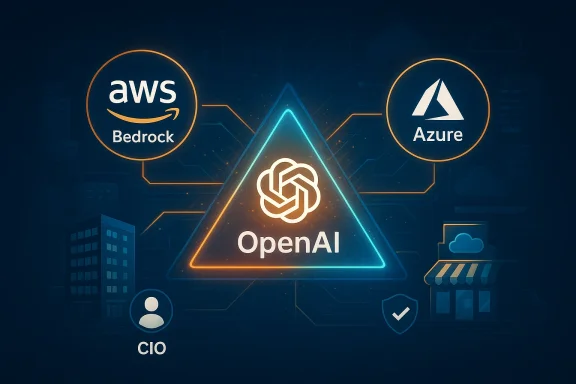
OpenAI’s latest move with Amazon Web Services marks more than a simple cloud-expansion story. It signals a deliberate attempt to widen distribution, deepen enterprise reach, and reduce the company’s dependence on Microsoft’s commercial stack at the very moment OpenAI is scaling into a much larger business. The result is a relationship triangle that now matters not just for infrastructure, but for sales strategy, product positioning, and the future balance of power in enterprise AI.
OpenAI’s rise was built on a partnership model that made Microsoft indispensable. Microsoft invested early, supplied critical Azure capacity, and turned OpenAI’s models into a core pillar of its own AI strategy through Azure OpenAI Service and products like Copilot. For several years, that arrangement gave OpenAI the compute, credibility, and enterprise access it needed to move from lab curiosity to mainstream platform.
At the same time, that dependency created a strategic ceiling. When one cloud vendor is also one of the world’s biggest enterprise software distributors, the line between partnership and channel control becomes blurry. That dynamic appears to be what OpenAI is now trying to rebalance, especially as its revenue base broadens and its customer mix shifts beyond early adopters and Microsoft-aligned buyers.
The current moment is especially important because OpenAI is no longer just a consumer phenomenon. CNBC has reported that enterprise customers account for a large share of revenue, while OpenAI has also said its annualized revenue has surged sharply over the past year. That matters because enterprise AI buyers do not all live inside the Microsoft ecosystem. Many are already standardized on AWS, and many more buy through procurement channels that favor broad platform compatibility over single-vendor alignment.
OpenAI’s relationship with Amazon has therefore emerged as a practical answer to a commercial problem. If a meaningful portion of enterprise AI demand sits inside AWS-centered organizations, then refusing to meet those buyers where they already operate is a growth handicap. That is the logic behind the company’s push to work more deeply with AWS and Amazon Bedrock, even as it publicly acknowledges Microsoft’s foundational role.
The shift also reflects a broader pattern in AI: the model company, the cloud company, and the enterprise software vendor increasingly compete and cooperate at the same time. The alliances are not replacing one another so much as overlapping. In that world, distribution matters as much as model quality, and the companies that can sell through multiple channels will likely capture more of the market over time.
The core issue is customer proximity. Microsoft is deeply embedded in the enterprise stack, but it is not the only enterprise stack, and in some verticals it is not even the preferred one. AWS remains the default cloud environment for a huge number of large organizations, particularly those with existing cloud-native workloads, governance processes, and procurement relationships built around Amazon’s ecosystem.
OpenAI’s reported embrace of AWS suggests it sees that friction as strategically expensive. By meeting AWS customers through a familiar platform, OpenAI can reduce procurement resistance, shorten evaluation cycles, and make its tools feel less like a separate bet and more like a native extension of existing workflows.
OpenAI’s growing presence there is significant because it places the company inside a marketplace where buyers compare model providers side by side. In one sense, that raises competitive pressure. In another, it gives OpenAI a chance to win customers who might never have reached it through Microsoft alone.
That makes the current recalibration less like a divorce and more like a renegotiation of boundaries. The companies have already had to revisit the economics and mechanics of their relationship as OpenAI grew into a much larger business with many more customers and many more cloud needs.
Microsoft also gains from OpenAI’s growth. Even if OpenAI seeks a wider distribution model, the company’s success can still drive more usage of Azure services, more demand for Copilot, and more general interest in Microsoft’s AI ecosystem. This is why the relationship remains strategically symbiotic even when it becomes commercially complicated.
That is why the phrase limited our ability matters so much. It suggests OpenAI sees the Microsoft relationship as no longer sufficient for the scale of ambition it now has. That does not erase Microsoft’s contribution; it simply acknowledges that contribution is not the same thing as future freedom.
That matters in enterprise AI because customers often want optionality. They may love OpenAI’s models but dislike being tied to one vendor’s software stack. AWS can help OpenAI present itself as a model provider that is available where customers already live, rather than one that asks them to reorganize around a single ecosystem.
This creates a useful strategic contrast with Microsoft. Azure is powerful, but for many customers it is still part of a broader Microsoft-centered worldview. AWS, by contrast, often reads as a more modular cloud utility. That difference can be commercially decisive for enterprises that want AI without deeper vendor lock-in.
That puts OpenAI and Anthropic into a more direct contest for enterprise mindshare. The competition is no longer only about who has the best model or the most users. It is about who can become the easiest, safest, and most flexible AI layer for enterprise adoption.
OpenAI’s move toward AWS suggests it wants to compete on the same battlefield without surrendering its distribution advantage. If AWS becomes a major channel for OpenAI, the company can challenge Anthropic in the enterprise market more effectively and blunt the idea that AWS is naturally Anthropic’s home field.
In that sense, OpenAI’s AWS deal is not just opportunistic. It is defensive. It prevents competitors from owning the cloud-specific enterprise narrative while OpenAI remains visible only through Microsoft-associated routes.
That helps explain why OpenAI is leaning into AWS and other partnerships. A broader sales funnel means more enterprise accounts, more usage, and more leverage in future negotiations. For a company reportedly racing toward major revenue milestones, even modest distribution gains can compound quickly.
OpenAI appears to understand that the enterprise market is not won by raw model performance alone. It is won by embedding the model inside the systems companies already trust. That is why AWS can matter as much as, or more than, a standalone product announcement.
This is a classic move for successful infrastructure businesses. The strongest platforms do not depend on one partner to reach the market. They create multiple routes in, then let customers choose the one that best fits their architecture.
That is why the AWS move is so consequential. It shows OpenAI acting less like a single-product sensation and more like an infrastructure vendor building a multi-channel business. That is the right instinct if the company wants to survive the next phase of AI competition.
OpenAI’s AWS strategy suggests it understands that reality. It also suggests the company sees itself as powerful enough to negotiate from a position of strength rather than dependence.
For consumers, the impact is less direct but still relevant. A stronger enterprise business can fund better products, faster model releases, and broader product availability. In other words, enterprise distribution may end up shaping consumer innovation too.
It also gives IT teams more confidence that they are not being forced into a Microsoft-first architecture simply to test or deploy OpenAI. For many CIOs, that distinction matters a great deal.
That makes the AWS relationship important even for people who never see the logo. It is behind-the-scenes leverage that can shape the pace of innovation.
What happens next will likely depend on three things: how quickly AWS-based enterprise demand translates into meaningful bookings, how Microsoft responds to the new balance of power, and whether OpenAI can keep its product story coherent across multiple cloud environments. The company is no longer operating like a startup with one primary patron. It is acting more like a strategic platform company trying to define its own orbit.
Source: TechRadar OpenAI says Microsoft has ‘limited our ability’ to build customer base
 Background
OpenAI’s rise was built on a partnership model that made Microsoft indispensable. Microsoft invested early, supplied critical Azure capacity, and turned OpenAI’s models into a core pillar of its own AI strategy through Azure OpenAI Service and products like Copilot. For several years, that arrangement gave OpenAI the compute, credibility, and enterprise access it needed to move from lab curiosity to mainstream platform.At the same time, that dependency created a strategic ceiling. When one cloud vendor is also one of the world’s biggest enterprise software distributors, the line between partnership and channel control becomes blurry. That dynamic appears to be what OpenAI is now trying to rebalance, especially as its revenue base broadens and its customer mix shifts beyond early adopters and Microsoft-aligned buyers.
The current moment is especially important because OpenAI is no longer just a consumer phenomenon. CNBC has reported that enterprise customers account for a large share of revenue, while OpenAI has also said its annualized revenue has surged sharply over the past year. That matters because enterprise AI buyers do not all live inside the Microsoft ecosystem. Many are already standardized on AWS, and many more buy through procurement channels that favor broad platform compatibility over single-vendor alignment.
OpenAI’s relationship with Amazon has therefore emerged as a practical answer to a commercial problem. If a meaningful portion of enterprise AI demand sits inside AWS-centered organizations, then refusing to meet those buyers where they already operate is a growth handicap. That is the logic behind the company’s push to work more deeply with AWS and Amazon Bedrock, even as it publicly acknowledges Microsoft’s foundational role.
The shift also reflects a broader pattern in AI: the model company, the cloud company, and the enterprise software vendor increasingly compete and cooperate at the same time. The alliances are not replacing one another so much as overlapping. In that world, distribution matters as much as model quality, and the companies that can sell through multiple channels will likely capture more of the market over time.
Why OpenAI Needs More Than Microsoft
OpenAI’s reported messaging to staff is notable because it frames Microsoft as both essential and constraining. That is not a repudiation of the partnership. It is an admission that a single dominant route to enterprise buyers is too narrow for a company that wants to become a broad platform business.The core issue is customer proximity. Microsoft is deeply embedded in the enterprise stack, but it is not the only enterprise stack, and in some verticals it is not even the preferred one. AWS remains the default cloud environment for a huge number of large organizations, particularly those with existing cloud-native workloads, governance processes, and procurement relationships built around Amazon’s ecosystem.
The enterprise sales problem
OpenAI’s challenge is not just technical distribution. It is sales motion. If a company already buys infrastructure, storage, security, and machine-learning services from AWS, then asking it to adopt AI through a Microsoft-centric path can slow adoption or add friction. That friction may be small on paper, but in enterprise software, small friction becomes lost revenue.OpenAI’s reported embrace of AWS suggests it sees that friction as strategically expensive. By meeting AWS customers through a familiar platform, OpenAI can reduce procurement resistance, shorten evaluation cycles, and make its tools feel less like a separate bet and more like a native extension of existing workflows.
What Bedrock changes
Amazon Bedrock is especially important because it is not simply a sales channel. It is a platform layer that enterprises already use for accessing multiple model providers and building AI applications. That makes it a natural landing zone for organizations that want flexibility, governance, and multi-model optionality.OpenAI’s growing presence there is significant because it places the company inside a marketplace where buyers compare model providers side by side. In one sense, that raises competitive pressure. In another, it gives OpenAI a chance to win customers who might never have reached it through Microsoft alone.
- It expands OpenAI’s reach into AWS-native enterprises.
- It lowers the cost of adopting OpenAI models for existing AWS customers.
- It gives OpenAI a second major distribution route.
- It reduces the risk of overdependence on Microsoft.
- It positions OpenAI as a broader enterprise platform rather than a single-partner offering.
Microsoft’s Role Is Still Foundational
The most important nuance in this story is that OpenAI is not walking away from Microsoft. It cannot afford to, and Microsoft itself remains central to OpenAI’s commercial and technical future. Microsoft has been a capital partner, infrastructure partner, and product integrator, and both companies have publicly described the relationship as continuing.That makes the current recalibration less like a divorce and more like a renegotiation of boundaries. The companies have already had to revisit the economics and mechanics of their relationship as OpenAI grew into a much larger business with many more customers and many more cloud needs.
What the partnership still provides
Microsoft still provides scale, trust, and institutional reach. Its enterprise footprint is enormous, and many companies will continue to buy OpenAI-powered tools through Microsoft because it fits their existing IT strategy. For those customers, Azure remains a natural route, not a limitation.Microsoft also gains from OpenAI’s growth. Even if OpenAI seeks a wider distribution model, the company’s success can still drive more usage of Azure services, more demand for Copilot, and more general interest in Microsoft’s AI ecosystem. This is why the relationship remains strategically symbiotic even when it becomes commercially complicated.
Why tension is inevitable
Still, tension is inevitable when both sides want leverage. OpenAI wants more direct customer ownership and a broader cloud footprint. Microsoft wants to protect the value of its exclusive and semi-exclusive positions. When a fast-growing AI company starts pulling demand toward another hyperscaler, the old channel arrangement becomes a negotiation, not a fixed fact.That is why the phrase limited our ability matters so much. It suggests OpenAI sees the Microsoft relationship as no longer sufficient for the scale of ambition it now has. That does not erase Microsoft’s contribution; it simply acknowledges that contribution is not the same thing as future freedom.
Why AWS Is a Strategic Escape Hatch
The AWS relationship is not just about capacity. It is about reach, neutrality, and customer alignment. AWS can serve as an escape hatch from platform politics, giving OpenAI access to buyers who may prefer a cloud-agnostic or multi-cloud approach.That matters in enterprise AI because customers often want optionality. They may love OpenAI’s models but dislike being tied to one vendor’s software stack. AWS can help OpenAI present itself as a model provider that is available where customers already live, rather than one that asks them to reorganize around a single ecosystem.
Bedrock as a distribution layer
Bedrock’s real value to OpenAI is that it gives the company a place in a marketplace built for enterprise convenience. Buyers can compare models, integrate them into their workflows, and manage governance in one place. That is exactly where AI procurement is heading.This creates a useful strategic contrast with Microsoft. Azure is powerful, but for many customers it is still part of a broader Microsoft-centered worldview. AWS, by contrast, often reads as a more modular cloud utility. That difference can be commercially decisive for enterprises that want AI without deeper vendor lock-in.
Customer behavior is changing
Enterprise customers increasingly want AI to fit existing procurement, compliance, and architecture rules. They do not want to replatform their businesses just to use frontier models. If AWS can make OpenAI easier to consume, OpenAI gains a new lane into the market.- AWS customers can adopt OpenAI with less workflow disruption.
- Procurement teams may find Bedrock easier to approve.
- CIOs can preserve multi-cloud flexibility.
- Data governance can remain inside existing AWS controls.
- OpenAI can sell to buyers who would otherwise default elsewhere.
The Competition With Anthropic
OpenAI’s expanded AWS posture also has a competitive edge: it moves the company closer to Anthropic’s natural territory. Anthropic has built a reputation for enterprise-oriented AI and has leaned heavily on cloud partnerships that make Claude easier to buy through familiar infrastructure channels.That puts OpenAI and Anthropic into a more direct contest for enterprise mindshare. The competition is no longer only about who has the best model or the most users. It is about who can become the easiest, safest, and most flexible AI layer for enterprise adoption.
A battle over enterprise trust
Enterprise buyers care deeply about governance, reliability, and integration. They also care about policy posture and vendor risk. Anthropic has often positioned itself as a more cautious, safety-first alternative, while OpenAI has emphasized scale, capability, and broad ecosystem reach.OpenAI’s move toward AWS suggests it wants to compete on the same battlefield without surrendering its distribution advantage. If AWS becomes a major channel for OpenAI, the company can challenge Anthropic in the enterprise market more effectively and blunt the idea that AWS is naturally Anthropic’s home field.
The market is fragmenting
The generative AI market is not consolidating around one winner. It is fragmenting into multiple enterprise preferences, each shaped by cloud alignment, regulatory tolerance, and workflow fit. That fragmentation favors model providers that can show up in more than one ecosystem.In that sense, OpenAI’s AWS deal is not just opportunistic. It is defensive. It prevents competitors from owning the cloud-specific enterprise narrative while OpenAI remains visible only through Microsoft-associated routes.
Revenue, Growth, and the Pressure to Scale
OpenAI’s reported enterprise revenue mix gives this whole shift a sharper edge. If enterprise customers are contributing a large share of revenue, then every improvement in enterprise distribution has an outsized effect on the company’s financial trajectory. The company can grow faster without relying solely on consumer subscription expansion.That helps explain why OpenAI is leaning into AWS and other partnerships. A broader sales funnel means more enterprise accounts, more usage, and more leverage in future negotiations. For a company reportedly racing toward major revenue milestones, even modest distribution gains can compound quickly.
Enterprise demand is not abstract
The phrase “meet enterprises where they are” is more than corporate rhetoric. It describes a practical reality in which AI budgets are increasingly tied to existing cloud relationships, security reviews, and platform purchases. The biggest opportunities are often not new buyers; they are familiar buyers looking for a lower-friction AI add-on.OpenAI appears to understand that the enterprise market is not won by raw model performance alone. It is won by embedding the model inside the systems companies already trust. That is why AWS can matter as much as, or more than, a standalone product announcement.
Financial implications
If OpenAI can convert more AWS-native buyers, it gains not just revenue but resilience. The company becomes less exposed to the health of one sales channel and better positioned to resist pricing pressure from platform partners. That could matter enormously if OpenAI eventually moves toward a public offering or a more conventional corporate structure.- More enterprise channels can accelerate revenue growth.
- Channel diversity can improve negotiation leverage.
- Broader reach can reduce customer concentration risk.
- Better distribution can lift margins over time.
- Multi-cloud presence can support future valuation narratives.
OpenAI’s Platform Ambition
The bigger story here is that OpenAI is trying to become a platform company, not just a model company. That means building distribution, partnerships, and enterprise pathways that allow its models to appear in many contexts without forcing customers into one corporate ecosystem.This is a classic move for successful infrastructure businesses. The strongest platforms do not depend on one partner to reach the market. They create multiple routes in, then let customers choose the one that best fits their architecture.
From model maker to ecosystem player
OpenAI’s evolution reflects a broader industry reality. Frontier models are increasingly expensive to train and serve, which means the companies behind them need more than consumer subscriptions. They need enterprise integrations, cloud partnerships, developer ecosystems, and strategic capital.That is why the AWS move is so consequential. It shows OpenAI acting less like a single-product sensation and more like an infrastructure vendor building a multi-channel business. That is the right instinct if the company wants to survive the next phase of AI competition.
The importance of distribution
Distribution is becoming the hidden variable in AI. Model quality still matters, but the best model is not always the most successful business. The winner is often the one that can get into more enterprise accounts, more workflows, and more procurement pipelines.OpenAI’s AWS strategy suggests it understands that reality. It also suggests the company sees itself as powerful enough to negotiate from a position of strength rather than dependence.
What It Means for Customers
For enterprise customers, the main takeaway is flexibility. OpenAI’s AWS collaboration means more ways to use OpenAI models without committing to a single cloud vendor or a single enterprise software ecosystem. That can lower adoption barriers and make AI deployments more practical for complex organizations.For consumers, the impact is less direct but still relevant. A stronger enterprise business can fund better products, faster model releases, and broader product availability. In other words, enterprise distribution may end up shaping consumer innovation too.
Enterprise buyers benefit most
Enterprises that already rely on AWS are likely to see the biggest short-term benefit. They may be able to access OpenAI models through familiar procurement paths, compliance tools, and security frameworks. That reduces organizational resistance and may accelerate pilot-to-production timelines.It also gives IT teams more confidence that they are not being forced into a Microsoft-first architecture simply to test or deploy OpenAI. For many CIOs, that distinction matters a great deal.
Consumers benefit indirectly
Consumer users may not care which cloud backs a model, but they do care whether the company can keep investing in better features. If OpenAI’s enterprise strategy broadens revenue and reduces partner dependence, it could strengthen the company’s long-term ability to compete on product quality.That makes the AWS relationship important even for people who never see the logo. It is behind-the-scenes leverage that can shape the pace of innovation.
Strengths and Opportunities
OpenAI’s move has several obvious strengths. It broadens distribution, reduces dependence on a single partner, and aligns the company more closely with how enterprise cloud buying actually works. It also positions OpenAI to compete more effectively in a market where platform convenience is becoming as important as model capability.- Expands reach into AWS-native enterprise accounts.
- Reduces single-partner concentration risk.
- Improves access to multi-cloud procurement environments.
- Increases competitive pressure on Anthropic.
- Strengthens OpenAI’s bargaining position with Microsoft.
- Supports revenue diversification beyond consumer subscriptions.
- Reinforces OpenAI’s image as an ecosystem platform.
Risks and Concerns
The strategy is promising, but it also creates new complications. The more OpenAI spreads across major cloud partners, the harder it becomes to maintain clean governance, consistent economics, and a coherent channel strategy. There is also the risk that platform partners see OpenAI as a competitor as much as a collaborator.- Greater channel complexity could raise operational overhead.
- Microsoft may seek stronger protection of its ecosystem advantages.
- AWS and Microsoft could both limit how much they promote OpenAI.
- Multi-cloud strategies can create governance and support challenges.
- Competitive tension may complicate pricing and revenue-share negotiations.
- Enterprise buyers may still prefer competitors with stronger safety branding.
- Public perception could shift toward OpenAI as opportunistic rather than aligned.
Looking Ahead
The key question now is whether OpenAI can turn this wider distribution strategy into sustained market share without damaging the partnerships that made its rise possible. That will require careful balancing: enough independence to grow, but enough continuity to preserve access to compute, customers, and enterprise channels. It is a difficult line to walk, especially when the company is still scaling at remarkable speed.What happens next will likely depend on three things: how quickly AWS-based enterprise demand translates into meaningful bookings, how Microsoft responds to the new balance of power, and whether OpenAI can keep its product story coherent across multiple cloud environments. The company is no longer operating like a startup with one primary patron. It is acting more like a strategic platform company trying to define its own orbit.
- Watch for further AWS product integrations.
- Watch for any new Microsoft/OpenAI commercial terms.
- Watch for enterprise adoption metrics tied to Bedrock.
- Watch for changes in OpenAI’s revenue mix.
- Watch for stronger competitive positioning against Anthropic.
Source: TechRadar OpenAI says Microsoft has ‘limited our ability’ to build customer base
Last edited:
