

Amazon Web Services has moved OpenAI’s GPT-5.5, GPT-5.4, Codex, and OpenAI-powered Bedrock Managed Agents into Amazon Bedrock, first as a limited preview in spring 2026 and then, according to AWS’s June update, into general availability for enterprise customers. The headline is not merely that OpenAI models are available from another cloud menu. It is that the most important AI vendor outside the hyperscaler club is now being packaged as infrastructure by the cloud provider that built the modern enterprise stack. For Windows shops, .NET teams, security administrators, and CIOs already buried in AWS identity, logging, procurement, and compliance systems, this is the kind of partnership that turns a model announcement into an operating-model decision.
The first wave of generative AI was sold like software magic: a chat box, a model name, a benchmark chart, and a promise that the future had arrived. The second wave is less romantic and more consequential. It is about who controls the console, the billing relationship, the audit trail, the private network path, and the integration surface.
That is why OpenAI arriving in Amazon Bedrock matters. Bedrock is AWS’s managed foundation-model service, designed to let customers access models from multiple providers through AWS-native controls rather than stitching together separate vendor accounts. AWS has already positioned Bedrock as a catalog for Anthropic, Meta, Mistral, Cohere, Amazon’s own models, and other model families. Adding OpenAI changes the emotional and commercial weight of that catalog.
OpenAI said in its own announcement that the move brings its frontier models, Codex, and OpenAI-powered managed agents into AWS environments. Amazon’s own AWS blog later framed the availability as general availability, not merely a preview. That chronology matters because it tells enterprise buyers that this is not just a press-release handshake; AWS wants OpenAI to become a normal part of the Bedrock control plane.
The deeper story is that AWS is refusing to let Microsoft Azure become the default enterprise wrapper around OpenAI. Microsoft still has deep OpenAI ties, still has Copilot, still has Azure AI Foundry, and still owns the Windows-and-Office desktop flank. But AWS has now made its own pitch: if your infrastructure, security controls, data estate, and developer workflows already live in AWS, you should not have to leave that universe to use OpenAI’s best models.
That grammar is powerful because enterprise AI is a governance problem before it is a demo problem. A developer can get impressive results from a standalone API in an afternoon. A bank, insurer, hospital system, or government contractor needs access controls, records, retention, monitoring, region choices, change management, procurement approval, and incident response. Bedrock’s appeal is that it makes AI feel less like a rogue SaaS subscription and more like another governed AWS workload.
OpenAI entering that environment gives Bedrock a stronger claim to neutrality. AWS can now tell customers that they do not need to choose a single model religion before they build. They can compare OpenAI, Anthropic, Meta, Mistral, Amazon Nova, and others under a shared operational layer, even if the models differ in capability, latency, pricing, region support, and API behavior.
That does not make Bedrock magically open. It is still AWS, and the convenience is inseparable from the lock-in. But it changes the customer’s lock-in calculation. Instead of being locked into a single model vendor’s API, an enterprise may prefer being locked into AWS’s abstraction layer because AWS can keep swapping, adding, and packaging model providers as the market shifts.
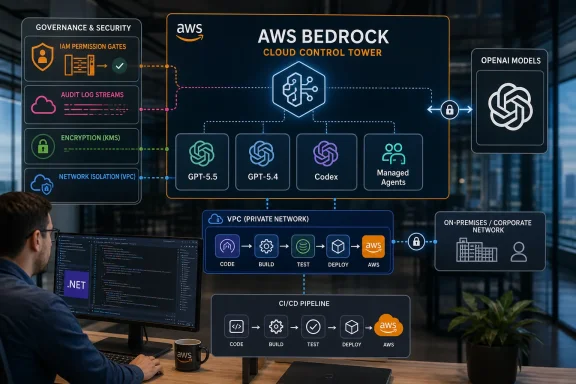
That is where AWS helps. A company that already uses IAM policies, AWS Organizations, VPC endpoints, CloudWatch, CloudTrail, KMS, and centralized billing does not need a philosophical debate about whether OpenAI is useful. It needs a way to put OpenAI into the same operational box as everything else. Bedrock gives OpenAI a path into those customers without requiring every customer to build a parallel governance stack.
Codex is the most interesting piece of that puzzle for developers. OpenAI’s Codex has evolved from the old “write me a function” coding assistant idea into something closer to an agentic software-development system: it can reason over codebases, generate patches, assist with reviews, and participate in longer-running engineering workflows. Putting that capability inside Bedrock is a direct challenge to the assumption that coding agents must live primarily in IDE plug-ins, GitHub workflows, or vendor-specific cloud environments.
For Windows developers, the implications are practical. A team building .NET services on Windows workstations, deploying containers into AWS, and authenticating through enterprise identity systems may prefer a coding agent that can be governed through AWS procurement and logging rather than a separate vendor pathway. That does not eliminate the need to evaluate code quality, security, and licensing risk, but it shifts the deployment conversation from “Can we use this tool?” to “Can we govern this workload like the rest of our stack?”
But exclusivity is not the same thing as influence. Once OpenAI models are available through AWS, Microsoft’s advantage becomes less about sole access and more about integration. Azure can still offer OpenAI models in a way that is tightly connected to Microsoft identity, Microsoft 365 data, GitHub, Visual Studio, Defender, Purview, and Windows management. AWS, meanwhile, can offer OpenAI models in a way that is tightly connected to cloud infrastructure, data lakes, serverless services, private networking, and production application stacks.
That distinction matters for IT buyers. A company using Copilot in Microsoft 365 may still choose Azure for employee productivity AI and AWS Bedrock for application AI. Another company may standardize AI development on AWS while keeping GitHub Copilot for developers. The future is not one vendor replacing another; it is a messy partitioning of AI workloads across productivity, software engineering, cloud operations, security, and line-of-business applications.
For WindowsForum readers, the Microsoft angle is still central because Windows remains the managed endpoint layer for many of these enterprises. AI coding agents may run in cloud-hosted sandboxes, but their outputs land in repositories, CI/CD systems, Visual Studio Code, Windows development machines, and production environments that administrators must secure. The cloud provider may change, but the operational burden still lands on IT.
OpenAI’s GPT-5.5 may be positioned as a frontier model, while GPT-5.4 may suit different cost or latency profiles. Codex is not simply another text-generation endpoint; it is a coding agent with a workflow model. Bedrock Managed Agents powered by OpenAI introduce another layer entirely, where the customer is not just calling a model but delegating actions through an agent framework.
That means application architects still need to design around specificity. A support chatbot, a code-review agent, a compliance summarizer, a document-search workflow, and a data-analysis assistant should not all be treated as the same “AI feature.” The model picker matters. So do the prompts, tools, retrieval sources, identity boundaries, and logging strategy.
This is where AWS has an advantage, but also a responsibility. The easier it becomes to invoke powerful models, the easier it becomes for organizations to deploy them badly. Bedrock can centralize governance, but it cannot automatically decide which data should be exposed, which actions should require approval, or how much autonomy a coding agent should have in a production repository.
In the old model, a developer asked an assistant for help and copied the result. In the new model, an agent can inspect a codebase, propose patches, run tests, and participate in a workflow that looks less like autocomplete and more like a junior engineer with unusual speed and no human common sense. That is powerful, and it is exactly why governance matters.
AWS hosting Codex inside Bedrock gives enterprises a more familiar way to impose boundaries. Access can be tied to roles. Activity can be logged. Network paths can be constrained. Billing can be centralized. Security teams can at least begin from known AWS controls rather than trying to reverse-engineer a new vendor’s operational model.
Still, Windows and enterprise development teams should be careful not to confuse managed access with safe output. Codex can generate insecure code, misunderstand business logic, introduce subtle regressions, or produce changes that pass tests while violating architecture. The arrival of Codex in Bedrock should accelerate adoption, but it should also accelerate the need for mandatory code review, software composition analysis, secret scanning, and policy-driven CI gates.
Amazon Bedrock Managed Agents powered by OpenAI are part of a broader industry shift toward systems that can plan, call tools, retrieve data, execute steps, and loop through tasks. This is the model-vendor dream because it moves AI from advisory software into operational software. It is also the point where IT governance becomes non-negotiable.
An agent that summarizes a PDF is one thing. An agent that opens a ticket, queries a database, modifies infrastructure, drafts a customer email, updates code, or triggers a workflow is something else. Every new tool permission becomes a potential blast radius. Every identity binding becomes a security decision. Every log becomes part of the audit story.
AWS knows this, which is why Bedrock’s enterprise pitch leans heavily on controls. But customers should not outsource judgment to the platform. The hard work is deciding which workflows are appropriate for autonomous or semi-autonomous execution, which require human approval, and which should remain off-limits until the technology matures.
AWS’s OpenAI move strengthens its role as a model supermarket. Microsoft’s strength is integration with the productivity and developer stack. Google’s strength is its own Gemini models, TPU infrastructure, and deep AI research base. Each vendor wants to become the default place where customers operationalize AI, even if the underlying models come from multiple labs.
The irony is that model providers also need the hyperscalers. Frontier AI is capital-intensive, infrastructure-hungry, and enterprise-sales-heavy. OpenAI can build direct relationships, but the cloud providers already have procurement channels, compliance teams, global infrastructure, partner networks, and the trust of CIOs who may be skeptical of AI startups but comfortable with AWS account teams.
This creates a strange new balance of power. Model companies supply the intelligence layer that customers want. Cloud providers supply the enterprise machinery that customers need. Neither side is fully in control, and that tension will define the next several years of AI infrastructure.
Enterprises should evaluate OpenAI models in Bedrock the same way they evaluate any high-impact platform capability. Which data classes may be sent to the model? Which regions are supported? What logging is enabled? How are prompts and outputs retained? Which users can invoke which models? Which agents can call which tools? How are costs allocated? What happens when a model version changes?
Those questions are not bureaucracy for its own sake. They are the difference between sustainable AI adoption and a shadow-IT mess with better branding. The companies that succeed with Bedrock will not be the ones that simply turn on every model. They will be the ones that build a model governance layer that developers can actually use without opening tickets for every experiment.
For Windows-heavy organizations, endpoint policy also belongs in the conversation. Developers may access Codex through IDEs, terminals, web consoles, or cloud workflows. Administrators need to understand where credentials live, how local files are shared, whether sensitive code leaves the device, and how AI tools interact with existing controls such as Defender, device management, DLP, and privileged access policies.
This is also why smaller AI vendors should be nervous. Bedrock’s value grows as it adds must-have models, and OpenAI is the biggest must-have model brand in the market. Once customers standardize on Bedrock as the interface for model experimentation and deployment, emerging providers may need AWS distribution as much as they need raw benchmark wins.
There is a downside to that consolidation. A unified model platform can reduce integration friction, but it can also concentrate purchasing power and architectural dependency. If Bedrock becomes the AI gateway for a large enterprise, AWS gains leverage not only over infrastructure but over the customer’s model roadmap.
Still, most CIOs will accept some platform dependency in exchange for governability. The AI market has moved too quickly for bespoke integrations to remain attractive at scale. Bedrock’s argument is that enterprises should spend less time wiring providers together and more time building useful, controlled systems. With OpenAI now in the catalog, that argument is much harder to ignore.
 AWS Turns the Model War Into a Procurement War
The first wave of generative AI was sold like software magic: a chat box, a model name, a benchmark chart, and a promise that the future had arrived. The second wave is less romantic and more consequential. It is about who controls the console, the billing relationship, the audit trail, the private network path, and the integration surface.That is why OpenAI arriving in Amazon Bedrock matters. Bedrock is AWS’s managed foundation-model service, designed to let customers access models from multiple providers through AWS-native controls rather than stitching together separate vendor accounts. AWS has already positioned Bedrock as a catalog for Anthropic, Meta, Mistral, Cohere, Amazon’s own models, and other model families. Adding OpenAI changes the emotional and commercial weight of that catalog.
OpenAI said in its own announcement that the move brings its frontier models, Codex, and OpenAI-powered managed agents into AWS environments. Amazon’s own AWS blog later framed the availability as general availability, not merely a preview. That chronology matters because it tells enterprise buyers that this is not just a press-release handshake; AWS wants OpenAI to become a normal part of the Bedrock control plane.
The deeper story is that AWS is refusing to let Microsoft Azure become the default enterprise wrapper around OpenAI. Microsoft still has deep OpenAI ties, still has Copilot, still has Azure AI Foundry, and still owns the Windows-and-Office desktop flank. But AWS has now made its own pitch: if your infrastructure, security controls, data estate, and developer workflows already live in AWS, you should not have to leave that universe to use OpenAI’s best models.
Bedrock Was Built for This Moment
Amazon Bedrock was never only about model access. It was a bet that enterprises would eventually tire of treating every model provider as a separate island. The service wraps model invocation, guardrails, agents, knowledge bases, IAM, CloudTrail, encryption, and private networking into the same grammar AWS customers already understand.That grammar is powerful because enterprise AI is a governance problem before it is a demo problem. A developer can get impressive results from a standalone API in an afternoon. A bank, insurer, hospital system, or government contractor needs access controls, records, retention, monitoring, region choices, change management, procurement approval, and incident response. Bedrock’s appeal is that it makes AI feel less like a rogue SaaS subscription and more like another governed AWS workload.
OpenAI entering that environment gives Bedrock a stronger claim to neutrality. AWS can now tell customers that they do not need to choose a single model religion before they build. They can compare OpenAI, Anthropic, Meta, Mistral, Amazon Nova, and others under a shared operational layer, even if the models differ in capability, latency, pricing, region support, and API behavior.
That does not make Bedrock magically open. It is still AWS, and the convenience is inseparable from the lock-in. But it changes the customer’s lock-in calculation. Instead of being locked into a single model vendor’s API, an enterprise may prefer being locked into AWS’s abstraction layer because AWS can keep swapping, adding, and packaging model providers as the market shifts.
OpenAI Gets Distribution Without Surrendering the Enterprise Story
For OpenAI, AWS distribution is a strategic hedge. The company became synonymous with consumer AI through ChatGPT and with developer AI through its API and Codex tooling. But the enterprise market is different. Large organizations often do not buy the best model directly; they buy the best model that fits their risk posture, vendor-management process, data controls, and existing architecture.That is where AWS helps. A company that already uses IAM policies, AWS Organizations, VPC endpoints, CloudWatch, CloudTrail, KMS, and centralized billing does not need a philosophical debate about whether OpenAI is useful. It needs a way to put OpenAI into the same operational box as everything else. Bedrock gives OpenAI a path into those customers without requiring every customer to build a parallel governance stack.
Codex is the most interesting piece of that puzzle for developers. OpenAI’s Codex has evolved from the old “write me a function” coding assistant idea into something closer to an agentic software-development system: it can reason over codebases, generate patches, assist with reviews, and participate in longer-running engineering workflows. Putting that capability inside Bedrock is a direct challenge to the assumption that coding agents must live primarily in IDE plug-ins, GitHub workflows, or vendor-specific cloud environments.
For Windows developers, the implications are practical. A team building .NET services on Windows workstations, deploying containers into AWS, and authenticating through enterprise identity systems may prefer a coding agent that can be governed through AWS procurement and logging rather than a separate vendor pathway. That does not eliminate the need to evaluate code quality, security, and licensing risk, but it shifts the deployment conversation from “Can we use this tool?” to “Can we govern this workload like the rest of our stack?”
Microsoft Loses Exclusivity, Not Relevance
It would be tempting to frame this as AWS taking OpenAI away from Microsoft. That is too simple. Microsoft remains one of OpenAI’s most important partners, and Azure remains deeply tied to OpenAI workloads, Microsoft 365 Copilot, GitHub Copilot, and the broader Windows enterprise ecosystem.But exclusivity is not the same thing as influence. Once OpenAI models are available through AWS, Microsoft’s advantage becomes less about sole access and more about integration. Azure can still offer OpenAI models in a way that is tightly connected to Microsoft identity, Microsoft 365 data, GitHub, Visual Studio, Defender, Purview, and Windows management. AWS, meanwhile, can offer OpenAI models in a way that is tightly connected to cloud infrastructure, data lakes, serverless services, private networking, and production application stacks.
That distinction matters for IT buyers. A company using Copilot in Microsoft 365 may still choose Azure for employee productivity AI and AWS Bedrock for application AI. Another company may standardize AI development on AWS while keeping GitHub Copilot for developers. The future is not one vendor replacing another; it is a messy partitioning of AI workloads across productivity, software engineering, cloud operations, security, and line-of-business applications.
For WindowsForum readers, the Microsoft angle is still central because Windows remains the managed endpoint layer for many of these enterprises. AI coding agents may run in cloud-hosted sandboxes, but their outputs land in repositories, CI/CD systems, Visual Studio Code, Windows development machines, and production environments that administrators must secure. The cloud provider may change, but the operational burden still lands on IT.
The Unified API Is Convenient, but the Abstraction Leaks
AWS’s pitch is that Bedrock gives customers a unified environment for many models. That is true as far as it goes, but no serious enterprise should mistake a unified control plane for interchangeable intelligence. Models differ in context handling, tool-use behavior, refusal patterns, latency, cost, multimodal support, output style, and failure modes.OpenAI’s GPT-5.5 may be positioned as a frontier model, while GPT-5.4 may suit different cost or latency profiles. Codex is not simply another text-generation endpoint; it is a coding agent with a workflow model. Bedrock Managed Agents powered by OpenAI introduce another layer entirely, where the customer is not just calling a model but delegating actions through an agent framework.
That means application architects still need to design around specificity. A support chatbot, a code-review agent, a compliance summarizer, a document-search workflow, and a data-analysis assistant should not all be treated as the same “AI feature.” The model picker matters. So do the prompts, tools, retrieval sources, identity boundaries, and logging strategy.
This is where AWS has an advantage, but also a responsibility. The easier it becomes to invoke powerful models, the easier it becomes for organizations to deploy them badly. Bedrock can centralize governance, but it cannot automatically decide which data should be exposed, which actions should require approval, or how much autonomy a coding agent should have in a production repository.
Codex Is the Wedge Into Developer Workflows
Codex may end up being more disruptive than GPT-5.5 itself. Frontier chat models attract attention because they answer impressive questions, but coding agents change the daily rhythm of engineering teams. They sit closer to the build system, closer to the bug tracker, closer to the repository, and closer to the mistakes that can become security incidents.In the old model, a developer asked an assistant for help and copied the result. In the new model, an agent can inspect a codebase, propose patches, run tests, and participate in a workflow that looks less like autocomplete and more like a junior engineer with unusual speed and no human common sense. That is powerful, and it is exactly why governance matters.
AWS hosting Codex inside Bedrock gives enterprises a more familiar way to impose boundaries. Access can be tied to roles. Activity can be logged. Network paths can be constrained. Billing can be centralized. Security teams can at least begin from known AWS controls rather than trying to reverse-engineer a new vendor’s operational model.
Still, Windows and enterprise development teams should be careful not to confuse managed access with safe output. Codex can generate insecure code, misunderstand business logic, introduce subtle regressions, or produce changes that pass tests while violating architecture. The arrival of Codex in Bedrock should accelerate adoption, but it should also accelerate the need for mandatory code review, software composition analysis, secret scanning, and policy-driven CI gates.
Agents Move the Risk From Answers to Actions
The phrase managed agents deserves more scrutiny than it usually gets. A model that answers a question can be wrong. An agent that takes action can be wrong with consequences.Amazon Bedrock Managed Agents powered by OpenAI are part of a broader industry shift toward systems that can plan, call tools, retrieve data, execute steps, and loop through tasks. This is the model-vendor dream because it moves AI from advisory software into operational software. It is also the point where IT governance becomes non-negotiable.
An agent that summarizes a PDF is one thing. An agent that opens a ticket, queries a database, modifies infrastructure, drafts a customer email, updates code, or triggers a workflow is something else. Every new tool permission becomes a potential blast radius. Every identity binding becomes a security decision. Every log becomes part of the audit story.
AWS knows this, which is why Bedrock’s enterprise pitch leans heavily on controls. But customers should not outsource judgment to the platform. The hard work is deciding which workflows are appropriate for autonomous or semi-autonomous execution, which require human approval, and which should remain off-limits until the technology matures.
The Cloud Wars Are Now Model-Distribution Wars
For years, the hyperscaler competition was mostly about compute, storage, databases, and platform services. AI has scrambled that map. Raw compute still matters enormously, especially for training and inference at frontier scale, but enterprise differentiation increasingly depends on which models are available, how they are packaged, and how easily customers can move from prototype to controlled deployment.AWS’s OpenAI move strengthens its role as a model supermarket. Microsoft’s strength is integration with the productivity and developer stack. Google’s strength is its own Gemini models, TPU infrastructure, and deep AI research base. Each vendor wants to become the default place where customers operationalize AI, even if the underlying models come from multiple labs.
The irony is that model providers also need the hyperscalers. Frontier AI is capital-intensive, infrastructure-hungry, and enterprise-sales-heavy. OpenAI can build direct relationships, but the cloud providers already have procurement channels, compliance teams, global infrastructure, partner networks, and the trust of CIOs who may be skeptical of AI startups but comfortable with AWS account teams.
This creates a strange new balance of power. Model companies supply the intelligence layer that customers want. Cloud providers supply the enterprise machinery that customers need. Neither side is fully in control, and that tension will define the next several years of AI infrastructure.
IT Departments Should Treat Bedrock as a Control Plane, Not a Permission Slip
The most dangerous interpretation of this announcement is that OpenAI in Bedrock is automatically approved because it is “inside AWS.” That is not how risk works. Bedrock can make OpenAI easier to govern, but it does not erase the need for policy.Enterprises should evaluate OpenAI models in Bedrock the same way they evaluate any high-impact platform capability. Which data classes may be sent to the model? Which regions are supported? What logging is enabled? How are prompts and outputs retained? Which users can invoke which models? Which agents can call which tools? How are costs allocated? What happens when a model version changes?
Those questions are not bureaucracy for its own sake. They are the difference between sustainable AI adoption and a shadow-IT mess with better branding. The companies that succeed with Bedrock will not be the ones that simply turn on every model. They will be the ones that build a model governance layer that developers can actually use without opening tickets for every experiment.
For Windows-heavy organizations, endpoint policy also belongs in the conversation. Developers may access Codex through IDEs, terminals, web consoles, or cloud workflows. Administrators need to understand where credentials live, how local files are shared, whether sensitive code leaves the device, and how AI tools interact with existing controls such as Defender, device management, DLP, and privileged access policies.
The AWS-OpenAI Deal Makes AI Boring in the Most Important Way
The real milestone here is not that GPT-5.5 can answer prompts from an AWS endpoint. It is that frontier AI is being normalized into the same infrastructure patterns that enterprises already use. That is how technologies become durable: not through demos, but through procurement, logging, access control, billing, regional availability, SDKs, and boring operational discipline.This is also why smaller AI vendors should be nervous. Bedrock’s value grows as it adds must-have models, and OpenAI is the biggest must-have model brand in the market. Once customers standardize on Bedrock as the interface for model experimentation and deployment, emerging providers may need AWS distribution as much as they need raw benchmark wins.
There is a downside to that consolidation. A unified model platform can reduce integration friction, but it can also concentrate purchasing power and architectural dependency. If Bedrock becomes the AI gateway for a large enterprise, AWS gains leverage not only over infrastructure but over the customer’s model roadmap.
Still, most CIOs will accept some platform dependency in exchange for governability. The AI market has moved too quickly for bespoke integrations to remain attractive at scale. Bedrock’s argument is that enterprises should spend less time wiring providers together and more time building useful, controlled systems. With OpenAI now in the catalog, that argument is much harder to ignore.
The Bedrock Announcement Gives Enterprises a Shorter Path and a Longer Checklist
AWS and OpenAI have made the commercial path to frontier models simpler, but they have not made the architectural decisions simple. The practical consequences are concrete enough that IT teams should treat this as a planning event, not just another model launch.- AWS customers can now evaluate OpenAI’s GPT-5.5, GPT-5.4, Codex, and OpenAI-powered managed agents through Bedrock rather than building every integration directly against OpenAI’s standalone services.
- The move strengthens Bedrock’s position as a multi-model enterprise control plane, especially for organizations that already rely on AWS identity, networking, logging, encryption, and billing.
- Codex inside Bedrock raises the stakes for developer governance because coding agents can affect repositories, tests, build pipelines, and production-bound software.
- Microsoft remains deeply relevant through Azure, GitHub, Windows, and Microsoft 365, but OpenAI’s AWS availability weakens the idea that Azure is the unavoidable enterprise route to OpenAI models.
- Administrators should define model-access policies, data boundaries, agent permissions, logging requirements, and cost controls before broad internal rollout.
References
- Primary source: iNews Zoombangla
Published: 2026-07-08T05:50:13.883745
Loading…
inews.zoombangla.com - Related coverage: aws.amazon.com
Loading…
aws.amazon.com - Related coverage: aboutamazon.com
Loading…
www.aboutamazon.com - Related coverage: docs.aws.amazon.com
Loading…
docs.aws.amazon.com - Official source: openai.com
Loading…
openai.com - Related coverage: builder.aws.com
Loading…
builder.aws.com
- Related coverage: techradar.com
Loading…
www.techradar.com