OpenAI Internal Code Host Could Become a GitHub Rival

  • Thread Author
OpenAI’s engineers have quietly built an internal code-hosting platform and — according to multiple reports — the company is now weighing whether to productize that tool as a commercial alternative to the Microsoft‑owned GitHub, a move that would set up one of the most surprising competitive cross-currents in the cloud‑AI era and raise new questions about reliability, strategy, and trust in the developer ecosystem.

OpenAI engineers code AI software in a high-tech global data center.Background​

OpenAI and Microsoft forged a deep, multifaceted partnership over the past several years: Microsoft has been a principal investor, the single largest cloud partner for OpenAI, and the primary commercial distributor for many OpenAI services. At the same time, Microsoft owns GitHub, the dominant code‑hosting service developers use for source control, pull requests, CI/CD, package registries, and collaborative workflows.
In late February and early March 2026, multiple outlets reported that OpenAI staff built an internal code repository after repeated GitHub outages impeded day‑to‑day engineering work. The internal tool reportedly solved specific reliability and agent‑integration needs for OpenAI’s own teams. Now — still described as nascent and possibly months away from any external availability — the project is being discussed internally as a potential commercial product OpenAI could sell to developer and enterprise customers.
That combination — a nascent product built to address reliability, plus OpenAI’s enormous developer footprint and deep AI tooling — is why the rumor matters. If real and commercialized, an OpenAI code host could touch virtually every step of modern software production: source control, AI‑assisted commits, automated review agents, CI/CD automation, artifact hosting, and security scanning.

Why engineers build internal tooling — and why that matters now​

The practical trigger: repeated GitHub disruptions​

Large engineering organizations often build internal systems when public tools don’t meet availability, scale, or latency requirements. Google’s internal monorepo system, Piper, and Meta’s Sapling are canonical examples: both were built to manage extreme scale and specialized developer workflows, and neither was originally intended as a commercial product.
What changed this time is that the broader developer community experienced an unusually dense string of service degradations and outages on GitHub in early 2026. Public status pages and independent incident trackers documented multiple partial and intermittent outages that affected web access, API requests, Git operations, Actions runs, and AI features (including Copilot) across February. For teams that rely on continuous integration, fast merge cycles, and AI‑assisted coding agents, repeated multi‑hour degradations are not a minor inconvenience — they are a productivity and reliability risk.
OpenAI’s engineering teams reportedly responded by creating an internal code host optimized for availability and tighter integration with its own AI agents. Whether that internal tool becomes a public product is the key strategic question.

From internal tool to commercial product: the logic​

There are three commercial incentives for turning internal developer tools into products:
  • Reliability as a differentiator: a code host that demonstrably outperforms incumbents on uptime and latency — especially for large monorepos and agent workflows — can attract enterprise teams.
  • Bundling with AI services: OpenAI can combine a code repository with AI coding agents, automated code generation, and code understanding features (e.g., agentic Codex-style assistants), creating a vertically integrated developer platform.
  • Revenue diversification: OpenAI is expanding commercially beyond API metered usage and ChatGPT subscriptions; developer tooling is a logical adjacent revenue stream that fits with enterprise adoption.
Those incentives are powerful. But they collide with an obvious friction point: this would directly compete with Microsoft, one of OpenAI’s largest investors and cloud partners.

The Microsoft paradox: partner, investor, and competitor​

The relationship between OpenAI and Microsoft has always been multi‑layered: investment, cloud partnership (historically Azure), product integration, and co‑development. That mix has delivered mutual commercial advantages — but it also creates strategic tension when either party moves into the other’s core product space.
A commercial GitHub competitor built by OpenAI would be a clear conflict with Microsoft’s product portfolio. The strategic implications are significant:
  • Microsoft stands to lose not only a key customer but potentially a major distribution channel for developer services tied to the OpenAI model stack.
  • GitHub has deep network effects: hundreds of millions of repositories, tens of millions of paying developers, and built‑in features like Actions, Packages, Codespaces, and an entrenched enterprise footprint. Unseating that requires more than reliability; it requires trust, integration, and migration ease.
  • Microsoft’s own investments in AI for developers — Copilot, Spark, and deeper IDE integrations — create a product overlap that raises questions about dual loyalties, data routing, and model access.
Yet the reported move also reflects OpenAI’s commercial calculus: diversify revenue, reduce single‑vendor operational risk, and own a platform where its AI agents can operate with fewer upstream dependencies.

What the rumored product could look like​

No definitive product blueprint has been released, but informed speculation and analogous offerings suggest some likely priorities if OpenAI decides to commercialize the internal repository:
  • Core code hosting features: Git semantics, pull requests, branch protections, issue tracking, and code search designed for scale.
  • Deep AI integration: native agent workflows that can write, review, refactor, and generate tests; AI‑driven code search and semantic analysis; automatic pull request drafting.
  • Reliability and multi‑region replication: stronger SLAs, partition‑tolerant architectures, and multi‑cloud or hybrid on‑prem options aimed at enterprise customers.
  • Developer productivity additions: integrated CI/CD pipelines, AI‑accelerated code review, and a marketplace for AI‑based developer tools.
  • Security and compliance: built‑in SCA (software composition analysis), secret scanning, dependency alerts, and SOC/ISO certifications for regulated customers.
If OpenAI bundles its agentic models directly into the platform, it can market a differentiated workflow: developers collaborate with fellow humans while AI agents proactively create and validate code changes, all inside the same hosting environment.

Technical and operational challenges​

Building a commercial code‑hosting platform at GitHub scale is monstrously hard. The challenges are both technical and socio‑operational:
  • Scale and durability: repository storage, git object storage, large file handling, and high‑throughput clone/push operations require global, highly optimized storage systems and careful egress/cost controls.
  • CI/CD scale: hosted runners and ephemeral build environments are resource‑intensive. Managing multi‑tenant build capacity without ballooning costs is a nontrivial systems engineering problem.
  • Latency and availability: to win on reliability OpenAI would need multi‑region, read‑replicated architectures and defensive measures for cascading failures in third‑party dependencies.
  • Migration friction: convincing large organizations to migrate hundreds of repositories, pipelines, and secrets is a slow, risk‑averse process.
  • Security and trust: enterprises require audit logs, data residency options, vulnerability scanning, and formal certifications. Perception matters: some open‑source communities may be wary of entrusting code to a centralized AI company.
  • Economic model: hosting, storage, compute for AI agent operations, and support all cost money. Pricing must balance competitiveness with the heavy infrastructure costs of inference and storage.
None of these obstacles are insurmountable for a well‑funded company, but they require sustained engineering focus and an enterprise go‑to‑market that emphasizes security, migration tools, and SLAs.

Strategic levers and market dynamics​

1) Developer mindshare and network effects​

GitHub’s lead is not just product features; it’s the network. Any newcomer must offer a clear migration path and a set of features that are either strictly better or uniquely integrated with developer‑facing AI services.

2) AI agents as a lock‑in vector​

If OpenAI bundles agentic workflows that demonstrably reduce engineering time — for example, by automating end‑to‑end story implementation or reducing bug fix cycles — that capability becomes a sticky differentiator. Enterprises may tolerate a new hosting vendor if the productivity gains are real and measurable.

3) Multi‑cloud and hybrid strategies​

To avoid direct Azure lock‑in and to reassure customers worried about single‑vendor risk, OpenAI would likely offer multi‑cloud or on‑prem solutions, or partner with other cloud providers for distribution. The recent large strategic investments OpenAI has announced (and the reported new funding partnerships) increase the plausibility of multi‑cloud options.

4) Regulatory and antitrust scrutiny​

A move into core developer infrastructure by a company that also supplies widely used AI models invites fresh regulatory scrutiny, particularly around competition policy, interoperability, and potential anti‑competitive bundling.

The broader context: funding, burn, and public trust​

Two broader forces shape how this rumor should be read.
First, OpenAI has aggressively pursued infrastructure and product expansion. In late February 2026 reports indicate a massive funding/partnership round led by large tech companies that dramatically boosted the company’s capacity and balance sheet. That capital could underwrite ambitious new products and the large upfront costs of a code‑hosting service.
Second, the company has faced public backlash over sensitive contracts and governance decisions. A recent defense contract with the U.S. Department of Defense triggered public protests and a wave of criticism, prompting OpenAI’s CEO to publicly acknowledge mistakes in timing and communication and to amend parts of the agreement. That controversy sparked a short‑term consumer response — app uninstall spikes, social media campaigns, and a momentary lift for alternative AI apps — and it highlights how reputation and trust can rapidly affect adoption.
Financial narratives are mixed. Some analysts and outlets have highlighted sizeable projected cash burn scenarios for advanced AI developers; others point to growing revenue from subscriptions and enterprise services. Projections about losses or cash exhaustion are inherently speculative and depend heavily on pricing, enterprise contracts, capital commitments, and the future cost curve of chip supply and GPUs. Any claim about impending bankruptcy or precise multi‑billion shortfalls should be treated as a forecast, subject to revision, and contingent on future strategic choices.

Risks and downside scenarios​

For OpenAI
  • Strategic fragmentation: competing with Microsoft in core product areas risks unraveling the cooperative strands of the partnership that facilitate compute, distribution, and enterprise sales.
  • Execution risk: failing to deliver on reliability, security, or migration tooling could leave OpenAI with an expensive engineering effort and little adoption.
  • Community backlash: the open‑source community could resist moving to a proprietary host, especially if code indexing or model training rights are unclear.
  • Regulatory heat: antitrust and procurement regulators could probe any move that tightens OpenAI’s control over both models and developer platforms.
For Microsoft and GitHub
  • Customer churn: repeated outages and perceived neglect could nudge some enterprise customers to evaluate alternatives.
  • Competitive exposure: Microsoft’s investments in AI and cloud make GitHub itself a continuing center of innovation; a well‑executed rival would force Microsoft to accelerate GitHub innovation, reliability investments, and tighter Copilot and Azure integration.
  • Relationship strain: a public commercial conflict could complicate Azure compute agreements, model licensing, and joint go‑to‑market arrangements.
For developers and enterprises
  • Migration costs: moving thousands of repositories plus CI/CD pipelines and policies is time‑consuming and risky.
  • Vendor lock‑in: platforms that tightly bind AI agents to a code host risk creating new lock‑in dynamics.
  • Data privacy and IP: Corporate legal teams will require explicit guarantees about code reuse, model training, and IP boundary protections.

What success looks like — and what failure looks like​

Success for a new OpenAI code host would look like:
  • Reliable global SLAs that consistently beat or match incumbent enterprise expectations.
  • Enterprise adoption at meaningful scale, especially from teams that value AI‑driven workflows.
  • Clear, auditable controls for data residency, IP protection, and compliance certifications.
  • Developer tooling that integrates smoothly into IDEs and pipelines without breaking existing workflows.
Failure would look like:
  • A slow, costly engineering slog that never reaches parity with mature Git hosting features.
  • Limited adoption because enterprises refuse to migrate or distrust the vendor.
  • Public disputes with Microsoft that result in contract or cloud‑compute complications.
  • Regulatory action or developer boycott over model training or data‑use practices.

Practical implications for developers and IT leaders​

If you manage developer platforms or evaluate code‑hosting services, now is the time to:
  • Audit dependencies: map which critical workflows depend on GitHub services (Actions, Codespaces, Copilot) and estimate business impact for multi‑hour outages.
  • Test migration paths: evaluate backup and mirror strategies, such as replicating repositories to secondary hosts or self‑hosting critical components.
  • Re‑examine SLAs: insist on clearer uptime and incident notification terms from current vendors and include availability clauses in procurement.
  • Consider agent risk: if you adopt AI‑driven coding agents, assess where those agents execute and how their compute and security posture align with compliance needs.
  • Watch vendor contracts: be wary of any terms that would allow a provider to reuse your code for model training without clear, auditable permission and compensation clauses.

What to watch next​

  • Official announcements: OpenAI and Microsoft statements will be determinative. Expect cautious corporate language but watch for commitments on compute, IP, and partnership terms.
  • Product signals: a public beta, waitlist, or developer preview would indicate commercialization intent; absence of these could mean the project stays internal.
  • Enterprise deals: early enterprise customers or pilot contracts would be a strong positive signal that the product can meet compliance and migration demands.
  • GitHub product response: look for accelerated reliability work, feature parity pushes, and possibly price or SLA changes to retain customers.
  • Regulatory attention: antitrust or procurement agencies may watch moves that alter competitive dynamics between major cloud and AI vendors.

Final analysis​

The rumor that OpenAI is building a GitHub rival is significant because it reframes the relationship between AIdriven model providers and developer infrastructure. At stake is much more than where code lives; it’s who controls the workflow where human engineers and AI agents collaborate to produce software.
There are persuasive reasons for OpenAI to explore this path: internal reliability needs, the commercial logic of bundling AI agents with hosting, and the opportunity to monetize a platform that touches software delivery’s most vital seams. There are equally persuasive reasons for caution: technical scale challenges, migration friction, and the broader strategic awkwardness of competing with a major investor and cloud partner.
The immediate facts are straightforward: engineers at OpenAI built an internal repository to reduce operational fragility; GitHub experienced a spate of incidents that exposed real developer pain; and OpenAI is reportedly discussing commercialization. Beyond those facts lies a messy strategic calculus. Success would require uniting world‑class systems engineering, airtight enterprise security, and a migration story convincing enough to overcome the greatest single obstacle in developer tools: inertia.
For IT leaders, the practical takeaway is the same whether or not OpenAI ships a product: the reliability of core developer services matters. Treat Git hosting and CI/CD as strategic dependencies, prepare migration and redundancy plans, and scrutinize how tightly any AI agent integration binds your organization to a single provider.
In short, the rumor is both a symptom and a signal. It’s a symptom of rising expectations for reliability in a world where AI increasingly automates development tasks. And it’s a signal that the boundaries between platform, tool, and model are blurring — which will force enterprises, developers, and regulators to rethink how software is built, hosted, and governed in the age of AI.

Source: Windows Central OpenAI challenges Microsoft amid rumors of a GitHub competitor
 

OpenAI’s engineers quietly building an internal code‑hosting platform that could be productized into a direct competitor to Microsoft‑owned GitHub is the kind of strategic development that reshapes both the developer tools market and the delicate partnership between two of the industry’s largest players. The project—reported by The Information and summarized by outlets across the web—was born out of operational pain: repeated GitHub outages that disrupted engineering workflows inside OpenAI. What began as a reliability workaround for internal teams now carries the potential to become a commercial product that would sit squarely in Microsoft’s territory, raising immediate questions about vendor concentration, commercial incentives, and the future architecture of developer workflows.

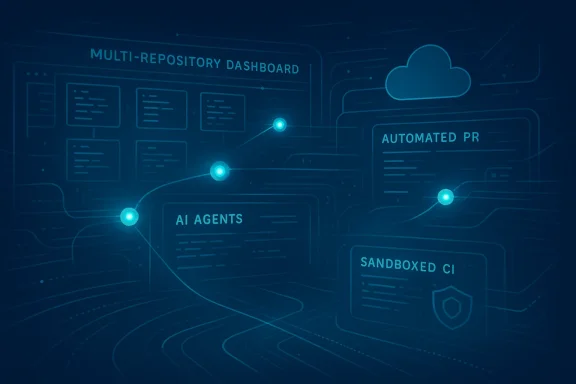
Blue digital dashboard showing AI agents, multi-repo flow, automated PR, and sandboxed CI.Background: why an internal repo matters right now​

OpenAI’s apparent decision to build its own repository platform is first and foremost an engineering response to availability risk. Developers at large AI labs increasingly rely on a tightly coupled stack: model training and inference on cloud providers, CI/CD and automation that invoke code hosting APIs, and agentic coding assistants that can open, edit, test, and merge across repositories. When GitHub suffers outages—or when migrations and configuration changes ripple through Azure infrastructure—those agentic pipelines and human workflows can stall, producing high operational costs. The Information traces this exact chain of events to recent GitHub incidents and an ongoing migration of GitHub services onto Azure, which contributed to several service disruptions for customers, including OpenAI.
That fragility cuts deeper for OpenAI because of how the company builds: it runs model training and inference at enormous scale and is increasingly embedding AI agents into engineering processes (Codex‑driven automation is a concrete example). Owning the repository layer reduces a dependency that historically sat squarely with Microsoft—the same company that acquired GitHub for $7.5 billion in 2018 and remains OpenAI’s largest strategic investor. Microsoft’s historic acquisition and multi‑billion investment relationship create a highly interdependent triangle: Microsoft owns GitHub and Azure, and has poured substantial capital inrning an internal tool into a product would therefore have both operational and geopolitical consequences inside the AI ecosystem.

What the reports say — and what they do not​

The report in brief​

  • OpenAI engineers built an internal code‑hosting and collaboration platform after being disrupted by recent GitHub outages; staff have discussed commercializing it.
  • The project is described as nascent: internal tooling first, potential product second; timelines and product details have not been confirmed publicly.
  • Microsoft, OpenAI, and GitHub declined to comment to reporters at the time of publication.

Clear facts (verified)​

  • Microsoft acquired GitHub for $7.5 billion in 2018.
  • GitHub reports continued growth in users and activity: its Octoverse metrics show GitHub reached well over 100 million developers years ago and reported substantially higher developer counts and repo activity through 2025. Those numbers underline how big an incumbent GitHub is in the market.
  • OpenAI has invested heavily in tooling that interacts directly with repositories—its Codex product family now runs as a first‑class developer agent across IDEs, CI and GitHub workflows, capable of multi‑file edits and automated pull‑request workflows. OpenAI’s own product documentation and release notes describe Codex as capable of repo navigation, creating PRs, running tests in sandboxes, and automating review tasks.

Unverified or contested claims​

  • Some articles reference historical profit‑sharing details and precise investor profit allocations (for example, a claimed “75% of profits” tranche). That specific phrasing and percentage are not clearly documented in accessible regulatory filings or in the public restructuring summaries; I was unable to locate a primary public filing that uses that exact formulation. Where such claims appear in reporting, they are best read as shorthand for complex contractual economics that have been renegotiated over time. Treat precise profit‑split percentages presented without primary source citation as unverified.

Why this matters strategically​

1) Vendor concentration and systemic risk​

Enterprises and developer teams prefer standardization—GitHub is the default hub for billions of commits, code review flows, integrations, package registries, actions, and third‑party apps. But that concentration creates single points of failure: when GitHub’s availability drops, many dependent processes—including model training pipelines and agentic automation—are impacted. For a company like OpenAI with tight operational coupling to its tooling, the incentive to own a more deterministic, instrumented, and resilient repo is strong. Building an internal platform is therefore a risk‑mitigation move as much as product experimentation.

2) Product/market fit: an AI‑native repository​

If OpenAI commercializes the platform, it would likely bake in deep, native integration with its Codex agents and broader developer toolkit. That integration could look like:
  • Native agent orchestration (Codex tasks that run within the repo environment, automated PR generation and review, and repo‑scale reasoning).
  • Built‑in security and privacy controls designed for enterprise AI use cases (sandboxing, fine‑grained approvals for agent actions).
  • Tight coupling to OpenAI’s model stack for features like automated code summarization, intent extraction, and dependency reasoning.
Those features could create a distinct product narrative: a repo built to accelerate AI‑native development. For teams already using OpenAI tools, an integrated repo could reduce friction and offer competitive advantages over a less integrated GitHub + Copilot arrangement. OpenAI’s existing Codex investments already aim in this direction.

3) A direct competitive tension with Microsoft​

OpenAI productizing a repo platform would place it in a direct product contest with GitHub—ironically, against the company that is a major investor and strategic cloud partner. Even with partnership agreements meant to preserve some operational independence, a commercial move into code hosting tests the boundaries of those arrangements. Potential consequences include:
  • Contract renegotiations or defensive positioning from Microsoft (reinstating exclusive rights, tightening licensing, or accelerating investment into GitHub features).
  • A commercial tug‑of‑war over enterprise customers who must choose between vertically integrated stacks.
  • A broader decoupling in which OpenAI seeks to diversify its dependencies (especially in light of OpenAI’s other recent funding and infrastructure partnerships).

Market landscape: fragmentation, incumbency, and AI tooling​

The incumbent’s strength​

GitHub’s scale is not incidental. The platform hosts hundreds of millions of repositories and tens to hundreds of millions of developers worldwide; it is deeply embedded into CI/CD, package ecosystems, and developer identity flows. That makes the incumbent hard to displace on pure network effects. GitHub also owns Copilot—a product that blends code completion with repository signals—and some Copilot services are hosted using OpenAI models on Azure infrastructure, creating complex mutual dependencies.

Competitive fragmentation​

Yet the developer tooling market is rapidly fragmenting around AI. New entrants and incumbents alike are building better agent orchestration, inner‑loop automation, and repo intelligence:
  • Tools like Cursor, Anthropic‑powered offerings, and Google’s developer AI investments are all vying for developer mindshare.
  • Large technology companies (Google, Meta) historically built internal code‑hosting platforms for scale—Google’s Piper and Meta’s Sapling/forked tools are examples of internal systems kept private and optimized for monorepos at hyperscale. These internal platforms show that scale and specializations are both possible and sometimes preferable for certain organizations, but they also illustrate why most companies keep such systems internal rather than commercialize them.

The path to revenue​

For OpenAI to convert an internal repo into a viable product, it would need to check several commercial boxes:
  • Build enterprise‑grade availability, SLAs, and compliance (SOC2, FedRAMP equivalents for public sector, etc.).
  • Provide migration and integration tools for existing GitHub and Git workflows (a major engineering lift).
  • Create a thriving third‑party ecosystem of dev tools, CI/CD integrations, packages, and marketplace features comparable to GitHub’s app ecosystem.
  • Articulate a pricing and data‑use policy that assuages enterprise concerns about vendor lock‑in and model training data.

Technical feasibility — what would it take?​

Creating a reliable, enterprise‑grade code hosting platform is hard but feasible. The key technical components are:
  • Distributed storage and metadata infrastructure capable of serving large monorepos or millions of smaller repos with consistent low latency.
  • A secure, reproducible sandboxing and CI environment that supports automated agent actions without data exfiltration risk.
  • Scalable search and cross‑repo reasoning to enable AI agents to reason about code at repo or organization scale.
  • Integration with existing identity (SSO), secrets management, and compliance telemetry to satisfy enterprise risk teams.
OpenAI already ships many of these components internally for Codex operations (sandboxed cloud execution, reproducible environments, and agent orchestration). Extending that infrastructure into a public SaaS offering is an engineering and product challenge—but one OpenAI appears technically well‑placed to attempt. That said, replicating GitHub’s ecosystem (marketplace of apps, open‑source community trust, package registries) is a different kind of challenge that takes sustained network‑effect investment.

Enterprise implications: procurement, lock‑in and governance​

Vendor lock‑in vs. diversity​

Many enterprise customers already juggle tradeoffs between consolidation and diversification. Using GitHub + Copilot + Azure is a consolidated approach; using OpenAI’s repo + Codex + OpenAI model stack would be too—but it would shift the balance of where the dependency sits. For regulated customers, the core questions will be:
  • Which vendor can provide the clearest contractual commitments on data use, archival, and model training exclusions?
  • Which vendor offers better guarantees around availability and incident transparency?
  • Which stack minimizes cross‑provider blast radius in the event of a platform outage or contractual dispute?
These practical procurement questions may favor diversified strategies—a mix of provider services, on‑prem mirrors, or multi‑cloud deployment options.

Security and compliance​

OpenAI would need to prove it can host private code with enterprise security standards. This includes strong encryption, access controls, immutable audit trails, and contractual assurances that customer code won’t be used to train public models without explicit permission. Those assurances are becoming table stakes after recent industry scrutiny about how large model providers use customer data. Enterprises will evaluate any new repo offering not just on features, but on the legal and compliance contract terms.

How Microsoft might respond​

Microsoft has several levers it could pull in response to OpenAI moving into code hosting:
  • Commercial / contractual adjustments: Microsoft could revisit engagement terms with OpenAI or GitHub enterprise customers to clarify exclusivities and obligations—especially where joint technical integrations exist.
  • Product acceleration: Microsoft could accelerate GitHub roadmap items: tighter Copilot integration, improved uptime SLAs, or deeper Azure‑native value propositions for GitHub Actions and Codespaces.
  • Strategic counter‑productization: Microsoft could push deeper Azure + GitHub ecosystem offerings, introduce new enterprise packages, or bundle Copilot capabilities with differentiated model hosting (including non‑OpenAI backends).
  • Regulatory and governance posture: Given the public scrutiny over the size and reach of the Microsoft–OpenAI relationship, Microsoft may choose to emphasize interoperability and open standards as a defensive posture.
Which combination of these Microsoft chooses will depend on how aggressively OpenAI pursues commercialization and on the public reaction from enterprise customers.

Risks, downsides, and open questions​

  • Market adoption risk. Launching a new general‑purpose repo into a market dominated by GitHub, GitLab, and Bitbucket requires not only parity on core features but also a convincing differentiator. Integration with Codex might be that differentiator—if OpenAI can demonstrate measurable productivity gains—but convincing large enterprises to migrate will still be slow and expensive.
  • Reputation and community trust. OpenAI would be judged on how it treats open source and community contributors. GitHub’s standing with open source communities is not unconditional, but it benefits from being the de facto platform. OpenAI will need to earn trust if it seeks to host public open‑source projects at scale.
  • Regulatory and investor tensions. The closeness between Microsoft and OpenAI has been under regulatory review in multiple jurisdictions; a product that competes with a major Microsoft asset could provoke renewed scrutiny or negotiations about governance and obligations.
  • Operational complexity. Building a high‑availability global code platform that supports a thriving third‑party ecosystem is expensive. Even if OpenAI’s internal platform is reliable for its own use cases, running a multi‑tenant public SaaS introduces new operational, legal, and support dimensions.
  • Unverified contractual claims. Certain historical reporting about precise profit‑sharing terms and the fine points of the Microsoft–OpenAI commercial arrangement vary from outlet to outlet. Where the public record is ambiguous, treat specific numerical claims with caution and seek primary documents or confirmed statements.

What to watch next​

  • Official announcements from OpenAI or GitHub. Public product launches, press statements, or job postings that describe a public product roadmap would materially change the likelihood of an external release. Right now the project is described as internal and early.
  • OpenAI’s commercial product posture. Look for signs that OpenAI is packaging Codex + repo workflows as an enterprise offering—enterprise signups, dedicated compliance pages, or an explicit migration story for teams currently on GitHub.
  • Microsoft’s strategic signals. Acceleration of GitHub feature roadmaps, expanded enterprise SLAs, or commercial bundling could indicate Microsoft treating this development as competitive. Microsoft’s partner statements and corporate blog posts will be important to read in full.
  • Developer reaction. Repo migrations are painful. If significant open‑source or enterprise projects begin experimenting with an OpenAI repo (or mirror strategies), that will be an early market signal that the product has traction. GitHub’s Octoverse metrics give a baseline for developer activity to compare against.

Conclusion — a reliability fix or a bet on the developer stack?​

At first glance the project appears to be a pragmatic reliability play—internal engineers frustrated with outages built a tool to keep work moving. But the strategic consequences extend far beyond internal uptime metrics. If OpenAI productizes the platform and leverages its AI‑native integrations, it could present a meaningful competitive alternative to GitHub for some classes of customers—particularly teams that value agentic automation and tight AI tooling integrations.
That outcome would force a careful reckoning between OpenAI and Microsoft: two companies whose commercial fates are entangled but not identical. For Microsoft, the immediate priority will be to stabilize GitHub’s availability and accelerate product differentiation. For enterprises and developers, the rise of an AI‑native repository adds another decision point in a crowded tooling landscape: balance the productivity gain of tighter AI integrations against the procurement, compliance, and lock‑in risks of consolidating on a single vendor.
For now, the project is early and unconfirmed as a shipping product; treat reporting as credible but incomplete, and watch for primary announcements and product artifacts. The story to watch is not only who wins the next developer tool, but how the industry manages the trade‑offs between convenience, resilience, and the commercial logic of companies whose investor and partner relationships cross the very markets they compete in.

Source: Unite.AI OpenAI Developing GitHub Rival That Could Challenge Its Biggest Investor
 

OpenAI engineers are quietly building an internal code‑hosting platform that could, if productized, become a direct alternative to Microsoft‑owned GitHub — a move driven by recurring GitHub outages, a high‑stakes Azure migration at GitHub, and growing concerns inside engineering teams about operational independence and developer productivity.

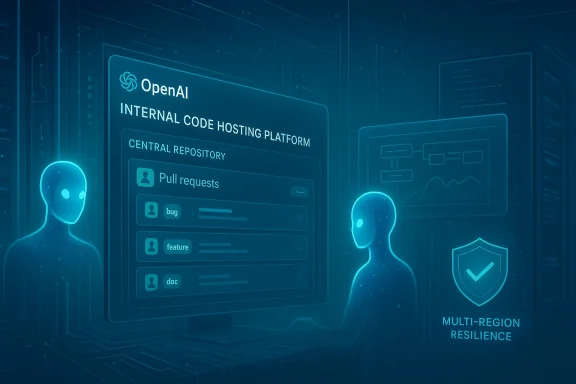
Futuristic OpenAI internal code-hosting platform with pull requests and a multi-region resilience shield.Background: what changed and why it matters​

For years GitHub has been the de facto hub for source code, collaboration, CI/CD and open‑source ecosystems. The platform’s acquisition by Microsoft in 2018 for $7.5 billion remade the competitive landscape by bringing a dominant cloud and productivity provider into close operational proximity with the world’s largest developer network. That relationship deepened further when Microsoft restructured its relationship with OpenAI in late 2025, acquiring a roughly 27% stake in the reconstituted OpenAI Group PBC as part of a wide-ranging deal that also tied compute commitments to Azure.
Those corporate ties make the latest development unusually consequential: OpenAI is reportedly constructing its own Git‑style repository and collaboration environment after engineers repeatedly encountered hours‑long interruptions to their workflows when GitHub suffered outages. The initial reporting surfaced in recent tech press coverage that cited The Information’s reporting and follow‑on summaries; our internal conversation threads and editorial notes corroborate that OpenAI staff have discussed the project internally and have considered both internal‑only and commercial‑offering routes.
This is not merely an engineering curiosity. If OpenAI decides to ship a commercial product — especially if it bundles advanced coding agents such as Codex with the repository service — the offering could become a competitive counterweight to GitHub and raise acute strategic questions about partnerships, vendor lock‑in, and the future of developer infrastructure in a cloud‑and‑AI era.

Overview: what reporting says and what’s verified​

  • The core claim: OpenAI has built (or is building) an internal code‑hosting and collaboration platform motivated by operational pain caused by GitHub outages. Multiple outlet summaries point to internal projects and discussions at OpenAI about whether to productize the tool. We treat the commercialization angle as speculative: the company has reportedly discussed selling access but may choose to keep it internal. This is the central claim from the initial reporting and industry summaries.
  • The proximate cause cited by engineers: recent spikes in GitHub incidents and several multi‑hour outages tied to an ongoing infrastructure migration to Microsoft Azure. Public GitHub incident logs show significant availability problems in early February 2026; GitHub’s status pages and incident reports document degraded availability affecting Git, Actions, Copilot, and other services during that period. OpenAI’s own status records during the same timeframe show Codex‑related disruptions that were linked to GitHub dependencies. These operational facts are verifiable in public incident timelines.
  • Contextual data: A mid‑year industry report collected by GitProtect recorded a 58% year‑over‑year increase in incidents for GitHub in the first half of 2025 (from 69 cases to 109), with 17 categorized as “major” and a cumulative disruption above 100 hours — a striking metric that underlines the reliability concerns raised inside engineering teams. We cross‑checked that figure with GitProtect’s mid‑year report and independent reporting that summarized the same data.
  • Corporate stakes: Microsoft remains a major investor with deep operational ties to OpenAI and ownership of GitHub. Those ties complicate the strategic calculus if OpenAI productizes an alternative to GitHub. The 27% stake figure and the 2018 GitHub purchase price are well documented in corporate announcements and mainstream reporting.
Where reporting relies on anonymous internal sources — for example, statements about internal debates, a timeline of “several months” to completion, or the productization roadmap — we flag those details as reported but not independently confirmed by public filings or an OpenAI spokesperson. They remain credible but provisional; the existence of an internal platform is reported by multiple outlets and reflected in community notes, but the eventual product strategy and commercial plans are still subject to change.

Why GitHub outages are different this year: Azure migration, scale, and configuration risk​

The migration context​

GitHub’s engineering leadership announced a high‑priority migration program to move core services to Microsoft Azure, a migration insiders called existential because it’s intended to scale GitHub to meet the low‑latency, high‑compute demands of AI tools like GitHub Copilot. That migration — publicly attributed to capacity limits in GitHub’s Northern Virginia colocation footprint — began in late 2025 and remains ongoing. Running split traffic across legacy Virginia infrastructure and Azure increases operational complexity and configuration surface area while both environments are used in parallel. Multiple independent summaries and internal memos referenced in reporting confirm that Azure migration started in October 2025 and was intended to complete within roughly two years.

The outage pattern​

What distinguishes the recent incidents is not only frequency but impact breadth: incidents affected not just web pages or API endpoints but core developer operations such as push/pull Git operations, pull request workflows, Actions runners, Copilot inference in IDEs, and artifact delivery. Public incident pages and independent incident analyses document a multi‑hour outage in early February 2026 that involved connection exhaustion in an HTTPS proxy layer and problems traceable to Azure upstream services and to configuration changes rolled out amid migration. Those kinds of failures create work stoppages for teams that rely on continuous commits, code reviews, and CI/CD pipelines.

The enterprise signal​

Engineers at large, tightly integrated AI companies — where large model development and productionization involve tens of repositories, large binary artefacts, and frequent commits — are particularly vulnerable to platform interruptions. The operational sensitivity coupled to AI model training and delivery means that even short outages can create cascading scheduling impacts across training jobs, deployment windows, and security review timelines. OpenAI’s internal discussions, as reported, reflect that sensitivity and a desire for tighter control over the developer path.

What OpenAI is reportedly building — scope, timeline, and options​

According to reporting and corroborating community notes, OpenAI engineers have prototyped an internal code‑host that mirrors the features teams expect from a modern developer forge: repository hosting, pull‑request style reviews, access controls, integrations with CI and automation agents, and the potential to surface AI‑driven assistant capabilities directly inside the development lifecycle.
Key reported attributes:
  • Designed for operational resilience and internal autonomy: the platform is being built to minimize external dependency surface area that previously caused disruptions. That includes tight controls for commit flows and local‑first failover behavior.
  • Integration potential with OpenAI’s Codex and agent tooling: teams have discussed bundling AI code assistants into this platform to accelerate code generation, review and automated maintenance tasks.
  • Early‑stage timeline: project leads expect several months of runway before a production‑grade offering would be available internally; commercialization discussions are exploratory rather than committed.
We should emphasize that the commercial path remains unverified: news reports indicate conversations about selling the platform to customers, but those are internal deliberations, and no public pricing, service SLAs, or roadmap was published at the time of reporting. Treat any claims of a near‑term market launch as speculative until OpenAI confirms.

How plausible is a competitive offering from a technical and business standpoint?​

Technical feasibility — yes, but nontrivial​

Large cloud‑native companies routinely build bespoke source‑control solutions when public systems don’t meet scale, speed, or governance needs. Google’s Piper and Meta’s Sapling are canonical examples: both are internal, large‑scale source control systems tailored to monorepo workflows and high‑velocity deployments. That precedent shows the engineering path is well trodden, but also that such systems are costly and complex to operate. OpenAI would have to solve for:
  • Scale and latency for large repositories and large teams
  • Secure secrets and credential handling at scale
  • High‑availability architectures with multi‑region failover and deterministic data replication
  • Auditing and compliance suitable for enterprise customers if it chooses to commercialize
The technical building blocks exist; the bigger questions are operational overhead, long‑term cost, and whether the product will be attractive enough to pull paying customers away from entrenched incumbents. Evidence from Google and Meta indicates the bar for internal scalability and developer ergonomics is high.

Business dynamics — conflict and opportunity​

If OpenAI were to offer a commercial GitHub‑like service, it would present several intertwined business dynamics:
  • Direct competition with an investor: Microsoft is both a major investor in and a strategic partner of OpenAI. A commercial attack on GitHub would create an awkward triangle: OpenAI competing against Microsoft’s portfolio while relying on Azure and a capital relationship. Public reporting emphasizes this tension, though the companies’ long history of doing business together suggests both would weigh the tradeoffs carefully.
  • Bundling AI value: Pairing a code host with embedded AI agents (Codex, review bots, automated refactoring) could create differentiated value, especially for organizations that prioritize an AI‑driven development loop. That differentiation would be meaningful to customers who want deeper AI assistance integrated directly into commit/PR processes.
  • Enterprise customers’ inertia: Many enterprise teams are deeply integrated into GitHub’s ecosystem (Actions, Dependabot, Codespaces) and have governance, SSO, and billing set up around Microsoft tooling. Convincing them to migrate would require clear migration paths, superior SLAs, and cost comparisons. In short: the sales and migration challenge is real even if the product is technically great.

Security, governance, and trust: the thorny tradeoffs​

An internal code host that ties closely to AI coding agents creates unique governance considerations:
  • Data exposure risk: AI assistants often require code context and may send diffs, prompts, or metadata to model inference endpoints. Enterprises will demand tight controls over what is routed to third‑party APIs versus what stays on premises or in approved clouds.
  • Agent actions and automation risk: Allowing agents to propose or merge code introduces the possibility of erroneous destructive operations (force pushes, resets) unless strict review gates are enforced.
  • Supply‑chain and dependency risks: Any integrated automation that pulls packages or runs scripts increases attack surface for supply‑chain attacks; these require hardened CI gating, signed artifacts, and reproducible builds.
WindowsForum readers managing corporate repositories should plan for these realities: require review gates for AI‑proposed changes, minimize token scopes, log all agent activity to SIEM solutions, and treat agent "skills" as third‑party code requiring code review and pinning. These governance practices mirror prudent recommendations circulating in security advisories and internal operational guidance.

Competitive scenarios: three plausible outcomes​

  • OpenAI keeps the platform internal and uses it to harden its engineering velocity.
  • Benefits: immediate reliability gains, no investor friction, lower go‑to‑market overhead.
  • Risks: sunk engineering cost with no external ROI, missed revenue opportunities.
  • OpenAI productizes the platform as a paid developer service bundled with Codex and enterprise contracts.
  • Benefits: direct new revenue stream, differentiated AI‑first developer product.
  • Risks: direct competition with Microsoft/GitHub, customer migration friction, regulatory or antitrust scrutiny given investor ties.
  • OpenAI partners with a neutral cloud or offers the platform as a hosted, multi‑cloud service that cooperates with GitHub integrations.
  • Benefits: minimizes conflict, opens to more customers, leverages existing ecosystem.
  • Risks: may not fully resolve the operational control that motivated the initiative.
Each scenario implies tradeoffs in engineering focus, partnership dynamics, and market‑entry complexity. The choice will depend as much on governance and board strategy as on technical readiness.

What developers and IT leaders should watch now​

  • Track incident timelines and SLAs. Review your current dependency map for GitHub (webhooks, Actions, Copilot integrations) and estimate potential business‑impact windows for multi‑hour outages. Public incident logs from February 2026 are a useful baseline for modeling risk.
  • Harden CI/CD and fallback flows. Ensure that critical pipelines have retry logic, local mirrors for essential repos, and documented procedures for working offline during a service outage.
  • Prepare governance for AI agents. If you plan to adopt AI coding assistants, require manual approvals for agent‑generated PRs, impose test and security gates, and instrument traceable logs for all automated changes. Security playbooks recommended by industry analysts provide concrete checklists.
  • Evaluate vendor lock‑in risk. For enterprises that depend on Microsoft/Azure/GitHub, assess contractual SLAs and consider multi‑region, multi‑provider resilience strategies if GitHub remains a single point of failure for core development flows.

Strengths of OpenAI’s reported approach — and why they matter​

  • Purpose‑built resilience: Building a platform tailored to internal workflows lets teams design failover behavior and controls that general‑purpose forges may not prioritize.
  • AI‑native integration: A native integration between repository and coding agents could reduce context switching, speed code reviews, and enable new automation patterns (e.g., safety checks, automated refactors).
  • Control over change windows: Internal ownership of the entire developer stack gives a company the ability to schedule migrations, test changes against narrow canary groups, and maintain ownership of incident response.
These are compelling operational advantages for large, continuous‑delivery organizations and they explain why OpenAI’s engineering leads might prefer an internal platform.

Risks and downsides — practical and strategic​

  • Operational cost and distraction: Building a globally available, secure, and compliant code hosting service is expensive and distracts engineering resources from core product tasks.
  • Competitive blowback: Turning the platform into a commercial product would pit OpenAI directly against an investor — raising relationship and strategic concerns that could complicate compute agreements or platform commitments.
  • Customer adoption friction: Even superior technical features may not suffice to overcome migration costs, integrations, and enterprise procurement cycles — especially when incumbents have deep integrations into CI, workflows, and identity systems.
  • Regulatory and antitrust scrutiny: Given the complex web of partnerships and large market players involved, any move that changes competitive dynamics at scale invites regulatory attention.

How this fits into broader industry trends​

Large tech firms have long preferred bespoke developer infrastructure when their operational needs outstrip what public tools provide. Google’s Piper and Meta’s Sapling illustrate that internal systems scale differently and cater to monorepo‑style workflows; neither was introduced to the market as a product. OpenAI’s potential move follows that pattern technically but — if commercialized — would break the pattern strategically by offering a market alternative.
The situation also reflects a larger industry tension: cloud consolidation and AI‑driven workloads press infrastructure owners to prioritize scale and availability, and those changes can expose dependencies and single points of failure. When outages occur, companies naturally consider verticalizing critical pieces of the stack to regain control.

Conclusion: a strategic inflection point for developer infrastructure​

OpenAI’s reported internal code‑hosting effort is a logical engineering response to repeated operational pain: distributed source control, continuous integration, and AI pipelines are mission‑critical components that amplify the cost of downtime. The technical precedent for internal forges exists, but OpenAI’s close financial and strategic ties to Microsoft make the potential commercialization of a GitHub alternative a fraught, high‑stakes choice.
For developers and IT leaders, the immediate takeaway is practical: treat dependency on any single external code host as an operational risk, harden pipelines, and prepare governance for AI‑augmented workflows. For industry watchers, the development is worth following because it sits at the intersection of reliability engineering, competitive strategy, and the economics of AI‑native developer tooling.
What remains uncertain — and worth watching over the coming months — is whether OpenAI will keep this platform internal as a reliability measure, or weaponize it as a new commercial product that bundles AI assistants with source control. Either path signals a shift: internal adoption validates the architectural thesis that tightly coupled AI+repo tooling increases velocity; commercial release would reshape how companies think about vendor relationships in a world where AI and developer infrastructure converge.


Source: ekhbary.com OpenAI Developing GitHub Alternative Amid Frequent Outages, Potential Microsoft Competition
 

OpenAI’s engineering teams have quietly begun building an internal code‑hosting and collaboration platform — a potential GitHub alternative that, if productized, would put the company in direct commercial contention with one of its largest partners and investors. The work, first reported by The Information and rapidly amplified across the tech press, was prompted by repeated GitHub service disruptions that allegedly impeded OpenAI engineers’ ability to commit, review and ship code during critical windows. ([theinformation.comrmation.com/articles/openai-developing-alternative-microsofts-github)

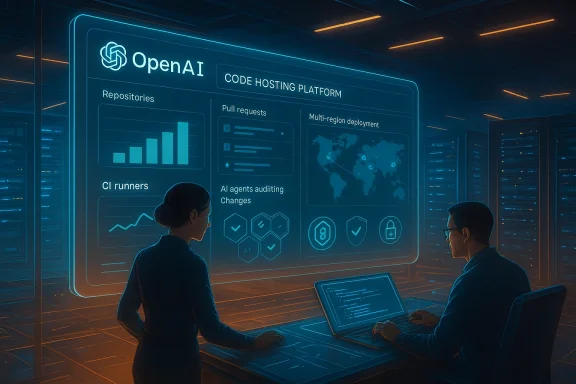
Two engineers review OpenAI's code hosting dashboard on a glowing HUD in a server room.Background: what was reported and why it matters​

OpenAI’s internal project is described by reporters as an early‑stage, in‑house code repository and collaboration system intended primarily to restore reliability and autonomy to day‑to‑day engineering workflows. Sources say the effort emerged after a string of incidents on GitHub left engineers unable to push commits, open or merge pull requests, or run CI pipelines for stretches of time — interruptions measured in hours, not minutes. The Information’s reporting frames the initiative as an operational workaround that could evolve into a commercial product if OpenAI decides to sell access to customers, or could remain an internal productivity tool.
Why this is consequential:
  • A vendor fork in the developer stack: GitHub is the default collaboration layer for most modern engineering organizations; a credible alternative from OpenAI would challenge that centrality.
  • A partner vs. competitor paradox: Microsoft owns GitHub and holds a multibillion‑dollar stake in OpenAI (roughly 27% after the companies’ 2025 recapitalization). A product from OpenAI competing with GitHub would be both strategic and politically fraught.
  • Operational trust and resilience: For companies that run continuous delivery, even a few hours of downstream failure cascades across releases, security patches, and compliance processes.
The core facts reported remain verifiable on a few points — The Information’s original briefing, GitHub’s own incident history in early 2026, and third‑party operational analytics that document a rise in incidents across DevOps platforms. These sources together form a plausible causal chain: persistent reliability problems drove an internal remediation proposal that could be turned outward as a product.

Overview: GitHub outages, the Azure migration, and operational strain​

A migration described as “existential”​

GitHub’s engineering leadership has publicly acknowledged a major infrastructure migration that began in October 2025: the platform is moving much of its production estate from legacy colocation in Virginia to Microsoft Azure. Internal memos leaked and reporting summarized by multiple outlets described the transition as both urgent and high‑risk — a strategic move intended to meet the scaling demands of advanced AI workloads like GitHub Copilot. That migration has left GitHub running in a split state across old and new infrastructure, complicating traffic routing and operational assumptions.

Recent incidents and measurable impacts​

Throughout late 2025 and into early 2026, GitHub experienced a noticeable uptick in service incidents. Public status posts and incident reports show multi‑hour incidents that affected major product areas — Git operations, pull requests, Actions, Codespaces and Copilot integrations. One high‑profile disruption in February 2026 lasted multiple hours and was traced by reporters to an upstream Azure management plane or configuration problem; a follow‑up outage a week later was attributed to a configuration change at GitHub. GitHub itself acknowledged that availability during this migration “was not yet meeting our expectations.”
Independent monitoring and industry reports back up the picture of growing operational friction. The DevOps security firm GitProtect documented a year‑over‑year increase in incidents in its mid‑year 2025 report — reported increases of roughly 58% in total incidents for GitHub during the first half of that year were flagged as an early warning of systemic strain. While incident counting and classification can vary, third‑party aggregators and enterprise users independently reported increased frequency and severity of outages in late 2025 and early 2026.

Why OpenAI would build an internal repo: operational logic​

At a technical level, the decision to create a bespoke internal repository makes straightforward sense for a company whose product availability is business‑critical.
  • Engineers at high‑velocity AI companies require deterministic source control, reproducible CI pipelines, and predictable infrastructure for large‑scale model training and deployment.
  • A single vendor outage in core developer infrastructure can freeze product work across multiple teams for hours, creating downstream slippages in model training schedules, integration testing, and security patches.
  • Controlling the full stack — from repository hosting through CI, artifact storage and integrated agentic assistants — enables tighter SLAs, custom telemetry and faster incident response loops.
OpenAI’s reported internal project reflects those priorities: it’s not merely a Git host but an integrated collaboration environment designed to protect engineering velocity. The initiative also aligns with a broader engineering pattern among hyperscalers: Google’s internal monolith “Piper” and Meta’s “Sapling” exist for similar reasons — scale, control, and bespoke operational tooling — though those systems were not commercialized.

Business implications: productizing an internal tool​

From internal bootstrapping to a commercial product​

Sources say OpenAI engineers discussed whether the internal repository could be sold to external customers or bundled with other developer products such as Codex‑style coding agents. Turning an internal platform into a market offering is nontrivial but strategically attractive:
  • It could become a high‑value enterprise product, with enterprise SLAs, integration into authentication and identity systems, and packaged AI features (code generation, automated review, dependency scanning).
  • Bundling with OpenAI’s coding assistants or agent orchestration could offer a differentiated developer experience: agents that both write code and manage the merge/review lifecycle inside a single, tightly integrated platform.
  • For customers concerned about vendor lock‑in to Microsoft/Azure, an OpenAI product might be positioned as multi‑cloud or provider‑agnostic (depending on how OpenAI chooses to host or resell compute).

Revenue and strategic tensions​

If commercialized, such a platform would introduce a new revenue stream and a direct competitive overlay with Microsoft’s GitHub business. That matters because Microsoft holds a sizable ownership stake in OpenAI (roughly 27% following their October 2025 recapitalization) and paid $7.5 billion to acquire GitHub in 2018. Any product move that puts the two companies in direct product competition would complicate a partnership that already balances cooperation, IP licensing, and commercial rights.
OpenAI’s calculus likely runs through several scenarios:
  • Keep the platform private for internal resilience, avoiding any commercial conflict.
  • Offer an enterprise, closed‑market product to select customers (possibly those with Azure neutrality requirements).
  • Launch a public product that competes directly with GitHub in features, SLA, and pricing.
Each path has trade‑offs in terms of revenue upside, partner friction and reputational signaling.

Technical design tradeoffs and engineering challenges​

Building a GitHub‑class product is far more than deploying git servers; it’s an orchestration problem at global scale.
Key technical areas OpenAI will need to design and validate:
  • Distributed Git backend and metadata store: Efficiently serving millions of repositories and scaling read/write traffic across regions requires specialized storage and indexing strategies.
  • CI/CD integration and runner orchestration: Supporting fast, secure, and elastic runners — especially for model training and agent workloads — will demand significant compute orchestration and cost management.
  • Pull‑request, review and merge semantics: Human workflows (reviewers, approvals, protected branches) must align with automation and agent contributions; this is a UX and governance challenge.
  • Security, audit and compliance: Enterprise customers require audit trails, role‑based access control, SSO, and regulatory compliance across jurisdictions.
  • Resilience and operational transparency: Parity with GitHub’s global scale requires mature incident response, observability and multi‑region failover mechanisms.
  • Cost and economic model: Hosting repositories, artifacts and runner compute at scale is expensive; OpenAI must build a commercial model that covers those costs while remaining competitive.
These are nontrivial engineering problems that typically require years of iteration. The history of other internal platforms shows that scale and edge cases — not the core git protocol — are where complexity accumulates.

Security, governance and supply‑chain concerns​

No discussion of a code‑hosting platform is complete without a sober look at security. Any new repository offering will face immediate scrutiny on threat models and supply‑chain risk.
  • Supply‑chain integrity: Agent‑augmented workflows that generate or modify code introduce new vectors where a malicious or compromised agent could push vulnerable or backdoored changes. DevOps controls must be engineered to require human signoff for sensitive merges.
  • Credential management: Tight scoping of tokens, rotation policies and least‑privilege defaults are essential to reduce blast radius when secrets leak.
  • Telemetry and privacy: If OpenAI ties repo activity to model training telemetry (for product improvement), it must clearly separate customer data usage and provide opt‑outs; otherwise the product risks regulatory and trust pushback.
  • Auditing and e‑discovery: Enterprises need immutable logs and robust e‑discovery tools for compliance and incident investigations.
  • Third‑party dependencies: Any packaged skills, agents or automations that call external package repositories need supply‑chain scanning and pinning strategies.
These concerns are amplified in a world where AI agents touch the commit, review and merge loop. OpenAI — like any vendor — will need to bake governance into the product from day one to gain enterprise confidence.

Competitive landscape: GitHub, GitLab, and the strategic stakes​

GitHub is deeply embedded in developer workflows and benefits from network effects: social discovery, package ecosystems, and marketplace integrations. Yet the platform’s migration‑driven instability has opened a rhetorical and operational window.
  • GitHub’s advantages: massive installed base, enterprise features, integrations, and Microsoft’s backing and cloud synergies.
  • GitLab and other rivals: GitLab, Bitbucket and self‑hosted solutions compete on different tradeoffs (single‑app CI/CD, on‑prem options, or specialized security features).
  • OpenAI’s potential differentiators:
  • Integrated AI agents (e.g., Codex) that can automate review, test generation and code synthesis inside a single hosted workflow.
  • Tight model-to-code telemetry that could accelerate automated code fixes and reproducible builds.
  • First‑party tooling to manage agent‑driven contributions and isolate agent worktrees.
But differentiation is not a guarantee. Developers value trust, performance, clear pricing, and a robust third‑party ecosystem. Convincing organizations to switch from a dominant player like GitHub will require more than AI novelty — it will demand predictable availability, enterprise governance, and migration tooling.

Partnership politics: how Microsoft fits into the equation​

OpenAI’s reported work on a GitHub alternative arrives against a backdrop of robust but complicated commercial ties with Microsoft. The October 2025 recapitalization left Microsoft with roughly a 27% economic interest in OpenAI Group PBC while broadening both companies’ commercial accords. Microsoft also acquired GitHub for $7.5 billion in 2018 — a historical fact that frames any potential rivalry. That web of relationships means OpenAI must weigh not just product and revenue trade‑offs, but the diplomatic costs of challenging a strategic investor and cloud partner.
Possible outcomes in partner diplomacy:
  • Internal-only option: OpenAI quietly keeps the platform for internal use and declines to commercialize — minimal partner tension.
  • Selective commercialization: OpenAI offers a controlled, enterprise‑grade product with limited external distribution — higher pressure, but potentially manageable through carve‑outs.
  • Public product: A full public launch would require careful negotiation and could trigger contractual friction over distribution, compute commitments and IP rights.
Each scenario carries different legal, financial and reputational consequences for both companies.

Precedents: what other hyperscalers have done​

Large technology companies commonly invest in internal tooling to protect engineering velocity:
  • Google’s Piper: a single monorepo and custom tooling optimized for the company’s scale; never commercialized.
  • Meta’s Sapling: an enterprise‑grade internal code host designed to serve enormous codebases.
  • Microsoft’s own history: prior to GitHub’s acquisition, Microsoft ran internal tools and has integrated GitHub heavily into its developer ecosystem.
These examples show that while internal code platforms are practical and powerful, translating them into a general‑purpose, multi‑tenant commercial product is a different challenge entirely. OpenAI’s potential offering would be unique in marrying an AI vendor’s models and agentic tooling with a developer platform.

Scenarios and timeline: what to expect next​

Based on the pace of the reported work and the technical reality of building large developer platforms, plausible near‑term scenarios are:
  • 3–6 months (internal hardening): OpenAI finalizes an internal beta, hardens CI/CD, and reduces internal exposure to GitHub outages. Outcome: improved engineering velocity; no external product.
  • 6–12 months (enterprise pilot): A controlled pilot with enterprise customers or select partners, possibly as a managed service tied to OpenAI’s compute offering.
  • 12+ months (public launch): If OpenAI elects to commercialize, expect a multi‑year roadmap to reach maturity comparable to GitHub, including enterprise SLAs, compliance certifications and migration tooling.
These estimates are speculative but grounded in typical platform development and operational readiness cycles. Reported comments from people familiar with the project emphasize that completion would take “several months,” not weeks — underscoring the early nature of the initiative.

What developers and organizations should do now​

Regardless of whether OpenAI brings a public product to market, the episode is a timely reminder about resilience in developer workflows. Practical steps organizations should consider:
  • Plan for multi‑source resilience:
  • Mirror critical repositories in more than one provider or maintain periodic backups.
  • Design CI/CD pipelines that can queue or rerun jobs in alternate environments.
  • Adopt GitOps and ephemeral runners:
  • Treat infrastructure failures as inevitable; use idempotent pipelines and rerunnable artifacts.
  • Instrument and practice incident response:
  • Run tabletop exercises that simulate prolonged outages of provider tooling.
  • Evaluate alternatives and exit costs:
  • Audit migration effort from a single provider to self‑hosted or alternative SaaS options.
  • Scrutinize AI agent workflows:
  • If agents are used to generate or apply code changes, require human approvals and add automated security gates.
These operational choices reduce the business risk from platform outages and supplier concentration.

Strengths and benefits — where OpenAI could add value​

  • Tighter agent integration: OpenAI can create a seamless workflow where coding assistants and review agents interact with repository metadata and CI, reducing friction for routine tasks.
  • Reduced vendor risk for OpenAI: An internal repository provides immediate protection against third‑party outages that interrupt mission‑critical engineering.
  • Potential enterprise differentiation: If OpenAI packages advanced code‑assistance and automated review features, enterprise customers might find the integrated offering compelling.
  • New product revenue: Commercialization could open a new revenue stream, particularly if OpenAI bundles agent subscriptions and compute in an enterprise package.

Risks, unresolved questions and cautionary notes​

  • Commercial viability remains unproven: Building a platform is one thing; capturing developers, migrating customers and maintaining ecosystem integrations is another. The network effects of GitHub are formidable.
  • Partner conflict risk: Selling a GitHub‑competing product while Microsoft remains a major investor creates obvious strategic tensions and potential contractual constraints.
  • Security and governance unknowns: Early reports don’t detail how OpenAI would handle audit, compliance and supply‑chain protections in a productized setting — areas where enterprise buyers will rigorously judge any newcomer.
  • Timeline uncertainty and scope creep: Initial internal tools often balloon in feature expectations when productized; this risks long development cycles and high operational costs.
  • Vendor neutrality and cloud dependence: If OpenAI’s offering relies on a single cloud provider, it could mirror the same concentration risks that prompted the work in the first place.
When a company as strategically positioned as OpenAI contemplates turning operational fixes into commercial offerings, the opportunity is real — but the execution risk is substantial.

Final assessment: a pragmatic move with strategic ripple effects​

OpenAI’s internal repository project is best read as a pragmatic engineering response to repeated provider outages that materially affected its productivity. The move to build what amounts to a bespoke code‑hosting stack is an engineeringly sensible way to guard velocity, and it mirrors patterns already visible at other hyperscalers.
If OpenAI chooses to commercialize the platform, the result would be strategically significant: a novel product that bundles AI agents and code hosting, and one that directly challenges Microsoft‑owned GitHub despite Microsoft’s ~27% stake in OpenAI and the enduring partnership between the companies. The technical, commercial and diplomatic hurdles are high, but so is the potential upside.
For development teams and platform owners, the episode is a clear signal to design for outages: practice failover, mirror critical assets, and demand predictable SLAs from vendors. For enterprise buyers, the potential entry of an AI‑first repository product is worth watching — but it should be evaluated on the same hard criteria as any incumbent: uptime, governance, migration cost and ecosystem support.
OpenAI’s reported work is an important moment in the ongoing reshaping of software infrastructure by AI: whether the project remains an internal hedge or becomes an outward product that rewrites competitive relationships, it underscores one immutable truth of modern engineering — when the tools that ship software wobble, companies will build their own rails or pay dearly to remain on someone else’s track.

Source: ekhbary.com OpenAI Developing GitHub Alternative Amid Frequent Outages, Potential Microsoft Competition
 

Back
Top