

OpenAI’s arrival on Amazon Web Services marks one of the most important cloud realignments of the generative AI era, not because it gives developers one more model menu, but because it loosens the architecture of a market that had been shaped by Microsoft’s privileged position. A day after Microsoft and OpenAI amended their partnership to let OpenAI serve products across any cloud provider, AWS announced that OpenAI models, Codex, and OpenAI-powered managed agents are coming to Amazon Bedrock. For enterprises already standardized on AWS, this is a practical procurement breakthrough; for Microsoft, it is a reminder that early access is no longer the same thing as exclusive control. The AI platform race has entered its multi-cloud phase, and the consequences will ripple through developers, CIO offices, chip suppliers, and Windows users alike.
OpenAI and Microsoft have spent the past several years as the defining partnership of the AI boom. Microsoft supplied cloud capacity, capital, enterprise reach, and product integration, while OpenAI supplied the models that helped make ChatGPT a household name and turned Copilot into a central pillar of Microsoft’s software strategy. That relationship reshaped expectations for Windows, Office, Azure, GitHub, Bing, and enterprise productivity.
The revised arrangement changes the balance without ending the alliance. Microsoft remains OpenAI’s primary cloud partner, OpenAI products are still expected to appear first on Azure in certain circumstances, and Microsoft keeps a long-running license to OpenAI intellectual property. But the most commercially important sentence is that OpenAI can now serve its products to customers across any cloud provider.
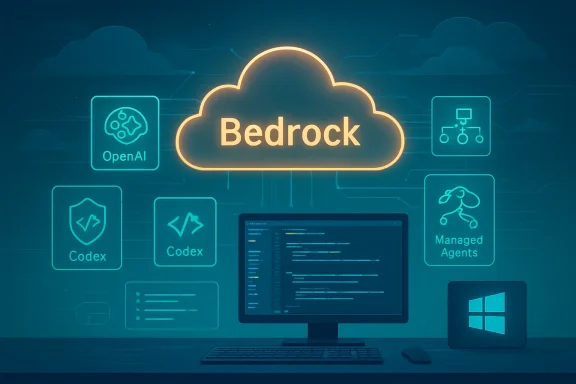
AWS moved quickly. Its announcement brings OpenAI’s latest models into Amazon Bedrock, adds Codex access through AWS environments, and introduces OpenAI-powered Managed Agents designed for production workflows. AWS customers that have spent years building identity, governance, logging, procurement, and compliance around Amazon’s cloud no longer have to treat OpenAI access as a detour through Azure.
This does not make Microsoft irrelevant. Instead, it turns Microsoft from OpenAI’s exclusive cloud gateway into one of several large-scale distribution channels. That is a subtler, more competitive world, and it may ultimately be healthier for customers who want model choice without re-platforming their infrastructure.
The market has also grown past the first wave of chatbot excitement. Companies now want AI agents that can maintain state, call tools, execute multi-step workflows, and operate under auditable controls. That makes cloud-native governance just as important as raw model capability.
The amended agreement does not erase that history, but it narrows Microsoft’s exclusivity. OpenAI can now pursue customers where they already operate, rather than steering them toward Microsoft’s cloud. That is a decisive shift from cloud as gatekeeper to cloud as distribution channel.
For WindowsForum readers, the important distinction is that Microsoft’s OpenAI relationship remains strategically important even as it becomes less singular. Windows, Microsoft 365, GitHub, Azure AI Foundry, and Copilot will continue to benefit from deep OpenAI integration. What changes is the assumption that OpenAI adoption must reinforce Azure by default.
Key changes include:
That matters because AI work is no longer just about sending prompts to an API. Enterprises need identity controls, private networking, encryption, audit logs, billing integration, model evaluation, guardrails, and lifecycle management. OpenAI arriving inside Bedrock gives AWS customers a way to use OpenAI models while staying inside familiar operational boundaries.
AWS is also positioning the move as a customer-demand story. Many large organizations have standardized on AWS over more than a decade, and their AI teams have often faced a choice between using OpenAI externally or selecting models already native to Bedrock. The new partnership reduces that friction and makes OpenAI one more option in a procurement and governance framework that many CIOs already trust.
For AWS, the win is broader than one model provider. It can now say Bedrock offers access to OpenAI alongside other major model families, which makes the service harder for enterprise buyers to ignore. The implication is clear: the cloud platform, not the model vendor alone, becomes the operating system for AI applications.
For OpenAI, Bedrock offers immediate reach into customers that may have resisted Azure migration. It also gives OpenAI a stronger hand in enterprise negotiations because deployment can align with existing AWS spending commitments. That may accelerate adoption in conservative organizations where procurement pathways matter as much as benchmark charts.
Important advantages for AWS customers include:
Codex on Amazon Bedrock puts OpenAI’s coding agent closer to AWS-native development environments. The announced access path includes Codex CLI, the desktop app, and the Visual Studio Code extension, which means the product strategy is not limited to a single browser workflow. That matters for engineering teams that already use AWS accounts, IAM roles, private repositories, and cloud-based development pipelines.
The move also sharpens competition with GitHub Copilot. Microsoft owns GitHub and has used Copilot as a flagship example of AI-enhanced software development. If Codex becomes more accessible through AWS workflows, enterprises may compare it not only with Copilot, but also with Claude Code, Cursor, Amazon’s own developer tooling, Google’s coding tools, and open-source agent frameworks.
This is where AWS has a strong argument. Many production applications already run on AWS, and developers often debug, deploy, monitor, and secure those systems through AWS services. Bringing Codex into that environment may reduce the gap between code generation and operational execution.
A practical enterprise coding-agent workflow might look like this:
OpenAI has described the agent challenge as operational as much as cognitive. A model may reason well, but a production agent must also remember what happened, resume safely after interruptions, follow approvals, and respect security boundaries. That is why stateful runtimes and managed agent environments are becoming a central battleground.
AWS has a natural interest in owning this layer. If Bedrock becomes the place where enterprises deploy and govern agents, AWS gains leverage even when the underlying model comes from OpenAI, Anthropic, Meta, or another provider. The cloud provider becomes the agent runtime, and the model becomes one component in a larger system.
That shift requires more durable infrastructure. Agents need to interact with customer databases, ticketing systems, development environments, finance tools, and compliance workflows. A stateless API call is not enough when the task involves approvals, retries, role boundaries, and sensitive records.
OpenAI-powered managed agents in Bedrock could serve use cases such as:
What changes is Microsoft’s cloud leverage. Azure can no longer rely on OpenAI exclusivity as a simple differentiator in every enterprise conversation. Instead, Microsoft must compete through product integration, reliability, price-performance, regional availability, security, developer experience, and Copilot adoption.
That may be healthy for Azure in the long run. Exclusivity can win attention, but operational excellence wins renewals. If Microsoft continues to deliver best-in-class OpenAI experiences through Azure while integrating AI deeply into Windows and Microsoft 365, it can still capture enormous value.
For Windows users, the broader implication is that Microsoft may double down on native AI experiences. Copilot in Windows, Recall-style productivity features, local AI acceleration, and cloud-backed enterprise assistants all become ways to differentiate the Microsoft ecosystem beyond raw API access. The OpenAI-AWS deal may push Microsoft to make Copilot feel less like a wrapper and more like an indispensable operating layer.
Microsoft still has important advantages:
Google Cloud faces a different challenge. It has Gemini, TPUs, Vertex AI, and deep research credibility, but enterprise buyers often prefer ecosystems where multiple leading models are available under one roof. If OpenAI’s multi-cloud strategy eventually extends more deeply to other providers, Google may benefit too; if AWS gets the strongest distribution path, Google will have to emphasize native model performance and AI infrastructure.
Anthropic is also affected. Amazon has been a major backer and cloud partner for Anthropic, and Claude has been a marquee Bedrock model family. OpenAI’s arrival raises the competitive temperature inside Bedrock itself, where model providers will compete side by side for enterprise workloads.
This is the platform-within-a-platform problem. If OpenAI becomes just another model tile in Bedrock, Amazon captures much of the workflow value. If OpenAI maintains distinctive agent runtimes, developer tools, and enterprise features, it keeps more direct customer influence.
The broader market may fragment into three layers:
That changes the internal politics of AI adoption. Security teams can ask how Bedrock handles identity, private networking, encryption, logging, and guardrails. Finance teams can examine whether usage fits existing AWS commitments. Platform teams can compare OpenAI models with other Bedrock options using a more standardized framework.
It also gives CIOs more leverage. When OpenAI access was closely tied to Azure, enterprise buyers had fewer credible paths. With AWS in the mix, buyers can negotiate across model providers and cloud platforms, which may improve pricing, service-level commitments, and support terms.
A disciplined evaluation should focus on:
The indirect impact may be substantial. If OpenAI can scale more broadly across cloud providers, application developers may build more OpenAI-powered Windows apps, enterprise assistants, and developer tools without anchoring everything to Azure. That could increase the number of AI-enabled applications available to Windows users.
For developers on Windows, the Codex angle is particularly relevant. If Codex integrates smoothly through VS Code, desktop workflows, and CLI tools while using AWS credentials, Windows machines become front ends to a more flexible cloud AI backend. That could matter for teams that develop on Windows but deploy heavily to AWS.
If OpenAI, AWS, and Microsoft all compete for developer workflows on Windows, users may benefit from better tools. GitHub Copilot will face more pressure to improve. Codex will need to justify itself in daily coding work. AWS will need to make Bedrock developer experiences feel natural on Windows, not just in cloud consoles.
For power users and IT professionals, the likely effects include:
OpenAI’s need for diversified infrastructure has become increasingly obvious. No single cloud provider can easily satisfy every capacity, geography, cost, and chip requirement of a rapidly growing AI company. AWS brings not only data centers and cloud distribution, but also custom silicon such as Trainium and large-scale infrastructure engineering.
Microsoft remains deeply important here, but AWS gives OpenAI another major supply path. That may reduce bottlenecks and improve OpenAI’s ability to meet demand. It may also intensify competition among Nvidia, AMD, Broadcom, Amazon’s silicon teams, Microsoft’s chip projects, and Google’s TPU ecosystem.
For OpenAI, multi-cloud access creates bargaining leverage. It can negotiate with providers based on capacity, cost, chip roadmaps, regions, and operational reliability. For cloud providers, OpenAI workloads can justify massive infrastructure investment, but they also carry financial risk if demand projections shift.
The compute race will influence customers in practical ways:
Microsoft, meanwhile, has to turn its remaining advantages into visible customer value. Azure will need to compete on performance and economics, while Windows and Microsoft 365 must make Copilot feel deeply useful rather than merely present. The more OpenAI becomes cloud-neutral, the more Microsoft’s differentiation must come from integration.
OpenAI’s move onto AWS is not the end of the Microsoft-OpenAI era; it is the end of the assumption that one partnership can contain the whole market. The cloud giants are now competing to become the safest, fastest, most economical place to run intelligent systems, while model providers compete to stay indispensable across every platform. For Windows users, developers, and enterprise IT leaders, that means more choice, more complexity, and a faster-moving AI stack that will increasingly shape how software is built, deployed, secured, and experienced.
Source: CNBC OpenAI brings its models to Amazon's cloud after ending exclusivity with Microsoft
 Overview
OpenAI and Microsoft have spent the past several years as the defining partnership of the AI boom. Microsoft supplied cloud capacity, capital, enterprise reach, and product integration, while OpenAI supplied the models that helped make ChatGPT a household name and turned Copilot into a central pillar of Microsoft’s software strategy. That relationship reshaped expectations for Windows, Office, Azure, GitHub, Bing, and enterprise productivity.The revised arrangement changes the balance without ending the alliance. Microsoft remains OpenAI’s primary cloud partner, OpenAI products are still expected to appear first on Azure in certain circumstances, and Microsoft keeps a long-running license to OpenAI intellectual property. But the most commercially important sentence is that OpenAI can now serve its products to customers across any cloud provider.
AWS moved quickly. Its announcement brings OpenAI’s latest models into Amazon Bedrock, adds Codex access through AWS environments, and introduces OpenAI-powered Managed Agents designed for production workflows. AWS customers that have spent years building identity, governance, logging, procurement, and compliance around Amazon’s cloud no longer have to treat OpenAI access as a detour through Azure.
This does not make Microsoft irrelevant. Instead, it turns Microsoft from OpenAI’s exclusive cloud gateway into one of several large-scale distribution channels. That is a subtler, more competitive world, and it may ultimately be healthier for customers who want model choice without re-platforming their infrastructure.
Why the timing matters
The timing is not accidental. Enterprises are moving from AI pilots to production systems, and production systems tend to follow existing cloud estates. If a bank, retailer, manufacturer, or public-sector agency already uses AWS for data lakes, identity controls, logs, and security tooling, model availability inside Bedrock is far more than a convenience.The market has also grown past the first wave of chatbot excitement. Companies now want AI agents that can maintain state, call tools, execute multi-step workflows, and operate under auditable controls. That makes cloud-native governance just as important as raw model capability.
The End of Practical Exclusivity
Microsoft’s original advantage was simple: if enterprises wanted the most direct access to OpenAI’s frontier models at scale, Azure was the natural route. That gave Microsoft a powerful story for Azure growth and a credible answer to AWS, Google Cloud, and Oracle. It also helped Microsoft wrap OpenAI capability into Copilot products across the company’s software stack.The amended agreement does not erase that history, but it narrows Microsoft’s exclusivity. OpenAI can now pursue customers where they already operate, rather than steering them toward Microsoft’s cloud. That is a decisive shift from cloud as gatekeeper to cloud as distribution channel.
For WindowsForum readers, the important distinction is that Microsoft’s OpenAI relationship remains strategically important even as it becomes less singular. Windows, Microsoft 365, GitHub, Azure AI Foundry, and Copilot will continue to benefit from deep OpenAI integration. What changes is the assumption that OpenAI adoption must reinforce Azure by default.
What changed in practical terms
The revised deal appears to separate three ideas that were often blurred together: partnership, exclusivity, and access. Microsoft still has a partnership, still has OpenAI technology rights, and still has a major economic interest. But customers no longer have to treat Azure as the only enterprise-grade path to OpenAI products.Key changes include:
- OpenAI can serve customers across any cloud provider
- Microsoft’s OpenAI license is now non-exclusive
- Microsoft no longer pays revenue share to OpenAI
- OpenAI continues revenue share payments to Microsoft through 2030, subject to a cap
- Microsoft remains a major OpenAI shareholder
- Azure remains a privileged and deeply integrated OpenAI platform
- AWS can now sell OpenAI access through Bedrock without relying only on open-weight models
Why AWS Bedrock Is the Natural Landing Zone
Amazon Bedrock has become AWS’s answer to the messy reality of generative AI adoption. Enterprises do not want to bet everything on one model provider, and developers increasingly need to compare models from Anthropic, Meta, Mistral, Cohere, Amazon, OpenAI, and others within the same operational framework. Bedrock’s value proposition is that it turns model choice into a managed cloud service.That matters because AI work is no longer just about sending prompts to an API. Enterprises need identity controls, private networking, encryption, audit logs, billing integration, model evaluation, guardrails, and lifecycle management. OpenAI arriving inside Bedrock gives AWS customers a way to use OpenAI models while staying inside familiar operational boundaries.
AWS is also positioning the move as a customer-demand story. Many large organizations have standardized on AWS over more than a decade, and their AI teams have often faced a choice between using OpenAI externally or selecting models already native to Bedrock. The new partnership reduces that friction and makes OpenAI one more option in a procurement and governance framework that many CIOs already trust.
Bedrock as a model marketplace
Bedrock’s strategic advantage is not that it always has the single best model. Its advantage is that it gives enterprises a place to compare, govern, and deploy multiple models without rebuilding the surrounding platform each time. In that sense, OpenAI’s arrival strengthens Amazon’s claim that model choice belongs inside the cloud control plane.For AWS, the win is broader than one model provider. It can now say Bedrock offers access to OpenAI alongside other major model families, which makes the service harder for enterprise buyers to ignore. The implication is clear: the cloud platform, not the model vendor alone, becomes the operating system for AI applications.
For OpenAI, Bedrock offers immediate reach into customers that may have resisted Azure migration. It also gives OpenAI a stronger hand in enterprise negotiations because deployment can align with existing AWS spending commitments. That may accelerate adoption in conservative organizations where procurement pathways matter as much as benchmark charts.
Important advantages for AWS customers include:
- Using existing AWS credentials and access policies
- Applying usage toward existing cloud commitments where supported
- Centralizing logs and audits in familiar AWS tooling
- Combining OpenAI models with Bedrock orchestration
- Testing OpenAI against other models inside the same platform
- Reducing architectural pressure to shift workloads between clouds
Codex Becomes an Enterprise Coding Layer
The inclusion of Codex may prove as important as the model availability headline. Coding agents are one of the first areas where generative AI has shown direct productivity value, measurable user demand, and clear enterprise budgets. Developers want tools that can understand repositories, propose changes, explain code, run tests, and automate repetitive engineering tasks.Codex on Amazon Bedrock puts OpenAI’s coding agent closer to AWS-native development environments. The announced access path includes Codex CLI, the desktop app, and the Visual Studio Code extension, which means the product strategy is not limited to a single browser workflow. That matters for engineering teams that already use AWS accounts, IAM roles, private repositories, and cloud-based development pipelines.
The move also sharpens competition with GitHub Copilot. Microsoft owns GitHub and has used Copilot as a flagship example of AI-enhanced software development. If Codex becomes more accessible through AWS workflows, enterprises may compare it not only with Copilot, but also with Claude Code, Cursor, Amazon’s own developer tooling, Google’s coding tools, and open-source agent frameworks.
The developer workflow battle
The coding-agent market is no longer just a feature contest. It is becoming a workflow contest across IDEs, terminals, repositories, CI/CD systems, cloud logs, and deployment pipelines. The winner may not be the tool that writes the cleverest function, but the one that safely navigates enterprise software delivery.This is where AWS has a strong argument. Many production applications already run on AWS, and developers often debug, deploy, monitor, and secure those systems through AWS services. Bringing Codex into that environment may reduce the gap between code generation and operational execution.
A practical enterprise coding-agent workflow might look like this:
- A developer opens a ticket tied to an internal service.
- Codex analyzes the relevant repository and service documentation.
- The agent proposes a code change and generates tests.
- The developer reviews the patch in the IDE or command line.
- The change moves through CI/CD with logs and permissions captured.
- Security and platform teams audit agent actions through existing controls.
Managed Agents Signal the Next AI Frontier
The most forward-looking part of the announcement is Amazon Bedrock Managed Agents powered by OpenAI. The industry is moving from single-turn chatbots to agents that can handle long-running, multi-step work. Those agents need memory, state, tool access, permissions, recovery logic, and auditability.OpenAI has described the agent challenge as operational as much as cognitive. A model may reason well, but a production agent must also remember what happened, resume safely after interruptions, follow approvals, and respect security boundaries. That is why stateful runtimes and managed agent environments are becoming a central battleground.
AWS has a natural interest in owning this layer. If Bedrock becomes the place where enterprises deploy and govern agents, AWS gains leverage even when the underlying model comes from OpenAI, Anthropic, Meta, or another provider. The cloud provider becomes the agent runtime, and the model becomes one component in a larger system.
From prompt engineering to process engineering
The first wave of AI adoption was dominated by prompt engineering. Teams learned to write better instructions, add context, and route outputs into human workflows. The next wave is process engineering, where AI systems participate in business operations over time.That shift requires more durable infrastructure. Agents need to interact with customer databases, ticketing systems, development environments, finance tools, and compliance workflows. A stateless API call is not enough when the task involves approvals, retries, role boundaries, and sensitive records.
OpenAI-powered managed agents in Bedrock could serve use cases such as:
- Customer support triage across multiple internal systems
- IT help desk automation with human approval gates
- Sales operations workflows involving CRM updates
- Financial reconciliation tasks with audit trails
- Developer operations assistance tied to cloud telemetry
- Security investigation workflows that preserve logs
- Procurement and contract review with role-based access
Microsoft Keeps a Strong Hand, But Not the Only Hand
It would be a mistake to portray this as a clean loss for Microsoft. The company still has one of the strongest AI positions in the market: OpenAI integration across Microsoft 365, GitHub, Windows, Azure, security products, and business applications. It also remains financially tied to OpenAI’s growth.What changes is Microsoft’s cloud leverage. Azure can no longer rely on OpenAI exclusivity as a simple differentiator in every enterprise conversation. Instead, Microsoft must compete through product integration, reliability, price-performance, regional availability, security, developer experience, and Copilot adoption.
That may be healthy for Azure in the long run. Exclusivity can win attention, but operational excellence wins renewals. If Microsoft continues to deliver best-in-class OpenAI experiences through Azure while integrating AI deeply into Windows and Microsoft 365, it can still capture enormous value.
Azure’s new competitive test
Azure’s test is no longer “Do you want OpenAI?” It is “Do you want OpenAI inside Microsoft’s enterprise software and cloud ecosystem?” That is a more focused but still powerful proposition. Many customers will answer yes, especially those already invested in Microsoft 365, Entra ID, Defender, Sentinel, GitHub, and Power Platform.For Windows users, the broader implication is that Microsoft may double down on native AI experiences. Copilot in Windows, Recall-style productivity features, local AI acceleration, and cloud-backed enterprise assistants all become ways to differentiate the Microsoft ecosystem beyond raw API access. The OpenAI-AWS deal may push Microsoft to make Copilot feel less like a wrapper and more like an indispensable operating layer.
Microsoft still has important advantages:
- Deep integration with Microsoft 365 workflows
- GitHub ownership and Copilot distribution
- Enterprise identity through Entra ID
- Security integration through Defender and Sentinel
- Windows as the dominant desktop productivity platform
- Azure AI infrastructure and model orchestration
- A continuing economic stake in OpenAI’s success
Competitive Shockwaves Across the AI Cloud Market
AWS gains the most obvious near-term benefit because it can now tell customers that OpenAI models are part of its AI platform story. That helps counter the narrative that AWS was late to the generative AI boom compared with Microsoft. It also strengthens Bedrock as a neutral marketplace for enterprise AI models.Google Cloud faces a different challenge. It has Gemini, TPUs, Vertex AI, and deep research credibility, but enterprise buyers often prefer ecosystems where multiple leading models are available under one roof. If OpenAI’s multi-cloud strategy eventually extends more deeply to other providers, Google may benefit too; if AWS gets the strongest distribution path, Google will have to emphasize native model performance and AI infrastructure.
Anthropic is also affected. Amazon has been a major backer and cloud partner for Anthropic, and Claude has been a marquee Bedrock model family. OpenAI’s arrival raises the competitive temperature inside Bedrock itself, where model providers will compete side by side for enterprise workloads.
The platform-within-a-platform problem
Model companies increasingly depend on cloud platforms for distribution, but cloud platforms do not want to become mere resellers. That creates tension. AWS wants Bedrock to be the customer relationship, while OpenAI wants its models, tools, and agents to remain differentiated.This is the platform-within-a-platform problem. If OpenAI becomes just another model tile in Bedrock, Amazon captures much of the workflow value. If OpenAI maintains distinctive agent runtimes, developer tools, and enterprise features, it keeps more direct customer influence.
The broader market may fragment into three layers:
- Model providers competing on reasoning, coding, multimodality, safety, and price-performance
- Cloud platforms competing on governance, distribution, infrastructure, procurement, and integration
- Application vendors competing on workflow ownership and user experience
- Chip providers competing on training capacity, inference efficiency, and ecosystem support
- Consulting and systems integrators competing to turn prototypes into production deployments
Enterprise Impact: Procurement, Governance, and Lock-In
For enterprises, the biggest win is not novelty. It is alignment. A company that already runs regulated workloads on AWS can evaluate OpenAI through a familiar control plane rather than treating it as a separate procurement and security project.That changes the internal politics of AI adoption. Security teams can ask how Bedrock handles identity, private networking, encryption, logging, and guardrails. Finance teams can examine whether usage fits existing AWS commitments. Platform teams can compare OpenAI models with other Bedrock options using a more standardized framework.
It also gives CIOs more leverage. When OpenAI access was closely tied to Azure, enterprise buyers had fewer credible paths. With AWS in the mix, buyers can negotiate across model providers and cloud platforms, which may improve pricing, service-level commitments, and support terms.
What CIOs should evaluate first
The announcement should not trigger reckless migration. It should trigger structured evaluation. Enterprises need to test availability, regional support, data-handling terms, latency, cost, governance controls, and integration with existing application architectures.A disciplined evaluation should focus on:
- Which OpenAI models are available in which AWS regions
- Whether access is preview, limited preview, or generally available
- How data is handled, retained, logged, and isolated
- How Bedrock guardrails interact with OpenAI safety systems
- Whether Codex can operate safely against private repositories
- How agent actions are logged and reviewed
- How costs compare with Azure OpenAI and direct OpenAI access
- Whether existing AWS commitments reduce effective spend
- How identity and permissions map to existing IAM policies
Consumer and Windows User Implications
Most consumers will not notice this deal directly. ChatGPT users will not wake up to a different interface simply because OpenAI models are available through AWS. Windows users will still encounter AI primarily through Copilot, Microsoft 365, browsers, developer tools, and third-party applications.The indirect impact may be substantial. If OpenAI can scale more broadly across cloud providers, application developers may build more OpenAI-powered Windows apps, enterprise assistants, and developer tools without anchoring everything to Azure. That could increase the number of AI-enabled applications available to Windows users.
For developers on Windows, the Codex angle is particularly relevant. If Codex integrates smoothly through VS Code, desktop workflows, and CLI tools while using AWS credentials, Windows machines become front ends to a more flexible cloud AI backend. That could matter for teams that develop on Windows but deploy heavily to AWS.
Why this matters to the Windows ecosystem
Windows has always thrived when developers could target broad infrastructure choices. The PC became powerful not because every workload ran on one vendor’s stack, but because Windows served as a practical environment for diverse software ecosystems. The same logic now applies to AI development.If OpenAI, AWS, and Microsoft all compete for developer workflows on Windows, users may benefit from better tools. GitHub Copilot will face more pressure to improve. Codex will need to justify itself in daily coding work. AWS will need to make Bedrock developer experiences feel natural on Windows, not just in cloud consoles.
For power users and IT professionals, the likely effects include:
- More AI coding tools available through Windows development environments
- Broader model choice in enterprise Windows applications
- Potentially faster adoption of AI agents in internal business software
- More competition between Copilot and third-party assistants
- Greater pressure on Microsoft to improve local and cloud AI integration
- A larger role for identity, endpoint security, and policy management
The Compute Question Behind the Deal
Every major AI partnership eventually comes back to compute. Training frontier models requires enormous clusters, power, networking, and specialized chips. Serving those models at consumer and enterprise scale requires still more infrastructure, especially as users shift from short prompts to long-context reasoning, coding, multimodal generation, and agentic workflows.OpenAI’s need for diversified infrastructure has become increasingly obvious. No single cloud provider can easily satisfy every capacity, geography, cost, and chip requirement of a rapidly growing AI company. AWS brings not only data centers and cloud distribution, but also custom silicon such as Trainium and large-scale infrastructure engineering.
Microsoft remains deeply important here, but AWS gives OpenAI another major supply path. That may reduce bottlenecks and improve OpenAI’s ability to meet demand. It may also intensify competition among Nvidia, AMD, Broadcom, Amazon’s silicon teams, Microsoft’s chip projects, and Google’s TPU ecosystem.
Chips, power, and bargaining leverage
The AI market is constrained by hardware and energy as much as software. Model access announcements are easy to publish; building the data center capacity behind them is hard. The companies that can secure power, cooling, networking, and accelerator supply will shape the pace of AI deployment.For OpenAI, multi-cloud access creates bargaining leverage. It can negotiate with providers based on capacity, cost, chip roadmaps, regions, and operational reliability. For cloud providers, OpenAI workloads can justify massive infrastructure investment, but they also carry financial risk if demand projections shift.
The compute race will influence customers in practical ways:
- Inference prices may fall as providers compete
- Regional availability may vary based on capacity
- Latency will become a differentiator for agent workflows
- Custom chips may reduce dependence on Nvidia over time
- Cloud commitments may become central to AI procurement
- Energy constraints may affect where models can be served
- Reliability expectations will rise as agents handle critical tasks
Strengths and Opportunities
The OpenAI-AWS expansion creates a more open and competitive AI deployment landscape, especially for organizations that already rely on Amazon’s cloud. Its biggest strength is not simply that OpenAI models are available in another place, but that they are entering a mature enterprise environment with identity, governance, procurement, and operational tooling already in place.- Broader enterprise access to OpenAI without requiring Azure-centric architecture
- Stronger model choice inside Amazon Bedrock for teams comparing AI providers
- Improved procurement alignment for customers with existing AWS commitments
- More pressure on Microsoft to differentiate through product quality and integration
- Faster production paths for agents that need AWS-native governance and logging
- Greater developer flexibility through Codex access in CLI, desktop, and VS Code workflows
- Healthier cloud competition that may improve pricing, reliability, and customer leverage
Risks and Concerns
The announcement also introduces real complexity. More cloud choice can reduce lock-in, but it can also create fragmented deployments, inconsistent behavior, and unclear accountability when something fails. Enterprises should welcome the new options while resisting the temptation to treat preview-stage services as finished production foundations.- Limited preview constraints may delay real-world adoption for some customers
- Regional availability gaps could complicate regulated or latency-sensitive deployments
- Model behavior differences across platforms may undermine portability assumptions
- Agent failures could create security, compliance, or operational incidents
- Cost visibility may become harder when AI usage spans multiple clouds and tools
- Vendor accountability may blur between OpenAI, AWS, Microsoft, and application providers
- Data governance confusion could grow as AI features appear in more enterprise workflows
Looking Ahead
The next phase will be defined by execution, not announcements. AWS must show that OpenAI models, Codex, and managed agents can operate reliably inside Bedrock with the controls enterprises expect. OpenAI must prove that multi-cloud distribution does not dilute product quality or create inconsistent developer experiences.Microsoft, meanwhile, has to turn its remaining advantages into visible customer value. Azure will need to compete on performance and economics, while Windows and Microsoft 365 must make Copilot feel deeply useful rather than merely present. The more OpenAI becomes cloud-neutral, the more Microsoft’s differentiation must come from integration.
Signals to watch
Several near-term indicators will reveal how meaningful this deal becomes. The headline is important, but enterprise adoption depends on details that often arrive after the launch event.- When OpenAI models move from limited preview to broad availability in Bedrock
- Which AWS regions support the models, Codex, and managed agents first
- How pricing compares with Azure OpenAI and direct OpenAI access
- Whether major regulated customers announce production deployments
- How Microsoft responds in Azure, GitHub Copilot, and Windows Copilot experiences
OpenAI’s move onto AWS is not the end of the Microsoft-OpenAI era; it is the end of the assumption that one partnership can contain the whole market. The cloud giants are now competing to become the safest, fastest, most economical place to run intelligent systems, while model providers compete to stay indispensable across every platform. For Windows users, developers, and enterprise IT leaders, that means more choice, more complexity, and a faster-moving AI stack that will increasingly shape how software is built, deployed, secured, and experienced.
Source: CNBC OpenAI brings its models to Amazon's cloud after ending exclusivity with Microsoft
