OpenAI’s announcement that it will begin testing advertisements inside ChatGPT marks a clear turning point for conversational AI: the free and lower‑cost “Go” tiers will start seeing clearly labeled, separated ads beneath answers for logged‑in adults in the U.S., while higher‑paid plans remain ad‑free.
Background
The move was publicly laid out by OpenAI on January 16, 2026, when the company published a policy and product note titled Our approach to advertising and expanding access to ChatGPT. It explained that ads are being trialed to help subsidize broad access to powerful AI, and described core principles — answer independence, conversation privacy, choice and control, and exclusion of ads from sensitive topics.Industry reporting and app teardown signals had already hinted at an advertising subsystem in development for months. Reverse‑engineered Android APK strings and beta UI artifacts suggescontent,” and a horizontal “search ads carousel,” pointing to commerce‑oriented card formats that would sit apart from generated responses. Those artifacts have been discussed in community analyses and internal briefings.
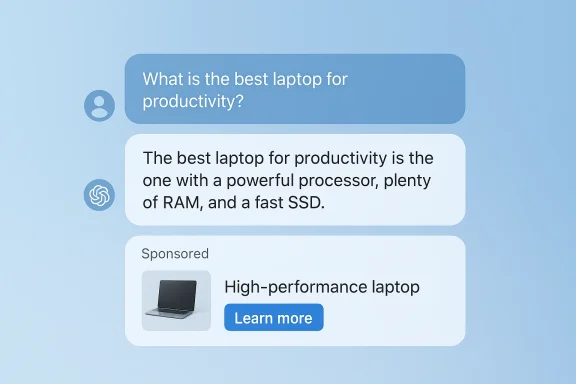
At launch, the practical parameters OpenAI outlined are simple and narrow: tests in the U.S., shown to logged‑in adult users on Free and ChatGPT Go tiers, placed beneath answers when a relevant product or service can be served, and explicitly separated from the assistant’s organic response. OpenAI also promises not to sell raw conversation text to advertisers.
What changed — the practical summary
- Ads will appear to some users in the ier and the new lower‑cost Go ($8/mo) tier. Paid levels (Plus, Pro, Business, Enterprise) are promised to remain ad‑free.
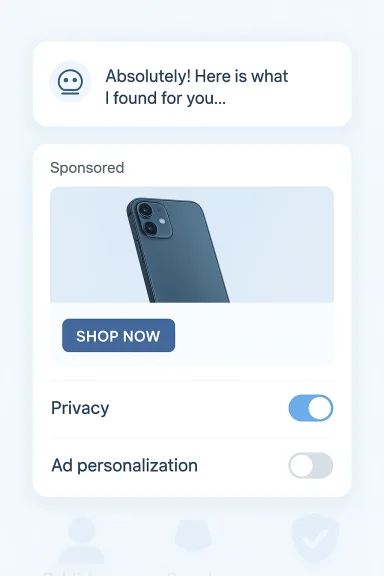
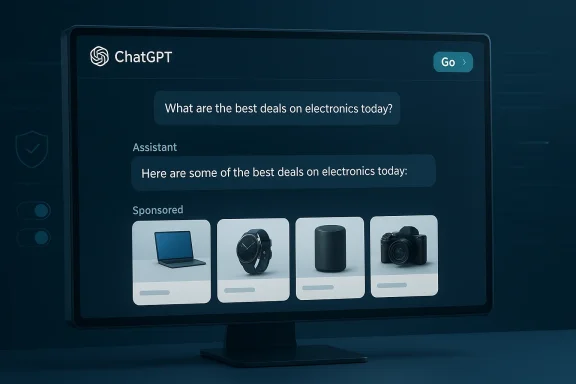
- Format: ads will be clearly labeled, visually separated from ChatGPT’s answer, and typically placed below the assistant’s generated output. Early prototypes suggest shoppable product cards, carousels, or sponsored follow‑ups. (openai.com
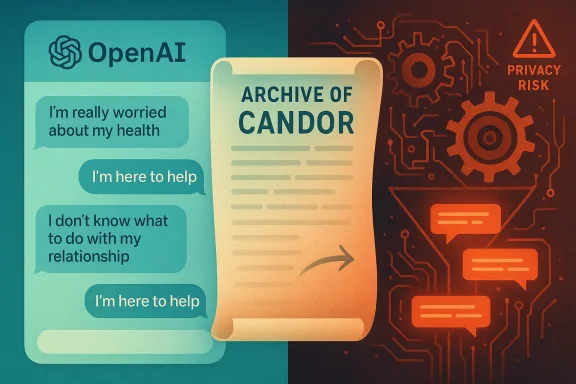
- Guardrails: no ads for users known or predicted to be under 18, and no ad placements in sensitive information contexts such as health, mental health, or political queries (as described by OpenAI).
- Data claims: OpenAI states it will keep conversations private from advertisers and will not accept money to influence answers; targeting will be contextual and there will be user controommitments rather than independently audited technical guarantees at this stage.
Why OpenAI is doing this — the economics and strategy
The economics behind the decision are straightforward: running at-scale generative models is extremely expensive. Compute, data pipelines, safety systems, and ongoing model research create a large recurring cost base that subscription and enterpry not fully cover at scale. Advertising — a historically scalable way to monetize large, free audiences — promises incremental revenue without forcing all users to pay.Analysts and inside reports estimate ad revenue could become material quickly if ChatGPT captures discovery and purchase intent the way search does. Early industry notes suggest advertisers are being pitched impression‑based buys and that placements will initially favor large brands able to meet high minimum spend commitments. OpenAI’s pitch to advertisers reportedly emphasizes the contextual intent captured inside conversations as a uniquely valuable signal for commerce.
That commercial calculus also explains why OpenAI is offering an ad‑ preserves a clear value proposition for paying customers while monetizing the bulk of free users. In classic internet product terms, it is the familiar “freemium with ads” model adapted to a conversational UI.
The user‑facing experience: what to expect and what to watch
Early ad formats and placement hypotheses
Product previcate the ad UI will attempt to mimic commerce placements used by other AI services:- Shoppable product cards shown beneath a product recommendation or comparison.
- Search ad carousels, a horizontal row of sponsored cards tied to retrieved web results.
- Sponsored follow‑ups, labeled CTAs such as “See today’s deals” or “Buy now” that live separately from the assistant’s answer.
Targeting, personalization and data flows — the open questions
OpenAI claims it w text and that answers won’t be influenced by ad dollars. But the company has also said ads can be personalized and that users can turn off personalization. The critical technical questions that remain unanswered in public documentation are:- Exactly what telemetry or conversation‑level signals will be shared with ad systems and advertisers (e.g., hashed identifiers, inferred intents, conversion pixels).
- Whether memory features (persistent user preferences saved by ChatGPT) will ever be used for ad targeting, and if so, whether that will be strictly opt‑in and auditable.
- How revocation works: if a user clears personalization data, how quickly is that enforced across ad pipelines and reporting.
Impact on publishers and content creators
One immediate flashpoint is news publishers and content licensing partners. OpenAI has licensing deals with many publishers, yet early reporting indicates publishers were not offered direct revenue sharing from ad placements inside ChatGPT. That creates a tension: publishers supply content and training data (or licensing access) but may not see a cut of ad revenues that flow when ChatGPT answers rely on similar information. This gap is already prompting industry commentary and concerns about the alignment of incentives.Publishers have leverage — they can restrict access to snippets and revoke APIs — but the balance of power is uneven. If ad placements drive more discovery inside assistants (reducing outbound referral traffic), publishers could see diminished direct traffic and ad income while their content powers models that monetize externally. This is a sector‑level policy and commercial problem that will likely require negotiated revenue‑share models or regulatory attention.
Competitive landscape and market responses
Anthropic and other competitors have made differentiated positioning choices. Anthropic publicly pledged that Claude would remain ad‑free and used a high‑profile Super Bowl ad to highlight privacy and trust as differentiators. That positioning aims to attract users and organizations who put an ad‑free conversation at the top of their checklist. OpenAI and Anthropic’s competing messages have already sparked public sparring, with OpenAI’s leadership calling some of Anthropic’s characterizations misleading.Other players — Perplexity, Google’s Bard/Gemini, Microsoft’s Copilot — are experimenting with commerce, sponsored results, or ad formats in different ways. Perplexity has earlier ad offerings that influenced how advertisers view conversational placements, and Big Tech’s tie‑ins to search and commerce give them different ad moats and regulatory exposures.
For advertisers, ChatGPT represents a new inventory type with possibly higher intent signals than traditional display, but the measurement, attribution, and privacy constraints are unproven. Early adopter advertisers will learn fast, but expect high entry prices and limited scale initially.
Privacy, regulatory and legal risks
Putting advertising into assistant interfaces raises multiple regulatory considerations:- Targeting rules and consent: If personalization uses inferred attributes (age, health, political leanings), regulators in multiple jurisdictions will scrutinize whether the platform respects consent and avoids sensitive targeting. OpenAI has promised no ads for users under 18 and no ads near health/politics, but enforcement and auditability remain essential.
- Data protection and telemetry: The line between not selling conversation text and using derived signals for ad targeting can be thin. Regulators will ask for clear documentation of telemetry retention, sharing, and contractual limits with ad networks.
- Competition and antitrust: If chat assistants divert user journeys away from publishers and direct search engines, antitrust scrutiny could follow where incumbents or platforms gain dominant adverConsumer protection and disclosure: Advertising labeling standards will be central. If sponsored content is not unmistakably identified, consumer protection agencies may intervene.
Enterprise and IT implications
For organizations that have embedded ChatGPT‑based assistants into workflows, the immediate concerns are governance and contractual clarity:- Verify the SKU: Confirm whether corporate or managed accounts are technically excluded from ad surfaces (OpenAI says paid Business and Enterprise tiers will not have ads). Risk‑averse teams should insist on contractual language guaranteeing ad‑free, auditable service.
- Mind the client: Enterprise devun consumer app builds. Use MDM policies to block early beta builds or app stores that may roll out ad tests to devices
- Data flows and telemetry: Update procurement language to demand transparency on telemetry endpoints, retentir aggregated signals can be used for advertising.
- Training and policy: Educate staff about memory and personalization settings; make clear what types of sensitive queries must be routed through internal, on‑premise LLMs rather than consumer assistants.
Practical guidance for users who want to avoid ads
- Upgrade to a paid tier (Plus, Pro, Business, Enterprise) if you need an ad‑free experience guaranteed by OpenAI.
- Turn off personalization and clear memory settings in account preferences to reduce data used for targeted ads.
- For sensi enterprise deployments or self‑hosted LLM instances where you control telemetry.
- On managed devices, use MDM to limit which ChatGPT client versions can be installed and block beta channels.
- Watch for audit reports and policy updates from OpenAI that clarify exactly what data is sent to advertising systems.
Strengths of OpenAI’s announced approach
- s:** OpenAI publicly laid out core principles — answer independence, conversation privacy, choice and control — which sets a baseline for user expectations. That transparency is a positive step in a domain often opaque to end users.
- Targeted, commerce‑first ad placements: Restricting early tests to shopping and commerce contexts reduces the risk of ads contaminatingsensitive conversations. If executed conservatively, commerce placements can add user utility (e.g., discovery, direct purchase flow).
- Ad‑free paid tiers preserve a premium offering: Consumers and enterprises that require ad‑free experiences have a straightforward path through subscription offerings.
Key risks and unknowns
- Implementation gap vs. promise: Many of OpenAI’s commitments are policy-level promises. The true test is in the implementation details: how labeling is enforced, what telemetry is shared, and whether age gating and sensitive‑topic exclusions are robust. Those details are still pending audit.
- Publisher economics: Without clear revenue‑share mechanisms, publishers could be economically harmed if assistant‑first experiences reduce referral traffic but do not share ad revenue. That mismatch could fuel disputes and content access restrictions.
- Trust erosion if labeling fails: If sponsored content ever appears fused with answers, user trust in the assistant will decline quickly. Junior product mis‑steps here would be costly and visible.
- Regulatory backlash: Cross‑jurisdictional privacy laws and ad targeting restrictions are likely to collide with experimentation, especially if inferred attributes get used for ad personalization. Formal enforcement actions could force rapid product changes.
How this could reshape web discovery and advertising
Conversationaeen users and the web. If ad placements in chat assistants succeed at discovery and commerce conversion, they could siphon intent and revenue away from traditional search engines and publisher pages. That would accelerate a shift in the ad ecosystem toward platform‑owned feeds of answers and commerce. The long‑term result could be:- Less direct traffic and attribution for publishers.
- A concentration of ad inventory controlled by a few assistant platforms.
- New ad measurement and creative formats optimized for conversational discovery rather than clicks.
What to watch next — concrete signals and dates
- OpenAI’s test schedule: the company said testing would begin in the coming weeks after January 16, 2026. Watch for the first visible, customer‑facing experiments and the exact UI implementations.
- Privacy and telemetry documentation: look for updated privacy policies, help‑center docs, and technical whitepapers that explicitly enumerate what signals advertisers can access.
- Third‑party audits: independent attestations about the treatment of conversation text, memory, and personalization will be crucial for credibility.
- Publisher negotiations or legal actions: whether publishers seek compensation or restrict content access will shape the upstream content economics.
- Competitor positioning: Anthropic’s ad‑free pledge and marketing will test whether a trust‑first product strategy can win sustainable market share.
Final assessment
OpenAI’s decision to test ads in ChatGPT is a pragmatic recognition of the cost structure behind large‑scale generative AI. The company has put forward a clear set of principles and constrained, commerce‑focused formats as a first step. That conservatism is a pragmatic way to reduce obvious harms and preserve the product’s utility.Yet the real determinants of success will be engineering and governance: how clearly ads are labeled, how tightly targeted signals are controlled, whether age and topic exclusions are enforceable in practice, and whether publishers and privacy regulators are adequately considered in the commercial stack. For users and IT teams, the moment calls for careful configuration, contractual clarity for enterprise customers, and a demand for transparency.
If OpenAI executes on its principles and the ecosystem establishes fair compensation and robust auditability, conversational ads could fund broader access to AI without destroying trust. If not, the rollout could accelerate fragmentation — with a split between ad‑free, paid experiences and ad‑supported free tiers — and leave publishers and privacy advocates with unresolved grievances. Either way, the coming weeks of visible tests and the first independent audits will be decisive.
Conclusion
The era of purely ad‑free, mass‑market chat assistants appears to be ending for the majority of everyday users. What remains to be decided is whether advertising can be implemented in a way that preserves the core value of conversational AI — trust, accuracy, and privacy — while unlocking the revenue needed to sustain and broaden access. For IT teams, publishers, advertisers, and users, the prudent approach now is to watch the first tests closely, demand auditable guarantees, and prepare governance and contractual defenses where necessary.
Source: ZDNET Is ChatGPT starting ads today? Here's a preview - and which AIs don't have them
Source: findarticles.com ChatGPT Begins Testing Ads For Some Users