

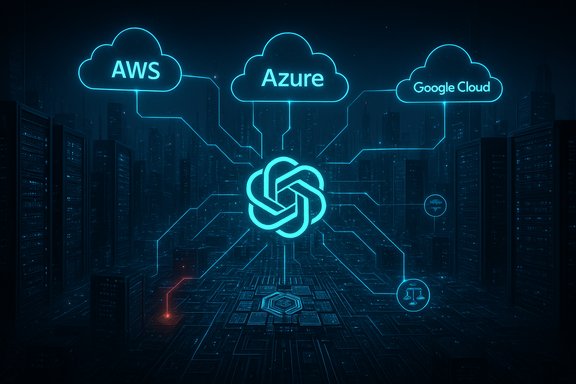
OpenAI’s recent string of mega-deals and platform moves has shifted the conversation from “can it survive?” to “what happens if it stumbles?” — the company’s growing web of cloud, chip, and enterprise relationships now reads less like the supply chain of a single startup and more like the nervous system of an industry, and that interconnection is exactly what makes the question of systemic risk urgent today.
Background / Overview
OpenAI’s public-facing products — most notably ChatGPT and the GPT family — created a sudden mass market for generative AI. That popularity quickly translated into massive infrastructure commitments, large cloud partnerships, and deep ties to the major chip vendors that supply GPUs for training and inference. These moves have reshaped OpenAI from an experimental lab into an organization that functions, in many ways, as an infrastructure provider for a broad ecosystem of enterprise features and developer tools.At the same time, some of the more dramatic numerical claims circulating in industry commentary — multi-hundred-billion-dollar GPU supply contracts, $1.4 trillion of long-term commitments, or trillion-dollar funding needs — are either rhetorical framing or not fully substantiated in the public record. Several community and investigative write-ups emphasize that the underlying facts (revenue run-rates, large cloud deals, growing spend) are verifiable, while the larger aggregate dollar figures are often speculative and should be treated with caution.
The Amazon–OpenAI axis: what happened and what it means
The deal that made headlines
The recent announcement that linked OpenAI with a very large AWS compute commitment has been framed as a watershed moment — a hyperscaler offering OpenAI sizable GPU capacity to host training and inference workloads. Industry observers read this as both redundancy beyond Microsoft Azure and as a confirmation that GPU-first architectures remain central to AI infrastructure. The broader point: OpenAI is deliberately diversifying infrastructure partners to reduce single-vendor dependence and to secure the massive scale it needs for frontier models.Why AWS + Nvidia still point back to a narrow hardware stack
Even where cloud diversification is visible, the underlying compute layer remains heavily dependent on accelerators supplied by a tiny set of vendors. Nvidia’s GPU ecosystem — driver stacks, performance libraries, and accelerators — continues to be the practical backbone for large-scale model training. That makes the industry resilient in some ways (standardized stacks) and fragile in others (single-supplier concentration). Analysts and community briefs underline that diversification at the cloud level does not eliminate hardware concentration.The expanding network of high-stakes partnerships
Not just one or two relationships
OpenAI’s commercial footprint now spans multiple clouds, chip suppliers, and enterprise tooling partners. The strategic logic is simple: frontier models require enormous, consistent compute; by hedging across providers and striking long-term commitments, OpenAI aims to secure the throughput necessary to train and iterate advanced models while preserving negotiating leverage.- This multi-provider posture reduces immediate single-point failure risk at the cloud-provider layer.
- But it increases interdependence across the entire value chain — software, chips, networking, and hosting — amplifying systemic linkage.
The structural consequence: “too connected to fail”
The business analogue to “too big to fail” in finance is now “too connected to fail”: not purely a scale threshold, but a network effect where one node’s failure would produce cascading economic and operational shocks. Firms that supply GPUs, cloud capacity, or critical enterprise integrations would feel the tremors. Community analyses stress that what makes OpenAI central is not only how much revenue it makes but how many downstream products and platform experiences now depend on its models.Revenue, economics, and the illusion of scale
Contrasting commitments and cash flow
Public and community reporting shows OpenAI’s revenue grew rapidly into the multi‑billion range by mid‑2025, and subscriptions (consumer and enterprise ChatGPT tiers) are a major revenue driver. However, many of the headline figures about aggregate long-term commitments vastly outstrip verifiable revenue numbers. Analysts warn that conditioning long-term capital allocation assumptions on non-transparent commitments is risky. In short: large headline commitments do not automatically translate into sustainable margin economics.The math problem: compute is expensive, and subscriptions don’t scale the same way
Model training and online serving consume orders of magnitude more compute and power than typical SaaS services. Subscription fees and API usage fees are useful, but they face a headwind: a single frontier training cycle can cost tens to hundreds of millions of dollars in GPU-hours and power. Several community reports observe that, while OpenAI’s consumer and enterprise revenue is large, turning that into reliable funding for repeated, frontier-scale training is a structural challenge — especially if model architectures or routing choices make inference more expensive per query. These cost dynamics are central to why organizations hedge through large infrastructure deals.Compute, energy, and the emerging scarcity economy
Compute is the new oil — but it’s flammable and grid-tied
Modern foundation models are bounded by raw compute capacity, cluster orchestration, and energy availability. Large labs have prioritized long-term compute access as a strategic asset, locking in capacity via cloud contracts and supply deals. Analysts and community reviews frame these contracts as hedges against compute scarcity — insurance against being unable to deploy or iterate models when market demand spikes.Environmental and operational friction
Gigawatt-scale clusters materially affect local grids and require careful planning: power purchase, cooling, and permitting are non-trivial. Reports caution that vertical integration into data-center scale operations exposes companies to new forms of political, regulatory, and execution risk. A failed or delayed capacity build can saddle an organization with expensive underutilized infrastructure.Geopolitics, export controls, and national-security pressure
Where technology meets policy
The geopolitics of advanced accelerators is now a policy tool. Restrictions on advanced chip exports and close monitoring of where large-scale compute equipment may be deployed have turned the AI supply chain into a geopolitical battleground. Industry analysts observe that the concentration of compute and talent in a handful of firms invites scrutiny from national-security and antitrust perspectives. This increases the regulatory overlay companies must navigate when negotiating global infrastructure.What regulators see as risk
From a policy vantage, a privately held company that effectively controls significant portions of the compute fabric supporting critical infrastructure and product flows raises questions about resilience, market power, and strategic sovereignty. Community reporting stresses that this is why legislators and regulators are increasingly focused on AI supply chains, export policy, and competition policy in the cloud and semiconductor sectors.Leadership, governance, and the public stage
From founder to statesman
The CEO of a systemic technology player must balance product execution, investor relations, and public accountability. That shift in role is now part of the OpenAI narrative: leadership is increasingly judged on public messaging, regulatory posture, and operational transparency as much as on modeling breakthroughs. Community analysis highlights that public pronouncements by leadership move markets, and this prominence carries both leverage and scrutiny.Transparency and the governance gap
OpenAI’s trajectory raises a core governance question: how should accountability scale with influence? Observers note the tension between proprietary IP, competitive secrecy, and the public good of resilience and safety. The industry has not yet converged on norms for public reporting, independent audits, or shared contingency planning for systemic AI services. This governance gap magnifies the systemic risk that arises when one company sits at the center of many commercial and infrastructure relationships.Risks: concentration, vendor lock-in, and systemic fragility
The main failure modes to watch
- Vendor concentration and price power — a few chipmakers and cloud providers can influence cost and availability.
- Product and operational missteps — large, visible rollouts can damage trust (recent model launch rollbacks illustrate this point).
- Energy and permitting delays — capacity builds can be slowed or derailed by local permitting and grid constraints.
- Regulatory and geopolitical shocks — export controls or sanctions could abruptly reroute supply and demand.
Why “too connected to fail” is different from “too big to fail”
Systemic banks were saved because their collapse would crash financial intermediation; for modern AI, the equivalent shock would be widespread loss of essential model-based services and compute demand collapse across chip and cloud markets. The important distinction is that the fragility is cross-sectoral: a model vendor’s failure could cascade into hardware valuations, cloud utilization, and enterprise application availability. Community analyses frame this as network fragility — high utility, high dependency, high risk.Practical guidance for enterprise IT and Windows-focused shops
Short-term operational hedges
- Maintain human-in-the-loop checks for critical outputs.
- Employ retrieval-augmented generation (RAG) and verified knowledge connectors to reduce hallucination risk.
- Contract explicit SLAs with fallback provisions and multi-cloud routing options.
Architecture & procurement tactics
- Adopt multi-model testing to evaluate cost, latency, and accuracy across providers.
- Negotiate reserved capacity with more than one cloud supplier to avoid a single-point failure.
- Where feasible, design hybrid on-prem inference options for the most sensitive workloads to reduce external dependency.
Governance and policy controls
- Create AI procurement review boards to assess vendor concentration risk.
- Log and retain audit trails for automated decisions, and require model-versioning visibility in procurement contracts.
Where the public claims diverge from verifiable facts (and what to believe)
Several high-profile monetary totals and sweeping claims circulating in essays and industry think pieces compress complex contract dynamics into single headline figures. Community investigations repeatedly caution that:- Core facts that are verifiable: OpenAI’s rapid revenue growth, the strategic pivot toward multi-cloud relationships, and high infrastructure and talent spending are all substantiated.
- Claims that are not independently verifiable in the public record: trillion-dollar funding tallies, precise dollar amounts for specific future supply contracts, or definitive internal cost accounting for specific model versions. Treat these as rhetorical framing unless corroborated by primary filings or official disclosures.
Strategic implications for the ecosystem
For chipmakers and hyperscalers
- Expect continued demand volatility paired with political scrutiny. Those who can offer alternatives to dominant accelerator architectures will gain leverage.
For enterprises and software vendors
- Designing for multi-model orchestration (routing requests to models optimized for cost or accuracy) will become an industry best practice. Vendors that lock customers into a single proprietary stack risk competitive displacement if customers prioritize resilience.
For policymakers
- There is a credible case for public-policy engagement: resilience standards, supply-chain transparency, and contingency planning for critical AI services should be on the agenda where national or economic security is implicated.
Final thoughts: resilience over rescue
OpenAI has stitched itself into the fabric of modern AI infrastructure. That connectivity brings power — faster innovation, broad distribution, and a new class of productivity tools — but it also amplifies systemic fragility where a single disruption could resonate across chips, clouds, and enterprise applications. The correct frame for the next phase is not whether one company will be bailed out but whether the ecosystem can be made resilient.- Resilience requires diversity: multiple clouds, multiple accelerator suppliers, and an open ecosystem of models and standards.
- Resilience requires governance: transparent SLAs, auditability, and fallback pathways must become procurement and engineering norms.
- Resilience requires healthy skepticism: treat dramatic aggregate dollar figures and urgent-sounding headlines as starting points for verification, not as definitive evidence.
Source: Blockchain Council Is OpenAI Now Beyond Failure? - Blockchain Council
