

OpenText is pitching AI content management as the necessary foundation for scaling Microsoft Copilot, arguing in a June 2026 blog post that enterprise AI disappoints when business content is fragmented, poorly governed, or inaccessible to the assistants expected to reason over it. The claim is not that Copilot is weak, nor that OpenText has discovered a magic layer for generative AI. It is that the expensive assistant sitting in Word, Teams, Excel, or PowerPoint is only as useful as the governed enterprise memory behind it. For Windows shops already deep in Microsoft 365, that is an uncomfortable but practical message: the next phase of Copilot adoption is less about prompts and more about records, permissions, metadata, and old repositories nobody wants to clean up.
The first year of enterprise generative AI was sold as a productivity revolution. The second year has been more sobering. IT departments bought licenses, ran pilots, encouraged users to summarize meetings and draft documents, and then discovered that the assistant’s confidence did not always map to business confidence.
OpenText’s argument lands because it names the part of the stack that many AI rollouts politely step around. The model can be capable, the Microsoft 365 integration can be polished, and the user interface can be familiar, but none of that fixes a content estate where contracts live in one system, invoices in another, HR records in a locked-down archive, engineering drawings in a file share, and operational procedures in SharePoint sites with unknown owners.
That problem is not new. Enterprise content management vendors have been warning about information sprawl for decades. What is new is that generative AI has turned a dull governance issue into a front-line productivity issue. A search system that misses a document is annoying; an AI assistant that confidently answers without that document can become a business risk.
Microsoft’s own Copilot architecture reinforces the same point, even if in more platform-friendly language. Microsoft 365 Copilot grounds responses in content a user is authorized to access, and Microsoft emphasizes permissions, sensitivity labels, retention, audit, and data loss prevention as part of making Copilot safe for organizational use. That is reassuring, but it also makes the boundary clear: Copilot can respect governance that exists. It cannot invent a clean information architecture for content that has never been classified, connected, or made discoverable.
That is different from simply dumping documents into a data lake. The lake strategy is tempting because it looks like acceleration. Copy everything into a central store, point retrieval-augmented generation at it, and let the assistant answer questions. For some analytics workloads, that may be reasonable. For regulated enterprise content, it can also create a second, less governed universe of records with uncertain freshness, broken lineage, and awkward compliance questions.
The OpenText position is that AI should come to governed content rather than forcing governed content to be copied into AI systems. That is the right instinct for organizations with contractual, legal, medical, financial, personnel, or engineering records. The moment a record leaves its system of control, the organization has to prove that access rules, retention rules, deletion rules, and audit rules still apply with the same rigor.
This is why the “content management” part matters more than the “AI” part. The AI assistant may be the visible feature, but the durable control plane is metadata, permission trimming, lifecycle management, and process context. In other words, the expensive generative layer depends on the boring substrate IT pros have been trying to fund for years.
That matters because enterprise content is not a neat corpus. It is a sedimentary record of mergers, departmental projects, abandoned workflows, file migrations, cloud transitions, and compliance regimes. Even well-run Microsoft 365 tenants often contain overshared sites, stale Teams workspaces, orphaned OneDrive content, unlabeled sensitive documents, and libraries whose permissions reflect old organizational charts.
OpenText’s examples are the classic enterprise objects: contracts, invoices, purchase orders, packing slips, HR files, customer records, and SAP or Salesforce-linked documents. None of these are exotic AI use cases. They are exactly the documents employees already hunt for before calls, claims reviews, audits, renewals, escalations, and exceptions.
The dark data problem becomes especially important when organizations ask Copilot to move from convenience to judgment support. Summarizing a meeting transcript is one thing. Preparing a customer account briefing that draws from contracts, unpaid invoices, open support cases, delivery records, and correspondence is another. The second task requires not only retrieval, but relationship awareness.
That is where knowledge graphs, ontologies, and business metadata enter the picture. Those terms can be abused, but the practical goal is modest: make sure the system understands that a customer, a contract, an order, a shipment, an invoice, and a dispute are not six unrelated blobs of text. They are parts of one business situation.
The pitch is easy to understand. If a user is already living in Microsoft 365, the assistant interface should not force them to leave that workflow to query governed business content. Copilot becomes the front door; Content Aviator becomes the specialist that knows how to search, retrieve, summarize, and synthesize the OpenText-governed content behind it.
This is also a revealing moment in the evolution of enterprise AI. The industry is moving from chatbots as destinations to assistants as brokers. Instead of every system presenting its own standalone bot, one assistant calls another assistant, which calls a governed repository, which returns an answer trimmed by identity and policy. That sounds convoluted, but it reflects how enterprises actually operate. No single assistant owns all the truth.
For Microsoft, this pattern supports the broader Copilot strategy. Microsoft 365 Copilot is most valuable when it becomes the user’s work surface for enterprise intelligence, not merely a clever autocomplete in Office apps. For OpenText, the integration is defensive and offensive at the same time. It keeps OpenText repositories relevant in a Microsoft-centered workflow, while positioning the company’s content management stack as a prerequisite for trustworthy AI.
But convenient does not mean wrong. The awkward truth is that many Copilot pilots expose problems that existed long before Copilot. Poor permissions hygiene, stale content, weak retention, duplicate records, and disconnected repositories were already liabilities. Generative AI simply makes those liabilities visible to more people, faster.
A traditional search result page gives users clues. They can see file names, dates, folders, owners, and maybe decide whether something looks authoritative. A generated answer compresses those clues into prose. That compression is useful, but it can also hide uncertainty unless the system is designed to preserve provenance and show references clearly.
This is why “trust” in enterprise AI cannot be reduced to model accuracy. Trust also means knowing which sources were consulted, which were excluded, whether the user had legitimate access, whether the content was current, whether the answer crossed a policy boundary, and whether the organization can reconstruct what happened later. That is records management language, not AI hype language.
The security angle is just as important. Microsoft’s Copilot model is permission-aware, but that does not absolve administrators from fixing oversharing. If thousands of employees technically have access to documents they should not see, Copilot respecting those permissions is not a comfort. It is an accelerant.
But most enterprises do not keep their entire operational memory inside Microsoft 365. They keep customer state in Salesforce, financial state in SAP or Oracle, legal records in document management systems, engineering artifacts in specialized repositories, service data in ITSM platforms, and archived material in systems that predate the current CIO. The Microsoft Graph is powerful, but it is not automatically a map of the whole business.
That is the opening for OpenText. Its argument is that intelligent content management can provide a single source of truth for unstructured business content while Microsoft supplies the productivity surface, identity fabric, and governance tooling across Microsoft 365. In the clean version of this architecture, Copilot handles the user interaction, Microsoft Entra handles identity, Purview handles policy, and OpenText maintains the authoritative content context for records outside the Microsoft-native estate.
The hard part is that real deployments are rarely clean. Connectors have to preserve permissions. Metadata has to be normalized. Duplicates have to be resolved. Sensitive content has to be labeled. Users have to understand why Copilot can answer some questions but not others. Administrators have to monitor the integration as a living system, not a one-time project.
This is where many AI programs underestimate cost. The license line item is visible; the remediation work is not. Yet the remediation work often determines whether the license feels transformative or disappointing.
A signed contract should not compete with a draft found in a project folder. A paid invoice should not be treated the same as an old invoice export. A current HR policy should outrank a copied PDF from three revisions ago. A customer’s active support escalation should be connected to the account and entitlement data that explain what the company promised.
For AI, that discipline is essential. Large language models are good at synthesizing text, but they do not inherently know which enterprise artifact is authoritative. The surrounding retrieval, metadata, ranking, and governance systems have to encode that authority. Otherwise, the assistant becomes a fluent intern with access to a messy filing cabinet.
The blog’s emphasis on metadata and lineage is therefore more than content-management boilerplate. Metadata is how an AI system distinguishes the current master agreement from an obsolete draft. Lineage is how an organization proves where an answer came from. Retention is how stale material stops polluting results. Access control is how the system avoids turning productivity into leakage.
The irony is that AI makes traditional information governance easier to justify. For years, governance projects were sold around compliance and risk reduction, which often made them feel like necessary overhead. Now they can be sold around AI value. The same cleanup that reduces regulatory exposure can also improve answer quality, workflow speed, and employee trust.
The best candidates are exception-heavy workflows. These are processes where most cases are routine, but a meaningful minority require human review because something does not match, a rule is ambiguous, a customer situation is unusual, or a document is missing. Claims handling, contract review, customer onboarding, invoice exceptions, procurement disputes, and regulated case management all fit the pattern.
In those workflows, AI does not need to replace the human decision-maker to create value. It can gather the relevant file, summarize the history, surface discrepancies, explain policy context, and prepare a recommended next step. The human remains accountable, but the time spent hunting and assembling context drops.
This is also a healthier way to evaluate Copilot and Content Aviator together. Generic productivity claims are hard to measure. A specific process can be measured by cycle time, rework, escalation rate, error rate, user satisfaction, and compliance findings. If the assistant shortens a review from forty minutes to fifteen while maintaining or improving quality, the business case becomes concrete.
A narrow pilot also limits blast radius. If permissions are wrong, content is stale, or the assistant produces weak summaries, the organization learns inside a bounded process. That is far better than lighting up broad Copilot access across a messy content estate and discovering after rollout that users do not trust the answers.
If a company has already committed to a large Azure spend, modernization projects that consume that commitment can look financially easier than alternatives that require fresh budget. That does not make them free, and it does not prove they are architecturally superior. But it can change which projects get approved.
For Microsoft, this is part of the cloud flywheel. Copilot drives demand for governed data. Governed data drives modernization. Modernization drives Azure consumption. Azure consumption makes Microsoft’s ecosystem stickier. OpenText benefits if its content platforms ride along as part of that modernization rather than being displaced by a Microsoft-only content strategy.
For customers, the risk is lock-in by accounting. A project can be sensible and still deserve scrutiny. IT leaders should ask whether moving a content platform to Azure improves latency, security, governance, integration, and operational resilience, not merely whether it burns down a commitment already sitting on the balance sheet.
The best modernization case is architectural, not promotional. If placing OpenText-managed content closer to Microsoft 365, Copilot, Entra, Purview, and Azure AI services reduces complexity while preserving governance, the move can be justified. If it simply relocates a messy repository into a cloud invoice, the AI foundation remains shaky.
SharePoint and OneDrive hygiene are obvious starting points. Overshared sites, anonymous links, abandoned groups, stale libraries, and unlabeled sensitive files can all become Copilot problems. But the same logic extends beyond Microsoft 365. If Copilot can reach external content through connectors or agent integrations, those repositories need the same review.
This is not a call to freeze AI adoption until every repository is perfect. That would be a convenient excuse to do nothing. It is a call to match rollout scope to governance confidence. Give Copilot access where content ownership, permissions, and lifecycle rules are understood. Be cautious where they are not.
Administrators should also resist the assumption that AI output quality is purely a vendor issue. If Copilot produces shallow answers because it sees only public SharePoint content and not the governed contract repository, that is an architecture issue. If Content Aviator surfaces old documents because metadata and retention rules are weak, that is an information management issue. If users distrust answers because they cannot see provenance, that is a product and deployment design issue.
The mature stance is to treat AI assistants as new consumers of enterprise data. They need identity, access control, monitoring, logging, change management, and incident response. They also need content design, which is still a foreign concept in many infrastructure teams.
That is why the “foundation before scale” message is likely to age well. Models will improve. Copilot’s interface will change. OpenText’s Aviator branding may evolve. Microsoft’s agent architecture will keep expanding. But the requirement for accurate, governed, contextual business content will not go away.
For IT leaders, the challenge is to keep the project grounded. Do not let AI become a vague transformation program with no measurable process. Do not let content management become a multiyear taxonomy exercise that never reaches users. The winning pattern is smaller and more operational: select a process, identify the authoritative content, clean the access model, connect the systems, test with real users, measure the outcome, and repeat.
That also means being honest about where AI should not yet be trusted. If a repository has unknown ownership, ambiguous permissions, and outdated records, the answer is not to hide those facts behind a conversational interface. The answer is to remediate or exclude it until it can be governed.
 Copilot’s Next Bottleneck Is Not the Model
The first year of enterprise generative AI was sold as a productivity revolution. The second year has been more sobering. IT departments bought licenses, ran pilots, encouraged users to summarize meetings and draft documents, and then discovered that the assistant’s confidence did not always map to business confidence.OpenText’s argument lands because it names the part of the stack that many AI rollouts politely step around. The model can be capable, the Microsoft 365 integration can be polished, and the user interface can be familiar, but none of that fixes a content estate where contracts live in one system, invoices in another, HR records in a locked-down archive, engineering drawings in a file share, and operational procedures in SharePoint sites with unknown owners.
That problem is not new. Enterprise content management vendors have been warning about information sprawl for decades. What is new is that generative AI has turned a dull governance issue into a front-line productivity issue. A search system that misses a document is annoying; an AI assistant that confidently answers without that document can become a business risk.
Microsoft’s own Copilot architecture reinforces the same point, even if in more platform-friendly language. Microsoft 365 Copilot grounds responses in content a user is authorized to access, and Microsoft emphasizes permissions, sensitivity labels, retention, audit, and data loss prevention as part of making Copilot safe for organizational use. That is reassuring, but it also makes the boundary clear: Copilot can respect governance that exists. It cannot invent a clean information architecture for content that has never been classified, connected, or made discoverable.
The Content Layer Has Become the AI Control Plane
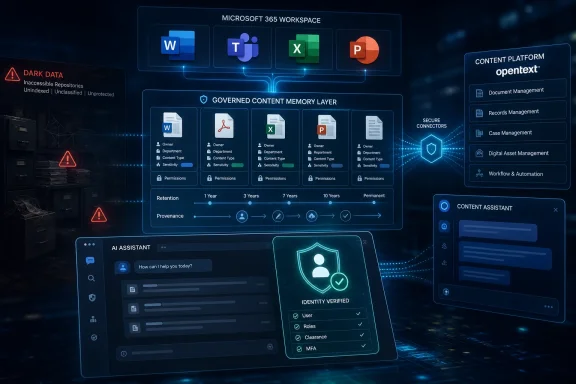
OpenText’s blog, drawn from a panel with Microsoft, frames “AI content management” as the missing middle between business applications and AI assistants. That phrase can sound like vendor packaging, but the underlying idea is straightforward. If an enterprise wants AI to reason over business content, the content has to carry the context an assistant needs: who owns it, what it relates to, which version is authoritative, who may see it, when it expires, and how it connects to the surrounding business process.That is different from simply dumping documents into a data lake. The lake strategy is tempting because it looks like acceleration. Copy everything into a central store, point retrieval-augmented generation at it, and let the assistant answer questions. For some analytics workloads, that may be reasonable. For regulated enterprise content, it can also create a second, less governed universe of records with uncertain freshness, broken lineage, and awkward compliance questions.
The OpenText position is that AI should come to governed content rather than forcing governed content to be copied into AI systems. That is the right instinct for organizations with contractual, legal, medical, financial, personnel, or engineering records. The moment a record leaves its system of control, the organization has to prove that access rules, retention rules, deletion rules, and audit rules still apply with the same rigor.
This is why the “content management” part matters more than the “AI” part. The AI assistant may be the visible feature, but the durable control plane is metadata, permission trimming, lifecycle management, and process context. In other words, the expensive generative layer depends on the boring substrate IT pros have been trying to fund for years.
Dark Data Is No Longer Just Storage Waste
The blog leans heavily on the problem of dark data, the unstructured and semi-structured content that exists inside an organization but remains hard to find, classify, or use. For human workers, dark data causes duplicated effort and incomplete decisions. For AI systems, it creates a sharper failure mode: the assistant may produce a plausible answer from the accessible slice of reality while ignoring the inaccessible slice that would change the conclusion.That matters because enterprise content is not a neat corpus. It is a sedimentary record of mergers, departmental projects, abandoned workflows, file migrations, cloud transitions, and compliance regimes. Even well-run Microsoft 365 tenants often contain overshared sites, stale Teams workspaces, orphaned OneDrive content, unlabeled sensitive documents, and libraries whose permissions reflect old organizational charts.
OpenText’s examples are the classic enterprise objects: contracts, invoices, purchase orders, packing slips, HR files, customer records, and SAP or Salesforce-linked documents. None of these are exotic AI use cases. They are exactly the documents employees already hunt for before calls, claims reviews, audits, renewals, escalations, and exceptions.
The dark data problem becomes especially important when organizations ask Copilot to move from convenience to judgment support. Summarizing a meeting transcript is one thing. Preparing a customer account briefing that draws from contracts, unpaid invoices, open support cases, delivery records, and correspondence is another. The second task requires not only retrieval, but relationship awareness.
That is where knowledge graphs, ontologies, and business metadata enter the picture. Those terms can be abused, but the practical goal is modest: make sure the system understands that a customer, a contract, an order, a shipment, an invoice, and a dispute are not six unrelated blobs of text. They are parts of one business situation.
OpenText Wants to Be the Memory Copilot Can Call
The most concrete news in the blog is OpenText’s AI-to-AI integration between Content Aviator and Microsoft Copilot. OpenText describes Content Aviator as an assistant that can analyze and summarize unstructured content managed in OpenText platforms, while also drawing context from connected systems such as Salesforce or SAP. The integration lets users working in Copilot invoke Content Aviator from Microsoft 365 experiences, including Word, PowerPoint, Excel, or a dedicated Copilot interface.The pitch is easy to understand. If a user is already living in Microsoft 365, the assistant interface should not force them to leave that workflow to query governed business content. Copilot becomes the front door; Content Aviator becomes the specialist that knows how to search, retrieve, summarize, and synthesize the OpenText-governed content behind it.
This is also a revealing moment in the evolution of enterprise AI. The industry is moving from chatbots as destinations to assistants as brokers. Instead of every system presenting its own standalone bot, one assistant calls another assistant, which calls a governed repository, which returns an answer trimmed by identity and policy. That sounds convoluted, but it reflects how enterprises actually operate. No single assistant owns all the truth.
For Microsoft, this pattern supports the broader Copilot strategy. Microsoft 365 Copilot is most valuable when it becomes the user’s work surface for enterprise intelligence, not merely a clever autocomplete in Office apps. For OpenText, the integration is defensive and offensive at the same time. It keeps OpenText repositories relevant in a Microsoft-centered workflow, while positioning the company’s content management stack as a prerequisite for trustworthy AI.
The Vendor Story Is Convenient, but the Risk Is Real
There is a danger in accepting the vendor narrative too cleanly. OpenText sells content management, so naturally it argues that content management is the missing foundation. Microsoft sells Copilot, so naturally it argues that governance, labels, Graph connectors, and Purview controls can make AI enterprise-ready. The overlap is commercially convenient.But convenient does not mean wrong. The awkward truth is that many Copilot pilots expose problems that existed long before Copilot. Poor permissions hygiene, stale content, weak retention, duplicate records, and disconnected repositories were already liabilities. Generative AI simply makes those liabilities visible to more people, faster.
A traditional search result page gives users clues. They can see file names, dates, folders, owners, and maybe decide whether something looks authoritative. A generated answer compresses those clues into prose. That compression is useful, but it can also hide uncertainty unless the system is designed to preserve provenance and show references clearly.
This is why “trust” in enterprise AI cannot be reduced to model accuracy. Trust also means knowing which sources were consulted, which were excluded, whether the user had legitimate access, whether the content was current, whether the answer crossed a policy boundary, and whether the organization can reconstruct what happened later. That is records management language, not AI hype language.
The security angle is just as important. Microsoft’s Copilot model is permission-aware, but that does not absolve administrators from fixing oversharing. If thousands of employees technically have access to documents they should not see, Copilot respecting those permissions is not a comfort. It is an accelerant.
Microsoft 365 Is Not the Whole Enterprise
For WindowsForum readers, the Microsoft 365 angle is obvious. Many organizations now treat Teams, SharePoint, OneDrive, Outlook, and Office as the default collaboration layer. Copilot’s appeal flows directly from that ubiquity. It meets users where they already work.But most enterprises do not keep their entire operational memory inside Microsoft 365. They keep customer state in Salesforce, financial state in SAP or Oracle, legal records in document management systems, engineering artifacts in specialized repositories, service data in ITSM platforms, and archived material in systems that predate the current CIO. The Microsoft Graph is powerful, but it is not automatically a map of the whole business.
That is the opening for OpenText. Its argument is that intelligent content management can provide a single source of truth for unstructured business content while Microsoft supplies the productivity surface, identity fabric, and governance tooling across Microsoft 365. In the clean version of this architecture, Copilot handles the user interaction, Microsoft Entra handles identity, Purview handles policy, and OpenText maintains the authoritative content context for records outside the Microsoft-native estate.
The hard part is that real deployments are rarely clean. Connectors have to preserve permissions. Metadata has to be normalized. Duplicates have to be resolved. Sensitive content has to be labeled. Users have to understand why Copilot can answer some questions but not others. Administrators have to monitor the integration as a living system, not a one-time project.
This is where many AI programs underestimate cost. The license line item is visible; the remediation work is not. Yet the remediation work often determines whether the license feels transformative or disappointing.
The “Single Source of Truth” Is a Discipline, Not a Product
OpenText uses the familiar phrase “single source of truth,” and it is worth being precise about what that can and cannot mean. No large organization has one literal repository for all truth. The useful interpretation is that each class of content has an authoritative system, and AI interactions should know which system that is.A signed contract should not compete with a draft found in a project folder. A paid invoice should not be treated the same as an old invoice export. A current HR policy should outrank a copied PDF from three revisions ago. A customer’s active support escalation should be connected to the account and entitlement data that explain what the company promised.
For AI, that discipline is essential. Large language models are good at synthesizing text, but they do not inherently know which enterprise artifact is authoritative. The surrounding retrieval, metadata, ranking, and governance systems have to encode that authority. Otherwise, the assistant becomes a fluent intern with access to a messy filing cabinet.
The blog’s emphasis on metadata and lineage is therefore more than content-management boilerplate. Metadata is how an AI system distinguishes the current master agreement from an obsolete draft. Lineage is how an organization proves where an answer came from. Retention is how stale material stops polluting results. Access control is how the system avoids turning productivity into leakage.
The irony is that AI makes traditional information governance easier to justify. For years, governance projects were sold around compliance and risk reduction, which often made them feel like necessary overhead. Now they can be sold around AI value. The same cleanup that reduces regulatory exposure can also improve answer quality, workflow speed, and employee trust.
The Pilot Phase Should Be Narrower Than the Ambition
OpenText’s recommended starting point is sensible: pick one high-value, content-heavy business process, define success, validate with real data, and scale only after the pattern works. That advice may sound conservative, but it is probably the difference between an AI program that survives budgeting season and one that becomes a cautionary slide.The best candidates are exception-heavy workflows. These are processes where most cases are routine, but a meaningful minority require human review because something does not match, a rule is ambiguous, a customer situation is unusual, or a document is missing. Claims handling, contract review, customer onboarding, invoice exceptions, procurement disputes, and regulated case management all fit the pattern.
In those workflows, AI does not need to replace the human decision-maker to create value. It can gather the relevant file, summarize the history, surface discrepancies, explain policy context, and prepare a recommended next step. The human remains accountable, but the time spent hunting and assembling context drops.
This is also a healthier way to evaluate Copilot and Content Aviator together. Generic productivity claims are hard to measure. A specific process can be measured by cycle time, rework, escalation rate, error rate, user satisfaction, and compliance findings. If the assistant shortens a review from forty minutes to fifteen while maintaining or improving quality, the business case becomes concrete.
A narrow pilot also limits blast radius. If permissions are wrong, content is stale, or the assistant produces weak summaries, the organization learns inside a bounded process. That is far better than lighting up broad Copilot access across a messy content estate and discovering after rollout that users do not trust the answers.
Azure Commitments Make the Economics More Political
The blog briefly notes that joint OpenText and Microsoft customers may be able to apply Microsoft Azure Consumption Commitment spending to move content management systems to Azure. That detail matters because enterprise AI decisions are often shaped as much by procurement mechanics as by architecture.If a company has already committed to a large Azure spend, modernization projects that consume that commitment can look financially easier than alternatives that require fresh budget. That does not make them free, and it does not prove they are architecturally superior. But it can change which projects get approved.
For Microsoft, this is part of the cloud flywheel. Copilot drives demand for governed data. Governed data drives modernization. Modernization drives Azure consumption. Azure consumption makes Microsoft’s ecosystem stickier. OpenText benefits if its content platforms ride along as part of that modernization rather than being displaced by a Microsoft-only content strategy.
For customers, the risk is lock-in by accounting. A project can be sensible and still deserve scrutiny. IT leaders should ask whether moving a content platform to Azure improves latency, security, governance, integration, and operational resilience, not merely whether it burns down a commitment already sitting on the balance sheet.
The best modernization case is architectural, not promotional. If placing OpenText-managed content closer to Microsoft 365, Copilot, Entra, Purview, and Azure AI services reduces complexity while preserving governance, the move can be justified. If it simply relocates a messy repository into a cloud invoice, the AI foundation remains shaky.
Windows Shops Need to Treat Copilot Readiness Like Security Readiness
The practical implication for administrators is that Copilot readiness belongs beside security readiness, not end-user training. Prompt guides and lunch-and-learns are useful, but they are downstream. The upstream work is knowing what Copilot and connected agents can see, whether that access is appropriate, and whether the content being surfaced is authoritative.SharePoint and OneDrive hygiene are obvious starting points. Overshared sites, anonymous links, abandoned groups, stale libraries, and unlabeled sensitive files can all become Copilot problems. But the same logic extends beyond Microsoft 365. If Copilot can reach external content through connectors or agent integrations, those repositories need the same review.
This is not a call to freeze AI adoption until every repository is perfect. That would be a convenient excuse to do nothing. It is a call to match rollout scope to governance confidence. Give Copilot access where content ownership, permissions, and lifecycle rules are understood. Be cautious where they are not.
Administrators should also resist the assumption that AI output quality is purely a vendor issue. If Copilot produces shallow answers because it sees only public SharePoint content and not the governed contract repository, that is an architecture issue. If Content Aviator surfaces old documents because metadata and retention rules are weak, that is an information management issue. If users distrust answers because they cannot see provenance, that is a product and deployment design issue.
The mature stance is to treat AI assistants as new consumers of enterprise data. They need identity, access control, monitoring, logging, change management, and incident response. They also need content design, which is still a foreign concept in many infrastructure teams.
The Real AI Project Is the Cleanup Nobody Wanted
The OpenText-Microsoft story is not really about a shiny assistant calling another shiny assistant. It is about an industry discovering that enterprise AI depends on decades of unresolved content debt. The assistant is new; the mess is old.That is why the “foundation before scale” message is likely to age well. Models will improve. Copilot’s interface will change. OpenText’s Aviator branding may evolve. Microsoft’s agent architecture will keep expanding. But the requirement for accurate, governed, contextual business content will not go away.
For IT leaders, the challenge is to keep the project grounded. Do not let AI become a vague transformation program with no measurable process. Do not let content management become a multiyear taxonomy exercise that never reaches users. The winning pattern is smaller and more operational: select a process, identify the authoritative content, clean the access model, connect the systems, test with real users, measure the outcome, and repeat.
That also means being honest about where AI should not yet be trusted. If a repository has unknown ownership, ambiguous permissions, and outdated records, the answer is not to hide those facts behind a conversational interface. The answer is to remediate or exclude it until it can be governed.
The Copilot Rollout Succeeds or Fails in the Repository
Before organizations add more assistants, agents, and connectors, they should pause over the less glamorous work OpenText is pointing at. The immediate lesson is not that every Microsoft customer needs OpenText. It is that every Copilot customer needs a content strategy strong enough to survive AI.- Copilot can only be as reliable as the governed content and permissions available to it.
- AI-ready content requires metadata, ownership, access control, lifecycle management, and provenance, not just storage.
- Copying regulated enterprise content into new AI stores can create freshness, lineage, and compliance problems if governance does not travel with it.
- OpenText’s Content Aviator integration positions Copilot as a front-end assistant that can call into OpenText-managed business content from Microsoft 365 workflows.
- The safest starting point is a narrow, high-value business process where real outcomes can be measured before broader rollout.
- Administrators should treat Copilot readiness as an extension of security, compliance, and information architecture rather than as a user-training exercise.
References
- Primary source: OpenText Blogs
Published: Tue, 23 Jun 2026 23:00:24 GMT
Build your AI content management foundation before scaling Microsoft Copilot
Discover how AI content management helps organizations build a trusted foundation for Microsoft Copilot with governed, connected enterprise content.blogs.opentext.com - Related coverage: opentext.com
- Official source: marketplace.microsoft.com
Microsoft Marketplace | cloud solutions, AI apps, and agents
marketplace.microsoft.com
- Related coverage: investors.opentext.com
Open Text Corporation - OpenText Expands Availability of Core Threat Detection and Response with Deep Microsoft Integrations
OpenText™ (NASDAQ: OTEX), (TSX: OTEX), a global leader in secure information management for AI, today announced new innovations within OpenText™ Core Threat Detection and Response , an AI-powered cybersecurity solution deeply integrated with Microsoft Defender for Endpoint, Microsoft Entra ID...investors.opentext.com
- Official source: techcommunity.microsoft.com
Federated Copilot connectors - bringing real-time enterprise data within Microsoft 365 Copilot | Microsoft Community Hub
Announcing federated Copilot connectors. Bring real-time data within Copilot via connectors from partners like Moody's, HubSpot, LSEG (London Stock Exchange... techcommunity.microsoft.com
- Related coverage: videos.opentext.com
OpenText Content Aviator: AI content assistance in the flow of work without switching apps
Information knowledge workers need is often scattered across apps like SAP, Microsoft 365, Salesforce, and others. Having to switch back and forth between apps and AI chats breaks concentration and hurts productivity. Watch the video to see how OpenText Content Aviator brings AI content...videos.opentext.com
- Related coverage: news.cognizant.com
Cognizant and Microsoft Expand Partnership to Advance AI Transformation and Frontier Firm Experiences - Dec 18, 2025
PDF documentnews.cognizant.com
- Official source: cdn-dynmedia-1.microsoft.com
