

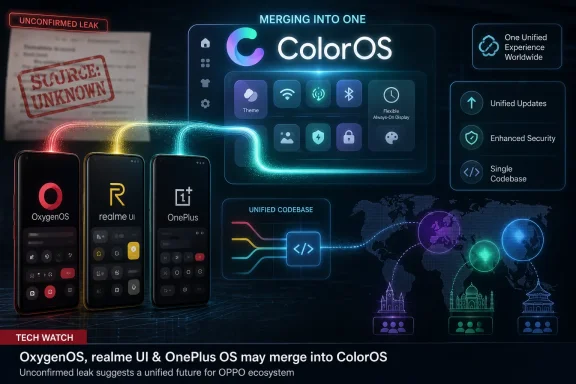
Smartprix reported on July 3, 2026, citing an unnamed OPPO industry source, that OPPO plans to retire OxygenOS and Realme UI branding globally and move future OnePlus and Realme phones onto ColorOS. The companies have not confirmed the claim, which is exactly why the story sits in that uncomfortable zone between leak and obituary. But if the report is right, it is less a sudden execution than the last visible step in a software merger that began years ago.
The emotional reaction from longtime OnePlus users is understandable because OxygenOS was never just a settings menu. It was the original OnePlus bargain: near-stock Android, fast updates, enthusiast-friendly defaults, and fewer carrier-style annoyances than buyers expected from a phone that undercut Samsung and Google on price.
That identity was already under pressure by the time OnePlus and OPPO publicly deepened their integration in 2021. OnePlus co-founder Pete Lau said then that the companies would share a common codebase for OxygenOS and ColorOS while maintaining separate product identities. The phrasing mattered. OnePlus wanted the engineering benefits of consolidation without admitting that the thing customers loved might become mostly branding.
That compromise never fully worked. OxygenOS 12, built after the integration, was widely criticized by users and reviewers for feeling like ColorOS wearing a OnePlus badge. Some later releases clawed back stability and polish, but the philosophical shift was visible: OxygenOS had stopped being an independent software culture and had become a regionalized expression of OPPO’s Android platform.
Realme UI had even less room to claim independence. Realme began life as an OPPO offshoot, and its interface has long been understood as ColorOS-derived software tuned for Realme’s device lineup. If OxygenOS had a soul to lose, Realme UI mostly had a costume.
That does not make it implausible. It makes it a classic consumer-tech consolidation leak: the kind of story that sounds dramatic because the branding change is visible, while the operational change behind it has been happening in increments for years.
The more interesting question is not whether OPPO can do this. It obviously can. The question is whether OPPO believes the OxygenOS and Realme UI names still create more value than they cost to maintain.
For OnePlus, the answer may no longer be obvious. The company’s enthusiast cachet has weakened, its product line has drifted, and its software differentiation has narrowed. If the brand is increasingly concentrated around India and China, as Smartprix reports, the case for a globally distinct operating-system identity becomes harder to defend internally.
For Realme, the branding math is even colder. Realme competes heavily on specifications, price, charging speed, camera claims, and retail availability. Realme UI was rarely the reason someone bought a Realme phone. In a cost-cutting meeting, that makes it vulnerable.
OxygenOS used to belong in that conversation because it had a point of view. It was fast, sparse, and opinionated in favor of users who hated clutter. It was not “stock Android,” exactly, but it understood why people said they wanted stock Android.
The OPPO-era OxygenOS is different. It still has OnePlus flourishes, and recent OnePlus flagships remain good phones, but the operating system no longer feels like a separate institution. The settings hierarchy, visual language, animations, privacy prompts, launcher behavior, and app management all point back toward the same design and engineering pool.
That is why the rumored move feels both shocking and unsurprising. The name OxygenOS still carries memory. The software underneath has already been domesticated.
OPPO’s likely internal argument is brutally practical. Maintaining OxygenOS, Realme UI, and ColorOS as separate global brands means duplicated localization, testing, certification, documentation, bug triage, support scripts, release calendars, and regulatory review. Even when the codebase is shared, the last 10 percent of differentiation is expensive because it must be validated across dozens of devices and markets.
From an engineering manager’s perspective, one ColorOS reduces complexity. From a fan’s perspective, it erases the reason OnePlus once felt special. Both can be true.
The “Never Settle” era was not just marketing bravado. It was a compact between a young brand and a specific kind of Android user: the person who watched launch events, unlocked bootloaders, knew what a kernel scheduler was, and still wanted a phone that could be recommended to normal people.
That compact weakened as OnePlus grew. Prices rose. Product lines multiplied. Carrier partnerships and retail ambitions made the company less weird and more conventional. The OPPO integration then made the software feel less like a OnePlus creation and more like an inherited platform.
This is why a branding change would sting even if the day-one user experience barely changes. OxygenOS is no longer only software; it is a proxy for whether OnePlus still sees enthusiasts as central to the brand. If future OnePlus phones boot into ColorOS, many users will read that as the company finally saying the quiet part out loud.
OPPO may argue that customers care about stability, battery life, camera tuning, AI features, update speed, and after-sales support more than a legacy software name. For most buyers, that may be correct. But OnePlus did not build its reputation on most buyers. It built it on the people who persuaded most buyers.
Realme UI has had fans, especially among users who like customization, gaming modes, charging controls, and device-management tools. But it has never had the mythology OxygenOS accumulated. Nobody bought a Realme because Realme UI represented a cleaner Android ideal.
That makes Realme UI’s rumored retirement easier to understand. If Realme is already leaning on OPPO’s supply chain, R&D, and software base, keeping a separate interface name may be more about shelf differentiation than product substance.
Smartprix’s report also claims Realme is moving away from China and concentrating on international markets. If that is accurate, OPPO may see Realme as the global value spear, OnePlus as a premium performance brand in fewer key markets, and OPPO as the umbrella identity with ColorOS tying the stack together.
That structure would make sense on a spreadsheet. It also risks making the brands feel interchangeable in stores. If OPPO, OnePlus, and Realme all run ColorOS, the burden shifts to hardware design, pricing, camera tuning, update promises, and retail support. Software identity stops being a differentiator and becomes infrastructure.
That is not a cosmetic change. Service networks are where brand independence becomes operationally real or fake. If the repair counter, spare-parts logistics, customer-support workflow, and escalation process are shared, then the brand separation is already thinner than the logo suggests.
For customers, this can be good news. A larger service footprint can mean easier repairs, better parts availability, and fewer long-distance shipping headaches. In a market like India, where after-sales support can determine whether buyers trust a brand, OPPO’s infrastructure may strengthen OnePlus.
But it also changes the story OnePlus tells about itself. A phone sold as a OnePlus device, serviced through OPPO centers, built on OPPO’s platform, and potentially running ColorOS is not meaningfully independent in the way early OnePlus fans understood the term.
That does not make the product bad. It makes the brand more like a trim level inside a larger automotive group: different tuning, different styling, different audience, shared platform. Some great cars are built that way. But nobody mistakes them for rebels.
The worry is not that ColorOS exists. The worry is which commercial version of ColorOS lands on which phone in which market.
Android skins are not uniform experiences across regions and price tiers. A flagship OPPO in Europe or a premium OnePlus in India may feel polished and restrained. A budget OPPO or Realme device in a more price-sensitive market may arrive with more preinstalled apps, more notification prompts, more app-store nudges, and more monetization hooks.
That is the line OnePlus must not cross. OxygenOS’ remaining value is the expectation that a premium OnePlus phone will not behave like a bargain-bin handset stuffed with promotional surfaces. If OPPO retires the OxygenOS name but preserves the lighter OnePlus configuration, the backlash may fade. If it uses unification as cover to normalize ads, bloat, and dark-pattern notifications across the portfolio, the damage will be immediate.
This is where branding becomes accountability. “OxygenOS” gave OnePlus users a name to invoke when the company drifted too far from its promise. “ColorOS” may make responsibility fuzzier. Is the problem OPPO’s platform, OnePlus’ regional build, carrier demands, or a market-specific monetization decision?
Power users will notice. They always do.
If OPPO can test one core build across related devices, centralize bug fixes, and reduce duplicated engineering work, users could benefit. Rollouts may become more predictable. Security patches may arrive faster. Feature development may become less fragmented. In theory, the same team solving a battery-drain bug for ColorOS could help OnePlus and Realme users at the same time.
But this only works if OPPO treats unification as a quality program rather than a cost-cutting program. The worst version of the plan would keep the efficiencies while lowering the standard: fewer distinct QA paths, fewer brand-specific safeguards, and less willingness to preserve OnePlus’ cleaner defaults.
OnePlus users have been through enough software turbulence to be skeptical. OxygenOS 12 damaged trust because it felt like a forced migration disguised as continuity. Even when later releases improved, the memory remained. Users do not evaluate software strategy only by changelogs; they evaluate it by whether the company’s last promise held up.
OPPO therefore faces a communications problem as much as an engineering one. If the report is true, silence will not help. A vague statement about “synergies” will help even less. Users will want to know whether update policies, bootloader practices, system ads, app recommendations, notification behavior, and preinstalled software rules are changing.
The arc is familiar: launch the sub-brand with autonomy, let it build an audience, integrate supply chains, merge R&D, unify software, consolidate service, and preserve the name only as long as it sells phones. Eventually, the sub-brand becomes a channel strategy rather than a product philosophy.
OnePlus appears to be deep into that arc. Realme may be even further along. The rumored ColorOS move would simply remove one of the last consumer-visible signs that the brands had separate software destinies.
This is not unique to OPPO. The economics of Android hardware are unforgiving. Component costs rise, margins compress, update commitments lengthen, and regulators demand more accountability around security and privacy. Maintaining multiple skins for brands that share ownership becomes harder to justify unless those skins clearly drive sales.
The tragedy for OnePlus fans is that OxygenOS did drive sales. It was not decorative. It was one of the main reasons the company mattered. But the version of OxygenOS that drove those sales was built for a smaller, hungrier OnePlus than the one OPPO now manages.
A OnePlus phone running ColorOS could still feel like a OnePlus phone if OPPO gives it a distinct configuration: minimal preloads, no system ads, clean notification defaults, fast patch delivery, strong performance tuning, and transparent update commitments. That would make the change annoying but survivable.
A Realme phone running ColorOS could also benefit if the unified platform brings better stability and longer support. Budget and midrange buyers are often the first to suffer when vendors fragment software work across too many models. Consolidation could raise the floor.
The risk is that OPPO sees the floor and ceiling as the same thing. One build, one brand, one set of defaults, one monetization model. That would be tidy, efficient, and strategically foolish.
OnePlus does not need OxygenOS as a label if it can still deliver the OxygenOS promise. But if both disappear together, the company will have little left to say to the customers who made it famous.
The practical test will come with the next major OnePlus and Realme launches after this report. Spec sheets, boot screens, review units, update pages, and regional support documents will tell us more than any corporate statement. If “OxygenOS” quietly disappears from launch materials, the rumor becomes reality by omission.
Buyers should watch the details rather than the logo alone.
 ColorOS Did Not Conquer OxygenOS Overnight
The emotional reaction from longtime OnePlus users is understandable because OxygenOS was never just a settings menu. It was the original OnePlus bargain: near-stock Android, fast updates, enthusiast-friendly defaults, and fewer carrier-style annoyances than buyers expected from a phone that undercut Samsung and Google on price.That identity was already under pressure by the time OnePlus and OPPO publicly deepened their integration in 2021. OnePlus co-founder Pete Lau said then that the companies would share a common codebase for OxygenOS and ColorOS while maintaining separate product identities. The phrasing mattered. OnePlus wanted the engineering benefits of consolidation without admitting that the thing customers loved might become mostly branding.
That compromise never fully worked. OxygenOS 12, built after the integration, was widely criticized by users and reviewers for feeling like ColorOS wearing a OnePlus badge. Some later releases clawed back stability and polish, but the philosophical shift was visible: OxygenOS had stopped being an independent software culture and had become a regionalized expression of OPPO’s Android platform.
Realme UI had even less room to claim independence. Realme began life as an OPPO offshoot, and its interface has long been understood as ColorOS-derived software tuned for Realme’s device lineup. If OxygenOS had a soul to lose, Realme UI mostly had a costume.
The Report Is Unconfirmed, but the Direction Is Not
The important caveat is that Smartprix’s report remains unconfirmed. OPPO, OnePlus, and Realme have not publicly announced that OxygenOS and Realme UI are ending. Android Authority, Gizmochina, and other outlets have amplified or analyzed the claim, but the original report still rests on an unnamed source.That does not make it implausible. It makes it a classic consumer-tech consolidation leak: the kind of story that sounds dramatic because the branding change is visible, while the operational change behind it has been happening in increments for years.
The more interesting question is not whether OPPO can do this. It obviously can. The question is whether OPPO believes the OxygenOS and Realme UI names still create more value than they cost to maintain.
For OnePlus, the answer may no longer be obvious. The company’s enthusiast cachet has weakened, its product line has drifted, and its software differentiation has narrowed. If the brand is increasingly concentrated around India and China, as Smartprix reports, the case for a globally distinct operating-system identity becomes harder to defend internally.
For Realme, the branding math is even colder. Realme competes heavily on specifications, price, charging speed, camera claims, and retail availability. Realme UI was rarely the reason someone bought a Realme phone. In a cost-cutting meeting, that makes it vulnerable.
The End of the Name Would Merely Admit the Engineering Reality
The smartphone industry has a long history of pretending that skins are separate operating systems when they are really commercial packaging over Android. Samsung’s One UI is meaningfully distinct because Samsung has the scale, services, and platform ambitions to make it so. Xiaomi’s HyperOS is a branding and ecosystem play tied to phones, cars, wearables, and appliances. Google’s Pixel software is a product strategy disguised as Android purity.OxygenOS used to belong in that conversation because it had a point of view. It was fast, sparse, and opinionated in favor of users who hated clutter. It was not “stock Android,” exactly, but it understood why people said they wanted stock Android.
The OPPO-era OxygenOS is different. It still has OnePlus flourishes, and recent OnePlus flagships remain good phones, but the operating system no longer feels like a separate institution. The settings hierarchy, visual language, animations, privacy prompts, launcher behavior, and app management all point back toward the same design and engineering pool.
That is why the rumored move feels both shocking and unsurprising. The name OxygenOS still carries memory. The software underneath has already been domesticated.
OPPO’s likely internal argument is brutally practical. Maintaining OxygenOS, Realme UI, and ColorOS as separate global brands means duplicated localization, testing, certification, documentation, bug triage, support scripts, release calendars, and regulatory review. Even when the codebase is shared, the last 10 percent of differentiation is expensive because it must be validated across dozens of devices and markets.
From an engineering manager’s perspective, one ColorOS reduces complexity. From a fan’s perspective, it erases the reason OnePlus once felt special. Both can be true.
OnePlus Spent Years Selling the Feeling of Not Being OPPO
OnePlus’ problem is that it trained its customers to care about exactly the thing OPPO now appears ready to flatten. Early OnePlus phones appealed to users who wanted flagship performance without flagship bloat. OxygenOS became the proof that OnePlus understood that audience.The “Never Settle” era was not just marketing bravado. It was a compact between a young brand and a specific kind of Android user: the person who watched launch events, unlocked bootloaders, knew what a kernel scheduler was, and still wanted a phone that could be recommended to normal people.
That compact weakened as OnePlus grew. Prices rose. Product lines multiplied. Carrier partnerships and retail ambitions made the company less weird and more conventional. The OPPO integration then made the software feel less like a OnePlus creation and more like an inherited platform.
This is why a branding change would sting even if the day-one user experience barely changes. OxygenOS is no longer only software; it is a proxy for whether OnePlus still sees enthusiasts as central to the brand. If future OnePlus phones boot into ColorOS, many users will read that as the company finally saying the quiet part out loud.
OPPO may argue that customers care about stability, battery life, camera tuning, AI features, update speed, and after-sales support more than a legacy software name. For most buyers, that may be correct. But OnePlus did not build its reputation on most buyers. It built it on the people who persuaded most buyers.
Realme UI Was Always Easier to Sacrifice
Realme occupies a different place in the story. It grew quickly by attacking the value segment with aggressive hardware, frequent launches, and youth-oriented marketing. Its software mattered, but mostly as a delivery mechanism for features rather than as a philosophical statement.Realme UI has had fans, especially among users who like customization, gaming modes, charging controls, and device-management tools. But it has never had the mythology OxygenOS accumulated. Nobody bought a Realme because Realme UI represented a cleaner Android ideal.
That makes Realme UI’s rumored retirement easier to understand. If Realme is already leaning on OPPO’s supply chain, R&D, and software base, keeping a separate interface name may be more about shelf differentiation than product substance.
Smartprix’s report also claims Realme is moving away from China and concentrating on international markets. If that is accurate, OPPO may see Realme as the global value spear, OnePlus as a premium performance brand in fewer key markets, and OPPO as the umbrella identity with ColorOS tying the stack together.
That structure would make sense on a spreadsheet. It also risks making the brands feel interchangeable in stores. If OPPO, OnePlus, and Realme all run ColorOS, the burden shifts to hardware design, pricing, camera tuning, update promises, and retail support. Software identity stops being a differentiator and becomes infrastructure.
The India Service Shift Shows the Merger Is Already Physical
The software rumor lands harder because it is not happening in isolation. OnePlus service in India has already been moving into OPPO’s broader service network, with reports and company materials pointing to OnePlus support availability through hundreds of OPPO service centers.That is not a cosmetic change. Service networks are where brand independence becomes operationally real or fake. If the repair counter, spare-parts logistics, customer-support workflow, and escalation process are shared, then the brand separation is already thinner than the logo suggests.
For customers, this can be good news. A larger service footprint can mean easier repairs, better parts availability, and fewer long-distance shipping headaches. In a market like India, where after-sales support can determine whether buyers trust a brand, OPPO’s infrastructure may strengthen OnePlus.
But it also changes the story OnePlus tells about itself. A phone sold as a OnePlus device, serviced through OPPO centers, built on OPPO’s platform, and potentially running ColorOS is not meaningfully independent in the way early OnePlus fans understood the term.
That does not make the product bad. It makes the brand more like a trim level inside a larger automotive group: different tuning, different styling, different audience, shared platform. Some great cars are built that way. But nobody mistakes them for rebels.
The Real Risk Is Not ColorOS; It Is Which ColorOS
ColorOS is not inherently a bad Android skin. Recent versions have become smoother, more coherent, and more competitive with other major Android interfaces. OPPO has invested heavily in animations, multitasking, privacy controls, battery management, and cross-device features.The worry is not that ColorOS exists. The worry is which commercial version of ColorOS lands on which phone in which market.
Android skins are not uniform experiences across regions and price tiers. A flagship OPPO in Europe or a premium OnePlus in India may feel polished and restrained. A budget OPPO or Realme device in a more price-sensitive market may arrive with more preinstalled apps, more notification prompts, more app-store nudges, and more monetization hooks.
That is the line OnePlus must not cross. OxygenOS’ remaining value is the expectation that a premium OnePlus phone will not behave like a bargain-bin handset stuffed with promotional surfaces. If OPPO retires the OxygenOS name but preserves the lighter OnePlus configuration, the backlash may fade. If it uses unification as cover to normalize ads, bloat, and dark-pattern notifications across the portfolio, the damage will be immediate.
This is where branding becomes accountability. “OxygenOS” gave OnePlus users a name to invoke when the company drifted too far from its promise. “ColorOS” may make responsibility fuzzier. Is the problem OPPO’s platform, OnePlus’ regional build, carrier demands, or a market-specific monetization decision?
Power users will notice. They always do.
Updates Could Improve, but Trust Will Not Automatically Follow
The strongest argument for consolidation is software maintenance. Android vendors are under pressure to deliver longer support windows, faster security patches, and more reliable major-version upgrades. A unified platform can help.If OPPO can test one core build across related devices, centralize bug fixes, and reduce duplicated engineering work, users could benefit. Rollouts may become more predictable. Security patches may arrive faster. Feature development may become less fragmented. In theory, the same team solving a battery-drain bug for ColorOS could help OnePlus and Realme users at the same time.
But this only works if OPPO treats unification as a quality program rather than a cost-cutting program. The worst version of the plan would keep the efficiencies while lowering the standard: fewer distinct QA paths, fewer brand-specific safeguards, and less willingness to preserve OnePlus’ cleaner defaults.
OnePlus users have been through enough software turbulence to be skeptical. OxygenOS 12 damaged trust because it felt like a forced migration disguised as continuity. Even when later releases improved, the memory remained. Users do not evaluate software strategy only by changelogs; they evaluate it by whether the company’s last promise held up.
OPPO therefore faces a communications problem as much as an engineering one. If the report is true, silence will not help. A vague statement about “synergies” will help even less. Users will want to know whether update policies, bootloader practices, system ads, app recommendations, notification behavior, and preinstalled software rules are changing.
Enthusiasts Lose the Argument When Brands Become Channels
There is a broader industry pattern here. Smartphone sub-brands are often born to create emotional separation from the parent company. They promise speed, value, youth culture, gaming performance, camera specialization, or enthusiast credibility. Then, once they scale, the parent company pulls operations back together.The arc is familiar: launch the sub-brand with autonomy, let it build an audience, integrate supply chains, merge R&D, unify software, consolidate service, and preserve the name only as long as it sells phones. Eventually, the sub-brand becomes a channel strategy rather than a product philosophy.
OnePlus appears to be deep into that arc. Realme may be even further along. The rumored ColorOS move would simply remove one of the last consumer-visible signs that the brands had separate software destinies.
This is not unique to OPPO. The economics of Android hardware are unforgiving. Component costs rise, margins compress, update commitments lengthen, and regulators demand more accountability around security and privacy. Maintaining multiple skins for brands that share ownership becomes harder to justify unless those skins clearly drive sales.
The tragedy for OnePlus fans is that OxygenOS did drive sales. It was not decorative. It was one of the main reasons the company mattered. But the version of OxygenOS that drove those sales was built for a smaller, hungrier OnePlus than the one OPPO now manages.
The Companies Still Have a Way to Avoid the Worst Backlash
If OPPO does move everything to ColorOS, it can still preserve much of what users care about. The name is not the only thing that matters. Defaults matter. Policies matter. Update speed matters. The number of uninstallable apps matters. Whether the phone nags users through system notifications matters.A OnePlus phone running ColorOS could still feel like a OnePlus phone if OPPO gives it a distinct configuration: minimal preloads, no system ads, clean notification defaults, fast patch delivery, strong performance tuning, and transparent update commitments. That would make the change annoying but survivable.
A Realme phone running ColorOS could also benefit if the unified platform brings better stability and longer support. Budget and midrange buyers are often the first to suffer when vendors fragment software work across too many models. Consolidation could raise the floor.
The risk is that OPPO sees the floor and ceiling as the same thing. One build, one brand, one set of defaults, one monetization model. That would be tidy, efficient, and strategically foolish.
OnePlus does not need OxygenOS as a label if it can still deliver the OxygenOS promise. But if both disappear together, the company will have little left to say to the customers who made it famous.
The ColorOS Era Will Be Judged by the First Phones That Ship
For now, current OnePlus and Realme owners should not panic. The report concerns future devices and future branding. It does not mean existing phones suddenly stop working, lose support overnight, or receive an unexpected ColorOS conversion tomorrow.The practical test will come with the next major OnePlus and Realme launches after this report. Spec sheets, boot screens, review units, update pages, and regional support documents will tell us more than any corporate statement. If “OxygenOS” quietly disappears from launch materials, the rumor becomes reality by omission.
Buyers should watch the details rather than the logo alone.
- Future OnePlus and Realme devices may be the real test, because the report does not claim that existing phones immediately lose their current software support.
- OPPO has not confirmed Smartprix’s report, so the claim should be treated as credible but still unverified.
- OxygenOS and ColorOS have shared a codebase since 2021, which means the technical merger largely preceded the rumored branding change.
- The biggest user-facing risk is not the ColorOS name, but whether OnePlus devices inherit heavier app recommendations, promotional notifications, or budget-phone monetization habits.
- A unified ColorOS platform could improve update consistency if OPPO uses consolidation to strengthen engineering rather than merely reduce costs.
- OnePlus’ challenge is to preserve the old OxygenOS promise even if the OxygenOS name disappears.
References
- Primary source: BestForAndroid
Published: 2026-07-05T22:01:00.170592
Is this the end of OxygenOS and Realme UI? ColorOS to dominate now – BestForAndroid
A new report claims OPPO will discontinue OxygenOS and Realme UI, merging OnePlus and Realme into ColorOS globally.bestforandroid.com - Related coverage: gizmochina.com
OxygenOS and Realme UI to discontinue, OnePlus and Realme phones to run ColorOS instead
OnePlus' OxygenOS and Realme's RealmeUI to discontinue for ColorOS. All future Realme and OnePlus will have ColorOS. www.gizmochina.com
- Related coverage: androidpure.com
OxygenOS and Realme UI reportedly ending: what buyers stand to lose – AndroidPure
OxygenOS and Realme UI are reportedly being discontinued for ColorOS. What the report says, and what OnePlus and Realme buyers stand to lose.www.androidpure.com - Related coverage: gizguide.com
OPPO to unify OnePlus OxygenOS and realme UI into "supercharged" ColorOS
In an exclusive report, Smartprix claims that OPPO's aggressive corporate restructuring will extend deeply into software, favoring ColorOS.www.gizguide.com
- Related coverage: phonearena.com
New report warns OnePlus and Realme owners about a coming software shakeup - PhoneArena
The claim says Oppo is rethinking the software both fanbases have relied on for years.www.phonearena.com - Related coverage: megamobilecontent.com
- Related coverage: gizchina.com
OxygenOS Is Dead. Realme UI Is Dead. Everything Runs ColorOS Now
OxygenOS and Realme UI are reportedly being discontinued as Oppo consolidates all three brands under ColorOS globally. OnePlus narrows to India and China only.www.gizchina.com - Related coverage: tech.sportskeeda.com
Why is OPPO replacing OxygenOS and Realme UI with ColorOS?
For years, OxygenOS and Realme UI stood apart from OPPO with their own software identities, even while sharing the same corporate roots. That could soon change.tech.sportskeeda.com - Related coverage: lowyat.net
- Related coverage: oneplus.gadgethacks.com

OnePlus Oxygen OS Discontinued? Report Points to ColorOS Takeover << OnePlus :: Gadget Hacks
OnePlus Oxygen OS Discontinued? Report Points to ColorOS Takeover A new report claims OPPO is moving to retire OxygenOS on all future global devices,...
oneplus.gadgethacks.com
- Related coverage: gizbot.com
OxygenOS and Realme UI Reportedly Being Discontinued as OPPO Moves to ColorOS for All - Gizbot News
A Smartprix report claims OxygenOS and Realme UI are being discontinued as OPPO consolidates all brands under ColorOS. Heres what the rumour says and why its plausible.www.gizbot.com - Related coverage: vgtimes.com
OPPO Ends OxygenOS and Realme UI: All Future OnePlus and Realme Phones to Run ColorOS
OPPO has officially announced it will discontinue support and development for its signature Android skins, OxygenOS and Realme UI, moving all new...vgtimes.com - Related coverage: androidauthority.com
The end of an era: OnePlus' Oxygen OS could soon be history
A new report claims OPPO will discontinue Oxygen OS and realme UI on future OnePlus and realme devices globally, in favor of Color OS.www.androidauthority.com - Related coverage: androidcentral.com
Major reports say OnePlus, Realme merge, but there's a lot still in the dark | Android Central
If the statement we received is anything to go by, we should stay hesitant for now.www.androidcentral.com - Related coverage: techradar.com
OnePlus is reportedly merging with Realme and 'evaluating' its future — but I'm convinced that this is fantastic news for Android fans | TechRadar
Not the end, just the end for nowwww.techradar.com - Related coverage: los40.com
Rumores hablan de que OnePlus va a desaparecer. Que no cunda el pánico. Hablemos de Oppo y OnePlus. | Dispositivos | LOS40
OnePlus y OPPO llevan años compartiendo “cocina”. Esa integración puede traducirse en ajustes de estrategia y en un parecido cada vez más evidente entre sus modelos.los40.com