

Oracle’s multicloud database play accelerated sharply in 2025, with Oracle Database@Azure moving from a niche co‑location experiment into a broad, production-ready platform that now hosts Exadata on Exascale, a VM-based Base Database Service, an AI-native Autonomous AI Lakehouse, and native replication and observability integrations with Azure — a set of changes that materially lowers the friction for running Oracle operational data alongside Azure analytics and AI services.
Oracle Database@Azure is a co‑location model: Oracle runs and manages Oracle Database services and Exadata infrastructure physically inside Microsoft Azure data centers, while Oracle retains operational control and SLAs. That architectural choice preserves Oracle’s enterprise features (RAC, Data Guard, etc. and gives Azure applications low‑latency, native access to transactional data for analytics and AI. The relationship has moved from proof‑of‑concept to scale in 2025 through geographic expansion, new SKUs (Exascale, Base Database Service), and tighter Azure platform integrations such as Azure Key Vault for TDE and streaming Exadata events into Azure Monitor. Oracle’s 2025 push is part product engineering, part commercial packaging: the company added new managed database SKUs on Azure, opened more regions, and created purchase paths and credits (Multicloud Universal Credits and partner programs) that let customers buy Oracle database services through Microsoft’s channel. These moves aim to reduce procurement friction and let customers keep Oracle’s operational model while consuming Azure AI and analytics.
Source: Oracle Blogs https://blogs.oracle.com/cloud-infrastructure/oracle-databaseazure-2025-highlights/
 Background / Overview
Oracle Database@Azure is a co‑location model: Oracle runs and manages Oracle Database services and Exadata infrastructure physically inside Microsoft Azure data centers, while Oracle retains operational control and SLAs. That architectural choice preserves Oracle’s enterprise features (RAC, Data Guard, etc. and gives Azure applications low‑latency, native access to transactional data for analytics and AI. The relationship has moved from proof‑of‑concept to scale in 2025 through geographic expansion, new SKUs (Exascale, Base Database Service), and tighter Azure platform integrations such as Azure Key Vault for TDE and streaming Exadata events into Azure Monitor. Oracle’s 2025 push is part product engineering, part commercial packaging: the company added new managed database SKUs on Azure, opened more regions, and created purchase paths and credits (Multicloud Universal Credits and partner programs) that let customers buy Oracle database services through Microsoft’s channel. These moves aim to reduce procurement friction and let customers keep Oracle’s operational model while consuming Azure AI and analytics. 2025: The key milestones and what they mean
March — Exadata Database Service on Exascale (GA)
Oracle announced general availability of Oracle Exadata Database Service on Exascale Infrastructure for Oracle Database@Azure in March 2025. Exascale provides a shared, RDMA‑enabled Exadata storage layer that lets Oracle deliver Exadata‑class performance without requiring customers to provision dedicated physical database and storage servers, lowering minimum infrastructure cost and enabling elastic consumption patterns. Oracle’s press release describes up to 95% lower minimum infrastructure costs for some Exascale configurations and positions the offering as a practical option for AI inference and high‑performance analytics workloads. Why it matters: Exascale turns Exadata from a heavy fixed‑cost appliance into a cloud‑friendly, multi‑tenant offering that supports rapid cloning, single‑node clusters for small workloads, and scale‑to‑zero developer scenarios — a major cost and agility win for teams that want Exadata performance without dedicated hardware.August — Observability: Exadata logs to Azure Monitor
Oracle added the capability to stream Exadata logs and infrastructure events directly into Azure Monitor, enabling customers to use existing Azure tooling (Log Analytics, Event Hub, Azure Monitor alerts) to monitor Exadata health and activity. This improves operational visibility for mixed Oracle/Azure estates and simplifies SIEM and incident workflows for Azure-centric teams.September — Oracle Base Database Service (GA)
Oracle made Oracle Base Database Service generally available on Oracle Database@Azure. This VM‑based managed database SKU runs Oracle Database Enterprise Edition and Standard Edition 2 (including 19c and 23ai/26ai lineage), provides automated lifecycle management, low‑code development tooling, and pay‑as‑you‑go compute scaling. Base Database Service is targeted at teams that need Oracle database compatibility without full Exadata economics. Why it matters: Base Database Service is a pragmatic, lower‑cost onramp for customers who want Oracle database behavior in Azure but don’t need Exadata’s highest performance — or who want to migrate development, QA, and smaller production workloads quickly.October — Autonomous AI Lakehouse, GoldenGate, partner programs, and Universal Credits
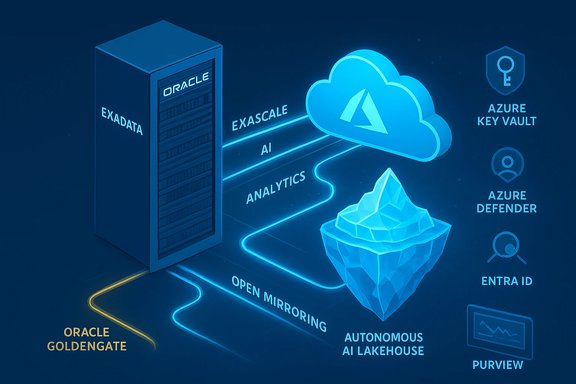
In the autumn, Oracle expanded the portfolio with the general availability of the Oracle Autonomous AI Lakehouse (built on Apache Iceberg), OCI GoldenGate on Oracle Database@Azure, the Oracle Database@Azure partner program (marketplace/private‑offer buying and reselling through Microsoft), and Oracle Multicloud Universal Credits — a commercial mechanism that lets customers commit once and spend credits across Oracle Database@AWS, Oracle Database@Azure, Oracle Database@Google Cloud, and OCI. These initiatives were explicitly designed to reduce procurement complexity and enable consistent pricing across multicloud footprints. Autonomous AI Lakehouse is pitched as an open lakehouse for enterprise AI use cases, with Iceberg tables and Exadata‑class query acceleration for vector and analytic workloads. GoldenGate and Open Mirroring into Microsoft Fabric/OneLake were emphasized as the low‑latency replication paths for feeding analytics and AI without heavy ETL.November — Microsoft Ignite and AI World: integration momentum
Oracle and Microsoft used Microsoft Ignite and Oracle AI World to demonstrate integration points: Azure Key Vault support for TDE keys, native integrations with Microsoft Defender, Entra ID, Sentinel, Microsoft Fabric, Copilot Studio, and demo scenarios for low‑latency analytics and agentic AI where Oracle is the operational data store and Azure provides analytics/AI surfaces. Microsoft’s Azure community posts and Oracle’s event recaps stressed the 30+ regional footprint and continued product launches.December — New regions (West Europe / Netherlands)
Oracle Database@Azure expanded into West Europe (Netherlands) at year‑end, reinforcing EU data residency and latency options. Region rollouts were a recurring theme: Oracle and Microsoft moved aggressively to add regions to meet customer requirements for compliance, disaster recovery, and lower network RTT to Azure services. However, region tallies changed during the year and varied by announcement and by whether counts included all hyperscalers or only Azure. That variability is material and covered below.Technical deep dive: performance, observability, and AI readiness
Exadata on Exascale: what’s new technically
Exascale provides a shared Exadata storage fabric with RDMA and storage‑offload features (AI Smart Scan, columnarization, vector acceleration) designed to accelerate both OLTP and vector/analytic workloads. Documentation lists new capabilities such as single‑node Exascale VM clusters, scale‑to‑zero ECPU for dev/test cost control, and Exadata X11M support for dedicated infrastructure. Oracle literature cites storage‑layer I/O latencies in the microseconds for optimized topologies; however, those are storage‑level metrics measured under controlled conditions and do not directly translate to application‑level round‑trip latency over the network. Validate real‑world latencies with a PoV.GoldenGate and Open Mirroring into Microsoft Fabric / OneLake
Oracle positioned OCI GoldenGate as the enterprise replication option for mission‑critical, heterogenous replication topologies, while Open Mirroring to Microsoft Fabric/OneLake provides a zero‑ETL, public‑preview path for landing fresh Oracle tables into Fabric/OneLake (Parquet/Delta/OneLake formats) for analytics and Copilot/Foundry scenarios. The two options give customers a tiered approach to replication: GoldenGate for high‑SLAs and bidirectional CDC; OneLake mirroring for lower‑cost analytics and rapid prototyping.Observability and security integrations
Streaming Exadata logs into Azure Monitor and integrating TDE master key management with Azure Key Vault close a critical operational gap for Azure‑first teams: they can keep their monitoring, alerting, and key lifecycle in Azure while Oracle operates the database control plane. Microsoft also emphasized integrations with Entra ID, Defender, Sentinel, and Purview for identity, detection, governance, and lineage across the hybrid estate. These are essential elements for regulated workloads.Commercial packaging: credits, partners, and procurement
Oracle’s Multicloud Universal Credits and the Database@Azure partner program were designed to simplify how customers budget, purchase, and consume Oracle database services across multiple clouds. Practically, universal credits let an organization commit dollars to Oracle services and consume them on Oracle Database@Azure or Oracle‑operated services on other clouds with consistent pricing and flexibility; the partner program enables Microsoft and Oracle partners to buy through the Microsoft Marketplace and resell to customers. These moves address a major enterprise blocker — procurement and billing complexity across vendor stacks — and make multicloud database consumption more predictable.Notable customers and early results
Oracle highlighted several early adopters with tangible outcomes:- Conduent: Nearly doubled its Oracle Database@Azure footprint since January 2025, starting with a U.S. tolling application and expanding QA and DR workloads, and planning additional line‑of‑business migrations. Oracle positions this as an agility win for multi‑workload modernization.
- Liantis: Migrated DR from memory‑optimized Azure VMs to Exadata Database Service on Oracle Database@Azure, reporting lower latency, faster response, better security controls, and cost savings.
- SEFE: With a modest Oracle footprint, SEFE moved to Oracle Database@Azure to gain high availability and recovery without high costs and reported an average performance improvement of about 10% halfway through a migration of 17 applications and 37 environments. These case studies illustrate both the performance and economics arguments Oracle is making to Azure customers.
Verification, nuance, and what to watch closely
- Region counts: Public statements about how many regions Oracle Database@Azure is “in” evolved through 2025. Oracle’s March announcement counted 14 live Azure regions with 18 planned additions in the next 12 months; later in the year Microsoft reported Oracle Database@Azure live in 31 regions with plans for 33; Oracle’s own year‑end messaging cites broader numbers (across clouds) and phrasing such as “from 14 to 34 regions.” These differences are a combination of timing, whether the count refers to Azure only or to Oracle‑operated services across AWS/Azure/GCP, and SKU‑by‑SKU availability (some services reach GA later in a given region). Treat any single region number as a snapshot and verify SKU‑level availability for targeted regions before planning production rollouts. This is an unverifiable single‑number risk unless you confirm availability on the vendor portals for the exact SKUs you need.
- Growth claims: Oracle’s fiscal Q2 FY2026 earnings materials and executive comments attribute very large year‑over‑year growth rates to their Multicloud database business (a quoted 817% increase in Q2), a signal that the commercial strategy is gaining traction. That figure appears in Oracle’s official earnings release and was repeated widely in analyst and press coverage; however, high percentage growth often stems from a small base. Use that growth figure as a directional indicator — not a precise predictor of sustained margin or revenue performance for a specific account.
- Performance claims and microsecond latencies: Oracle documents microsecond‑level storage I/O latencies for Exascale under controlled configurations; those are storage‑layer benchmarks and do not automatically mean application latency will be microsecond‑class for real apps across a network. Always validate latency claims with realistic, workload‑representative benchmarking in your network topology.
- Security and key control: Azure Key Vault integration for TDE is a strong operational control for Azure‑owned governance models, but teams must validate key‑rotation policies, HSM tiering (Standard vs Premium vs Managed HSM), and audit trail requirements against their compliance controls. Integration reduces friction but does not eliminate the need for careful design and independent auditability.
Strengths: why this matters for enterprise Windows/Azure teams
- Friction reduction for AI/analytics — Co‑locating Oracle with Azure reduces round‑trip latency and eliminates heavy ETL for many retrieval‑augmented generation (RAG) and real‑time analytics scenarios when paired with GoldenGate or OneLake mirroring.
- Choice across cost/performance — Customers can choose Exadata on Dedicated Infrastructure (X11M), Exadata on Exascale (elastic, lower minimums), or Base Database Service (VM‑based) depending on scale and budget. This allows phased migrations: dev/test on Base DB, DR on Exascale, production on Dedicated Exadata if needed.
- Operational consistency and governance — Azure Key Vault for TDE keys, Azure Monitor observability, and Entra/Purview/Defender integrations help centralize governance across hybrid estates. That’s especially important for finance, healthcare, and regulated public sector workloads.
- Commercial simplification — Universal Credits and marketplace partner programs reduce procurement friction for customers that want to consume Oracle services through Microsoft channels. This has real value for enterprise procurement cycles.
Risks and downsides
- Operational complexity — A co‑located, managed Oracle database that appears “native” to Azure still has Oracle control planes and Oracle SLAs. This introduces dual‑vendor operations (Oracle + Microsoft) that require clear runbooks, escalation paths, and contractual clarity around incident response and liability.
- Contract and license nuance — BYOL (bring your own license), license included options, and the new universal credits change procurement math. Legal and procurement teams must validate TCO modeling carefully, including data egress rules, interconnect charges, and credit‑usage limitations.
- Cost trajectory and corporate investment risk — Oracle is investing heavily in AI datacenter capacity and multicloud distribution; investors and analysts have noted rising CapEx. For customers, that means rapid feature velocity but also potential commercial flux as pricing and packaging evolve. Use PoV pilots and short‑term contracts to hedge risk.
- Regional SKU lag — Not all SKUs are available immediately in all regions. Some customers will need to stage rollouts based on the precise SKU availability in target regions. Confirm SKU‑by‑SKU availability in vendor portals during planning.
A practical checklist for IT teams evaluating Oracle Database@Azure
- Verify SKU availability for the exact Oracle database service (Exascale VM cluster, Dedicated Exadata X11M, Base Database Service, Autonomous AI Lakehouse) in your target Azure region.
- Run latency and throughput PoV workloads from your Azure application layer to the Oracle instance to validate real‑world RTT and IOPS for your application mix.
- Validate key management: confirm Azure Key Vault/HSM tier support and proof out TDE key rotation and auditing with your compliance team.
- Map replication needs: choose OCI GoldenGate for enterprise CDC and bidirectional replication, or OneLake mirroring for analytics and low‑cost RAG data pipelines.
- Model costs using both license‑included and BYOL scenarios; include network/interconnect and monitoring costs. Consider short‑term universal credits to limit vendor lock‑in while you validate benefits.
- Define runbooks and RACI for incident escalation between Oracle and Microsoft to avoid operational ambiguity. Document expected SLAs and remediation paths.
- Start with a contained migration (QA, DR, or low‑risk production) to gather operational experience and runbooks before migrating critical transactional systems.
Conclusion
Oracle Database@Azure moved from experimentation to operational reality in 2025. The combination of Exadata on Exascale, Base Database Service, Autonomous AI Lakehouse, native GoldenGate replication and Azure‑centric observability and key management materially reduces the friction of building AI and analytics on top of live Oracle data. For Azure‑first enterprises that rely on Oracle databases, 2025 delivered a credible multicloud operational model: choice across performance tiers, clearer procurement paths, and the integrations required for governance and AI readiness. At the same time, timing and numbers matter: region counts, SKU availability, and headline growth rates have shifted during the year and should be validated for any production rollout. The practical approach for enterprise teams is disciplined: validate SKUs and latency with PoV workloads; test key management and replication options; and model costs under both BYOL and universal‑credit scenarios. Execution risk — operational, contractual, and financial — is real, but so are the operational benefits for teams that carefully plan and pilot their migrations. Oracle and Microsoft have laid down a pragmatic multicloud pathway for enterprise AI that balances Oracle’s database leadership with Azure’s AI and analytics ecosystem. The result is a compelling option for organizations that need enterprise database fidelity and Azure‑native analytics — provided engineering, procurement, and security teams validate the technical and commercial details before committing mission‑critical workloads.Source: Oracle Blogs https://blogs.oracle.com/cloud-infrastructure/oracle-databaseazure-2025-highlights/
