

Oracle’s Oracle Database@Azure service has quietly moved another piece into place for enterprise AI and analytics in Europe: the offering is now available in the West Europe (Netherlands) Azure region, expanding the co‑located Oracle database footprint inside Microsoft Azure datacenters and giving customers an additional locality and compliance option for low‑latency, enterprise‑grade Oracle workloads.
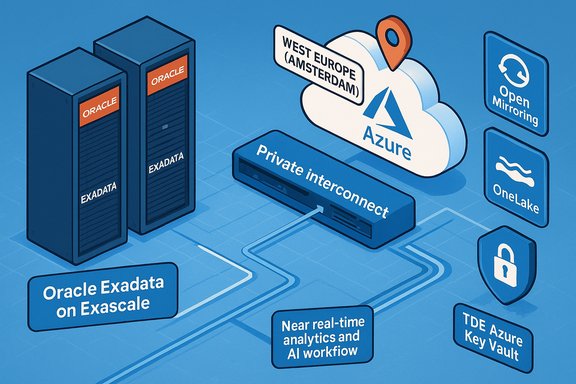
Oracle Database@Azure is the joint Oracle–Microsoft offering that places Oracle‑managed database services — from Exadata Database Service to Autonomous AI Database and Autonomous AI Lakehouse — physically inside Azure datacenters while Oracle retains operational management. The result is a platform designed to let Azure apps, analytics, and AI services access Oracle operational data with lower round‑trip times and without forcing customers to reengineer mission‑critical database deployments. The West Europe (Amsterdam) availability is part of a broader 2025 rollout that has pushed Oracle Database@Azure into more than 30 Azure regions worldwide and added new features such as Exadata on Exascale, Open Mirroring/OneLake integration, and Azure Key Vault TDE support. This article breaks down what the West Europe launch means in practical terms, verifies the main technical claims, evaluates strengths and risks, and offers a pragmatic checklist for IT teams considering migration or proof‑of‑value (PoV) pilots.
Oracle Database@Azure is explicitly designed to reduce that friction: by installing Oracle Exadata‑class infrastructure inside Azure datacenters, Oracle preserves the full Oracle database feature set (RAC, Data Guard, GoldenGate, TDE, etc. while enabling native‑feeling integration with Azure services such as Entra ID, Purview, Microsoft Fabric/OneLake, Power BI, and Azure AI. The objective is to give enterprises the operational consistency of Oracle plus the AI/analytics reach of Azure.
However, embracing this model is not a free pass. It requires disciplined PoVs, governance controls, commercial clarity, and clear runbooks for joint support. Enterprises should view the offering as an enabler — not an automatic replacement — and use it to remove specific friction points (latency, residency, heavy ETL) rather than as a blanket “move everything to cloud” strategy.
Key takeaways:
Source: Oracle Blogs https://blogs.oracle.com/cloud-infr...abase-at-azure-expands-to-west-europe-region/
 Overview
Oracle Database@Azure is the joint Oracle–Microsoft offering that places Oracle‑managed database services — from Exadata Database Service to Autonomous AI Database and Autonomous AI Lakehouse — physically inside Azure datacenters while Oracle retains operational management. The result is a platform designed to let Azure apps, analytics, and AI services access Oracle operational data with lower round‑trip times and without forcing customers to reengineer mission‑critical database deployments. The West Europe (Amsterdam) availability is part of a broader 2025 rollout that has pushed Oracle Database@Azure into more than 30 Azure regions worldwide and added new features such as Exadata on Exascale, Open Mirroring/OneLake integration, and Azure Key Vault TDE support. This article breaks down what the West Europe launch means in practical terms, verifies the main technical claims, evaluates strengths and risks, and offers a pragmatic checklist for IT teams considering migration or proof‑of‑value (PoV) pilots.Background: why colocated Oracle in Azure matters
The multicloud friction point
Many enterprises run front‑end apps and analytics on Azure while keeping Oracle databases on‑premises or in Oracle Cloud Infrastructure (OCI). That split creates friction for AI use cases that need fresh, governed data with minimal latency to the AI inference surface. Re‑architecting legacy applications or performing heavy ETL is expensive and slow.Oracle Database@Azure is explicitly designed to reduce that friction: by installing Oracle Exadata‑class infrastructure inside Azure datacenters, Oracle preserves the full Oracle database feature set (RAC, Data Guard, GoldenGate, TDE, etc. while enabling native‑feeling integration with Azure services such as Entra ID, Purview, Microsoft Fabric/OneLake, Power BI, and Azure AI. The objective is to give enterprises the operational consistency of Oracle plus the AI/analytics reach of Azure.
Regional expansion and data sovereignty
Regional availability is not just about performance; it’s about compliance. Local availability helps address data residency and regulatory requirements (e.g., for GDPR or national cloud policies) and supports disaster‑recovery topologies with nearby pairs. The West Europe (Amsterdam) launch expands those options for customers operating across EMEA. Oracle and Microsoft have been aggressive in 2025 in adding regions to meet latency and sovereignty needs.What’s included in the West Europe availability
Service portfolio on Azure
Oracle Database@Azure exposes a broad set of Oracle services to Azure customers, including:- Oracle Exadata Database Service (on Dedicated Infrastructure and on Exascale infrastructure)
- Oracle Autonomous AI Database and Oracle Autonomous AI Lakehouse
- Oracle Base Database Service
- Oracle GoldenGate for CDC and replication
- Oracle Database Zero Data Loss Autonomous Recovery Service (ZDLRA) and other MAA (Maximum Availability Architecture) building blocks
- Customer-managed keys for Transparent Data Encryption (TDE) via Azure Key Vault
Verified regional footprint
Oracle’s public region matrix and Microsoft’s documentation now list West Europe (Amsterdam) among the Azure regions where Oracle Database@Azure operates. This mirrors Microsoft and Oracle announcements through 2025 that increased the joint footprint to 30+ regions. Customers planning production rollouts should treat region lists as snapshots and verify availability for the exact SKU (Exadata on Exascale vs. dedicated Exadata, Autonomous AI Database, GoldenGate, etc. because some capabilities may arrive earlier or later than others in a region.Technical deep dive: performance, Exascale and microsecond claims
Exadata Exascale, RDMA and the microsecond argument
Oracle has been promoting Exadata Exascale as an elastic, cloud‑friendly Exadata service that brings RDMA‑style performance and storage‑level acceleration to cloud deployments. Oracle literature cites I/O latencies at the storage layer in the tens of microseconds for some Exascale configurations (for example, 17 μs I/O latency benchmarks are published in Oracle material). These figures are tied to Exadata’s RDMA data paths, XRMEM/XRMEM Data Accelerator, and Smart Flash caching, and they reflect storage‑to‑memory I/O under optimized conditions. Important verification note: the quoted microsecond latencies are vendor benchmarks measured under specific hardware, topology, and workload profiles. Real‑world application latency (the round trip from an Azure app through the network to the Oracle database and back) will typically be higher and is influenced by network topology, virtual‑network design, private interconnects, application chatiness, and workload mix. Treat microsecond claims as achievable storage‑level metrics under idealized conditions; validate them in a PoV before relying on any specific latency SLA.Low‑latency integration with Azure services
The co‑location model uses private interconnects and orchestration between Oracle’s control plane and Azure’s management plane. For analytics and AI patterns, Oracle and Microsoft emphasize near‑real‑time replication into Microsoft Fabric/OneLake using Open Mirroring and Oracle GoldenGate integrations. That reduces ETL friction for AI pipelines and lets Power BI, Fabric analytics, and Azure AI access fresher, governed datasets from mirrored OneLake tables. Microsoft’s mirroring docs and Oracle GoldenGate integration posts confirm both the preview status of some mirroring capabilities and the GoldenGate support for Fabric’s open mirroring when configured.Security and governance: Azure Key Vault and identity integrations
Azure Key Vault for TDE
Oracle Database@Azure supports storing Transparent Data Encryption (TDE) master keys in Azure Key Vault (including Managed HSM), enabling centralized key control, rotation, and compliance with FIPS standards. Microsoft Learn and Oracle documentation provide step‑by‑step configuration guidance for enabling Azure Key Vault as the master key store for Exadata Database@Azure clusters and databases. This integration is explicit and production‑grade: it supports key rotation, Managed HSM, and the operational processes required for DR and Data Guard setups.Identity, monitoring and governance stacks
The joint architecture also surfaces Azure Entra ID for identity, Microsoft Defender and Sentinel for monitoring and SIEM, and Microsoft Purview for data classification and lineage across mirrored datasets. These integrations matter because enterprises often require a single governance plane for auditable AI pipelines, especially when mirrored operational data is used for model training or RAG scenarios. However, customers should validate audit‑trail fidelity and log normalization in PoVs — cross‑cloud logging can be tricky to reconcile in compliance audits.Migration paths and licensing options
Fast migration choices
Oracle Database@Azure supports multiple migration patterns:- Oracle Zero Downtime Migration (ZDM) — to automate and minimize migration downtime for lift‑and‑shift scenarios.
- GoldenGate replication — for continuous data replication and staged cutovers or hybrid architectures.
- Mirroring into OneLake (Open Mirroring) — for use cases that only require analytics copies rather than a full database migration.
Licensing and procurement
Customers can bring existing Oracle licenses (BYOL) or use license‑included models. One benefit of the Oracle‑in‑Azure arrangement is procurement flexibility: enterprises can often purchase Oracle Database@Azure through Azure’s commercial channels and apply existing cloud commitments. Pricing parity claims exist between Oracle Cloud Infrastructure and Oracle Database@Azure SKUs in some communications, but billing models, commitment discounts, and effective TCO must be validated with commercial teams. Any migration plan should include contractual review to avoid surprises on support boundaries and SLAs.Strengths: what makes this expansion notable
- Reduced latency to Azure AI and analytics — co‑location and private interconnects materially lower round‑trip time compared to cross‑cloud traffic. For chatty transactional‑to‑inference scenarios, this matters.
- Preservation of Oracle features — RAC, Data Guard, Exadata optimizations and Oracle’s enterprise features remain available, easing migration risk for mission‑critical apps.
- Open mirroring and lakehouse interoperability — GoldenGate + Open Mirroring into Microsoft Fabric/OneLake and the Autonomous AI Lakehouse (Apache Iceberg) reduce ETL friction for AI pipelines.
- Enterprise key management — Azure Key Vault integration provides centralized, auditable KMS controls across Azure applications and Oracle databases.
- Regional expansion for compliance — adding West Europe increases options for data residency and disaster recovery in EMEA.
Risks, caveats and operational considerations
Marketing vs. production SLAs
Microsecond I/O or storage‑level latency numbers are useful benchmarks but are not production guarantees for application response times. Network topology, peering, tenant isolation, and workload patterns all influence real results. Put bluntly: vendor benchmarks under lab conditions are not a substitute for a rigorous PoV measuring your actual application load.Dependency and vendor boundaries
The operational model places Oracle in charge of the database control plane while Azure provides the compute and AI front end. That dual‑vendor model can complicate incident response: in complex failures you will rely on coordinated support between Microsoft and Oracle, so validate SLA definitions, escalation paths, and joint support processes before migrating critical workloads.Feature parity by region and SKU
Not all Oracle Database@Azure SKUs arrive simultaneously in all regions. Exadata on Exascale, dedicated Exadata, Autonomous AI Database, or GoldenGate may have staggered rollouts. Confirm the exact SKU availability for West Europe (and DR pair regions) when planning production deployments.Licensing and cost
BYOL vs license‑included economics vary by org. Oracle license rules can be complex — ensure effective license positions and cloud amortization are reviewed by licensing and finance teams. Misinterpreting license mobility rules can lead to unexpected costs.Mirroring and preview features
Microsoft Fabric Mirroring and Open Mirroring are powerful but have been in preview for some source types and features; for example, Oracle Autonomous Database historically had different support nuances. Confirm whether the exact mirroring path your architecture requires is GA or preview and include contingency plans to handle feature‑gap scenarios.A practical checklist for IT teams evaluating Oracle Database@Azure in West Europe
- Validate SKU availability
- Confirm the specific Oracle database SKU (Exadata on Exascale, Autonomous AI, Base DB, GoldenGate) is live in West Europe for your required capacity tier.
- Run a PoV
- Measure real application latency and throughput using production‑like workloads, including complex transactions and model inference paths.
- Test Key Vault and DR
- Configure Azure Key Vault (or Managed HSM), enable TDE integration, and test failover/standby behavior with Data Guard to confirm key accessibility post‑failover.
- Pilot mirroring and replication
- If your target is analytics/AI, pilot GoldenGate → OneLake or Open Mirroring into Fabric to validate CDC latency, format conversion, and lineage.
- Contract and SLA review
- Confirm joint support, escalation paths and expected response SLAs when Oracle and Microsoft must coordinate.
- Cost and license audit
- Model BYOL vs license‑included options and include networking, data egress (if any), and mirrored storage costs.
- Governance controls
- Validate Purview (data classification), Sentinel (SIEM), and Defender integrations for full‑lifecycle governance across the mirrored lakehouse and source databases.
- Security posture
- Conduct threat modelling around mirrored data landing zones, RAG exposure, and model training pipelines; ensure row‑level security and access controls are enforced in Fabric/OneLake.
Strategic implications for enterprise architecture
This West Europe availability is another sign that vendors are moving from “multicloud marketing” to operational, production‑grade partnerships that are tailored for large enterprises. For organizations with deep Oracle investments and a strategic commitment to Azure for AI and analytics, Oracle Database@Azure offers a practical compromise: keep the Oracle operational plane intact while gaining fast, governed access for analytics and AI workloads.However, embracing this model is not a free pass. It requires disciplined PoVs, governance controls, commercial clarity, and clear runbooks for joint support. Enterprises should view the offering as an enabler — not an automatic replacement — and use it to remove specific friction points (latency, residency, heavy ETL) rather than as a blanket “move everything to cloud” strategy.
Conclusion
The launch of Oracle Database@Azure in West Europe (Netherlands) broadens the low‑latency and compliance choices for customers building AI‑enabled applications on Azure while keeping Oracle’s enterprise database capabilities intact. The expansion aligns with Oracle’s broader Exascale, Exadata, GoldenGate and Open Mirroring roadmap and Microsoft’s Fabric/OneLake data strategy, and is accompanied by enterprise features such as Azure Key Vault TDE integration and well‑defined migration tools.Key takeaways:
- Region availability matters for latency and compliance; confirm per‑SKU availability for West Europe.
- Performance claims (microsecond I/O) are real at the storage layer but must be validated in a PoV for real application topologies.
- Mirroring and GoldenGate create practical, near‑real‑time paths into Microsoft Fabric and OneLake for analytics and AI — a major win for RAG and model training workflows, but some features are preview‑stage and require validation.
- Security and governance are enterprise‑grade with Azure Key Vault integration and Azure policy/monitoring tooling — integrate these early in your design.
Source: Oracle Blogs https://blogs.oracle.com/cloud-infr...abase-at-azure-expands-to-west-europe-region/
