

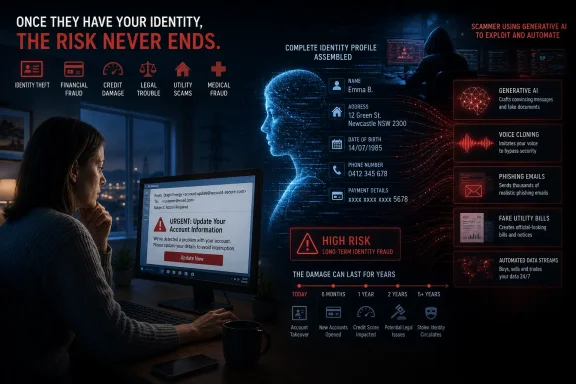
Origin Energy’s confirmed customer data security incident is a sharp reminder that the most damaging consequences of a breach may arrive after the initial intrusion. Names, addresses, dates of birth, phone numbers, email addresses and fragments of financial account information can give criminals the raw material for an extended campaign of fraud—one made considerably more convincing by generative AI, voice cloning and automated data profiling.
The immediate risk is not that incomplete card or bank-account digits can simply be used to drain an account. Origin has said the affected information may include only the last four digits of some payment cards or the last three digits of some bank accounts, which are not enough on their own to make purchases or access banking services. The danger is that these details can make a fraudulent message, phone call or identity-verification attempt appear legitimate.
For customers, the practical lesson is clear: a data breach is no longer a one-time event to file away after changing a password. It is a long-term exposure that can turn ordinary personal data into an unusually effective weapon for phishing, account takeover attempts and identity fraud.
Origin Energy has confirmed that there was unauthorised access to and disclosure of some customer data. The company is continuing to determine the total number of affected customers and has said it will contact people once their exposure is confirmed.
The information potentially involved includes:
A name and email address alone may be common. A name, address, phone number, date of birth and partial financial information together are more useful because they can help a criminal establish a believable identity profile. When that profile is paired with details collected from public social-media accounts, old breaches, scraped databases or data brokers, it can support highly targeted scams.
This is the defining risk in the modern breach economy. Criminals do not necessarily need one perfect, complete dataset. They can combine several imperfect datasets until the result becomes convincing enough to deceive a person—or, in some cases, a weak account-recovery or customer-service process.
For a retailer the scale of Origin Energy, customer trust is central. Electricity and gas accounts are tied to homes, billing arrangements and long-term household relationships. That gives fraudsters a powerful narrative to exploit: an urgent account issue, a bill correction, a refund, a payment dispute, a meter appointment or an offer of support after the breach itself.
Partial financial details can act as trust signals. A scammer who knows that a customer’s card ends in a particular four-digit sequence may sound far more credible than a random caller. The same is true if the attacker can state the customer’s street address, date of birth or last few digits of a bank account.
In a fraud scenario, the attacker does not need to reveal every fact at once. They may use one piece of information to establish apparent legitimacy, then ask the victim to provide the missing details.
A typical conversation might follow this pattern:
This is why the phrase “no full financial details were exposed” should be treated as reassurance with limits. It reduces certain types of direct card and account fraud, but it does not erase the threat of social engineering.
In the past, a convincing scam required time, research and a reasonably competent writer or caller. Attackers needed to manually search social-media profiles, create plausible emails and tailor language to an individual or business. That work limited how many victims a criminal could realistically target.
Generative AI removes much of that friction.
That means the old warning signs of obvious scams—poor spelling, bizarre phrasing and irrelevant details—may be less reliable than they once were. A phishing email can be clearly written, professionally formatted and tailored to the recipient’s circumstances.
An AI-assisted attacker can produce different messages for different audiences:
Where an attacker has access to public audio—social-media videos, podcasts, recordings, livestreams or voicemail greetings—modern tools may be able to create a synthetic imitation of that voice. The quality can vary, but even an imperfect clone may be persuasive in a short call or voice message when the target is rushed or distressed.
The most dangerous version is the family emergency scam. An attacker may impersonate a relative, claim that they are stranded, injured or in trouble, and demand urgent financial help. Breach data makes this more credible when it supplies names, addresses and clues about household relationships.
AI also helps criminals script the interaction in real time. A scam caller can use an automated prompt system to answer questions, imitate customer-service language and adjust their story based on the victim’s responses.
People are more likely to make mistakes when they are:
The scam may arrive by email, SMS, social media, messaging apps or phone call. It may include a link to a convincing fake portal designed to collect account credentials, card details or one-time passcodes.
A legitimate-looking logo and a correct address do not prove that a message is genuine. Neither does the caller knowing your date of birth or the last four digits of a card.
Email accounts deserve special attention because they are often the reset point for other services. If a criminal takes over an email inbox, they can attempt password resets across banking, shopping, cloud storage, social media and government-service accounts.
This is why email security should be a priority after any major data exposure. A unique password and strong multi-factor authentication can significantly reduce the chance that a breach elsewhere turns into a wider digital compromise.
If successful, they may receive password reset links and security codes intended for the victim. Not every account is vulnerable to this technique, and telecommunications providers have added safeguards, but SMS remains a weaker authentication option than an authenticator app or hardware security key.
Customers should be cautious of sudden loss of mobile service, unexpected device-registration messages or notifications that a number has been transferred. These can be warning signs that require immediate contact with the mobile provider through a trusted channel.
The possibility is especially serious when a victim’s name, date of birth and address are all available. Those details may be used to answer identity questions, establish fake accounts or support fraudulent applications.
Not every organisation uses the same checks, and many have strengthened their verification processes. Still, the existence of partial data can give attackers an advantage against systems designed around “knowledge-based” identity checks—questions that assume only the real customer would know the answer.
A criminal who has enough personal information may attempt to construct a fraudulent bill, statement or account notice. Such material may be used to deceive a person, satisfy a weak verification process or support further identity fraud.
This does not mean that a leaked Origin record automatically enables a criminal to create a valid document that will pass robust checks. It does mean organisations should not rely on a utility bill alone as strong proof of identity, particularly when an applicant’s details match publicly available or previously breached data.
If a password has been reused across services, change it immediately. Each important account should have its own unique password, ideally stored in a reputable password manager.
Priority accounts include:
Instead, open a new browser window and type the organisation’s known official web address manually. Use the phone number listed on a recent legitimate bill, the back of a payment card or an official website accessed independently.
This rule applies even if the caller knows private facts about you. In the aftermath of a data breach, that knowledge is precisely what should make you more cautious—not less.
No legitimate support representative should pressure a customer to disclose a one-time password, authenticator code or banking approval code received by SMS, email or an authentication app.
If a caller asks for one, assume it is a scam.
It is also prudent to check credit reports for unfamiliar accounts, loans or inquiries. Unexplained correspondence from lenders, debt collectors or service providers should not be ignored, even if it initially appears to be a mistake.
Keep records of suspected fraud, including screenshots, dates, phone numbers, transaction details and report reference numbers. Documentation can matter if a dispute unfolds over time.
A fraudulent “Origin account update” may contain a malicious attachment, a link to a fake Microsoft sign-in page or an instruction to install a supposed billing viewer. The real aim may be to steal browser passwords, cryptocurrency wallets, saved card details or work credentials.
Before entering credentials, inspect the site carefully. Better still, avoid using links in unexpected messages entirely. Navigate to Microsoft services through a known bookmark, the Windows app or a manually typed address.
Password managers can provide another useful warning. If the manager does not recognise the site and refuses to autofill a saved credential, stop and examine the address rather than typing the password manually.
Legitimate companies do sometimes provide remote support, but unsolicited remote-access requests should be treated as hostile. Never install software, grant screen control or allow a stranger to access a PC because of an unexpected phone call.
Customers need clear answers about the nature of the incident, the categories of information affected, the number of people involved, the likely risks and the practical safeguards available to them. Vague updates can create uncertainty, and uncertainty creates an opening for scammers.
A trustworthy notification should clearly explain:
That creates a responsibility to treat customer data as a high-value security asset rather than a routine business record. Encryption, access controls, monitoring, vendor governance, data minimisation and strong incident-response planning are not optional extras in this environment.
There is also a design lesson. Organisations should move away from identity checks based on static personal information. A name, address, date of birth and partial card digits are no longer reliable secrets. They are attributes that may already be exposed, guessed, purchased or assembled from unrelated sources.
That permanence makes data breaches increasingly consequential in the AI era. Criminals can store exposed records, enrich them with new information and revisit them months later when public attention has faded. They can use automated tools to generate polished messages, impersonate trusted organisations and test which targets are most likely to respond.
Customers should therefore avoid two unhelpful extremes: panic and complacency. There is no reason to assume every affected person will suffer fraud, but there is every reason to expect criminals to exploit the incident with highly tailored scams.
The strongest defence is a disciplined verification habit. Use unique passwords, protect email accounts with multi-factor authentication, monitor financial activity, distrust unexpected requests and independently contact organisations through known channels. In an environment where a scammer may know your address, date of birth and partial payment details, the safest assumption is simple: personal information is no longer proof that the person contacting you is legitimate.
The immediate risk is not that incomplete card or bank-account digits can simply be used to drain an account. Origin has said the affected information may include only the last four digits of some payment cards or the last three digits of some bank accounts, which are not enough on their own to make purchases or access banking services. The danger is that these details can make a fraudulent message, phone call or identity-verification attempt appear legitimate.
For customers, the practical lesson is clear: a data breach is no longer a one-time event to file away after changing a password. It is a long-term exposure that can turn ordinary personal data into an unusually effective weapon for phishing, account takeover attempts and identity fraud.
 Overview: What the Origin Energy Data Breach Means
Origin Energy has confirmed that there was unauthorised access to and disclosure of some customer data. The company is continuing to determine the total number of affected customers and has said it will contact people once their exposure is confirmed.The information potentially involved includes:
- Full names
- Residential addresses
- Dates of birth
- Phone numbers
- Email addresses
- Customer account information
- The last four digits of some credit cards
- The last three digits of some bank accounts
A name and email address alone may be common. A name, address, phone number, date of birth and partial financial information together are more useful because they can help a criminal establish a believable identity profile. When that profile is paired with details collected from public social-media accounts, old breaches, scraped databases or data brokers, it can support highly targeted scams.
This is the defining risk in the modern breach economy. Criminals do not necessarily need one perfect, complete dataset. They can combine several imperfect datasets until the result becomes convincing enough to deceive a person—or, in some cases, a weak account-recovery or customer-service process.
For a retailer the scale of Origin Energy, customer trust is central. Electricity and gas accounts are tied to homes, billing arrangements and long-term household relationships. That gives fraudsters a powerful narrative to exploit: an urgent account issue, a bill correction, a refund, a payment dispute, a meter appointment or an offer of support after the breach itself.
Why Incomplete Financial Details Still Matter
It is tempting to judge a breach primarily by whether full credit-card numbers, bank logins or passwords were exposed. That remains an important distinction, but it is not the only meaningful one.Partial financial details can act as trust signals. A scammer who knows that a customer’s card ends in a particular four-digit sequence may sound far more credible than a random caller. The same is true if the attacker can state the customer’s street address, date of birth or last few digits of a bank account.
In a fraud scenario, the attacker does not need to reveal every fact at once. They may use one piece of information to establish apparent legitimacy, then ask the victim to provide the missing details.
A typical conversation might follow this pattern:
- The caller claims to be from Origin Energy, a bank, a telecommunications provider or a fraud-prevention team.
- They correctly state the customer’s name, address and partial payment details.
- They create urgency by alleging suspicious activity, an unpaid bill or a breach-related security problem.
- They ask the customer to “verify” their identity by providing a password, one-time code, full card number or banking information.
- They use that newly supplied information to access a real account or authorise a transaction.
This is why the phrase “no full financial details were exposed” should be treated as reassurance with limits. It reduces certain types of direct card and account fraud, but it does not erase the threat of social engineering.
AI Changes the Economics of Scamming
Artificial intelligence has not invented phishing, impersonation or identity fraud. What it has changed is the speed, scale and polish with which criminals can run those operations.In the past, a convincing scam required time, research and a reasonably competent writer or caller. Attackers needed to manually search social-media profiles, create plausible emails and tailor language to an individual or business. That work limited how many victims a criminal could realistically target.
Generative AI removes much of that friction.
Personalisation at Scale
A criminal can feed a set of stolen personal details into an AI tool and generate dozens of variants of a scam message in seconds. The messages can reference an energy account, a local suburb, a family name, a recent move, a payment method or a supposed support case.That means the old warning signs of obvious scams—poor spelling, bizarre phrasing and irrelevant details—may be less reliable than they once were. A phishing email can be clearly written, professionally formatted and tailored to the recipient’s circumstances.
An AI-assisted attacker can produce different messages for different audiences:
- A billing-warning email for customers likely to use online payments
- A text message about a service interruption for mobile-first users
- A fake refund notice for people who may respond to a financial incentive
- A fraudulent “data breach support” message for customers worried by media coverage
- A fake job offer, parcel notification or bank alert designed around known demographic details
AI Voice Cloning Raises the Stakes
Voice cloning is particularly troubling because phone calls still carry an emotional authority that email and SMS often lack. A calm voice claiming to be from a bank’s fraud team can trigger panic, especially if it already knows private details.Where an attacker has access to public audio—social-media videos, podcasts, recordings, livestreams or voicemail greetings—modern tools may be able to create a synthetic imitation of that voice. The quality can vary, but even an imperfect clone may be persuasive in a short call or voice message when the target is rushed or distressed.
The most dangerous version is the family emergency scam. An attacker may impersonate a relative, claim that they are stranded, injured or in trouble, and demand urgent financial help. Breach data makes this more credible when it supplies names, addresses and clues about household relationships.
AI also helps criminals script the interaction in real time. A scam caller can use an automated prompt system to answer questions, imitate customer-service language and adjust their story based on the victim’s responses.
The Human Weakness AI Exploits
The underlying weakness is not technology alone. It is trust under pressure.People are more likely to make mistakes when they are:
- Worried about money
- Concerned their identity has been compromised
- Afraid an essential service could be interrupted
- Embarrassed about a suspected security error
- Rushed by a caller who claims immediate action is required
- Reassured by personal information that appears impossible for a stranger to know
The Most Likely Secondary Attacks
The breach itself may have been a single unauthorised access event. The secondary attacks could unfold over months or years, particularly if the data is traded, repackaged or combined with material from other incidents.Breach-Themed Phishing
This is likely to be the most immediate risk. Criminals can pose as Origin Energy representatives and claim that customers need to confirm their identity, reset an account, accept support or review a security notice.The scam may arrive by email, SMS, social media, messaging apps or phone call. It may include a link to a convincing fake portal designed to collect account credentials, card details or one-time passcodes.
A legitimate-looking logo and a correct address do not prove that a message is genuine. Neither does the caller knowing your date of birth or the last four digits of a card.
Account Recovery and Takeover Attempts
Personal information can be used to answer weak account-recovery questions. If an online service relies heavily on date of birth, address, phone number or partial payment data, an attacker may try to reset passwords or persuade customer support to grant access.Email accounts deserve special attention because they are often the reset point for other services. If a criminal takes over an email inbox, they can attempt password resets across banking, shopping, cloud storage, social media and government-service accounts.
This is why email security should be a priority after any major data exposure. A unique password and strong multi-factor authentication can significantly reduce the chance that a breach elsewhere turns into a wider digital compromise.
SIM-Swap and Mobile-Number Fraud
A phone number can become a valuable target when it is used for SMS-based verification. Criminals may attempt to convince a telecommunications provider to transfer a victim’s number to a SIM card under their control.If successful, they may receive password reset links and security codes intended for the victim. Not every account is vulnerable to this technique, and telecommunications providers have added safeguards, but SMS remains a weaker authentication option than an authenticator app or hardware security key.
Customers should be cautious of sudden loss of mobile service, unexpected device-registration messages or notifications that a number has been transferred. These can be warning signs that require immediate contact with the mobile provider through a trusted channel.
Identity Fraud and Synthetic Identities
Personal data may also support attempts to open accounts, apply for credit or create forged documents. Fraudsters can combine real information from multiple people to create a synthetic identity—a profile that appears plausible enough to pass basic screening.The possibility is especially serious when a victim’s name, date of birth and address are all available. Those details may be used to answer identity questions, establish fake accounts or support fraudulent applications.
Not every organisation uses the same checks, and many have strengthened their verification processes. Still, the existence of partial data can give attackers an advantage against systems designed around “knowledge-based” identity checks—questions that assume only the real customer would know the answer.
Fake Utility Bills and Proof-of-Address Abuse
Utility bills are commonly treated as evidence of residential address. That makes energy-account data more sensitive than many customers may initially appreciate.A criminal who has enough personal information may attempt to construct a fraudulent bill, statement or account notice. Such material may be used to deceive a person, satisfy a weak verification process or support further identity fraud.
This does not mean that a leaked Origin record automatically enables a criminal to create a valid document that will pass robust checks. It does mean organisations should not rely on a utility bill alone as strong proof of identity, particularly when an applicant’s details match publicly available or previously breached data.
What Affected Customers Should Do Now
Customers should wait for verified contact from Origin Energy, but they do not need to wait to improve their account security. The most effective response is calm, methodical and focused on the accounts that could be used to unlock everything else.Secure the Email Account First
Email is the control centre for most online identities. Start there.- Change the password to a long, unique passphrase that is not used anywhere else.
- Enable multi-factor authentication.
- Prefer an authenticator app or security key where available instead of relying only on SMS codes.
- Review recent sign-in activity and logged-in devices.
- Check that recovery email addresses and phone numbers are correct.
- Inspect inbox rules and forwarding settings for anything unfamiliar.
Change Reused Passwords
The Origin incident does not mean Origin account passwords were exposed. However, data breaches often trigger broader attacks because criminals test known email addresses against login pages for banks, retailers, streaming services and social networks.If a password has been reused across services, change it immediately. Each important account should have its own unique password, ideally stored in a reputable password manager.
Priority accounts include:
- Primary email
- Banking and payment services
- Government and tax-related services
- Mobile-provider account
- Cloud storage
- Social media and messaging platforms
- Online shopping accounts with saved payment details
- Energy and utility accounts
Treat Every Unsolicited Contact as Suspicious
Do not click a link in an unexpected message about the breach. Do not call a phone number supplied in a suspicious SMS or email. Do not scan a QR code sent by a purported support team.Instead, open a new browser window and type the organisation’s known official web address manually. Use the phone number listed on a recent legitimate bill, the back of a payment card or an official website accessed independently.
This rule applies even if the caller knows private facts about you. In the aftermath of a data breach, that knowledge is precisely what should make you more cautious—not less.
Never Share a One-Time Code
Verification codes are not harmless confirmations. They can be the final piece an attacker needs to sign in, reset a password, add a device or approve a payment.No legitimate support representative should pressure a customer to disclose a one-time password, authenticator code or banking approval code received by SMS, email or an authentication app.
If a caller asks for one, assume it is a scam.
Monitor Financial and Credit Activity
Review bank and credit-card transactions regularly. Enable transaction alerts where available, particularly for card-not-present payments, transfers and newly added payees.It is also prudent to check credit reports for unfamiliar accounts, loans or inquiries. Unexplained correspondence from lenders, debt collectors or service providers should not be ignored, even if it initially appears to be a mistake.
Keep records of suspected fraud, including screenshots, dates, phone numbers, transaction details and report reference numbers. Documentation can matter if a dispute unfolds over time.
Practical Security Steps for Windows Users
For Windows users, the risk is not limited to account fraud. A targeted phishing email may try to deliver malware, remote-access software or information-stealing tools.A fraudulent “Origin account update” may contain a malicious attachment, a link to a fake Microsoft sign-in page or an instruction to install a supposed billing viewer. The real aim may be to steal browser passwords, cryptocurrency wallets, saved card details or work credentials.
Keep Windows Defences Active
A secure baseline includes:- Installing current Windows security updates promptly
- Keeping Microsoft Defender Antivirus enabled and updated
- Using Microsoft Defender SmartScreen protections in supported browsers and Windows features
- Avoiding the use of an administrator account for everyday tasks where practical
- Keeping browsers, PDF readers and office applications updated
- Removing software that is no longer used or supported
- Backing up important files using a separate, protected backup method
Watch for Fake Microsoft Login Pages
Criminals often use stolen customer data to make a message feel relevant, then redirect victims to a fake Microsoft 365, Outlook or OneDrive login page. This is especially effective because email access is so valuable.Before entering credentials, inspect the site carefully. Better still, avoid using links in unexpected messages entirely. Navigate to Microsoft services through a known bookmark, the Windows app or a manually typed address.
Password managers can provide another useful warning. If the manager does not recognise the site and refuses to autofill a saved credential, stop and examine the address rather than typing the password manually.
Be Wary of Remote-Access Requests
A scammer claiming to help with an energy account, bank transaction or security incident may ask the customer to install remote-access software. Once connected, the attacker can view the screen, access files, manipulate online banking or direct the victim to approve payments.Legitimate companies do sometimes provide remote support, but unsolicited remote-access requests should be treated as hostile. Never install software, grant screen control or allow a stranger to access a PC because of an unexpected phone call.
Where Origin’s Response Will Be Judged
Origin’s immediate acknowledgement that unauthorised access and disclosure occurred is an important step, but the quality of a breach response depends on what comes next.Customers need clear answers about the nature of the incident, the categories of information affected, the number of people involved, the likely risks and the practical safeguards available to them. Vague updates can create uncertainty, and uncertainty creates an opening for scammers.
The Need for Specific, Direct Communication
Direct customer communication should make it easy to distinguish genuine notices from criminal impersonation attempts. That means companies should avoid asking customers to click urgent links, disclose passwords or share verification codes.A trustworthy notification should clearly explain:
- Whether the individual is confirmed to be affected
- What data categories are involved
- What information was not involved
- How the company will contact the customer
- Which channels it will never use for verification
- What fraud-monitoring or support options are available
- Where customers can independently verify updates
A Broader Lesson for Essential-Service Providers
Energy retailers, telecommunications companies, insurers, banks and government agencies all hold identity-rich datasets. Customers often have little practical choice but to provide accurate details to receive essential services.That creates a responsibility to treat customer data as a high-value security asset rather than a routine business record. Encryption, access controls, monitoring, vendor governance, data minimisation and strong incident-response planning are not optional extras in this environment.
There is also a design lesson. Organisations should move away from identity checks based on static personal information. A name, address, date of birth and partial card digits are no longer reliable secrets. They are attributes that may already be exposed, guessed, purchased or assembled from unrelated sources.
The New Reality: Personal Data Is a Long-Term Liability
The most important takeaway from the Origin Energy breach is that personal information has a long shelf life. A password can be changed. A credit card can be replaced. A date of birth and residential history cannot be reset.That permanence makes data breaches increasingly consequential in the AI era. Criminals can store exposed records, enrich them with new information and revisit them months later when public attention has faded. They can use automated tools to generate polished messages, impersonate trusted organisations and test which targets are most likely to respond.
Customers should therefore avoid two unhelpful extremes: panic and complacency. There is no reason to assume every affected person will suffer fraud, but there is every reason to expect criminals to exploit the incident with highly tailored scams.
The strongest defence is a disciplined verification habit. Use unique passwords, protect email accounts with multi-factor authentication, monitor financial activity, distrust unexpected requests and independently contact organisations through known channels. In an environment where a scammer may know your address, date of birth and partial payment details, the safest assumption is simple: personal information is no longer proof that the person contacting you is legitimate.
References
- Primary source: ABC News & Headlines – Australian Broadcasting Corporation
Published: 2026-07-23T19:04:19+00:00
Origin data breach could fuel wave of AI-powered scams, cyber experts warn - ABC News
The theft of names, addresses and phone numbers may seem less serious than stolen bank details, but cyber experts say AI is changing what criminals can do with that information. www.abc.net.au
- Related coverage: oaic.gov.au
Identity fraud | OAIC
Identity fraud (also known as identity theft or crime) involves someone using another individual’s personal information without consent, often to obtain a benefit.www.oaic.gov.au