

Microsoft shipped a tiny, ill-fated experiment in the 1980s — a bespoke build of OS/2 intended to run on the Mach 20 CPU‑upgrade card — and according to a long‑running anecdote from a Microsoft engineer, only eleven boxed copies were ever sold and eight of those were returned, leaving the release as a likely contender for the company’s worst‑selling product ever.
Personal computing in the mid‑1980s was a fractured landscape of rapid CPU evolution, constrained expansion slots, and corporate procurement rules that favoured incremental upgrades over wholesale replacements. The IBM PC and PC/XT dominated business desks, but their 8‑bit bus and limited slot count made expanding or modernizing systems inconvenient and expensive.
For historians and collectors the reward is tangible: locate the artifacts and the ledger entries, and the legend becomes a documented chapter of computing history. For modern engineers and product managers the lesson is immediate: design for the realities of the whole stack — from the cheapest drive mechanism to the accounts payable clerk who signs off on a purchase — before committing to a hardware‑specific software release.
Source: UNILAD Tech Microsoft's 'worst selling product of all time' sold just 11 times
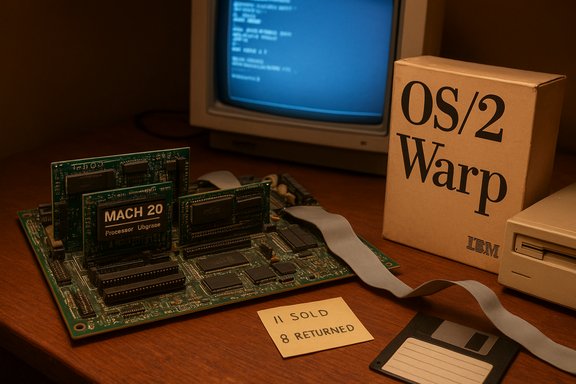 Background: the era of upgrade cards and Microsoft’s Mach series
Personal computing in the mid‑1980s was a fractured landscape of rapid CPU evolution, constrained expansion slots, and corporate procurement rules that favoured incremental upgrades over wholesale replacements. The IBM PC and PC/XT dominated business desks, but their 8‑bit bus and limited slot count made expanding or modernizing systems inconvenient and expensive.- Microsoft experimented with hardware add‑on cards that effectively replaced the on‑board CPU with a ribbon‑cable adapter and a full‑length expansion board.
- The Mach 10 upgraded 8088 machines with a 9.54 MHz 8086; the Mach 20 pushed further by bringing an Intel 80286 class CPU to older systems and adding daughterboard expansion for memory and floppy connectivity.
- The Mach 20 offered an 80287 coprocessor socket and a Memory Plus daughterboard capable of presenting several megabytes of RAM local to the card — an attractive idea when motherboards had only a handful of slots and RAM was expensive. Contemporary reporting placed the Mach 20’s retail price in the several‑hundred‑dollar range (InfoWorld reported roughly $495).
What was “OS/2 for Mach 20”?
OS/2 began as a joint Microsoft–IBM project intended as a successor to DOS, offering protected‑mode operation, better multitasking, and a richer API model than DOS/Windows of the era. In the late 1980s Microsoft produced a specialized build of OS/2 tailored to the Mach 20 card so owners of the upgrade could — in theory — run OS/2’s protected‑mode features on an XT‑class machine.- The intent: let users gain AT‑class functionality (protected mode, multitasking) without buying a full AT system.
- The reality: running OS/2 demanded more memory and faster I/O than a typical XT chassis provided, even with the Mach 20’s local RAM; disk speed, bus semantics, and driver stability remained frequent bottlenecks.
Verifying the claim: what can be corroborated and what remains anecdote
A responsible retelling separates three layers: the documented facts, contemporaneous reporting, and the oral history that supplies the 11/8 figure.- Documented facts:
- The Mach 10 and Mach 20 cards existed and were sold; trade press reviews and adverts from the period describe their capabilities and price.
- Microsoft produced a Mach‑specific OS/2 image. Multiple retrospectives and period write‑ups confirm the existence of a Mach‑targeted OS/2 build.
- Contemporaneous reporting:
- InfoWorld and other trade outlets covered the Mach 20 and its Memory Plus and Disk Plus daughterboards, underscoring that a functioning OS/2 setup would require significant additional memory and improved I/O beyond what most XTs offered. These period pieces help explain why the Mach 20 + OS/2 combo struggled in practice.
- The oral history:
- The “11 copies sold, 8 returned” tally originates from Raymond Chen’s recollection of a conversation with a former Microsoft support specialist; Chen explicitly labels it anecdotal and encourages archivists to hunt for physical artifacts to corroborate it. That makes the number credible as an oral history but not a verified corporate ledger. Flagged: anecdotal/unverified.
Why the Mach 20 + OS/2 pairing failed: technical and market dynamics
Several concrete technical and market factors explain why a tailored OS image for a niche card was unlikely to scale.1. Mismatched system requirements and host constraints
OS/2’s protected mode and multitasking model demanded memory and disk performance that typical XT systems did not provide. An XT with 640 KB of base RAM and legacy MFM disk controllers could not deliver the I/O throughput or the memory footprint OS/2 needed to run acceptably, even with local Mach 20 RAM.- OS/2 1.x required substantially more RAM than a standard XT; contemporary reporting notes the necessity of at least 1.5–2 MB to run OS/2 plus DOS applications comfortably, which meant buyers needed the Mach Memory Plus daughterboard and more — a cost that quickly outstripped the Mach 20’s initial price.
2. Support complexity and driver fragility
Hardware‑level compatibility is expensive to support. A bespoke OS image must reconcile subtle timing differences, nonstandard buses, and peripheral idiosyncrasies. When only a handful of customers exist, per‑customer support costs become unsustainably high.- Drivers needed to account for the Mach 20’s local memory, disk passthrough, and interactions with slow motherboard buses; gaps in documentation or poorly documented host setups would lead purchasers to return the product in frustration.
3. Expectation mismatch and marketing clarity
Many buyers likely purchased the OS/2 image assuming an easy upgrade to a modern OS, without understanding the full list of prerequisites (memory, disk, sometimes a new video card). That gap between promise and delivered experience drives returns quickly.4. Economics of overfitting
Shipping software tightly coupled to a transient hardware add‑on is an asymmetric bet: the cost of engineering and support is similar regardless of customer count, while revenue depends on a tiny installed base. That economic imbalance makes commercial failure likely unless the niche is large enough or the margin high enough to absorb support overhead.The strengths of the experiment — why it still mattered
Despite its commercial failure, the Mach 20 + OS/2 story has technical virtues and historical value.- Engineering ingenuity: The Mach concept — putting an entire CPU subsystem plus local memory onto one card to bypass limited motherboard slots — was clever and pragmatic for its time. It solved a real problem: extending the usable life of expensive hardware without triggering depreciation‑driven replacement budgets.
- Proof of concept for OS portability: Producing an OS/2 image that booted on nonstandard hardware demonstrated Microsoft’s ability to target different hardware profiles, a competence that later mattered for Windows ports and device ecosystems.
- Preservation value: Rare failures like this are important archival targets. Finding sealed boxes or original floppies would resolve open questions about packaging, licensing, and real shipment volumes — and would be a boon to software preservationists.
Practical lessons for modern product teams and Windows ecosystem engineers
The Mach 20 episode maps cleanly onto modern product risks: narrow hardware targets, brittle support models, and unmet user expectations. Contemporary teams can learn these lessons:- Publish a clear compatibility matrix before launch and keep it up to date.
- Price in support and lifecycle costs when selling customized builds or OEM variants.
- Use virtualization/emulation and comprehensive automated testing to broaden tested configurations cheaply.
- Invest in human‑readable installation guidance and diagnostic tools that reduce support cycles for rare configurations.
- Consider staged rollouts and early adopter programs that surface corner cases before general availability.
- Require a minimum verified host configuration and make that list highly visible at point‑of‑sale.
- Provide a pre‑installation validation utility (or VM image) to confirm a host can meet runtime requirements.
- Offer a captured, documented recovery path for common failure modes (driver mismatch, disk I/O starvation).
- Bundle an affordable, time‑limited support contract for niche hardware targets.
- Maintain a small hardware compatibility lab (real devices + emulators) to triage field issues quickly.
Preservation, collectors, and the “final boss” of software archaeology
The Mach 20 OS/2 image is now a sought‑after artifact for retro‑computing collectors and archivists. Raymond Chen himself framed the challenge of locating the remaining sealed copies as a preservationist’s “final boss.” If a collector or archivist wants to contribute:- Priorities for discovery:
- Search estate sales, university surplus auctions, and corporate surplus inventories from the late 1980s and early 1990s.
- Review vintage software archives, but be cautious: many community archives removed obscure titles long ago.
- Practical steps for preservationists:
- Capture any floppy images using hardware that can read 5.25‑inch media reliably.
- Photograph and catalogue packaging, manuals, and any serial/part numbers to help triangulate shipment records.
- Share images and metadata with major software archives and museums to make verification easier for historians.
Risks in the historical narrative and how to treat them
The story’s appeal — a multibillion‑dollar company selling only 11 copies of a product — makes for great headlines. But a high bar for evidence is required in historical reporting.- The “11 sold, 8 returned” figure is a powerful anecdote, but it is an oral‑history claim that Chen passes along as recollection from support staff; it has not been corroborated by a scanned sales ledger or Microsoft shipping manifest accessible in the public domain. Treat it as a credible oral history rather than an audited fact until further artifacts are found.
- Several reputable outlets have echoed Chen’s account while responsibly flagging the claim as second‑hand. That cross‑coverage strengthens plausibility but does not substitute for primary documentation.
SEO‑friendly summary of the facts (compact)
- Microsoft produced the Mach 20 CPU‑upgrade card to give IBM PC/XT systems 80286 capabilities and to save expansion slots; the Mach 20 was reviewed at roughly $495 in the period press.
- Microsoft released a tailored build of OS/2 for the Mach 20; contemporaneous reporting stresses the high memory and I/O requirements that made the combination fragile on XT platforms.
- Raymond Chen’s Old New Thing recounts a support‑staff memory that only 11 copies of the boxed OS/2 for Mach 20 were sold and 8 were returned, which has been widely repeated but should be considered oral history, not an audited sales record.
Conclusion — a compact lesson from a tiny failure
The Mach 20 + OS/2 episode is far more than a quirky footnote; it’s a concentrated case study in product economics, the hazards of over‑specialization, and the realities of engineering under constrained hardware ecosystems. The technical cleverness behind the Mach card family and Microsoft’s willingness to ship a specialized OS image deserve respect. At the same time, the sales anecdote — compelling, quotable, and likely true in spirit — reminds product teams that compatibility ecosystems, support economics, and customer expectations are as decisive as engineering ingenuity.For historians and collectors the reward is tangible: locate the artifacts and the ledger entries, and the legend becomes a documented chapter of computing history. For modern engineers and product managers the lesson is immediate: design for the realities of the whole stack — from the cheapest drive mechanism to the accounts payable clerk who signs off on a purchase — before committing to a hardware‑specific software release.
Source: UNILAD Tech Microsoft's 'worst selling product of all time' sold just 11 times
